Specs are compiled from manufacturer listings and verified buyer reviews and can change over time — please confirm the key details on the product page before buying.
A versatile sleeping bag has to do one hard thing: work across seasons, climates and sleep styles without weighing down your pack or leaving you shivering at 3 a.m. Start with fill type: down packs smaller and warms more per ounce, while synthetic keeps some warmth when damp and costs less. Everything else (shape, temperature rating, zipper direction) hangs off that choice. The picks below cover the whole spectrum, from a roomy plush bag you can unzip into a blanket to a 3-in-1 system that shifts from summer to frost.
This guide is built by comparing the manufacturers’ published specifications and the patterns across verified customer reviews, so you get each pick’s real strengths and trade-offs instead of marketing spin.
Below you will find nine bags lined up by real-world job, each one checked against its own published temperature rating, fill weight and packed size. The right versatile bag is the one whose temperature rating and packed size match your trips, not the one with the biggest brand name.
Top Picks


How To Choose The Best Versatile Sleeping Bag
The wrong assumption most first-time buyers carry is that one bag’s temperature rating means the same thing everywhere. It does not. A bag labelled 20 degrees can mean “you will sleep comfortably at 20” on one brand’s tag and “you will survive 20 without dying” on another. Matching the rating to your actual trip temperature, then looking at what the number costs you in weight and bulk, is the whole game.
Read the temperature rating before anything else
Look for the comfort figure, not just the headline number. A bag with a 32°F comfort and 10°F lower limit keeps you warm through a mild autumn night and holds on through a frost. If you sleep cold, pick a bag rated below your expected low, because the rating assumes a warm sleeper on an insulated pad.
Down versus synthetic fill
Down (natural feather clusters) lofts higher per ounce, so it packs smaller and weighs less for the same warmth. Synthetic polyester fill is heavier but keeps some warmth if it gets damp and generally costs less. For wet coastal trips, synthetic is the safer bet. For cold, dry backpacking, down earns its place.
Mummy, rectangular, or something between
A mummy bag tapers at the shoulders and feet, trapping heat with less material — ideal for backpacking. A rectangular bag gives you room to roll over and often unzips flat into a blanket. A hybrid, like a mummy top over a rectangular foot box, splits the difference.
Zipper direction matters more than you think
If you ever want to zip two bags together into a double, one bag needs a left-side zipper and the other a right. Buy two bags with the same side and they will not join. Check the zipper side before you commit.
Packed size and carry weight
Your bag is the bulkiest item in a backpack, so packed dimensions decide whether the trip is comfortable. A compression sack cinches the bag down further. Look for the stuffed size listed on the tag and compare it to your pack’s volume.
Side-by-Side Comparison
| Model | Best For | Temp Rating | Fill | Weight | Amazon |
|---|---|---|---|---|---|
| TETON Sports ALTOS★ Best Overall | Cold-weather backpacking | 20°F / 0°F options | Synthetic | 3.5 lb | Amazon |
| FARLAND Fleece-LinedWarmest First Touch | Car camping and cold sleepers | — | Cotton | 2.83 kg | Amazon |
| Coleman North Rim 0°FBig and Tall Pick | Big and tall campers | 0°F | Polyester | — | Amazon |
| Teton LEEF Lightweight | Backpacking on a budget | 0 / 20 / 30°F options | Micro Fibre | 3.5 lb | Amazon |
| ZOOOBELIVES 10 Degree Down | Cold nights, couples | 10°F lower / 32°F comfort | 550+ down | 1.75 kg | Amazon |
| Naturehike 40-12℉ Ultralight | Ultralight backpacking | 40.4°F comfort | 650FP RDS down | 2 lb | Amazon |
| Marmot Trestles 15 | Wet-weather trekking | 15°F | SpiraFil synthetic | 1535 g | Amazon |
| Kelty Cosmic 20 | Backpacking in damp cold | ISO limit 21°F | 550FP down | 2.6 lb | Amazon |
| The North Face Dolomite One 15F | Year-round flexibility | 15°F to 50°F (3-in-1) | Recycled polyester | 4 lb | Amazon |
Detailed Reviews
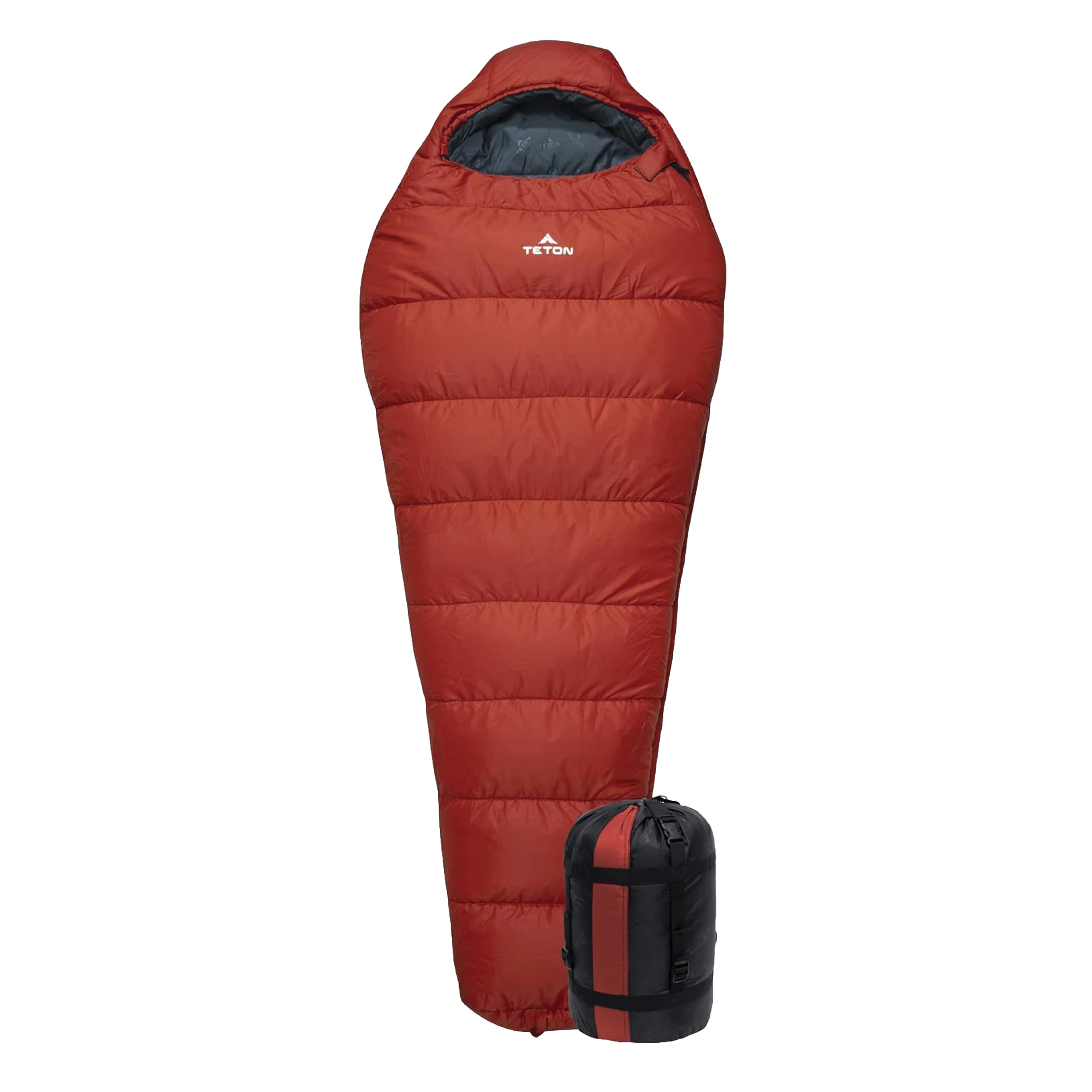
1. TETON Sports ALTOS Lightweight Mummy Sleeping Bag
Our pick — 4.5+★ from 600+ verified ratings; the strongest balance of quality and price.
A mummy bag that gives your feet a built-out footbox instead of a tight squeeze.
The ALTOS earns its place at the top for one reason: it solves the two complaints that push most mummy bags back onto the shelf. Warmth is the thing that wins people over most, and the numbers back it up — 84 inches long and 32 inches wide gives you shoulder and leg room a normal mummy shape takes away, and the built-out footbox means your toes are not pinned flat all night. Few synthetic mummy bags at 3.5 lb pair that much shoulder room with a built-out footbox.
At 3.5 pounds this bag sits near the ZOOOBELIVES down bag’s 1.75 kg; if your priority is a featherweight pack, compare both figures. What you trade for is durability and damp tolerance: this is a synthetic-fill bag, so a wet tent floor will not cost you the whole night’s warmth the way soaked down can. It includes a compression sack you stuff rather than roll, which saves time at camp on a cold morning.
Hand wash only, so plan on a tub rather than a machine. The 20-degree and 0-degree options let you pick how cold you want to camp, and the water-resistant shell handles light condensation. If you want one synthetic bag for mild autumn nights down to frost that still fits broad shoulders, pick this one.
What earns the crown
- 84″ x 32″ gives real shoulder and leg room for a mummy cut
- Built-out footbox keeps your feet uncramped
- Water-resistant synthetic fill tolerates damp better than down
- Compression sack included — stuff, don’t roll
Where it gives ground
- 3.5 lb is heavier than the lightest down picks on this list
- Hand wash only, so no machine cycle
- Zipper quality draws some mixed feedback
Go for it if: you want a roomy, warm synthetic bag for backpacking and car camping and do not mind a little extra carry weight.
Think twice if: every ounce counts — compare this bag’s 3.5 lb with the 1.75 kg down option.
2. FARLAND Sleeping Bag for Adults, Fleece-Lined
A fleece-lined bag built for cold sleepers who dread sliding into a chilly lining.
If you always feel cold at night, the FARLAND’s fleece lining is warm the moment you get in. The plush fleece lining wraps the entire interior — back, sides and foot area — so there is no thin bottom letting ground cold creep up through your back. At 87 inches long and 33 inches wide, it is the most generously cut bag on this list, comfortably fitting users up to six feet tall, and the 2.83 kg weight reflects all that fabric and fill.
That size is the trade-off, and it is an honest one. The same roominess that lets two adults share it and lets you roll over freely also means it is bulky to pack and less suited to cold alpine camping — warm enough in milder conditions, but a bag rated below zero is the better call for real deep-winter nights. The two-way snag-resistant zipper opens from either end, and the bag unzips fully to work as a warm blanket, which is where its flexibility shows up: it doubles down as a couch throw, a winter trunk emergency bag, or a layer over cold dorm bedding.
The case for it: instant warmth on first touch, a bag you can share or open into a blanket, and a budget-friendly build that suits car camping, guest rooms and emergency kits better than alpine expeditions.
The honest limit: if your trips genuinely hit sub-freezing, this is a milder-weather bag and the extra bulk takes up real space in a pack.
Reach for this if: you are a cold sleeper, a car camper, or want one bag for guests, dorms and the trunk.
Look elsewhere if: you need a genuinely sub-freezing, packable bag for backcountry cold.
3. Coleman North Rim 0°F Sleeping Bag
A 0°F mummy cut for tall campers, with a draft tube that keeps body heat off the zipper line.
The North Rim’s headline is a rating that holds warmth down to 0°F, built with Coletherm hollow polyester insulation, a hollow-fibre fill that traps warmth without adding as much weight as solid synthetic. The big-and-tall sizing means it is cut for campers up to 6 ft. 2 in, at 82 x 32 in overall. The Thermolock draft tube blocks the warmth that normally leaks out along the zipper — an easy bit of heat to lose on a cold night.
Two details make it genuinely versatile in the campsite sense. The adjustable hood lets you close in fully for warmth or crack it open for ventilation, and the whole bag is machine washable, so a muddy season’s worth of grime is not a problem. A no-snag zipper and a 5-year limited warranty round out the practical side.
Do note the fit caveat: this is billed as big and tall, but the sizing draws mixed reactions from campers at the taller end, so measure your height against the 6 ft. 2 in ceiling before committing.
What it does well: a 0°F rating, warm-sealing draft tube, adjustable ventilation and machine-wash simplicity — a solid cold-weather car-camping bag.
The catch: some taller buyers find the big-and-tall fit snugger than expected, so check the height ceiling first.
Best fit for: cold-weather campers and taller sleepers who want warmth and easy washing without fuss.
skip it if: you are right at or over 6 ft. 2 in and want guaranteed legroom.
4. Teton LEEF Lightweight Mummy Sleeping Bag
A mummy bag that opens up the foot room backpackers usually give away.
The LEEF’s roomier mummy design tackles claustrophobia head-on: feet have room to move without being pinned, and the 81 inch length by 21 inch width keeps the taper mild enough to turn over. It packs into the included compression sack for a backpacking trip without sacrificing that insulation.
That 21 inch width is the narrowest on this list — notably narrower than the FARLAND’s 33 inch cut — so if you are a broad-shouldered or side sleeper who spreads out, this is a mummy’s compromise. What you gain is a genuinely packable bag for hiking and backpacking. You also get a choice of 0, 20 or 30 degree ratings and three sizes, so you can dial the warmth to your season instead of buying one compromise bag.
It stuffs into the included compression sack and fits a standard backpacking kit. For a first hiking kit, the 0, 20 and 30 degree rating options are the real value here.
Strengths worth naming
- Roomier mummy cut than most slim mummies
- Choice of 0, 20 or 30 degree ratings and three sizes
- Compression sack included for backpacking
- Build quality is what owners praise most
Worth knowing
- 21″ width is the narrowest here — snug for broad sleepers
- Micro-fibre fill is heavier than down for the same warmth
The pick for: first-time backpackers who want to match a rating to their season and stay on a sensible budget.
Pass if: you need a wide, roomy sleeping surface rather than a tapered mummy.
5. ZOOOBELIVES 10 Degree Down Sleeping Bag

Real down warmth in a bag that packs down to a couch-cushion bundle.
Down is the reason this bag is here. It is filled with 35 oz of 550+ fill power down — fill power is a loft measure, the higher the number the more warmth you get per ounce of feather — so the warmth-to-bulk ratio is strong.
Build quality is what wins people over, and the details support it: 20D ripstop nylon shell, a smooth YKK anti-snag zipper, and separate hood and neck drawcords for quick adjustments when the temperature drops. The draft collar and insulated draft tube block cold air at the openings, and an internal pocket keeps your phone and headlamp close. It is rated at a 32°F comfort with a 10°F lower limit, which handles crisp fall nights and mild winter camping.
The honest catch is fit around the feet — some sleepers find the footbox snug — and the down demands more care than synthetic when wet. Left and right zipper options let two bags join into a double for couples.
Standout spec: 550+ fill power down packing to 10 x 7 x 15 inches, with a 32°F comfort and 10°F lower limit and left/right zip pairing for couples.
One fit note: the footbox runs snug for some, so if you have large feet, size up your expectations.
Choose this if: you want down warmth, light pack weight and the option to pair two bags for a couple.
Not for you if: you camp in steady wet weather where synthetic fill survives damp better.
6. Naturehike 40-12℉ Ultralight Down Sleeping Bag
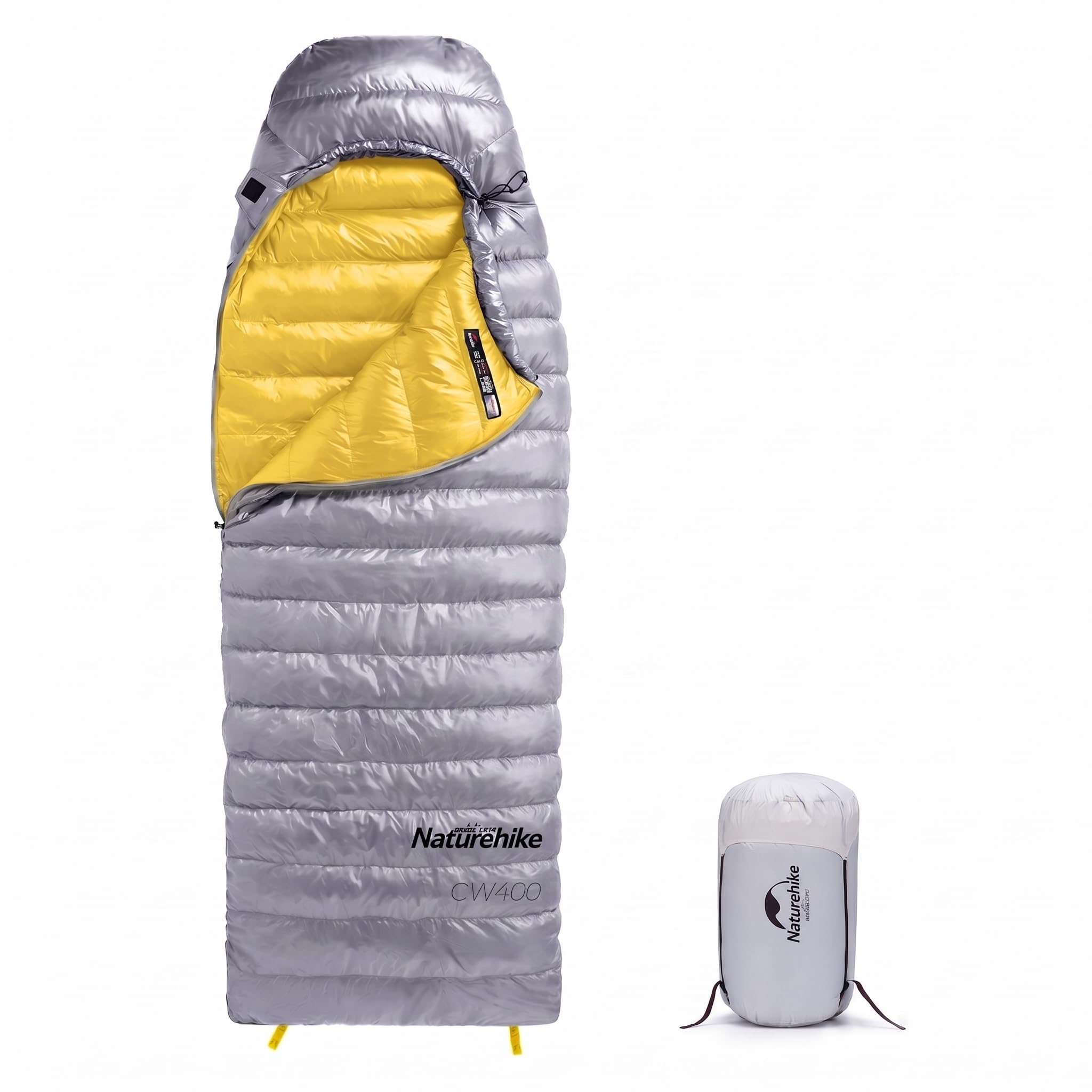
Two pounds of down that packs to 13.8 by 7.1 inches — the lightest carry here.
If pack weight is your deciding spec, this is the number that matters: 2 lbs (910g), packed to 13.8 x 7.1 inches. That is lighter than the Kelty Cosmic’s 2.6 lb and the ZOOOBELIVES’s 1.75 kg, and it comes with 650 fill power RDS-certified down — higher loft than the 550+ on the ZOOOBELIVES, meaning more warmth per ounce. The RDS label traces the down’s origin for buyers who care about sourcing.
The shape is where it earns the “versatile” label. The upper body is mummy-cut to trap heat at the head, while the lower half is rectangular so you can move your legs and even expose your feet on a warm night — a hybrid that suits people who find a full mummy too restrictive. Two sizes (82.7 x 29.5 in regular, 86.6 x 33.5 in large) let taller sleepers get the length they need.
The catch is temperature ceiling. The comfort rating sits at 40.4°F, so this is a three-season shoulder-season bag, not a deep-winter one — warm through cold nights, but you would want layers on a hard frost. The 400T 20D ripstop nylon and YKK zipper round out a durable build.
Where it shines: 2 lb packed weight, 650 fill power RDS down, and a hybrid shape that keeps heat at the head but lets your feet breathe.
Its limit: a 40.4°F comfort rating makes it a shoulder-season bag — pair it with layers for a real frost.
Order this if: you are a weight-conscious backpacker who wants down loft and a shape that does not clamp your legs.
Think again if: you camp below freezing in winter — this tops out at shoulder-season warmth.
7. Marmot Trestles 15 Sleeping Bag

Built for damp mountain weather, with synthetic loft that holds warmth when wet.
Marmot’s pitch rests on SpiraFil high-loft synthetic insulation, which stays warm in wet weather in a way down cannot — that is the exact reason a synthetic bag earns a spot on a cold, damp trekking list. Material quality is the quality owners praise most here, and the build backs it: an anatomical 3D footbox keeps your toes uncramped, a wave construction top combines with a blanket construction bottom for comfort, and a locking YKK two-way zipper lets you vent without getting fully out.
At 72 inches long and 31 inches wide, with a weight of 1535 g, it is a solid cold-weather synthetic. The bag is rated to handle the elements in a way a fair-weather bag does not, and it stuffs into the included sack for backpacking, trekking or mountaineering. It is a dependable synthetic bag for the person whose trips involve gusty, damp mountain weather where a wet down bag would be a bad night.
If you need the lightest possible carry, the down bags here win that contest. What the Trestles gives back is the confidence that a damp tent will not gut its warmth.
Why it earns its slot
- SpiraFil synthetic stays warm in wet weather
- Anatomical 3D footbox for uncramped toes
- Locking YKK two-way zipper for easy venting
- Includes a compression stuff sack
Trade-offs to weigh
- Heavier than the down bags here — 1535 g
- Synthetic loft is bulkier to pack than down
Right bag for: trekkers heading into wet, windy mountain weather where synthetic resilience beats down’s low weight.
Not ideal if: you are chasing the absolute lightest pack and camp in reliably dry conditions.
8. Kelty Cosmic 20 Down Mummy Sleeping Bag

A backpacking classic with traceable down and a build that resists light moisture.
The Cosmic 20 has been a staple of Kelty’s backpacking lineup for good reason: 550 fill power compressible down, a silky shell, and dual-direction zippers for flexible venting. Quality is what owners praise most, and the spec sheet supports the reputation — recycled nylon and recycled polyester taffeta shell and liner, finished with a durable water repellent to shrug off light moisture. The down is 100% ethically sourced and traceable via an RDS tag on the product.
It is rated to an ISO limit of 21 degrees and an ISO extreme of -11 degrees, with a total weight of about 2 lbs. 6 oz. (regular) and a stuffed size of 13 x 7 inches — noticeably lighter than the Marmot Trestles’s 1535 g, so it carries better on longer treks. Three sizes map to sleeper height: Short fits up to 5 ft. 6 in, Regular 6 ft, Long 6 ft. 6 in. That sizing range is the answer for taller backpackers who struggle to get length right.
The recurring gripe is fit — the Cosmic runs snug for some sleepers, so consider sizing up if you want room to move. A limited lifetime warranty backs the build.
The draw: 550 FP traceable RDS down in a 2 lb. 6 oz. build with an ISO limit of 21 degrees, three length options, and a limited lifetime warranty.
The honest caveat: it runs snug, so broader sleepers should size up for comfort.
Picture it on: a multi-night backpacking trip where light pack weight and traceable down matter to you.
Best to pass if: you need a wide bag with room to sprawl and dislike a snug mummy fit.
9. The North Face Dolomite One 15F 3-in-1 Sleeping Bag
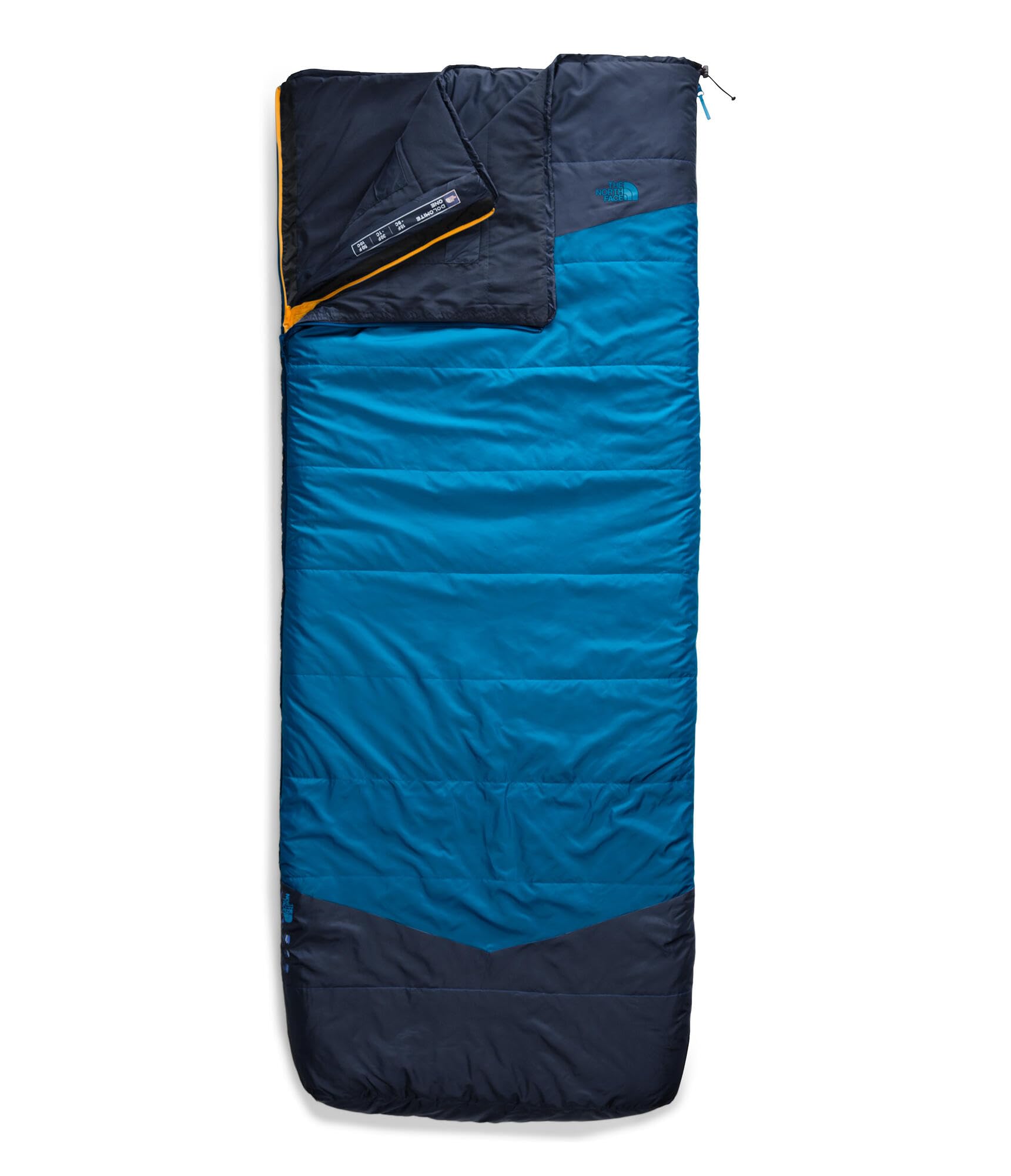
Three bags in one: a 50°F layer, a 30°F mid layer, and a 15°F bag when joined.
This is the bag for the camper who will not know the weather until the morning of. The Dolomite One is a genuine 3-in-1 system: a 50°F (10°C) top layer and a 30°F (-1°C) mid layer that can be zipped together into a single 15°F (-9°C) bag. That layering is the whole versatility argument in one product — bring the top layer alone for a mild night, add the mid layer when the forecast drops. North Face notes the temperature limits can shift with local weather.
The rectangular shape is deliberate, offering plenty of leg room, and the bag unzips from the bottom for ventilation on a warm evening. Soft fleece lining makes it pleasant against the skin, the polyester taffeta outer shell carries a durable water repellent finish to shed light moisture, and the fill is 30% recycled polyester cut-staple insulation with a strong warmth-to-weight ratio. At 4 lb it is the heaviest bag here — comfortable car camping, less ideal for long backpacking treks. An internal phone/watch pocket keeps devices safe.
Size is what people appreciate most about it — the rectangular cut and 77 x 33 inch footprint make it great for car camping. The zipper is the one thing that draws mixed feedback, with the layering system taking a moment to understand, so read the setup before your first trip.
The clever part
- 50°F, 30°F and 15°F configurations from one bag
- Rectangular shape with real legroom
- Fleece lining and water-repellent shell
- Bottom zip opens for ventilation
Where it asks more
- 4 lb is the heaviest here — car camping territory
- Layering zipper setup takes a beat to learn
Made for: campers who face a range of climates and want one bag that reshapes to the forecast.
Weigh before you buy: backpackers watching every pound will feel the 4 lb.
Know the Specs
Temperature Rating
A bag’s tag usually carries three figures: comfort (the temperature at which a warm sleeper stays comfortable), lower limit (still warm but relying on layers), and extreme (survival, not comfort). Buy to your actual expected low, and if you sleep cold, drop a rating step. A 20°F bag is not automatically warmer than another brand’s 20°F bag, so check which figure the number refers to.
Fill Power
Fill power measures how much space an ounce of down lofts to — the higher the number, the more warmth per ounce and the smaller the pack size. A 550 fill power bag is a solid cold-weather choice; 650 lofts higher and packs smaller for the same weight. Synthetic fill (polyester or micro-fibre) keeps some warmth when damp but is heavier for the same rating.
Mummy vs Rectangular Shape
A tapered mummy traps heat efficiently and saves weight, at the cost of legroom. A rectangular cut gives room to roll over and often unzips flat into a blanket, but is bulkier. A hybrid — mummy top, rectangular lower body — keeps heat at the head while letting your feet move and vent.
Packed Size and Carry Weight
Your bag is usually the bulkiest item in a pack, so the stuffed dimensions decide comfort on the trail. A compression sack cinches it down further. Compare the packed size to your pack volume, and if you hike long distances, treat carry weight as seriously as the temperature rating.
Common Questions
Can two sleeping bags zip together into a double?
Is down better than synthetic for a versatile sleeping bag?
What does a 20 degree sleeping bag actually mean?
How do I know if a sleeping bag will fit my height?
Can I machine wash a sleeping bag?
What is fill power and does it really matter?
Is a sleeping bag enough for winter camping without a pad?
What is a 3-in-1 sleeping bag and is it worth it?
Are mummy bags warmer than rectangular bags?
How should I store a sleeping bag between trips?
The Bottom Line
For most campers, the versatile sleeping bag winner is the TETON Sports ALTOS because it pairs a 20°F or 0°F rating with a roomy 84 x 32 inch mummy cut and a built-out footbox — warmth and space in one synthetic package that tolerates a damp tent. If pack weight is your deciding figure, grab the ZOOOBELIVES 10 Degree Down, which packs 550+ fill power down into a 10 x 7 x 15 inch bundle at 1.75 kg. And for a bag that reshapes to the forecast, the North Face Dolomite One gives you 50°F, 30°F and 15°F configurations in one. The crowd favorite of the group, with 4.5+★ across 600+ ratings, is the ALTOS — and it earns that spot on the strength of its warmth and space, not its label.
How we choose
We do not accept paid placement. Every pick is matched to a real buyer and a real use-case; we do not hands-on test units.
Sources
Specifications: manufacturer listings and product documentation. Review insights: verified customer reviews, as of November 2026. Pricing: not shown on this page (it changes often); check the current price via the retailer link.
As an Amazon Associate, Tactical Gear Guy earns from qualifying purchases. This does not affect which products we feature.