Specs are compiled from manufacturer listings and verified buyer reviews and can change over time — please confirm the key details on the product page before buying.
You want a light you can switch on, dim, or recolour from the back door — without climbing a ladder in the dark. That is the entire appeal of a solar light with a remote, and it is also where most listings oversell. The numbers that actually decide your night are the lumen figure (how much light comes out), the milliamp-hour battery rating (how long it keeps glowing), and the size of the solar panel that refills it.
This guide is built by comparing the manufacturers’ published specifications and the patterns across verified customer reviews, so you get each pick’s real strengths and trade-offs instead of marketing spin.
Below you get eight picks sorted by what they genuinely do well, from floodlights that wallop a driveway to colour-changing ground discs that line a path. Every remote range, sensing distance, and waterproof rating is taken straight from the maker’s own listing. The one thing almost no listing tells you is how panel placement decides whether your solar light with remote survives its first overcast week.
Top Picks


How To Choose The Best Solar Light with Remote
Buying light for a yard is not one decision — it is three. Where the panel sits relative to the sun, how much dark you need to cover, and what you want the light to do when nothing is moving. Get those three right and the remote becomes a genuine convenience instead of a novelty.
Panel placement is the real foundation
A solar panel only refills the battery when it faces direct sun, so a panel bolted into permanent shade will leave you with a dead light no matter how good the LED is. Some fixtures here keep the panel attached to the lamp body, which means you choose a wall for light quality and hope the sun agrees. Others use a separate panel on a long cable, letting you hang the lamp inside a shed or under a rafter while the panel sits outside soaking up rays.
Match the lumen figure to the job, not the marketing
A lumen (the unit of visible light output) tells you how much brightness the fixture can throw. Path markers and fence accents usually sit in the tens of lumens because you want a pool of light at your feet, not a searchlight. Security floods climb into the thousands because you need to see a gate, a driveway, or a footprint from twenty feet away. Pick the low end for decoration and the high end for detection.
Understand your lighting modes before you mount
Most remotes here switch between three flavours of behaviour. Motion mode keeps the light dim or off and jumps to full brightness when the sensor trips — ideal for security, since it also startles intruders. Dusk-to-dawn mode simply runs from sunset to sunrise at a brightness you choose. Timed modes hold a set brightness for a set number of hours before reverting. Match the mode to the job: a driveway wants motion, a patio table wants steady dim light, and a path wants a constant low glow all night.
Waterproofing beyond the IP number
IP65 means the housing shrugs off water jets from any direction, which covers rain and snow melt. IP66 survives more forceful spray, and IP67 handles brief submersion — the last one is what you want for fixtures sitting flat in wet grass. All of them are about the enclosure, not the cable joint or the mounting screws, so keep an eye on the panel cable where it enters the housing.
Side-by-Side Comparison
| Model | Best For | Brightness | Battery | Waterproof Rating | Amazon |
|---|---|---|---|---|---|
| Tuffenough Solar Outdoor Lights 2500LM★ Best Overall | Reliable budget security flood | 2500 lm | 1800 mAh | IP65 | Amazon |
| 6000LM Solar Lights Outdoor 4-HeadMost Coverage | Wide coverage on a low roof line | 6000 lm | — | IP65 | Amazon |
| Ropelux Solar Lights Indoor OutdoorBest For Sheds | Sheds, barns, and dark interiors | 3000 lm | — | IP65 | Amazon |
| 2 Pack Solar Street Lights 13000LM | Largest area, biggest panel | 13000 lm | 6000 mAh | IP65 | Amazon |
| WYWNA Solar Lights Outdoor 2-Pack | Front doors and walkways | — | 5000 mAh | IP66 | Amazon |
| VIODAIM Color Changing Ground Lights | Path and garden colour | — | — | IP67 | Amazon |
| Adewalk 5000W Solar Lights | Big-flood look at mid-tier | 3000 lm | 2000 mAh | IP65 | Amazon |
| JOFIOS Fence Lights 12 Pack | Whole-fence accent run | 60 lm | — | IP65 | Amazon |
Detailed Reviews
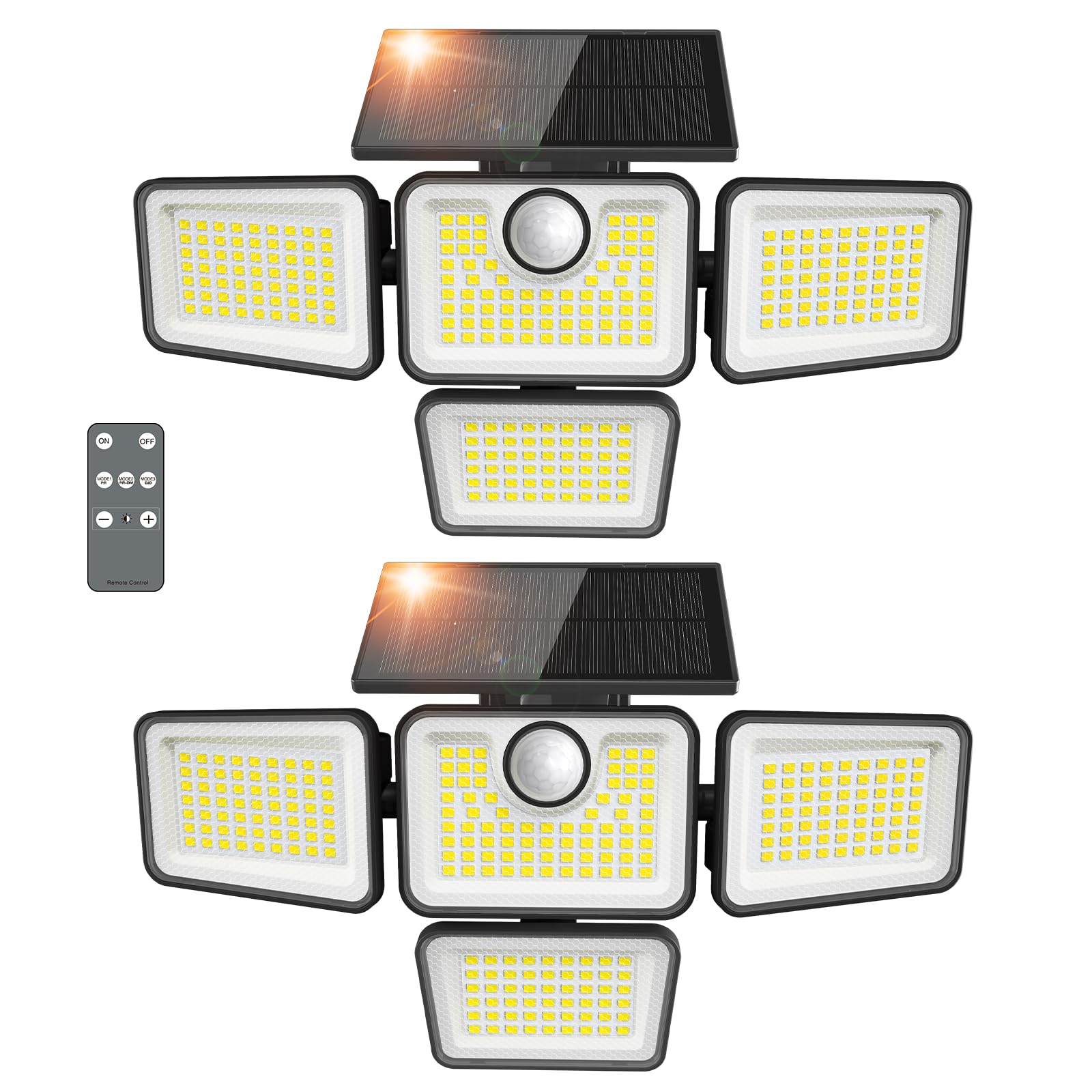
1. Tuffenough Solar Outdoor Lights 2500LM
Our pick — 4.0+★ from 42,000+ verified ratings; the strongest balance of quality and price.
Three wings of light that swing to aim exactly where your gate is.
This is the big-volume fixture in the room, and not for a silly reason: 42,000+ owners have rated it at 4.0+ stars, a score built on the unglamorous reliability a security light needs. The three heads each pivot independently, and combined they throw across a 270° spread with a 26-foot motion sensing reach. Aim one down the drive, one at the side gate, one along the fence line, and the whole yard stops being a dark unknown.
The 2500 lm output runs at 6500 K daylight white — bright, neutral, and slightly on the cool side. That is exactly what you want when you need to identify a shape at the fence, though it is not a warm porch glow. The battery is a 1800 mAh pack, which is modest next to the big street-light style units further down this list, and the maker is upfront about it: on cloudy stretches you press the button to off and let the panel refill for two to three days before switching back on. That is a fair weather caveat, not a flaw in daily use.
Install notes from the maker matter here — mount at 6.5 to 8 ft with the panel unobstructed. Put it too high and the motion sensor starts missing people walking underneath; too low and you get nuisance triggers from cats and moving shrubs. The IP65 housing handles heavy rain and snow according to the maker, and the wireless design means no wiring run, no adapter, and no replacement batteries to buy.
Where this earns its keep
- Three independently aimable heads cover a 270° arc from a single mount point
- Motion sensor reads up to 26 feet, so people are caught before they reach the door
- Wireless install with the included screws — no wiring, no added power source
- Three remote modes: strong sensor, dim sensor, and strong long light
What to plan around
- 1800 mAh battery needs the two-to-three-day recharge drill across long overcast spells
- 6500 K output reads cool and clinical rather than cosy
- Mounting height of 6.5–8 ft is not optional if you want the motion sensor to behave
Reach for this if: you want one fixture guarding a gate or drive with heads you can aim at three separate spots.
Look elsewhere if: you need a warm accent glow or all-night full brightness in a cloudy climate.
2. 6000LM Solar Lights Outdoor 4-Head
Four swivelling heads and a claimed 1,600 sq ft wash of light from one bracket.
Where the Tuffenough above sells three heads, this fixture sells four — and it pushes the lumen count up to 6000 lm at the same 6500 K daylight white. The four heads rotate up, down, and sideways so you can fan the beam across a patio, a corner of a yard, and both flanks of a gate at once. The maker claims up to 1,600 sq ft of coverage from four heads that swing through 270° combined.
The remote switches three modes. Sensor mode runs the light at full brightness when the PIR sensor (a passive infrared eye that spots body heat in motion) trips, then shuts off 20 seconds after movement stops. Dim-and-sensor mode drops to 3% after those 20 seconds so there is always a low glow. Dim mode sits at 10% all night and only wakes for motion. That middle setting is the hero for people who want a lit path that still responds the moment a fox or a visitor crosses it.
What owners talk about most is that it simply works, followed by build quality and brightness — and the chicken-coop habit is real, with backyard flocks getting a gentle overnight glow that goes bright on approach. The honest caveat sits in the value and durability chatter: not everyone feels the light outlasts its promise over years. Also note the size. At 4.53 inches wide it is far narrower than the Ropelux down this list at 7.87 inches, so plan the mount for a slimmer wall patch.
The mode logic is the point: three remote-selectable behaviours — full-on sensor, 3% floor with sensor boost, or 10% constant — cover security, ambience, and porch-lighting jobs without touching a ladder.
Setup warning worth tattooing on the wall: the maker insists you press the power button to turn the unit on before you mount it, and skipping that step is the most common reason a brand-new light appears dead.
The pick for: a wide flat surface — a long patio wall, coop, or garage face — where you want one bracket to do four directions of work.
The compromise: long-term durability sits in mixed territory, so treat the panel-cleaning routine as part of ownership.
3. Ropelux Solar Lights Indoor Outdoor
A panel on a 16.4-foot cable, so the sun lives outside while the light lives in the shed.
This is the only pick here that solves the darkest problem in solar lighting — where to put the panel when your light has to hang somewhere with no sun at all. The panel is separate and connected by a 16.4-foot cord, so you can bolt it on a sunny roof edge while the lamp itself hangs from a rafter inside a barn, gazebo, or garage. The maker rates the panel at 22% conversion efficiency, and its adjustable tilt lets you angle it toward the sun.
Output lands at 3000 lm from a 6500 K source, and the maker claims up to 12 hours of continuous run — the kind of number that matters when you are feeding animals or working in a dark shed through a winter evening. The remote does more than on/off: you dial brightness anywhere from 20% to 100% and set the sensing window at 16, 25, 35, or 45 seconds. Settings are remembered after a power cycle, so you are not reprogramming every night.
The five modes split into two families. Modes 4 and 5 are built for all-day interior lighting — mode 4 lights only on motion, mode 5 stays on and jumps to full brightness when movement is detected. Modes 1 to 3 are classic dusk-to-dawn behaviours, two of them motion-triggered and one constant. Owners light 20 by 20 sheds with it and report a spread reaching a 100-foot circle, though battery life and lifespan divide opinion — some units hold a charge all night, others fade sooner.
Its real strengths
- Separate panel on a 16.4-foot cord lets you light sunless interiors
- Brightness dialable from 20% to 100% with remembered settings
- Hangs from a bracket, mounts to a wall, or secures with steel wire
- Five modes covering both interior work light and dusk-to-dawn security
Where it gets fiddly
- Charge retention splits opinion — some units hold all night, others fade early
- At 2.95 inches tall but 7.87 inches across, it is the widest footprint of the mid-tier picks
- Setup takes the promised 15 minutes only if you plan the cable route first
Built for the outbuilding: sheds, coops, barns, and garages where the lamp hangs away from daylight but you still want a remote in your pocket.
Think twice if: you need a guaranteed all-night ceiling of light and cannot tolerate a shorter run on a gloomy week.
4. 2 Pack Solar Street Lights 13000LM
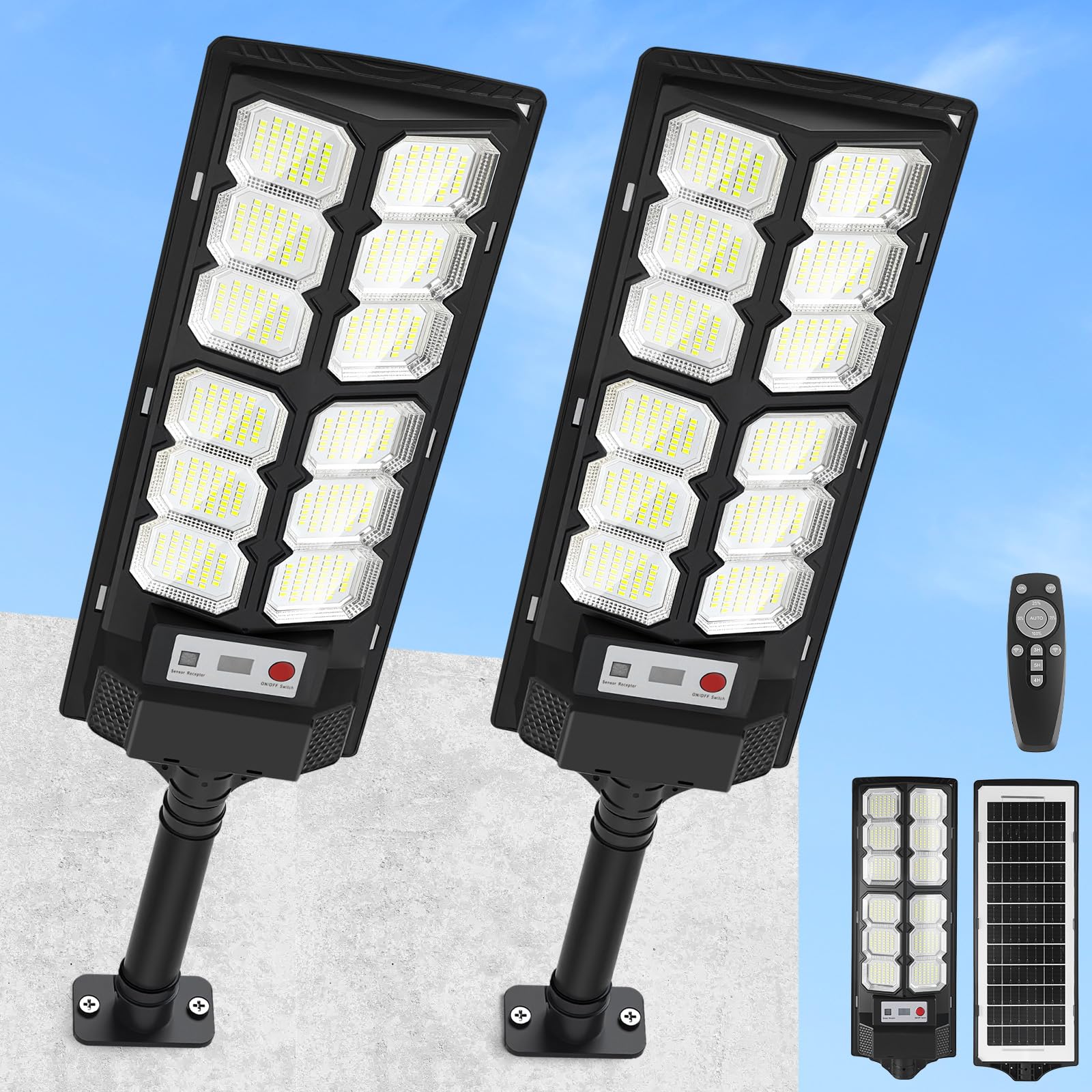
The heavyweight — 13000 lm and a 6000 mAh battery in a two-pack.
There is no polite way to say this: this fixture pits 13000 lm against the Tuffenough’s 2500 lm, spread across 528 LED beads and a 220° throw. Its 6000 mAh battery goes up against the Tuffenough’s 1800 mAh, and the maker says that capacity stretches the run to 12 hours. If you are lighting a parking pad, a long driveway, or a commercial corner, this is the pick that actually throws enough light to matter.
The larger solar panel carries a maker-quoted 25% higher conversion rate and a full charge in 6 to 8 hours of direct sun. Three operating families sit under the remote: a dusk-to-dawn auto mode with brightness adjustable at 25%, 50%, 75%, or 100%; a motion mode that keeps a 30% floor and jumps to 100%; and a motion mode that sits fully off and only wakes on movement. A timer runs 3, 4, or 5 hours before reverting or shutting down.
Reliability is what owners keep coming back to — the fixture works, and the install is straightforward. The caution is honest and belongs in the details: brightness divided opinion. Some find the 13000 lm figure delivers the spread claimed; others feel the real-world throw is softer than the listing suggests. At IP65 it handles rain and snow; if you have standing water where you plan to mount it, plan a bracket higher than the splash line.
The big-area answer: two 13000 lm heads, a 6000 mAh battery each, and a 220° spread for lots and long driveways where one weak light is pointless.
The catch to weigh: the brightness claim divides opinion, so buy expecting a strong flood rather than a floodlight-grade beam.
5. WYWNA Solar Lights Outdoor 2-Pack

The IP66 outlier that tilts the waterproofing conversation up a notch.
Most fixtures in this category settle for IP65. This one goes to IP66 — the grade that survives more forceful water jets — and that single step matters if you live somewhere with driving rain on a wall that gets the full weather. The housing is high-quality ABS with a metal mounting bracket, and the maker lists it against rainy days, high temperatures, and low temperatures.
Power comes from a 6V/5W polycrystalline solar panel with a claimed 25% conversion rate, driving a 5000 mAh battery that the maker says fully charges in 4 to 6 hours of direct sun and runs 6 to 8 hours. That 5000 mAh sits below the street-light pair’s 6000 mAh but well above the entry sets, and it lands as a solid middle-of-the-road workhorse for a front door or a walkway.
The motion sensor covers a 120 to 200 inch detection span, the remote drives motion mode, timed modes (2, 3, 5, 6, or 8 hours before reverting to motion), and adjustable brightness from 25% to 100%. The 5730-type LEDs run at 6000 K, slightly warmer than the 6500 K lights further up this list. Owners find the install fuss-free, with the maker promising no complicated wiring or programming, and reports of performance holding up in lower sunlight are the reassuring bit for anyone worried the panel is underpowered.
Waterproofing level-up: IP66 weather resistance is the headliner here — a real step past the IP65 norm when the mounting wall takes a beating.
Where it settles in: the 5000 mAh pack gives you a workable overnight run without the street-light bulk, which is the right call for a porch or path light you want slim against the render.
Best for exposed walls: front doors, side walls, and walkways where wind-driven rain is a normal Tuesday.
Not for the biggest jobs: if you need daylight-level throw over a car park, the 13000 lm pair up the list beats it on raw output.
6. VIODAIM Color Changing Ground Lights

Nine colours and two RGB cycles controlled from a patio chair.
This is a different animal from the wall floods above: a flat, in-ground disk that sits close to the soil and throws a coloured pool across a path or flower bed. The colour palette is the star — warm white, natural white, cold white, plus red, green, blue, turquoise, sky blue, and violet, all switchable from a remote with 33 feet of reach. If you have ever wanted a garden that changes mood for a party, this is the fixture that does it.
Being flat matters. The low-profile round body sits near ground level for a clean in-ground look, and the multi-layer waterproof material carries an IP67 rating — the only submersion-grade fixture on this page, which is what you want in wet grass. The panel is enlarged so it recovers charge under ordinary daylight, and the maker sets the whole run up as dusk-to-dawn accent lighting with no wiring and no outlet needed.
What lands with people is colour and appearance — the garden brightens, the front pathway reads better at night, and the remote works from across the yard. Reliability is where the note gets honest: some units run as expected and last the evening, while others have stopped working inside a few months. That split belongs to any low-cost solar disk, so treat the IP67 sealing and panel position as your first defence and mount them where the drain runs properly.
The decorative pick: garden borders, flower beds, and party lighting where the colour change matters more than a security blast.
Where it falls short: this is accent light, not security light, and the mixed track record on long-term reliability says keep a spare disk in the box.
7. Adewalk 5000W Solar Lights Outdoor
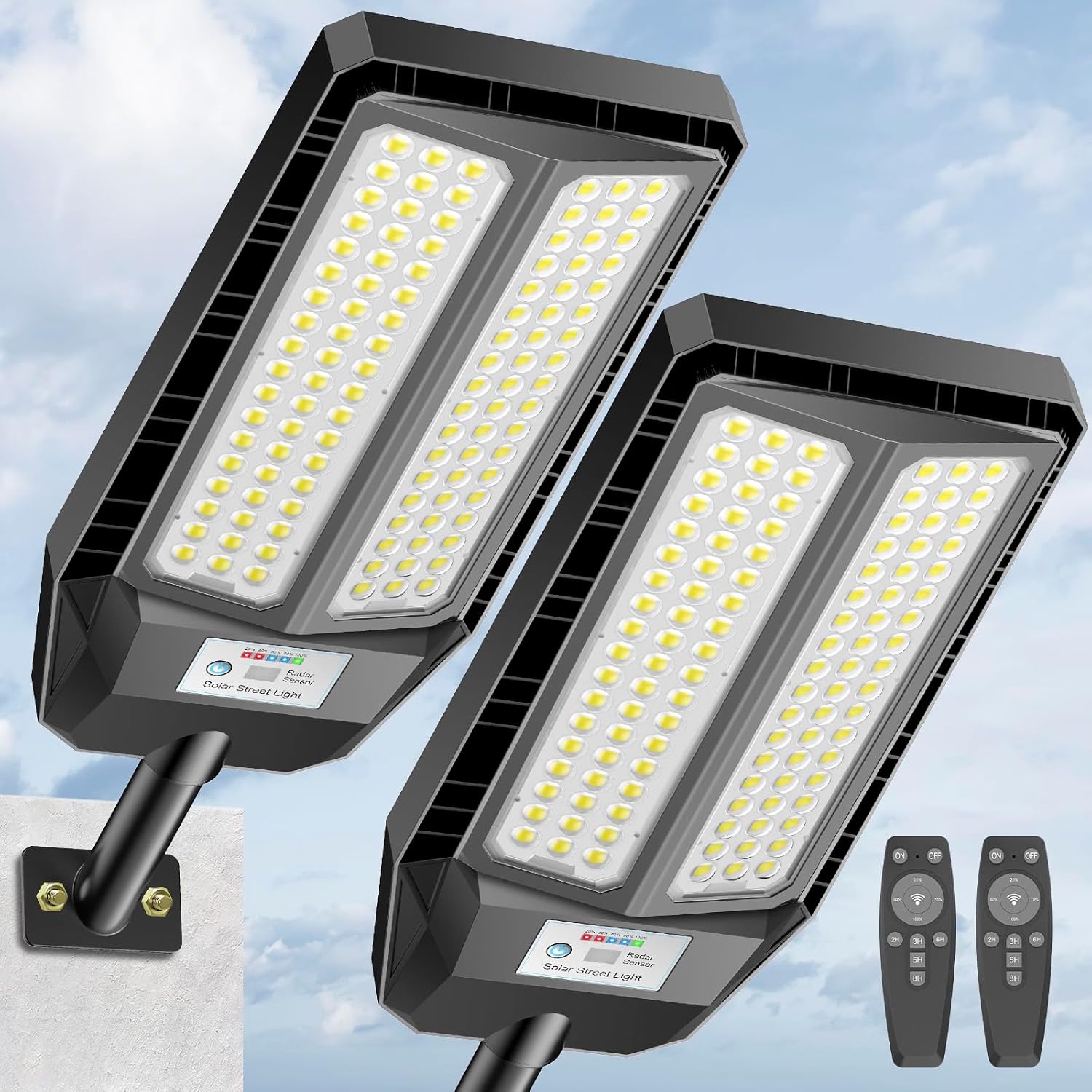
A wide, flat floodlight bar with a cool 7000 K cast and 188 LED beads.
Read the specs carefully on this one because the listing uses two different numbers. The headline calls it a 5000W solar light, while the specification line and feature copy both quote 3000 lm at 6500 K from 188 LED beads. It is the 3000 lm figure that determines the light you actually get. If you want the brightest pick, the 13000 lm pair above is the real answer; if you want a long, slim floodlight form factor against a fence or porch, this is the one to look at.
The form factor is genuinely different — at 15.55 inches long and 1.18 inches tall it lies flat along a wall or fascia rather than hanging out from it. Three remote-controlled modes run strong-on-sensor, dim-on-sensor, and a strong long light mode that holds full brightness for a continuous 4-hour window. The PIR sensing reaches 26 feet across 270°, and the 3-head adjustable design lets you fan the beam.
The 2000 mAh battery is on the smaller side, and the recharge story is the one to watch on this fixture. Lighting quality and brightness are what owners praise most, and installation gets credit for being straightforward. Reliability, battery life, and durability each draw mixed notes, so the sensible plan is to keep the panel clean and face it full south (or full north, in the southern hemisphere) where the sun actually lands. The IP65 housing is fine against rain, snow, and storms.
The flat-bar advantage: a 15.55-inch wide body gives you long, even light along a fence line rather than a single hot spot.
The smaller battery to plan around: 2000 mAh means the recharge routine is not optional, and durability has been a recurring point, so shade or dirt on the panel will cost you run time.
Right for long flat runs: fence tops, fascia boards, and porch headers where a slim bar sits tidier than a bulky flood head.
Look past it if: you want the highest output on this page — the 13000 lm pair is the genuine brightness leader.
8. JOFIOS Fence Lights Solar Powered 12 Pack
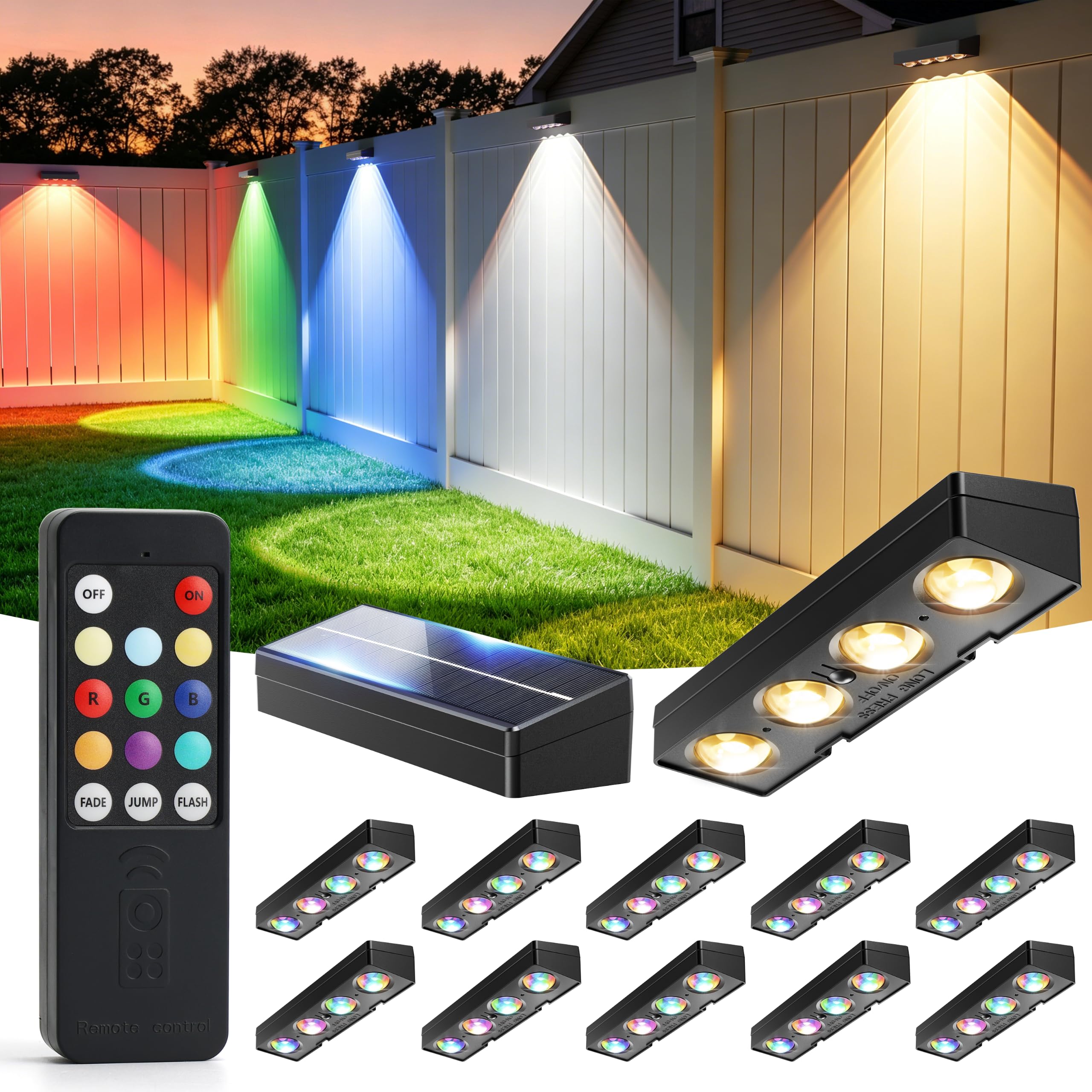
Twelve little lights, one remote, and a fence that changes colour in seconds.
This is a whole-fence system rather than a single fixture. Twelve units arrive in the box, each delivering 60 lm through an anti-glare focusing lens with four lens designs for a wider spread. The remote covers up to 33 feet and, more usefully, syncs all the lights with a single click — walk out, press, and every post along the fence changes at once. No running back and forth to set each fixture.
Colour choice is the second draw: warm white, cool white, mixed white, red, green, blue, purple, yellow, and ice blue, plus three RGB cycle modes (smooth changing, flash changing, and a yellow light flash). Warm white is the everyday setting, and the RGB modes are what you flick on for a party. A monocrystalline solar panel charges in 4 to 6 hours of sunlight, and the maker claims 10+ hours of dusk-to-dawn run.
Owners point to how good the yards look after fitting and how simple the installation is. Brightness is the deliberate compromise — 60 lm is accent output by design, so if you want to see across a driveway, this is the wrong pick. Reliability and lifespan split opinion in the same way most low-cost solar sets do, and the ABS housing carries IP65 against snow, rain, salt air, and temperatures from -4°F to 122°F.
One-click sync is the killer detail: a single press from the remote changes all twelve units at once, which turns a fence into a controllable scene rather than twelve individual lights.
The deliberate low output: at 60 lm per light this lights a post, not a path across the garden, so pair it with a security fixture rather than replacing one.
The 12-pack is for the whole run: fences, railing tops, deck edges, and step risers where you want many small points of light that sync to one remote.
skip it if: you need to spot a person at the gate — at 60 lm this is decoration, and the floodlight picks are the actual security answer.
Know the Specs
Lumens, the unit of light you actually see
A lumen measures how much light a fixture sends out, and the spread is wide in this category — from 60 lm on a fence accent to 13000 lm on a street-light fixture. Match the number to the job: tens of lumens for path and fence marking, low thousands for a porch or shed, and five figures when you need to see a gate or driveway from distance. Colour temperature rides alongside, and it is measured in Kelvin. Some fixtures here run 6500 K or even 7000 K, which is a cool daylight white; if you want warmth against render or brick, that cooler cast is the trade-off.
Milliamp-hours, how long the battery holds the night
Battery capacity is stated in mAh (milliamp-hours — think of it as the size of the tank), and this page runs from 1800 mAh on the entry flood up to 6000 mAh on the 13000 lm pair. Bigger tanks run longer, but only if the panel refills them. That is why a separate panel on a long cable, or a larger panel with a higher conversion rate (quoted as a percentage in the listing), often beats a bigger battery alone. If a fixture claims 12 hours of run on a 6000 mAh cell, the honest question is whether the panel gets enough sun to charge it the next day.
Motion sensing and remote range
A PIR sensor (passive infrared — it detects the heat of a moving body) is what turns a light from a lamp into a security device. Sensing distance here runs to 26 feet on several fixtures, and detection angle runs from 120° on some to 270° on the wide-head lights. Remote range lands around 33 feet on the colour and fence sets, and it is line-of-sight — so a wall between you and the fixture will cut the range. Plan the remote’s home near a window or porch you actually use.
IP ratings, what the number really guarantees
IP65 protects against water jets from any direction and is what most of this page carries. IP66 steps up to forceful spray, which is where the WYWNA fixture sits, and IP67 on the VIODAIM ground lights handles brief submersion — the useful one for in-ground disks. None of the ratings cover the panel cable joint or the screws, so a bead of sealant at the entry point is the practical fix. Rated housings still need the sensor lens kept clean; pollen and cobwebs will fake a motion trigger on their own.
Common Questions
How far away will the remote actually work on these solar lights?
Will a solar security light still work through a cloudy week?
What does IP65 mean and is IP67 better for a garden light?
Can these lights work indoors if I run the panel outside?
How high should I mount a motion sensor solar floodlight?
How long should the battery last before it stops holding charge?
What is the difference between dusk to dawn and motion sensor mode?
Why do some solar lights show two different wattage or lumen numbers in the listing?
Can I dim the brightness on these solar lights?
Do I need direct sunlight or will a shaded wall work?
The Bottom Line
For most yards the safe choice in a solar light with remote is the Tuffenough Solar Outdoor Lights 2500LM — three aimable heads, 26 ft motion sensing, three remote modes, and a proven track record that sits well clear of the pack on owner confidence. A 4.0+ star average across 42,000+ buyers is the strongest owner signal in this group.
If you want the most raw light, the 13000 lm pair is the pick that delivers a genuine flood rather than a glow. If the light has to sit on a shed or barn where the sun never lands, the Ropelux with its separate 16.4-foot panel is the only fixture here built for that problem. And for a whole fence that changes colour from one remote press, the JOFIOS 12-pack turns the garden into a controllable scene.
Pick the one that matches your panel placement and your job. The remote is the fun part, but the sun is the thing that decides whether the light still works in six months.
How we choose
We do not accept paid placement. Every pick is matched to a real buyer and a real use-case; we do not hands-on test units.
Sources
Specifications: manufacturer listings and product documentation. Review insights: verified customer reviews, as of November 2026. Pricing: not shown on this page (it changes often); check the current price via the retailer link.
As an Amazon Associate, Tactical Gear Guy earns from qualifying purchases. This does not affect which products we feature.