Specs are compiled from manufacturer listings and verified buyer reviews and can change over time — please confirm the key details on the product page before buying.
The fastest way to ruin a good hike is gear that quits on you halfway up — a pole that slips shorter, a pack that bounces, wet feet at mile four. What you actually need is a small set of accessories that stay put and stay out of your way. Below are the nine pieces that hold up on real trails, sorted by what they do best, with the honest catch on each one spelled out.
This guide is built by comparing the manufacturers’ published specifications and the patterns across verified customer reviews, so you get each pick’s real strengths and trade-offs instead of marketing spin.
Each pick earns its spot for a different reason, so match the accessory to your terrain and load. That is the whole logic behind this shortlist of women’s hiking accessories.
Top Picks

How To Choose The Best Women’s Hiking Accessories
Accessories are the cheapest part of a hike and the easiest to get wrong — a slipping pole or a bouncing pack reminds you every step.
Match the poles to your knees, not your ego
Trekking poles take load off your legs on descents, but only if the lock holds. Lever and flip locks adjust with one hand and tend to stay put; twist locks need two hands and can creep under weight. Pole weight matters too — a lighter pole in ounces means less swing weight at the end of every stride.
Size the pack to the hours, not the gear pile
A 5-liter vest carries water, gels and a shell for a fast few hours. A 10-liter pack swallows a layer, lunch and a towel for a longer day. A pack bigger than you need bounces, and bounce wears you down.
Check the fit points before the fabric
Gaiters and hydration vests live or die on closure and chest measurement. Measure around the fullest part of your chest before ordering a vest, and check that a gaiter’s instep strap is reinforced — that is the part that meets rock and mud first.
Side-by-Side Comparison
| Model | Best For | Weight | Capacity / Length | Lock or Closure | Amazon |
|---|---|---|---|---|---|
| TrailBuddy Trekking Poles★ Best Overall | All-round trail support | 1.2 lb (pair) | 24.5″–54″ | Lever | Amazon |
| Foxelli Carbon Fiber Trekking PolesFeatherweight Pick | Long-mile fatigue savings | 7.6 oz per pole | 24″–54″ | Flip | Amazon |
| Cascade Mountain Tech PolesBest Grip Design | Steep climbs on a budget | 10.08 oz per pole | 26″–54″ | Quick | Amazon |
| MIYCOO Hydration Backpack | Full-day hydration and layers | 0.67 kg | 10 liters | Adjustable mesh straps | Amazon |
| Zelvot Hydration Vest | Race-day hands-free drinking | 7.5 oz | 500 ml flask | 3 adjustable chest straps | Amazon |
| Becojadde Running Vest | Fast runs with pocket space | 0.2 kg | 5 liters | Chest and dual waist straps | Amazon |
| UtiaMiaoGonGo 15L Daypack | Packable travel and day trips | 13.4 oz | 15 liters | Chest strap with whistle | Amazon |
| BIAT Rechargeable Headlamp | Low-light starts and finishes | 2.47 oz | 230° beam | Motion sensor + button | Amazon |
| TAYOVSZY Gaiters | Mud, scree and snow days | 200 g | Adjustable one size | Velcro with steel buckles | Amazon |
Detailed Reviews
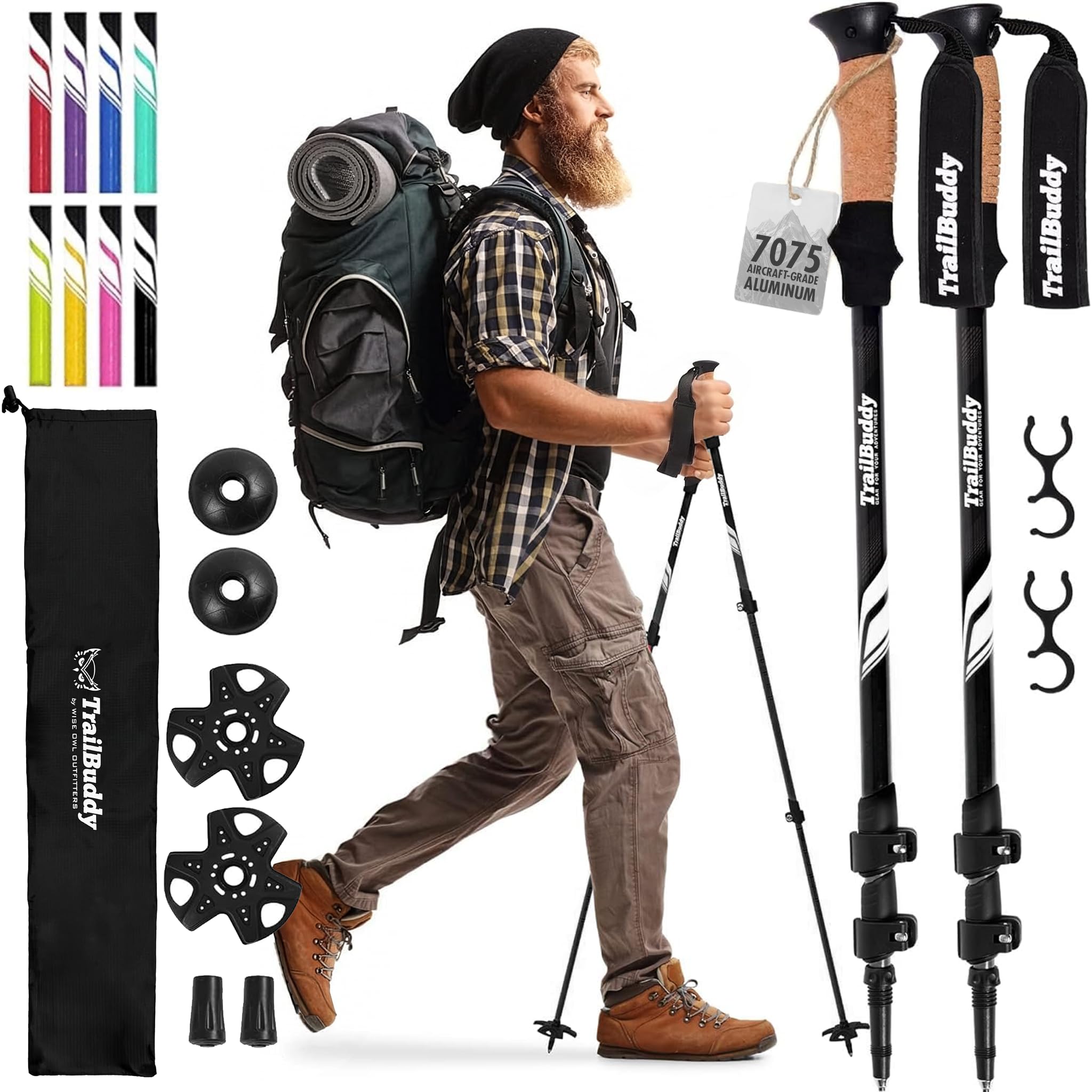
1. TrailBuddy Trekking Poles
Our pick — 4.5+★ from 64,000+ verified ratings; the strongest balance of quality and price.
One-hand lever locks and a 24.5″ to 54″ range — the pole set that does the basics right.
What makes these the default pick for most hikers is the lock, not the tube. Each pole uses a lever lock you flip with one hand — no two-handed twisting while you balance on a rock. The aluminium is 7075 aircraft-grade, the same family of alloy used in airframes, and each pole is built to hold up on rugged ground and snow.
Height runs from 24.5 inches fully collapsed up to a 54-inch maximum, so the same pair fits a tall adult and a kid aged 7 and up. The handles are moisture-wicking cork with padded straps that mold to your hand shape. A threaded pole tip keeps the baskets attached in snow and mud, which is the small detail that stops you hunting for a lost basket mid-trail.
Travel is where these quietly win. Break them down and they measure 21 inches, short enough to slide into a carry-on or the bottom of a pack. Three colorways are listed, including Berry Pink and Aqua Blue, if you want your poles to be findable in a gear pile.
What earns the top spot
- One-hand lever locks make mid-trail height changes quick and calm.
- 24.5″ to 54″ range covers adults and kids aged 7+ with one pair.
- Cork grips and padded straps mold to your hands instead of rubbing.
- Collapses to 21″ for carry-on and backpack travel.
Before you commit
- Aluminium poles carry more swing weight than carbon, so arms work a little harder over very long days.
- The set weighs 1.2 pounds as a pair, which matters if you count every ounce.
Reach for these if: you want one dependable pair for hiking, Nordic walking and travel, shared across the family.
Look elsewhere if: you are chasing the absolute lightest swing weight and already own a carbon setup.
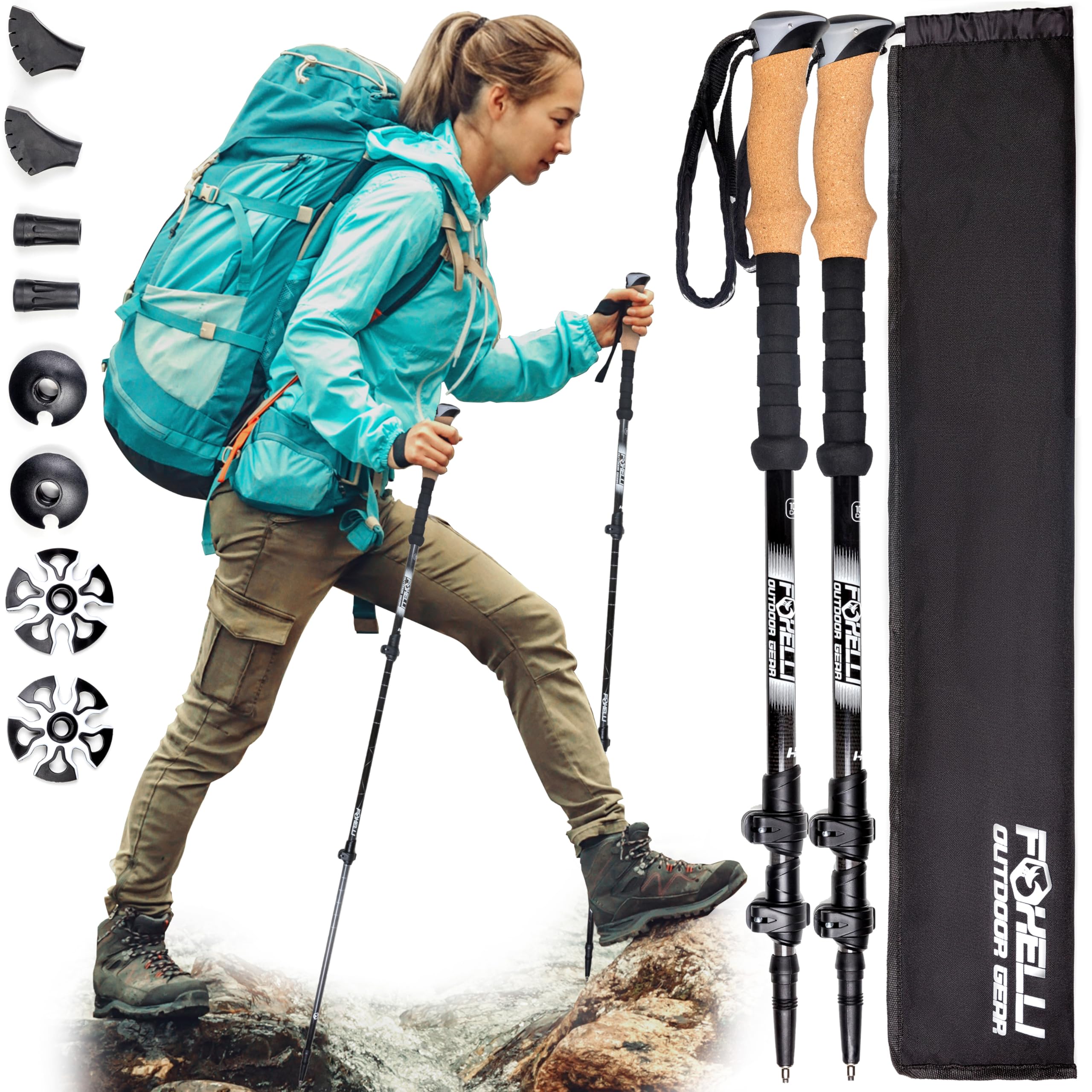
2. Foxelli Carbon Fiber Trekking Poles
At 7.6 ounces a pole, these cut swing weight on every stride.
Carbon fiber is the whole point here: 7.6 ounces per pole, against the 10.08 ounces of the Cascade Mountain Tech pair below. That difference is swing weight you feel at the end of every stride on a long descent, and it is the number to weigh if fatigue is your enemy. High-stress zones are reinforced to resist cracking, and the flip locks are built to stay tight under load.
The grip system is where these go further than most. Natural cork handles mold to your hands, an EVA foam choke-up grip gives you a second hold on steep climbs, and padded straps ease wrist fatigue. Length adjusts from 24 to 54 inches, folding down to 24 inches and breaking down to 21 inches when disassembled — shorter than most carry-on suitcases.
Tungsten carbide tips and interchangeable baskets keep them planted on rock, mud and snow. A carry case and a clip come in the box, and replacement tips are sold separately if the carbide eventually wears. The honest trade-off is carbon itself: it is stiff and light, but treat it kindly around sharp rock edges and car doors.
Where the weight shows up: over a full day of climbing and descending, that 7.6-ounce-per-pole figure is the reason these feel easier in the arms than the aluminium pairs on this list.
Handle it with care: carbon fiber rewards good treatment. Cinch them down in the car and avoid slamming them into rock, and they will reward you on every mile.
Best match: hikers logging long miles who feel every extra ounce by the last hour.
Think twice if: you want a pair to throw loose in a truck bed and forget about.
3. Cascade Mountain Tech Trekking Poles
The extended foam grip is the smart bit — grab lower on steep climbs and keep moving.
Most poles give you one place to hold. These add an extended EVA down grip below the cork handle, so on a steep pitch you can slide your hand down and shorten the effective pole without stopping to adjust anything. The cork upper grip works to dampen vibration on uneven ground, which is the part your palms notice after an hour.
The shaft is 6061 aircraft-grade aluminium at 10.08 ounces per pole, adjusted with a quick lock from 26 to 54 inches. Tungsten carbide tips handle year-round use, and rubber snow and mud baskets, boots and tip covers come in the box. A travel bag is included so they pack down for day hikes and backpacking trips.
What buyers report most often about this pair is straightforward value and function — the poles perform on trips without fuss. The recurring caution is the locking mechanism: a few find it slips when weight leans hard on a pole. Set the lock firmly and reseat it if it creeps, and it behaves.
Standout detail: that extended EVA grip section is what separates these from every single-height pole on this list — it gives your hand a second home on a climb.
Fair warning on setup: the quick lock needs a firm hand. Get it tight at the trailhead and check it once more after the first mile.
Pick it for: hilly, varied terrain where you constantly change hand position.
Pass if: you want a lock you can set once a season and never revisit.
4. MIYCOO Hydration Backpack
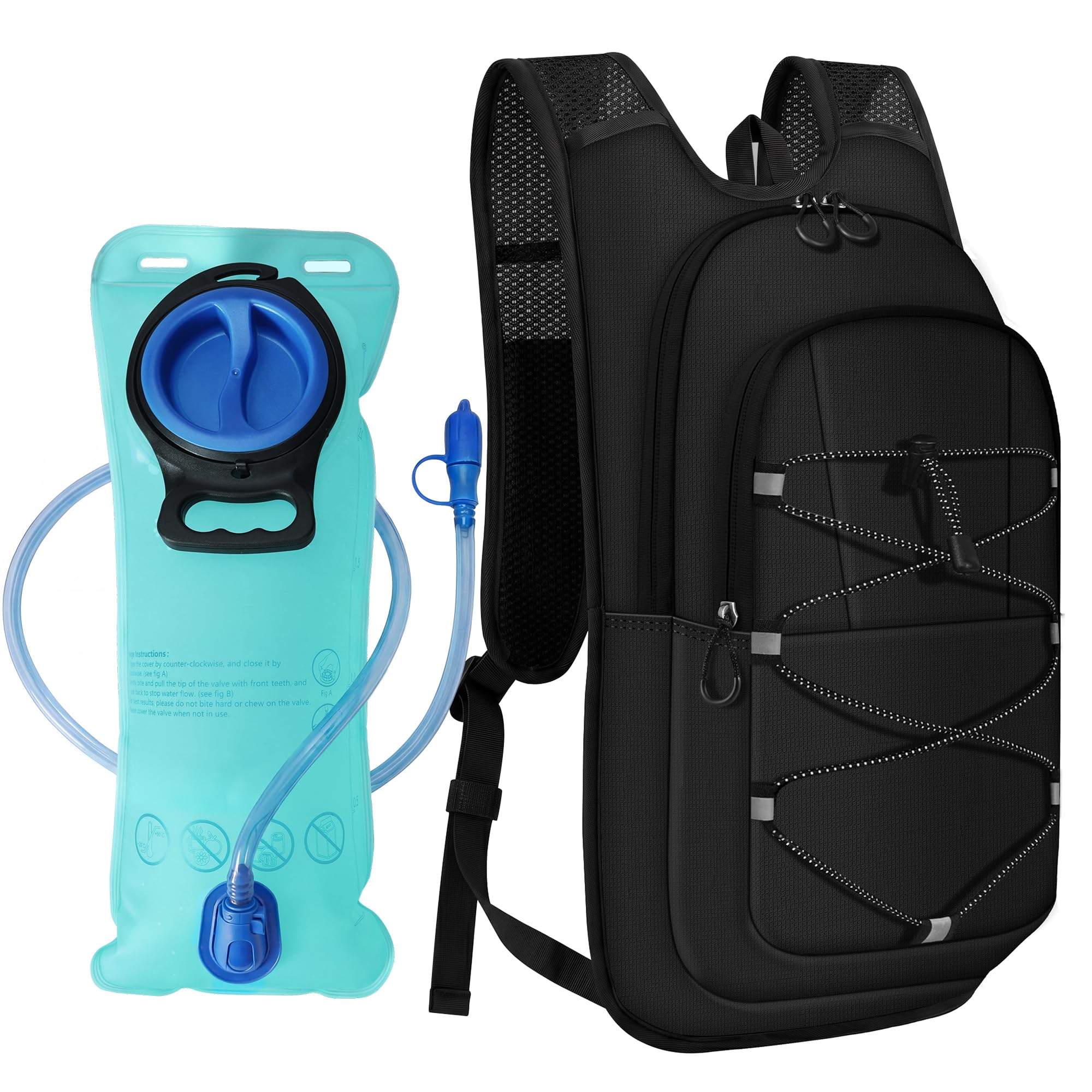
Ten liters of pack around a two-liter bladder — enough for a full day, not just a lap.
You get double the room for a layer, lunch and a towel: the MIYCOO holds 10 liters, while the Becojadde vest holds 5 liters. That extra space comes at a weight cost — 0.67 kg versus the vest’s 0.2 kg, a 3.4x heavier build. Five pockets include a dedicated bladder sleeve (a compartment for your water reservoir), a front zipper pocket and two phone pockets on the shoulder straps.
The bladder itself is 2 liters, food-grade, BPA-free and odorless, with a wide opening that makes filling and cleaning easy. An insulated pocket takes an ice pack and keeps water cold for 4 hours — a real advantage on a hot climb when warm water starts tasting like a chore. Ventilated mesh shoulder straps with silica gel padding work to keep air moving against your back.
Quality of build is what buyers call out first, and the storage layout runs close behind. The one thing to watch is the bladder seal: most owners mention no leaks at all, while a minority hit one. Fill it at home once before your trip, check the closure, and you will know where you stand.
Why day hikers like it
- 10 liters of space plus a 2-liter bladder for full-day carries.
- Insulated pocket keeps water cold for 4 hours with an ice pack.
- Wide bladder opening makes filling and cleaning genuinely easy.
- Two shoulder-strap phone pockets keep your device reachable.
The honest caveats
- At 0.67 kg it is noticeably heavier than a bare running vest.
- A minority of owners run into a bladder leak — test the seal before you rely on it.
Made for: the hiker who wants water and layers in one bag and does not mind carrying a little more.
Not the one if: you are packing for a fast run and count grams.
5. UtiaMiaoGonGo 15L Small Hiking Backpack

It folds to the size of a paperback, then opens into a real 15-liter daypack.
The shoulder straps are the feature nobody else copies. Each one carries a zippered pocket that fits phones up to 7 inches, plus a drawstring pocket for keys, cards or snacks — so you grab your phone without swinging the pack off your back. For anyone who has fumbled a strap buckle one-handed on a ridge, that is the whole pitch.
For a pack this small, storage runs deep: two zippered main compartments, an expandable elasticized front pocket for a towel or thin jacket, a hidden back pocket for a wallet, and two mesh side pockets for a mug or umbrella. The body is rip-stop nylon (a fabric woven to stop tears from spreading) built to resist scratches, with SBS zippers and reinforced stitching. At 13.4 ounces (about 380 g) it disappears on your shoulders.
Folded, it measures 8.3 x 7.5 x 6.3 inches — small enough to live in your suitcase until you need a spare bag. The chest strap secures both shoulder straps, and the buckle doubles as a survival whistle. Reflective strips add visibility on evening walks. Check the listed 17.3″ H x 10.6″ L x 5.5″ W dimensions against your load, because 15 liters fills faster than you think.
The phone-pocket trick: chest-strap pockets are the reason this pack gets reached for over bigger bags on short trips — your essentials stay in front of you.
Sizing honesty: 15 liters is a day-trip number, not a backpacking number. Pack it for a few hours out and it shines.
Right for you if: you travel light and want a spare bag that vanishes into a suitcase.
Keep looking if: you need to carry a sleeping bag or multi-day kit.
6. BIAT Rechargeable Headlamp (2-Pack)

A 230-degree wash of light that follows your eyes, not just your head direction.
Most headlamps throw a narrow circle you have to aim by turning your whole head. This one spreads light across 230 degrees, so the trail edge and your hands are both lit without a neck swivel. There is a spotlight as well, for when you need to pin light on one spot — a map, a knot, a bootlace.
The motion sensor is the second useful trick. Wave a hand within 10 cm of the lamp and it switches on or off, which means no fumbling for a button with gloves on in the cold. Six modes cycle through COB high and low, XPE high and low, strobe, and the motion sensor. The whole unit weighs 2.47 ounces and folds small enough for a jacket pocket.
It is rated IPX4, which means it shrugs off splashes from any angle — rain or a sudden snow flurry will not end your night. The two honest caveats are the ones buyers raise: a share of owners find the battery will not hold a charge over time, and a few report LEDs failing early. The two-pack format helps here, since you have a spare.
What wins people over: the hands-free wave control and that wide beam, which together make night hiking feel far less clumsy than a standard spot lamp.
Set expectations: lithium-ion cells age. Charge it before a big trip, and treat the second lamp as your backup rather than a shelf ornament.
Snag it if: you start before sunrise, finish after dark, or hike in changeable weather.
Skip if: you need a lamp for months of nightly use without charging.
7. Zelvot Hydration Vest with 500ml Soft Flask
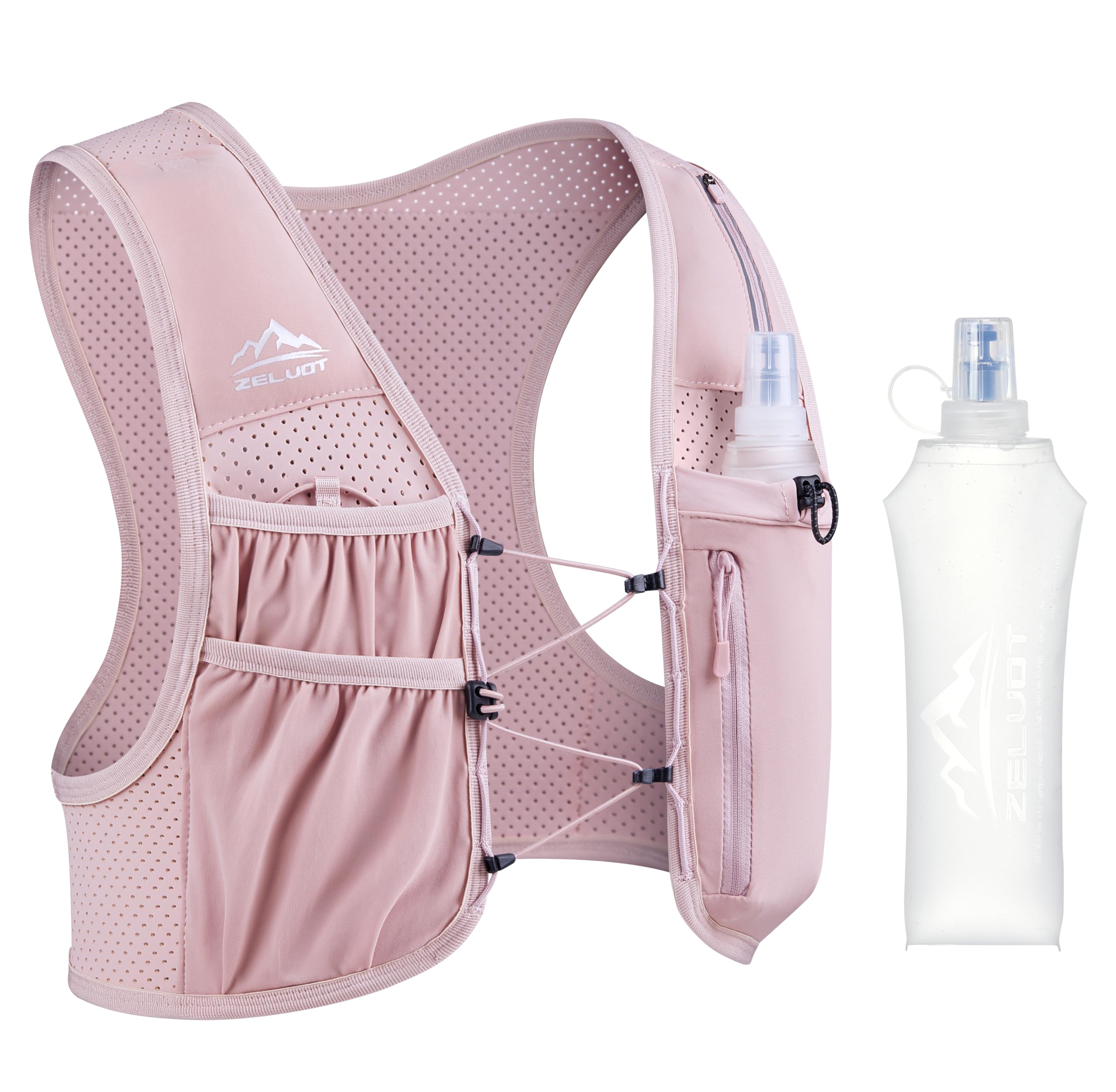
The flask shrinks as you drink, so nothing sloshes on the downhill miles.
Soft flasks solve a problem hard bottles create: as you drink, a rigid bottle empties and starts rattling against your chest. This 500ml flask collapses with the volume, and the drawstring tightening holds it steady. Bite the valve and drink hands-free without breaking stride. The flask is free from BPA and PVC.
Storage is generous for a race vest: 7 pockets on the front and 2 large ones on the back, including a hidden zippered phone pocket, two quick-access shoulder pockets and two flask pockets with a bungee cord. The body is breathable neoprene with triple-sized ventilation holes, and the whole vest weighs 7.5 ounces. A reflective logo and strip help you get seen in low light.
Fit is where this vest asks you to pay attention. Measure around the fullest part of your chest and ignore your clothing size — the chart runs XS/S at 27″–34″, M/L at 30″–40″, L/XL at 38″–46″ and XL/XXL at 45″–52″. A 34-inch chest lands in M/L. If you are between sizes, size up.
What racers notice
- Soft flask shrinks with the water, cutting slosh and bounce.
- 9 pockets keep gels, phone and a layer separated and reachable.
- 7.5 ounces total makes it near-invisible on long runs.
- Three chest straps hold a stable fit across body shapes.
Where it asks more of you
- Sizing is measurement-based, not clothing-based — a wrong guess feels tight fast.
- Some find the cut runs small, so sizing up is the safer call.
Built for: marathon and trail runners who want hands-free drinking and organized pockets.
Look elsewhere if: you want a vest to carry a full day’s water supply — this one holds 500 ml.
8. Becojadde Running Vest (5L)

Eight pockets on a vest that weighs less than half a pound — the organizer’s choice for fast miles.
What sets this vest apart is the pocket layout, not the fabric. Eight pockets include a waterproof phone pocket, dual rear zippered compartments for clothes, and dedicated slots for keys, snacks and a water bottle. At 0.2 kg for the pack, it is the lightest carrier here — well under the 0.67 kg MIYCOO pack, though it holds 5 liters against that pack’s 10.
It comes in five configurations, so you choose your setup: a 5L vest alone, a 5L with a 1.5L bladder, a 5L with two 500ml soft bottles, a 6L vest alone, or a 6L with a 2L bladder. The 5L pack measures 14 x 11 inches; the 6L measures 16.5 x 11.4 inches. Nylon and breathable stretch fabric over a ventilated mesh back keeps air moving.
Adjustable chest and dual waist straps with a tube clip hold the fit secure, and sliding chest straps and securing loops reduce bounce. The material is quick-drying with soft edging to prevent chafing. Sizing is the one note to plan for: check the configuration and fit against your body before ordering, because the range covers a lot of ground.
The pocket argument: for a vest this light, eight organized pockets is the reason it works for trail runs that need snacks, phone and a shell.
Configuration trap: five versions exist under one listing. Decide if you want the bladder (water reservoir) or bottle option before you order, or you will end up with the bare vest.
Ideal for: runners who want pockets and light weight without a full hydration pack.
Skip if: you are hiking all day and need ten liters of space.
9. TAYOVSZY Gaiters for Hiking

The cheap fix for mud, scree and snow that would otherwise end up inside your boots.
These gaiters strap around your boot and lower leg to keep water, dirt, scree and snow out of your footwear. The build is a triple-layer waterproof polyester over rugged 900D nylon Oxford cloth, so the outer takes the abuse while your socks stay dry. They also block burrs and brush on overgrown trails.
One size covers women and men, with an adjustable drawstring to tune the fit around your boot. Hook and loop fastener paired with steel buckles holds the top and bottom in place during heavy activity, and a thickened reinforced TPU instep strap keeps your boot tied. The pair weighs 200 grams and comes with a drawstring tote bag to keep your pack clean.
Two things to know before you buy. Fit is adjustable but not tailored, so very slim or very wide calves may need extra care with the closure. And the instep strap is the weak point on any gaiter — this one is reinforced, but it is still the part that meets rock first. Set it snug and it will last.
Value read: for a mud and brush barrier, the waterproof nylon and steel-buckled closure do the job without asking much. It is the smallest spend on this list and among the most immediately useful on a wet day.
Fit caution: adjustable covers most legs, not all of them. If your calf sits at an extreme, loop the drawstring tight and check the velcro meets fully before heading out.
Grab a pair if: your trails run wet, muddy or brushy and you are tired of emptying grit from your boots.
Not for you if: you only walk groomed, dry paths where gaiters add nothing.
Know the Specs
Pole weight and lock type
Weight is measured per pole, in ounces, and it decides how tired your arms feel after a long descent. A 7.6-ounce carbon pole swings lighter in the hand than a 10.08-ounce aluminium one, which is why weight-obsessed hikers pay more for carbon. Lock type matters just as much: a lever or flip lock adjusts with one hand and holds under load, while a twist lock needs two hands and can creep when you lean on it. Check the length range too — 24 to 54 inches covers most adults.
Pack capacity in liters
Capacity is the internal volume of a pack, measured in liters. A 5-liter vest is enough for water and a snack on a fast run. A 10-liter pack adds room for a layer, lunch and a towel on a longer hike. Extra volume you do not fill tends to bounce, and bounce wears you down on descents. Match liters to hours out, and check the pocket count for where your phone and keys will live.
Waterproof ratings and fabrics
An IPX4 rating means a device resists splashing water from any direction, which covers rain and a sudden flurry but not a dunking in a stream. On gaiters, look for a layered waterproof fabric over a tough outer weave, plus a reinforced instep strap — that strap is what drags across rock and mud, so it takes the wear first.
Fit measurements for vests
Hydration vests are sized by chest measurement, not clothing size. Measure around the fullest part of your chest, and if you land between two sizes, go up. A vest that sits tight limits breathing on climbs, and a loose one bounces. Chest straps and waist straps let you fine-tune the hold once you are wearing it.
Common Questions
Do trekking poles actually help on descents?
How do I choose a hydration vest size without trying it on?
Are gaiters worth wearing on a summer hike?
What is the difference between a hydration backpack and a running vest?
How long should a hydration bladder last?
Can I fly with trekking poles in a carry-on?
Is carbon fiber better than aluminum for trekking poles?
How much water should I carry on a day hike?
Do I need a headlamp for a day hike?
What should I look for in gaiters for wide calves?
The Bottom Line
For most hikers, the winning set starts with the TrailBuddy Trekking Poles, because one-hand lever locks and a 24.5″ to 54″ range cover almost every walker in the family. If your arms tire on long descents, step up to the Foxelli carbon poles at 7.6 ounces each. For a full day out, the MIYCOO pack carries 10 liters around a 2-liter bladder, and the TAYOVSZY gaiters are the small, cheap addition that keeps mud out of your boots. Buy the one that matches the trail you actually walk.
How we choose
We do not accept paid placement. Every pick is matched to a real buyer and a real use-case; we do not hands-on test units.
Sources
Specifications: manufacturer listings and product documentation. Review insights: verified customer reviews, as of November 2026. Pricing: not shown on this page (it changes often); check the current price via the retailer link.
As an Amazon Associate, Tactical Gear Guy earns from qualifying purchases. This does not affect which products we feature.