Specs are compiled from manufacturer listings and verified buyer reviews and can change over time — please confirm the key details on the product page before buying.
If you are building or upgrading a gaming PC, the power supply is the one part that can quietly wreck everything else. You want a single rail unit that sends all its 12V power down one path, so a demanding graphics card gets what it asks for without tripping a shutoff. The eight picks below are all single-rail designs, sorted by what they actually do well and where each one falls short.
This guide is built by comparing the manufacturers’ published specifications and the patterns across verified customer reviews, so you get each pick’s real strengths and trade-offs instead of marketing spin.
You will see wattage, efficiency ratings and connector types explained in plain terms, plus the honest catch on each unit. Here is what actually matters when you shop for a single rail power supply for your next build.
Top Picks


How To Choose The Best Single Rail Power Supply
A single rail design puts every amp of 12V output on one channel. Older multi-rail units split that 12V into separate lanes, each with its own amp limit, so a graphics card that suddenly pulls a big spike can hit a ceiling and shut the system down. One rail removes that ceiling. This is the first thing to confirm on any box before you buy.
Match wattage to your graphics card, not your ego
A 750W unit comfortably runs a mid-range card. A 1000W or 1200W unit gives you headroom for a top-tier card and future upgrades. Overshooting costs more and buys nothing if your parts never draw it. Undershooting is worse: the supply runs near its limit and the fan never quiets down.
Read the efficiency badge and the noise badge separately
An 80 PLUS Gold rating (a certification that the unit wastes less electricity as heat) is the baseline most buyers want. Cybenetics ratings go further and score noise, with Platinum for efficiency and A++ for how quiet the fan runs. A unit can be efficient and still loud, so check both badges if silence matters.
Check the connectors before you fall in love
If you plan on a current-generation graphics card, you want a native 12V-2×6 connector, sometimes labeled PCIe 5.1. Older cards run fine on 6+2-pin PCIe cables. Count the connectors you need now and add one spare. A fully modular design lets you leave unused cables in the box, keeping airflow clean inside the case.
Side-by-Side Comparison
| Model | Best For | Wattage | Efficiency | Modularity | Amazon |
|---|---|---|---|---|---|
| be quiet! Pure Power 13 M 1000W★ Best Overall | Silent high-end builds | 1000W | 80 PLUS Gold / Cybenetics Platinum | Fully Modular | Amazon |
| Apevia ATX-GX850W Galaxy 850WBudget Entry | Tight-budget first builds | 850W | 80+ Gold | Semi-Modular | Amazon |
| GIGABYTE UD750GM PG5 V2Compact Pick | Mid-tier PCIe 5.1 builds | 750W | 80 PLUS Gold | Fully Modular | Amazon |
| Thermaltake Toughpower GT 850W | Balanced mid-range gaming | 850W | 80 PLUS Gold | Fully Modular | Amazon |
| be quiet! Pure Power 13 M 850W | Quiet mid-power systems | 850W | 80 PLUS Gold / Cybenetics Platinum | Fully Modular | Amazon |
| GAMEMAX Rampage GX1050 | High-wattage Platinum builds | 1050W | 80 Plus Platinum | Fully Modular | Amazon |
| Thermaltake Toughpower GF A3 1200W | Big GPUs and heavy loads | 1200W | 80+ Gold | Fully Modular | Amazon |
| GIGABYTE GP-UD1000GM PG5 Rev2.0 | Budget-minded 1000W builds | 1000W | 80 Plus Gold | Fully Modular | Amazon |
Detailed Reviews
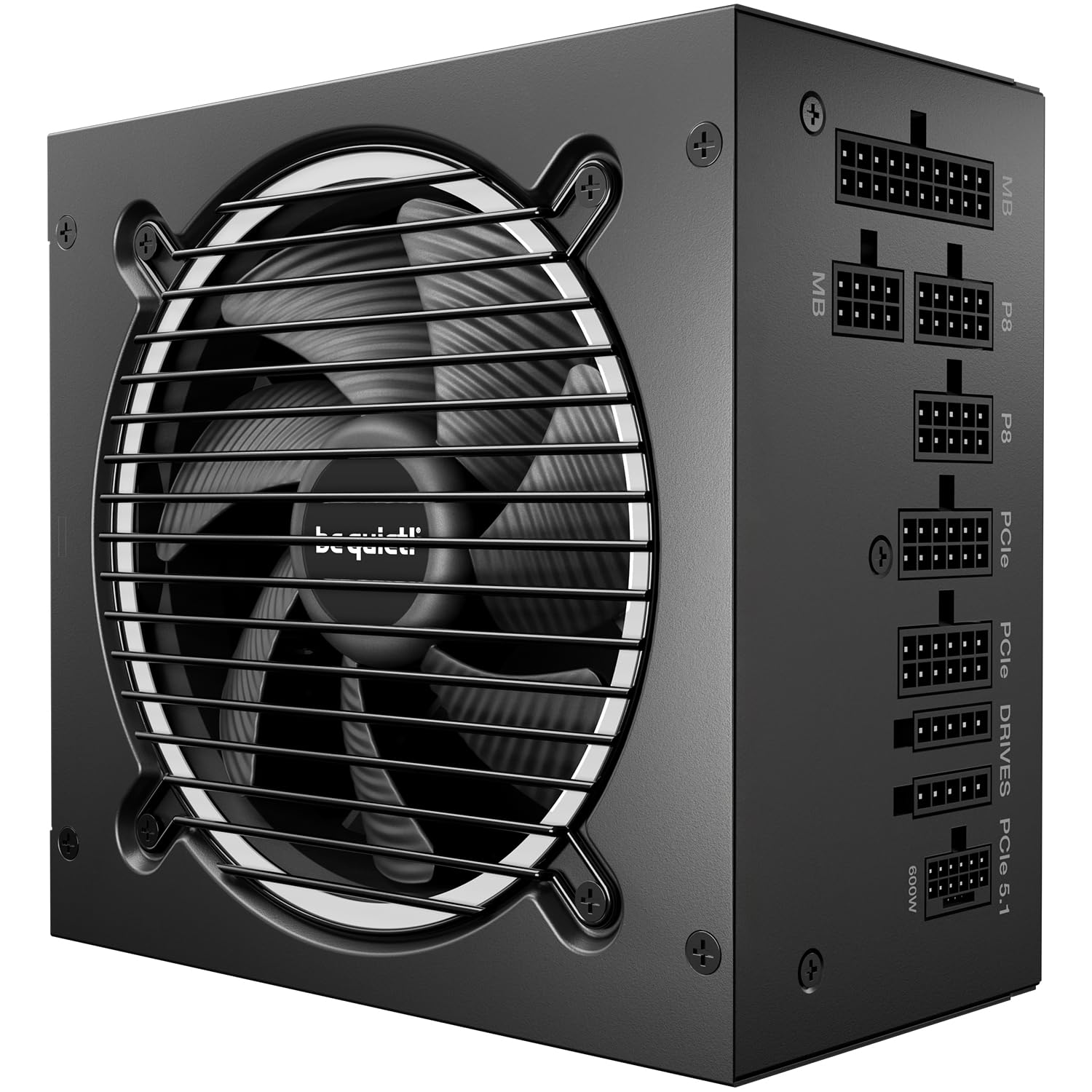
1. be quiet! Pure Power 13 M 1000W
Our pick — 4.5+★ from 300+ verified ratings; the strongest balance of quality and price.
A thousand watts on one rail, and the fan does not even spin until you ask for it.
This is the pick for a high-end gaming or media-creation build where you want power in reserve and near-silence at your desk. It delivers 1000W of continuous output through one massive 12V rail — a single channel that feeds every component instead of splitting the load into lanes. Be quiet! says the unit handles power excursions up to double its rated wattage for short bursts, which is exactly what happens when a graphics card spikes mid-game.
Two efficiency badges sit on the box: 80 PLUS Gold, plus Cybenetics Platinum and Cybenetics A++ — the second set also scores noise, so it tells you the fan runs quiet, not just that it wastes little electricity. The semi-passive zero-RPM cooling backs that up. Under low load the fan stops completely, so a light browsing session or a document edit is genuinely silent. Owners back this up, with the general theme being that it powers a top-shelf graphics card and stays whisper-quiet doing it. It also holds 4.5+ stars across 300+ ratings.
It is a fully modular ATX 3.1 unit with a native 12V-2×6 connector for PCIe 5.1 cards, and four PCIe 6+2-pin connectors for current-gen GPUs. The honest catch: at 3.14 kg this is a heavy block of a unit compared with something like the Thermaltake Toughpower GT 850W at 2.4 kg, and the LLC topology inside is the reason for the size. Plan the mounting before you slide it into a small case.
Where it earns the top spot
- 1000W continuous on a single 12V rail with headroom for transient GPU spikes.
- Cybenetics A++ noise rating plus a fan that stops entirely under light load.
- Native 12V-2×6 connector for PCIe 5.1 cards, with four 6+2-pin PCIe connectors alongside.
- 10 year warranty and fully modular cabling.
The trade-off to know about
- Heavier than most 850W units at 3.14 kg, so check case clearance first.
- 1000W is more capacity than a mid-range card will ever draw.
The verdict: Buy this if you are building a quiet, powerful system and want the wattage headroom already in place.
Think twice if: your case is tight or your card is modest — the extra weight and capacity will not pay you back.
2. Apevia ATX-GX850W Galaxy 850W
A budget 850W that asks you to read the connector instructions before you plug anything in.
If you are putting together a first gaming rig on a strict budget, this is the value play. It runs a single 12V output rated at +12V@66A — one channel delivering 66 amps, which is the number that lets a modest graphics card pull what it needs without a split-rail ceiling. The 135mm auto-thermally controlled fan spins up as the load climbs, and it accepts a 110 to 230 volt input range.
One thing to know up front: this unit has no PCIe 5.0 or Gen 5 12VHPWR connector. If you plan on a current-generation graphics card that needs that plug, look at the GIGABYTE UD750GM PG5 V2 instead. For older cards this unit covers you with four 8(6+2)-pin PCI-E connectors, four SATA, four peripheral and one floppy connector. The 135mm fan is also larger than the 12 centimeters on the be quiet! 1000W — a bigger blade moving the same air at a lower speed.
There is a real catch worth stating plainly. Buyers report the reliability picture is mixed, with most saying it runs well and a smaller group saying it stopped working after around ten months. That is the nature of entry-level parts. The three-pin connectors also split apart — the 24-pin into 20+4, the 8-pin CPU into 4+4, the 8-pin PCI-E into 6+2 — so a beginner can easily plug one in half-connected and think the supply is dead. It will not power on simply by connecting the cord; every cable must be seated on the motherboard first.
Build feel: The double-forward converter design and large Japanese capacitor are the parts that hold up under load, and the semi-modular layout lets you drop the cables you are not using.
What to accept: No PCIe 5.0 connector and a mixed durability record mean this is a starter part, not a keeper for a build you plan to grow.
Reach for this if: your graphics card is older, your budget is tight, and you want 850W of single-rail output at the lowest entry point.
Look elsewhere if: you need a native 12VHPWR connector for a new card.
3. GIGABYTE UD750GM PG5 V2 750W
The smallest box on this list, and still ready for a 16-pin next-gen card.
For a mid-tier build where the case is small and the budget is firm, this is the one to measure against. It delivers 750W through a single +12V rail, is ATX 3.1 certified and supports PCIe Gen 5.1 graphics cards through a 16-pin connector. That means the newer 12V-2×6 plug is native, not adapted. Its 5.91 x 5.51 x 3.39 inch footprint is a big part of the appeal — compare that with the Thermaltake Toughpower GT 850W at 10.83 x 8.31 x 4.76 inches and you can see how much less space this wants.
What wins people over here is performance — a fully modular layout plus a Gold efficiency badge at a modest capacity. It is also 80 PLUS Gold certified, so it wastes little power as heat. Owners describe it as a solid mid-tier modular system and a fair value, which lines up with the spec sheet.
The limit you will hit is capacity. At 750W, a top-tier graphics card plus a high-wattage CPU will push this supply near its ceiling. That is fine for a mid-range build, but not a build you plan to grow into. It also has one fan and caps at 120V on the input side, so overseas buyers should check their mains voltage before ordering.
The size advantage: It slips into compact cases where 850W and 1000W units will not fit, and the 16-pin connector means no adapter cable clutter.
Where it stops: 750W is a real ceiling, not a starting point if you plan to upgrade the card later.
Suits: a small-form-factor or mid-tower build with a mid-range card and a PCIe 5.1 upgrade path.
Not for: a machine driving a flagship graphics card at full tilt.
4. Thermaltake Toughpower GT 850W

The middle-ground pick that covers modern GPUs without reaching for a bigger wattage sticker.
Eighty-fifty watts on a high-amperage single +12V rail is the exact capacity most modern gaming builds want. It is fully compatible with Intel ATX 3.1 specifications and carries a native PCIe 12V-2×6 (12+4 pin) connector rated for 450W. Thermaltake claims up to 90% efficiency at the Gold badge, which cuts both your energy draw and the heat inside the case. The fully modular design with low-profile flat black cables makes routing behind the panel easier and keeps airflow clear.
Power quality is what owners notice most here, followed closely by how well it simply does its job. It handles sudden GPU spikes, its cable lengths reach in a full tower, and the installation is straightforward. The Smart Zero Fan technology backs that quiet reputation — it drops fan speed as load falls, so idle time is near-silent.
One honest point to weigh: reliability is the recurring gripe, with a smaller group reporting units failing after two to three months of use. The five-year EU spare-part availability and the five-year warranty are the safety net there. It is also a much bulkier box than the GIGABYTE UD750GM PG5 V2 — that wider footprint is worth checking against your case dimensions before you commit.
Why it sits high on this list
- Native 450W PCIe 5.1 connector for modern graphics cards.
- High-amperage single +12V rail built for spikes.
- Smart Zero Fan keeps idle near-silent.
- Fully modular flat black cables and a five-year warranty.
What you should factor in
- A smaller segment of buyers reports early failures, so keep the warranty handy.
- Its larger physical footprint rules out some tighter cases.
Best for: a mid-range gaming build with a modern card that needs a native next-gen connector and quiet operation.
Skip if: your case is cramped or you want a smaller physical unit.
5. be quiet! Pure Power 13 M 850W
The quieter sibling that trades 150W of headroom for the same silence and the same efficiency badges.
If your build does not need 1000W, this is the smarter move. It delivers 850W of continuous power on one massive 12V rail, and it handles power excursions up to double its rated power for short GPU spikes — the same behavior as the 1000W version. It carries the same 80 PLUS Gold, Cybenetics Platinum and Cybenetics A++ ratings, so efficiency and noise are both certified. The difference between this and the 1000W model is 150W of capacity and 0.7 kg of weight; the 12V-2×6 connector and four PCIe 6+2-pin connectors are identical.
What keeps this unit in the conversation is build quality — the heavy-duty feel of the unit and its cables. Reliability and quiet operation follow close behind. The semi-passive zero-RPM fan stops under light load, so a workstation or media PC sits silent until you push it. It is fully modular, comes with all needed cables, and carries a 10 year warranty.
Two caveats. There are mixed reports on individual units lasting very short periods, which is the nature of any electronics line, and the fit comes up as a point of disagreement because the unit is larger than some cases expect. Measure your case before you order.
The efficiency story: Gold plus Cybenetics Platinum plus A++ is about as much certification as a consumer supply gets, and the semi-passive fan delivers on it in real use.
The capacity question: Pick this over the 1000W version only if your parts never approach 850W — otherwise the headroom matters.
The pick for you if: you want certified silence and Gold efficiency without paying for capacity you will never use.
Move on if: you plan to drive a flagship card and want a bigger cushion.
6. GAMEMAX Rampage Series 1050W

A Platinum-badged 1050W with a six-year-deeper warranty than most of its rivals.
The number that earns the premium tier here is a 10 year warranty paired with a Platinum efficiency badge — GAMEMAX rates this unit at 92% efficiency or higher under typical loads through an APFC+LLC+DC-DC design. That efficiency translates to less heat in the case and a lower electricity bill over time. It is fully modular with a 100% free-cable internal PCB, so you route only what you need.
It is PCIe 5.0 ready with a native 16-pin (12VHPWR) connector rated for 600W continuous output — enough for a top-tier graphics card that demands a big single cable. The 135mm fluid dynamic bearing fan avoids the metal-on-metal contact of a traditional ball bearing fan and runs in ZERO RPM mode under 20% load for silent operation. It is also larger than the 12 centimeters on either be quiet! unit, which matters for airflow and noise. Electrical protections include OTP, OPP, OVP, UVP, SCP and OCP.
The honest reservation so far is on the CPU connectors — owners mention mixed experiences, with a share saying they do not deliver enough power. The rest of the picture is stronger: a clean, 105-degree Japanese capacitor build and a well-regarded appearance. Check your motherboard’s CPU power requirement against the supplied cables before ordering.
Built to last: 105°C Japanese capacitors, 10 year warranty and a fluid dynamic bearing fan are the components that outlive a cheaper supply.
The one point to verify: Your CPU power draw against the supplied connectors — a small portion of buyers found the CPU feed short on power.
Reach for this if: you are building a high-wattage rig and want a Platinum badge plus a 10 year warranty as insurance.
Look elsewhere if: your CPU needs a heavy feed and you want a supply with no questions about CPU delivery.
7. Thermaltake Toughpower GF A3 1200W

Forty percent more wattage than the Toughpower GT 850W, and a dedicated 600W cable for the biggest cards.
When the build is a flagship machine, the answer is capacity, and this is where the numbers land. It is 80 Plus Gold certified, fully compatible with Intel ATX 3.1 standards and ready for PCIe Gen 5.1 with a 12V-2×6 connector. A high-amperage single +12V rail is the core of the design. It is SLI/Crossfire ready and comes with fully modular low-profile flat cables.
What owners like is the noise level in normal mode and the cable lengths, with the dedicated 600W rated cable a real highlight for flagship GPUs. That cable handles a top-tier card’s full draw without an adapter.
You should go in knowing the durability picture is mixed — a stronger share of customers note it works well, a smaller group reports failures within a week or a supply fried within days. In a 1200W class unit that risk is worth weighing against the warranty. It is also physically the largest-capacity option here, so plan for the header and the mounting depth.
What stands out
- 1200W on a high-amperage single +12V rail.
- Dedicated 600W 12V-2×6 cable for flagship GPUs.
- Quiet in normal mode and fully modular.
- 80 Plus Gold and ATX 3.1 compatible.
The honest catch
- A share of buyers reports failures within a week, so test it thoroughly on arrival.
- The capacity is often more than one graphics card can use.
The pick for you if: you are building around a flagship graphics card and want the 600W dedicated cable plus a big single rail in reserve.
Move on if: your card draws far less and 850W would run it comfortably.
8. GIGABYTE GP-UD1000GM PG5 Rev2.0 1000W

A 1000W fully modular unit with Japanese caps and a genuine question mark over its fan noise.
If you want 1000W capacity and Japanese capacitors at the bottom end of the premium tier, this is the option. It carries a 1000W rating on a single +12V rail, is 80 Plus Gold certified, Intel ATX 3.0 certified and supports PCIe Gen 5.0 graphics cards via a 12+4 pin connector. It is fully modular, and the 120mm hydraulic bearing fan is the part that decides how much you hear it.
The experience is genuinely split. Some buyers get a unit that delivers excellent power quality, others find it fails to turn on. The noise level comes in for criticism from some, and cable quality is a point of disagreement. On the numbers side, the 12mm fan is smaller than the 13.5 centimeters on the Apevia Galaxy and GAMEMAX, which is a factor in how hard it has to work to stay quiet.
The upside is straightforward: Japanese capacitors and a fully modular design at a moderate entry into the 1000W class. If you buy this, test it on arrival and listen to the fan under load in the first week — that is where the split in experience lives.
The strength: 1000W capacity, Japanese capacitors, a 12+4 pin Gen 5.0 connector and full modularity.
The honest limit: Noise and reliability see mixed reports, so buy from a seller with an easy return path.
Best for: a builder who wants 1000W and Japanese caps and will test the unit carefully on arrival.
Skip if: a quiet fan is non-negotiable for your desk setup.
Know the Specs
Single 12V Rail and Amperage
A single rail design means all 12V current flows through one channel instead of being split into separate lanes. The +12V@66A figure on the Apevia unit tells you how much current that one channel can push — 66 amps. That is the number that matters for a modern graphics card, because cards spike hard and briefly. One rail lets that spike pass instead of tripping a lane and shutting the system down. Look for the +12V amp figure on the label, not just total wattage.
Efficiency Badges and What They Mean
80 PLUS Gold certifies that the unit loses less electricity as heat than a Bronze or unrated model. Cybenetics Platinum goes a step further on efficiency, and the Cybenetics A++ badge scores noise — how loud the fan runs under load. A supply can be efficient and still noisy, so read both. The GAMEMAX Rampage is rated at 92% efficiency or higher under typical loads at Platinum, and the be quiet! units carry both Gold and Cybenetics badges.
PCIe 5.1 and 12V-2×6 Connectors
The 12V-2×6 connector, sometimes called 12VHPWR or 16-pin, is the single cable that feeds a current-generation graphics card. A native connector is built into the supply; an adapter is a workaround. Native is the cleaner path because there is one fewer connection to loosen. The GAMEMAX unit rates its 16-pin at 600W continuous, and the Thermaltake GF A3 1200W includes a dedicated 600W rated cable.
Zero-RPM and Semi-Passive Cooling
A semi-passive fan stops entirely below a set load threshold and starts again when the load climbs. That makes idle and light work silent. The be quiet! units call it zero-RPM cooling, GAMEMAX runs it under 20% load, and Thermaltake’s Smart Zero Fan does the same job under a different name. The trade-off is that at high load the fan does have to spin, so the quietest supply at idle is not automatically quietest under full load.
Common Questions
What does single rail actually mean on a power supply?
Will a 750W supply run a current-generation graphics card?
Do I need a native 12V-2×6 connector or can I use an adapter?
Is 80 PLUS Gold good enough or should I chase Platinum?
How do I know if a power supply will fit my case?
What does semi-modular versus fully modular change for me?
Is a zero-RPM fan safe to leave running?
How long should a good power supply last?
Can a power supply damage my other components?
The Bottom Line
For most builders chasing a single rail power supply, the winner is the be quiet! Pure Power 13 M 1000W because it pairs 1000W of single-rail capacity with a fan that stops entirely under light load and a Cybenetics A++ noise rating. If your build does not need 1000W, the be quiet! Pure Power 13 M 850W delivers the same silence and efficiency badges with less capacity and less weight. And for a compact mid-tower where space is tight, the GIGABYTE UD750GM PG5 V2 is the one to reach for, because it fits where the bigger units will not.
How we choose
We do not accept paid placement. Every pick is matched to a real buyer and a real use-case; we do not hands-on test units.
Sources
Specifications: manufacturer listings and product documentation. Review insights: verified customer reviews, as of November 2026. Pricing: not shown on this page (it changes often); check the current price via the retailer link.
As an Amazon Associate, Tactical Gear Guy earns from qualifying purchases. This does not affect which products we feature.