Specs are compiled from manufacturer listings and verified buyer reviews and can change over time — please confirm the key details on the product page before buying.
If you or someone you love navigates the world with low vision, the right cane is the difference between walking tense and walking loose. The one that suits most people is the MonMed Medical 53-inch folding cane — a four-section aluminum shaft, a 360-degree marshmallow tip that rolls over cracks, and a 4.5+ star score. Below you will find nine real options, sorted by what each one actually does well, so you can match a cane to your height, your grip, and the way you get around.
This guide is built by comparing the manufacturers’ published specifications and the patterns across verified customer reviews, so you get each pick’s real strengths and trade-offs instead of marketing spin.
Length, tip type, and how the shaft folds matter far more than color or brand name. Get those three right and the cane stops fighting your grip. Here is how to read a walking stick for the visually impaired before you spend a cent.
Top Picks


How To Choose The Best Walking Stick for the Visually Impaired
A white cane is a sensing tool, not a walking aid. That single distinction decides everything else, because a cane made for support (like a crutch or a hiking pole) is built to carry weight. A cane made for the blind is built to find edges, curbs, and obstacles before your foot reaches them.
The first trap most new buyers fall into is buying too short a cane. A short cane makes you lean and shortens your warning distance, so the tip taps late. Measure from the middle of your sternum straight down to the floor and let that number guide you.
Measure before you fall in love with a color
Most of the canes here come in fixed lengths between 31.5 inches and 61 inches, and several use centimeters instead. A 135cm cane and a 53-inch cane are the same size, so check both before you order. If your measurement lands between two sizes, the longer cane gives more warning room.
Tip type changes the entire feel
A rolling marshmallow tip glides and rotates, so it catches less on cracks and grates. A fixed alloy tip gives sharper feedback, which some users prefer for identifying textures. Neither is better — one asks less of your wrist, the other tells you more about the ground.
Folding sections and the elastic cord
Four sections, five sections, six sections, seven sections — the more sections, the shorter the folded bundle and the easier it disappears into a bag. The elastic cord that holds the sections together is the part that wears. A double elastic cord assembly adds a second line of security.
Grip and wrist loop are safety features
A rubberized non-slip handle keeps the cane from rotating in your palm as you sweep. A wrist loop means the cane hangs from your arm when you need both hands, instead of dropping to the pavement. Look for both if you walk with bags or a dog.
Side-by-Side Comparison
| Model | Best For | Extended Length | Shaft Material | Sections | Amazon |
|---|---|---|---|---|---|
| MonMed Medical Folding Blind Cane★ Best Overall | All-round daily use | 53 inches | Aluminum alloy | 4 | Amazon |
| Watris Veiyi Folding CaneBest for Night Walks | Night walking | 135 centimeters | Aluminum | 5 | Amazon |
| VISIONU Adjustable Folding CaneMost Adjustable | Adjustable height and grip | 35.4 inches | Aluminum | 4 | Amazon |
| VISIONU 6-Section White Cane | Packable long cane | 55 inches | Aluminum | 6 | Amazon |
| VISIONU Aluminum Mobility Cane | Discreet everyday carry | 135 centimeters | Aluminum | 7 | Amazon |
| Aisenth Telescopic Retractable Cane | Travel and backup | 33 inches | Aluminum | — | Amazon |
| VSONE 6-Section Blind Cane | Taller users | 61 inches | Aluminum | 6 | Amazon |
| Tavkomco Telescopic Blind Cane | Hiking and travel | 54.3 inches | Titanium alloy | — | Amazon |
| Ambutech NO-JAB Cane | Reducing wrist impact | 54 inches | Graphite | — | Amazon |
Detailed Reviews
1. MonMed Medical Folding Blind Cane
Our pick — 4.5+★ from 800+ verified ratings; the strongest balance of quality and price.
A four-section cane that packs small and rolls over cracks instead of catching on them.
The number that sets this cane apart is 53 inches — the standard adult length, and the measured span from a typical sternum to the floor. It folds into 4 sections and the elastic rope snaps them straight again, so the whole cane stows in a tote when you walk into a café. That is the everyday win: you are not carrying a fixed-length rod across a restaurant.
The shaft is 0.5-inch aluminum alloy, and the red-and-white reflector tape picks up headlights so drivers see you before they see your outline. The tip is the real star for many people — a marshmallow ball hooked on by elastic cord that rotates 360 degrees, which means it slides around cracks rather than jamming into them. The handle is a 7×1-inch rubberized non-slip grip that works in either hand, with an 11-inch elastic loop you can slide over your wrist while you open a door.
The honest catch is the fold joint. Some users report the cane breaking within a couple of months, and others say it stays together fine — this is the one weak point, so avoid using it as a leaning post and check the joint periodically. For everyone else, the balance of price, length, and that rolling tip is why it holds the top spot and the crowd favorite status — 4.5+ stars across 800+ owners. It also beats most rivals on weight against the adjustable VISIONU below: 0.27 kg here versus 0.41 kg there.
What earns it the top slot
- 53-inch standard adult length for sternum-to-floor measuring
- Marshmallow rolling tip rotates 360 degrees to prevent catches
- Red and white reflector tape for after-dark visibility
- 11-inch elastic wrist loop keeps your hands free
- Aluminum alloy shaft stays light at 0.27 kg
Where it asks for care
- The fold joint draws the only real durability complaints
- Treated as a support cane, it can bend
- Fixed 53-inch length leaves no adjustment range
Reach for this if: you want one dependable cane for daily errands with a tip that glides on rough pavement.
Think twice if: you lean heavily on a cane for balance — the folding joint is not designed as a weight-bearing support.
2. Watris Veiyi Blinder Folding Cane
The lightest cane in this group at 0.24 kg, and the one built for dark streets.
At 0.24 kg, this aluminum cane is the featherweight of the list — the adjustable VISIONU model weighs 0.41 kg. If your wrist tires on long walks, the 0.24 kg versus 0.41 kg difference is the reason to pick it. It runs 135 centimeters, which is 53.1 inches, so the sternum-to-floor measurement applies here too.
The design leans hard on visibility. Red reflective tape wraps the shaft and lights up in headlights, which is the point for evening walks. The handle carries a non-slip wristband that keeps the cane from slipping off, and the ergonomic grip is shaped to stay comfortable over longer outings. It folds down — five pieces according to the reviews — so a purse or backpack swallows it without complaint.
What wins people over is plain effectiveness: it senses curbs and cracks well and folds without fuss. At 0.24 kg, your hand barely registers it over an hour of walking. Durability gets mixed feedback, so treat the elastic cord kindly, and pick up the marshamallow tip style if you can rather than jamming it into curbs. For travel and evening errands, this is a smart, light buy.
Pick this one when: low weight and night visibility top your list of priorities.
Look elsewhere if: you want a long fixed line you never have to recheck — the fold-and-cord system needs an occasional once-over.
3. VISIONU Adjustable Folding Cane
A short cane for shorter users — and the only one here with a firm wooden grip.
Most canes on this list lock to one length. This one adjusts anywhere from 31.5 inches to 35.4 inches, which suits shorter adults, teenagers, or someone whose height spans between sizes. It folds into 4 sections, so it still collapses for a bag.
Two features stand out. The handle is wood, not rubber — firm and easy to grip, a different feel from the foam and rubber handles elsewhere. The tip is a large-diameter long-life rubber tip, which gives a wide base for steady contact. The reflective red lower section sets off white upper sections, so you are visible to people around you without carrying a bright flag.
What buyers praise most is the adjustability — it lets the same cane work for different people in a household. Build quality is the one split note, so avoid treating it like a walking crutch and it holds up. The final word: if your measurement lands under 36 inches, this is the pick, because a standard adult cane would be too tall for you.
The size story: a 31.5-to-35.4-inch range is genuinely useful for shorter users — it means you do not have to accept a cane that reaches your chin.
The wood-handle difference: a firm grip takes a different hand posture than foam; try a friend’s cane first if you can before committing.
Best fit: shorter adults or a household sharing one cane across users.
Skip the shortcut: if you need a full 53-inch length, this will always feel low.
4. VISIONU 6-Section Aluminum White Cane

Six folding sections pack it small, and a 55-inch reach suits taller users.
The 55-inch reach is the longest here apart from the VSONE 61-inch, and it gives more warning distance for a taller walker. It breaks down into 6 sections, so the folded bundle is shorter than a 4-section cane and slides into a slim bag. The tip is a rolling style, held in place by the elastic cord, which rolls rather than snags.
Where the build earns trust is the double elastic cord assembly — two cords running the length of the shaft, so a single cord failure does not collapse the cane on you. The pink handle is the visual hook, and white-and-red reflective tape keeps you visible at night. Get the cable-tip hook style right and setup is fast: the sections snap taut and stay in place.
Sturdiness and value come up most often, and performance on sidewalks and asphalt holds up. The folding mechanism draws the only complaints — some find it a pain to work with — so practice the fold at home before you rely on it in public. This is a solid everyday cane for a taller user who needs it to pack down.
Reach and reason: 55 inches covers taller walkers, while 6 sections still let it collapse to a carry-friendly bundle.
And the fold: the one thing to rehearse — a couple of minutes of practice at home saves awkward moments in a doorway.
Good match for: taller users who want a long cane they can still fold into a slim bag.
Open the fold at home: the mechanism is the part to learn before trusting it on a busy street.
5. VISIONU Aluminum Mobility Folding Cane (7 Sections)

Seven sections fold it down to purse size, and it weighs just under 12 ounces.
The 7-section design is the headline — more sections mean a shorter folded bundle, so this cane disappears into a small purse or jacket pocket. It runs 135 centimeters (53.1 inches), the same standard adult length as several others on this page. At 11.99 ounces, it stays light enough for a long walk without wrist drag.
Construction leans on the double elastic cord assembly for security, so if one cord fails the cane still holds together. White and red reflective tape runs the shaft for nighttime visibility. The black handle keeps it understated. The tip is a fixed style, so the feedback is sharper on texture than a rolling tip.
What people talk about most is how it looks and how it carries — a tidy cane that folds small and works. Sturdiness splits, and the ergonomics are the one recurring niggle, some finding the elastic near the handle awkward.
Why it stands out
- 7 sections fold down to a small purse size
- 11.99 ounces keeps the wrist free of drag
- Double elastic cord assembly for backup security
- White and red reflective tape for night walks
Small things to know
- Ergonomics near the handle draw mixed feedback
- Fixed length with no adjustment range
Best for: anyone who wants a cane that folds truly small and still looks understated.
Check first: if a rolling tip is essential to you, the fixed tip here will feel different.
6. Aisenth Telescopic Retractable Cane
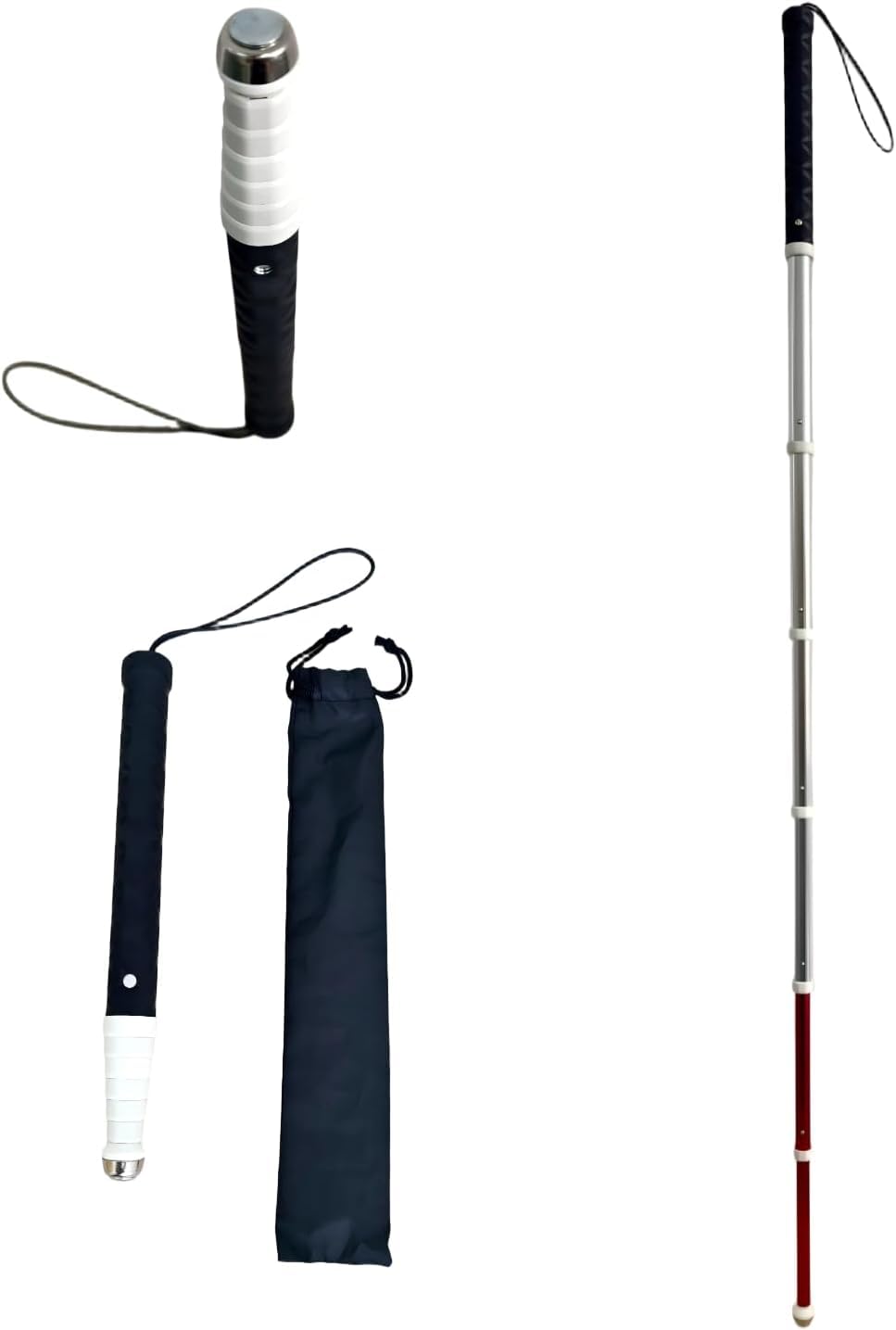
A telescopic cane that collapses with one button — built to live in a travel bag, not on a long walk.
The 33-inch extended length is short compared to the 53-inch standard canes here, so this is not a full-length daily cane. The maker is clear on that — the listing states it is not a primary mobility cane or a trekking pole. It is built for light-duty support, short walks, travel, and an emergency backup.
What it does well is pack down. A single button retracts it, and the telescopic design clicks into a secure lock as you extend. The non-slip handle soaks up sweat on a walk, and the fixed alloy tip gives feedback for probing and identification. A wrist strap and storage pouch come included, which is exactly the kit you want in a go-bag or a glove compartment.
Build quality earns positive notes, while durability runs mixed — several describe it as sturdy but expect occasional use, not daily hard work. Size it to your measurement: a 33-inch cane is not the same reach as a 53-inch, and the maker’s stated maximum height guidance tops out higher than the extended length. Buy it as a backup, and it does the job.
What it is built for: travel, commuting, and backup duty — retract it, stow it, forget it until you need it.
What it is not: a primary daily cane for full-length use, and the maker says so plainly.
Pick this if: you need a foldaway travel cane that lives in a bag without bulk.
Pick a different length if: your sternum-to-floor measurement calls for a full 53-inch cane.
7. VSONE 6-Section Blind Cane

The longest cane here at 61 inches — built for walkers a standard 53 won’t reach.
Most canes on this page land at 53 inches. This one goes to 61 inches, which suits a taller adult who would otherwise have to lean on a short cane. That extra reach matters: it puts the tip further ahead, giving you more warning before your foot meets a curb.
It folds into 6 sections for a shorter collapsed bundle, and the double elastic cord assembly adds security in case one cord gives. The handle is a firm rubber grip, which is easier on sweaty hands than a wooden grip. The tip is a hook-style rolling tip held by the elastic cord, so it rolls over cracks rather than snagging. White and red reflective tape covers the shaft for night walks.
The build is aluminum, and it is a fixed-length cane, so there is no adjustment to fiddle with. If your measurement is long, this is one of the few on the list that will actually fit you without a lean. For a tall user who wants a simple folding cane with a rolling tip, it is an easy call.
Best for: taller adults whose sternum-to-floor measurement tops a standard 53-inch cane.
Not for: anyone who wants one adjustable cane to fit a shorter user as well — this length is fixed.
8. Tavkomco Telescopic Blind Cane

Titanium alloy and a 30cm stow size make this the outdoors cane on the list.
The material is the story — a titanium alloy shaft at 1.5 pounds, which is sturdier and more corrosion-resistant than plain aluminum. It runs 54.3 inches (138 centimeters), landing in standard adult range. When you are done, it retracts to a compact 30cm, or 11.8 inches, so it tucks into a backpack or travel bag with room to spare.
The telescopic design lets you dial in the height you like, and each section carries a safety locking hole. The finish on those locking holes is smooth, so there are no burrs to catch your hand. Red reflective film runs across the connections and the bottom two sections, which reflects light after dark so both pedestrians and vehicles can see you. It ships in three package styles: A is the cane and storage bag, B adds one extra tip, and C adds two.
It suits outdoor use — hiking, travel, montaineering, and similar activities. The one caution is weight: at 1.5 pounds it is the heaviest here, and a heavier cane takes more wrist work on a long walk. If you want a rugged cane for trail use rather than a featherweight for city sidewalks, this one fits.
What makes it outdoors-ready
- Titanium alloy shaft for durable outdoor use
- Retracts to a compact 30cm for a backpack
- Safety locking holes on every section
- Red reflective film on the connections and bottom sections
- Three package options, including extra tips
What to weigh first
- 1.5 pounds is the heaviest cane here, so long walks take more wrist effort
- Telescopic sections can loosen over time
Best for: trail walkers and travelers who need a rugged, retractable cane for uneven ground.
Think twice if: a light cane matters most — the titanium build is sturdy but not featherweight.
9. Ambutech NO-JAB Cane

A handle that recoils five inches on impact — built to stop the sharp jab up your arm.
The defining feature is the shock-absorbing handle, which recoils about five inches when it strikes a solid object. That recoil absorbs the impact and cuts the jabs that travel up to the wrist and shoulder on a long walk. The 54-inch shaft is graphite, which the maker says is stronger and lighter than aluminum while giving better tactile feedback through the shaft.
The grip is a genuine sheepskin leather handle, 10.5 inches long with perforated vent holes to cut down sweaty palms. The shaft is white reflective (not silver) with a red reflective bottom section, so night visibility is strong. The tip is a rolling marshmallow hook style, and the double center cord has had its strength and durability improved by the maker.
The trade-off is price and specialization — this is a mobility cane, and the maker warns in plain terms not to use it as a support cane or crutch. It also assumes you have some sense of how to sweep a cane; the maker suggests training from a certified orientation and mobility instructor. Buy this one if jabs and wrist fatigue are your daily problem — the higher price reflects the graphite shaft and that recoil handle.
The recoil payoff: five inches of give on impact is the difference between a cane that rides with you and one that fights you.
Tactile bonus: graphite pushes feel back up the shaft, so texture underfoot lands in your hand more clearly than aluminum.
Best fit: daily long-distance users whose wrist and arm take a beating from constant contact.
Not for support: the maker is explicit — a mobility cane, never a replacement for a crutch.
Know the Specs
Extended Length and Your Measurement
The number that matters most is the extended length, because it sets how far the tip reaches ahead of you. A 53-inch cane suits a typical adult, while 61 inches fits a taller walker and 31.5 to 35.4 inches suits a shorter one. Measure from your sternum straight down to the floor and match it. Too short a cane and you lean; too tall a cane and the tip rides the ground at an awkward angle. Several canes list centimeters instead of inches, so check both — 135 centimeters is 53.1 inches.
Tip Type: Rolling vs Fixed
A rolling marshmallow tip is a rounded ball that rotates as you sweep, so it glides over cracks and grates instead of catching. A fixed alloy tip is sharper and stays still, giving more texture feedback but catching easily on rough ground. Neither is safer by default — a rolling tip suits faster walking on pavement, a fixed tip suits slow probing and reading surface texture. Match the tip to where you walk most.
Fold Sections and the Elastic Cord
The number of fold sections decides how small the cane gets. Four sections make a longer bundle that is quick to set up; seven sections pack shorter and are easier to stash. The elastic cord that runs through the sections is the wear point. A double elastic cord assembly adds a second cord as backup, and a hook-style tip held by the cord keeps the tip from being lost when it is set down.
Shaft Material and Wrist Fatigue
Aluminum is the common choice and keeps weight low. Graphite and titanium alloy are stronger and lighter than aluminum in the maker’s view, and graphite pushes more tactile feedback up the shaft. Weight runs from 0.24 kg to 1.5 pounds across this list, and that mass shows up at the end of a long walk — a light cane with a rolling tip is easier on the wrist than a heavy shaft with a rigid tip.
Common Questions
How do I measure myself for a blind cane length?
What is the difference between a marshmallow tip and a fixed tip?
Can a folding blind cane be used as a support cane?
How many fold sections should I look for?
Why does a blind cane have reflective tape?
Is a telescopic cane better than a folding cane?
How long does the elastic cord inside a folding cane last?
Does a graphite shaft feel different from an aluminum shaft?
Can I replace the tip on these canes?
Should I get training before using a new blind cane?
The Bottom Line
For most people, the walking stick for the visually impaired choice is the MonMed Medical Folding Blind Cane, because its 53-inch length, 4-section fold, and 360-degree rolling tip cover the daily sensing job at a fair price. If you walk after dark, the Watris Veiyi at 0.24 kg is the light one that reflects headlights. And if wrist pain is your daily problem, the Ambutech NO-JAB recoils five inches on impact and is the one worth stepping up for. One honest nudge — with 4.5+ stars and a graphite shaft, the Ambutech earns its premium spot, but only if jabs are what you feel every day.
How we choose
We do not accept paid placement. Every pick is matched to a real buyer and a real use-case; we do not hands-on test units.
Sources
Specifications: manufacturer listings and product documentation. Review insights: verified customer reviews, as of November 2026. Pricing: not shown on this page (it changes often); check the current price via the retailer link.
As an Amazon Associate, Tactical Gear Guy earns from qualifying purchases. This does not affect which products we feature.