Specs are compiled from manufacturer listings and verified buyer reviews and can change over time — please confirm the key details on the product page before buying.
Any tripod can hold a camera still for a fraction of a second. Almost none can hold it still for thirty seconds while a shutter stays open and the wind pushes at your lens. That is the exact problem this list solves — a long exposure tripod has to fight vibration, settle instantly, and stay put through a bulb exposure without creeping an inch, and most cheap legs fail that test the moment you touch the shutter release.
This guide is built by comparing the manufacturers’ published specifications and the patterns across verified customer reviews, so you get each pick’s real strengths and trade-offs instead of marketing spin.
You will see which legs hold a heavy rig at full height, which heads pan without a jolt, and which models give up steadiness for travel weight. Every pick below earns its place on load capacity, lock design, and head damping — the three things that decide whether your night sky shot comes out sharp. These are the picks worth trusting as the tripod for long exposure.
Top Picks


How To Choose The Best Tripod for Long Exposure
A long exposure is unforgiving. The camera stays open long enough for a soft breeze, a footstep, or a sagging center column to smear the frame. So the tripod you choose for bulb mode is not the same one you would grab for a quick daytime snapshot — steadiness comes before everything else.
Load capacity is a margin, not a maximum
Load capacity is the weight a tripod is built to hold. You want headroom above your actual rig, because the closer you sit to the limit, the more the legs flex. A body with a long telephoto lens can push toward the top of a lighter tripod’s range, while a wider margin keeps the whole platform rigid during a slow shutter.
The head does half the stabilizing work
A fluid head is a pan-and-tilt mount filled with a damping system that resists sudden movement. That damping is what lets you start a pan with zero jolt and hold a frame steady while you count off seconds. A ball head is smaller and faster to aim, but for video-style pans the fluid head gives you smoother control.
Leg locks decide how fast you set up in the dark
Twist locks rotate to clamp each leg section, while flip locks snap shut with a lever. Both are fine — what matters is that the lock clamps hard and holds under the weight of your gear. If you shoot at night, you want to adjust height by feel without hunting for a latch.
Carbon fiber versus aluminum
Carbon fiber tubes are lighter and carry a reputation for soaking up vibration, while aluminum is heavier and more affordable. Both hold a rig steady when sized correctly — the trade-off is how much weight you carry to your shooting spot and how fast the legs settle after you nudge them.
Side-by-Side Comparison
| Model | Best For | Max Load | Max Height | Head Type | Amazon |
|---|---|---|---|---|---|
| NEEWER 74″ TP74★ Best Overall | All-round video and stills | 17.6 lbs / 8kg | 74 in (187 cm) | Fluid pan head | Amazon |
| Victiv 72″ Heavy DutyBudget Pick | Budget video work | Not listed | 72 in | Fluid pan head | Amazon |
| K&F CONCEPT 64″ CarbonBest for Travel | Travel and hiking | 17.6 lbs | 64 in | Ball head | Amazon |
| K&F CONCEPT 94″ | Tall standing shots | 22.04 lbs / 10kg | 94 in | Ball head | Amazon |
| SmallRig AD-01 | Smooth video pans | 17 lbs / 8kg | 73 in (186 cm) | Fluid head | Amazon |
| SIRUI Traveler 7C | Carry-on travel rigs | 17.6 lbs / 8kg | 65.55 in | Ball head | Amazon |
| SIRUI AM-324 | Heavy gear, low angles | 44 lbs / 20kg | 57 in (145 cm) | Head not included | Amazon |
| SmallRig AD-100 FreeBlazer | Fast one-handed setup | 22 lbs / 10kg | 78 in (197 cm) | Fluid head | Amazon |
| Benro Mach3 TMA38CL | Maximum load headroom | 35.3 lbs | 69.7 in | Head not included | Amazon |
Detailed Reviews
1. NEEWER 74″ Video Tripod with Fluid Head, TP74
Our pick — 4.5+★ from 600+ verified ratings; the strongest balance of quality and price.
The do-it-all workhorse that keeps a heavy rig dead still while you hold the shutter open
If you shoot landscapes, weddings, and long-exposure night scenes from the same tripod, the TP74 is the one to buy. Its double tandem aluminum alloy legs hold a max load of 17.6lb/8kg — plenty of margin for a full-frame body with a wide lens, so the legs stay rigid instead of flexing while the shutter is open. It holds 4.5+ stars across 600+ owners, and the reviews back up the build.
What wins people over is the build quality, and right behind it the sturdiness — the two things a slow shutter needs most. The fluid drag pan head has a friction damping and balancing system, so a pan starts without a jolt and holds its line. It supports 360° rotation and -75°/+90° tilt, and the ø3″ (75mm) bowl base carries a 360° scale for panoramic frames. A bubble level lets you confirm the platform is straight by eye, so you are not squinting at your screen to check the horizon mid-setup.
Setup is quick. The quick release plate locks in about a second, and the fluid head has two QR modes — one compatible with DJI RS2/RS3/RS3 PRO gimbals and one with Manfrotto 501PL/504PL plates — so you can move a camera between gimbal and tripod without swapping hardware. The 1/4″ and 3/8″ screws on top fit most DSLRs, mirrorless bodies, camcorders, and telescopes. There is even a 1/4″ threaded hole for a monitor, mic, or video light.
Where it delivers
- 17.6lb/8kg load holds a full-frame or cinema rig steady
- Fluid drag damping gives jolt-free pans and tilts
- Dual QR modes work with DJI gimbals and Manfrotto plates
- Bubble level plus 360° bowl scale for straight horizons
What to weigh
- At 10.9 pounds it is a shoulder-load for long hikes
- Folds to 36 inches, so it rides across a pack, not inside it
Buy this one if: you want one sturdy, well-damped tripod that handles video pans and long stills without a second purchase.
Think twice if: you hike far from the car — the 10.9-pound body is the price of that stability.
2. Victiv Video Tripod 72″
A budget-first video tripod that converts to a monopod when you want one leg of support
For a first serious fluid-head tripod, the Victiv stretches 72 inches and adds a trick the pricier picks skip: it converts to a monopod by combining the center column with a detachable leg. That matters for long-lens work where you carry your own support instead of setting down a stance. The professional fluid head offers 360° panning and +90°/-70° tilt, and the aluminum frame carries a weight hook so you can hang a bag to settle the platform.
Owners tend to call the build excellent and the setup easy, and the flip locks help — height adjusts to full 72 inches in seconds without hunting for a twist collar. The quick-release plate uses standard 1/4″ and 3/8″ screws, so most DSLRs, camcorders, and cinema bodies mount directly. It is also noticeably lighter than the NEEWER above at 2.15 kg.
The honest catch: steadiness and weight draw mixed reviews. Some owners find it impressively stable, others report a wobble — and a few find it heavier than expected. Hang a weight on the hook, keep the center column low, and it behaves; treat the extreme top of the height range as the place where flex shows up. For a deliberate, low-cost setup this remains a strong starting point.
The value math: 72 inches of aluminum, a fluid head, and monopod conversion make this the entry-level choice — as long as you hang a stabilizing weight and shoot below full extension.
The trade-off to know: stability is the recurring split. Size it as a deliberate, weight-the-hook tripod, not a grab-and-go street pod.
Reach for this if: you are building your first fluid-head kit and want height plus monopod flexibility without overspending.
Look elsewhere if: you need dead-solid performance at full 72-inch extension in gusty conditions.
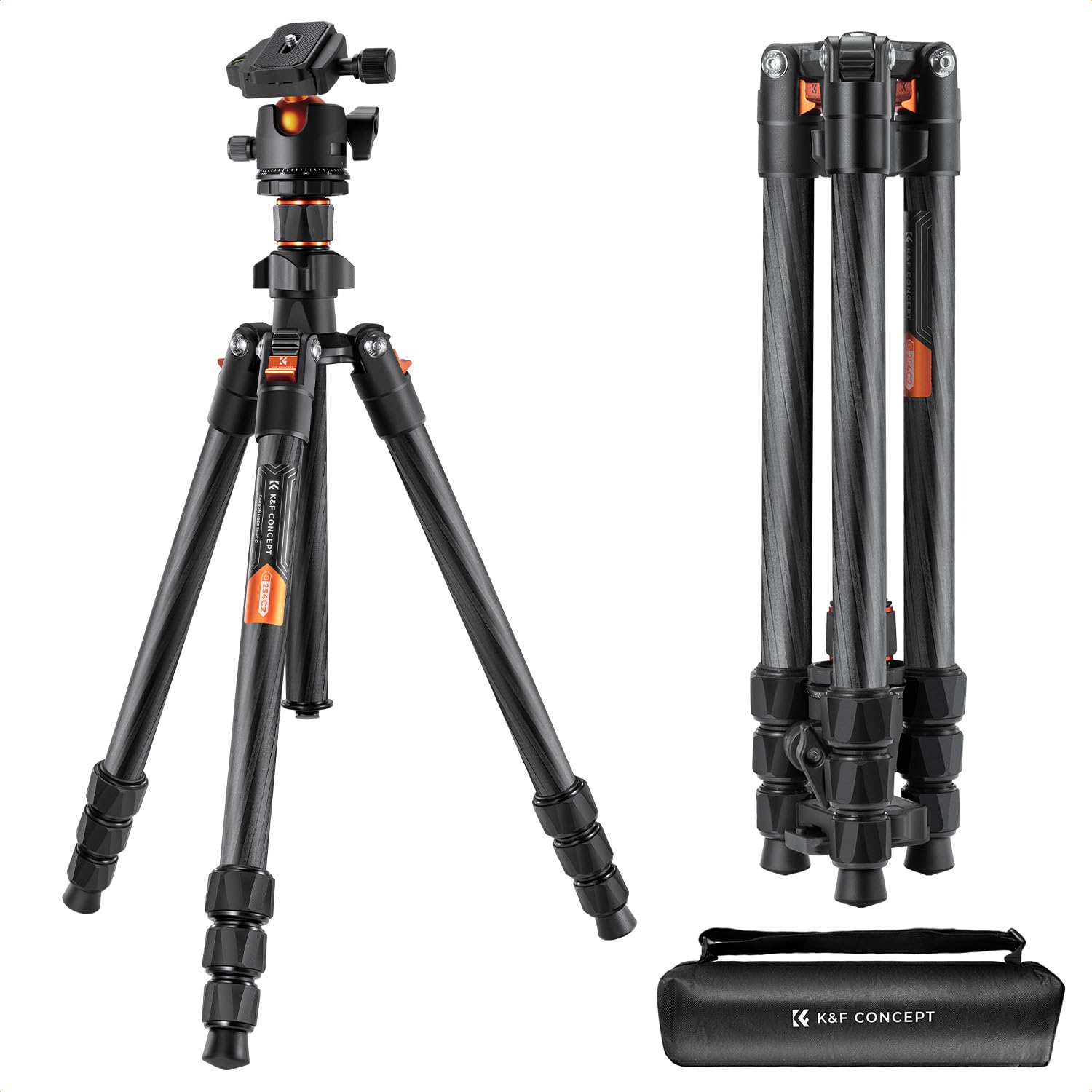
3. K&F CONCEPT 64″ Carbon Fiber Camera Tripod
A carbon-fiber travel pod light enough to carry all day, still rated for a heavy body
Hikers and backpackers need a tripod that disappears into a bag but still locks down for a slow sky shot. This K&F folds to 16.3 inches and weighs 1.4 kg (1.14 kg in the comparison spec) — light enough to strap to a pack and forget. The four-section legs extend from 21.2” to 64”, and the 17.6lbs capacity means a full-frame body and lens still sit well under the ceiling.
For stability in rough weather, the carbon fiber tube and reinforced synthetic nylon connectors hold up, and owners single out the lightweight build first — the thing that gets talked up most — with sturdiness not far behind. The 36mm ball head rotates a full 360°, and the 360-degree panning dial lets you fine-tune a landscape frame under the night sky. The center column inverts to bring the camera close to the ground for a low-angle long exposure, and the standard 1/4 inch thread fits most Arca-Swiss plates and camera bodies.
Read the numbers against the two K&F models: this one tops out at 64 inches versus the 94-inch model, and holds 17.6 lbs versus that model’s 22.04 lbs. The trade-off a buyer should know is the material itself — a few find the carbon build less rigid than aluminum when pushed hard. For hiking with a light-to-mid rig, the carry weight wins over that trade.
Best for: travelers who hike to a location and shoot from a light-to-mid rig.
Worth noting: 64 inches of height and 17.6 lbs are honest limits — step up to the taller K&F if you need max reach.
4. K&F CONCEPT 94 Inch Aluminum Tripod

The tallest pick here — stand fully upright and still frame the shot above the crowd
When you need the camera above a hedge, a railing, or a crowd of heads, this is the leg set that gets you there. The 94-inch max height beats the 64-inch K&F above by a wide margin, and the 22.04 lbs (10kg) load tops that model’s 17.6 lbs — a genuinely heavier-rated platform. The 25mm aluminum alloy tube and the 28mm metal ball head carry the load, and the transverse center column swings from 0 to 180 degrees for panorama work.
Owners praise the quality most, and the value for money lands right after. The spiral locking knobs let you set working height in seconds, and with the column removed it reaches 67.7 inches — plenty for standing eye-level. It also converts to a detachable monopod or a walking stick, which is a bonus for a hike-in shoot.
Honest caveats do exist here. Stability splits: some find it very solid, others say the ball head does not tighten enough, and durability shows up as a genuine concern on this model. When you shoot near the top of a 94-inch reach, keep the load light and the tripod on firm ground. For tall framing where no other pick here reaches, it does the job — with a reminder to check the head’s grip before every long frame.
Why it earns a spot: 94 inches of height and a 22.04 lbs rating are the tallest, heaviest-rated numbers in this K&F group.
Where to be careful: the ball-head lock is the recurring weak point, so tighten it firmly and keep the load modest at full extension.
Choose this when: standing height matters more than any other spec.
Pass on it if: you shoot heavy glass and want a head that clamps without question — go with a fluid-head pick instead.
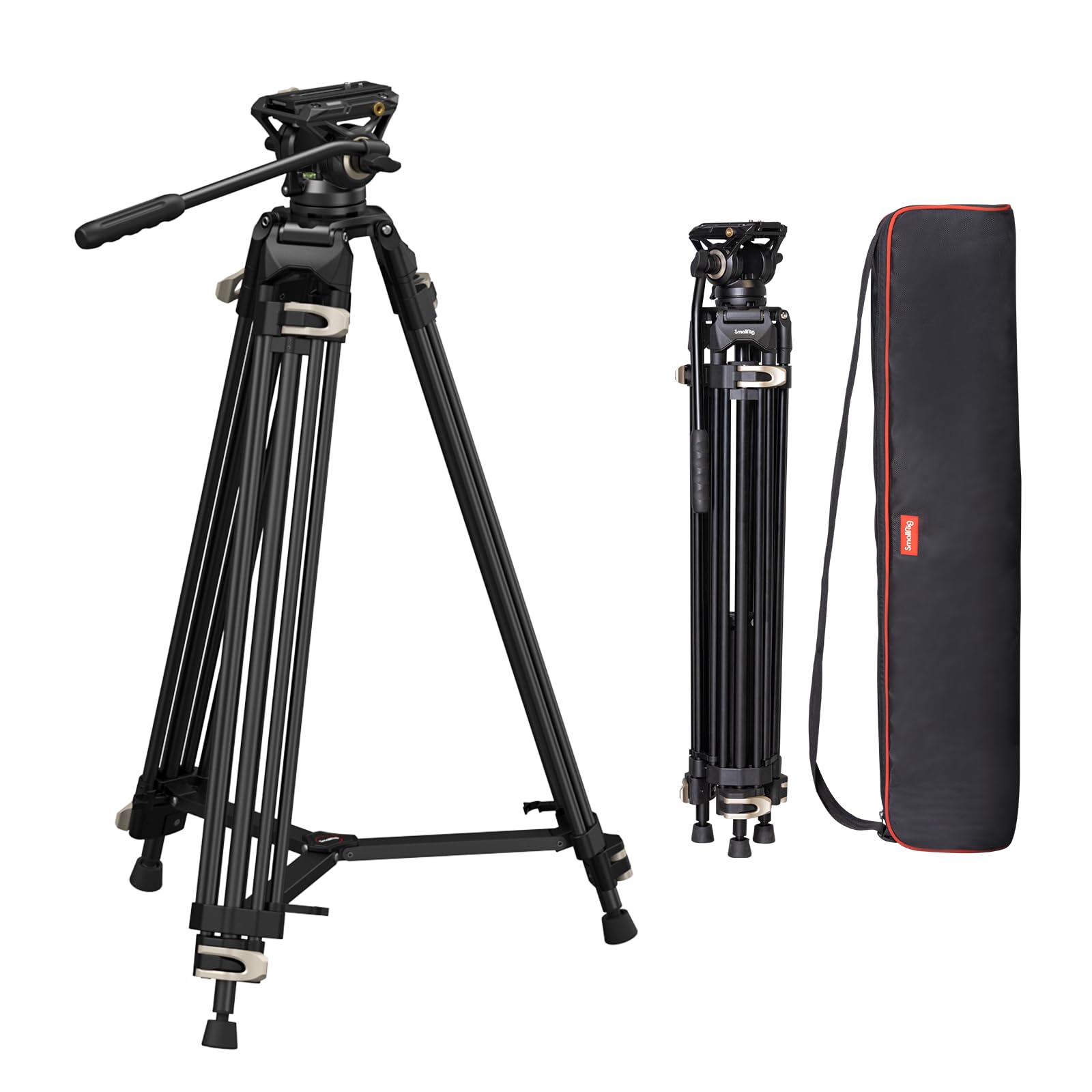
5. SmallRig 73.2″ Heavy Duty Video Tripod with Fluid Head AD-01
A video-first fluid head with a side-button release that keeps your hands free
Videographers who bounce between a gimbal and a tripod will feel at home here. The AD-01’s fluid head has dual-mode quick-release plate compatibility — one mode for DJI RS 2/RS3/RS3 PRO — so you switch plates without carrying a separate mount. The built-in damping and balancing system handles 360° horizontal and +90°/-60° vertical movement, and the side-pressed quick release open up with a push of the side button so a camera comes off fast.
The double-row aluminum tubes and 75mm bowl bottom give a rigid platform. Height adjusts from 85 to 186cm/33-73in, and the max load is 8KG/17LBS — right for a full-frame body or a compact cinema rig. Owners call it one of the best entry-level options and single out the build quality and the value. It also takes a carrying handle and a storage handbag, so moving between setups is easy.
The honest limit: the professional head is a big draw, but adjustability and height draw mixed notes — some want a lower low point than the 85cm minimum. Durability shows up as a recurring gripe, so treat the lock lugs with care and do not overload the head. Sized for the average two-camera video shooter, it is a strong mid-range pick.
Standout strengths
- Dual-mode plate fits DJI RS gimbals and standard plates
- Side-press release for fast camera changes
- 75mm bowl and double-row tubes for a rigid rig
- 33-73in working height with a built-in bubble level
Honest limits
- Minimum height of 85cm is high for low-angle work
- Durability is the recurring note — care for the lock hardware
Reach for this if: you split your time between gimbal and tripod shooting and want one mount to rule both.
skip it if: you need to drop the camera near the ground — that 85cm floor is the ceiling on low shots.
6. SIRUI Traveler 7C Carbon Fiber Tripod with E-10 Ball Head

Carbon legs and a panorama ball head built for the tripod that travels everywhere with you
Air travel changes what a long-exposure tripod can weigh. The Traveler 7C folds to 18.9 inches and weighs 3.46lbs/1.57kg — light enough to live in a carry-on bag. The four-section carbon fiber legs adjust from 18.9″ to 65.55″, and the 17.6 lbs/8kg capacity holds a DSLR and lens comfortably. A center column hook lets you hang a weighted bag for extra heft on windy nights.
The standout is the ball head. The E-10 head has two independent control knobs and rotates 360°, so you can level and aim a panoramic night frame without fighting the lock. Owners call out the quick-acting twist-locks and the reliability with heavy scopes. It converts to a full-size monopod by screwing the center column to the removable leg, and the invertible column brings the camera low for macro work.
What a buyer should know: the mounting system draws mixed feedback. Some find the quick-release plate very secure; a few want it tighter. Keep the load within 17.6 lbs and tighten the plate with intent, and the platform stays put. Sized for a carry-on kit and a light-to-mid rig, this is the travel-first pick.
Choose it if: your shooting day starts with a bag check and ends on a mountain — the 3.46-pound body carries with you.
pass on it if: you shoot a very heavy body all night — the mixed plate feedback says choose a fluid-head pick instead.
7. SIRUI 57″ Carbon Fiber Tripod, Max Load 20KG, AM-324

A no-center-column carbon pod that carries 44 lbs and drops to 3.1 inches
For a long-lens or medium-format rig, load capacity is the whole game. The AM-324 is rated to 44 lbs/20kg while weighing only 3lbs, which is the widest margin on this list by a country mile — a heavy body and a big lens sit easily under the ceiling. The 4-section legs use 10x carbon fiber tubes with a 32mm max diameter, and the height runs from 3.1 inches at the bottom to 57 inches at the top.
The head is a thoughtful omission: there is no center column, so the tripod gets lower and more compact, and the user picks the head that suits their glass. The blue twist locks carry six anti-slip rubber pads and need only a half turn to set. Semi-automatic flip locks give three leg angles (22, 55, and 85 degrees), and exchangeable rubber feet and metal spikes dig into mud, ice, and sand.
What buyers should size up: sturdiness is what owners praise most here, with quality close after. The trade-off is the short 57-inch max height — fine for low and mid shots, tight for a standing eye-level frame — and leg stability draws a mixed note. For heavier gear that needs a low, rock-solid base, this is the tool.
The load story: 44 lbs of capacity on a 3.1-inch-to-57-inch frame means heavy glass gets a stable home without a center-column sway point.
Where it stops: 57 inches is the ceiling, so tall standing shots are out. Confirm your head choice before you buy — none is included.
Buy it if: you shoot a heavy rig and want load capacity plus a genuinely low camera position.
Think again if: you need to shoot from standing height — 57 inches is the top of this leg set.
8. SmallRig AD-100 FreeBlazer Carbon Fiber Tripod

Lock two legs with one toggle and get a 78-inch carbon platform up fast
If your shooting day is a scramble from one location to the next, the FreeBlazer’s one-step locking system earns its name — one toggle clamps two leg sections, so you are not chasing each joint one at a time. The carbon fiber legs hold the weight down to 5kg (11 lbs) and the maximum safe load is 10kg (22 lbs). It reaches 78 inches fully extended, which puts the camera above most tripods on this list.
The fluid head is the real draw. Step-less damping lets you pan at whatever speed you want, and the 360° pan with +90°/-60° tilt covers the whole arc. The ⌀75mm detachable bowl head and interchangeable wide and spike feet help you level fast on uneven ground. The 9.1″-14.2″ telescope handle can be swapped for either dominant hand. It also takes dual quick-release plates for DJI RS 2 through RS 4 Pro and for MFT plates, so stabilizer and tripod share one camera.
What a buyer should weigh: owners compare it favorably to Manfrotto on quality and value, and the quick setup gets noticed. The honest limit is the price tier — this is a premium carbon system, and the rig that benefits most is a heavier one where the 22 lb load and one-step locks pay off. For a crew that repositions every few minutes, the one-step locks and 22 lb load earn the premium.
Pick this for: a production crew that repositions constantly and wants one-handed leg locking plus hand-swappable handles.
Look elsewhere if: you shoot a light rig on a budget — the premium carbon build is more tripod than a minimal kit needs.
9. Benro Mach3 9X Carbon Fiber Series 3 Long Tripod, TMA38CL

Nine layers of carbon for a pro rig that wants vibration gone and height to spare
At the top of the shelf sits a tripod built for sustained commercial and landscape work. The TMA38CL uses 9-layer carbon fiber tubing, which the maker ties to strength, light weight, and vibration resistance. It supports 35.3 lbs while weighing only 4.5 lbs, and it extends to 69.7 inches for full-height shooting. The four-section twist-lock legs combine that light carry with serious headroom for a DSLR, mirrorless, or cinema body.
The details show a pro kit: magnesium castings, a removable center column for low shots or macro, and interchangeable rubber and spiked feet for grip on any surface. The leg diameters step from 32.4 down to 21.8mm across the sections — the wide top tube is what keeps a heavy rig from twisting. The standard limited warranty is 3 years, and it extends by 2 more (for a total of 5 years) in applicable regions if you register online. A padded case and tool kit come in the box.
The honest catch: no head is included, so you supply your own and factor that into your rig. Owners are drawn to the sturdiness first, then the look and feel of the build, and the light carry weight for what it holds — one note calls it top-notch. For long-lens professional work where vibration is the enemy, this is the serious-money answer.
Why pros lean on it
- 35.3lb load on a 4.5lb carbon frame
- 9-layer carbon tubes aimed at vibration resistance
- Removable center column and swappable feet for any terrain
- 5-year total warranty when registered online
Know before you buy
- No head included — budget for one separately
- Premium-tier build means a professional-level outlay
Best suit: the long-lens landscape or commercial shooter who already owns a head and wants a light, rigid carbon base.
Size it right: 35.3 lbs of capacity is headroom, not a target — pair it with a head that matches the load.
Know the Specs
Max load capacity
The load rating is the total weight the tripod is built to hold, head and camera together. You want a margin above your actual rig, so a heavier body or a long lens does not push the legs to their limit. A rating stated in pounds and kilograms is the apples-to-apples number to compare across picks.
Leg lock style
Twist locks rotate the collar to clamp a leg section; flip locks snap with a lever. Both hold firm when designed well — the difference is speed and feel. In the dark, a lock that clamps with a half turn or a single toggle saves you fumbling with a rig on your shoulder.
Common Questions
What is the minimum weight rating I need for a long exposure tripod?
Does a ball head or a fluid head matter more for long exposures?
Will the carbon fiber tripods shake less than aluminum ones?
How low can a long exposure tripod get for low-angle shots?
Should I hang a weight on the tripod’s hook for extra stability?
Can I use the same tripod for a gimbal and a camera?
Do I need a center column on a long exposure tripod?
How tall should a tripod be for a standing eye-level shot?
Is a head included with every tripod on this list?
Can a lighter tripod still hold a heavy lens for a timed exposure?
The Bottom Line
tripod for long exposure winner is the NEEWER TP74 because its 17.6lb/8kg load, fluid drag head, and bubble level handle video pans and stills from one platform. If you want carbon travel weight, grab the K&F CONCEPT 64″; for heavy glass that needs a low, rock-solid base, the SIRUI AM-324 and its 44lb rating is the one to reach for. The one honest nudge: at 4.5+ stars across 600+ owners, the NEEWER is where most first-time long-exposure buyers land — and stay.
How we choose
We do not accept paid placement. Every pick is matched to a real buyer and a real use-case; we do not hands-on test units.
Sources
Specifications: manufacturer listings and product documentation. Review insights: verified customer reviews, as of November 2026. Pricing: not shown on this page (it changes often); check the current price via the retailer link.
As an Amazon Associate, Tactical Gear Guy earns from qualifying purchases. This does not affect which products we feature.