Specs are compiled from manufacturer listings and verified buyer reviews and can change over time — please confirm the key details on the product page before buying.
You want a real wood fire that heats a space and cooks a meal, and the three stoves below do exactly that — but only one of them fits how you actually plan to use it. Two of these are portable tent stoves you carry and assemble yourself, and one is a freestanding cabin stove that needs a proper chimney and a permanent spot. Pick the wrong one and you either freeze in a tent or own a stove too heavy to haul out of the garage.
This guide is built by comparing the manufacturers’ published specifications and the patterns across verified customer reviews, so you get each pick’s real strengths and trade-offs instead of marketing spin.
Firebox size, chimney diameter, and total weight are the three numbers that decide which stove works for your shelter. This breakdown covers all three so you can spot the right top ten wood burning stoves for your setup without guessing.
Top Picks

How To Choose The Best Top Ten Wood Burning Stoves
The first question is not which stove is strongest — it is where the stove will live. A stove you carry into a canvas tent needs to fold flat, pack its own chimney inside itself, and weigh little enough to load alone. A stove you bolt down in a cabin can be heavy, permanent, and built to feed a whole room. Those two jobs pull the design in opposite directions, and no single stove wins both.
Match the firebox to the space you are heating
Firebox volume, measured in cubic inches, is the usable space where the wood actually burns. A larger firebox swallows longer logs and holds coals longer between refills. A small firebox heats a small shelter well but forces you to feed it more often. Measure your tent or room first, then choose a firebox that suits it rather than the biggest box you can afford.
Understand chimney diameter and total height
The chimney pipe is what creates draft — the pull of air that feeds the fire and pushes smoke up and out. A wider pipe diameter often moves more air, while a taller chimney stack strengthens that pull. Both stoves here ship with their own pipe sections, so check the diameter before you plan an install, since you want to know how the draft will behave on a cold, windy night.
Weigh the stove against how you move it
Packed weight tells you who can realistically lift the stove into a truck bed or haul it to a campsite. Every portable stove here lists its weight and a folded footprint, and the heavier units reward you with more metal and a bigger oven. If the stove never moves, weight barely matters; if it travels every season, it matters a lot.
Side-by-Side Comparison
| Model | Best For | Firebox | Weight | Chimney Diameter | Amazon |
|---|---|---|---|---|---|
| Winnerwell Nomad Medium★ Best Overall | Tent and shelter heating | 800 cubic inch | 19.4 pounds | 2.5-inch | Amazon |
| M8 Rose Gold Tent Stove | Oven cooking at base camp | 2,100 cubic inch | 50.7 pounds | 2.76-inch | Amazon |
| Ashley Hearth AW1120E-P | Heating a cabin or small home | 1.3 cubic feet | — | 6-inch connector | Amazon |
Detailed Reviews
1. Winnerwell Nomad Medium Tent Stove
Our pick — 4.5+★ from 350+ verified ratings; the strongest balance of quality and price.
The tent stove that packs its own chimney inside its belly and still warms a shelter fast.
It’s the crowd favorite — 4.5+ stars across 300+ owners — because it handles the tent-stove job with tool-free assembly. The 800 cubic inch firebox is small next to the M8 below, but that smaller box is exactly what lets the whole unit weigh 19.4 pounds and collapse into a 15-inch by 8-inch by 8-inch pack. The four legs nest flat under the stove body, the five chimney sections stow inside it, and the side shelves double as a carry handle.
The build is 304 stainless steel, the grade chosen for staying rust-free in wet, cold conditions, and it comes with one spark arrestor and one ash scraper so you are not hunting for extras on the first trip. What wins owners over is the build: the stove feels solid once the legs are down and the pipe sections are locked on. It is rated for canvas tents, teepees, yurts, shacks, and tiny homes, with the maker noting it is a recreational wood stove rather than a residential one.
Set against the M8, this is the model that respects your back: 19.4 pounds versus 50.7 pounds, and 800 cubic inches versus 2,100 cubic inches. The trade-off is no oven, and the 800 cubic inch box needs more frequent log feeding on a long winter night. Budget-minded shoppers also find the cost on the high side for what reads as a small stove, though most accept it once the rust-proof steel and folding design prove themselves. Owner reports put it at roughly 20 minutes to warm a 16ft bell tent.
Where It Delivers
- 19.4 pounds with a 15″ x 8″ x 8″ packed footprint you can lift and load alone.
- 304 stainless steel body that the maker rates as rust- and corrosion-resistant in wet, cold weather.
- Chimney pipe and legs stow inside the stove body, so nothing gets left at camp.
What to Plan Around
- 800 cubic inch firebox needs more frequent refills than the M8’s 2,100 cubic inch box.
- No oven and no stovetop glass window, so cooking is pot-and-pan only.
- Recreational rating only — not built for residential installation.
Reach for this if: you heat a canvas tent, yurt, or shack and want the lightest serious stove you can carry in one trip.
Look elsewhere if: you want to bake bread or roast a chicken over the fire — the M8’s oven is the reason to spend more.
2. M8 Rose Gold Tent Stove with Oven and Base
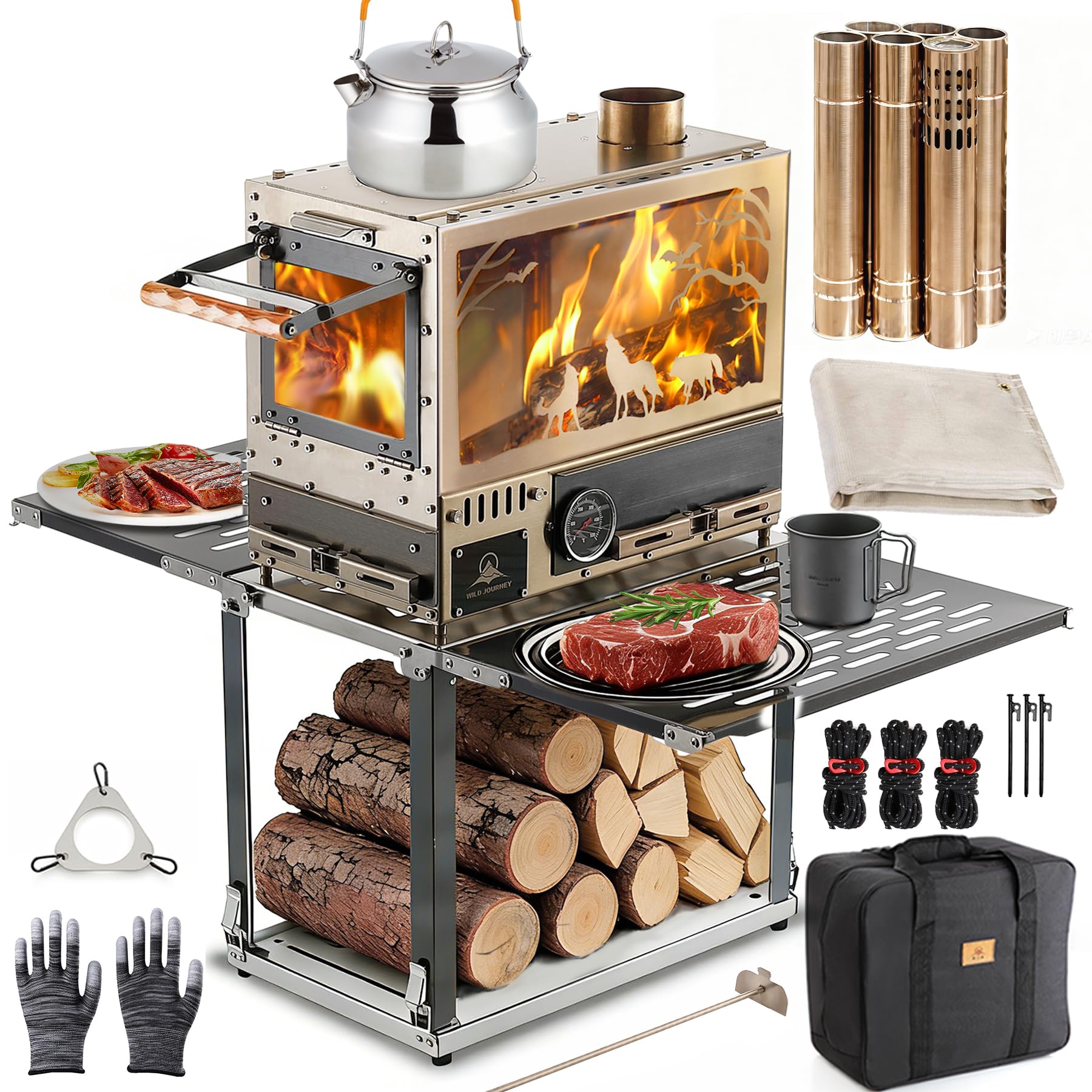
A full outdoor kitchen in one car-camping package, oven and all.
The number that sells this stove is 2,100 cubic inches of firebox — the ability to take logs up to 10 inches long and hold a burn through the night. That box is the direct contrast with the Winnerwell’s 800 cubic inches, and the extra volume is what makes the built-in drawer oven possible. You get two cooking modes in one unit: a drawer-style oven for pizza, chicken, or bread, and a flat stovetop for pots and pans. The maker rates it for spaces up to 300 sq ft.
The metalwork spec is worth reading carefully. The top plate is 4.8mm thickened stainless steel and the stove body is 1.8mm, both grade 304, reinforced with rivets against smoke leakage and deformation. The six-section chimney totals a 104-inch height and uses a wider 2.76-inch diameter than the Winnerwell’s 2.5-inch, a size the maker credits with better airflow. A built-in damper gives you direct control over burn rate, and the twist-to-lock pipe sections need no tools to assemble.
The catch is weight and setup effort. At 50.7 pounds versus 19.4 pounds for the Winnerwell, this is not a one-trip carry for most people — it reads as a truck-and-base-camp stove. But the foldable base improve it to working height, the two side panels hold utensils or firewood, and the chimney and accessories pack down inside the firebox. A pull-out ash drawer and the included ash rake mean cleanup is quick. It arrives with fireproof gloves, a fireproof mat, and a nylon storage bag, so you are not buying extras separately.
What the package buys: A 2,100 cubic inch firebox with a real oven, a foldable base, six chimney sections, a damper, a spark guard, a chimney stabilization kit, two side panels, and a glass window — a complete outdoor kitchen rather than a bare heater.
The honest trade: You pay for that oven in pounds, and at 50.7 pounds the base folds semi-automatically to make storage easier but the lift is real. The manufacturer lists it as dual-fuel compatible for wood and pellets.
Pick this one for: base camps, overlanding rigs, and backyard setups where you want to bake as well as stay warm.
Think twice about: solo backpacking trips — this is a two-person lift, not a one-arm carry.
3. Ashley Hearth AW1120E-P 1,200 sqft Wood Stove

The only stove here that heats a whole home and works when the power doesn’t.
This one is a different animal from the two tent stoves. It generates up to 68,000 BTUs of heat and is rated to warm spaces up to 1,200 square feet, with a 1.3 cubic feet firebox that takes logs up to 18 inches long. That log length is the number that separates a home stove from a camp stove — you cut and feed long lengths instead of short chunks. It runs on no electricity at all, which is the point during a grid outage in a cabin.
For a real room, the footprint is compact. It measures 21″ deep by 22″ wide by 29.5″ tall, and you choose between the included adjustable legs or the pedestal base depending on how you want it to sit in the room. The firebrick-lined interior is designed to improve combustion efficiency over the long haul, and the heavy cast iron door has air-washed ceramic glass so you can watch the fire while the glass stays cleaner.
The reviews reflect a well-built stove with some honest heat-output questions. Quality and appearance are the aspects drawing the most positive feedback — owners describe it as well-built and suited to small cabins. The mixed signals land on efficiency and heat output: some owners say it heats the home better than expected, others report insufficient heat and issues with the damper. Treat burn control as the thing to learn first, and pair it with the optional 100 CFM circulator blower if you want help pushing heat into the room. The unit meets EPA guidelines for burning cordwood and is approved for mobile homes when you install the 4FAK fresh air intake kit.
The Case for It
- 68,000 BTUs for spaces up to 1,200 square feet — cabin-scale heat, not tent-scale.
- Runs entirely without electricity, so a power outage doesn’t stop the warmth.
- Firebrick lining and a cast iron door with air-washed ceramic glass that stays clearer.
- Adjustable legs or pedestal base included, so you pick the look for the room.
What to Line Up First
- Needs a standard 6-inch chimney connector and chimney system, which is not included.
- Ships by LTL freight and requires a valid phone number for delivery.
- Heat output and damper behavior draw mixed feedback, so managing the burn takes practice.
Best for: a cabin, tiny home, or off-grid building where you need year-round heat and a permanent install.
Not for: anyone who wants to pack the stove into a vehicle — this is a bolt-down stove that needs a full chimney run.
Know the Specs
Firebox Volume and Log Length
Firebox volume is the measured space inside the stove where wood burns. A bigger box accepts longer logs and holds coals longer between refills. The tent stoves here list their box in cubic inches, while the Ashley lists it in cubic feet plus a maximum log length. In plain terms, a long log length means fewer trips to the woodpile, and a big box means fewer times you open the door on a cold night.
Chimney Diameter and Draft
The chimney pipe carries smoke out and pulls fresh air into the fire. That pulling effect is draft. A wider pipe diameter can move more air, and a taller stack strengthens the pull. The stoves here range from a 2.5-inch pipe on the Winnerwell to a 2.76-inch pipe on the M8, while the Ashley uses a standard 6-inch connector for a permanent flue. Match the pipe to the stove the maker specifies and never improvise the size.
BTU Output and Square-Footage Rating
BTU, or British thermal unit, is a measure of heat energy. The Ashley’s 68,000 BTUs and 1,200 square foot rating describe a stove meant to warm a whole building. Portable tent stoves list their coverage in smaller terms, since a canvas shelter loses heat differently than a house. Use the maker’s square-footage figure as your starting size, not your target.
Common Questions
Can I use a tent stove like the Winnerwell inside a house?
How big a tent will the Winnerwell Nomad Medium heat?
Does the M8 stove really bake, or is the oven just a warming drawer?
What chimney does the Ashley Hearth AW1120E-P need?
Can any of these stoves run without electricity?
Why does chimney pipe diameter vary between these stoves?
Is the M8 too heavy to take camping?
Do these stoves come with everything needed to set them up?
Which stove is easier to clean out after a burn?
Can I add a blower to push heat into a room?
The Bottom Line
For most campers and tent owners, the top ten wood burning stoves winner is the Winnerwell Nomad Medium because it packs its own chimney inside an 800 cubic inch body at 19.4 pounds and stays rust-free in wet weather. If you want to bake bread and roast a chicken at base camp, grab the M8 Rose Gold Tent Stove — its 2,100 cubic inch firebox and drawer oven make it a full outdoor kitchen. And for heating a cabin through a power outage, the Ashley Hearth AW1120E-P is the one to reach for, with 68,000 BTUs and a 1,200 square foot rating that no tent stove here can touch.
How we choose
We do not accept paid placement. Every pick is matched to a real buyer and a real use-case; we do not hands-on test units.
Sources
Specifications: manufacturer listings and product documentation. Review insights: verified customer reviews, as of November 2026. Pricing: not shown on this page (it changes often); check the current price via the retailer link.
As an Amazon Associate, Tactical Gear Guy earns from qualifying purchases. This does not affect which products we feature.