Specs are compiled from manufacturer listings and verified buyer reviews and can change over time — please confirm the key details on the product page before buying.
Most people buy a treadmill by the console and regret it by the third month. What actually decides whether you keep running is the deck under your feet — its length, its width, and the motor behind it. This guide sorts the real treadmill types apart: folding home decks, high-incline trainers, app-driven machines, and commercial-grade rigs built for marathon mileage.
This guide is built by comparing the manufacturers’ published specifications and the patterns across verified customer reviews, so you get each pick’s real strengths and trade-offs instead of marketing spin.
You will see belt sizes in inches, motor ratings in horsepower, and incline in percent, each explained in plain terms so you can match a machine to your stride. Below is a full breakdown of the types of treadmills worth your floor space.
Top Picks


How To Choose The Best Types of Treadmills
The treadmill type you pick should follow from two facts about you: how fast you plan to go, and how much floor you can give up. A walker at 3 mph and a runner holding 8 mph are shopping in two different categories, even though both machines look similar in a photo.
Match deck length to your stride, not to the room
A running deck is measured by length and width in inches. Short decks around 42.5 inches suit walking and light jogging. Longer decks at 55, 58, 60 and 62 inches let a tall runner land and push off without clipping the front or back. If you are over six feet and plan to run, favor the longer numbers.
Read motor horsepower as a durability figure
Horsepower (hp) describes the drive motor that spins the belt. A 2.5 hp or 2.6 hp motor handles steady walking and jogging. A 3.0 hp to 4.0 hp motor holds speed better under a heavier runner and during fast interval changes. Heavier riders should lean toward the higher numbers.
Treat incline percentages as a training dial
Incline raises the front of the deck so you climb instead of stride flat. Ranges here run from 10% up to 25% auto incline. Higher settings add intensity for walking workouts. Some listings overstate the real feel of their top setting, so keep your expectations calibrated.
Decide on folding versus fixed early
Folding frames let you lift the deck and roll the machine into a corner. Fixed commercial decks do not fold, but they usually carry the larger running surfaces and heavier motors. In a small apartment, folding wins. In a dedicated gym room, a fixed frame is the sturdier long-term choice.
Side-by-Side Comparison
| Model | Best For | Deck Size | Motor | Top Speed | Amazon |
|---|---|---|---|---|---|
| 3G Cardio Pro Runner X★ Best Overall | Runners who need space but fold it away | 20.5″ x 58″ | 3.0 hp | 12 mph | Amazon |
| Ateedge Folding TreadmillBudget Champion | Budget home walker with auto incline | 18″ x 42.5″ | 3 hp | 10 mph | Amazon |
| MERACH Incline TreadmillSteepest Incline | Steep incline training in a small room | 18″ x 47″ | 3.5 hp | 8.7 mph | Amazon |
| NordicTrack T Series | App-guided training on a trusted frame | 18″ x 55″ | 2.6 hp | 10 mph | Amazon |
| ProForm Carbon | iFIT coaching with a folding frame | 18″ x 55″ | 1000 watts | 10 mph | Amazon |
| Renestar Incline Treadmill | Big touchscreen and steep auto incline | 17.7″ x 47.3″ | 3.5 hp | 8.5 mph | Amazon |
| Sunny Health & Fitness | Arrives assembled, no tools needed | 20.1″ x 53.1″ | 2.5 hp | 10 mph | Amazon |
| WalkingPad X Series | Apartment runners who fold and stash | 20″ x 55.1″ | 3.5 hp | 11.5 mph | Amazon |
| Horizon Fitness | Wide-deck interval training | 22″ x 60″ | 3.5 CHP | 12 mph | Amazon |
| Peloton Tread | Class-led cross training at home | 59″ running space | — | — | Amazon |
| 3G Cardio Elite Runner X | Marathon mileage on a fixed deck | 22″ x 62″ | 4.0 hp | 12 mph | Amazon |
Detailed Reviews
1. 3G Cardio Pro Runner X Treadmill
Our pick — 4.5+★ from 150+ verified ratings; the strongest balance of quality and price.
A folding deck that runs like a fixed one, because the deck is genuinely long.
The Pro Runner X solves the one problem that ruins most folding treadmills: the belt is too short to actually run on. Here you get a 20.5-inch by 58-inch running belt, which is the kind of space a full stride needs. Compare that to the Ateedge folding model at 42.5 inches of deck length, and you can see why this one is the folding pick for real runners rather than walkers.
The drive side holds up too. A 3.0 hp motor pushes the 216-pound frame to 12 mph, and it gets there in 18 seconds from a standstill — that fast ramp is exactly what interval and H.I.I.T sessions demand. Compare the top speed to the MERACH at 8.7 mph and the difference matters if you plan to sprint. The 350 lb max user weight means bigger riders are covered.
What wins people over is performance, and it wins by a wide margin over every other quality owners talk about. Sturdiness and quiet running sit right behind it, and assembly lands as a pleasant surprise rather than a chore. The one recurring note is belt slip — a few owners had to re-tension or adjust tracking — so treat the included tool kit as part of setup, not an afterthought. There is no membership required here, which owners appreciate for a machine at this level.
Where it earns its keep
- 20.5″ x 58″ deck is the longest folding surface here alongside the WalkingPad
- 0 to 12 mph in 18 seconds suits fast interval work
- Folds to 40″ L x 35″ W x 65″ H for tight rooms
- 350 lb capacity with an Ortho Flex suspension deck
Where to set expectations
- Belt tracking can need adjustment after delivery
- 216 pounds is heavy to move even on its wheels
- No motion display beyond a 2-inch LED/LCD readout
Go for this if: you want a genuine running deck that still folds away, and you are working in a room where floor space is tight.
Think twice if: you want a big screen built in — the 2-inch display here is a stat readout, not a trainer.
2. Ateedge Treadmills
The lightest machine on the list by a wide margin, and the easiest to tuck behind a door.
That low heft is what makes it an entry-level pick for a spare bedroom or a small apartment, and the folded size of 35.43 by 27.5 by 48.43 inches means it genuinely disappears into a corner.
The shock-absorbing system uses 8 built-in and 6 external cushions to soften footfalls on the short 18-inch by 42.5-inch belt. You get 15 auto-incline options and a speed range of 0.5 to 10 mph, plus 36 preset programs. That incline gives you hill-style walking without needing the deck length of a runner’s machine.
Owners describe a machine that does its job, assembles quickly and runs quietly underfoot. The recurring honest note is size — some feel the belt is snug for fast work, and belt tracking can wander during long walks, so it is a walking and jogging deck first. A 3 hp motor still moves the belt with authority for the footprint.
Best at the entry level: 15% auto incline and 36 preset programs on a 90-pound frame is a lot of function for a first home treadmill.
Where the space shows: 42.5 inches of deck length rewards walkers and light joggers, not tall runners.
Reach for this if: you walk more than you run and want incline variety without sacrificing a corner of a room.
Look elsewhere if: you are over six feet and plan to sprint — you want at least 55 inches of deck.
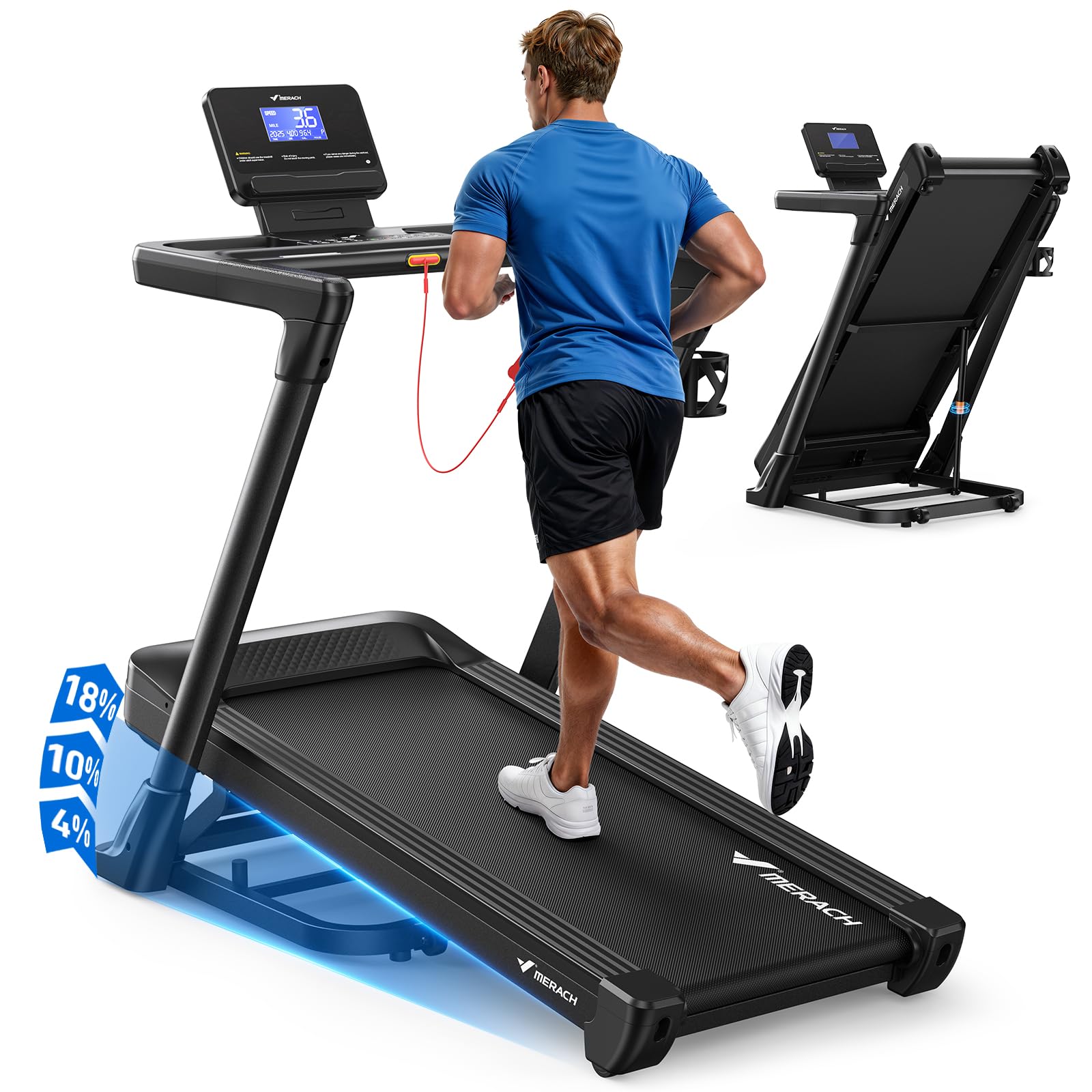
3. MERACH Treadmill with 15/18% Auto Incline
The steepest climb in a compact shell, with a brushless motor rated quieter than a conversation.
Start with the incline, because that is the whole point here. This MERACH reaches 18% auto incline against the Ateedge top of 15% — a little more slope to climb on a walking workout, and it is the ladder that makes walking feel like hiking. The 3.5 hp brushless motor outmuscles the 2.6 hp NordicTrack T Series, and it runs below 45 decibels, so it will not compete with the television in the next room.
The belt runs 18 inches wide and 47 inches long, with a 0.5 to 8.7 mph speed window. That shorter speed ceiling is the trade: this is built for steep, brisk training rather than flat sprinting. A hydraulic folding system gets it set up or stowed in 30 seconds, and the whole machine weighs 65 kg, which is easy to fold, roll and park.
Build quality is the thing owners praise most, with a sizable gap over the next most-mentioned theme of day-to-day function. Owners describe a machine that arrives close to assembled and takes minutes to finish, and the quiet operation keeps coming up too. The cushioned deck absorbs impact, which keeps long walking sessions easier on your knees.
The honest read: steep incline, quiet brushless drive, and a 30-second fold — a strong compact package if flat sprinting is not your goal.
The trade to know: an 8.7 mph ceiling sits below the 10 to 12 mph range of the wider decks.
Pick it when: hill-style walking and interval climbing are your training focus and your room is short on floor.
skip it if you want a machine that sprints above 10 mph.
4. NordicTrack T Series Treadmill
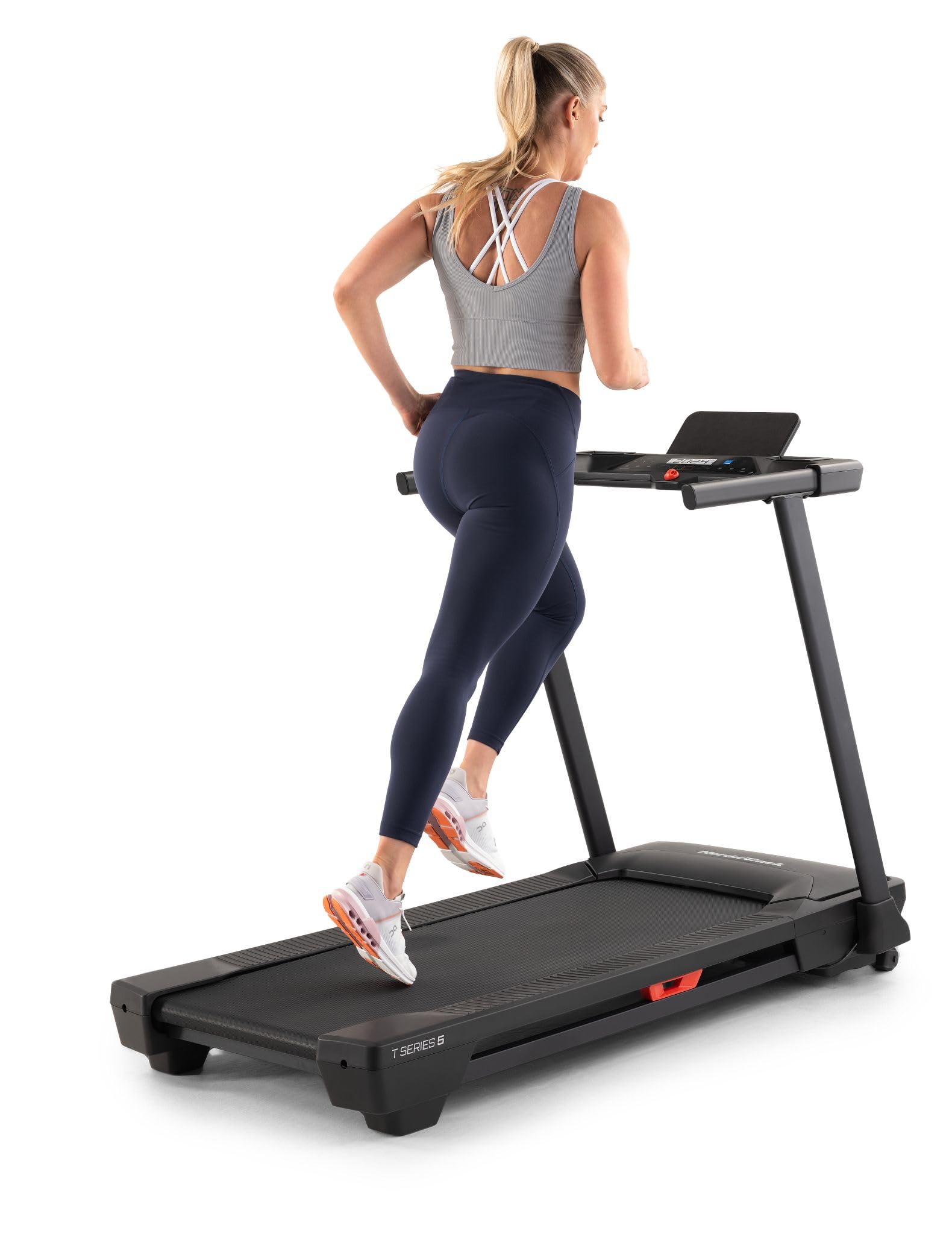
The name most people already trust, with a 55-inch deck and coaching that adjusts the machine for you.
Here is the type that built the home treadmill category: an 18-inch by 55-inch deck, a 2.6 hp motor, and a 5-inch LCD reading your live stats. The 0 to 10 mph speed and 0 to 10% incline cover walking, jogging and steady running. KeyFlex cushioning softens the landing, which is what keeps daily sessions comfortable.
The real draw is iFIT. With a membership, the trainer takes over the machine and adjusts speed and incline to match the terrain on screen, and SmartAdjust scales the workout to your fitness level. You can also sync with Strava, Garmin and Apple. That hands-off coaching is what keeps you coming back to the belt instead of letting it gather dust. The 2.6 hp motor does sit below the 3.5 hp MERACH above, so it favors controlled pacing over hard sprinting.
Quality is the quality owners talk about most, and by a wide margin over the next theme of value. Assembly splits opinion — some put it up solo, others needed a second set of hands. That is normal for a folding deck this size. The frame feels built to stay put, and that is a large part of why this series stays popular.
Why it holds its place
- iFIT trainers auto-adjust speed and incline for you
- 55-inch deck suits a full jogging stride
- Syncs with Strava, Garmin and Apple
- Folds to 68.3 x 30.5 x 48.7 inches
Worth knowing before you buy
- Full coaching features need an iFIT membership
- 2.6 hp motor is modest for heavy sprinters
- Assembly often needs two people
This suits: anyone who wants a trainer in the room without hiring one, on a machine that feels solid underfoot.
Look past it if: you refuse subscriptions and want the coaching-free experience — the console is a plain LCD without one.
5. ProForm Carbon Treadmill

A 55-inch deck with iFIT coaching and a hydraulic foot bar that lands the fold softly.
The Carbon is the sensible middle of the folding-iFIT category. Its 18-inch by 55-inch deck and 5-inch LCD sit right alongside the NordicTrack T Series above, so the decision between them depends on how you want to train. Here the 0 to 10 mph and 0 to 10% incline range covers the full walk-to-run spectrum, and ProShox cushioning takes the sting out of each landing.
The folding mechanism is the standout detail. Fold it, roll it away, and use the hydraulic foot bar for a controlled landing instead of a slam — a small touch that matters if the treadmill lives in a shared room. With iFIT and ActivePulse, a compatible Bluetooth heart rate monitor (sold separately) lets the machine adjust speed and incline to keep you in the right zone.
Owners describe a home machine that goes together in about 90 minutes and runs quietly enough to live with. The incline and speed adjustments do what the console promises, and it handles both a slow walk and a hard run. Just budget for the iFIT membership if you want the auto-adjust side of it, since the coaching needs the subscription.
Strongest trait: the hydraulic fold plus full iFIT control makes it the cleanest daily-use folding deck of the app-driven group.
Setup reality: about 90 minutes of build time — plan an evening, not ten minutes.
Best fit for: iFIT users who want the coaching to drive the belt and want the machine tucked away by morning.
Not the one if: you want a huge console screen — the Carbon keeps a modest 5-inch LCD and leans on your own phone or tablet.
6. Renestar Treadmill for Home with Auto Incline
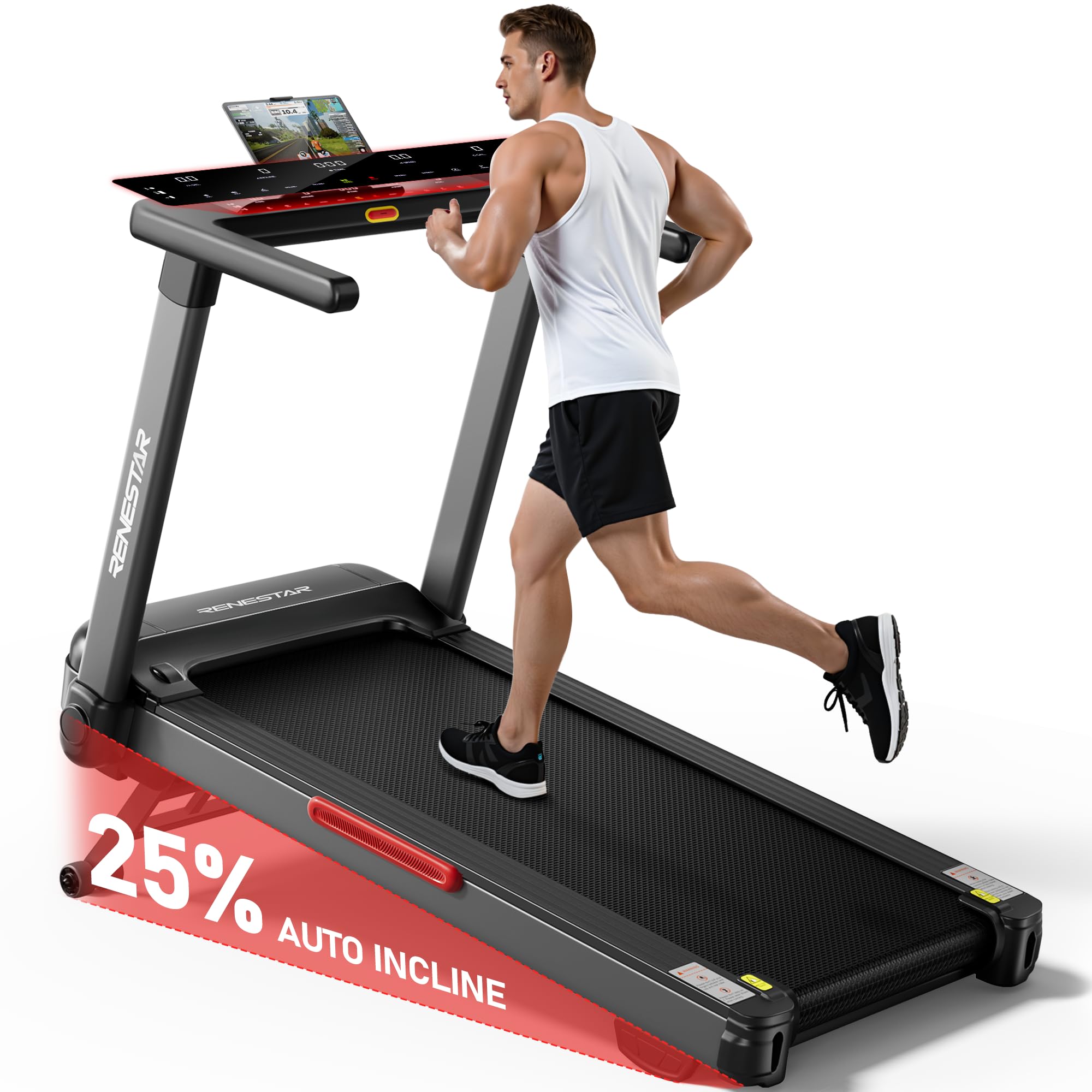
The one that puts a 19-inch touchscreen and a 25% incline in the same frame.
If the console is what keeps you on the belt, this is the type to look at. A 19-inch LED touchscreen sits above a 47.3-inch by 17.7-inch running belt with 4-inch protective borders on top. The belt is built in 8 layers with a textured face, so footing stays put during a hard push. A 12-inch device holder sits beside the screen for a phone or tablet.
The 3.5 hp brushless drive runs below 45 decibels and supports up to 300 pounds, and the maker rates the drive for an extended 6,500-hour operational life. The incline tops out at 25% across 25 levels of auto adjustment — the steepest setting on the whole list. That is a serious climb dial if steep walking is your workout. Setup is quoted at 15 minutes with 90% pre-assembled components.
Owners like the well-made feel and the easy build, and the roomy deck and quiet running come up often. The one honest caveat is the incline reading: a few owners feel the top setting looks steeper on the console than underfoot, so treat the percentage as a training dial rather than a measuring tape. The value for a screen this size is where this one earns its place.
What makes it different
- 19-inch LED touchscreen is the largest console on the list
- 25% auto incline across 25 levels
- 3.5 hp brushless drive rated under 45 dB
- 300 lb capacity and 6,500-hour drive rating
Set your expectations here
- Belt is 17.7 inches wide — the narrowest here
- 8.5 mph ceiling limits flat sprinting
- Some find the top incline feels gentler than the number
Choose this for: the screen — a 19-inch touchscreen and 25% incline give you a home-gym feel without the fixed commercial frame.
Pass on it if: you need a wide, long deck for fast running; a 17.7-inch belt will feel tight.
7. Sunny Health & Fitness Auto Incline Treadmill
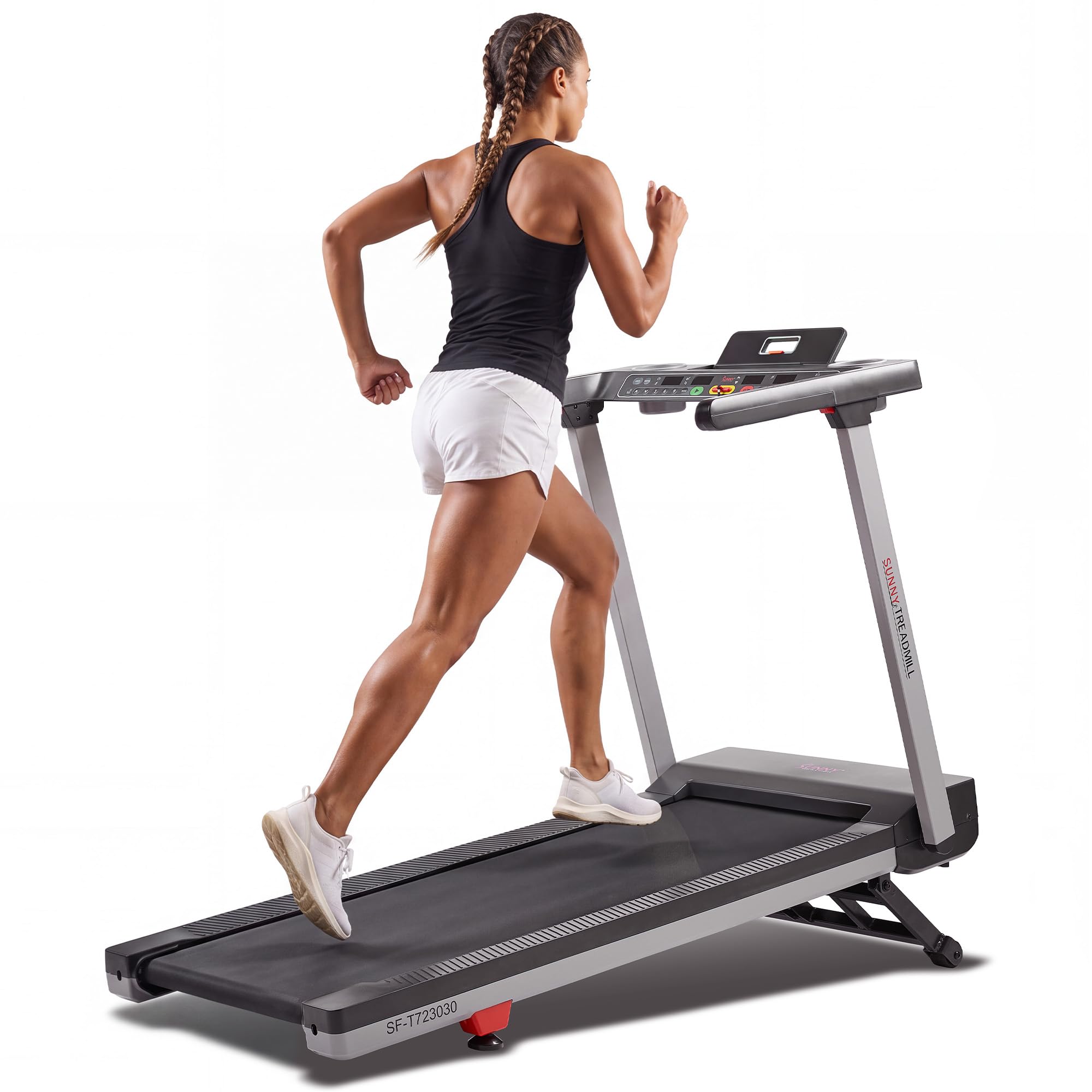
Ships fully built, folds flat to a 11.4-inch profile, and starts working the minute it lands.
This is the type that skips the toolbox entirely. It arrives fully assembled and sets up in seconds: raise and lock the handlebar and you are walking. The flat fold brings it down to 63.8 by 30.9 by 11.4 inches, which is the slimmest stowed height here — it slides under a bed or behind a sofa rather than standing in a corner.
The deck is a 20.1-inch by 53.1-inch running surface, so there is real width for a natural stride. A 2.5 hp brushless motor runs up to 10 mph and supports 300 pounds, with 15 auto-incline levels and 24 preset programs. The free SunnyFit app adds trainer-led videos and virtual tours. There is also a USB charging port and two cup holders on the console.
Owners praise the quality of this machine above anything else, and assembly is easy because there is none. The most-discussed downside is that the quiet running varies between units — some find it whisper-soft, others louder — and belt tracking can drift with use. It is a good-value pick for the size, with a build that suits steady daily sessions.
Most underrated trait: the flat fold to 11.4 inches and zero assembly — the two things new owners actually dread are removed.
The catch: noise varies unit to unit, so keep the deck on a mat if it lives above a downstairs neighbor.
An easy yes when: you want a wide 20-inch belt and no assembly, and you need the deck to slide out of sight between sessions.
Reconsider if: you want a hard sprint deck — 2.5 hp favors steady running over fast intervals.
8. WalkingPad X Series Folding Treadmill
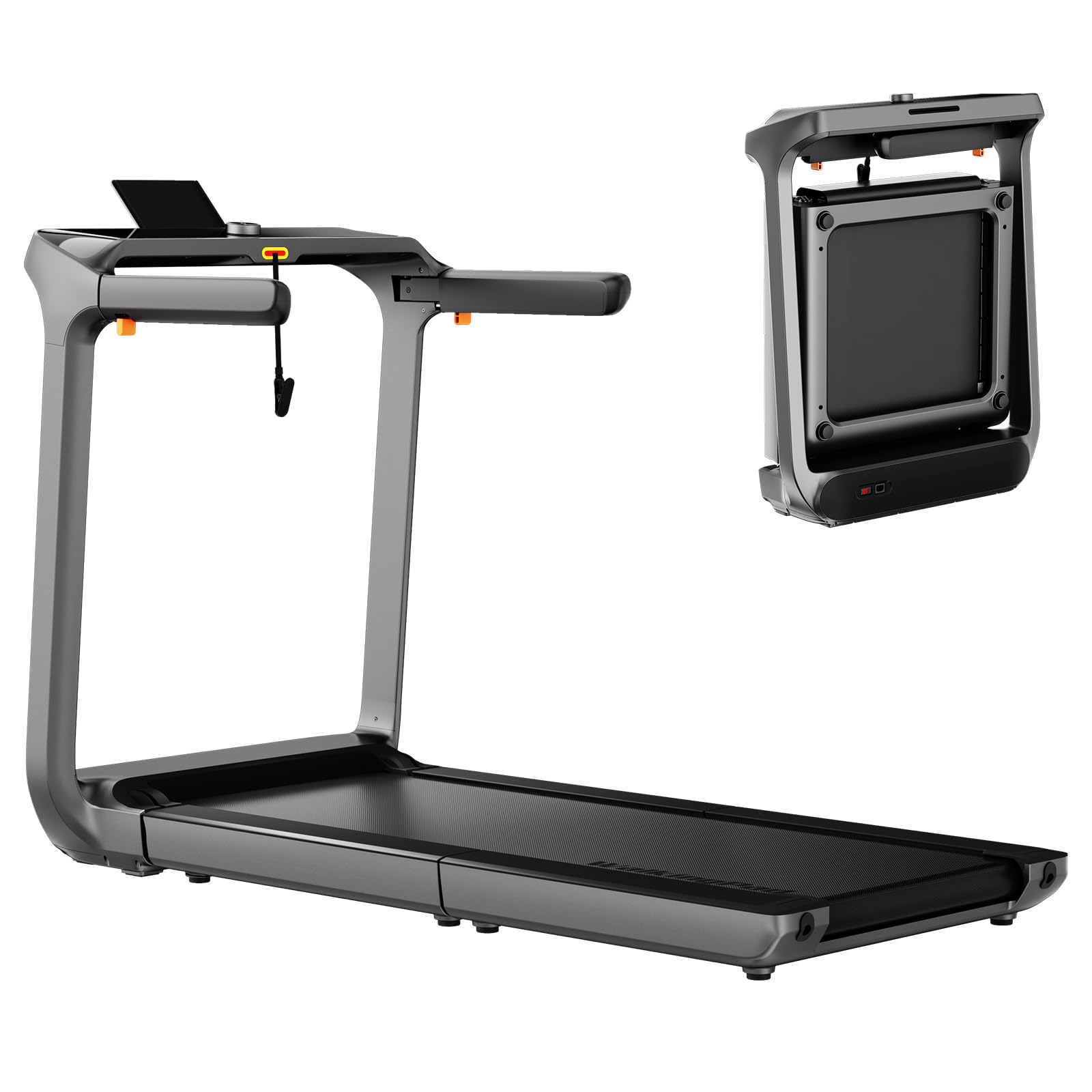
A true runner’s belt that folds in half and stands upright when the workout ends.
The WalkingPad X Series is the type you buy when the treadmill has to share the room with your life. Its tri-fold design lets the deck fold in half and stand vertical, collapsing to 42.5 by 33 by 11.6 inches. A 20-inch by 55.1-inch belt gives a wide running surface in a package that folds away — a rare combination.
The spec sheet is serious for a foldable. An aluminum frame carries a 3.5 hp brushless motor and a 11.5 mph top speed, with a 300-pound weight limit. Dual side handrails come up for stability when you run hard, and a rotary dial adjusts speed without hunting for buttons. The LED display stays minimal, matching the clean look.
Compact size is exactly what owners love, and folding comes up often as the second favorite thing. Folding up makes the belt easier to reach for lubricant, which is a maintenance win. On value, opinions split — some feel they got their money’s worth, others find it on the pricier end. It is a fixed top speed of 11.5 mph with real stability for fast running.
Where this type shines
- Tri-fold deck stands upright in seconds
- 20″ x 55.1″ belt is wide enough for real runs
- 3.5 hp motor with an 11.5 mph top speed
- Dual handrails add stability at speed
Where to weigh it up
- 131 pounds needs a bit of effort to lift upright
- Value splits opinion — not the cheapest folding deck
- LED display is minimal, so no big screen to follow
Made for: an apartment runner who wants 11.5 mph speed and a wide belt but has no permanent floor to give up.
Wrong pick if: you plan to leave it planted — a fixed deck buys more sturdiness for the same space.
9. Horizon Fitness Treadmill

A 22-inch wide deck built for interval training, with QuickDial controls that keep your stride going.
Width is the reason to pick this type. The Horizon runs 22 inches wide by 60 inches long — the widest deck here tied with the Elite Runner X — so you can swing your arms and land naturally without crowding. That is a meaningful upgrade over the 18-inch belts on the iFIT machines above. The 3-zone Variable Response Cushioning flexes where you need support through the stride.
The drive is a RapidSync 3.5 CHP system that the maker says delivers 33% faster speed and incline changes than before. A continuous-duty motor and a 500 lb thrust incline motor back that up for interval work. You get 0.5 to 12 mph and 0 to 15% incline, with QuickDial controls so you do not break stride to adjust. Seven programs cover 5K, calorie, distance, fat burn, hill climb, manual and max heart rate.
Owners prize the performance and the sturdiness above all, and the gym-like build is what people notice first. Setup is the mixed part — some breeze through it, others find it a slog — so line up a helper and an evening. The FeatherLight hydraulic fold gets it out of the way between sessions, and a rapid-charge USB port keeps your tablet topped up.
The winning number: 22 inches of deck width is the roomiest surface on this list, and it changes how a long run feels.
One thing to plan for: assembly is the recurring friction point — budget the time and grab a second person.
Right for: a runner who wants a wide fixed-feeling deck and fast interval control without paying commercial pricing.
Not for: you if you want a screen that walks you through workouts — this console is 8.25 inches of LCD.
10. Peloton Treadmill
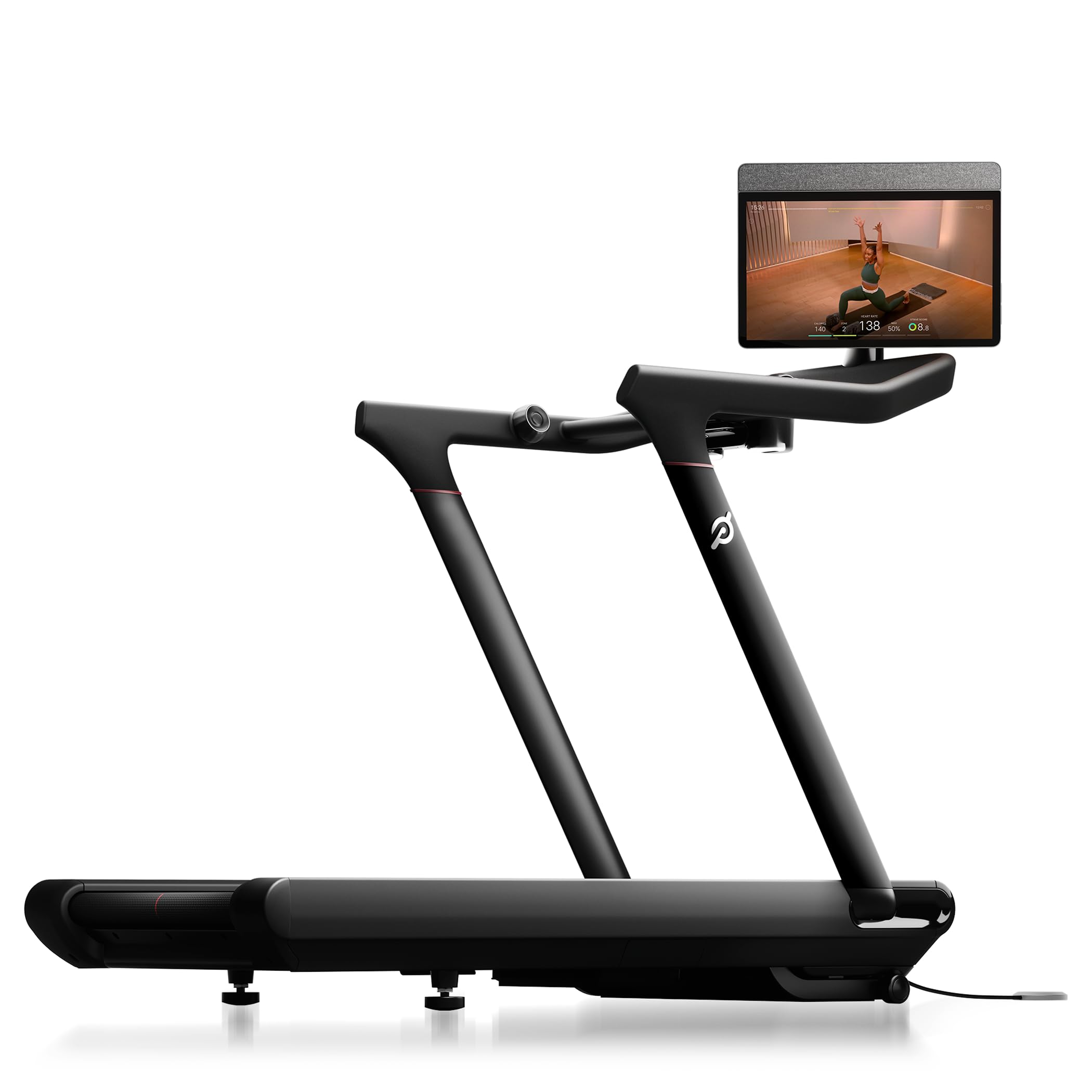
The one that turns a run into a class, with a screen that spins to face you on the floor.
No other machine here changes shape the way this one does. A 24-inch Full HD touchscreen swivels a full 360 degrees, so you can run, then turn the screen and drop into strength, yoga, Pilates or barre — the console says it opens up 15+ workout types. The deck itself is a textured belt with 59 inches of running space inside a compact footprint. Bluetooth 5.2 and USB-C charging round out the connections.
The build is carbon steel and rated for users from 4’11” to 6’4″ up to 300 pounds, with speed and incline knobs at the rails and auto-incline that follows instructor cues. The treadmill measures 68 inches long by 33 inches wide by 65 inches high and weighs 275 pounds — this is a heavy unit that needs proper lifting help on arrival. The setup notes call for 78.7 inches of clearance behind the tread and a minimum 8-foot ceiling.
Quality is the thing most talked about with this machine, and it earns it on feel and finish. Value is the honest sticking point — a good share of buyers question whether the price lines up with what they get. That is a fair question to sit with. The All-Access Membership is what open up the full class library, so the coaching is tied to a monthly subscription.
What makes it a different species
- 24″ Full HD screen swivels the full 360 degrees
- One machine for running plus 15+ workout types
- Bluetooth 5.2 and USB-C charging
- Fits users from 4’11” to 6’4″ up to 300 lbs
What you are signing up for
- Full class content requires the membership
- 275 pounds is heavy to move and set up
- Needs an 8-foot ceiling and space behind the belt
Best for the class devotee: if you want trainers, music and floor workouts in one machine, the swivel screen is the whole argument.
Think hard if: you will not use the classes — the hardware is priced around the subscription.
11. 3G Cardio Elite Runner X Treadmill

Club-grade hardware for marathon mileage, with the biggest motor and longest deck on the list.
This is what a treadmill looks like when it is not built to fold. A 4.0 hp club-rated motor drives a 22-inch by 62-inch deck — the longest surface here, at 62 inches, and the widest tied with the Horizon. The 386-pound frame does not fold, so it wants a permanent spot. A 400-pound max user weight covers nearly every rider, and the 7.5-inch step-up height leaves clearance from most ceilings.
Speed reaches 12 mph, ramping from zero in 18 seconds for H.I.I.T work, and elevation climbs to 15% with one-touch settings. A wireless chest strap comes included for heart rate control, and a 10.1-inch LCD tracks your stats. A USB charging port, a multi-speed fan and built-in speakers round out the console. There is no membership required — the built-in programs are yours without a subscription.
Owners highlight the sturdiness and the quiet, steady run, and the long hand bars get singled out for a secure hold. Most find installation straightforward. Where a few push back is on value — some question whether the price matches what they get — so weigh that against the 4.0 hp motor and the lifetime frame warranty on offer. For a dedicated home gym, it is the type you buy once.
The marathon angle: a 4.0 hp motor over a 22″ x 62″ deck with a lifetime frame warranty is built for long, repeated mileage, not quick folds.
The commitment: at 386 pounds and non-foldable, this needs a fixed home and a helper to move.
Built for: the serious runner who has a dedicated room and wants a machine that holds up to daily long runs.
Not your type if: you need to fold the deck away — this one stays where you put it.
Know the Specs
Deck length and width
The running belt is measured in inches, and both numbers set what you can do on it. A 42.5-inch length suits walking and light jogging; 55, 58, 60 and 62 inches give a runner room to land and push off. Width matters just as much — 17.7 to 18 inches is snug, while 20 to 22 inches lets you swing your arms freely. Taller or faster runners should aim long and wide.
Motor horsepower (hp)
Horsepower rates the motor that spins the belt. A 2.5 hp or 2.6 hp motor handles steady walking and jogging. A 3.0 hp to 4.0 hp motor holds speed under a heavier runner and recovers faster during intervals. Heavier riders and frequent sprinters should favor the higher number.
Incline percentage
Incline lifts the front of the deck to simulate climbing. Ranges here start at 10% and climb to 25%. Higher percentages make walking workouts harder by adding climb and engaging more muscle. Auto incline means the machine adjusts it for you during a program. Some top settings feel gentler underfoot than the number suggests.
Folding frame versus fixed deck
A folding frame lifts and rolls away to reclaim floor space, but is often built lighter. A fixed commercial deck skips the fold but usually carries the larger decks and heavier motors. Match this to your space: a shared room favors folding, a dedicated gym room favors fixed.
Common Questions
What is the difference between a folding treadmill and a fixed-deck treadmill?
How wide should a treadmill belt be for running?
How much motor horsepower do I need on a home treadmill?
Does a higher incline percentage make walking harder?
Will a folding treadmill fit under a bed or behind a sofa?
Do I need a membership to use these treadmills?
How heavy is a treadmill and can one person move it?
What deck length suits a tall runner?
Should I put a treadmill mat under the machine?
How long does a treadmill motor usually last?
What is the difference between auto incline and manual incline?
The Bottom Line
For most people shopping the types of treadmills out there, the winner is the 3G Cardio Pro Runner X because it gives you a genuine 20.5″ x 58″ running deck and a 3.0 hp motor in a frame that still folds away. If you want coaching that adjusts the belt for you, grab the NordicTrack T Series. And for a dedicated gym room where the deck never moves, the 3G Cardio Elite Runner X is the one to reach for, with its 4.0 hp motor and 22″ x 62″ surface.
One last nudge: match the deck length to your stride before anything else, then let the motor and incline follow. Get the deck length right and the machine will still suit your stride long after the console novelty wears off.
How we choose
We do not accept paid placement. Every pick is matched to a real buyer and a real use-case; we do not hands-on test units.
Sources
Specifications: manufacturer listings and product documentation. Review insights: verified customer reviews, as of November 2026. Pricing: not shown on this page (it changes often); check the current price via the retailer link.
As an Amazon Associate, Tactical Gear Guy earns from qualifying purchases. This does not affect which products we feature.