Specs are compiled from manufacturer listings and verified buyer reviews and can change over time — please confirm the key details on the product page before buying.
Skip the soundbar. If you want real surround sound for your TV — five separate speakers plus one subwoofer — the Logitech Z906 is the safest first pick. It carries THX certification (a THX lab stamp that the system meets a set audio standard) and built-in Dolby Digital and DTS decoding (it splits the movie soundtrack into the right channels itself). That means the Z906 splits the soundtrack into front and rear channels itself, with no extra receiver needed. The trick most people get wrong is assuming “5.1” on the box guarantees real rear speakers. It doesn’t, so every pick below was checked for an honest five-speaker-plus-subwoofer layout.
This guide is built by comparing the manufacturers’ published specifications and the patterns across verified customer reviews, so you get each pick’s real strengths and trade-offs instead of marketing spin.
You will see exactly how each set wires to your TV, what the subwoofer actually delivers, and where the real weaknesses sit before you commit to a box. The shortlist below covers every budget tier for a genuine 5.1 surround sound system for tv.
Top Picks


How To Choose The Best 5.1 Surround Sound System for TV
A 5.1 system is five speakers (front left, front right, center, rear left, rear right) plus one subwoofer. That layout puts dialogue in front of you and a helicopter behind you. Almost every disappointment in this category traces back to one of three things: a “5.1” box that is really a soundbar with fake rear channels, a subwoofer too small for the room, or a receiver with no clean way to talk to your TV. Get those three right and the rest is speaker placement and level trim.
Count the speakers before you buy
Look for the exact phrase “five speakers plus one subwoofer” in the what’s-in-the-box list. A box that ships two front speakers, two rears, one center, and a sub is the real thing. A soundbar plus a sub is not, no matter what the badge says. The Klipsch bundle below, for example, lists every component by name — two floorstanding, two bookshelf, one center, one sub — which is exactly the transparency you want.
Match the subwoofer size to your room
Subwoofer diameter is the number that decides whether explosions feel physical or thin. A 6.5-inch sub suits a small to medium room; an 8-inch or 10-inch sub moves more air and fills a bigger space. Wattage alone won’t save a small sub, which is why a 1500-watt-rated box with an 8-inch driver still out-punches many larger-wattage sets with smaller cones.
Check how it talks to your TV
HDMI ARC lets one cable carry the TV’s audio to the system and lets your TV remote handle volume. Optical works with almost any TV but can’t pass the newest object-based formats. Bluetooth is for phone music, not for surround. The Yamaha YHT-5960U uses HDMI 2.1 with eARC, while several budget picks here lean on optical and AUX — both fine, but they change your remote setup.
Side-by-Side Comparison
| Model | Best For | Subwoofer Driver | RMS Power | TV Connection | Amazon |
|---|---|---|---|---|---|
| Logitech Z906★ Best Overall | Balanced all-round pick | 6.5 inches | 500 W | Optical, coaxial, RCA, 3.5mm | Amazon |
| Bobtot 5.1 (6.5″ Sub)Party Pick | Karaoke and parties | 6.5 inches | — | TV ARC, Optical, Coaxial, AUX, USB | Amazon |
| Hisense HS5100Smallest Footprint | Small rooms and easy setup | 6.5 inches (wireless) | — | HDMI ARC, Optical, Bluetooth 5.3 | Amazon |
| Rockville HTS820 | Big bass on a mid budget | 8 inches | 375 W | HDMI, Optical, Bluetooth, RCA, USB | Amazon |
| Monoprice Premium | Lean speaker set for a receiver | 8 inches | — | Wired only | Amazon |
| Bobtot 1200W | Loud movie nights | 10 inches | — | ARC, Optical, Coaxial, AUX, USB, Bluetooth 5.3 | Amazon |
| Yamaha YHT-5960U | Future-proof home theater | — | — | HDMI 2.1 eARC (4 in/1 out) | Amazon |
| Fluance Elite SX51WR | Music-first sound quality | 10 inches | — | Wired (needs amplifier) | Amazon |
| Yamaha YHT-4970U | Atmos on a receiver bundle | — | — | HDMI eARC/ARC, Optical, Bluetooth | Amazon |
| Klipsch Reference Bundle | Top-tier component quality | 12 inches (R-12SW) | 400 W (subwoofer amp) | Wired (needs receiver) | Amazon |
Detailed Reviews
1. Logitech Z906 5.1 Surround Sound Speaker System
Our pick — 4.5+★ from 5,500+ verified ratings; the strongest balance of quality and price.
The set that decodes the movie before it reaches your ears.
Here is the detail that puts the Z906 on top: it carries its own Dolby Digital and DTS decoding inside the box. That means the surround soundtrack is unpacked and routed to the correct speaker by the system itself, not squeezed down to stereo and faked back out. For a first real 5.1 system, that is the difference between a helicopter flying behind your sofa and a helicopter that just sounds louder in front of you.
Power is split 1000W peak and 500W RMS. The RMS figure (root mean square — the sustained power it can hold, not a momentary spike) is the one to care about, and 500W RMS is the strongest sustained number in this group. The Rockville HTS820 offers 375W RMS by comparison. The 6.5-inch dynamic driver in the subwoofer is smaller than the Rockville’s 8-inch, so the Logitech is the more polished and more reliable-sounding system, while the Rockville will push more raw low-end air.
What wins people over is sound quality, and the volume control setup earns real affection. You can trim the level of each individual speaker and the sub from the control console or the wireless remote. That is exactly the tool you need when your rear speakers sit closer to the sofa than your fronts. Connectivity is generous too — 3.5mm, RCA, six-channel direct, digital coaxial, and optical — so up to six devices can stay plugged in at once. The recurring gripe concerns durability: buyers report individual speakers failing after a few months, so treat the satellites as gear rather than toys. If you want THX-certified decoding from a compact set and can live with a 6.5-inch sub, start here — it is the crowd favorite and the highest-confidence pick in this group by owner volume.
Where it earns its place
- Built-in Dolby Digital and DTS decoding means true surround, not a stereo upmix
- 500W RMS is the most sustained power in this lineup against the Rockville’s 375W
- Per-speaker and subwoofer level control from the console or the wireless remote
- Six devices connect at once across optical, coaxial, RCA, and 3.5mm
What to weigh first
- 6.5-inch subwoofer is smaller than the 8-inch Rockville cone
- No HDMI ARC, so the TV remote won’t control system volume on its own
- Some satellites have been reported to fail after several months of use
Start here if: you want the least fuss and the most reliable surround decoding from a set that installs around a normal living room.
Look to the Rockville instead if: the deepest possible bass matters more to you than the decoder and the per-speaker trim.
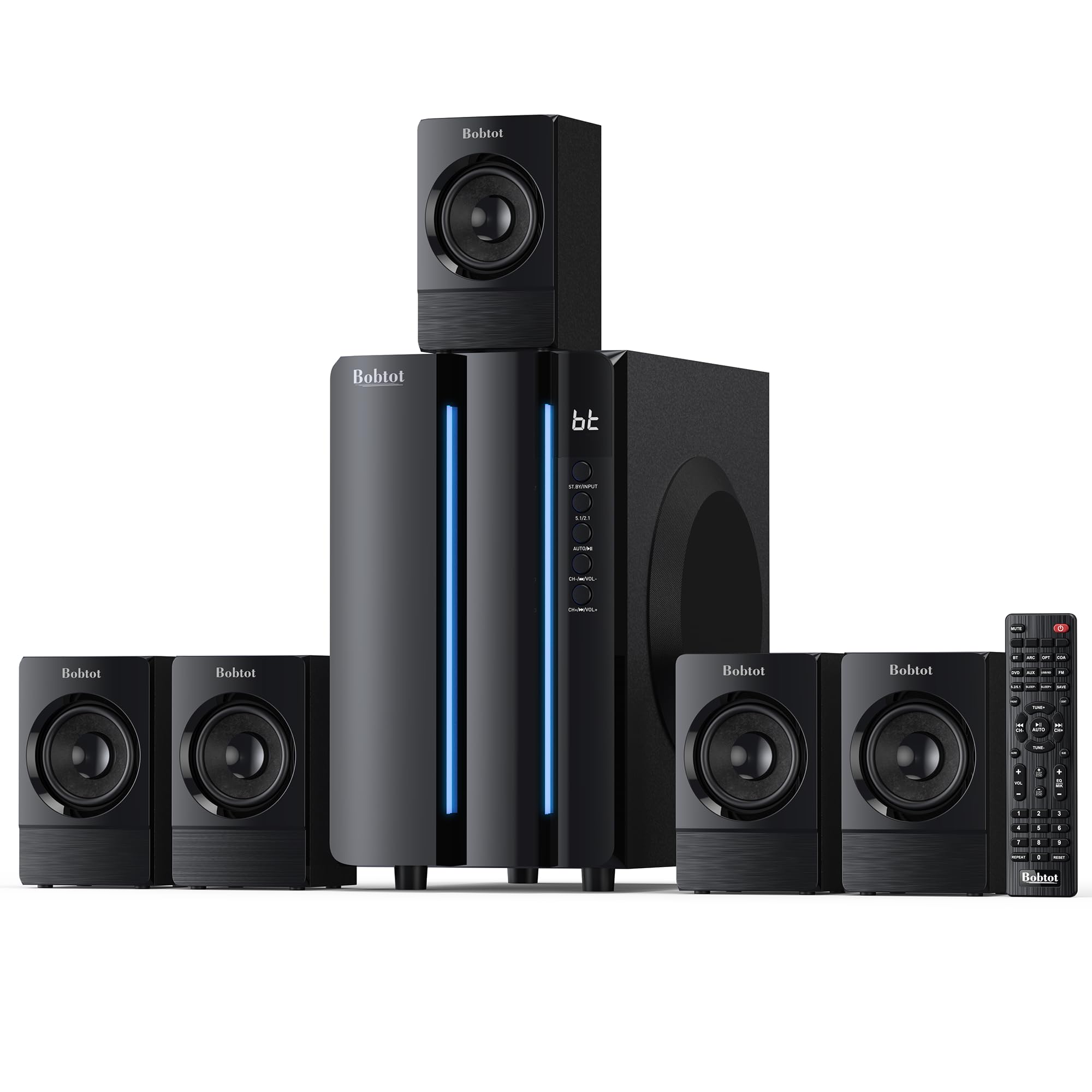
2. Bobtot Surround Sound Systems 6.5″ Subwoofer
Built for movie night, karaoke night, and the birthday party in between.
Two microphone inputs with an echo function are the headline here, and that is not a novelty — it turns the same system you watch films on into a karaoke rig without buying anything else. Add a built-in FM receiver, a digital display, five preset EQ modes (Jazz, Country, Classic, Pop, and Rock), and you have a box aimed squarely at the family room rather than the dedicated theater.
Underneath, an 800W peak amplifier drives a 6.5-inch subwoofer that houses the receiver itself — so the sub is the brain of the system and every satellite speaker wires back to it. The digital amplifier accepts AC 100–240V at 50/60Hz, which means it will behave the same on a travel adapter overseas. Bluetooth 5.3 gives you a stated 10 metres of wireless reach for phone music, and TV ARC, Optical, Coaxial, AUX, USB, and DVD inputs cover the rest of your gear.
Setup is the thing owners consistently find painless, and the surround effect does register — no coincidence for a system engineered to fill one room. The catch is honest and simple: sound quality splits opinion, with loudness and accuracy pulling in different directions, so this rewards buyers who want volume and fun over a neutral, calibrated mix. Keep all five speakers in the same room, as the maker specifies, and place the sub where its receiver can breathe.
Why it appeals: the karaoke-ready dual mic inputs, five EQ presets, FM radio, and 800W of headroom make this the most feature-dense set in the budget-to-mid bracket for social evenings.
Fit note: if you are chasing a flat, reference-accurate movie mix, this is the wrong tool — the speakers are tuned to sound loud and lively in a shared living room.
Reach for this if: your living room is also the party room and you want singing, streaming, and movie sound from one box.
Skip the mic feature if: you never plan to sing — the surround accuracy of other sets here will suit you better.
3. Hisense HS5100 5.1ch Soundbar with Wireless Subwoofer
A front bar, a wireless sub, and two rears that slip behind the couch.
Five hundred and forty watts of maximum output spread across eight speakers, a 6.5-inch wireless subwoofer you can tuck out of sight, and two wall-mountable rear surrounds: that is the HS5100 in one breath. It is the pick for anyone whose TV lives in a smaller room where five freestanding boxes would never earn permission from the other half of the household.
The wireless sub is the practical win. Because it connects to the soundbar without a cable, you can drop it beside the sofa or behind a chair without running anything across the floor. HDMI ARC (audio return channel — one cable sends sound from the TV to the bar) lets the TV remote do the volume. Bluetooth 5.3 streams from a phone. If you own a Hisense TV, the EzPlay feature lets the TV remote run the soundbar’s modes and even show its settings menu on the TV screen.
Dolby Digital Plus and DTS Virtual:X are both on board, and the center speaker uses voice enhancement to keep dialogue legible during quiet scenes — the centre channel clarity is the part that genuinely pleases. What to know before you buy: the two rear speakers are notably quiet in the mix, so the sense of sound behind you is gentler than a set with dedicated rear amplification. “Good for the price” is the fairest way to read it, which means treat this as a compact convenience system rather than a reference surround rig.
What you gain: a cable-free sub and wall-mountable rears make this the easiest true 5.1 set to fit into a small living room, and EzPlay ties the volume straight to a Hisense TV remote.
What you give up: rear-channel presence is mild — the quiet rears mean the wrap-around effect never dominates.
The right call for: compact rooms where neatness and a wireless sub beat raw rear-channel muscle.
Not the right call for: anyone expecting the back speakers to hit as hard as the front.
4. Rockville HTS820 5.1-Channel Home Theater System

Fifteen hundred watts printed on the box, and an 8-inch cone that backs it up.
Most bundles at this level give you a sub and then shortchange the wire. That is why the Rockville’s cable lengths matter more than they sound: 30-foot runs for the rear speakers, 12-foot for the fronts, and 10-foot for the center. Rear surrounds placed properly — behind and slightly out from the sofa — usually need the longest cable of all, and 30 feet removes the guesswork.
The power story is the loudest in the mid-range. Peak power is 1500W against 375W continuous RMS, and it out-punches the smaller Bobtot 5.1 system’s 800W peak by a wide margin. Each satellite pairs a 3-inch midrange driver with a 0.75-inch dome tweeter, and the sub uses a separate independent volume control. Frequency response spans 20Hz–20KHz with a stated signal-to-noise ratio of at least 75dB and 0.10% THD. It also brings a 5-band EQ, FM radio, SD and USB inputs, and dual ¼-inch mic inputs with echo for karaoke.
Here is the honest read from the review floor: sound quality and Bluetooth both split opinion, with some loving how loud it goes and others finding the sub less forceful than the 1500W badge implies. The build is solid — MDF cabinets with plastic front panels, moving 30.86 lbs — and the satellite mounting kits are in the box. Treat the peak number as headroom, not as a promise of measured bass, and this remains a lot of system for a mid-range outlay.
Why the big numbers land
- Extra-long cable kit means rear speakers can actually go behind the sofa
- 8-inch subwoofer beats the 6.5-inch drivers on the Logitech and the smaller Bobtot
- 5-band EQ, FM radio, and dual mic inputs add real flexibility
What to keep realistic
- Peak power reads louder on paper than the bass feels in the room
- Bluetooth pairing is not always steady for every owner
- Satellites and centre are modest in size, so dialogue lacks the weight of the big systems below
Pick it when: you want more cone area and more cable than anything else at this outlay, and karaoke is a bonus.
Think again if: you expect real THX-grade decoding — this set relies on your TV or source to unpack surround.
5. Monoprice Premium 5.1 Channel Home Theater System

The speaker-only route for anyone who already owns a receiver.
This is a set of speakers, not a brain. The box contains four satellite speakers, one center channel speaker, and one subwoofer — no receiver, no decoding, no amplification for the satellites beyond whatever you plug them into. If you already have a surround receiver sitting idle, that is exactly the point: you buy the parts that make sound and keep the electronics you trust.
The subwoofer runs an 8-inch dynamic driver, and specs list 100-watt satellites with a 200-watt subwoofer. Bass boost is on board for owners who want more low-end. Owners describe hooking this straight into gear like an Onkyo HT-RC460 receiver and having it perform beautifully; the spring connectors make the wiring simple even if you have never hooked up bare speaker wire before. Clear highs and a subwoofer that stays controlled rather than muddy are the two recurring praises.
The fair caveat here is that this is a passive speaker set with a basic feature list — it has no HDMI, no Bluetooth, no ARC, so all of that responsibility sits with your receiver. A smaller share of buyers flag durability questions, which is the ordinary risk with an entry-level speaker set. Buy it because you want the speaker portion sorted cheaply and already own the electronics; do not buy it expecting an out-of-the-box TV solution.
Best for the receiver owner: four satellites, a center, and an 8-inch sub with bass boost, all at the level where a spare amplifier finally meets a reason to use it.
The honest limit: with no HDMI, optical, or Bluetooth on the speakers themselves, every control and input has to come from your receiver.
Choose it if: a receiver already sits in your rack and you just need the five speakers and the sub.
Pass on it if: you want a system that unpacks Dolby on its own — this one needs a partner.
6. Bobtot Home Theater Systems 1200 Watts Peak

A 10-inch sub that turns a small cinema into a nightclub.
Ten inches. That is the largest subwoofer driver of the Bobtot pair and one of the biggest in this lineup, and it is the single spec that tells you whether this system suits your room. A 10-inch cone with a built-in receiver moves serious air, so explosions and drum hits carry real body in a large living space. If your TV lives in a big open-plan room, a 10-inch cone is the size that stops bass feeling like background sound.
Around the cone sits a full feature set: 1200W peak power and two modes — 5.1 surround or 2.1 stereo — switchable from the remote or the sub’s front panel. Four LED lighting modes on the sub include one that pulses to the beat. The cable kit is generous: 13 feet to each front speaker, 31 feet to each rear, and 10 feet to the center. Bluetooth 5.3 pairs to phones directly, and ARC, optical, coaxial, AUX, USB, and DVD inputs mean almost anything with an audio output will plug in. Dual ¼-inch mic inputs with echo bring karaoke into the same box.
Sound quality is what owners praise most, and setup is generally painless — with one caveat that shows up often: the speakers connect by wire to the sub, so plan around cables rather than expecting wireless rears. Reliability wavers in places, with reports of half the speakers working from the start or the remote failing to pair. Given the 10-inch sub, 1200W peak, and four LED modes at this price, most buyers walk away pleased.
The reason to shortlist it: a 10-inch subwoofer, 1200W peak, 31-foot rear speaker cables, and four LED modes make it the most spectacle you can buy before spending seriously.
What to accept: the rears are wired, not wireless, and a handful of units have arrived with a speaker or the remote misbehaving.
Great match for: larger rooms, loud movie nights, and anyone who wants the bass to be felt rather than heard.
Second-guess it if: cable runs across the room are a deal-breaker — the rears need 31-foot runs back to the sub.
7. Yamaha YHT-5960U Home Theater System

An AV receiver bundle that handles 8K today and won’t bottleneck your next console.
If you bought a console or a new TV in the last couple of years, the video path is the spec you should be reading first — not the watts. This receiver passes 4K60, 4K120AB, and 8K60B over HDMI 2.1, with HDCP 2.3 and eARC, across four inputs and one output. It also carries Dolby Vision, Hybrid Log-Gamma, and BT.2020 colour, plus ALLM and VRR for gaming. In plain terms: the receiver sits between your devices and the screen and won’t downgrade the picture or the game-mode features on the way through.
YPAO automatic room calibration is the other feature worth understanding. The bundled microphone measures how your room colours the sound, then the receiver adjusts its own output to compensate — a genuinely useful tool in a room with hard floors and bare walls. The box contains one AV receiver, four surround speakers, and one subwoofer, wired to match the receiver with speaker cable chosen per channel. MusicCast brings wireless streaming to the system, and video processing, Dolby TrueHD, and DTS-HD Master Audio handle the soundtrack side.
Reliability is the split in owner experience: some units work exactly as advertised for years, others stop working, and a slice of owners mention failure inside two years. The catch is not the sound — the sound is good and setup is straightforward — but the gamble on a complex receiver. If you would rather own a modern receiver with future video support than a simple all-in-one, this is a strong shortlist entrant.
Where the value sits: 8K60B and 4K120AB HDMI 2.1 passthrough with eARC, Dolby Vision, and VRR means your receiver keeps pace with your TV and console rather than holding them back.
What to weigh: this is the heaviest and most involved install here, and long-term reliability is not universal across owners.
The pick for: gamers and 4K/8K TV owners who need the receiver to be as current as the screen.
The pick against: anyone who wants to low-maintenance — a simpler all-in-one has fewer things to fail.
8. Fluance Elite 5.1 Channel Speaker System

Real wood cabinets and floorstanding towers — for people who care how music sounds.
Timbre matching is the concept that makes this system different. Every one of the five speakers is tuned to voice similarly, so when a sound pans from the center channel across to a rear surround, it doesn’t suddenly change character. Pair that with a 10-inch powered DB10 subwoofer and you get a setup that feels cohesive rather than assembled. If your listening is half music and half movies, this is the pick that leans musical.
The floorstanding towers are three-way designs with dedicated high-frequency tweeters and a dynamic midrange, sat in MDF cabinets with a natural walnut woodgrain finish that is a visible step above black plastic. The bass note comes from that 10-inch powered sub, which pushes deeper than the 6.5-inch sub on the smaller Bobtot or the Logitech. Eight 1-inch isolation floor spikes come in the box for the towers, and the set carries a lifetime parts-and-labor warranty direct from the manufacturer, plus a two-year warranty on the subwoofer.
What you should know before ordering: this is a passive speaker set — there is no receiver, no HDMI, no Bluetooth, so you will need to supply your own amplifier or receiver to make a single sound. Sound quality and build quality are exactly what owners emphasize, and the walnut finish is repeatedly praised as looking far nicer than the cost would suggest. For the buyer who already owns a receiver and wants the five speakers and sub sorted, this is the sweet answer.
Why it earns this spot
- Timbre-matched five-speaker set for consistent sound across every channel
- 10-inch DB10 powered subwoofer digs deeper than the compact subs in this list
- Natural walnut MDF cabinets that look like furniture, not gear
- Lifetime parts-and-labor warranty on speakers from Fluance
What you must know
- No receiver, no amplifier, no HDMI — you bring the electronics
- Towers need floor space and eight spikes to level them
- Not the set to buy if you want an all-in-one TV solution
Best for: a buyer with a receiver ready who wants music-grade speakers with a big walnut look.
The trade-off: everything electronic — amplification, decoding, inputs — is on you, so this can’t be a one-box purchase.
9. YAMAHA YHT-4970U 5.1-Channel Home Theater System
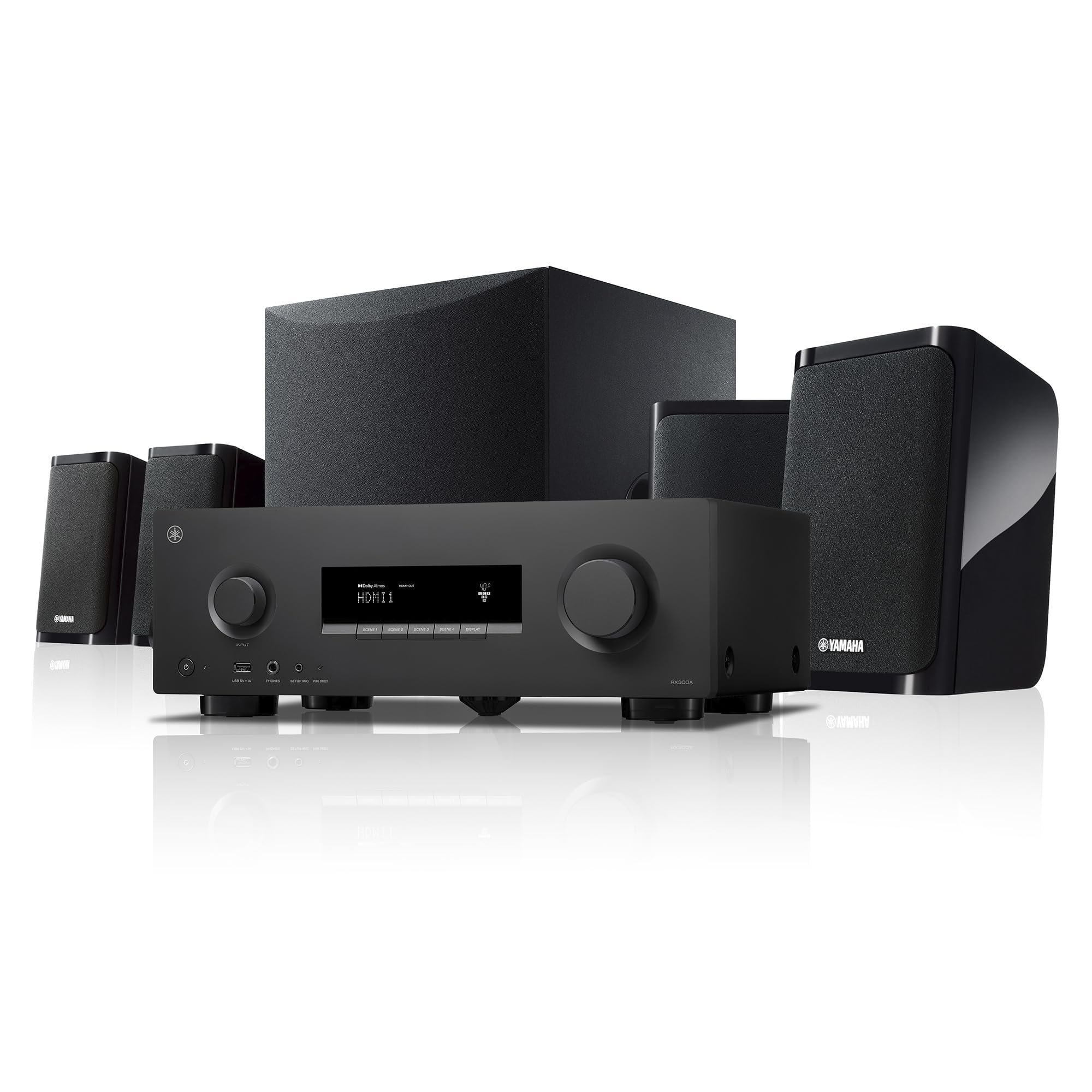
Dolby Atmos decoding, a full 5.1 speaker set, and 80 feet of speaker wire in one box.
This is the most complete one-box system in the list, and the wire is where it shows. The package includes 80 feet of speaker wire and a 16-foot subwoofer cable, so the front, center, and rear speakers get real placement freedom even in a long room. Add a Yamaha RX300A receiver with a setup microphone and small cardboard stand, an FM antenna, and batteries, and you can wire it once and rarely think about it again.
What sets the picture and sound apart is the receiver’s support for Dolby Atmos and DTS Virtual:X for a more dimensional mix, plus 4K/120 and 8K/60 video with Dolby Vision and HDR10+ on HDMI eARC/ARC. Gaming features include ALLM and VRR. Room correction is automatic: the included microphone measures your room’s acoustics and speaker characteristics and the receiver adjusts to suit. Bluetooth Multipoint pairs two source devices at once and lets you switch between them without re-pairing, useful if you switch between a phone and a tablet.
The honest part: quality splits opinion among owners, and the biggest complaint is bass — a surprising number find the subwoofer light and the voices hollow, even though the receiver itself is often praised. Treat this as an entry-level Atmos receiver paired with modest speakers; if you want serious low-end, its 10-inch competition in this group delivers far more thump. Buy it for the receiver and the room correction, and plan to upgrade the sub later if bass matters.
The strong half: Dolby Atmos support, 4K/120 and 8K/60 passthrough, HDMI eARC, automatic room correction, and Bluetooth Multipoint make the RX300A receiver a real highlight.
The weak half: the subwoofer underwhelms, and a few buyers find the dialog thin — the make-or-break next upgrade is bass.
Right for you if: Atmos decoding and a modern receiver matter more than bass quantity, and you like being able to buy a better sub separately later.
Look elsewhere if: chest-thumping low end from the start is the requirement.
10. Klipsch Reference 5.1 Home Theater System Bundle

Real floorstanding towers, a 12-inch sub, and a horn-loaded tweeter to carry dialogue.
Every other pick in this list is a compact system. This one isn’t. You get two R-26FA floorstanding towers, two R-41M bookshelf speakers, one R-25C center channel, and one R-12SW subwoofer — actual separate speaker boxes, not satellites pretending to be. The R-12SW sub uses a 400W all-digital amplifier and a 12-inch driver, which is the largest cone in this guide. It is front-firing, so you can place it near a wall without killing the bass.
Tractrix Horn technology is the Klipsch signature, and here it appears on both the towers and the center channel in a 90×90 horn. That horn shape is designed to focus high-frequency output and improve dialogue intelligibility and imaging — which is exactly what makes the center channel punch through in a busy action scene. The towers also carry built-in elevation channels that bounce sound off your ceiling, so the same pair supports an Atmos-style height effect without extra speakers on the wall. Copper-spun IMG woofers keep the cones rigid for cleaner low-frequency response, and LTS tweeters reduce distortion on the high end.
Sound quality is what buyers consistently praise, with some describing music here as more convincing than a live performance, and value for money runs second. The system needs a receiver, because there’s no amplification inside the speakers and the sub connects via line or LFE inputs — so budget for an AV receiver or already own one. Five-way binding posts make connections secure and allow bi-wiring.
Why it justifies the top spot in this tier: real floorstanding towers, a 12-inch sub, and horn-loaded highs make this the most revealing, most theater-like set in the group once it’s paired with a receiver.
The practical catch: no amplification, no inputs, no wireless anything — this is a set of loudspeakers and a sub, so you supply the whole electronics side.
Buy it when: you already own a good receiver and want the nicest speakers in this lineup, with a 12-inch sub to finish the job.
skip it if: you want one box you can plug into the TV — that’s the Logitech’s job, not this one’s.
Know the Specs
RMS power versus peak power
Peak power is the loudest spike a system can hit for a moment. RMS power — root mean square — is the sustained output it can hold, and is the number worth reading. A set rated 500W RMS (like the Logitech) will play louder all night than one that only advertises a bigger peak number with a lower RMS behind it. When a listing gives only peak, that’s your cue that sustained output isn’t being highlighted.
Subwoofer driver size
The cone diameter is the physical amount of air a subwoofer moves. A 6.5-inch driver suits a normal living room; an 8-inch or 10-inch cone pushes more low-frequency energy and fills a bigger space. That’s why the Bobtot 10-inch and Klipsch 12-inch subs feel deeper than the 6.5-inch options, even before you look at wattage. Bigger cones need more floor space and placement is more important.
HDMI ARC and eARC
Audio Return Channel carries the TV’s audio down the same cable your picture travels up, so you need one cable and the TV remote can control volume. Enhanced ARC, called eARC, adds bandwidth for the newest high-resolution formats. Systems without HDMI ARC, like the Logitech, need an optical or RCA cable and you’ll usually use the system’s own remote for volume.
Surround decoding
Dolby Digital and DTS are the formats that carry which sound goes to which speaker. A system that decodes them itself (Logitech) or via a receiver (Yamaha, Fluance, Klipsch) turns the movie soundtrack into real 5.1. A box that doesn’t decode needs your TV or source device to handle that job, or you’ll get a simulated surround effect instead.
Common Questions
Do I need a receiver to run a 5.1 surround sound system?
Will a 5.1 system work with any TV?
How big does my room need to be for real 5.1?
Do the rear speakers need to be wireless?
What is the difference between 5.1 and a soundbar with a subwoofer?
How long do these home theater systems usually last?
Can I use a 5.1 system for music as well as movies?
Do I need Dolby Atmos to enjoy 5.1?
Where should I place the subwoofer in the room?
Is a bigger subwoofer always better?
What cables come in the box?
The Bottom Line
For most people buying a 5.1 surround sound system for tv, the safest choice is the Logitech Z906. It decodes Dolby Digital and DTS on its own, so you get real surround without adding a receiver. The 500W RMS and per-speaker volume trim give it the most polished, predictable result of anything in this group.
If you want raw bass and long rear cables for the money, the Rockville HTS820 offers an 8-inch sub and 1500W peak power. For the best speaker-only route, the Fluance Elite is timbre-matched (all speakers voiced to sound alike) and walnut-finished with a 10-inch DB10 sub. For the true top of the list, the Klipsch Reference bundle gives you floorstanding towers and a 12-inch sub if you already own the receiver. Any one of these will serve for years if you match the subwoofer size to the room and run the rear speaker cable behind the sofa.
How we choose
We do not accept paid placement. Every pick is matched to a real buyer and a real use-case; we do not hands-on test units.
Sources
Specifications: manufacturer listings and product documentation. Review insights: verified customer reviews. Pricing: not shown on this page (it changes often); check the current price via the retailer link.
As an Amazon Associate, Tactical Gear Guy earns from qualifying purchases. This does not affect which products we feature.