Specs are compiled from manufacturer listings and verified buyer reviews and can change over time — please confirm the key details on the product page before buying.
Your TV probably won’t send sound to a plain Bluetooth headset at all. And when it does, you often see lips move a half-second before you hear the words. A headphone system with its own transmitter box fixes both problems. The box plugs into your TV’s audio output, sends the sound wirelessly, and keeps voices and mouths lined up. The nine systems below all include that transmitter box — no “sold separately” surprises.
This guide is built by comparing the manufacturers’ published specifications and the patterns across verified customer reviews, so you get each pick’s real strengths and trade-offs instead of marketing spin.
Some picks here are 2.4GHz and RF systems (radio-based sets built just for TV watching). Others are aptX Low Latency models (a Bluetooth codec that keeps audio and video in sync) that also work as everyday Bluetooth headphones. Each one is sorted by who it suits. The right wireless headphones with transmitter depends on three things: your TV’s ports, your hearing needs, and how many people are watching.
Top Picks


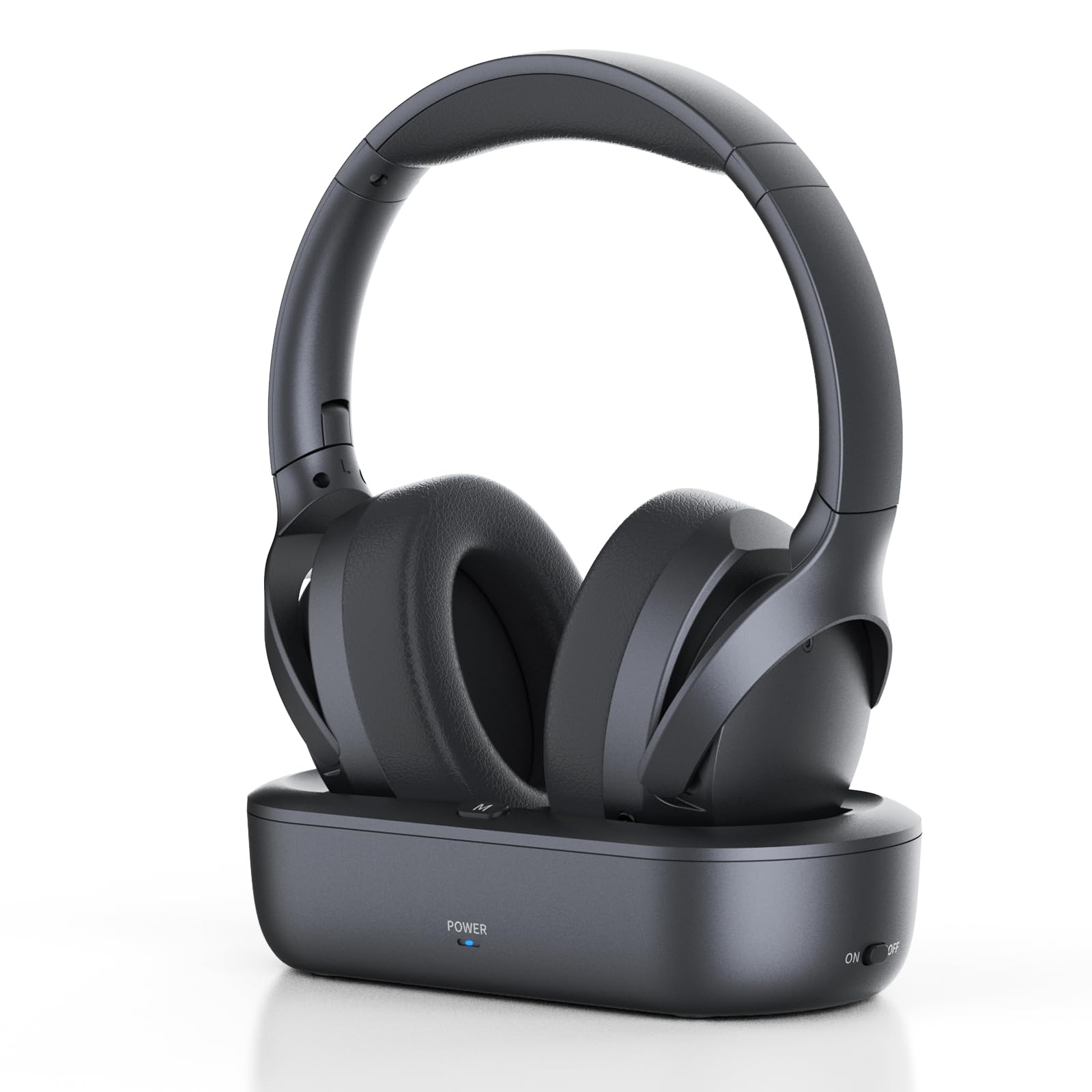
How To Choose The Best Wireless Headphones with Transmitter
Start with your TV, not the headset. A transmitter system is only as good as the port it plugs into, so look at the back of your set before you look at any product page. The three ports that matter are optical (sometimes labelled TOSLINK or Digital Audio Out), RCA (the red-and-white pair), and 3.5mm AUX (the round headphone-style jack).
Check your TV’s audio ports first
Most of the systems in this list connect through optical, RCA, or AUX, and several include cables for all three. HDMI ARC is a different story — it’s the port that carries audio both ways over a single HDMI cable, and only a couple of picks here support it at all. If your TV only has HDMI ARC and nothing else, check that before buying, because an optical-only transmitter won’t see any signal from it.
The PCM setting nobody tells you about
Here’s the setup step that trips up a lot of buyers. Many smart TVs ship set to output Dolby or DTS surround, and an optical-based transmitter often can’t decode those formats — you get silence or a hiss. Switch your TV’s digital audio output format to PCM (plain stereo) in the sound menu and the audio usually appears. This one setting fixes most “it doesn’t work” complaints with optical transmitters.
Latency: why lip-sync matters
Latency is the gap between the picture changing and the sound reaching your ears. Bluetooth adds delay by design, which is why a phone headset can feel out of step on TV. A dedicated 2.4GHz transmitter skips most of that, and aptX Low Latency is a codec built to shrink it further. If you watch a lot of dialogue-heavy drama or live sport, low latency is worth more than extra bass.
Hearing support versus a hearing aid
A TV headphone with a voice-clarity or volume-boost mode lifts dialogue above background music and effects — genuinely useful for mild to moderate hearing loss. It is not a hearing aid, and none of these products claim to be. If a household member needs hearing-aid-level amplification, these systems will likely fall short, and that’s a fit question rather than a fault.
Side-by-Side Comparison
| Model | Best For | Battery Life | Transmitter Inputs | Wireless Tech | Amazon |
|---|---|---|---|---|---|
| MEE Audio Connect T1CMA★ Best Overall | Everyday TV plus phone use | 30 hours | 3.5mm, RCA, Optical | Bluetooth 5, aptX Low Latency | Amazon |
| ZUPVIY Wireless TV Headphones for SeniorsBudget Champion | Budget-friendly senior listening | 5 days (standby rated) | Optical, AUX, RCA, USB | 2.4GHz + Bluetooth 5.0 | Amazon |
| ANSTEN Wireless Headphones for TVLong Range Pick | Long-range private viewing | 30 hours | Optical, RCA, 3.5mm AUX | RF dock + Bluetooth 5.4 | Amazon |
| RETRADEKING Senior Friendly Headphones | Arthritic hands and low vision | 15 hours | 3.5mm AUX, RCA, Optical | 2.4GHz + Bluetooth 5.3 | Amazon |
| Dytole Wireless Headphones for TV | All-day binge watching | 65 hours | Optical, 3.5mm AUX, RCA | 2.4GHz + Bluetooth 5.2 | Amazon |
| Avantree HT5009 Plus | aptX-Adaptive sound quality | 50 hours | Optical, 3.5mm AUX | aptX Adaptive | Amazon |
| Avantree Opera Plus | HDMI ARC households | 35 hours | HDMI ARC, Optical, AUX | Bluetooth 5 | Amazon |
| SIMOLIO 737D Plus | Two viewers, one TV | 20 hours | Optical, AUX, RCA | 2.4GHz + Bluetooth 4 | Amazon |
| Sennheiser RS 255 | Virtual surround immersion | 50 hours | Optical, 3.5mm analog | Bluetooth 4.2 | Amazon |
Detailed Reviews
1. MEE Audio Connect T1CMA
Our pick — 4.0+★ from 200+ verified ratings; the strongest balance of quality and price.
The box that handles old TVs and new phones in the same evening.
What makes the Connect T1CMA the pick to beat is that the transmitter ships paired to the headphones — you plug it in and you’re watching. It reaches your TV three ways: a 3.5mm headphone jack, RCA, or digital optical (TOSLINK, the square optical port). That trio covers most sets made in the last couple of decades, plus cable boxes, projectors, and computers. It holds 4.0+ stars across 200+ owner reviews.
Sync is handled by Qualcomm aptX Low Latency, a codec built to keep audio and video locked together so dialogue doesn’t drift behind the picture. The headphones run up to 30 hours on a charge and take 2 hours to fill — and the transmitter stays plugged in, so you’re only ever charging the headset. Against the ANSTEN below, the MEE fills in 2 hours versus the ANSTEN’s 3, though its Bluetooth version sits at 5 against the ANSTEN’s 5.4.
Where this one quietly wins is the dual-link feature: a second Bluetooth headset or speaker can join, with independent volume for each. That’s the difference between one person turning the TV up and two people each hearing it their own way. The honest catch is the volume control, the most mixed-feedback aspect on this model — a few buyers find the adjustment fussier than they’d like. Set the volume once from the headset and leave the TV level alone.
What earns it the top slot
- Ships pre-paired, so setup is plug-in-and-watch rather than a pairing routine
- Three transmitter inputs — 3.5mm, RCA, and optical — cover old and new TVs alike
- Up to 30 hours per charge, and the transmitter stays plugged in so only the headset needs topping up
- Dual-link lets a second headset or speaker join with its own volume level
Where it asks for patience
- Volume adjustment is the most mixed aspect on this model — expect some fiddling to find your level
- Optical-only TVs still need the PCM output setting before sound comes through
Reach for this if: you want one system that handles late-night TV and doubles as a normal phone headset.
Look elsewhere if: your TV is HDMI ARC only — the MEE’s transmitter has no HDMI input.
2. ZUPVIY Wireless TV Headphones for Seniors
The entry-level pick that treats lip-sync as non-negotiable.
ZUPVIY skips Bluetooth for TV duty entirely. The transmitter dock uses 2.4GHz wireless, a short-range radio band that carries the audio with no perceived delay — so football commentary lands with the tackle, not after it. There’s a Bluetooth 5.0 mode on the headset as well, but that’s for pairing to your phone or laptop, not the TV.
The dock is generous with ports: optical, AUX, RCA, and USB digital output all work. Setup is automatic — switch on the transmitter and the headphones, and they find each other. Buyers rate this one highly for exactly that: it’s a simple system that just connects. Owners praise the build and sound quality most, and the price stays firmly in budget territory.
Comfort is handled with protein leather pads over memory sponge, shaped for an ergonomic fit that stays put through a long session. Battery is listed at 5 days, and the fast-charge claim in the listing is genuinely quick. One thing to note: this model relies on its own 2.4GHz link for TV audio, so if you also want to stream from your phone at the same time, you’re switching modes rather than doing both.
Best fit for tight budgets: seniors who want a no-fuss, single-purpose TV headphone that pairs itself.
The trade-off to accept: the auto-pairing 2.4GHz link is TV-first — the Bluetooth 5.0 mode is a separate setting, not a parallel one.
Top value for simple setups: an optical, RCA, or AUX port and a viewer who wants dialogue back without a learning curve.
Think twice if: your TV offers only HDMI ARC — none of these ports will feed the dock.
3. ANSTEN Wireless Headphones for TV
Walk to the kitchen mid-match and the commentary follows you.
ANSTEN’s headline number is range: the RF transmitter dock holds a stable signal up to 100 feet, or 30 meters. That’s not a small detail — it means you can refill a drink or answer the door without the audio dropping out. The dock needs an optical, RCA, or 3.5mm AUX port; there’s no HDMI ARC support, so check the back of your set first.
Audio goes out with ultra-low latency, which keeps speech and lip movement together. The headphones run up to 30 hours per charge and can top up either on the transmitter base or over USB-C. There’s a second life here too: a standalone Bluetooth 5.4 mode for pairing with phones, tablets, and laptops, which is a newer Bluetooth version than most in this list.
Sound quality is this model’s most-praised aspect by a clear margin, and the swivel ear pads ease long wearing sessions. One setup quirk deserves a flag: on Roku, TCL, and many smart TVs you must manually set the digital audio output to PCM, or you’ll get no sound at all. That’s a menu fix, not a fault, but do it before you decide anything is broken.
The range argument: 100 feet of stable RF coverage makes it the most roam-friendly system in this list.
Set-up note worth knowing: switch your TV’s audio format to PCM first — Dolby and DTS won’t decode through the dock.
Made for restless viewers: anyone who wants to move around the house without pausing the programme.
Not your pick if: your set has only HDMI ARC for audio — this dock has no ARC input.
4. RETRADEKING Senior Friendly Headphones with Large Buttons

Built for hands that no longer enjoy hunting for tiny controls.
The design brief here was dexterity, and it shows. Power, volume, and EQ switching all run off extra-large buttons you can find by feel in a dim room. Three sound modes do different jobs: Voice Clarifying pushes dialogue forward, Full Mode adds cinema weight, and Normal Mode keeps things even. A one-tap mute is there for when the phone rings mid-scene.
Inside sit 40mm dynamic drivers, and the whole headset weighs 206g — light enough that a two-hour film doesn’t leave your ears aching. The base is the multi-tasker: transmitter, charger, and stand in one, with AUX, RCA, and optical cables all in the box. Charging runs 3 hours for up to 15 hours of playback, and the headset shuts itself off after 3 minutes of silence to save power.
Two honest points. The headband is built to twist and straighten without snapping, which is a real plus for rough handling. But 15 hours of playback is the shortest run time among the 2.4GHz systems here, so heavy daily viewers will be docking it most nights. Bluetooth 5.3 handles phone and tablet pairing, and you switch the base off to use it that way.
Where it shines for older viewers
- Extra-large buttons for power, volume, and EQ — no squinting at tiny switches
- 206g net weight keeps long sessions comfortable
- Twist-and-straighten flexible headband shrugs off rough handling
- Base doubles as charger, stand, and transmitter with all three cables included
What to weigh up
- Up to 15 hours of playback is the shortest of the 2.4GHz group
- Bluetooth 5.3 needs the base switched off before it will connect to a phone
Built around accessibility: the right choice for arthritic hands, low vision, or anyone who finds small controls a chore.
Check the run time: if you watch for hours daily, plan on docking nightly given the 15-hour figure.
5. Dytole Wireless Headphones for TV
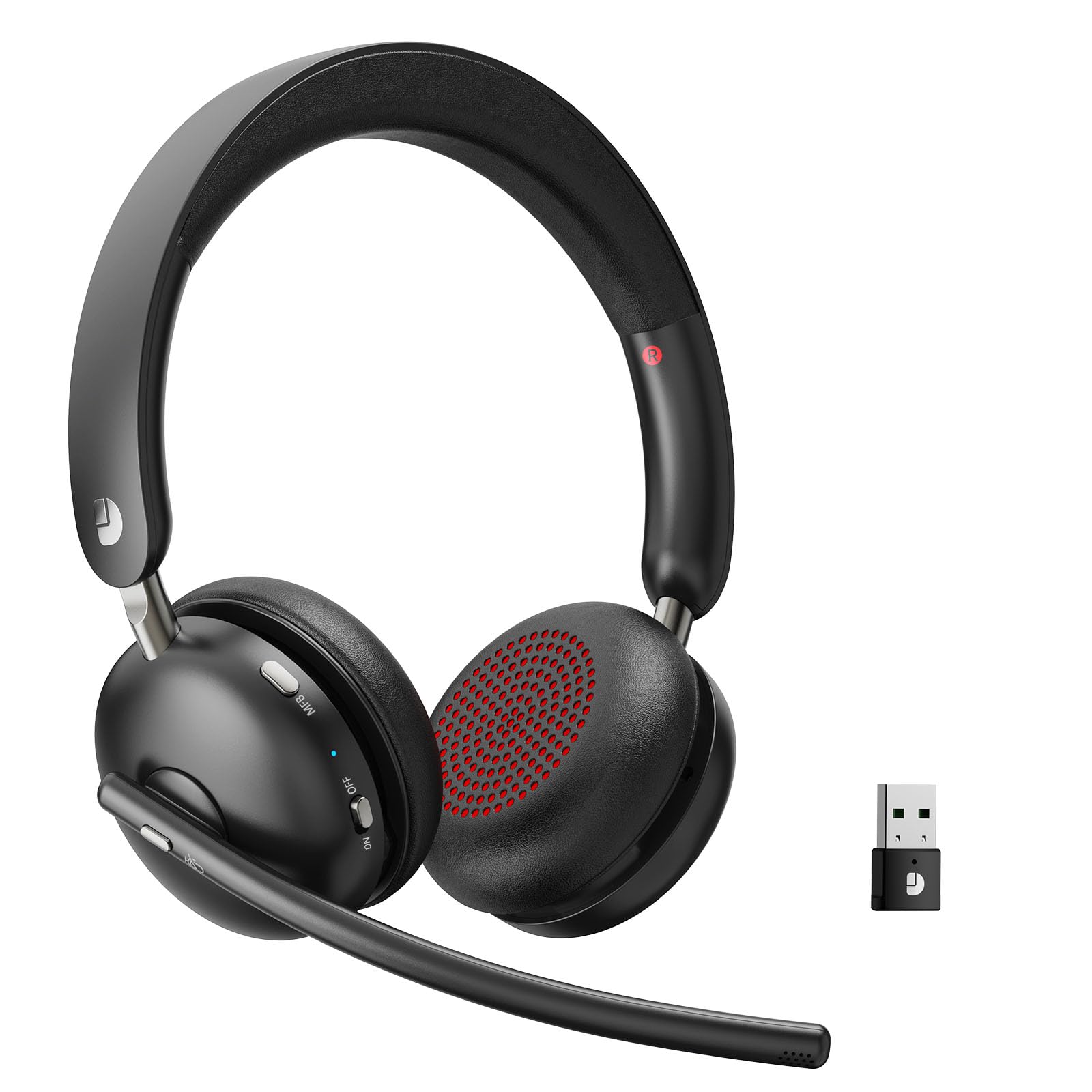
Sixty-five hours between charges, for the household that never turns the set off.
If battery anxiety is your thing, this is the number that settles it: 65 hours of rated playback, the longest run time in this list. Latency sits under 40ms, a figure small enough that lip movement and speech stay together on screen. Range reaches 30 meters, or 100 feet, and the transmitter base doubles as a charging stand.
Connections cover optical fibre, 3.5mm AUX, and RCA, and Bluetooth 5.2 lets the headset pair to a phone or computer when the TV is off. The drivers are dynamic, and the over-ear shape is built for long wearing. Personalized volume control is there for viewers with hearing impairment who want dialogue lifted above the mix.
Now the honest part, because it matters here. The quality and sound clarity get strong marks from owners, and setup is described as straightforward. But durability is the one aspect drawing negative feedback on this model — a segment of buyers report the headband or housing giving out within a few months. Treat that as a reason to handle them carefully and keep the receipt. If you’re hard on gear, factor it in.
The battery case: 65 hours is the longest figure on this list — charge it weekly, not nightly.
The honest warning: durability is the weak spot in owner feedback, so buy with care and expect to look after them.
Best for the always-on TV: households that watch from breakfast news to late-night talk shows.
Buy carefully if: the headphones get tossed in bags or handled roughly — durability is the recurring concern.
6. Avantree HT5009 Plus
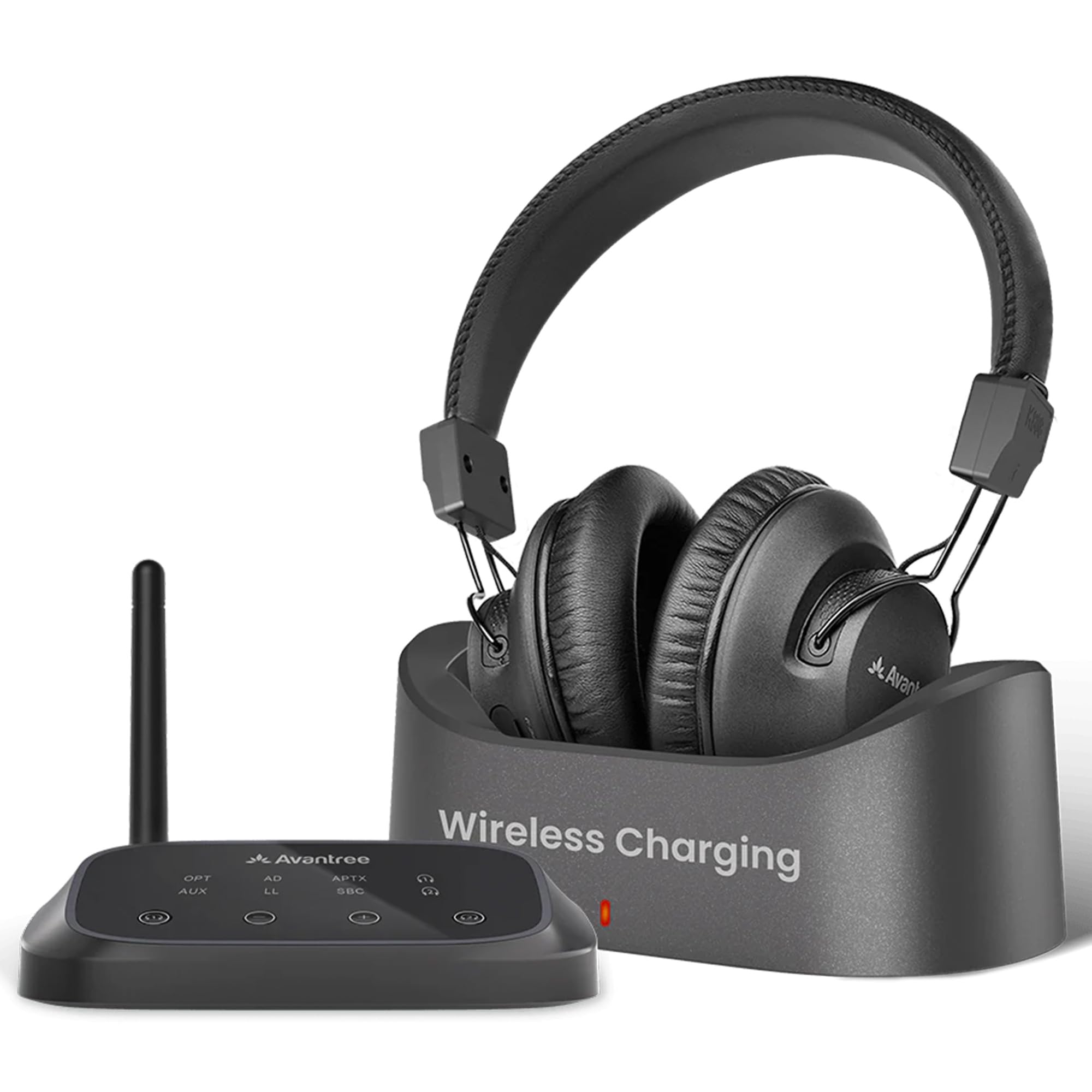
aptX Adaptive audio, a Clear Voice mode, and a dock that stays out of the way.
The HT5009 Plus leans on aptX Adaptive, a codec that adjusts its bitrate to keep audio stable and detailed on a wireless link. Add the Clear Voice mode and dialogue gets a lift above background music and effects — handy for news, dramas, and talk shows. It runs for up to 50 hours, sits in a wireless charging dock, and takes 2 hours to fill.
Compatibility is honest and specific: the transmitter works with TVs that have an optical (digital audio out) or 3.5mm AUX port. It is not compatible with sets that only offer HDMI ARC, so check before you buy. If your TV feeds a soundbar, this system can work alongside it.
Owner feedback is warm on the build and the everyday functionality, with setup drawing praise. But sound quality and connectivity are more divided — some find it great and easy to pair, others hit poor sound or smart-TV pairing trouble. That split is worth knowing if you’re on a fussy smart TV, and it’s the main reason it sits below the MEE in this list.
The codec edge: aptX Adaptive and Clear Voice make this the pick for listeners who want dialogue and detail together.
Where it splits opinion: pairing with some smart TVs takes patience, and a few owners mention thin sound.
Choose it for audio-first viewing: film and drama watchers who value sound detail over pure simplicity.
Skip if: your TV only has HDMI ARC output — the transmitter won’t see it.
7. Avantree Opera Plus

The one that plugs into the port most modern TVs actually use.
Most transmitters in this category want optical or AUX. The Opera Plus is the exception: it accepts HDMI ARC, the audio-return channel that carries sound back up an HDMI cable from the TV. That makes it the natural fit for a newer set with no spare optical port. Optical and AUX are also on board, so older TVs aren’t left out.
Latency sits at 30 milliseconds, a gap small enough to keep dialogue and lip movement aligned. Battery is rated at up to 35 hours, charges in 2 hours, and works over a Bluetooth range of 50 meters. A volume boost is built in for viewers who need dialogue pushed forward, and 3D surround sound adds depth to films. The 2-in-1 transmitter also serves as a charging dock.
Sound quality is the most-praised aspect by a wide margin, with ease of use close behind. But performance and connectivity draw mixed feedback, with some buyers hitting occasional dropouts or failing to get a picture with their set at all. One specific limit worth knowing: if you run a soundbar, only optical passthrough is supported — HDMI soundbar passthrough is not.
The ARC advantage: a direct HDMI ARC input makes this the friendliest pick for modern TVs with no free optical port.
The honest caveat: “boost” is not hearing-aid-level amplification, and a few owners hit TV connection trouble.
Pick it for a modern TV: owners of newer sets whose only spare audio port is HDMI ARC.
Go optical instead if: you need HDMI soundbar passthrough — only optical pass-through is supported here.
8. SIMOLIO 737D Plus
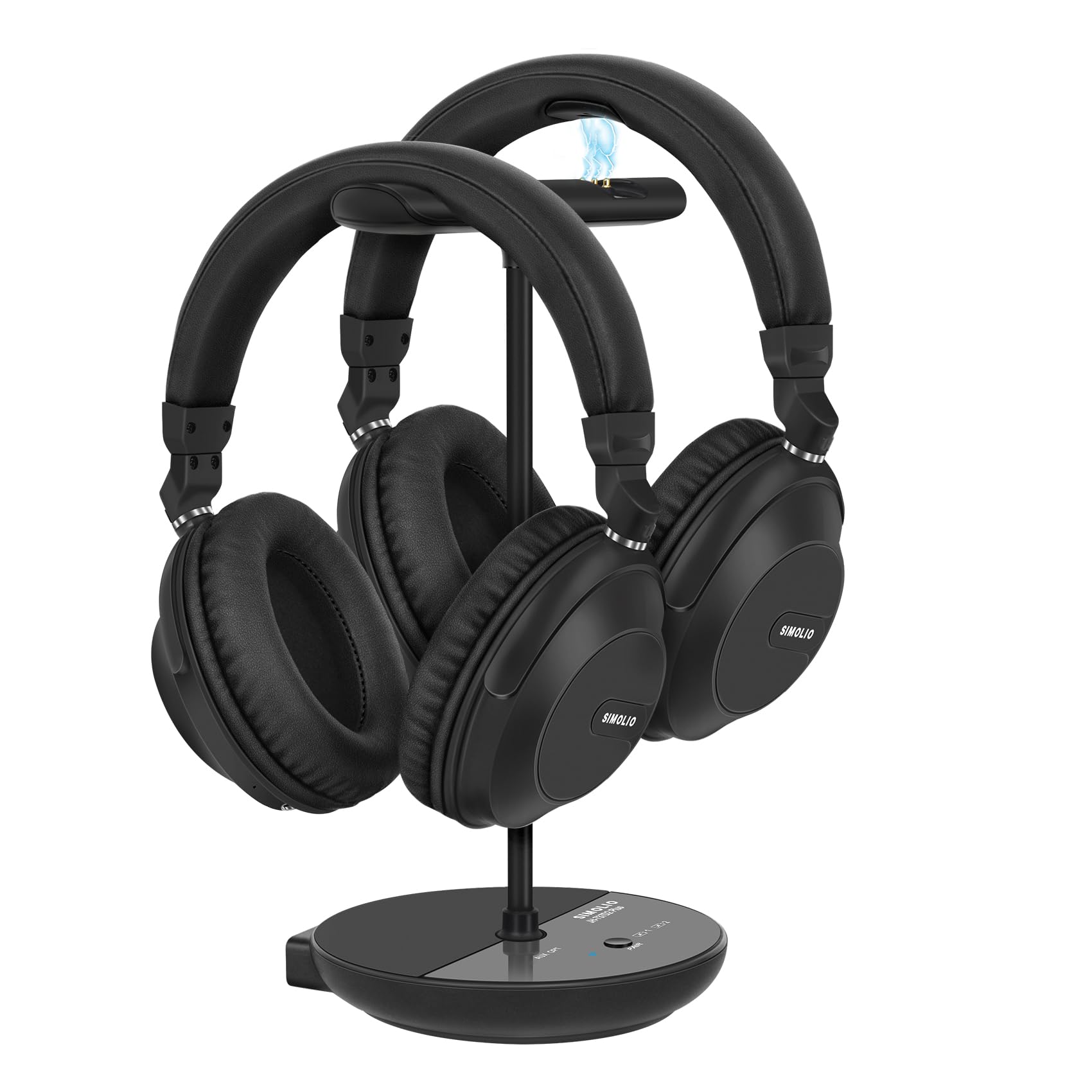
Two headsets in the box, each with its own volume dial.
The 737D Plus is the pick when more than one person is watching. Two pre-paired headphones come in the box, and each has independent volume — so a hard-of-hearing viewer can crank dialogue while their partner keeps a softer level. There’s a bypass feature that lets both the headphones and an existing soundbar or AV receiver share the same audio output, so nobody is left out of the room.
Latency is rated at 25ms, keeping audio and picture in step. Range stretches to 164 feet, or 50 meters, in open air, which covers most homes and then some. Three EQ modes — clear dialogue, standard, and cinema — let you tune to the content. Battery runs up to 20 hours per charge, and the transmitter doubles as a charging dock with cable charging available too.
Setup is straightforward: plug the transmitter into the TV’s optical, AUX, or RCA output, switch both on, and you’re away. The protein ear cushions and retractable padded headband stay comfortable through a film or two. Owners praise the build quality most, along with a two-headset setup that works as intended. One limit worth noting: for HDMI-ARC-only TVs, SIMOLIO points to a different model in its range.
Why couples like it
- Two pre-paired headphones included, each with its own volume control
- Optical bypass lets a soundbar and the headphones share one audio output
- 164-foot open-air range covers kitchen, garden, and garage
- Three EQ modes including a dialogue-clarifying setting
Keep in mind
- HDMI-ARC-only TVs aren’t supported — SIMOLIO directs you to a different model
- 20 hours per charge is shorter than several singles here
The two-viewer solution: couples or families where one person has hearing needs and the other doesn’t.
Only one thing to check: confirm your TV has optical, AUX, or RCA — ARC-only sets need the other SIMOLIO model.
9. Sennheiser RS 255

Virtual surround and speech clarity, bundled with a BTA1 transmitter.
Sennheiser brings two audio tricks that set it apart. Virtual Surround Sound widens the soundstage, and Speech Clarity lifts character voices above background effects so dialogue stays intelligible. There’s also automatic levelling of sudden volume spikes — so an explosion doesn’t blast your ears mid-film. Hearing-profile customisation is in there too.
Battery is rated at up to 50 hours on a user-replaceable cell, and the bundle includes a BTA1 transmitter with optical and 3.5mm analog cables. Comfort comes from an adjustable design with plush ear cups. Classic Bluetooth 4.2 covers pairing to a phone or tablet when the TV is off.
If virtual surround and clearer dialogue matter more to you than the newest Bluetooth version, that trade makes sense. For room to move, its 50-meter range matches the Arc models above.
The cinema angle: virtual surround and speech clarity are features the budget picks simply don’t have.
The spec trade: Bluetooth 4.2 is older than most in this list, so expect the value in audio processing, not wireless modernity.
For film lovers: anyone who wants surround-style depth and clearer dialogue in the same headset.
Look at the MEE instead if: you want the newer Bluetooth version and a lower tier for the same dual-purpose TV-and-phone use.
Know the Specs
Transmitter inputs (optical, RCA, AUX, HDMI ARC)
The transmitter is the little box that takes sound out of your TV and beams it to the headphones. Optical (also called TOSLINK or Digital Audio Out) is the square port, RCA is the red-and-white pair, and AUX is the round headphone jack. HDMI ARC is the newer one-way-audio-over-HDMI port that only some picks here accept. More inputs means more TVs it’ll fit — a unit with optical, RCA, and AUX covers the widest range of sets, new and old.
Latency in milliseconds
Latency is the delay between the picture and the sound. Bluetooth adds it by design, which is why a phone headset can feel out of step on TV. Dedicated 2.4GHz transmitters cut it down, and aptX Low Latency is a codec built to shrink it further. A figure of 30ms or less feels essentially in sync; a figure under 25ms is tighter still. If you watch sport or dialogue-heavy drama, lower is better.
Battery life and charge time
Battery life is rated in hours of playback, and the spreads here run from 15 hours to 65. Charge time is how long the headset takes to fill. Many systems let the transmitter double as a charging dock, so you set the headset down and it tops up. If you watch nightly, a longer run time and a dock save you the nightly cable routine.
Dual-headphone and independent volume
Some systems support a second headset or speaker joining the same transmitter. Each connected device can have its own volume, which matters when one viewer needs more volume than another. Two-headphone packages include both headsets pre-paired, so there’s nothing extra to buy. Independent volume means each pair is adjusted on its own, not tied to a shared master level.
Hearing support features
Voice-clarity modes, dialogue-boost settings, and volume-boost controls lift speech above background. These help with mild hearing loss — but none of these products are hearing aids, and the manufacturers are clear they don’t offer hearing-aid-level amplification. If a viewer needs that level of help, these are the wrong tool.
The PCM setting
PCM is plain stereo. When your TV is set to output Dolby or DTS, an optical-based transmitter may fail to decode it. Switch the TV’s digital audio output to PCM and audio typically returns. It’s the single most common fix for “no sound” complaints with optical systems.
Common Questions
Will a TV headphone with transmitter work if my TV only has HDMI ARC?
Why do I get no sound when I plug the transmitter into the optical port?
Will the headphones cause a delay between the picture and the sound?
Can two people use the same TV headphone system at once?
Is a TV headphone the same as a hearing aid?
Will the headset also work with my phone and laptop?
Can I use the headphones with a soundbar at the same time?
How far away can I walk from the transmitter before losing signal?
Does the transmitter recharge the headphones automatically?
How long do these headphone systems last before they wear out?
The Bottom Line
One pick handles the most jobs well: the MEE Audio Connect T1CMA. It gives you three transmitter inputs, aptX Low Latency for clean sync, and dual-headphone streaming. So it covers a quiet late-night film and a phone call the next morning. Want the most battery for the money? The Dytole leads with 65 hours, though handle it gently. Two viewers with different hearing needs can share the SIMOLIO 737D Plus, which comes with two pre-paired headsets and independent volume. And if your TV only offers HDMI ARC (the audio-return channel on an HDMI port), the Avantree Opera Plus is the one built for that port. Whichever you choose, check your TV’s audio ports and set it to PCM (an uncompressed audio format most TVs can output) before declaring anything broken.
How we choose
We do not accept paid placement. Every pick is matched to a real buyer and a real use-case; we do not hands-on test units.
Sources
Specifications: manufacturer listings and product documentation. Review insights: verified customer reviews, as of November 2026. Pricing: not shown on this page (it changes often); check the current price via the retailer link.
As an Amazon Associate, Tactical Gear Guy earns from qualifying purchases. This does not affect which products we feature.