Specs are compiled from manufacturer listings and verified buyer reviews and can change over time — please confirm the key details on the product page before buying.
You want something you can strap on, clip on, or hold that actually pulls your nervous system down a gear — not another step counter that just tells you how stressed you already feel. In this category, whether a device acts on you or just reports on you decides whether you’ll still use it in a month. A wearable stress reducer has to do something active: guide your breath, buzz a calming rhythm into your skin, or read your brainwaves and feed that back to you in real time. The nine devices below all do one of those things, and each one earns its place for a different kind of buyer.
This guide is built by comparing the manufacturers’ published specifications and the patterns across verified customer reviews, so you get each pick’s real strengths and trade-offs instead of marketing spin.
Some of these are guided-breathing tools you hold in your palm; others are EEG headbands that map alpha and theta waves while you sit still. Match the method to your moment: a palm-held breath pacer for a mid-meeting reset, an EEG headband for a seated evening session. Read on for nine wearable stress reducers, from a blow-through necklace to an EEG-plus-fNIRS headband.
Top Picks


How To Choose The Best Wearable Stress Reducers
Start with one question: do you want a device that does something to calm you, or one that shows you what your body is doing so you can learn to calm yourself? Both approaches appear on this list, and picking the wrong one is the most common reason people buy a calming gadget and stop using it inside a month. A handheld breathing guide physically paces your inhale and exhale — you follow it. An EEG headband reads your brainwaves and turns them into feedback — you practice and watch the numbers shift. Neither approach is better on paper — a breath pacer suits someone who wants to be led, an EEG headband suits someone who wants to watch the numbers move.
Session length and how much of your day it takes
Some of these tools work in a couple of minutes of quiet breathing. Others ask for a structured session — using a vibration-based device twice daily, for instance, or building up meditation time on a headband. Be honest about how long you will actually sit still. A two-minute handheld session fits into a commute; a structured twice-daily routine needs a fixed slot in your day.
What you’re actually measuring
Heart-rate variability (HRV) is the tiny variation in the gap between heartbeats; a calmer nervous system tends to produce a more relaxed, steady pattern. Skin conductance measures how much your skin sweats in response to stress — a subtle electrical signal. EEG reads electrical activity across the brain and sorts it into wave bands like alpha and theta. Knowing which of these a device tracks tells you what kind of progress you’ll be able to see.
Subscriptions, batteries, and the long-haul cost
Several wearables bundle a membership — a year of guided content or data insights — with the hardware, and once that year runs out some features keep working while others ask to renew. Rechargeable batteries range from about a week of use to far shorter sessions per charge. Check the membership terms and the per-charge session count before you buy, since both decide what the device costs you after year one.
Fit and form on your body
A necklace, a headband, a palm-sized pebble, and a chest piece all feel completely different to wear. Anything that needs skin contact — hydrogel sensors on a forehead, a pulse sensor on a sternum — has to stay put through a full session. Weight decides carry: a 29-gram headband or a 4.59-ounce handheld travels in a bag, while a 15.52-ounce chest device stays on the nightstand.
Side-by-Side Comparison
Three columns carry the buying decision here: what the device actually does to calm you, how you wear or hold it, and the connectivity or membership that keeps it working.
| Model | Best For | Calming Method | Wear / Carry Form | Battery or Membership | Amazon |
|---|---|---|---|---|---|
| LOVETUNER 528Hz Breathing Necklace★ Best Overall | Fast breathing resets anywhere | 528Hz pitched sound whistle | Necklace | — | Amazon |
| Glowco CalmCarryBedtime Favorite | Kids and bedtime calm | Microcurrent pulses | Handheld | Up to 30 sessions per charge | Amazon |
| COVEStructured Program | Structured twice-daily practice | Subtle vibration | Wearable skin-contact | 12-month membership included | Amazon |
| Reflect Orb | Learning to relax with light feedback | Light biofeedback | Handheld orb | Up to 2 weeks per charge; 1-year membership | Amazon |
| SereniBrain EEG Headband | Brainwave training without subscriptions | Real-time EEG neurofeedback | Headband | No subscription fees | Amazon |
| Flowtime Biosensing Headband | Deep data on meditation sessions | EEG + HRV biosensing | Headband | 8 hrs meditation / 50 days standby | Amazon |
| moonbird Handheld Breathing Guide | Guided breathing with HRV insight | Expanding/contracting breathing coach | Handheld | Rechargeable | Amazon |
| Sensate Relaxation Device | Chest-worn vibrotactile calm | Infrasonic vibration | Chest piece | 12 months Sensate Plus included | Amazon |
| Muse S Athena | Advanced EEG + fNIRS sleep and focus | EEG + fNIRS biofeedback | Headband | Optional Premium subscription | Amazon |
Detailed Reviews
1. LOVETUNER 528Hz Breathing Necklace
Our pick — 4.0+★ from 350+ verified ratings; the strongest balance of quality and price.
A necklace you blow into that turns a long exhale into the whole point.
Here is the appeal in one line: you breathe out through a tuned whistle that sounds a steady 528Hz note, and the length of that note is the length of your exhale. Because you have to keep the tone smooth and constant to make it work, your breath naturally slows and deepens. That’s the entire mechanism, and it’s why this is the top pick — no app, no charge, no pairing, no screen. You pull it from the cap, put the engraved-dove side between your lips, and blow gently like a flute. One long exhale easily runs well past a minute if you keep the volume soft and even.
The build quality is what wins people over — it’s the most-praised thing about this necklace by a clear margin, and the patent (US 11,986,601) marks it as a real trademarked instrument rather than a novelty. Owners describe it as beautiful enough to wear as jewelry and useful enough to reach for during a stressful meeting or a pre-meditation reset. It’s tuned to 528Hz exactly, and the maker is upfront that careless handling or extreme temperature swings can nudge that pitch. Treat it like the sensitive instrument it is, store it back in its cap dove-side-up, and it holds its tune.
What earns it the top spot
- Works in seconds with zero setup — no app, no battery, no pairing
- 528Hz pitch gives your exhale a built-in timer so breathing slows naturally
- Necklace form means it’s on you when stress hits, not in a drawer
- Patented, trademarked device with real craftsmanship behind it
Where it asks for care
- It’s a precise instrument — drops and temperature swings can shift the pitch
- Some owners question the value; it’s a simple object for a wellness-category price
- You have to be willing to actually blow into it, which is very public in an open office
Reach for this if: you want the simplest possible calming tool — one that lives around your neck and works the instant you pick it up.
Think twice if: you want data or a guided program; this gives you sound and breath, not readings.
2. Glowco CalmCarry Sleep Aid Device
The palm-sized pebble that has parents buying a second one for the kids.
This is the lightest and most pocketable microcurrent tool on the list — it slips into a bag and you forget it’s there. It weighs 4.59 ounces and packs down to 4.72 x 2.95 x 2.24 inches. Compare that with the COVE device above, which runs 15.52 ounces and 6.5 x 6.42 x 4.25 inches: the CalmCarry is a fraction of that bulk, so it fits in a palm or a coat pocket without a second thought. You hold it against a hand acupoint (a pressure point on your hand) and it delivers soft microcurrent pulses (tiny electrical currents). Current models ship without the automatic 20-minute shut-off, so you control session length.
You get up to 30 sessions per charge from the rechargeable battery, so you’re not hunting for a cable every night. What wins people over is straight-up relaxation — buyers report it’s by far the most-praised thing about this device. Reviews lean heavily toward bedtime use, including kids aged 3 and up under adult supervision easing through transitions like school mornings or lights-out. It’s screen-free, which is a real draw if you’re trying to get a wired child to wind down without a glowing rectangle.
The honest catch is that microcurrent is divisive. Effectiveness and quality draw genuinely mixed reactions — plenty of buyers call it life-changing, while others say it simply didn’t do anything for them. There’s also a subset who notice the current itself as a shock or tingle, so if you’re sensitive to electrical sensation, that’s the one to weigh. Start at the lowest comfortable level and let your own response decide.
Who this fits: parents who need a screen-free wind-down tool for a child, or adults who want something tiny and rechargeable for the bedside table.
Fair warning: the pulse is felt, not invisible — test the sensation gently before you hand it to a kid.
Go for it if: you want a lightweight, kid-usable bedside device at the entry end of the price range.
Look elsewhere if: you dislike the idea of electrical sensation on your skin — a breathing or vibration tool suits you better.
3. COVE Wearable Stress & Sleep Device
Twenty minutes of gentle vibration that asks you to commit twice a day.
COVE’s pitch is specific: subtle vibration activates a skin-to-brain calming pathway, and the maker recommends using it twice daily — once before bed — at a low calibrated vibration level for the first 30 days. That’s not a casual, use-it-when-you-feel-stressed device. It’s a routine, and the results people describe track with that. Anxiety reduction is the thing owners praise most, with sleep quality and a general sense of calm right behind it. Some describe the effect as life-changing, and the AI biometric feedback after each session gives you something concrete to look at beyond a vague “that felt nice.”
What you’re buying into is the bundled 12-month all-inclusive membership, which open up wellness content, your biometric data, and more. That’s the heart of the value here — the hardware is a vibration tool, but the membership is where the structure lives. It’s bulky next to the handhelds (15.52 ounces), so this is a nightstand device, not a travel companion.
The trade-off is that results aren’t universal. Effectiveness splits down the middle — some find it genuinely helpful, others report it did nothing for them over the trial period. Connectivity also draws complaints, so pairing and app syncing can be the friction point. Give it the full 30-day twice-daily window before you judge it, because a couple of sessions won’t tell you much.
The real value: a year of structured content and biometric feedback wrapped around a vibration device — you’re buying a practice, not a gadget.
The honest limit: it needs real commitment, and a meaningful slice of buyers never felt the payoff.
Best for: someone who wants a guided, twice-daily routine and values seeing their own biometric data afterward.
Not for: the impatient or the traveler — this wants a fixed spot on your nightstand and a month of consistency.
4. Reflect Orb Smart Biofeedback Device

A glowing orb that dims and brightens with your body, teaching you to relax.
Set the orb up once with the Reflect app for iPhone or Android, then you can put the phone away and use the orb on its own for sessions. Here’s what makes it different from every other tool here: its light changes in response to your body’s signals, so the feedback is visual and immediate. You adjust your breathing, watch the light shift, and slowly learn what actually calms you — building the skill rather than just borrowing a moment of quiet. That’s why owners call it one of the more useful wellness tools they’ve tried: it encourages a consistent practice and lets you see progress in your meditation rather than guessing.
The battery runs up to 2 weeks per charge depending on use, which keeps it off the charger for real stretches. Your purchase includes 1 year of premium app access with guided breathing, meditation, and session insights. Once that year is up, premium content asks for a paid membership — but the orb’s light biofeedback keeps working without any renewal, so the hardware never turns into a brick.
The thing to know going in: this is an adult-oriented tool, and the real payoff comes from treating it as a daily practice rather than an emergency button. If you want something to grab in a panic, the breathing-focused tools do that faster. If you want to build a skill over weeks, the light feedback is quietly powerful.
Why it works: visual feedback you can act on in the moment — you see your body respond instead of being told about it.
Keep in mind: it’s a practice tool, so a slow, regular rhythm with it beats an occasional rescue session.
Pick this if: you want to learn to relax on your own and like the idea of seeing your body respond in real time.
Pass if: you need instant, on-the-spot relief — the orb rewards patience over panic.
5. SereniBrain EEG Neurofeedback Headband
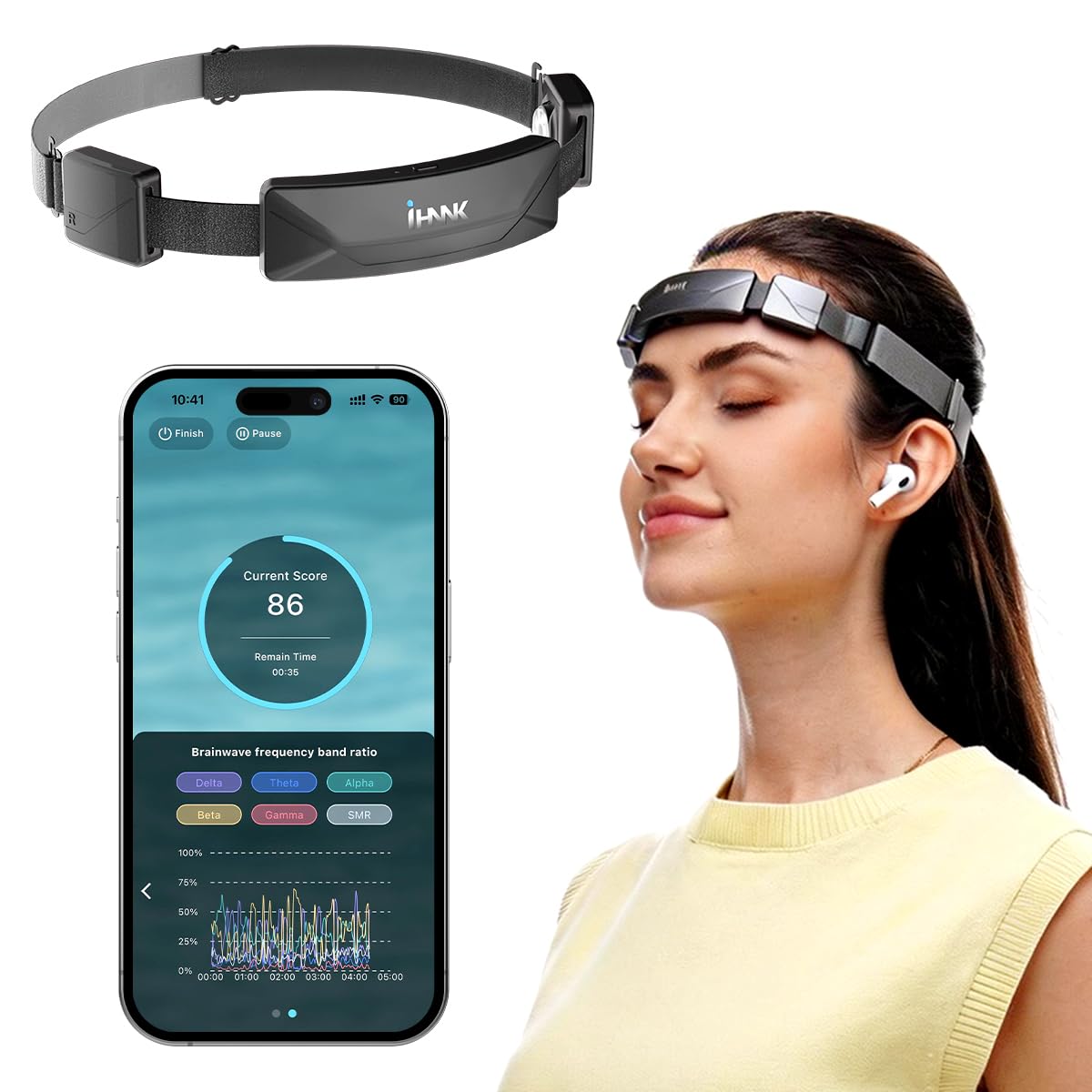
Real brainwave feedback on your forehead with no membership hanging over it.
At 50 grams — about the weight of a couple of AA batteries — this headband is easy to forget you’re wearing, and hydrogel skin-contact sensors adapt to your forehead for a stable signal. Those sensors use a low-impedance interface, which is a fancy way of saying they keep the electrical connection clean so the brainwave readings hold steady. You get real-time tracking of alpha, beta, and theta waves, and the app turns those into feedback: when your mind calms, the visuals and sound become clearer. That’s the training loop — you’re rewarded with clarity as you settle.
You pay once and skip the annual memberships that crowd this category — the no-subscription-fees design is a genuine draw. Reviewers praise quality and meditation feedback the most. The app records your sessions — meditation duration, focus levels, and training history — and keeps records of your last 30 uses, so you can download your data and watch a trend build over about a month. You connect over Bluetooth (a short-range wireless link) to iOS 14 or higher or Android 10 or higher, and it’s compatible with the Apple App Store, Google Play, and Samsung Galaxy Store.
Function and accuracy draw mixed reactions, so treat the readings as a training aid rather than a lab instrument, and expect to spend a little time getting the sensor placement right. The included carrying case and six collecting pads give you spares for the sensor surface.
Strong points
- No subscription fees — the app’s guided meditation and training are part of the deal
- Light 50 grams with hydrogel sensors for comfortable, stable signal pickup
- Tracks alpha, beta, and theta for a real read on focus versus calm
- Ships with a carrying case and six spare signal pads
Things worth weighing
- Function and accuracy are hit-and-miss, so don’t expect clinical-grade numbers
- There’s a learning curve to sitting still and getting good contact
- App compatibility varies by phone, so check yours first
the balance: budget-minded brain training for someone who wants EEG feedback (a readout of your brain’s electrical activity) and resents paying for a subscription.
The caveat: readings and app behavior vary enough that you should expect some setup fiddling.
6. Flowtime Biosensing Meditation Headband

The data nerd’s headband: alpha, beta, theta, gamma, HRV, all in one sitting.
If you want to know exactly what your meditation is doing, this is the most data-dense option on the list. It surfaces real-time brainwaves plus heart rate, HRV, relaxation, attention, and pressure level — so you can see whether you actually slipped into a meditative state or just sat with your eyes closed. At 29 grams it’s the lightest headband here, and the battery runs about 8 hours of meditation with 50 days on standby, which means a full week of short sessions easily fits between charges. Bluetooth connects it to the free app on the App Store or Google Play.
The software is what people rave about — it’s the single most-praised thing about this headband, comfortably ahead of everything else. The lessons cover a spread of topics that build basic technique day by day, and veterans get an unguided mode if they’d rather just sit. The detailed biodata report breaks down your performance minute by minute, flags when you hit a meditative state, and compares this session with your last seven so you can see the trend line. If progress to you means a graph, this delivers.
The honest picture: reliability and connectivity are the recurring gripes — Bluetooth dropouts and the odd glitchy session are the friction points in an otherwise rich software experience. Ease of use draws mixed notes too, mainly from the setup side. Wear it soft, keep it charged, and the app carries the weight.
Where it leads: sheer depth of session data — minute-by-minute breakdowns and a seven-session comparison that no handheld here matches.
Where it stumbles: Bluetooth reliability, so budget a little patience for pairing and the occasional reconnect.
For the numbers person: you want to treat meditation like training and watch your HRV and wave bands move over weeks.
Skip if: you’d rather breathe than read charts — a simpler guided tool will get used more.
7. moonbird Handheld Breathing Guide

A palm-sized puck that swells and shrinks so your breath has something to follow.
Moonbird works on a beautifully simple idea: it gently expands and contracts in your hand, and you match your breathing to its rhythm. That physical cue is why it works within minutes — you’re not reading a timer or watching a screen, you’re holding the pace in your palm. It’s screen-free and rechargeable, so it lives on a nightstand, goes to work in a bag, and pulls you toward a slower breath without any app session required. Reaching for it before bed is its natural home, since slowing your breath is the whole path to unwinding before sleep.
When you do wire it to the moonbird app, you get insight into how your body responds — heart rate, HRV, and coherence data — so the practice isn’t blind. That’s the difference between this and a plain breathing timer: the device paces you, the app shows you the effect. It’s a mid-priced tool with a premium feel and a genuinely different mode of operation from the headbands above.
Where it asks something of you: this is a coaching tool, not a rescue device, and the payoff comes from regular use. If you want something that reports a stress score back to you, this doesn’t do that — it leads your breath and lets the app mirror the results afterward.
What clicks: a tactile breathing pace you can feel without looking at anything — no screen guiding you, just a rhythm in your hand.
What to accept: it’s a practice tool that rewards consistency, so an occasional grab won’t show you much.
Choose this when: you want a tactile, screen-free breathing coach with optional HRV insight from the app.
Reconsider if: you want on-demand readouts of your stress level — the headbands deliver data more directly.
8. Sensate Relaxation Device
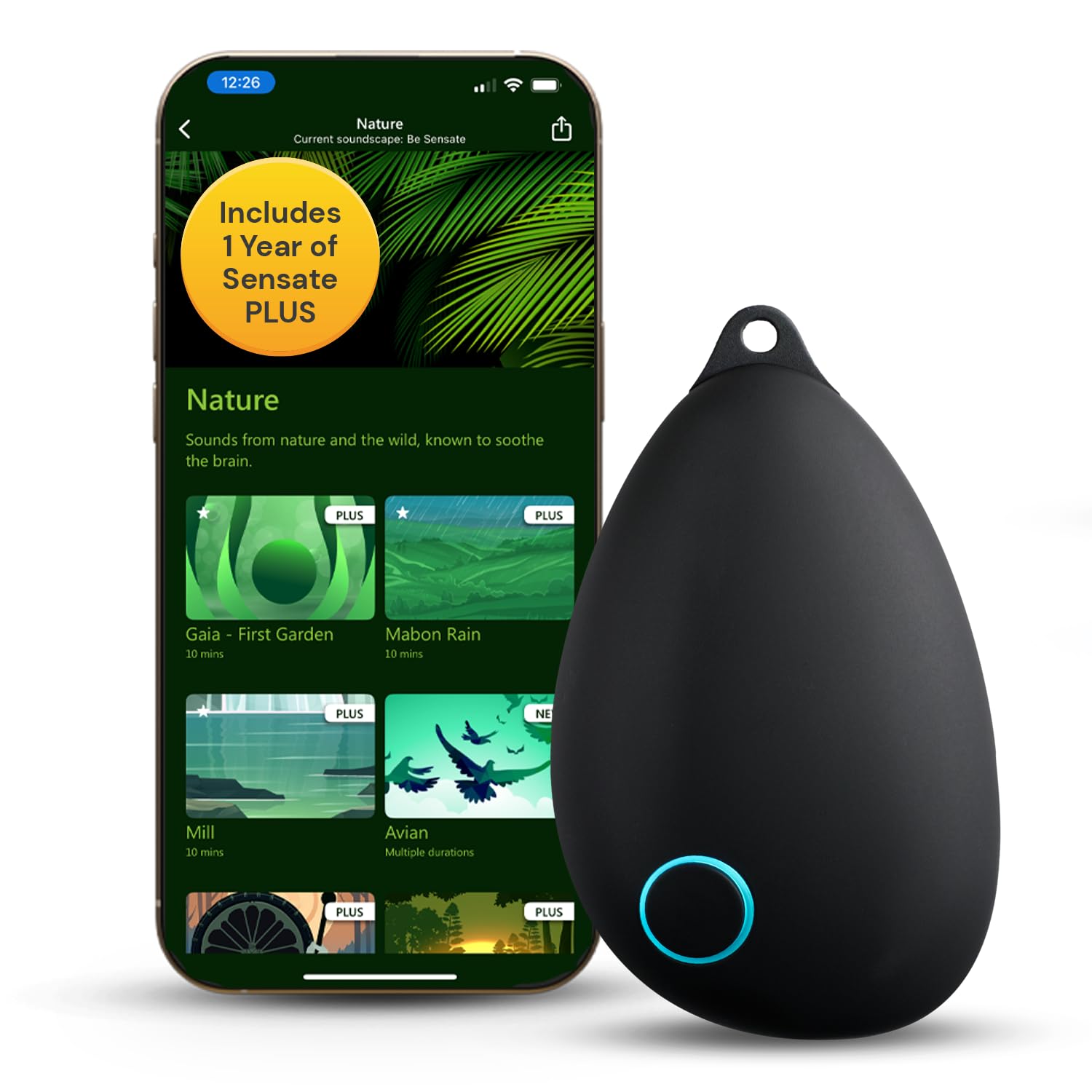
Soothing vibrations through the sternum, not electrical shocks — a different route to calm.
You rest this against your chest and it sends gentle infrasonic vibrations (low-frequency vibrations you feel rather than hear) through your sternum. The maker frames the goal as shifting your body out of fight-or-flight in as little as 10 minutes. The key design choice is that it uses tactile sound rather than electrical pulses, so if the microcurrent approach made you flinch earlier, this is the gentler alternative. The device comes with 12 months of Sensate Plus, an rich soundscape experience you activate by creating an account and submitting the redemption form.
What owners respond to is straightforward: the vibrations soothe the nervous system and help with sleep, and the music options get a warm reception for how they shift from meditation into melodic tracks. The chest placement makes it a sit-down, lean-back kind of ritual rather than a pocket companion — 13.76 ounces means it’s a device you set where you unwind, not one that travels. Compared with the handheld tools here, it’s built for a dedicated session in one spot.
The honest note: it’s a practiced routine, and the bundled soundscape subscription is where much of the experience lives once you’re past the hardware. If you want something you can use on the subway or mid-meeting, the CalmCarry or Lovetuner suit you better.
Why it stands out: no electrical sensation — the calm arrives as tactile vibration and soundscapes, which many find easier to settle into.
The trade-off: it’s a stationary chest-worn ritual, not a grab-and-go tool for stressful moments out in public.
Great fit for: someone who wants a sit-down evening ritual with soothing chest vibrations and rich audio. If you need on-the-go relief in the middle of a workday, this one stays home.
Not ideal if: you need calm on the move — this one wants a quiet room and a few minutes to settle.
9. Muse S Athena 3rd Gen Brain Sensing Headband
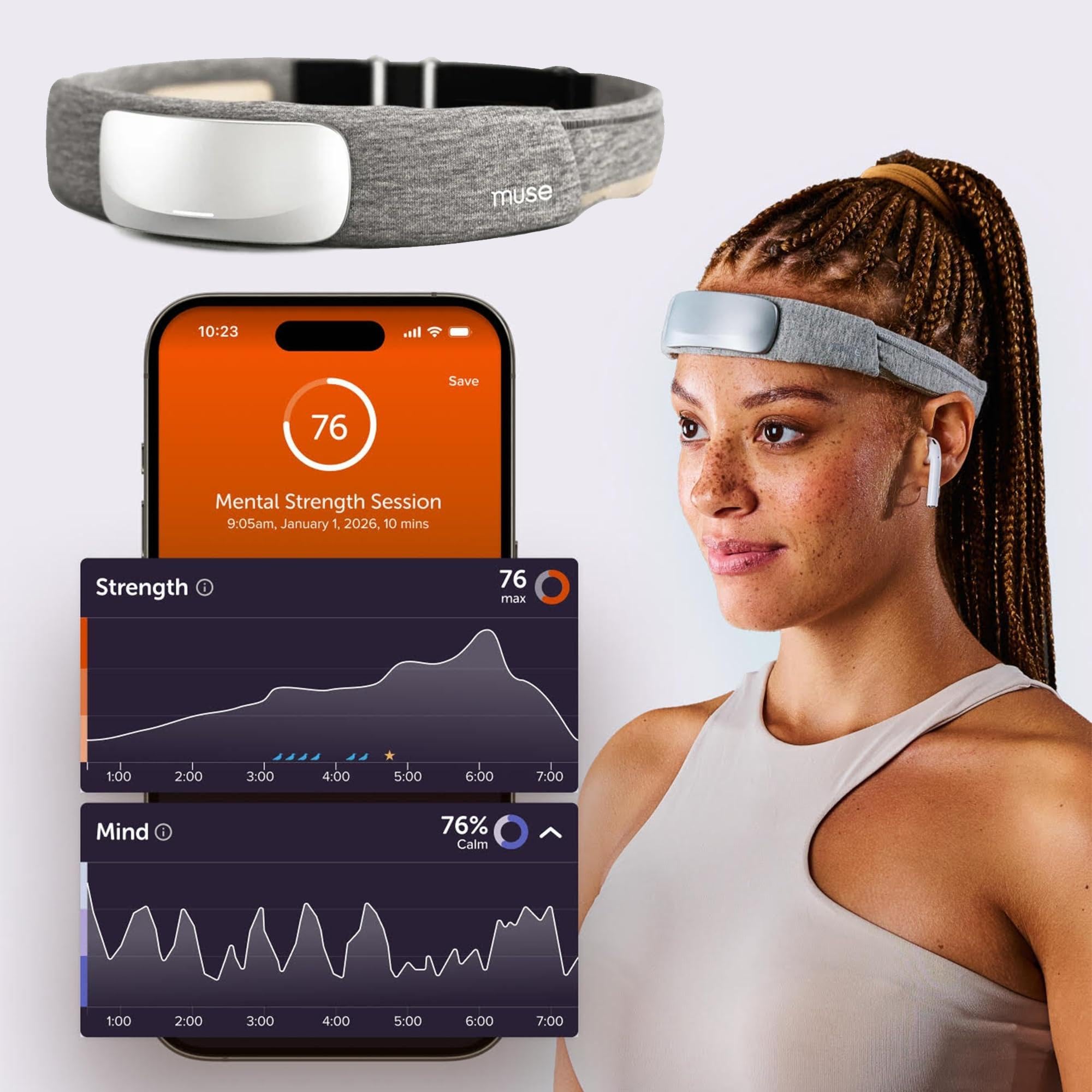
The headband that watches your brain with two sensor types and both sleep stages.
Two sensors in one headband push this into the premium tier: EEG (which reads electrical brain activity) paired with fNIRS (which uses light to measure blood flow in the brain). For sleep, a new Deep Sleep Boost feature detects slow-wave sleep and works to sustain it longer, complementing the Sleep Assist feature that helps you fall asleep faster. On the focus side it trains you to calm your busy mind and develop what Muse calls mental fitness. It connects to the Muse app over Bluetooth to run a meditation, sleep, or brain-training session.
The strap is a soft, adjustable headband you position so the sensors make skin contact, and sleep-stage accuracy is the standout — it reads sleep stages accurately enough that tracking is genuinely informative rather than a guess. Comfort earns a nod too. Premium features like the AI Coach, deeper brain insights, and access to 500+ meditations are optional via subscription; the base EEG and fNIRS tracking works without it.
What you should plan for: this is the most involved headband on the list, and some buyers found it effective only after several attempts at getting the placement and practice right. Data quality is the most-discussed topic and it draws mixed reactions, so go in expecting some interpretation rather than a clean daily number. For the buyer who wants the deepest brain-and-sleep picture and will put in the effort, it’s the most capable tool here.
The headline: EEG plus fNIRS biofeedback with dedicated slow-wave sleep support — the most advanced sensing of any headband on this page.
Set expectations: it improves with practice, and the data won’t always agree with itself, so patience is part of the buy.
The deep-dive pick: you want the most sophisticated brain and sleep measurement available and are willing to learn how to use it.
Hold off if: you want simple, instant calm — this one wants study and repetition before it shows its value.
Know the Specs
These four terms come up on nearly every listing in this category. Here’s what each one actually means for you.
EEG and Brainwave Bands
EEG is a reading of the tiny electrical signals your brain gives off, captured by sensors on your scalp. Those signals get sorted into wave bands — alpha, beta, theta, gamma — and a device shows you how much of each you have. When you settle into calm, the picture shifts, and watching that happen is how neurofeedback trains you to get there faster. You don’t need to memorize the bands; you just need to see the feedback respond.
HRV and HRV Coherence
Heart-rate variability is the small, natural variation in the timing between your heartbeats. A calmer nervous system often shows a more relaxed, steady pattern, so a device tracking HRV gives you a window into how wound-up or settled you are. Coherence data goes a step further and looks at how smoothly your breathing and heart rhythm sync up. Tools like the moonbird and Flowtime surface this so progress isn’t just a feeling.
Microcurrent
Microcurrent means a very small, controlled electrical pulse delivered through a hand-held contact point. On the CalmCarry it’s used to create a soft, tingling sensation that many find grounding while winding down. The sensation is felt, not invisible, so it suits people who don’t mind a gentle electrical tingle — and a low starting setting is smart for anyone new to it.
Vibrotactile and Infrasonic
Vibrotactile simply means “touch-vibration” — the device physically vibrates against your skin instead of using electricity. Infrasonic describes vibration at a frequency too low to hear, felt rather than heard through a surface like your chest. Sensate uses infrasonic resonance this way, while COVE and moonbird use vibration as a physical guide, so the calm arrives through touch rather than sound or light.
Common Questions
Is a wearable stress reducer the same as a fitness tracker?
Do microcurrent and vibration devices feel like a shock?
Can kids use a handheld calming device?
Do these devices need a subscription to keep working?
How long does a headband battery last between charges?
What is the difference between EEG and fNIRS on a headband?
Can a breathing necklace actually slow your breathing?
Will a headband still give good readings if I have a lot of hair or a busy forehead?
Which is better, a handheld breathing tool or an EEG headband?
Is a calming device safe to use before bed?
The Bottom Line
For most people, the wearable stress reducers winner is the LOVETUNER 528Hz Breathing Necklace — it’s the one device here that needs no app, no charge, and no learning curve, and it simply slows your breath the moment you reach for it. If you want a structured twice-daily routine with biometric feedback (body readings like heart rate), grab the COVE. And for the buyer who wants deep brainwave and HRV data (heart-rate variability, the timing between heartbeats) to train with, the Flowtime is the one to reach for. Every pick here is built to slow your breath, buzz your skin, or feed back your brainwaves — choose the one that matches how you actually calm down.
How we choose
We do not accept paid placement. Every pick is matched to a real buyer and a real use-case; we do not hands-on test units.
Sources
Specifications: manufacturer listings and product documentation. Review insights: verified customer reviews, as of November 2026. Pricing: not shown on this page (it changes often); check the current price via the retailer link.
As an Amazon Associate, Tactical Gear Guy earns from qualifying purchases. This does not affect which products we feature.