Specs are compiled from manufacturer listings and verified buyer reviews and can change over time — please confirm the key details on the product page before buying.
Flat pedals live or die on one thing: whether your shoe stays where you put it when the trail turns to wet roots and loose rock. The nine options here all hold a foot well, but they do it in different ways — some with a huge platform, some with sharper pins, some with a shape that shrugs off rock strikes. The short answer is that the Crankbrothers Stamp is the one most riders should buy, while the FIFTY-FIFTY is the value pick if your feet are average-sized and your budget is tight.
This guide is built by comparing the manufacturers’ published specifications and the patterns across verified customer reviews, so you get each pick’s real strengths and trade-offs instead of marketing spin.
Below you will find a plain-English breakdown of platform sizes, pin counts and spindle standards, so you can match a pedal to your shoe size and your riding style instead of guessing. This walkthrough of the top rated flat pedals covers grip, platform dimensions and durability in straightforward terms.
Top Picks


How To Choose The Best Top Rated Flat Pedals
Buying flat pedals is mostly a sizing exercise disguised as a shopping decision. Get the platform right for your shoe and the trailing edge of your foot stops overhanging, which is the single biggest cause of a foot sliding off mid-corner. Get the pins and bearings right and the pedal survives a season of mud instead of grinding to a halt by July.
Match the platform to your shoe, not to the photo
A large platform sounds universally better, but the number that matters is length front-to-back. A 114 x 114 mm platform like the Crankbrothers Stamp spreads support under a size 10 to 15 shoe. A smaller 106 x 104 mm platform like the FIFTY-FIFTY still gives a stable base under an average shoe. If your feet run narrow, a smaller platform actually keeps your arch centered instead of letting your foot wander across a wide deck.
Pin count is not the same as grip
Ten steel pins per side will hold a rubber sole firmly, but the pins need to be replaceable. Every pedal on this list uses removable pins, which matters because a pin sheared off on a rock is a cheap fix rather than a dead pedal. Pins that thread in from the top are easier to swap at home with a small tool.
Composite or aluminum, and why it changes the ride
A nylon or glass fiber-reinforced composite body shrugs off rock strikes and never dents. A machined aluminum body feels stiffer underfoot and typically uses a thinner profile. Composite bodies are lighter as a rule, and that lower rotating mass is noticeable on a short-travel bike.
Check the spindle thread before you buy
Almost every adult mountain bike takes a 9/16″ spindle, and all nine pedals here use that standard. What changes is the spindle material and bearing setup. Chromoly steel spindles resist bending, while sealed bearings and bushings keep grit out of the rotation. That seal is what separates a pedal that spins smoothly after a wet spring from one that creaks.
Side-by-Side Comparison
| Model | Best For | Platform | Weight (pair) | Pins Per Side | Amazon |
|---|---|---|---|---|---|
| Crankbrothers Stamp Flat MTB Pedals★ Best Overall | Big-footed trail riders | 114 x 114 mm | 384 g | Replaceable traction pins | Amazon |
| FIFTY-FIFTY Mountain Bike PedalsBest Grip For Less | Best grip for the money | 106 x 104 mm | 351 g | 9 steel | Amazon |
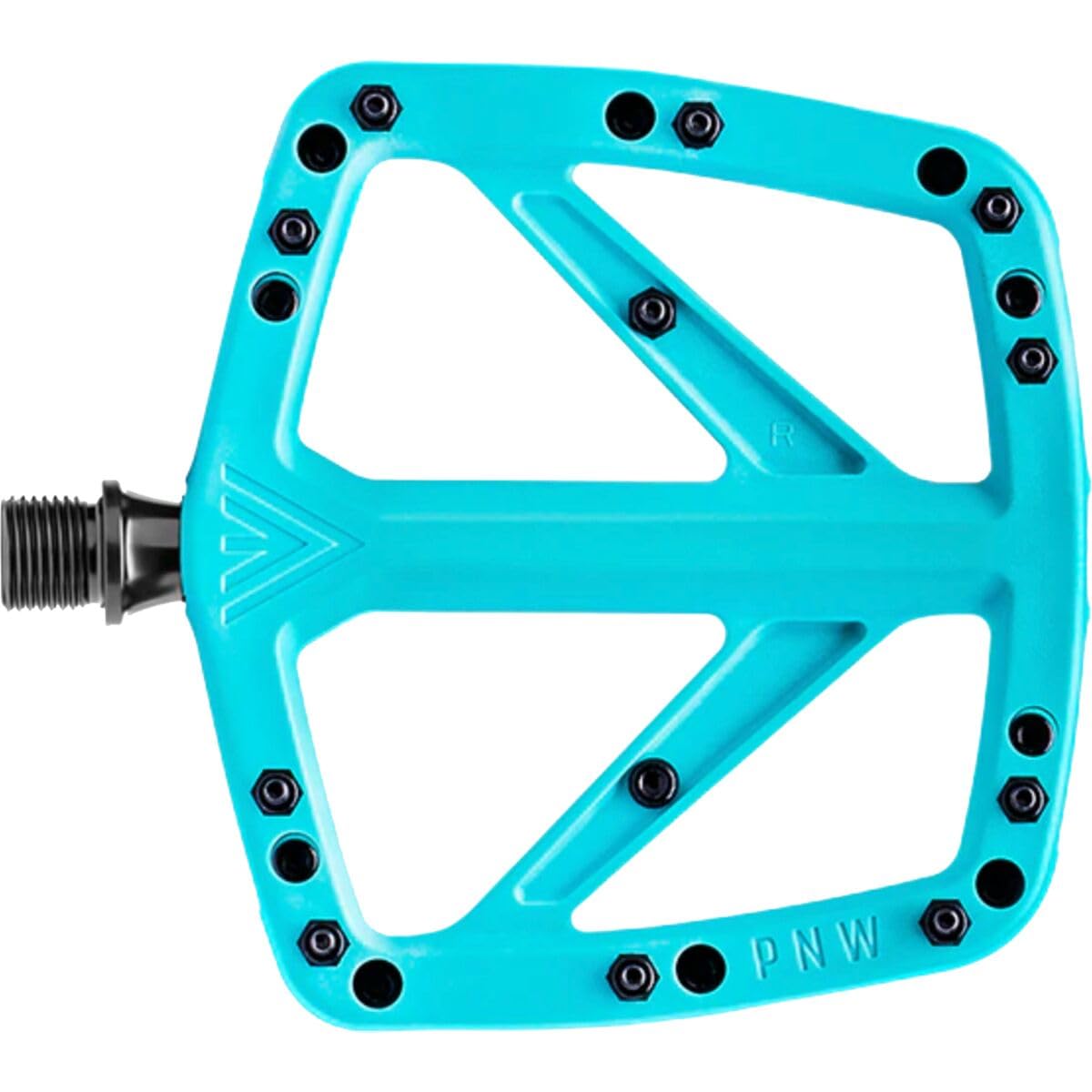
| PNW Components Range CompositeTrail and Downhill Pick | Aggressive trail and downhill | 110 mm platform | 390 g | Replaceable steel | Amazon |
| Crankbrothers Stamp 1 Large Turquoise | Color-matched builds | 3.94″ x 3.94″ | 395 g | 10 adjustable | Amazon |
| PDX G11 Mountain Bike Pedal | Concave feel and finish | 110 x 105 mm | 418 g | 11 | Amazon |
| Shimano Flat PD-GR400 | Confidence in a known name | 3.9″ x 3.8″ | 0.4 kg | Removable | Amazon |
| Race Face Atlas Pedal | Premium alloy build | 110 x 108 mm | 386 g | Removable | Amazon |
| OneUp Components Composite Pedals | Small feet and kids’ bikes | 3.84″ x 3.62″ | 14.4 oz | 7 steel | Amazon |
| Wellgo B087 BMX Pedals | Budget BMX and street builds | 5.5″ x 4.5″ | 1.1 lb | Molded | Amazon |
Detailed Reviews
1. Crankbrothers Stamp Flat MTB Pedals
Our pick — 4.5+★ from 650+ verified ratings; the strongest balance of quality and price.
A square 114 mm deck that finally puts the whole shoe on the pedal.
Buy this one if your feet are big and your current pedals leave your heel hanging in the air. The Stamp’s platform measures 114 x 114 mm and is explicitly sized for US 10-15 shoes, so the support runs the full length of your foot rather than stopping under the arch. That extra length is the difference between planting your foot once and shuffling it back into position every hundred metres.
The body is a reinforced composite, and the spindle is a forged SCM 435 chromoly steel core running on IGUS LL-glide bearings with seals. In plain terms, the steel core resists bending when you clip a rock, and the sealed bearings keep trail grit out. Pins are one-piece replaceable traction pins, so a sheared pin unscrews instead of ending the pedal’s life. Owners consistently rank build quality and grip as this pedal’s two strongest traits.
Weight lands at 384 g for the pair, versus the FIFTY-FIFTY at 351 g — but you are buying the larger 114 x 114 mm platform versus the FIFTY-FIFTY’s 106 x 104 mm. Composite does have limits: a hard enough strike on square-edged rock can gouge the body, and the pedal is not the flat-cage-thin profile an alloy design would give you.
What earns the top spot
- 114 x 114 mm deck sized for US 10-15 shoes, so nothing overhangs
- One-piece replaceable pins — swap a broken one in minutes
- Forged chromoly spindle with IGUS sealed bearings
- 384 g per pair keeps the rotating mass low
Where it holds you back
- Composite body can scar on hard rock contact
- Only worth it if your shoe is genuinely on the larger side
Made for you if: you ride trail or enduro and wear a size 10 or up.
Think twice if: you have a narrow, small foot and want a compact deck instead.
2. FIFTY-FIFTY Mountain Bike Pedals
Nine steel pins per side and a 351 g pair that punches past its class.
If you want maximum grip for the least outlay, this is the one. Each side carries 9 replaceable steel pins, and those pins sit on a 106 x 104 mm platform that holds an average-sized shoe planted without letting it wander. The nylon composite body with a high-strength Cr-Mo spindle is built to shrug off abrasion and corrosion, which is exactly what a pedal that lives outdoors needs.
The number that surprises is weight — 351 g for the pair, lighter than the Crankbrothers Stamp 1 at 395 g. The body is also just 0.7 inch thick, so it clears roots and rocks with less chance of a pedal strike. Sealed bearings protect the spindle from water and dust. Owners rank grip second only to build quality on this pedal.
Here is the trade-off to know before you click: the body is nylon, and clearance plus lighter weight comes at the cost of long-term toughness versus pricier alloy cages. Owners do report the composite holds up, but there is a real split on durability over many seasons. Fourteen extra M3 and M4 pin hardware pieces ship in the box so you can refresh grip yourself.
Weight and clearance win: at 351 g and 0.7 inch thin, this clears obstacles the beefier pedals snag on — a genuine advantage on tight tech.
The honest caveat: nylon composite may not survive the same abuse as an alloy body over a long ownership stretch.
Reach for this if: grip and weight matter more than alloy toughness on your build.
Look elsewhere if: you want a pedal you can beat on for a decade without changing the body.
3. PNW Components Range Composite MTB Pedals
A 110 mm glass-fiber deck sold with a lifetime warranty and aggressive steel pins.
Downhill and aggressive trail riders should start here. The Range uses a 110 mm platform in a glass fiber-reinforced nylon composite body, and that body has earned a reputation for not cracking under the kind of abuse that finishes lesser plastic pedals. Replaceable steel pins do the traction work, and the pin height is aggressive enough to keep a shoe locked in place on steep, chattery descents.
Inside, sealed bearings paired with DU bushings keep the rotation smooth and grit out of the spindle. The 390 g weight sits right in the middle of the range — heavier than the FIFTY-FIFTY beyond that, but the difference buys you a stouter body for downhill use. Owners rank build quality as the top strength, and the 110 mm platform that fits bigger feet is the recurring reason they keep buying it.
The genuine draw here is the lifetime warranty against manufacturing defects, which is a statement of confidence you do not see on most composite pedals. The catch with any composite is limited pin adjustability: pins can be swapped, but the body will not give you the tunable feel of a fully machined alloy design. If your riding is heavy on square-edged rock, alloy remains the more forgiving material.
Built for the steep stuff: the 110 mm platform and aggressive replaceable steel pins are aimed squarely at downhill and enduro use.
What to accept: composite body limits how much you can tune the pin feel compared with alloy.
Great match for: gravity riders who want a durable composite deck backed by a lifetime warranty.
Pass on it if: you insist on an all-metal cage that can be tuned pin by pin.
4. Crankbrothers Stamp 1 Large Turquoise

Ten adjustable pins per side on a forged aluminum body in a loud turquoise finish.
Before you look at the color, look at the deck: 10 adjustable pins per side puts this a notch above most pedals that come with eight. That adjustability lets you tune traction to your shoe compound — more pin height for a hard rubber sole, less for the softer sticky soles that grip hard. The body is forged 6061-T6 aluminum, and the spindle is forged SCM 435 chromoly steel with IGUS LL-glide bearings on both the inner and outer side.
Weight is 395 g per pair, which makes it heavier than the FIFTY-FIFTY at 351 g, and the platform runs 3.94 inch by 3.94 inch. Those two numbers explain each other: you carry more metal for a bigger deck. Owners tend to call this the best flat pedal they have ridden, citing the 3.94-inch platform and the turquoise finish as the reason they pick it over the black version.
The practical note is maintenance. IGUS LL-glide bearings are serviceable, but the pedal is not user-serviceable by pin swap alone — you will want the 8 mm Allen key for removal and a bearing kit down the line. Also worth knowing: turquoise is a commitment, so match it to your frame or accept the clash. Sizing is Large, so small-footed riders should look at the smaller version instead.
Reasons it stands out
- 10 adjustable pins per side for tunable grip
- Forged 6061-T6 aluminum body with chromoly spindle
- Bold turquoise finish that matches custom builds
Reasons to pause
- 395 g per pair is on the heavier side of this group
- Large sizing pushes smaller feet toward the smaller version
Worth it for: riders with a large shoe who want tunable pin grip and a signature color.
Skip if: you ride a small frame or wear a small shoe and need the compact deck.
5. PDX G11 Mountain Bike Pedal
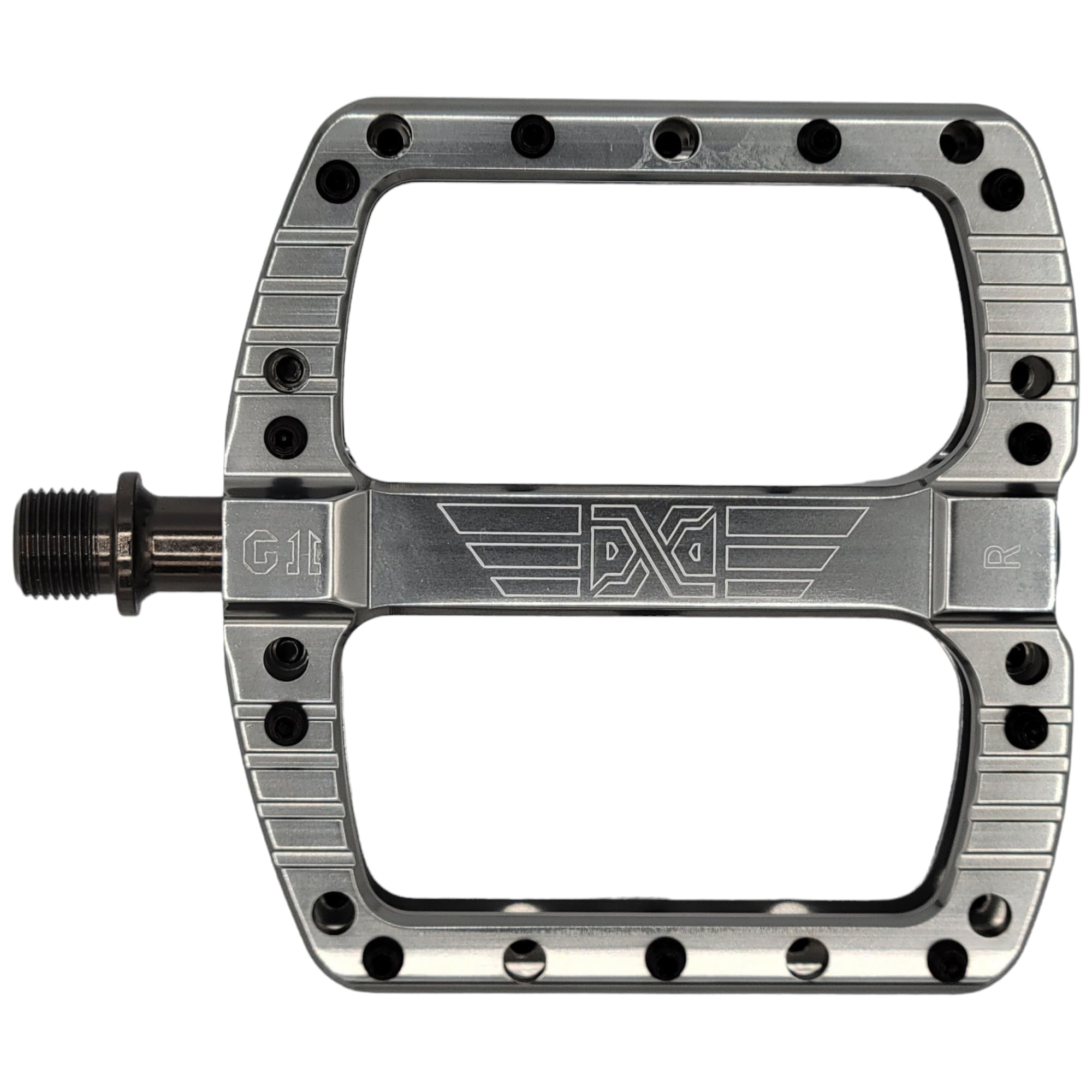
Eleven pins per side and a 2 mm concave dip that cups your shoe.
Most flat pedals are flat in name only — this one actually dips. The PDX G11 runs a 2 mm concave profile across a 110 x 105 mm platform, which means the center sits lower than the edges and your shoe settles into that pocket instead of teetering on top of it. Eleven pins per side sit around the perimeter, so the grip wraps the outside of your foot rather than only the middle.
The body is fully CNC machined aluminum in a polished titanium finish, and the spindle is a chromoly 9/16 core running on three sealed ball bearings. Three bearings rather than the usual two spreads the load more evenly, which tends to mean smoother rotation and longer life before a rebuild. At 418 g per set it is the heaviest pedal on this list, though the machined finish and concave shape are what buyers talk about most.
The package is unusually complete: two pedals, ten replacement pins, an installation tool, a bearing refresh kit and two washers. The honest trade-off is weight — 418 g is more than 60 g heavier than the FIFTY-FIFTY — and appearance matters as much as performance here, since the polished titanium look is a big part of the appeal. Buyers rate the machined build quality and the polished titanium finish above everything else.
Concave done right: the 2 mm dip and 11 perimeter pins per side create a pocket that holds a shoe instead of a flat plate it slides across.
The weight cost: at 418 g this is the heaviest pick here, so it suits riders who prioritize feel over grams.
Choose it for: a concave platform and a show-quality machined finish with a full spares kit.
Leave it if: every gram counts on your build.
6. Shimano Flat PD-GR400 Resin Pedals

A resin-bodied Shimano pedal for riders who want a name they recognize.
Shimano’s PD-GR400 is a flat pedal built around an ABS resin body with removable pins and a platform measuring 3.9 inch by 3.8 inch. At 0.4 kg for the pair it sits in the middle of this group on weight. The resin body should absorb rock strikes better than alloy, and the removable pin design means you can refresh grip rather than replace the pedal.
What you are really buying is the Shimano name and the consistency that comes with it — the spec sheet on this one is short, so the case rests on the brand’s track record for durable, well-sealed components rather than headline numbers. The 9/16 spindle standard means it drops onto almost any mountain bike crank straight from the start.
If you want to compare pin-for-pin against the rest of this list, this is the weakest page for that. It suits a rider who wants a known manufacturer and does not need to obsess over grams.
Reach for this if: you want a removable-pin Shimano flat pedal and trust the brand over the spec sheet.
Look elsewhere if: you want the pin count and bearing type spelled out before you buy.
7. Race Face Atlas Pedal
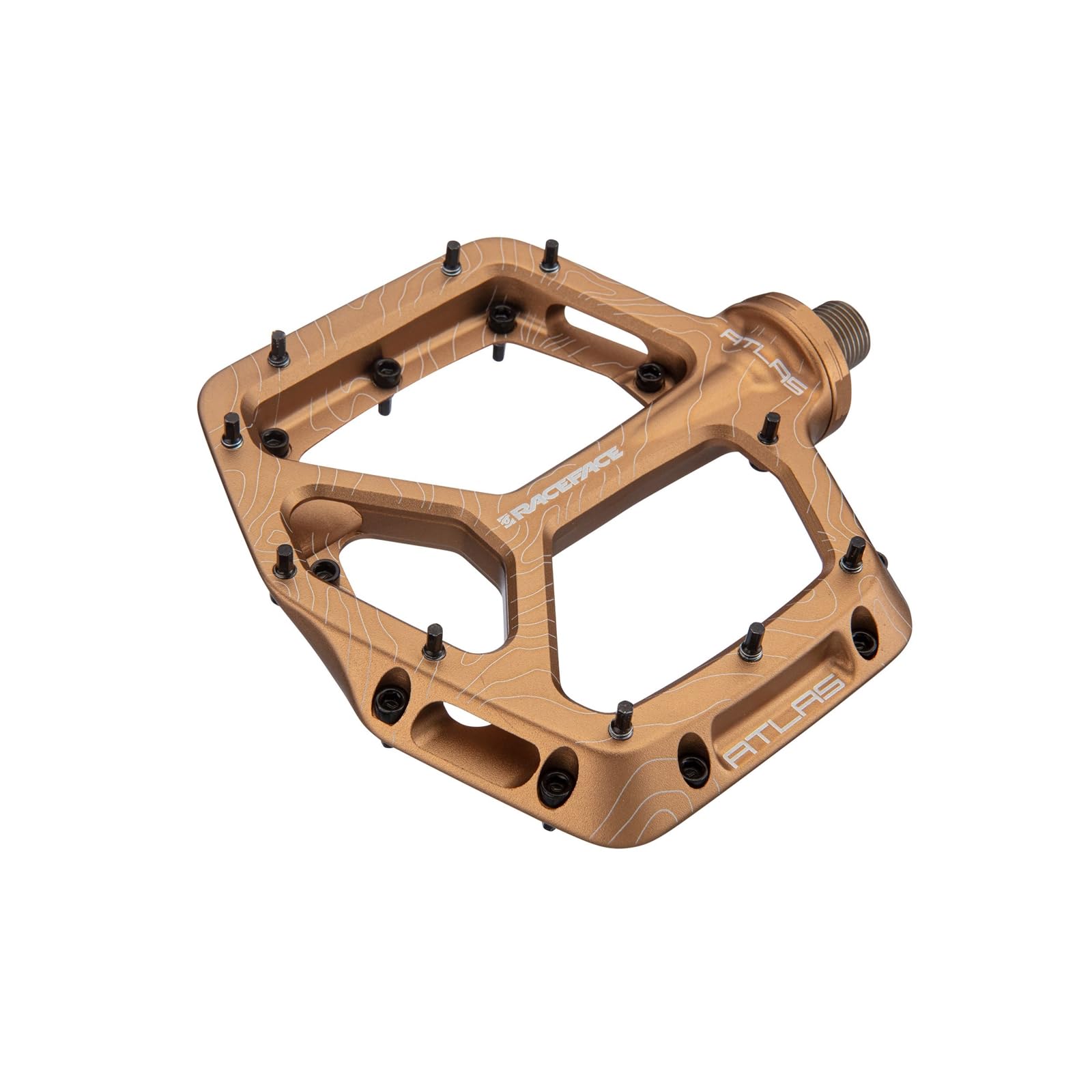
A 110 x 108 mm alloy platform with plenty of pins and a Kashmoney finish.
This is the premium end of the group, and it earns the spot on materials rather than clever features. The body is 6061 aluminum, the axle is chromoly steel, and the platform measures 110 x 108 mm with removable pins and a 9/16 inch spindle. At 386 g for the pair it is lighter than both Crankbrothers pedals here, which is a genuinely impressive figure for a metal body.
The package includes two pedals, four replacement pins and 36 pin washers, so you can run the pin height you want and keep spares on hand. Riders call out grip second only to build quality, and the removable pin count backs that up on rough ground. Stability on chundery downhill and punchy uphill climbs is a common theme in how riders describe it in use.
The trade-off is honest and worth stating plainly: durability ratings are mixed, with pins stripping being the recurring complaint. Treat the threads gently when you swap pins and the pedal holds up well. For the outlay this is a buy driven by materials and finish rather than the most forgiving pin hardware on the market.
Why the premium tag holds up
- 6061 aluminum body with a chromoly axle
- 386 g per pair — lighter than either Crankbrothers option
- 4 replacement pins and 36 washers included
Where it asks for care
- Pin threads can strip if you overtighten during a swap
- Priciest pedal here, and the pin hardware is the weak point
Best for: a rider who wants a light, all-metal platform and will look after the pins.
Consider skipping if: you change pins often and want them to take heavy-handed torque.
8. OneUp Components Composite Pedals
The small-platform option built for shoes up to US 6.5.
Not every rider wants a dinner-plate deck, and this is the pick for the ones who do not. OneUp sizes this pedal for shoes up to US 6.5 in men’s, 8 in women’s, 6 in kids and 38 EU — so it is the correct choice for a junior rider or a smaller adult who has been swimming on a large platform. The body is composite, the pair weighs 14.4 ounces, and the platform runs 3.84 inch by 3.62 inch.
Each side carries 7 steel pins in OneUp’s Friendly Pin design, and the pedal ships with 14 pre-installed short pin nuts so you can dial traction back for a gentler feel on a shin or a softer sole. Fourteen replacement short pin nuts come in the box alongside the pre-installed steel pins and a left and right pair. The pedal is available in seven colors.
The honest limit is platform size: for an adult with a size 9 shoe this is too small, and you would be better served by one of the larger decks above. Service kits are sold separately, so at-home bearing service needs a separate purchase. Buy it for the fit, not for the footprint.
Fit first, everything else second: the shoe-size range up to US 6.5 is the entire reason this pedal exists, and it fills a gap the rest of the list ignores.
Know the cost: service kits are separate, and the small deck will feel cramped under an adult foot.
Pick it when: you are kitting out a junior rider or have a smaller shoe and want a proper-fitting platform.
Walk away if: your shoe is US 7 or larger — go up to a full-size deck.
9. Wellgo B087 BMX Pedals

An aluminum BMX pedal with molded pins that installs in minutes.
For a BMX or street build on a tight budget, this Wellgo does the job. The body is aluminum, the spindle is chromoly steel at a 9/16 inch thread, and the pins are molded into the body rather than threaded in. That molded design means fewer moving parts to lose, and the pedal installs with a standard pedal wrench.
Weight lands at 1.1 pounds for the pair, which is heavier than the composite pedals here, and the platform measures 5.5 inch by 4.5 inch overall. Riders mention durability second only to value, and the aluminum body takes the kind of beating street riding delivers. It installs easily and fits a standard crank without fuss.
The one thing to know is spin: smoothness draws mixed feedback, with several riders noting the pedals do not spin completely freely. Weight is also a negative callout for some. Neither is a defect — it is a BMX pedal built for durability rather than spin speed, and a molded-pin design means a worn pin is not a swap-out job. Buy it for a street BMX build, not for trail riding.
Built for BMX abuse: the aluminum body and chromoly spindle take street-level punishment, and installation is straightforward.
Not a trail pedal: molded pins cannot be replaced, and the spin is not as free as on the sealed bearing options above.
Reach for this if: you are building a BMX or street bike and want a tough pedal without spending much.
skip it if: you need freely spinning pedals or replaceable pins for trail grip.
Know the Specs
Platform dimensions (mm)
The length and width of the pedal body, measured in millimetres. A larger figure gives your shoe more support, which matters most if your foot is size 10 or bigger. A 114 x 114 mm platform spreads support under a large shoe, while a 106 x 104 mm deck suits an average shoe and keeps a smaller foot from sliding around.
Pin count and pin type
Pins are the small spikes on the pedal face that bite into your shoe sole. More pins and taller pins mean more grip, but replaceable pins are what make the design practical — a sheared pin unscrews instead of ending the pedal’s life. Molded pins, by contrast, are part of the body and cannot be swapped.
Spindle and bearing setup
The spindle is the steel axle that threads into your crank arm, and 9/16 inch is the standard adult mountain bike size. Bearings let the pedal spin, and sealed bearings keep water and trail dust out of the rotation. A bushing can supplement the bearings to share the load.
Body material: composite vs alloy
Nylon and glass fiber-reinforced composite bodies are lighter and shrug off rock strikes without denting. Aluminum bodies feel stiffer underfoot and can be machined thinner. Composite tends to lose finish and grip over years of hard contact; alloy dents but holds its shape.
Common Questions
Will these flat pedals fit my mountain bike crank?
Do I need a special tool to install flat pedals?
What pedal size suits a large foot?
Are composite pedals as strong as aluminum flat pedals?
How do I stop my foot slipping off a flat pedal?
Can I replace pins that break off?
Do sealed bearings really matter on a flat pedal?
What does the concave shape on the PDX G11 actually do?
Do flat pedals fit BMX bikes and e-bikes too?
The Bottom Line
For most riders, the top rated flat pedals pick is the Crankbrothers Stamp Flat MTB Pedals because the 114 x 114 mm platform genuinely fits a large shoe and the replaceable pins make it a long-term buy. If you want grip for the least outlay, the FIFTY-FIFTY at 351 g and 9 pins per side is hard to argue with. And for downhill duty with a lifetime warranty behind it, reach for the PNW Components Range Composite at a 110 mm platform.
Pick your pedal by shoe size first and riding style second — a size 10 foot needs the 114 mm Stamp deck, while a US 6.5 shoe fits the OneUp’s 3.84-inch platform.
How we choose
We do not accept paid placement. Every pick is matched to a real buyer and a real use-case; we do not hands-on test units.
Sources
Specifications: manufacturer listings and product documentation. Review insights: verified customer reviews, as of November 2026. Pricing: not shown on this page (it changes often); check the current price via the retailer link.
As an Amazon Associate, Tactical Gear Guy earns from qualifying purchases. This does not affect which products we feature.