Specs are compiled from manufacturer listings and verified buyer reviews and can change over time — please confirm the key details on the product page before buying.
You already know the drill: you cut the hole, you clamp the bung, and then you find out the thread is off or the flange is too thin to hold a weld without warping. That is the exact problem this shortlist solves. Every pick below is a real, weldable sleeve or bung with published thread sizes and metal types you can check against your own pipe before you buy.
This guide is built by comparing the manufacturers’ published specifications and the patterns across verified customer reviews, so you get each pick’s real strengths and trade-offs instead of marketing spin.
Sort these by matching the thread to your sensor or fitting first, then checking the wall thickness you are welding into.
Top Picks


How To Choose The Best Weld-In Sleeve
A weld-in sleeve or bung only works if two things line up: the thread matches what you are screwing into it, and the base metal matches the wall you are welding onto. Get either wrong and you are grinding out a bad weld instead of finishing the job.
Start with the thread, not the looks
The thread callout is the whole ballgame here. An M18x1.5 bung takes a standard O2 sensor — the “1.5” is the pitch, or the gap between threads in millimeters. A 3/4″-16 bung takes a heim joint with right- and left-hand threads. A 10AN (7/8-14 UNF) bung takes a flared hose fitting. Write your fitting’s spec on the box before you shop, then match it exactly.
Match the metal to the pipe
304 stainless handles exhaust heat and rust well, which is why it shows up in O2 sensor bungs. 316 stainless is the heavier-duty version used in brewing, marine, and pressure work — the half coupling here carries a 150# pressure rating. Mild and 1045 steel work fine on fuel cells and chassis tube, but they will rust without paint or coating.
Check the wall thickness and sleeve diameter
A bung sized for 0.120 wall tube will not seat properly in 0.065 wall. Likewise, a weld-on sleeve built for a 1.4″ to 1.5″ diameter C1 taper will not grip a spear of a different size. Measure the pipe outside diameter with calipers and buy to that number, not to a guess.
Side-by-Side Comparison
| Model | Best For | Thread / Fit | Material | Quantity | Amazon |
|---|---|---|---|---|---|
| 12 Pcs O2 Sensor Bung★ Best Overall | Exhaust sensor work and shops | M18x1.5 | 304 Stainless Steel | 12 pcs | Amazon |
| 2″ NPT 316 Stainless Half CouplingBest for Pressure | Brewing, industrial, pressure lines | 2″ FNPT | 316 Stainless Steel | 1 | Amazon |
| 10AN Male Steel Weld On Bung | Fuel cells and oil plumbing | 10AN (7/8-14 UNF) | Alloy Steel | 2 pcs | Amazon |
| Jeremywell 3/4-16 Weld-In Bung Set | Heim joint and link mounts | 3/4″-16 RH + LH | 1045 Steel | 1 set | Amazon |
| Bale Spear Weld On Sleeve | Hay spear mounting | C1 taper, 1.4″–1.5″ | Steel sleeve | 1 | Amazon |
Detailed Reviews
1. 12 Pcs O2 Sensor Bung, 304 Stainless Steel M18x1.5
Our pick — 4.5+★ from 150+ verified ratings; the strongest balance of quality and price.
Twelve stainless O2 bungs with a stepped lip that lands flush on thin exhaust pipe.
If your exhaust project means adding a wideband sensor or moving an existing one, this is the box to grab. The M18x1.5 thread is the standard size most O2 sensors screw into, so you are not hunting adapters. And the 304 stainless body shrugs off the heat and moisture that rust out mild steel bungs in a few winters.
The stepped design is the part that earns its keep. A stepped bung has a small raised shoulder that lets the flange sit down onto the pipe for a flush finish, so you weld around a clean lip instead of fighting a flat ring on curved tube. It also helps you avoid warping thin-wall exhaust. Together that makes the install faster whether you are running TIG or MIG.
The one honest catch: you are buying a pack, not a single unit. If you only have one project ahead of you, eleven spare bungs will sit in the drawer. For a shop or anyone with a steady stream of exhaust jobs, though, the quantity is the whole point — you stop reordering every time a sensor hole needs a home. The 304 stainless body and stepped shoulder are what sell it before you even strike an arc.
Why It Tops The List
- Standard M18x1.5 thread fits the common O2 sensor sizes without an adapter
- 304 stainless resists exhaust corrosion far better than plain steel
- Stepped shoulder lets the bung sit flush for a cleaner weld bead
- Twelve per box means a shop never runs short mid-job
The Trade-Off
- A multi-pack gives you spares you may not need for a single build
- Stepped style demands you match it to pipe thickness for a true flush fit
Reach for this if: you are adding O2 sensors to exhaust and want stainless bungs on the shelf for the next job.
Look elsewhere if: you need a single large pipe-thread coupling — this thread is M18x1.5, not NPT.
2. 2″ NPT 316 Stainless Steel Threaded Half Coupling
A pipe-thread coupling, not a sensor bung — and at 4 ounces the lightest pick here.
This one is built for a different job than the O2 bungs. Instead of a small metric sensor thread, it gives you a 2″ FNPT pipe thread, which is a taper thread sized to screw onto standard pipe. That makes it the pick for brewing kettles, industrial tanks, and any weld-on port that needs to accept a pipe fitting rather than a sensor.
The material is the story. It is cast 316 stainless, the marine-grade alloy, with machined surfaces on the threads so they start clean. It also carries a 150# pressure rating, which tells you what pressure class the fitting is intended to hold. For welding into a tank wall on a home brewery, that is the reassurance you want before you fill it. Weighing 4 ounces, it stays light on the workpiece and is easier to hold in place than the 11.2-ounce Jeremywell bung set below.
What you should know going in: this is a single piece and a large-diameter pipe thread. If you actually need to mount a narrowband O2 sensor, the 2″ NPT opening is far too big — this is a pipe port, not a sensor port. It is a specialty fitting that does one job, and it does that job at 316 grade.
Where it earns a spot: 316 stainless plus machined threads plus a 150# rating — a serious fitting for brewing and industrial weld-on ports.
Know before you buy: the 2″ FNPT thread is for pipe connections, so it will not accept a standard O2 sensor.
The right buy when: your project needs a heavy-duty pipe-thread port welded into stainless.
Not your part if: you are chasing an M18x1.5 sensor mount.
3. 10AN Male Steel Weld On Bung Fitting Adapter 2PCS
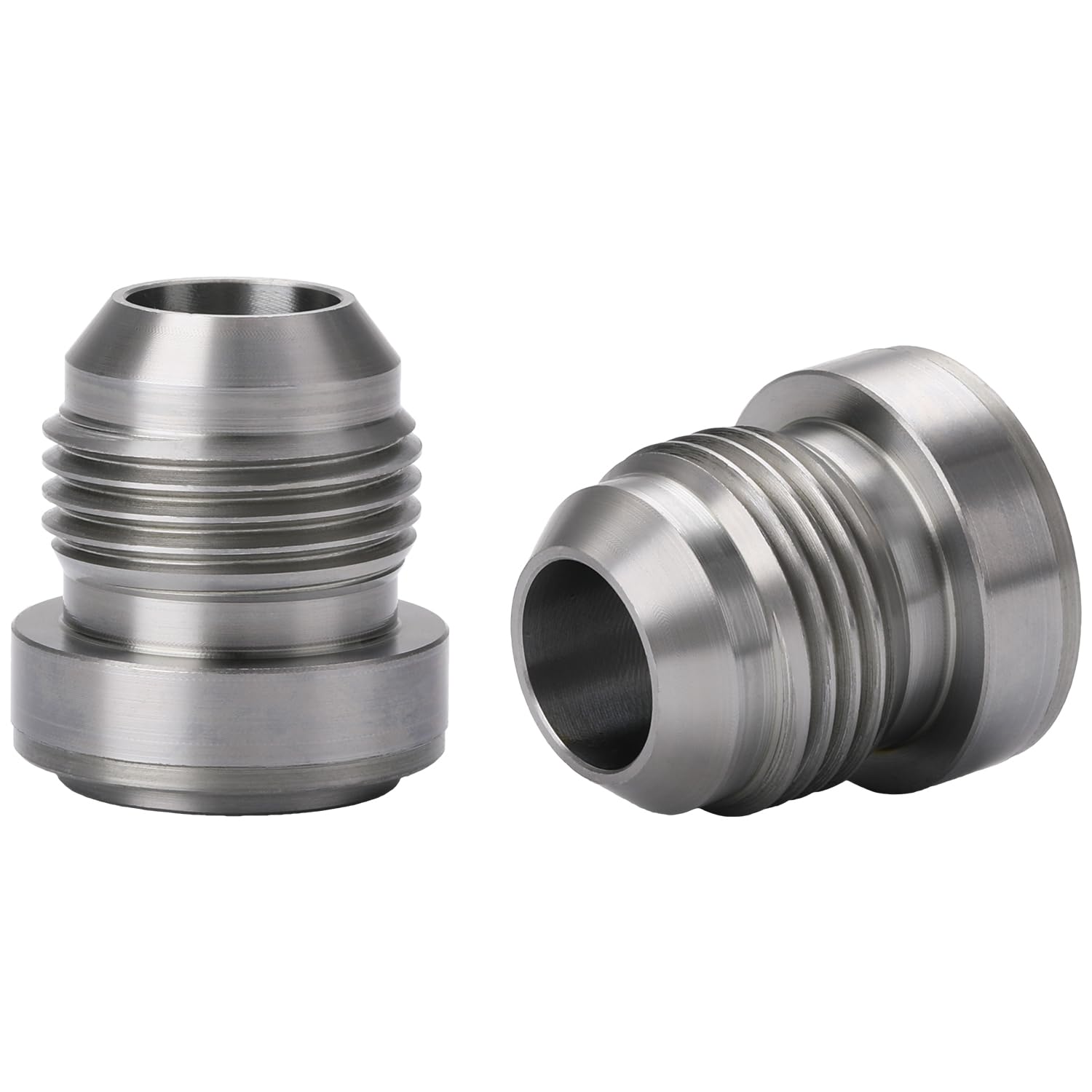
A CNC-machined 10AN flare bung that handles high-pressure fuel and oil plumbing.
For fuel cells, oil pans, radiators, and custom tanks, the connection is a flared AN fitting — not a pipe thread or a sensor thread. This 10AN bung gives you that interface in a pack of two. The thread is 7/8-14 UNF, the AN standard, and the 37° flared sealing face is what lets a matching hose end seat and seal under pressure.
Two details make install easier. First, it is CNC machined from mild steel, so the thread and flare are cut clean rather than cast. Second, the weld end is stepped to help you locate it on the tank wall before you strike an arc. Both point to a fitting built for people doing custom plumbing, not a rough bracket. The maker rates it for high-pressure use, which matches fuel and oil plumbing.
Set your expectations on the material and count. Mild steel will rust, so plan to coat it if it lives somewhere wet. And it comes as a pair — one spare for the parts bin. If you are plumbing a fuel system or oil return and need an AN flare interface, this is the straightforward choice.
The real draw: a precision 37° flare plus a 7/8-14 UNF thread — exactly what a 10AN hose end needs for a pressure-tight joint.
Worth noting: mild steel construction means unprotected spots can corrode, so treat the welds afterward.
Pick it for: fuel cells, oil pans, and custom tank plumbing that use AN flare fittings.
Pass it over for: exhaust sensor mounting — that calls for an M18 thread, not a 10AN flare.
4. Jeremywell 3/4-16 Threaded Weld-In Bung Set RH + LH

One right-hand and one left-hand 3/4″-16 bung for building adjustable link mounts.
This set solves a specific problem that single bungs cannot. You get one right-hand and one left-hand threaded 3/4″-16 bung, which is exactly the pairing you need to build a heim joint link that adjusts in place. Weld one at each end of a tube and you can lengthen or shorten the assembly without unbolting anything.
The threads are cut to fit 1 1/4″ OD tube with a 0.120″ wall and 1″ ID, so measure your tube before ordering. The 1045 steel is a tough, hardenable grade that takes a weld well and holds up on suspension and steering links. It comes as one set — the two opposing bungs — which is what you want for a single adjustable link. At 11.2 ounces for the pair it carries more heft than the 4-ounce NPT coupling above, which fits its thicker threaded bodies.
Two honest notes. It is steel, not stainless, so the welded area needs paint or coating to keep rust off. And it is one set, meaning a four-link setup needs two of these, so count your joints first.
Why fabricators like it: the RH-plus-LH pairing lets you build an adjustable link that tunes on the vehicle, and the 1045 steel holds its thread under load.
Plan around this: one set covers a single link, so a full four-link setup needs more than one order.
Best suited to: chassis and suspension work needing a matched left/right thread pair for heim joints.
Think twice if: you need corrosion-proof stainless — this is 1045 carbon steel.
5. Bale Spear Weld On Sleeve (C1 OD 2″, Length 4.1″)

The only non-threaded piece here — a 4.1-inch weld-on sleeve for C1 hay spears.
Every other pick on this list joins a threaded fitting. This one is a plain sleeve bushing, made to weld onto a frame so a C1 bale spear seats into it. It is built for spears with a standard C1 taper on the mounting end and a 20mm or 24mm hex nut, which is the fitment you need to confirm before ordering.
The dimensions are the spec that matters. The outside diameter is 2 inches and the total length is 4.1 inches, which gives you a solid surface to weld a bead around. It weighs 2.4 pounds, so it is the heaviest item in this group — appropriate for a part that has to hold a loaded spear in a tractor bucket. These numbers run larger than the 3x3x1-inch Jeremywell bung body above, and the extra length means more weld contact on the frame.
Understand what it is not. It has no threads and no sensor thread, so do not buy it for exhaust or plumbing. It only fits a C1 taper mounting end and will not work with a differently tapered spear. For a hay-handling build, though, it is the right part with the right length to hold a weld.
What Holds Up
- 4.1-inch length gives a generous weld surface for a strong frame joint
- Fits C1 taper spears with 20mm or 24mm hex nuts
- 2-inch outside diameter takes a solid bead around the sleeve
Where It Limits You
- No threading at all — it is an unthreaded sleeve, not a bung
- Only fits the C1 taper size, so mismatched spears will not seat
The right part for: anyone mounting a C1 bale spear into a tractor or loader frame.
Step away if: your project needs a threaded connection instead of a plain seat.
Know the Specs
Thread Pitch and Size
The thread callout tells you what screws in. M18x1.5 means an 18mm thread with a 1.5mm pitch between threads — the common O2 sensor size. 7/8-14 UNF is the 10AN flare standard for fuel and oil. 3/4″-16 is a heim joint size in inches. Match this number exactly to your fitting before you weld.
Stainless vs Carbon Steel
304 and 316 stainless resist rust and exhaust heat without a coating, and 316 is the marine-grade version with a 150# rating on the coupling here. Mild and 1045 steel are stronger and take a weld readily, but they need paint or coating to keep corrosion off the joint. Pick stainless for wet or exhaust duty; pick carbon steel where strength and cost matter.
Stepped vs Flat Bungs
A stepped bung has a raised shoulder that sits down onto the pipe for a flush finish, which helps on thin exhaust tube. A flat bung is a simple ring you weld directly. The stepped style is friendlier for O2 sensor installs on curved pipe; a flat half coupling is common on tanks and industrial ports.
Wall Thickness and Sleeve Diameter
A 0.120 wall bung is built for thicker tube, while thinner wall needs a different fit or the weld pulls the pipe out of shape. For a weld-on sleeve, the outside diameter and length set how much contact you get for a bead — a 2-inch OD with 4.1 inches of length gives a sturdy seat on a bale spear frame.
Common Questions
Will an M18x1.5 bung fit a standard O2 sensor?
What is the difference between a weld-in bung and a weld-on sleeve?
Can I weld a stainless bung to a mild steel exhaust pipe?
How do I know if a bung fits my tube wall thickness?
What does 10AN and 7/8-14 UNF mean on a weld bung?
Is a 316 stainless half coupling better than a 304 bung for brewing?
Do I need right-hand and left-hand threads for a heim joint setup?
How long does a weld-in bung last on an exhaust pipe?
Can I weld a 10AN steel bung to an aluminum fuel tank?
What size bale spear does the C1 weld-on sleeve fit?
The Bottom Line
For most fabrication jobs, the weld-in sleeve winner is the 12 Pcs O2 Sensor Bung because the M18x1.5 thread fits common O2 sensors and the 304 stainless handles exhaust heat with a stepped lip that lands flush. If you are welding a pipe port into stainless for brewing or industrial work, grab the 2″ NPT 316 Stainless Half Coupling and its 150# rating. And for a fuel or oil build that runs AN flare line, the 10AN Male Steel Weld On Bung is the one to reach for.
How we choose
We do not accept paid placement. Every pick is matched to a real buyer and a real use-case; we do not hands-on test units.
Sources
Specifications: manufacturer listings and product documentation. Review insights: verified customer reviews, as of November 2026. Pricing: not shown on this page (it changes often); check the current price via the retailer link.
As an Amazon Associate, Tactical Gear Guy earns from qualifying purchases. This does not affect which products we feature.