Specs are compiled from manufacturer listings and verified buyer reviews and can change over time — please confirm the key details on the product page before buying.
If you are building a home server or a storage-heavy workstation, the case is the part that decides how many drives you can actually fit and how painful every upgrade will be. Pick a chassis with enough bays and adding a drive takes two minutes; pick one without and every upgrade means stripping the build down. This guide sorts the real server tower cases by drive bays, hot-swap support, and cooling room, so you can match the chassis to the machine you plan to run.
This guide is built by comparing the manufacturers’ published specifications and the patterns across verified customer reviews, so you get each pick’s real strengths and trade-offs instead of marketing spin.
If you are building a home server, the drive bays and hot-swap trays (slots that let you pull a drive out without opening the case) matter more than glass panels. So the picks below are ranked on storage first and looks second. Every option here is a tower you can stand on a desk or a shelf, not a rack unit, and each one is matched to a specific job so you can pick fast when shopping for a server tower case.
Top Picks


How To Choose The Best Server Tower Case
A server tower case is a chassis (the frame that holds your parts) you stand upright. It holds your motherboard, power supply, and a stack of drives. Your buying decision depends on three things: how many drives it holds, whether those drives slide out without opening the case, and whether the cooling can keep a drive array (a group of drives running together) from cooking itself. Glass panels, RGB, and front-panel extras come after those three.
Count your drives before you count anything else
Start with the number of hard drives you plan to run now, then double it. Server storage grows, and the internal bay count is the hard ceiling you cannot upgrade later. A case with 13 internal bays gives you room to expand; a case with 4 bays locks you in. Note the split too — most cases list 3.5″ HDD mounts and 2.5″ SSD mounts separately, and those are not interchangeable.
Hot-swap trays versus fixed cages
A hot-swap bay lets you pull a drive out through the front of the case while the system stays on. That matters on a running NAS, where a failed disk needs replacing without downtime. Fixed cages mean opening a side panel and unscrewing the drive. A 24/7 NAS wants hot-swap trays so a failed disk comes out the front; a workstation you power down for maintenance is fine with fixed cages and a screwdriver.
Cooling room for a drive wall
Drives packed tight run warm, so look at fan mounts and radiator support together. Radiator support is the space and mounting points for a liquid cooler (an all-in-one loop that moves heat to a radiator). A case that fits a 360mm radiator in the top, or multiple 420mm radiators, gives you headroom if you later add a high-power CPU or GPU alongside your drives. The more drive cages you fill, the more you need front intake fans feeding them.
Size, depth, and where it will sit
Full towers are deep. Several picks here run past 20 inches front to back, which will hang off a shallow desk or fail to fit a shelf. Measure the depth of your desk or shelf before you order. Weight matters too on a loaded server — a heavy steel chassis full of drives is a two-person lift, and it needs a surface that can take it.
Side-by-Side Comparison
| Model | Best For | Internal Bays | Max Radiator | Form Factor | Amazon |
|---|---|---|---|---|---|
| Antec C8★ Best Overall | Showcase dual-chamber builds | 2x 3.5″ + 4x 2.5″ | 360mm (top, bottom, side) | Full Tower E-ATX | Amazon |
| DARKROCK Classico MaxStorage Champion | Maximum drive count on a budget | 13 | 360mm (top) | Full Tower E-ATX | Amazon |
| Phanteks Enthoo ProWater-Cooling Ready | Water-cooled storage builds | 6 | Up to triple 120/140mm | Full Tower | Amazon |
| Antec Performance 1 FT | Build quality with cable covers | 4 | Not listed | Full Tower E-ATX | Amazon |
| Rosewill Thor NAS Pro | Hot-swap NAS on a tower footprint | 8 | Not listed | Full Tower E-ATX | Amazon |
| ASUS ProArt PA602 | Airflow-first workstation | 9 | 420mm | Full Tower E-ATX | Amazon |
| Fractal Design Define 7 XL | Silent mass-storage builds | Up to 18 HDD + 5 SSD | 480mm | Full Tower E-ATX / SSI-EEB | Amazon |
| JONSBO N5 | Home server with room for GPUs | 16 (12x 3.5″ + 4x 2.5″) | 240/280mm AIO | Full Tower E-ATX | Amazon |
| Lian Li O11D EVO XL | Showcase builds with huge radiators | 7 | 3x 420mm | Full Tower E-ATX | Amazon |
| SilverStone CS383 | Enterprise-grade hot-swap NAS | 8 hot-swap | 420mm | Full Tower E-ATX / SSI-EEB | Amazon |
| Cooler Master HAF 700 | High-airflow multi-GPU builds | 8 | Dual 360 / 480mm | Extended ATX Tower | Amazon |
Detailed Reviews
1. Antec C8 Full-Tower PC Case
Our pick — 4.5+★ from 450+ verified ratings; the strongest balance of quality and price.
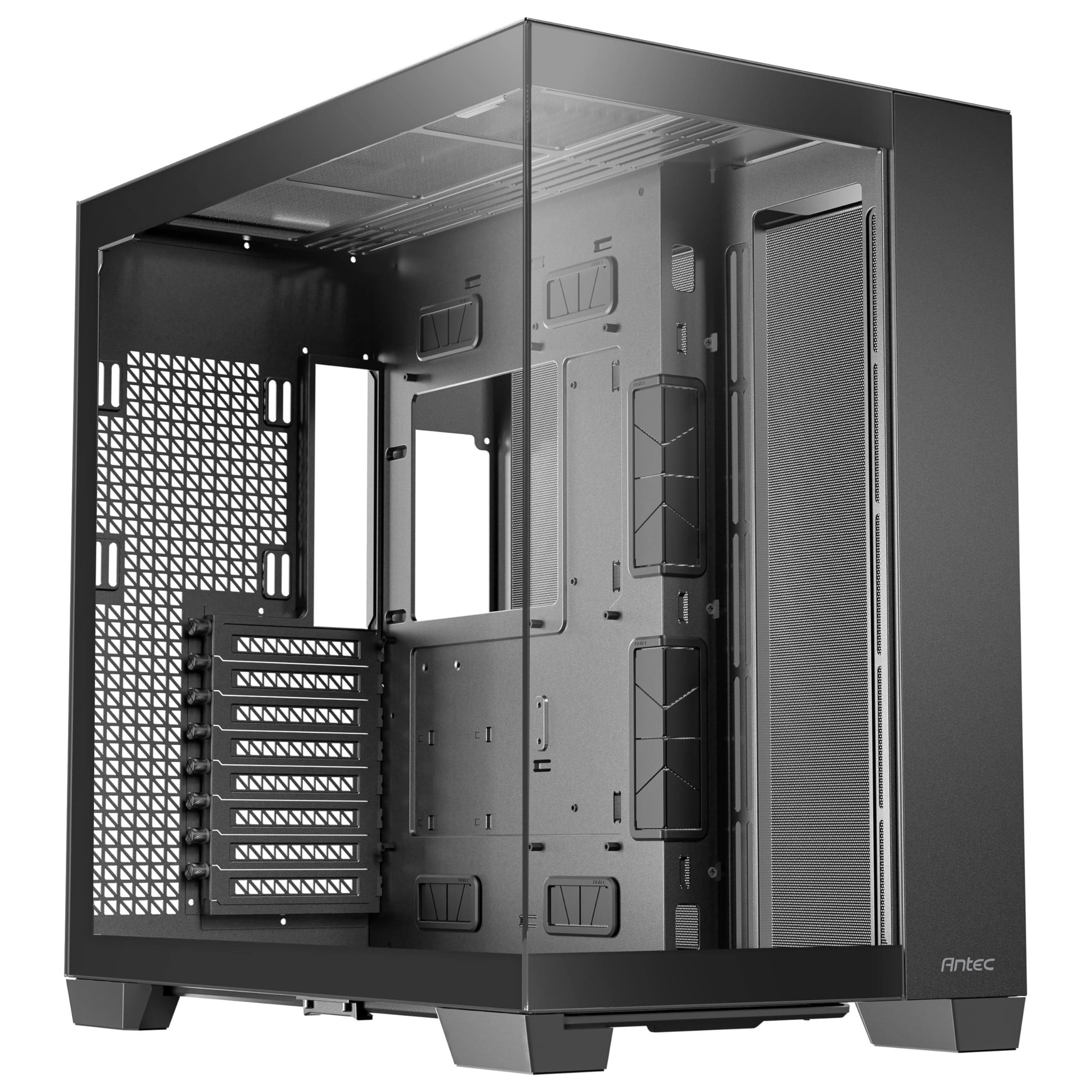
Three thick 360mm radiators at once, in a dual-chamber layout that keeps the drive and cable side hidden.
The C8 is for the builder who wants a server-workstation hybrid that looks like a showcase piece. Its dual-chamber design splits the case into two zones — motherboard and hardware up front, power supply and cabling behind — which gives the build a clean face. Tempered glass covers the front and the side, so your storage wall and your components are both on display. It takes E-ATX, ATX, Micro-ATX, and ITX boards, plus 8 expansion slots for add-in storage cards.
What earns it the top spot is cooling flexibility that almost nothing else here matches. You can run thick 360mm radiators in the top, bottom, and side panels at the same time. The bottom has a full cut-out with interchangeable 120mm and 140mm fan brackets, and the top and bottom will each take either three 140mm or two 160mm fans. Antec quotes support for up to 10 fans total. For a server that doubles as a workstation, that headroom means you can add a liquid loop for the CPU and still move air across your drives.
Two honest catches. Fans are not included, so budget for a full fan set on top of the case. And the drive mounts are lean — 2x 3.5″ HDD and 4x 2.5″ SSD — so if mass storage is your whole reason for buying, look at the DARKROCK or the Define 7 XL below. This is a cooling-and-showcase chassis with enough drive room for a small array, not a storage monster.
What the C8 gets right
- Three simultaneous 360mm radiator positions in top, bottom, and side.
- Dual-chamber layout with tool-free design and a USB Type-C port up front.
- Front and side tempered glass show off the internal build.
- Fits RTX 40 Series graphics cards alongside an E-ATX board.
Where it asks for more
- No fans in the box — you supply the entire cooling setup.
- Only 2x 3.5″ HDD and 4x 2.5″ SSD mounts, tight for a drive-heavy server.
- At 23.1 pounds empty, it is a heavy chassis before drives go in.
Go for it: your build is a cooled workstation or small server where radiator space and looks both count.
Pass on it: your priority is a wall of spinning drives — the drive mounts here are the limiting factor.
2. DARKROCK Classico Max Storage Master E-ATX Computer Case
Thirteen drive mounts in a full tower — the case built for people who count bays before they count fans.
If your server exists to hold disks, this is the chassis that does it. The Classico Max supports 10x 3.5″ hard drives plus 3x 2.5″ solid-state drives, giving it 13 internal bays. That is a 3.2x gap over the Antec Performance 1 FT’s 4 bays, and it is the reason this case sits near the top of the list for pure storage. The drive cages come with screws for installing drives, and the mesh front panels keep air moving across a full stack.
The layout has flexibility most storage cases skip. You can mount the graphics card vertically through three vertical slots, so the front and rear fans form parallel air ducts across the card. A 360mm radiator fits in the top for CPU cooling. E-ATX boards are supported, but note that the hard drive cages have to come out first to install an E-ATX motherboard — a fair trade for the drive room.
It is also compact for the storage it holds. At 18.3″D x 9.06″W x 18.78″H it stands shorter in depth than the Phanteks Enthoo Pro’s 21.65″D. The one recurring wrinkle is mounting: the screw holes are the most-discussed sticking point, so take your time lining drives up. Who it suits: anyone building a NAS or media server on a tight budget who needs maximum drives in one tower.
Storage math: 10x 3.5″ plus 3x 2.5″ is the biggest drive count of any case here that is not a dedicated hot-swap NAS.
Better in practice: the vertical GPU mount with parallel front-and-rear airflow keeps a working card cool even with the front packed with drives.
The right call if: a tall stack of 3.5″ drives is your whole reason for building.
Know before you buy: the drive cages must be removed to fit an E-ATX board, and the screw mounting takes patience.
3. Phanteks Enthoo Pro Full Tower Chassis
Two fans in the box, a PWM hub to control them all, and radiator room that swallows a 420mm cooler.
Most cases here make you buy fans. This one arrives ready to run, with a 200mm front fan and a 140mm rear fan already installed. The design is the thing buyers talk about most — brushed plastic finished to look like aluminum, with a stealth interior that hides the power supply and the hard drive cages behind closed panels. A closed HDD panel keeps the chassis rigid even with both drive cages pulled out.
For a server that needs liquid cooling, the radiator support is generous. There are four different install areas for single to triple radiators in 120mm and 140mm sizes, with clearance for push-pull fan setups, and the case will take a 420-sized all-in-one CPU cooler. The included PWM hub lets you drive every connected fan — even 3-pin ones — from one PWM connector, which tidies your cable run at the same time. Front I/O gives you 2x USB 3.0, a USB-C Gen 2 port, mic, and headphone.
The steel chassis is the durable half of the build, and 6 internal bays cover a moderate drive array. One thing to note: the listed shipping weight reads unusually light for a steel full tower, so confirm the real figure if you are planning a shelf install. Set that aside and this is the sensible choice for a quiet, water-cooled storage build that does not need a glass window.
Cooling built in: two SP-series fans and a PWM hub mean a working airflow setup from the first boot, no extra shopping.
No-window trade: the solid side panel hides your drives but also your cable work — this is a case for people who care about function over display.
Reach for this if: you want radiator room and quiet operation without buying fans separately.
Look elsewhere if: 6 bays will not cover your drive count going forward.
4. Antec Performance 1 FT Full Tower E-ATX PC Case, 3 PWM Fans

A chassis you can take apart and reassemble without swearing at it, with a temperature readout up front.
Build quality is what this case sells, and it sells it hard. Owners describe it as easy to strip down and put back together, which is exactly what a server builder wants when a drive needs swapping or a fan needs cleaning. The 12.55 kg chassis is the heaviest steel build here by a wide margin against the Phanteks Enthoo Pro’s listed weight, and you feel that in how planted it sits with drives loaded.
Space is generous where it counts. The interior takes graphics cards up to 370mm in length, and there is room for a full-size power supply alongside the drive cages. Two cable covers are included to tidy the routing, and a dual 4mm tempered glass side panel shows off the finished build. The Type-C port is rated at 10Gbps for fast external transfers, and Antec’s iUnity software surfaces instant data on your PC specs while the temperature display shows system status at a glance.
The limit is drive count. Four internal bays is respectable for a workstation but thin for a storage server — the DARKROCK above fits 13. If your server is a compute box with a couple of big drives rather than a rack of spinning disks, this is one of the sturdiest, easiest-to-service towers you can buy.
Standout strengths
- Tool-friendly assembly that makes drive and fan service painless.
- Built-in temperature display plus iUnity spec readout.
- Type-C port rated at 10Gbps for quick external drive work.
- Two cable covers keep the interior clean.
Trade-offs to weigh
- Only 4 internal bays — a hard ceiling on drive count.
- 12.55 kg empty makes it a heavy lift loaded.
Made for: a workstation server where build quality and easy service matter more than drive volume.
Think twice if: your storage plan runs past four drives.
5. Rosewill Thor NAS Pro Full Tower Workstation Case

Eight drives you can pull out the front while the server keeps running.
This is the first case on the list that treats a drive as something you swap, not something you unscrew. Eight 3.5″ SATA/SAS bays are hot-swappable, so you pull a tray from the front while the system stays on. Add a 3.5″ bay and two dedicated 2.5″ SSD slots and you have a hybrid storage layout under one roof. The chassis takes E-ATX boards and rates an expansion card length of up to 400mm, so a long HBA or storage controller fits without a fight.
Build quality is what holds this one up — the aluminum and stainless steel frame is the most-praised element, which is what you want in a chassis that will hold a running drive array. A 140mm PWM fan and tuned airflow paths handle thermals, and the front USB 3.2 Gen Type-C port moves bulk data quickly for a workstation or NAS. Rosewill points this at AI clusters, media servers, and scalable small-business storage, and the five external 5.25″ bays give you room for more drive cages or a card reader.
The honest notes: fit is where expectations need calibrating, since the backplanes sit tight, and cable management is workable but not generous. Neither is a fault in the build — it is a dense server chassis, and dense means tight. If you want hot-swap drives in a tower footprint rather than a rack, this is the pick.
The reason it earns a spot: hot-swap front access turns a drive failure into a two-minute front-panel job instead of a teardown.
Best for: a NAS or media server builder who wants enterprise hot-swap habits in a tower.
Worth knowing: tight backplane fit and modest cable routing room — plan your wiring before you install drives.
6. ASUS ProArt PA602 E-ATX Full-Tower PC Case

Two extra-thick 200mm intake fans push a wall of air straight across a nine-bay drive setup.
If your server runs hot and you would rather not build a custom loop, start here. The front panel uses a 15.5 mm grill with 45% porosity — meaning nearly half of that panel is open to airflow — fed by two extra-thick 200 x 38 mm front fans. A 140 mm rear exhaust fan finishes the path, and two deflectors inside send incoming air toward the motherboard and internal components to keep temperatures in check. A built-in fan hub manages it all from one spot.
Space and cooling room are both serious. It holds 9 internal bays and accepts a 420 mm radiator for all-in-one or custom liquid loops, and ASUS says even the largest graphics cards get room for horizontal or vertical mounting. The front panel has an IR dust indicator that tells you when the filter needs cleaning, which matters more than usual when a drive array is breathing through one intake. Front I/O includes a Power Lock Latch, two-section PWM control, and a USB Type-C port rated at 20Gbps.
It is a big, heavy piece of kit at 35.5 pounds, so measure your shelf and plan a two-person lift. For a storage-and-compute server where airflow is the whole game, though, few towers push this much air through a real dust-managed front.
Airflow by the numbers: a 45% porosity front grill and dual 200 x 38 mm fans mean the intake is not strangled — the drives get the air they need.
The catch: 35.5 pounds empty and a 23.35″D footprint — this is a case that takes up real space and asks for help moving when loaded.
Pick this when: cooling a drive array and a big GPU in one tower is the priority and you want the fans supplied.
Measure first: deep and heavy enough that a shallow desk or shelf will not work.
7. Fractal Design Define 7 XL Full Tower
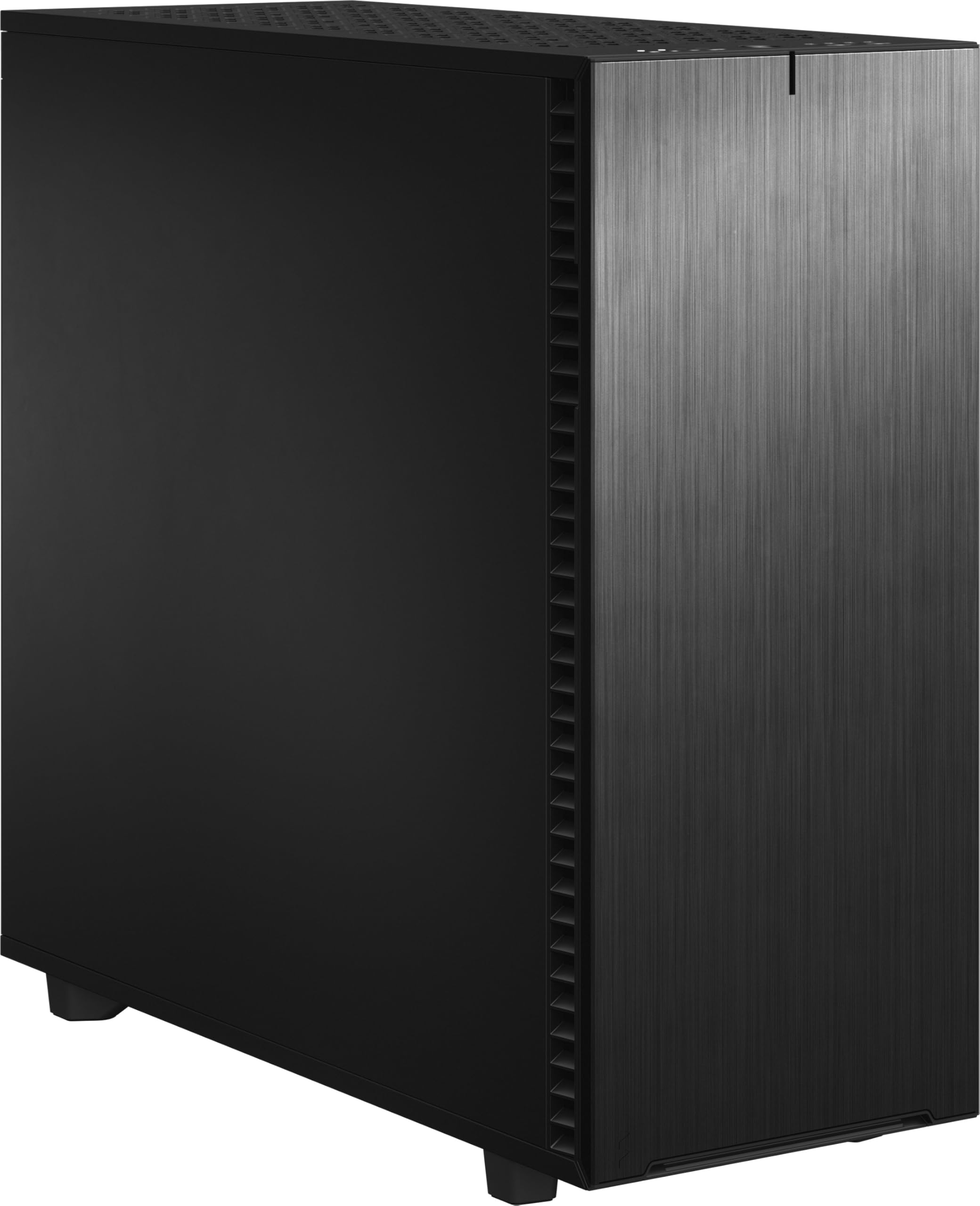
The quiet storage vault — 18 drives, a brushed aluminum door, and a weight that feels like a bank safe.
For a server whose job is silent mass storage, this is the reference point. In its default Storage Layout the Define 7 XL takes up to 18 HDDs alongside 5 SSD mounts — more drive positions than anything else on this list. The brushed aluminum front door has reversible dual-handed hinges and magnetic latching, so it closes with a firm click and keeps drive noise behind it. Internal layout fits boards up to E-ATX and SSI-EEB, and you get 8 expansion slots for storage cards.
Convert it to the Open Layout and the interior makes room for a custom water loop with large reservoirs and radiators up to 480 mm. That flexibility is where the versatile multi-brackets earn their keep: they convert any unused fan position to an HDD, SSD, or pump mount, so the case reshapes itself around your build. CPU coolers up to 185mm tall fit, graphics cards run up to 530mm in length, and airflow is handled with a vented top.
The weight is the reality check — this is a heavy steel and aluminum tower that gets heavier with 18 drives inside, so it belongs on a solid floor or a strong shelf. Everything about it says long-term storage build, and the craftsmanship is why it commands its premium standing among the picks here.
Why storage builders love it
- Up to 18 HDDs and 5 SSDs in the default Storage Layout.
- Radiators up to 480mm in the Open Layout for custom loops.
- Brushed aluminum door with reversible hinges and magnetic latching.
- Multi-brackets turn any spare fan mount into a drive or pump mount.
The price of all that steel
- Heavy — nearly 24 inches deep and dense enough that a loaded build needs a sturdy floor.
- tune for silence and storage, not for showing off internals.
Choose it for: a large, quiet NAS or media server that will live in a room where you work.
skip it if: you want a lightweight case you can move around easily.
8. JONSBO N5 NAS PC Case, E-ATX, 12HDD+4SSD Drive Bay

A home server that looks like furniture, with twelve hot-swap hard drive bays behind a wood veneer front.
The N5 hides its purpose well. A North American black walnut veneer panel fronts a case that holds 12x 3.5″ hot-swap hard drives at the front plus 4x 2.5″ SSDs mounted on the side — 16 drive positions total. That is the most bays of any home-server case here, and it explains why storage capacity is one of the two things buyers praise. The same chassis takes ITX through E-ATX boards, so you can build something modest or something serious inside it.
This is also the rare NAS case that takes real graphics horsepower. It supports up to 4 GPUs in the case, with room for a 240/280 AIO for cooling, and the one-piece removable top cover plus a removable 4-bay HDD cage make the build easier than the bay count suggests. There are 8 PCI expansion slots, front USB 3.2 Gen2 Type-C plus USB 3.0, and three fans built in.
It is a compact tower at 9.37 kg, which makes it easier to place than the big steel chassis here. Two things to plan around: value is a split question for buyers at this tier, and the power supply choice matters — a PSU of 170mm or more reduces the front to 8 drive slots. Confirm your PSU length before you commit to all 12 drives.
Storage and compute together: 12 hot-swap 3.5″ bays plus support for up to 4 GPUs means one box can run a storage array and GPU workloads.
Plan the PSU: an ATX supply of 170mm or larger cuts front drive capacity to 8 slots — pick your PSU length first, drives second.
Ideal for: a home server that needs to look good in a living space and run GPUs alongside drives.
Check before ordering: your power supply length, because it decides whether all 12 front bays are usable.
9. LIAN LI O11D EVO XL White E-ATX Full Tower Case

Three 420mm radiators, a removable front pillar, and glass on two sides — the modular showpiece of the group.
This is the case for a server that is also a display piece. The front pillar lifts out for an unobstructed view of the internals without weakening the structure, and an ARGB strip syncs to the motherboard for lighting that follows your build. Airflow is engineered in: the top mesh panel opening grew by 14.5% and the side mesh by 14% over the prior generation, the bottom panel is fully open, and three dust filters keep the interior clean.
Cooling capacity is the headline. It holds three 420mm radiators, plus up to 11 fans and 7 storage drives, with full-size power supplies fitting easily. The adjustable motherboard tray moves up and down through three height levels so you can fit different fan and radiator combinations. Toolless installation, a multi-directional power button, a movable I/O module, and movable fan brackets make the build flexible rather than fixed. Three dual-layer cable clips mount anywhere along the vertical grommets for routing.
The 7 drive bays are the ceiling to know about, and cable management at this density is a consider-it-in-advance job rather than an afterthought. For a white-themed, water-cooled build that shows off a small-to-moderate drive setup, this is the one with the most configuration freedom.
Customization is the draw: a tray with three height levels and movable fan brackets lets you reshape the case to your parts instead of building around its fixed layout.
Suits you if: you want the most radiator room and modular layout in a white showcase build.
Keep in mind: 7 storage bays cap the drive array, and the wiring wants planning.
10. Silverstone Technology CS383 Full Tower NAS Chassis
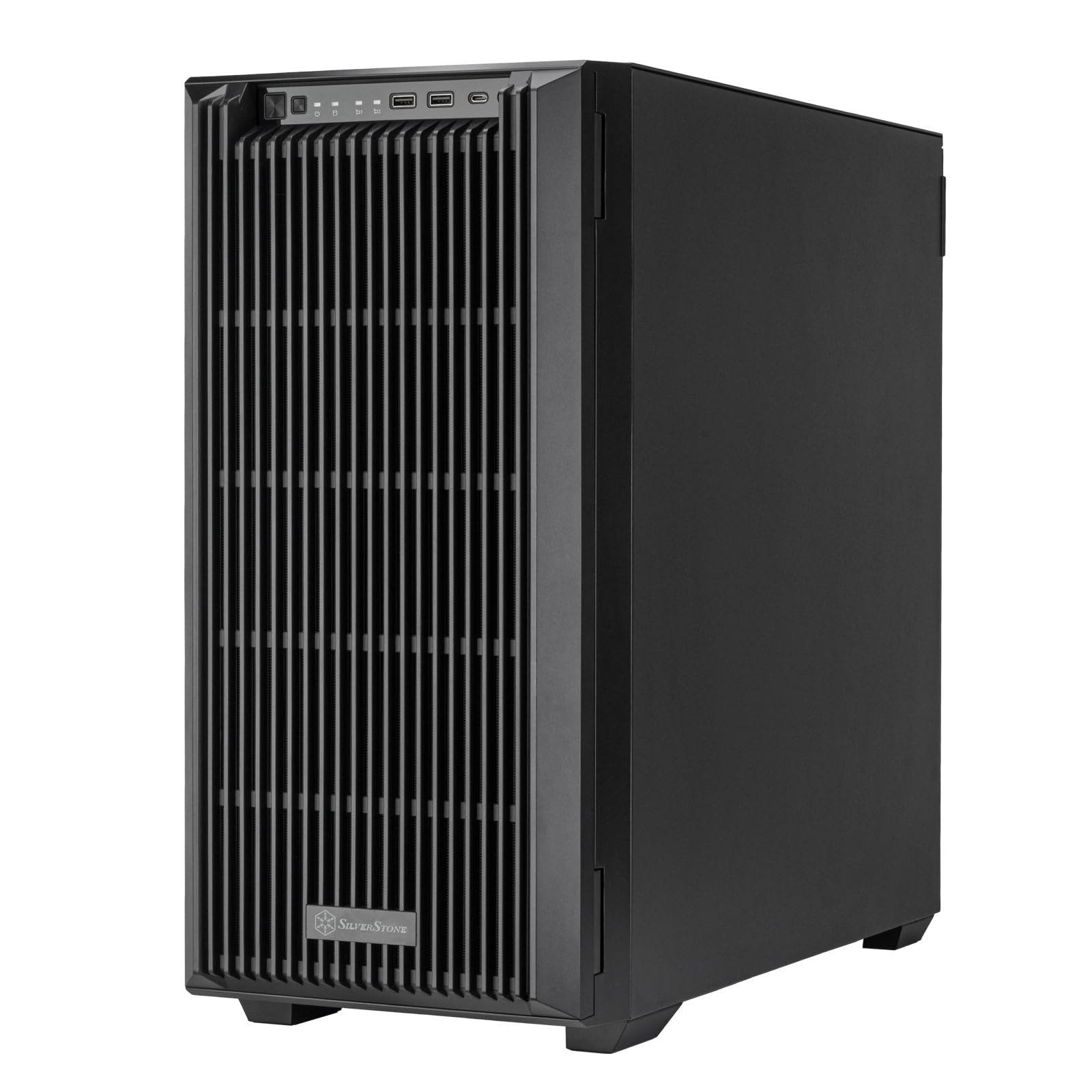
Bare-metal server pedigree in a tower: eight hot-swap trays, SSI-EEB boards, and room for two power supplies.
This is the case for someone who wants real server hardware without a rack. It takes motherboards up to E-ATX and SSI-EEB, the larger server-grade board standard, and holds 8 hot-swappable 3.5″ or 2.5″ drive trays rated for SAS-12G and SATA-6G drives. Eight expansion slots support a graphics or adapter card up to 340mm long.
Two features put this a tier above the home gear. It can run dual power supplies for redundancy, which is what you want on a server that must stay up, and it supports up to 4 additional 5.25″ drive bays when you need more front storage. Cooling leans to air — it takes a 420mm liquid cooling radiator or an air cooler up to 186mm tall, so a big tower heatsink is a real option. Build quality is the standout here, and with an alloy steel and aluminum frame that is what you would expect.
One line verdict: the tower NAS to buy when dual PSUs and front-swap trays matter more than bay count.
Server-grade features
- 8 hot-swap trays rated for SAS-12G and SATA-6G drives.
- Dual power supply capable for redundancy.
- Supports E-ATX and SSI-EEB motherboards.
- Fits a 420mm radiator or a 186mm-tall air cooler.
Where it stops short
- 8 drive bays is below the top storage picks here.
- Enterprise focus means less consumer-facing polish.
Buy it for: a tower-based NAS or SMB server that needs dual PSUs and front-swap trays.
Look past it if: you need the biggest possible drive count in one chassis.
11. Cooler Master HAF 700 E-ATX High Airflow PC Case

A high-airflow monster that fits eighteen 120mm fans and dual 360 or 480mm radiators inside one tower.
The HAF 700 is built around moving air, and it shows. A mesh front panel feeds dual 200mm Sickleflow ARGB fans, and the case accepts anything from eighteen 120mm fans to dual 360 and 480mm radiators. ARGB Gen 2 lets each LED be controlled independently, so the lighting can be tuned per component. The tool-less design runs through the whole case, which makes assembly quicker on a multi-fan build.
On the connection side it is well stocked: one USB 3.2 Gen 2 Type-C port and four USB 3.2 Gen 1 (3.0) ports up front. The 8 internal bays handle a moderate drive array, and the case takes Extended ATX boards. Appearance is the element buyers respond to most here, and the mechanical detailing is part of that — it is a chassis meant to be looked at as well as cooled.
The size is the real decision point. At 26.22″D x 11.46″W x 24.65″H it is the deepest case here, and 19.6 kg makes it a genuine two-person lift before drives go in. It will not tuck under a low desk. Build it as a high-airflow server for a room where you have floor or deep-shelf space, and it earns its place; try to squeeze it into a tight spot and it will fight you.
Cooling headroom: support for eighteen 120mm fans or dual 360/480mm radiators means you can cool a heavy load without running fans at full tilt.
Space reality: at 26.22″ deep and 19.6 kg, this is the largest footprint on the list — verify your floor or shelf can take it.
Right for: a high-airflow build with a big GPU array or heavy compute load that needs maximum fan space.
Not for: tight spaces or anyone who needs to move the case regularly.
Know the Specs
Internal bays and hot-swap trays
Internal bay count is how many drives fit inside the case, and it is the number that caps your storage forever. Manufacturers list 3.5″ HDD and 2.5″ SSD mounts separately, and they are not swappable, so read the split. A hot-swap bay lets you remove a drive from the front while the system runs — the key difference for a 24/7 NAS. Fixed cages mean opening a side panel and unscrewing the drive, which is fine for a workstation you shut down.
Radiator and cooler clearance
Radiator support is the size and mounting locations for liquid cooling, measured in millimeters. A 240mm or 280mm AIO fits the smallest mounts here; the largest cases take a 420mm or 480mm radiator, or three 420mm units at once. Air cooler height and GPU length are separate clearances — a case might take a big radiator but cap your CPU heatsink, so check both against your parts. More clearance means more cooling options as your build grows.
Motherboard form factor support
Form factor is the size standard for the motherboard. ITX is smallest, then Micro-ATX, ATX, E-ATX, and SSI-EEB for server boards. Every case here handles E-ATX, which keeps your expansion-card options open. Some storage-first designs require removing drive cages to fit an E-ATX board — an important detail if you plan a large board alongside a full drive array. Confirm the case takes your board size before you buy drives.
Case depth and weight
Depth is the front-to-back measurement, and it decides whether a full tower fits your desk or shelf. Several cases here run past 20 inches deep, which will overhang a shallow surface or fail to fit a shelf. Weight matters once drives are loaded — a steel chassis full of 3.5″ disks becomes a two-person lift, and it needs a floor or shelf that can take that load. Measure the depth of your desk or shelf and confirm it can carry a loaded chassis before you order.
Common Questions
Do I need hot-swap drive bays for a home server?
How many drives can a server tower case hold?
Can I use an E-ATX motherboard in these cases?
What radiator size can a server tower case fit?
Is a full tower case too big for a home server?
Do these server cases come with fans included?
Can a server tower case hold a large graphics card alongside the drives?
What does SSI-EEB motherboard support mean for a server build?
Will a 12-drive NAS build fit a tower case?
Do I need a dual power supply for a server tower case?
The Bottom Line
For most builds, the server tower case winner is the Antec C8. It puts cooling first, and it can run three 360mm radiators (liquid-cooling panels, each 360mm long) at once, so a hot drive array stays cool. A dual-chamber layout (two separate compartments inside) also keeps your build clean. If pure storage is your goal, the DARKROCK Classico Max gives you 13 drive mounts in a compact tower, so you can pack in drives without a full-size chassis. If you want a silent vault, reach for the Fractal Design Define 7 XL, which has room for up to 18 HDDs (hard disk drives, the spinning kind).
The quickest way to choose: count your drives honestly, then pick the case that clears that number with room to spare. Hot-swap trays are worth it if your server runs around the clock, and radiator room is worth it if your CPU or GPU runs hot. Match bay count and cooling to your drives and CPU, and the chassis will outlast two or three drive upgrades.
How we choose
We do not accept paid placement. Every pick is matched to a real buyer and a real use-case; we do not hands-on test units.
Sources
Specifications: manufacturer listings and product documentation. Review insights: verified customer reviews, as of November 2026. Pricing: not shown on this page (it changes often); check the current price via the retailer link.
As an Amazon Associate, Tactical Gear Guy earns from qualifying purchases. This does not affect which products we feature.