Specs are compiled from manufacturer listings and verified buyer reviews and can change over time — please confirm the key details on the product page before buying.
Buying a trekking watch for men is mostly about one fear: running out of battery or losing the trail halfway up. The fix is to know which watches actually hold a satellite fix on a forested ridge, and which ones will still show the time after a week of no charging. This guide runs through eleven real options, from solar-assisted models that sip power all day to twin-sensor Casio outdoor watches that run on a rechargeable battery for months in the dark.
This guide is built by comparing the manufacturers’ published specifications and the patterns across verified customer reviews, so you get each pick’s real strengths and trade-offs instead of marketing spin.
We focus on what holds up on a wet, muddy trail: altimeter drift, compass accuracy under tree cover, and how fast the battery drains once you start a GPS hike. Read on for a straightforward look at the trekking watches for men that earn their spot on your wrist.
Top Picks

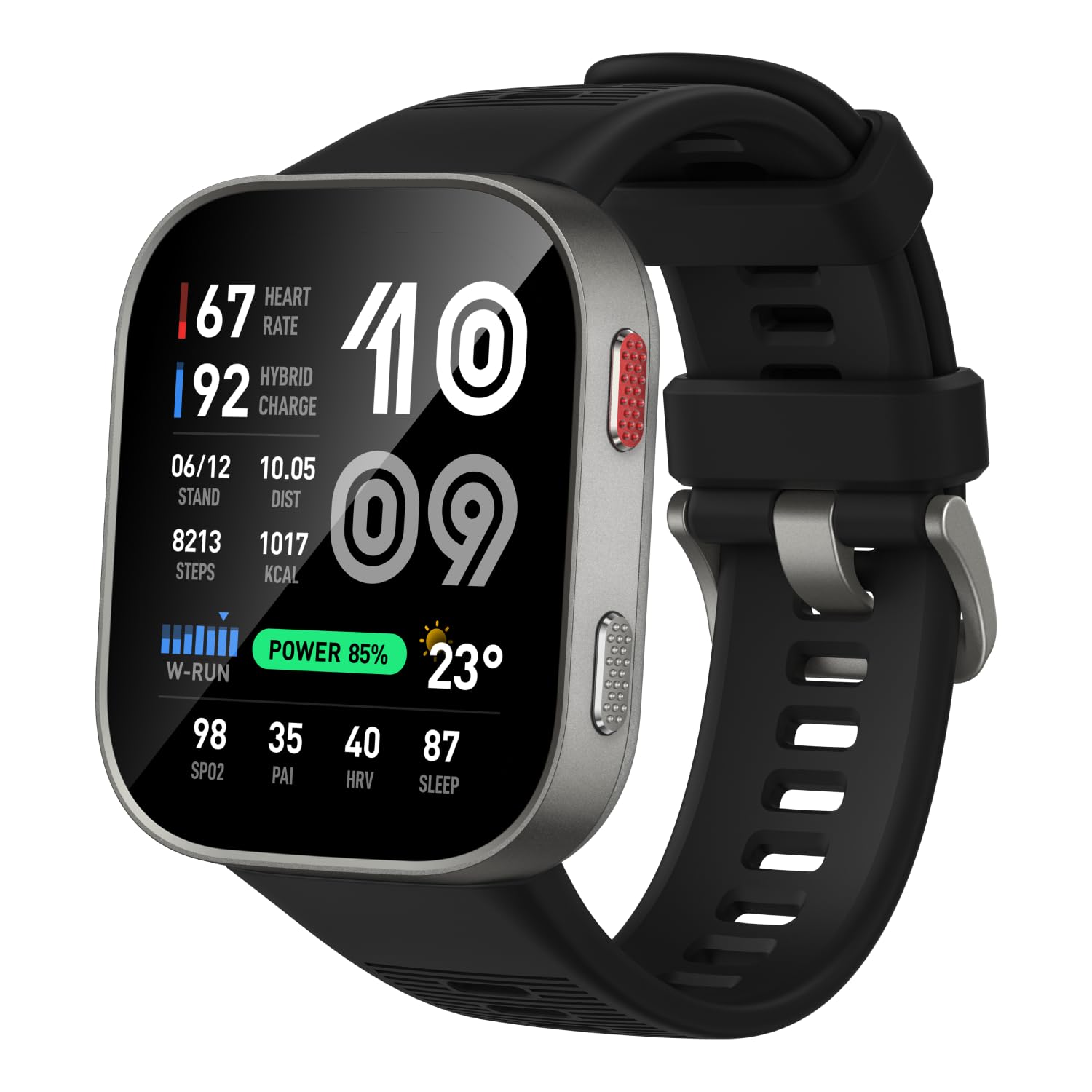
How To Choose The Best Trekking Watches for Men
A trekking watch is a wearable tool, not a fashion piece. You want it to tell you where you are, how high you have climbed, and how much power you have left, all while keeping the mud off a normal phone screen. The tricky part is that every model lists a pile of sensors and a battery figure that only applies in one specific mode.
Start with your navigation sensors
The core set is a 3-axis compass, a barometric altimeter, and GPS. A 3-axis compass (a sensor that reads your heading from any tilt) means you do not have to hold the watch flat to get a bearing. A barometric altimeter (a pressure sensor that measures height) settles faster than GPS for a climb, so it tracks gain accurately as you move.
Work out your real battery budget
A watch that claims weeks of battery in smartwatch mode will drop far faster once you start a GPS hike. Look at both figures separately. Solar charging adds a top-up, but it only counts if the panel is in direct sun, so a solar model is a nice buffer, never a replacement for charging before a long route.
Decide how much watch you want on your wrist
Cases get bigger as sensors and batteries grow, and a 50 mm case is noticeably more weight and bulk than a slimmer outdoor model. Look for a case that will not catch on long sleeves and a strap wide enough to sit flat under a pack strap.
Match the construction to your terrain
Water resistance, shock rating, and case material separate a true trail tool from a desk-friendly wearable. A military or 100 m water rating means you can get it soaked in a river crossing or wear it in rain without a second thought.
Side-by-Side Comparison
| Model | Best For | Battery (Smartwatch Mode) | Navigation Sensors | Case Size | Amazon |
|---|---|---|---|---|---|
| Garmin Instinct 2X Solar – Tactical Edition | All-round trail survival | Infinite with 3 hrs sun/day | 3-axis compass, barometric altimeter, multi-band GPS | 50 mm | Amazon |
| Amazfit Bip Max | Big-screen value | 20 days | GPS with 5 satellite systems, offline maps | Not listed | Amazon |
| Suunto 9 Peak Pro | Fast-charging expedition days | 40 hrs GPS / 300 hrs tour | 4 satellite systems, turn-by-turn navigation | Not listed | Amazon |
| Casio PRG340 Pro Trek | Sensor-first bushcraft | 7 months on charge | Compass, altimeter, barometer, thermometer | Not listed | Amazon |
| Garmin Instinct 2 Solar | Slimmer solar outdoor watch | Unlimited with 3 hrs sun/day | 3-axis compass, barometric altimeter, GPS/GLONASS/Galileo | Not listed | Amazon |
| Amazfit T-Rex 3 Pro | Offline maps with toughness | 25 days | Offline POI search, 6 satellite systems dual-band | 48 mm or 44 mm | Amazon |
| COROS Nomad | Long-day trail logging | 22 days | Pre-loaded global maps, Back-to-Start navigation | Not listed | Amazon |
| Casio PRW6600Y Pro Trek | Solar with atomic time | Tough Solar power | Compass, altimeter, barometer, thermometer | Not listed | Amazon |
Detailed Reviews
1. Garmin Instinct 2X Solar – Tactical Edition
A solar trail watch that runs indefinitely in smartwatch mode on three hours of daily sun.
This Garmin is built to U.S. military standard 810 for thermal, shock, and water resistance, which in plain terms means dropped rocks and cold mornings are not a problem. The 50 mm case is a slab of fiber-reinforced polymer, and the Power Glass solar lens (a clear panel that turns sun into charge) produces 50% more energy than the standard Instinct 2 solar watch.
Battery is the headline. Garmin says you get infinite battery life in smartwatch mode when the watch sees 3 hours of direct sunlight at 50,000 lux (bright, direct summer sun) each day. On a ridge where the sun is on your arm, that means you can stop budgeting charge on multi-day routes.
The band width is the widest of the group at 26 millimeters, so it settles firmly on your wrist rather than twisting under a pack strap. That is the 18% more gap compared to the 22-millimeter strap on the Amazfit Bip Max, which matters if you have a thicker wrist. Multi-band signal reception (picking up several satellite frequencies at once) also gives you positioning accuracy that single-band watches struggle to match under cliffs. The built-in LED flashlight runs several intensities plus strobe, and the SOS strobe mode is there to signal in an emergency. A 3-axis compass and barometric altimeter round out the navigation, so you get a bearing and a height reading even when the phone never leaves your pocket.
What holds up in the field
- Solar charging produces 50% more energy than the standard Instinct 2 solar
- Infinite smartwatch-mode battery with 3 hours of daily direct sun
- Military standard 810 build for shock, thermal, and water resistance
- Rugged build that keeps its reputation for survival in the review base
Where it asks something of you
- The 50 mm case is big on a slim wrist
- The 26 mm band needs a secure fit to stay put
Built for: trekkers who spend days outside and want a watch that charges itself while they walk.
Keep in mind: the 50 mm polymer case is genuinely large, so try it on before committing.
2. Amazfit Bip Max Smart Watch
A 2.07-inch AMOLED display that stays legible in daylight, paired with a flat 20-day battery.
Most trail watches hide behind small displays. This one goes the other way with a 2.07-inch AMOLED panel (active-matrix OLED, which is bright and crisp in daylight), so you can read the map and the elevation without squinting. The body is aluminum alloy, which keeps it light enough to forget you are wearing it.
Battery is a straight 20 days of typical use. That is a flat figure rather than a solar-dependent one, so you can plan on it. Owners consistently note the runtime as one of the things they like most, and they frequently praise the overall build quality as the watch’s strongest trait. Offline maps download free from the Zepp App with turn-by-turn directions and off-track alerts, and 5 satellite systems keep the fix quick. There is also 4GB of onboard storage, which is enough room for maps and media so you can leave your phone behind on a route.
The honest catch is that this is an everyday smartwatch adapted to trail use, not a mil-spec field tool. There is no barometric altimeter or compass listed, so you are leaning on GPS for elevation and heading. The band measures 22 millimeters — 4 mm narrower than the 26 mm on the Garmin Instinct 2X Solar above — so it feels more like a fitness strap than a load-bearing trail strap. If you want the biggest screen for the least outlay and your hiking is day routes rather than deep wilderness, it is a sensible place to start.
The screen argument: a 2.07-inch AMOLED display and a 20-day battery in an aluminum body covers navigation and reading in daylight better than most watches at the entry level.
The trail-grade trade-off: no compass or barometer listed, so elevation and heading depend on GPS alone.
Reach for this if: you want a wide, bright map screen and multi-day battery without a premium price tag.
Look elsewhere if: you need a dedicated compass and a barometric altimeter for off-trail navigation.
3. SUUNTO 9 Peak Pro
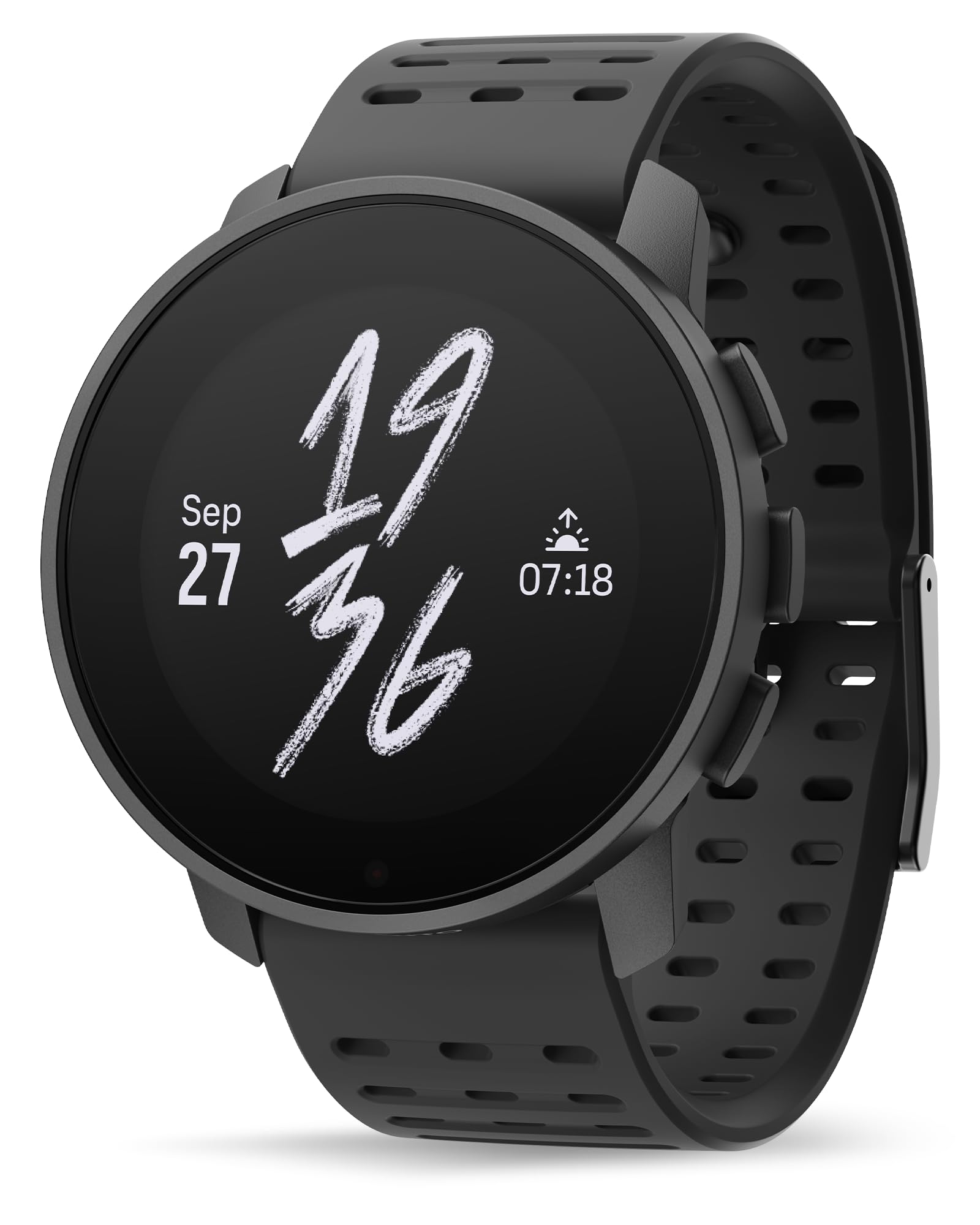
A 10-minute top-up delivers 2 hours of GPS, and a full charge takes 1 hour.
That quick-charge figure is the reason to look at this Suunto. A 10-minute top-up delivers 2 hours of GPS training, and a full charge gives you 40 hours in best GPS mode, 70 hours in endurance mode, or 300 hours in tour mode. For a fastpacker who charges from a power bank at camp, that is a genuinely useful ratio. The 600 mAh battery fills in 1 hour.
Construction is a step above the everyday trail watch. This is a titanium, stainless steel, and sapphire glass build with 100 m water resistance, and Suunto has been making outdoor instruments since 1936. Navigation runs on 4 different satellite systems (satellite constellations the watch listens to at once), which keeps the signal steady in canyons and among tall buildings. You get 97 sport modes, turn-by-turn navigation, weather alerts, and avalanche maps.
The Suunto app ties it together with structured workouts, goals, and real-time guidance on the watch, plus Strava and Training Peaks connections. What owners praise most is simply the watch itself — the overall quality of the build is the most-praised trait in the review base, and battery life comes second. The catch is honest: reliability and GPS accuracy both drew mixed feedback, so a few people found the positioning less consistent than expected. Sleep tracking is also mentioned as imprecise. Treat it as a training and navigation tool first, and it delivers.
The case for strapping it on
- 2 hours of GPS on a 10-minute charge
- Full charge in 1 hour on a 600 mAh battery
- Titanium, stainless steel, and sapphire glass with 100 m water resistance
- 97 sport modes plus turn-by-turn navigation
What to weigh first
- GPS accuracy feedback is mixed
- Sleep tracking is imprecise according to feedback
Best matched to: athletes who cut it fine on charge time and want a fast, deep top-up at camp.
Worth knowing: GPS accuracy is not its strongest suit, so pair it with a paper map on unfamiliar terrain.
4. Casio PRG340 Pro Trek

A triple sensor — compass, barometer, and altimeter — each read on a single button press, with no app or charger needed.
This is the watch for the trekker who wants readings, not notifications. The Triple Sensor (a compass, barometer, and altimeter with a thermometer) puts a direction reading, air pressure and temperature, and altitude each on a single button press. The oversized buttons carry a nonslip finish, so you can work them with gloves on. Sensor placement has been moved to the side of the case to slim the profile.
The power story is what makes it a serious bushcraft pick. Tough Solar (a built-in panel that recharges from sunlight and UV light) keeps the rechargeable battery going for about 7 months of normal use without any further light exposure. Store it in total darkness with power save on and Casio says it runs 27 months. Water resistance is 100 m, and there is low-temperature resistance rated down to -10℃, so a cold morning does not stall the screen.
The case, case back, and soft urethane band use biomass plastics made from renewable sources such as castor oil plants and corn. A duplex LCD (two stacked display layers) shows compass graphics on top and a large time and measurement readout underneath. There is a 1/10-second stopwatch with a 1,000-hour measuring capacity, a countdown timer, 5 daily alarms, and a full-auto Super Illuminator LED backlight. What earns it the most praise is build quality, with functionality close behind. The honest note: this is a sensor instrument rather than a mapping watch, so you get no on-screen trail maps.
Where the value sits: a triple sensor suite plus solar charging and 100 m water resistance in a biomass-plastic case built for gloved hands.
The limitation to accept: no GPS mapping — the navigation is bearing and elevation, not a moving map.
Suited to: the trekker who reads a paper map and wants an independent compass and altimeter that never needs a charger cable.
Not for: anyone expecting turn-by-turn trail directions on the screen.
5. Garmin Instinct 2 Solar

The leaner Instinct: unlimited solar smartwatch battery and TracBack routing without the tactical extras.
Think of this as the leaner sibling of the tactical Instinct. It still delivers unlimited battery life in smartwatch mode, assuming all-day wear with 3 hours per day outside in 50,000 lux conditions. In GPS mode it runs up to 48 hours with solar charging continuously in direct sunlight. The fiber-reinforced polymer case is scratch-resistant Gorilla glass up front and water-rated to 100 meters.
Navigation leans on a built-in 3-axis compass and barometric altimeter, plus multiple global navigation satellite systems: GPS, GLONASS, and Galileo. TracBack routing is the standout — it turns your outbound track into a breadcrumb line home, so you never have to retrace a junction from memory. A power manager lets you see exactly how settings and sensors chew the battery and change them on the fly. Full charge takes 2 hours.
What people respond to most is how it looks; the styling is the top-praised trait across the review base. Battery life is right behind it, with the runtime often described in terms of charging roughly once a month. Durability holds up too, including through a full running season. Accuracy, reliability, value, and connectivity each drew a more mixed response, so this is a watch you buy for solar range and looks first. It is a genuine all-day tool for hiking, running, and swimming, and it does all three without complaint.
What earns it a spot
- Unlimited smartwatch-mode battery with 3 hours of daily sun
- TracBack routing for an easy line back to camp
- 100 m water rating and scratch-resistant Gorilla glass
- 3-axis compass and barometric altimeter onboard
The quiet compromises
- Accuracy and connectivity feedback is mixed
- 2 hours to fully recharge
The right call for: hikers who want a good-looking solar Garmin without the tactical bulk.
A caution first: if precision accuracy is your priority, read the mixed accuracy feedback before you commit.
6. Garmin Instinct 3 AMOLED

A 1.3-inch AMOLED dis under sapphire glass, with a titanium alloy bezel and buttons.
Screen brightness is the spec that jumps out here. The 1.5-inch AMOLED display puts out 3000 nits (a measure of brightness), which keeps it readable in full sun. Sapphire glass covers it, and the bezel and buttons are titanium alloy. You have a choice of 48 mm or 44 mm case sizes, so a slimmer wrist can still get the full feature set.
Maps are fully offline. You get offline POI search (points of interest stored on the watch), auto rerouting, round-trip route creation, and detailed ski maps. Positioning uses dual-band support from six satellite systems, which helps under dense tree cover and tall buildings. Water resistance is 10 ATM, and it carries diving certification to 45m. The built-in two-color flashlight offers soft red for low interference, bright white for clarity, and a Turbo Mode for maximum visibility, plus an SOS signal.
Battery is up to 25 days from a 700 mAh cell. Owners find the wide spread of sport modes — 180+ of them — the most useful part, with battery life the second most-discussed strength. The menu is easy to navigate too. Durability and connectivity both drew mixed feedback, so treat those as the softer points. A full charge takes 3 hours, which is a figure to plan around before a multi-day trek. Bluetooth calls and hands-free message replies work with an Android phone.
The outdoor-first package: a 3000-nit sapphire-covered AMOLED screen, titanium alloy bezel, offline maps, and 10 ATM water resistance at a 700 mAh battery.
Where it wobbles: connectivity and durability feedback is mixed, and 3 hours to recharge is a long wait.
A strong match for: trekkers who want offline maps and a hard-wearing case without moving to the top price tier.
Think about this: plan your charging around a 3-hour refill if you are going remote.
7. COROS Nomad
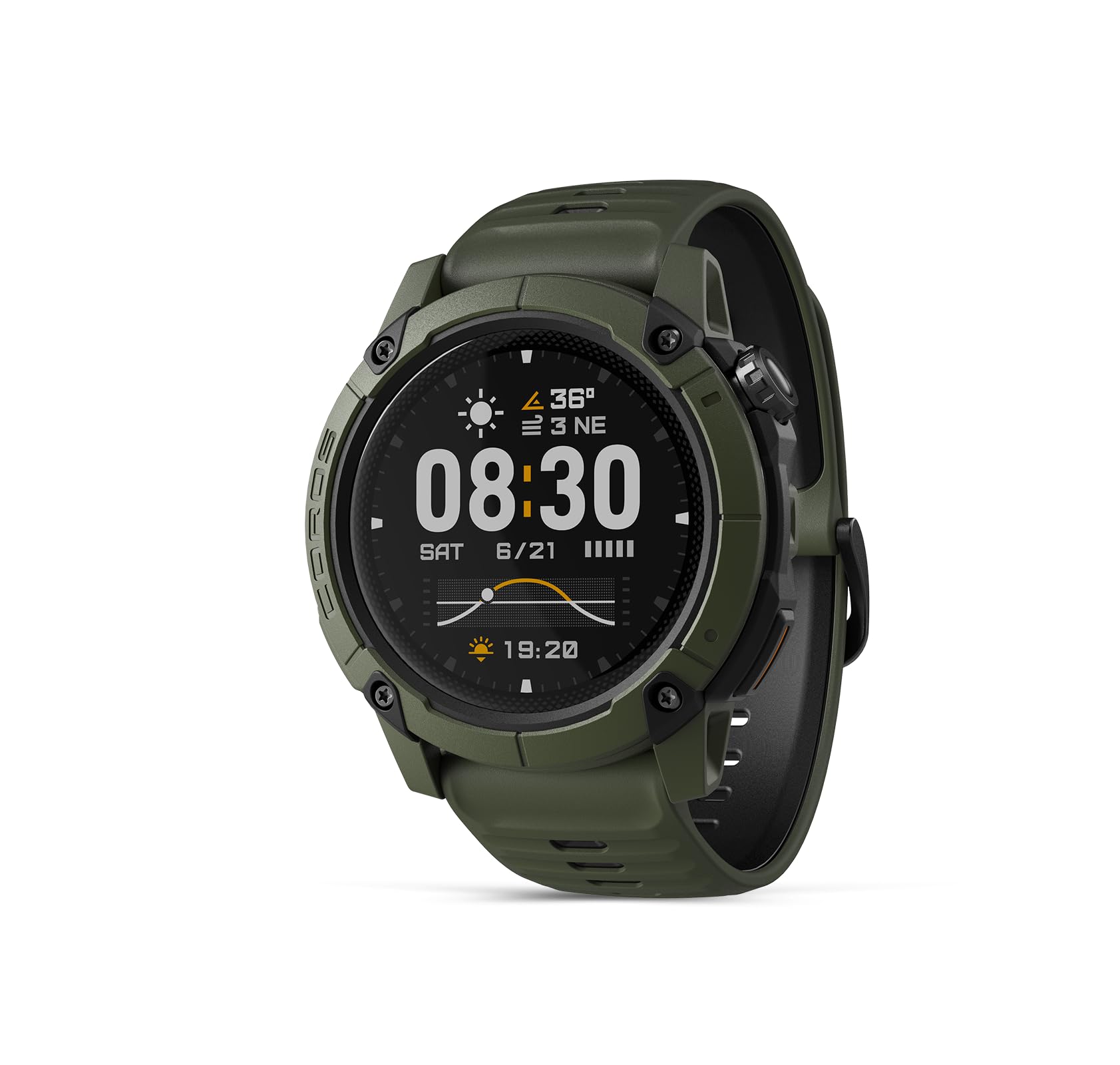
A wrist log for voice notes, photos, and tagged spots, with 50 hours of GPS and 22 days of daily use.
The feature that sets this COROS apart is the built-in Adventure Journal. You can record voice notes, tag locations, add photos, and transcribe voice-to-text memos within an activity. In practice that means you log a good fishing spot or a tricky junction without pulling out a phone. The 1.3-inch Memory in Pixel screen (a low-power reflective display) is built for high contrast in direct sun and clear visibility in low light.
Battery splits into two useful numbers: 50 hours of GPS battery life and 22 days of daily use. For long trail days that means the watch outlasts you. Free pre-loaded global maps come with street names, plus real-time weather and environmental data, Back-to-Start navigation, and safety alerts. Anglers get real-time and forecasted sunrise, tides, and moon phase data, and can log catches and mark key spots.
The case is dual-layer polymer with an aluminum alloy bezel, so it feels sturdy without the weight of a steel build. Owners rate it as performing well against Garmin watches, and the battery life gets singled out as superb. Practical features and an easy-to-use interface round out the praise, and it earns its keep for outdoor activities like trail running. Where it needs care is mapping workflow — if you want turn-by-turn street routing, this is more breadcrumb than city navigation.
Why it earns the spot: 50 hours of GPS and 22 days of daily use, plus voice-note and photo logging that most watches cannot do.
The honest limit: navigation is Back-to-Start and pre-loaded maps rather than full turn-by-turn street guidance.
Reach for this if: you want a durable GPS watch whose battery lasts weeks and lets you log the trip as you go.
Skip the mapping argument if: you need precise street-level turn prompts on every route.
8. Casio PRW6600Y Pro Trek

A solar Pro Trek that also sets its own time from an atomic signal.
Atomic timekeeping (a radio signal that corrects the watch to the exact time) is the difference between a watch that drifts and one you never reset. Combined with Tough Solar power, this Pro Trek asks almost nothing of you: no cable, no clock correction. The compass, altimeter, barometer, and thermometer are all there, every one of them a single-button read, and 100 m water resistance covers river crossings and rain.
Function is exactly what owners praise. The compass and the barometer/thermometer readings get called out as the standout sensors, and the interface is described as straightforward and easy to use. Comfort and value both come up favorably too, which matters on a watch you wear all day. The stopwatch runs to 1/10-second precision with a 1-100 second range on displayed splits, and the countdown timer and world time round out the field set.
This is a lighter-weight design statement than the titanium-cased adventure watches here, and it earns that by doing the sensor job well rather than trying to be a mapping computer. If your treks are about knowing your heading and your altitude — and never worrying about a battery dying in the drawer between trips — this is the one that never needs managing.
Why it stays in the rotation
- Atomic timekeeping corrects itself from a radio signal
- Compass, altimeter, barometer and thermometer each on one button
- 100 m water resistance for wet trails
- Functionality and ease of use that hold up in feedback
What you give up
- No GPS mapping or route guidance
The right fit for: a traditional trekker who wants solar power and self-correcting time on a watch that needs zero charging discipline.
Not the pick for: anyone who wants GPS breadcrumbs on a screen.
9. Garmin fēnix 7X Pro Solar
Smartwatch Mode vs GPS Mode Battery
Smartwatch mode is the watch as a watch: time, notifications, health tracking. GPS mode is when the watch is actively logging a route, and it drains the battery much faster. A watch that runs 22 days in daily use may run only 50 hours of GPS. Always check both figures before a long route. Solar charging adds a top-up, but only in direct sun at bright intensity — treat it as a cushion, not a replacement for charging.
Multi-Band GPS and Satellite Systems
Multi-band GPS listens on more than one satellite frequency at once, which helps lock a position in canyons and under tree cover where a single-band signal bounces. Counting satellite systems — GPS, GLONASS, Galileo — tells you how many constellations the watch can pull from. More systems generally means a faster, steadier fix. SatIQ on the Garmin Instinct 3 and fēnix 7X Pro switches modes on the fly to balance that accuracy against battery life.
Tough Solar and Water Resistance Ratings
Tough Solar is a built-in panel that recharges from sunlight and UV light, which is why a Casio Pro Trek can run months on a charge in normal use. Water resistance is a separate number: 100 m on the Casio and Garmin Instinct 2/2X/2 Solar, and 10 ATM on the Amazfit T-Rex 3 Pro. Those ratings tell you the watch survives rain and a river crossing; they are not a depth diving figure.
Common Questions
Will a trekking watch keep a GPS signal under dense tree cover?
How long does the battery really last on a hiking trip?
Do I need a barometric altimeter or is GPS altitude enough?
Can a trekking watch survive being submerged in a river crossing?
Is solar charging enough to skip the charger on a week-long trek?
What is the difference between 100 m water resistance and 10 ATM?
Does a built-in flashlight really matter on a trekking watch?
Do I have to pay a subscription to use a satellite SOS watch?
Which is better for trekking, a Casio Pro Trek or a Garmin GPS watch?
How big a watch case should I get for a trekking watch?
The Bottom Line
For most trekkers, the trekking watches for men winner is the Garmin Instinct 2X Solar – Tactical Edition because it pairs infinite smartwatch-mode battery on 3 hours of daily sun with multi-band GPS, a 3-axis compass, and a barometric altimeter — the full trail kit in one rugged 50 mm case. If a bright, legible screen matters more to you than solar survival, the Garmin Instinct 3 AMOLED delivers a 1.3-inch AMOLED panel with SatIQ. And for remote routes where a satellite SOS is the whole point, the Garmin fēnix 9 Pro Solar inReach is the one to reach for. Whichever way you lean, the crowd favorite here is a 4.5+ star watch with 600+ ratings behind it — that is a lot of muddy boots agreeing with each other.
How we choose
We do not accept paid placement. Every pick is matched to a real buyer and a real use-case; we do not hands-on test units.
Sources
Specifications: manufacturer listings and product documentation. Review insights: verified customer reviews, as of November 2026. Pricing: not shown on this page (it changes often); check the current price via the retailer link.
As an Amazon Associate, Tactical Gear Guy earns from qualifying purchases. This does not affect which products we feature.