Specs are compiled from manufacturer listings and verified buyer reviews and can change over time — please confirm the key details on the product page before buying.
Buying a tent for two is mostly a math problem about compromise: you want two adults to sleep without touching the walls, you want the whole thing under five pounds on your back, and you want the fly to hold when the sky opens at 2 a.m. The picks below solve that math in different ways, and the short answer is that the Naturehike Mongar 2 is the one most people should buy — double doors, two vestibules, and a full double-wall build at a mid-range outlay.
This guide is built by comparing the manufacturers’ published specifications and the patterns across verified customer reviews, so you get each pick’s real strengths and trade-offs instead of marketing spin.
Below you will find eleven two-person shelters sorted by what they actually do best on a trail, framed in plain English so you can pick in one sitting. Every entry here is a legitimate two-person hiking tent, and the differences between them come down to packed weight, floor area, and how much rain the fly can shrug off.
Top Picks


How To Choose The Best Two Person Hiking Tent
Most people buying their first two-person shelter make the same mistake: they trust the “2 person” badge and ignore the floor dimensions. A tent listed as a two-person model can carry a floor as narrow as 51 inches across, and two average adults on 25-inch sleeping pads need roughly 50 inches of width before anyone touches a mesh wall. Read the length, width, and floor area first, then read the weight.
Floor area in square feet is the honest number
Square footage of sleeping space is what separates a tent two people tolerate from a tent two people enjoy. Anything at or around 30 square feet is the working standard for a two-person backcountry shelter, and it holds two regular pads side by side with room for a small bag at your feet. Wider floors around 53 inches let you push pads apart. Narrower floors push you into the wall, and a wall is where condensation collects.
Weight versus packed size
Packed weight is what your shoulders feel on the climb, and it is usually listed twice: a minimum weight with the bare essentials and a packaged weight with stakes, guylines, and the stuff sack. Packed size matters just as much because a light tent that fills your whole pack leaves no room for food. A shelter that packs down near 16 inches long slides into a pack horizontally, which is far easier to carry than a long bundle strapped on top.
Hydrostatic head and why the fly does the real work
Waterproofing on hiking tents is quoted as a hydrostatic head in millimeters, which measures how tall a column of water the fabric can hold before it leaks through. A 1,500mm fly handles steady rain; a 3,000mm or 4,000mm fly handles a sustained downpour with more margin. The rainfly is the part taking the weather, so a fully taped, full-coverage fly is worth more than a heavy tent body. Seam taping on the floor keeps ground water from creeping in while you sleep.
Doors, vestibules, and living with a partner
Two doors and two vestibules turn a two-person tent into two private rooms. Each person exits on their own side and stashes boots and a pack under their own awning, so nobody climbs over anyone at night. A single-door tent with one vestibule still works, but you will coordinate every exit and every gear grab. If you and your partner keep different bedtimes, the second door is worth the extra cost.
Side-by-Side Comparison
| Model | Best For | Floor Area | Packed Weight | Packed Size | Amazon |
|---|---|---|---|---|---|
| Naturehike Mongar 2★ Best Overall | All-round two-person pick | 30 sq ft | 5.3 lbs | 19.7 x 5.9 in | Amazon |
| MOBI GARDEN Talo 2Fastest Pitch | Fast pitches in rain | — | 3 lbs | — | Amazon |
| Kelty Grand Mesa 2Trail Standard | Trusted name, trail-ready build | 30 sq ft | 4 lbs 7 oz | 16 x 7 x 7 in | Amazon |
| Kelty Late Start 2P | Arriving after dark | 30.6 sq ft | 4 lb 12 oz packaged | 16 x 6.5 x 6.5 in | Amazon |
| MC TOMOUNT 2 | Tall hikers on a budget | — | 4.4 lbs | 17.3 x 7.5 in | Amazon |
| ATEPA Voyage 2 | Cold and wet trips | — | — | — | Amazon |
| OneTigris COSMITTO 2 | Rough-ground durability | 30.96 sq ft | — | 23.6 x 6.3 in | Amazon |
| Marmot Crane Creek 2P | Two doors at mid-range | 32 sq ft | — | — | Amazon |
| The North Face Stormbreak 2 | Headroom and airflow | 30.56 sq ft | 5 lbs 5 oz trail | — | Amazon |
| MSR Elixir 2 | Wide pads, vertical walls | 30 sq ft | — | — | Amazon |
| Big Agnes Copper Spur HV UL2 | Light is the goal | 29 sq ft | — | — | Amazon |
Detailed Reviews
1. Naturehike Mongar 2 Person Backpacking Tent
Our pick — 4.5+★ from 700+ verified ratings; the strongest balance of quality and price.
Two doors, two vestibules, and a full double wall — the shape most couples actually want.
The number that clinches this one is 30 square feet of sleeping floor, split as 82.7 inches long by 53.2 inches wide. That width is the part that matters: two 25-inch sleeping pads sit side by side with a small gap between them, so nobody sleeps pressed into a mesh wall. It is the crowd favorite here at 4.5+ stars across 700+ ratings, and the reason tracks with the specs — twin doors mean separate exits, and twin vestibules mean your pack and boots live outside the sleeping box instead of under your knees.
What wins people over is the build quality, and the waterproofing numbers back the consensus. The fly and floor are both 210T polyester rated to a 3000mm hydrostatic head — that is a column of water 3,000mm tall before the fabric leaks, which comfortably covers a night of steady rain. The inner is B3 mesh, which keeps bugs off and lets a breeze through on a warm evening. The 7001 aluminum alloy poles form a simple Y-frame that one person can raise alone, and the setup instructions are sewn inside the stuff sack so you cannot lose them.
Compare the floor to the Naturehike’s closest rival on paper: this tent runs 82.7 inches long against the ATEPA Voyage at 82.68 inches, effectively identical, so the width and the second door are what you are really choosing between. The honest limit is the 5.3 lbs full-set weight, which includes the free groundsheet — respectable, but not ultralight, and long-distance fastpackers will feel it. Durability notes are mixed on the review pages, mostly around long-term wear rather than anything that shows up in the first season.
Where It Pulls Ahead
- Two doors plus two vestibules so each sleeper exits on their own side
- 3000mm waterproof fly and floor for real rain rather than drizzle
- Includes a free groundsheet in the 5.3 lbs total
- 82.7-inch floor length fits taller sleepers flat
What To Weigh Up
- 5.3 lbs is solid mid-weight, not a fastpacking load
- Long-term durability reports vary on the review pages
- Single-wall fans will find the double wall adds fabric and bulk
Buy this if: you want the most complete two-person shelter here without jumping to the top price band.
Look elsewhere if: every ounce counts and you would trade a door for a lighter pack.
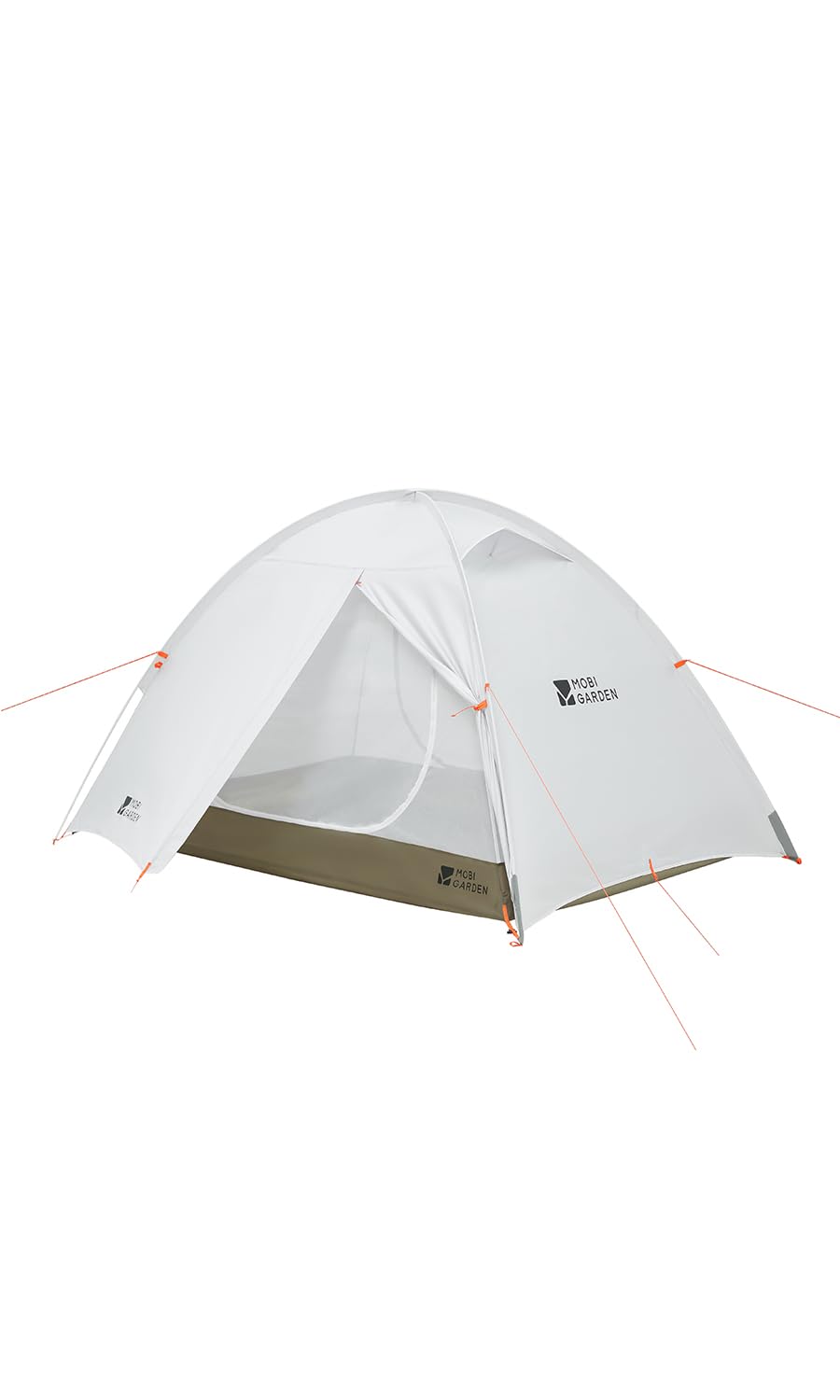
2. MOBI GARDEN Talo 2 Person Backpacking Tent
The fly and inner go up together in two steps, so your sleeping bag never gets wet while you pitch.
Most tents make you raise the body first and wrestle the fly over it afterward, which is exactly when a downpour catches you. This one pitches as a single assembly, meaning the sleeping area is covered from the first move. Buyers report it comes together in about 5 minutes from unpacking. At 3 pounds it is by far the lightest shelter on this list, and that alone changes what you can carry — food, a stove, and a warmer bag instead of a heavier tent.
The fabric numbers are serious for the weight. The fly uses a 2,000mm hydrostatic head CompWeave ripstop (a woven fabric with a grid that resists tears), and the 150D polyester floor is rated to 4,000mm — that is a lot of water pressure before ground moisture pushes through. The X-cross sleeve geometry is tested in winds up to 30 mph (13.5 m/s), enough for exposed valley camps and forest clearings. The asymmetric fly creates a covered vestibule you can cook in, and trekking poles will hold the tarp out with no extra hardware.
Here is the catch worth knowing before you buy. Interior volume draws split feedback — plenty of room for one person camping solo, tighter than expected with two full-size adults inside. The overall floorplan is generous on paper, but the shape is what makes a couple feel the squeeze. If you mostly hike alone and want a light, weather-proof shelter, this is a superb buy. If you always split the tent with a partner, size down your expectations or aim for a wider floor.
The 3-pound advantage: nothing else here matches it, and 2,000mm fly plus 4,000mm floor means the weather protection did not get traded away to get there.
Two-person reality check: the interior feels generous alone and close with a partner, so treat this as a solo shelter that occasionally sleeps two.
Best matched to: solo hikers and bikepackers who want a light shelter that can take a friend in a pinch.
Skip if: you and your partner are both broad-shouldered and want separate elbow room.
3. Kelty Grand Mesa Backpacking Tent
A long-running two-person shape with color-coded clips, seam-taped seams, and 30 square feet of floor.
Kelty Quick Corners hold the pole ends in place while you thread the frame, and color-coded clips and fly attachments take the guesswork out of the rest. Owners mention it stands in about 6 1/2 minutes on a first attempt. That is slower than the Kelty Late Start below, which goes up in 3 minutes, but this one brings more tent for the same job — two compact aluminum pressfit poles, a 68D polyester floor and fly, and fully seam-taped construction throughout.
The floor measures 85 by 57 inches with 30 square feet of interior space and a 44-inch peak height, which is tall enough to sit up and change a layer. The 57-inch width beats the Naturehike Mongar’s 53.2 inches, so two wide pads fit with less shoving. Packed weight is 4 lbs. 7 oz at 16 by 7 by 7 inches, and the Shark Mouth carry bag opens wide enough that packing up is not a fight. Quality is what buyers praise most across the review pages, and the seam taping is a repeated point of praise.
One fair caveat: the size and capacity scores on the review pages are mixed rather than glowing. Two adults fit, but the interior feels like a two-person tent rather than a two-person suite — a night of gear, boots, and wet jackets inside gets crowded fast. The EZ-Zip vestibule exists precisely to move that clutter outside, so use it.
Why it earns its place: 57 inches of width, full seam taping, and a 4 lbs. 7 oz pack weight make it a dependable three-season shelter that does not ask you to baby it.
Go with this if: you want a proven brand-name footprint without climbing into the premium tier.
Think twice if: you expect the interior to swallow two packs and two people at once.
4. Kelty Late Start 2P Backpacking Tent

Built for the hike that ran long and the headlamp pitch at dusk.
Three minutes is the assembly figure here, and the name tells you who it is for. Pre-bent aluminum poles create extra interior living space without a complicated frame, and the short pole segments pack into a 16 by 6.5 by 6.5 inch bundle that slides into a pack sideways. Pre-attached guylines and stakes mean nothing needs threading in the dark. The floor runs 89 inches long and 54 inches wide for 30.6 square feet, so it is the longest floor on this list — taller sleepers get room to stretch flat instead of curling.
Weather gear is where the detail lives. The rainfly is full-coverage and color-coded with a built-in vent, so moisture escapes instead of pooling on the inside of the fly. No-See-Um mesh keeps the smallest biting insects out while moving air through on a warm night, and the fabric uses a PFAS-free DWR finish (a water-repellent coating applied without those particular chemicals). Packaged weight is 4 lb. 12 oz, with a 4 lb. 5 oz minimum when you leave the extras behind.
What buyers notice first is how solid it feels — top-notch construction and stitching come up again and again — and how easily one person can raise it alone. Weight is the dividing line on the review pages: some find it very light for the space, others wanted less on their back. Neither read is wrong; it depends on what you carried before.
What Holds Up
- 3-minute pitch with pre-attached guylines and color-coded clips
- 89-inch floor is the longest here for tall sleepers
- Full-coverage vented fly manages condensation
- PFAS-free DWR suits trail-minded buyers
The Honest Trade-Offs
- 4 lb. 12 oz packaged is not a fastpacking weight
- One door and one vestibule means coordinating exits
- Weight opinions split on the review pages
Made for: the hiker who reaches camp after sunset and wants the tent up before the light dies.
Not for: couples who want independent doors on each side.
5. MC TOMOUNT Backpacking Tent

An 86.6-inch floor and 45.3-inch center height give long-limbed hikers somewhere to actually sit up.
Length is the headline. At 86.6 inches long and 53 inches wide, this floor lets a tall man lie flat without his head jammed in a corner, and the 45.3-inch center height means you can sit upright for a meal instead of folding in half. Build quality is what wins the most praise on the review pages, and the reports back it — no leaks through heavy rainfall is a recurring point. It weighs 4.4 pounds and packs to 17.3 by 7.5 inches, small enough to strap to a bike frame.
The material is 20D nylon with a PU3000mm coating, meaning a 3,000mm water column before it leaks. The windows on both sides plus the inner mesh keep air moving and bugs out, and the nylon top on the inner tent stops condensation drips from landing on your face. The inner is self-standing, so it can double as an inner tent inside a larger shelter if you winter camp. Extended space at both doors gives you a spot for packs and boots.
Note the honest label: the brand calls it 1-2 person, and it can fit one person with plenty of space or two in a squeeze. Size opinions split down the middle on the review pages, with some buyers wishing for more room. Rain protection is the other caveat the maker states plainly — in prolonged heavy rain they suggest adding a tarp over the top.
The tall-hiker answer: very few two-person shelters in this range give you 86.6 inches of floor and 45.3 inches of headroom, and the 3,000mm coating means the length did not come at the cost of protection.
Pick it for: one tall hiker, or a pair who plan on fair-weather trips and split their time outside the tent.
Leave it if: you need genuine two-person volume or plan to camp through multi-day downpours.
6. ATEPA Voyage 1-2 Person Backpacking Tent

The highest waterproof rating here, built into a single-pole frame that goes up as a freestanding shelter.
A 4000mm hydrostatic head on the 20D silicone-coated nylon with fully taped seams is what separates this from the rest of the group. That is a 4,000mm column of water before the fabric gives, which is where the maker positions this as a four-season shelter that blocks rain, wind, and snow. It measures 82.68 inches long, 53.2 inches wide, and 43.31 inches high — a wide floor for two sleepers plus gear.
The single-pole 7001 aluminum alloy frame sets up quickly and stands firm, which keeps the packed bundle simple. High-density B3 mesh on the inner, dual ceiling vents, and double D-shaped doors move air through the tent and cut condensation on cold mornings. The rainfly extends with trekking poles into a front awning for shade and gear storage, giving you a covered porch without adding hardware. Removable side storage panels, inner mesh pockets, and a ceiling lantern hook keep small items off the floor, and reflective guylines and stake heads make the tent visible at night.
The trade-off is honesty about what the specs do not say: packed weight and floor square footage are not published, so if your whole decision hinges on ounces, you will be guessing. The single-pole frame is light and quick but offers less structure than a multi-cross-pole dome in high wind.
What makes it worth the step up: 4,000mm waterproofing and taped seams on a single-pole shelter puts rain protection above everything else in the group.
Worth knowing: no published packed weight or floor area, so confirm those before you commit if either is a priority.
Choose this for: shoulder-season and wet-weather trips where staying dry outranks saving ounces.
Pass on it if: you camp in exposed alpine wind and want a heavier frame for stability.
7. OneTigris COSMITTO 2 Person Backpacking Tent

A 75D nylon floor under a lightweight ripstop fly — the mix you want on rocky, rooty ground.
The floor is the part that fails first on rough terrain, and this one uses a thick 75D nylon bottom rather than the thin fabric found on weight-first shelters. Above it sits a 20D plaid ripstop polyester fly with a 1,500mm waterproof coating — a lighter shell with a tougher base, which is the right split for overnight backpacking and hunting trips where you pitch on whatever the ground offers.
Floor area is 30.96 square feet across a 7.2 by 4.3 foot footprint, and the frame goes up in about 3 minutes with the rain fly, tent body, and aluminum alloy poles assembling together. It packs into a 23.6 by 6.3 inch stuff sack, which is longer than the 16-inch bundles elsewhere here, so plan your pack layout around that length. The kit includes three poles, four 9.8ft guy-lines with adjusters, and ten tent pegs. A 1-year limited warranty covers quality issues.
Durability and ventilation are the two mixed notes. Some customers note it holds tight in windy conditions, while others have seen seam tape separate after repeated use — worth a look over the seams before each season rather than a reason to avoid the tent.
Standout Strengths
- 75D nylon floor resists abrasion on hard ground
- 30.96 sq ft floor for two sleepers
- Full kit: 3 poles, 4 guy-lines, 10 pegs, stuff sack
- 3-minute assembly with poles, body, and fly together
Worth Checking
- 23.6-inch packed length is long for tight packs
- Seam tape longevity varies on the review pages
- Ventilation feedback is mixed rather than glowing
Reach for this if: you camp on rocky ground and want a floor that will not tear on a root.
Look elsewhere if: you need a short packed bundle or expect years of seam-tape life without checking it.
8. MARMOT Crane Creek 2P Camping and Backpacking Tent
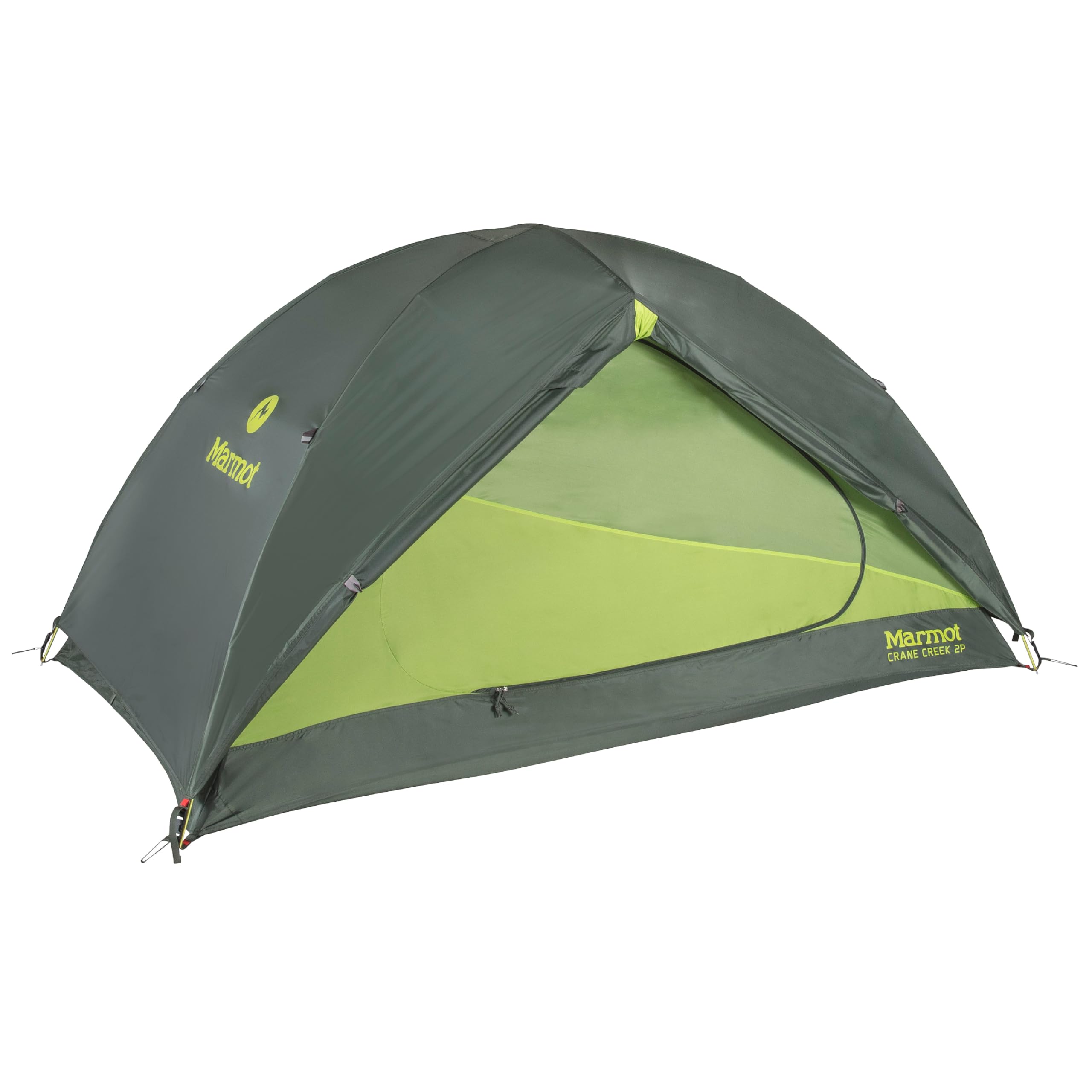
Two large D-shaped doors and two overhead vestibules at a mid-range mid-weight build.
Thirty-two square feet is the largest floor area on this entire list, laid out 88 inches by 51.3 inches. That extra length is what lets two adults lie straight rather than angled. Two large D-shaped doors mean separate entries, and two spacious overhead vestibules stash packs and boots outside the sleeping box — the same two-room idea as the Naturehike Mongar but with more floor and a narrower width.
The shell is fully waterproof: a seam-taped floor stops ground water, and a seam-taped polyester fly keeps rain out while still letting air move. The 7000 series aluminum poles add toughness to a packable frame, and the build is made without PFAS for trail-minded buyers. Setup happens in about 2 minutes once you know the sequence, and the shape shrugs off wind — owner reports describe it holding in winds up to 60 mph. Footprint is not included and is sold separately.
The realistic read is that this is a snug two-person tent, not a palace. It is comfortable for one person and close for two, which is the trade-off for that 51.3-inch width. Durability and weight scores land mixed on the review pages rather than uniform praise.
The floor-area argument: 32 square feet is the most sleeping space you can get here, and two doors plus two vestibules make sharing it workable.
This suits: a couple who want separate doors and the biggest floor in the group without a premium-tier outlay.
skip it if: you and your partner both need generous width, not just length.
9. The North Face Stormbreak 2 Two-Person Camping Tent

High-low ventilation and 43 inches of headroom — a tent that breathes even with the fly sealed.
Ventilation is the reason this one exists. Breathable mesh walls feed air from a low intake to a high exhaust, so circulation keeps moving even with the rainfly fully on — the night when most tents turn into a condensation chamber. The two large doors stuff into adjacent mesh pockets instead of needing to be rolled, which saves a small daily annoyance. Headroom runs 43 inches, enough to sit up and pull on a layer.
The floor is 87 inches long with 30.56 square feet of area, and the trail weight is 5lbs 5oz — the maker frames that as manageable for group trips where the load gets split across the crew. Total weight is 5lbs 14.2oz, and the fastpack weight drops to 3lbs 14.1oz when you pitch fly and poles without the body. A waterproof rainfly with a seam-taped floor does the weather work, and two twin-zip vestibules give you a covered spot to pull off muddy boots. The finish is a non-PFC DWR, made without a flame-retardant coating.
Size is where opinions divide — very roomy for one, too small for two large adults. Aluminum poles draw praise, and the tub-style floor keeps moisture out at the edges. If you want a palace for two, look at the Marmot’s 32 square feet instead; if you want headroom and airflow, this delivers both.
The airflow case: high-low ventilation plus mesh walls means less condensation, and 43 inches of headroom means you are not lying down all evening.
The weight question: 5lbs 5oz trail weight is real, so split it with a partner or use the fastpack setup.
Go here for: warm, humid nights where a stuffy tent would ruin your sleep.
Think twice if: two large adults will share it every trip.
10. MSR Elixir 2
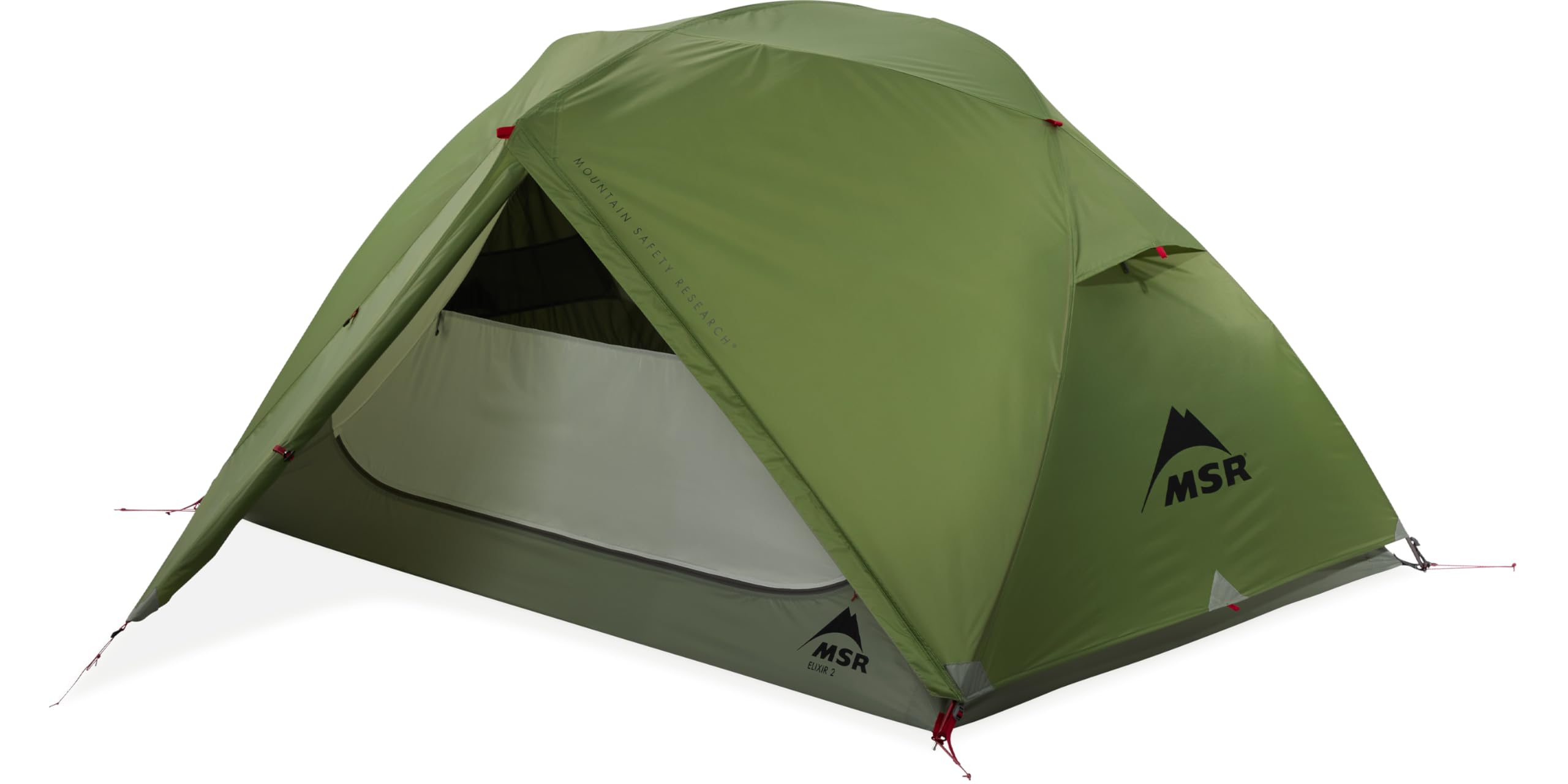
A true rectangular floor and near-vertical walls that swallow wide, thick sleeping pads.
If your pads are wide and thick, this is the tent that stops the fight. A true rectangular floorplan with nearly vertical walls means the corners do not taper away, so a full rectangle of pad fits rather than a wedge. The floor measures 84 inches by 52 inches at 30 square feet. The frame goes up with all-metal corner hardware and straight pull zippers — which are easier to find by feel at night than curved ones.
The body has strategically placed mesh panels that move air to clear condensation while retaining warmth, plus a gear loft and end pockets with cable ports so a phone or headlamp can charge inside. The fabric blend is 75% polyester and 25% nylon with PFAS-free waterproofing treatment, and the included footprint means the floor gets a second layer of protection. The corner hardware is updated so poles seat and lock without a struggle.
There is no published packed weight in the listing, so if you are counting ounces for a long thru-hike you will want to confirm that before you commit. What you get for the step-up outlay is durability-first construction and a floorplan built around real sleeping pads rather than a roughly rectangular shape.
What Makes It Different
- True rectangular 84 x 52 inch floor fits wide pads without gaps
- Nearly vertical walls add usable living volume
- Footprint included for floor protection
- All-metal corner hardware and straight pull zippers
What To Factor In
- Packed weight not published in the listing
- Premium tier outlay compared with the mid-range picks
- 30 sq ft is the same sleeping area as several cheaper options
Choose it for: thick, wide rectangular pads that never quite fit other tents.
Skip if: you need a confirmed packed weight before you buy.
11. Big Agnes Copper Spur HV UL2

A built-in LED tent light and an ultralight double rip-stop body for the top of the price band.
Ultralight nylon double rip-stop with mixed denier fabric is the construction idea — extra tear and puncture resistance without piling on weight. The floor runs 88 inches across 29 square feet, and a pre-bent span pole with a 4-way high-volume hub design adds strength and helps shed rain and snow while creating livable space where you sit. The frame goes up in about 15 minutes per the maker’s assembly figure, which is longer than any other tent here and worth planning around on a first pitch.
What separates this from everything above it is the mtnGLO Tent Light Technology — durable LEDs built into the tent that light the interior well enough to read in bed or find a toothbrush without a headlamp in your partner’s eyes. It runs on three AAA batteries, which are not included. Awning-style vestibules with double zippers extend covered living space and let you control how much wind-driven rain reaches your gear, and there are two doors and two vestibules. Storage goes well beyond the norm: a 3-D bin mezzanine at the foot, an oversized ceiling pocket at the head, and media pockets with cord routing for a phone.
The trade-off is honest: 29 square feet is the smallest floor here, and 15 minutes is the slowest setup. Ultralight fabric always asks for a little more care than a heavier shell. What you get for that is the lightest, most feature-packed package on this list, aimed squarely at backpackers who feel every ounce.
The ultralight case: mixed-denier rip-stop fabric, a high-volume hub frame, and integrated mtnGLO lighting make this a shelter built around a light pack.
For the weight-obsessed: hikers who will trade an easy pitch and a wide floor for the lightest, brightest shelter available.
Not ideal if: you want a fast setup or the biggest floor for the outlay.
Know the Specs
Hydrostatic Head in Millimeters
A hydrostatic head rating tells you how much water pressure a fabric holds before water pushes through, quoted as a column height in millimeters. A 1,500mm fly handles steady rain, while 3,000mm and 4,000mm coatings give more margin in a sustained downpour. The fly takes the weather, so the fly rating matters most — and taped seams stop water sneaking in at the stitching.
Floor Area and Dimensions
Floor area in square feet is the honest measure of sleeping space, and floor length and width in inches tell you whether two pads fit side by side or end up overlapping. A two-person tent around 30 square feet is the working standard; narrower floors push sleepers into the mesh wall, where condensation collects, while longer floors let tall hikers stretch flat.
Packed Weight Versus Minimum Weight
Tents list two weights: minimum weight with just the essentials, and packaged weight including stakes, guylines, and the stuff sack. Both matter — the first is what you carry, the second is what you actually put in your pack on day one. Packed size in inches decides whether the bundle slides into your pack horizontally or has to ride strapped on top.
Pole Material and Frame Shape
Aluminum alloy poles flex and return to shape under wind load, and 7001 or 7000 series alloys are common in hiking tents. A cross-pole dome gives more structure in exposed weather; a single-pole or Y-frame design pitches faster and packs smaller. Freestanding frames let you pick the tent up and move it to a flat spot before you stake it out.
Common Questions
Can two adults actually sleep comfortably in a two-person hiking tent?
What does the 2 person label on a hiking tent actually mean?
How much rain can a 3000mm rainfly handle on a hiking trip?
Is a single-wall or double-wall two person tent better for cold nights?
How much should a two person hiking tent weigh for backpacking?
Do I need two doors on a two person backpacking tent?
Can a tall hiker lie flat in these two person tents?
Is a freestanding tent easier to pitch than a staked one?
How long does setup take on a hiking tent for two people?
Do these two person tents come with a footprint or groundsheet?
What is a vestibule and why do I need one on a hiking tent?
The Bottom Line
For most buyers, the two person hiking tent that gets the balance right is the Naturehike Mongar 2 — 30 square feet of floor at 82.7 by 53.2 inches, a 3000mm waterproof fly and floor, and two doors with two vestibules for separate exits. If your priority is the lightest pack on the hill, grab the MOBI GARDEN Talo 2 at 3 pounds with a 4,000mm floor. And for the widest floor in the whole group with separate doors and vestibules, the Marmot Crane Creek 2P gives you 32 square feet without the top-tier outlay.
If you hike with a partner every trip rather than occasionally, the two-door, two-vestibule layout is the single upgrade that changes how a shared shelter feels — and the Naturehike delivers it with more width than the Marmot for two pads side by side.
How we choose
We do not accept paid placement. Every pick is matched to a real buyer and a real use-case; we do not hands-on test units.
Sources
Specifications: manufacturer listings and product documentation. Review insights: verified customer reviews, as of November 2026. Pricing: not shown on this page (it changes often); check the current price via the retailer link.
As an Amazon Associate, Tactical Gear Guy earns from qualifying purchases. This does not affect which products we feature.