Specs are compiled from manufacturer listings and verified buyer reviews and can change over time — please confirm the key details on the product page before buying.
Every driver has the same quiet worry: the parking lot dent you come back to, the cyclist who clips your mirror and keeps going, the collision where it becomes your word against theirs. A vehicle security camera is the only thing that turns that argument into a file you can hand to your insurer. The short answer up front — the TERUNSOUl 4K 3-Channel is the most complete package here, pairing three simultaneous channels with a 128GB card already installed. But three channels versus four, a pre-installed card versus a sold-separately one, and Wi-Fi 6 versus older connections are what actually decide which camera you should mount to your windshield.
This guide is built by comparing the manufacturers’ published specifications and the patterns across verified customer reviews, so you get each pick’s real strengths and trade-offs instead of marketing spin.
Below you will find plain descriptions of every channel count, card limit, and parking mode, so the differences between these nine systems read clearly before you commit. The shortlist that follows covers each real spec behind our picks for Best Vehicle Security Cameras.
Top Picks
How To Choose The Best Vehicle Security Cameras
The mistake most first-time buyers make is shopping by megapixel count alone instead of channel count, parking mode, and card ceiling. A 4K label tells you the front lens records at high resolution, but it says nothing about whether the camera can see inside your cabin, whether the footage survives a 140°F windshield, or whether the clip of a rear-end hit is still there when you need it. Those three answers live in the channel count, the parking mode, and the storage ceiling.
Count your channels before you count pixels
A single-lens camera watches the road ahead. Add a rear lens and you cover the SUV that taps you in a car park. Add an interior lens and you cover rideshare passengers and car-seat monitoring. The four-channel systems here go further with side cameras, which is what you want if parking-lot door dings are your main worry.
Parking mode needs a hardwire kit, not the box
Every parking mode in this roundup requires a separate hardwire kit sold on its own. Without it, the camera only records while your car’s accessory power is on. Plan the kit into your decision, because a parking feature you never wire up is a feature you never use.
Check the card ceiling and what ships in the box
Loop recording overwrites the oldest footage once the card fills, so card size sets how many days of driving you keep. Several picks here include a card already installed — a real convenience on day one. Others top out at different ceilings, so match the card to how much you drive.
Side-by-Side Comparison
| Model | Best For | Channels | Max Card | Card Included | Amazon |
|---|---|---|---|---|---|
| TERUNSOUl 4K 3-Channel★ Best Overall | All-round family and rideshare coverage | 3 (front, rear, cabin) | 512 GB | 128 GB | Amazon |
| BOTSLAB G300H PlusNight Clarity Pick | Clean front-and-rear daily driving | 2 (front, rear) | 256 GB | 64 GB | Amazon |
| 70mai T800ERideshare Ready | Rideshare and long commutes | 3 (front, interior, rear) | 512 GB | 64 GB | Amazon |
| Icesky S03 4-Channel | Full side-to-side coverage | 4 (front, rear, left, right) | 512 GB | 128 GB | Amazon |
| Aputeta 4K+4K Dual | Matching front and rear resolution | 2 (front, rear) | 512 GB | 128 GB | Amazon |
| Zunfly W2 4-Channel 360° | Budget four-way monitoring | 4 (front, rear, sides, interior) | 128 GB | 64 GB | Amazon |
| BOTSLAB 4-Channel 360° | Split-screen incident review | 4 (front, sides, rear) | 512 GB | 128 GB | Amazon |
| Vantrue N4S | Night clarity and huge card space | 3 (front, interior, rear) | 1 TB | — | Amazon |
| THINKWARE U3000 PRO | Radar parking watch and safety alerts | 2 (front, rear) | 512 GB | 64 GB | Amazon |
Detailed Reviews
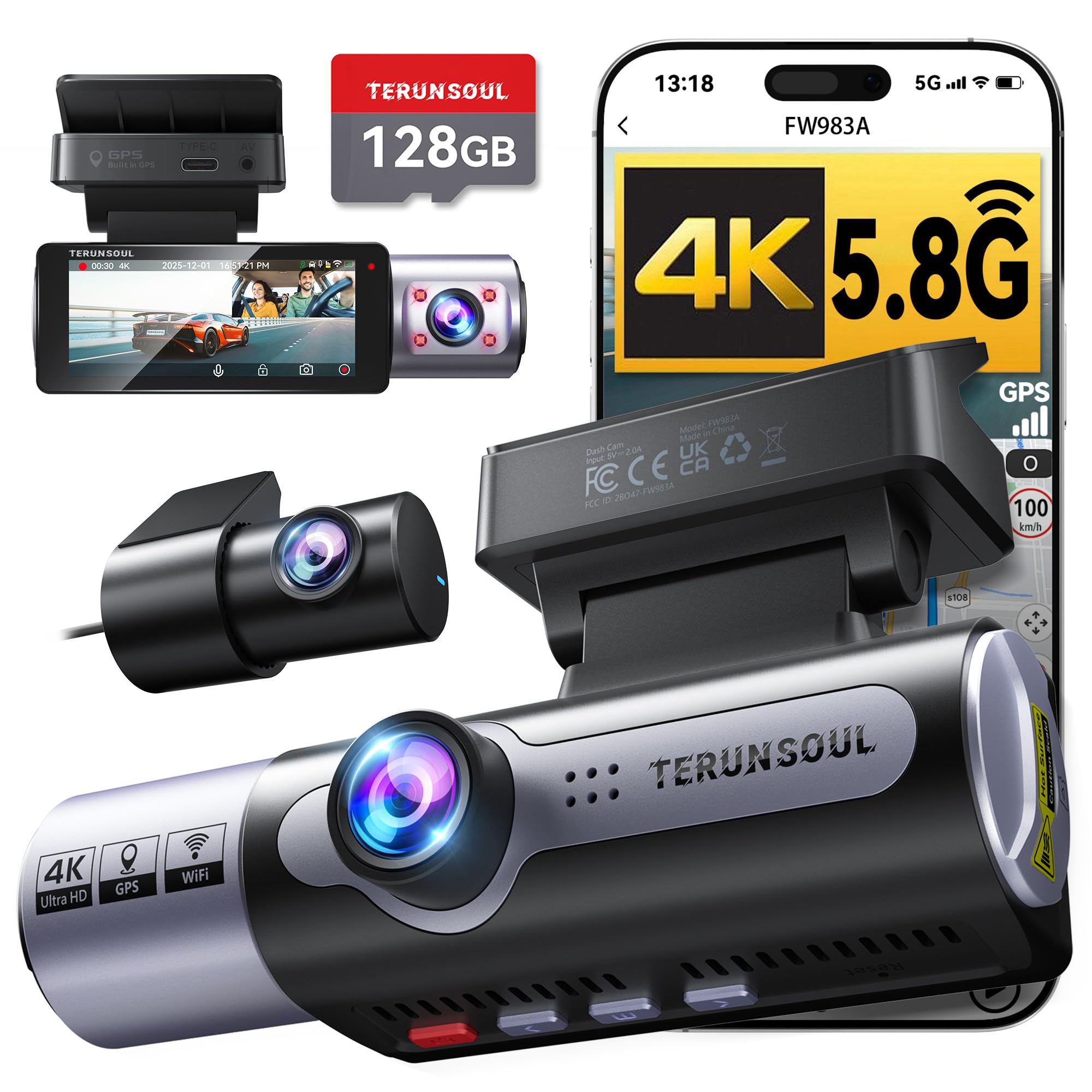
1. TERUNSOUl 4K 3-Channel Dash Cam
Our pick — 4.5+★ from 450+ verified ratings; the strongest balance of quality and price.
Three lenses, one pre-installed card, and a windshield view that sees the road, the tailgater, and the cabin at once.
This is the pick that covers the most ground without asking you to buy anything extra on day one. It records at 4K up front, 1080P out the rear, and 1080P inside the cabin — three streams at the same time. The front lens takes in 170 degrees of the road, and both the rear and cabin lenses take in 165 degrees each. For a family road trip or a rideshare shift, that combination means the person behind you and the passenger beside you are both on file.
The card situation is why this lands first. A 128GB microSD card comes pre-installed and ready to record, and the camera accepts cards up to 512 GB. Compare that with the BOTSLAB G300H Plus, which includes a 64GB card and tops out at 256 GB — this one ships with twice the included storage and accepts double the ceiling. A collision sensor locks the clip of an impact automatically, and loop recording overwrites the oldest files so you are never managing space by hand.
Where it earns its keep after dark is the starlight-grade five-layer lens with an F1.6 aperture and HDR. In plain terms, the F1.6 aperture is a wide opening that lets a lot of light reach the sensor, which is what keeps a licence plate legible under streetlights. Built-in GPS stamps speed, route, and time directly onto the footage, so a claim has a time-stamped record rather than just a video. The 3.16-inch IPS screen is a touch larger than the 3-inch panel on the Zunfly W2, which makes checking a clip at the roadside a little easier.
The case for mounting this one
- Three simultaneous channels at 4K front plus 1080P rear and cabin — covers the road, the car behind, and the interior
- 128GB card already installed, with support up to 512 GB for long stretches between overwrites
- 5.8GHz and 2.4GHz Wi-Fi with a claimed 20MB/s download speed for pulling footage to your phone
- GPS embeds speed, location, compass, and timestamp into the video itself
What to know before you buy
- Parking mode needs a separate hardwire kit, sold on its own — without it the camera stops recording when the car is off
- The included cable kit asks for some trim work along the rear-camera run
Go for it if: you want one box that covers front, back, and cabin with a card already inside, and you are willing to add the hardwire kit for parked protection.
Think twice if: you only ever need a front view — the extra lenses add setup steps you would not use.
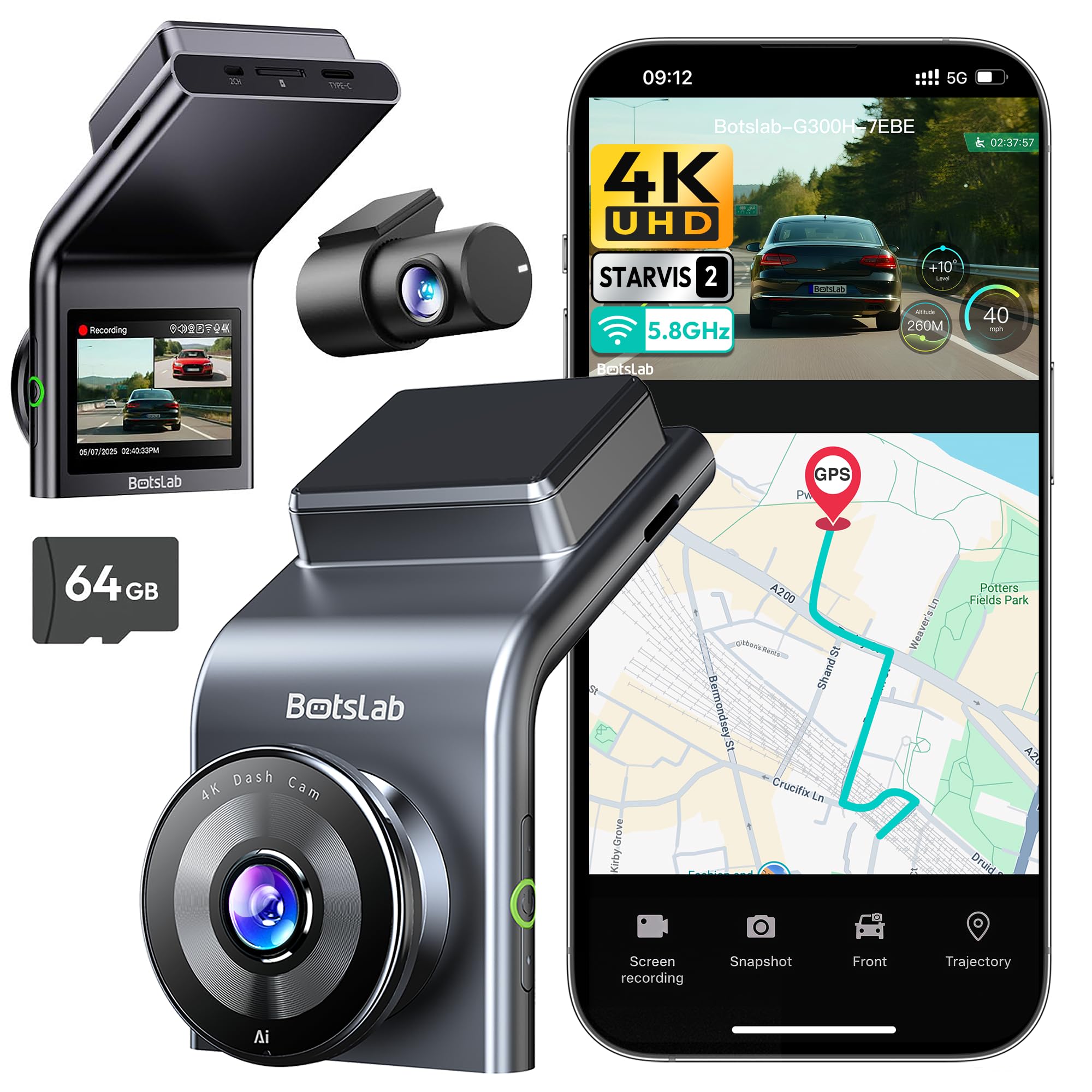
2. BOTSLAB G300H Plus 4K Dual Dash Cam
Two lenses done properly, with a sensor built to keep number plates readable after dark.
The draw here is the STARVIS 2 sensor — a light-sensitive chip designed to pull clean detail out of a dark road. Botslab claims it delivers 2X better low-light sensitivity than a generic dashcam, and the front lens pairs that with an F1.5 aperture. HDR balances the glare of oncoming headlights against a black road. What wins people over, though, is sheer reliability: quality is the aspect that dominates the feedback on this camera by a wide margin, with build quality right behind it.
Resolution is 4K up front and 1080P out the rear, with a 170-degree front lens to catch multiple lanes. Footage transfers over 5.8GHz Wi-Fi, which Botslab rates at 10x faster than 2.4GHz, and GPS stamps speed, route, and location onto every clip. There is a 64GB card in the box, and the camera accepts cards up to 256 GB.
The honest catch is the phone connection. Because iPhones support only one active Wi-Fi connection at a time, the camera and CarPlay cannot run together — connect to one and the other drops. If you rely on CarPlay for navigation, plan to review footage after you park rather than mid-drive.
Where the money goes: a light-sensitive front sensor, a voice-controlled interface that takes “take photo” commands hands-free, and a heat-tolerant supercapacitor instead of a battery that ages in the sun.
The one limit to plan around: CarPlay and the camera’s Wi-Fi fight for the same phone connection, so reviewing clips happens after the drive, not during it.
Best matched to: night commuters and anyone who wants the front-and-rear essentials done without wiring side cameras.
Look elsewhere if: you need interior or side coverage, since this is a two-lens system.
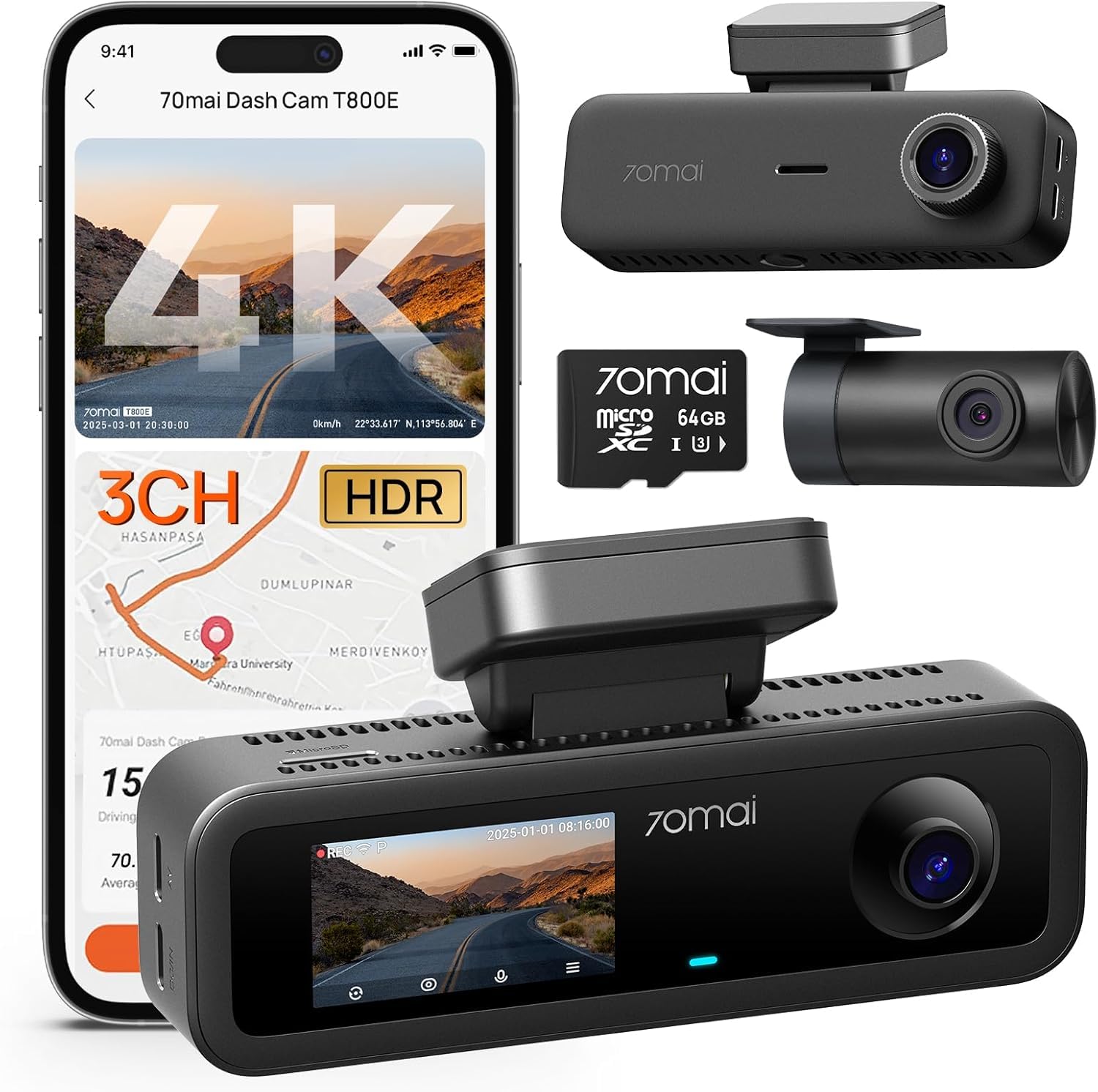
3. 70mai T800E 3-Channel Dash Cam
The cabin-facing lens with switchable infrared is what sets this one apart for a driver with passengers.
If you drive for a living, the interior camera is the one that matters. This 70mai records 4K up front, 1080P inside, and 1080P out the rear, and the interior lens has switchable infrared — flip it on for a dark cabin, off when you do not need it. The front lens runs an F1.55 aperture, and the camera applies HDR and 3D noise reduction to keep plates and road signs sharp after sundown.
Transfers use Wi-Fi 6, which 70mai rates at up to 10 MB/s — enough to pull a clip onto your phone at the roadside instead of waiting at a desk. Built-in GPS runs a 5-mode positioning system for speed, route, and location. A 64GB card ships installed, and it accepts up to 512 GB, which is the same ceiling as the TERUNSOUl above but with half the included card. The supercapacitor holds steady from 14°F to 140°F — real range for a frozen morning or a hot parked afternoon.
Owners consistently describe setup as quick and the front footage as sharp, and note that it does not block their field of view. The trade-off to know: this camera does not support 4G connectivity, so there is no remote live view from your phone while you are away from the car. Parking monitoring still works, but it needs the hardwire kit (UP06 or UP03) and records to the card for later review.
Why drivers lean this way
- Switchable infrared on the interior lens for clear cabin footage at night
- Wi-Fi 6 transfers rated up to 10 MB/s for fast clip retrieval
- Accepts up to 512 GB of storage for long rideshare shifts
Set your expectations here
- No 4G support, so no remote live monitoring from your phone
- Continuous parking watch needs the separate hardwire kit
Reach for this if: you carry passengers and want them on camera with infrared for night pickups.
Look past it if: remote phone-based live viewing is part of your plan.
4. Icesky S03 4-Channel Dash Cam
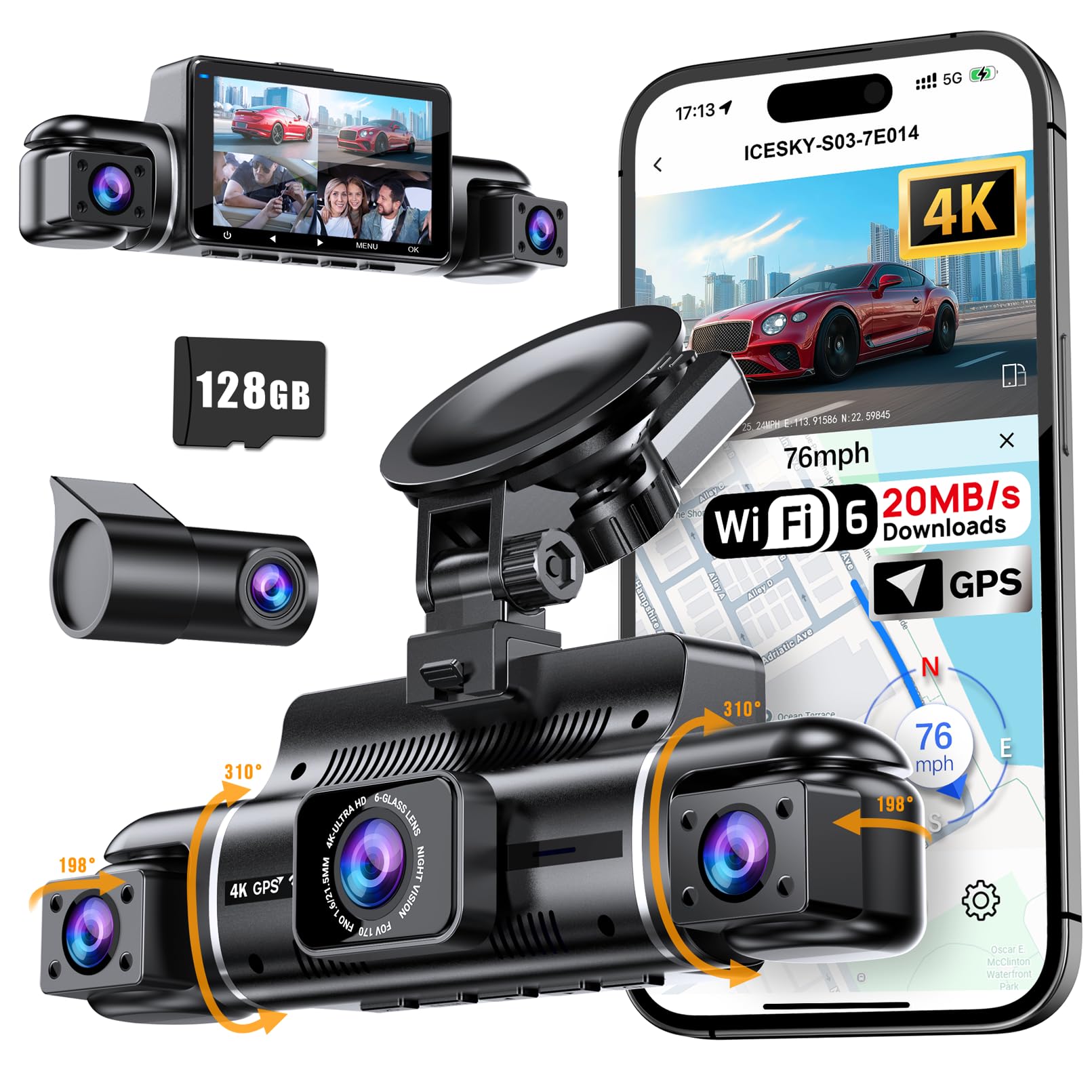
Four cameras and a screen that shows left, right, front, and rear at the same moment.
Door dings come from the side, and that is the exact gap most dash cams leave open. This Icesky records 4K up front and 1080P from the rear, inside, left, and right — four streams running together for full 360-degree coverage. The 3-inch built-in screen supports a multi-view display, so you can watch all four angles at once instead of switching between them. Side cameras carry 8 IR lights, and the left and right infrared can be switched independently so one side’s footage stays clean while the other brightens.
Storage is generous: a 128GB card is included and the camera accepts up to a 512GB U3-speed microSD. That U3 rating is a speed class for cards, ensuring the write speed keeps up with high-resolution recording so frames are not dropped. Wi-Fi 6 at 5.8GHz pulls files at up to 20MB/s without pulling the card, and built-in GPS logs speed, route, location, and time for claim evidence. A G-sensor locks impact clips, and 24H parking mode monitors while you are away.
Owners describe it as easy to install with clear 4K daytime footage and complete coverage from every angle. The cable run is the real work: four cameras mean more wire to route, and the hardwire kit for parking mode is sold separately, not included. Note too that the power source listed for this model is a lithium polymer battery cell, unlike the supercapacitor builds on the BOTSLAB and 70mai picks.
What the four lenses buy you: side impact coverage a front-and-rear camera simply cannot see, with a multi-view screen for instant review at the roadside.
The setup cost: more cameras mean more cable to hide, and parking mode still requires a kit you buy separately.
Worth it for: drivers in tight lots and busy streets who want to catch a side swipe or a door ding.
Not your pick if: you want the simplest single-cable install.
5. Aputeta 4K+4K Dual Dash Cam
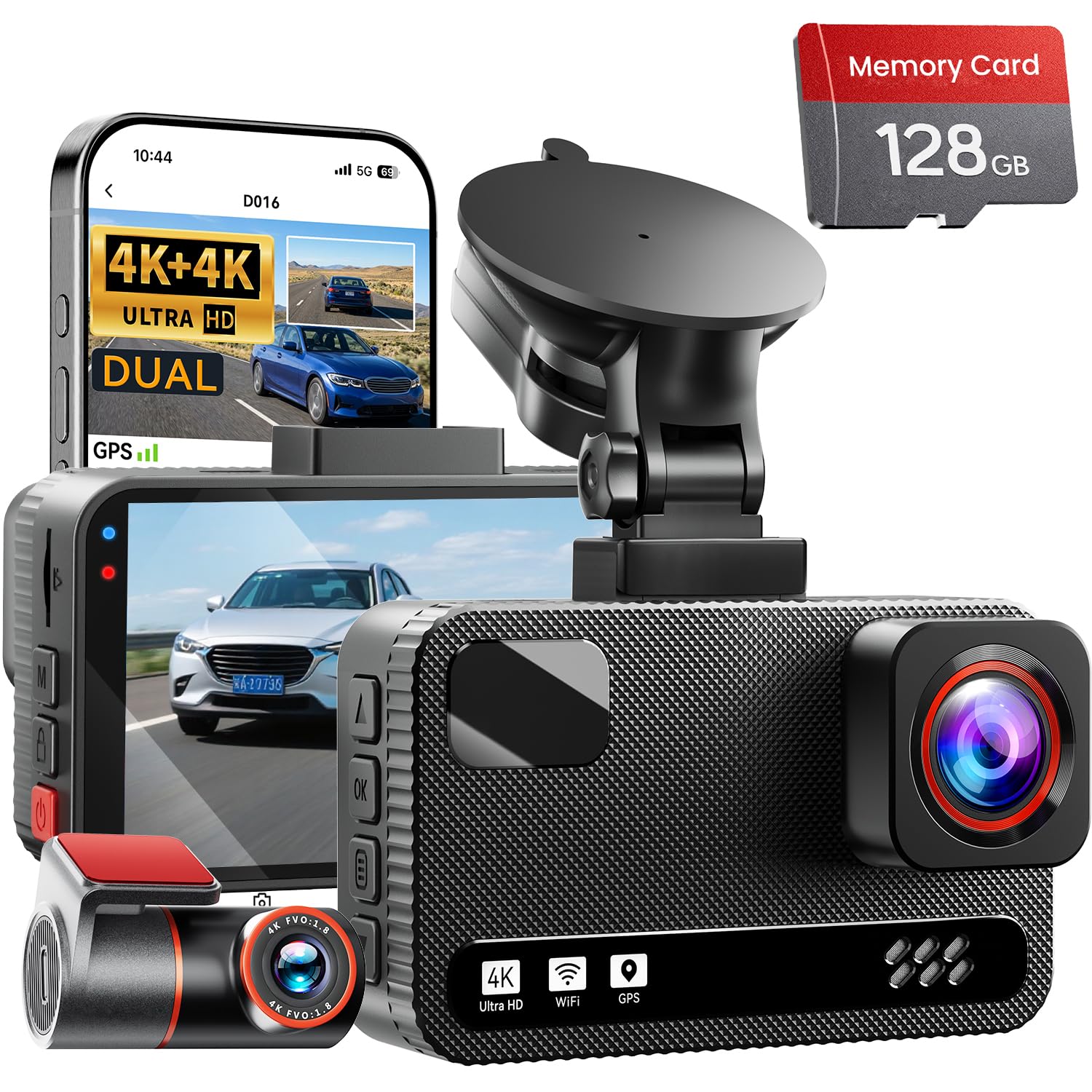
Both lenses shoot at 4K here, so the car behind gets the same detail as the road ahead.
Most dual cameras put a sharper lens up front and a lesser one at the rear. This one does not: the front records at 3840x2160P and the rear also records at 3840x2160P, both at once. The front lens takes in 170 degrees and the rear takes in 160 degrees. For a hit from behind, that means the plate of the car that rear-ended you gets the same clarity as the road ahead.
Night performance runs on an f/1.5 large aperture and a 5-element optical lens, with WDR balancing highlights and shadows so plates stay readable in mixed light. A 128GB card is included, and the camera accepts up to 512 GB. Transfers go over 5.8GHz and 2.4GHz Wi-Fi at up to 20MB/s, and GPS positioning is built in. Owners describe it as plug-and-play and praise the resolution specifically — the footage is described as crisp.
The parked-car story is where the details matter. In time-lapse mode it monitors continuously, and when the collision sensor trips it records a full 1-minute clip and locks it in an event folder. That needs the hardwire kit, listed separately. Set aside the wiring time, because a rear 4K camera means a cable run to the back of the car.
What stands out
- 4K on both front and rear lenses, not just the front
- 128GB card included and support up to 512 GB
- 20MB/s Wi-Fi transfer and built-in GPS tagging
What to factor in
- Parking mode requires the separately sold hardwire kit
- Rear 4K camera means running a cable to the back of the vehicle
The one to grab if: rear-end collisions are your worry and you want a 4K record behind you as well as ahead.
Skip the upgrade if: a 1080P rear view would already do the job.
6. Zunfly W2 4-Channel 360° Dash Cam

The cheapest route to four lenses, with 170-degree front glass and a 360-degree field of view.
Four cameras in one system is the headline, and it is the same channel count as the two higher-priced four-lens picks above — this is the entry point into that tier. It syncs four lenses at 2K front plus 1080P from the rear, sides, and interior, with a 360-degree field of view overall. The front and rear lenses shoot full color at night, while the side cameras switch on infrared automatically, and the F1.8 aperture and 6-layer glass are aimed at keeping plates readable under headlight glare.
Storage comes in at 64GB pre-installed with a 128GB ceiling — the lowest ceiling in this roundup, and half the included card of the TERUNSOUl and Icesky systems. Frame rate runs at 30 FPS or higher, which keeps motion smooth enough that a passing plate is not a blur. The 5GHz Wi-Fi is meant for faster transfers, and built-in GPS tags speed and location onto clips for insurance claims. A supercapacitor holds up through power failures so an impact file is not lost.
If the cabin and the sides matter more than long retention, this delivers that coverage without the higher-tier outlay. Just plan on clearing older footage sooner given the smaller card ceiling, and remember the parking mode — time-lapse or impact detection — needs a hardwire kit bought separately.
The tradeoff that works in its favor: four-lens coverage, a 360-degree field of view, and a supercapacitor for power-failure protection at the entry tier.
The limit to accept: a 64GB included card and a 128GB ceiling mean footage overwrites sooner than on the 512 GB systems.
The value angle: four-way coverage for a buyer who wants eyes on every side without a premium outlay.
The honest catch: short retention if you drive long hours daily.
7. BOTSLAB 4-Channel 360° Dash Cam
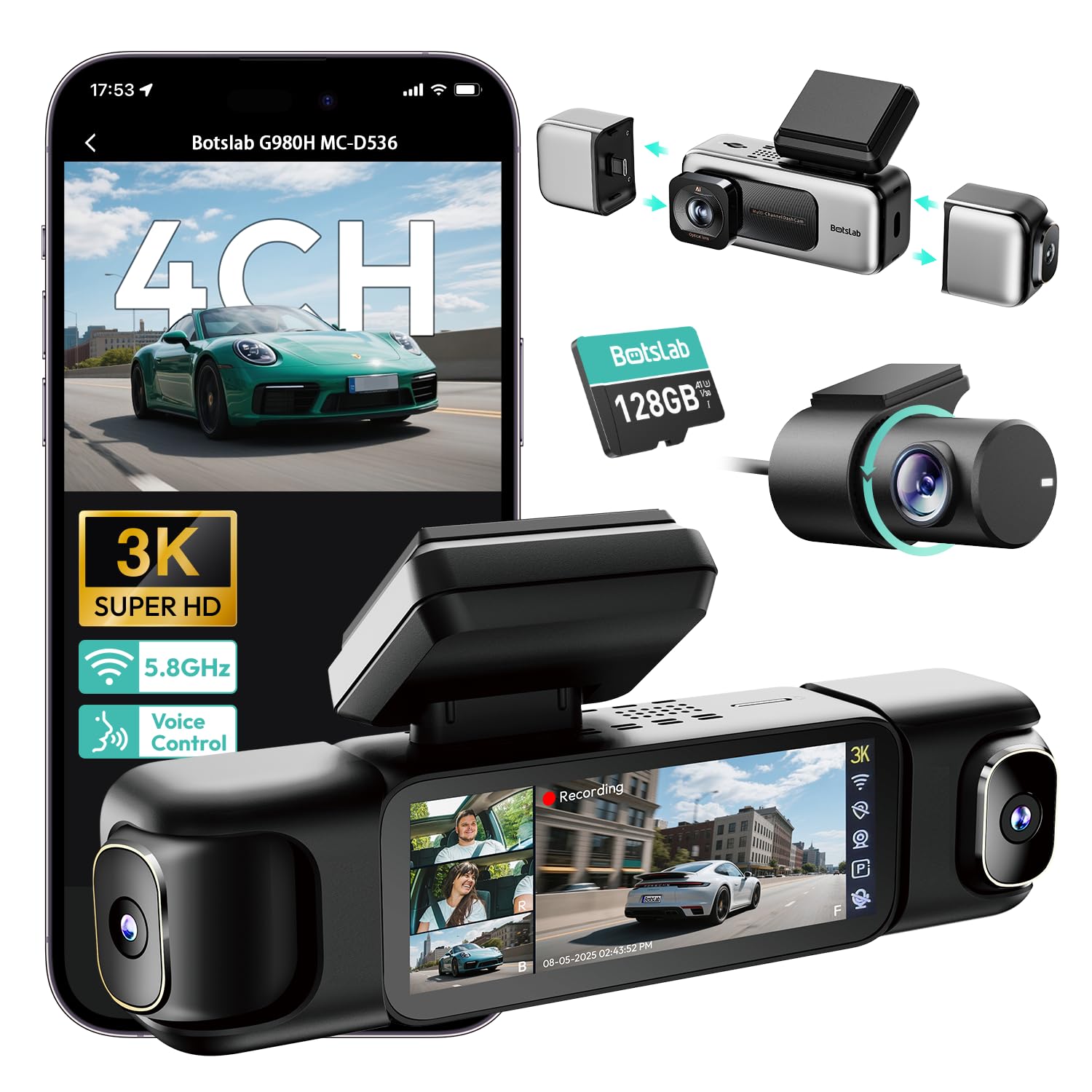
Four lenses, a 3.18-inch touch screen showing all angles at once, and footage that starts eight seconds before impact.
The standout feature here is the pre-recording. When the G-sensor detects a collision or abnormal vibration, the camera preserves the crucial 8 seconds of footage before the impact — not just what happens after. That is the difference between showing a brake-check and showing only the bumper contact. It records four channels at 3K with a 170-degree front lens, dual 120-degree side lenses, and a 150-degree rear, for a 560-degree field of view overall. The side cameras use a detachable magnetic mount, so you can drop to a 3-channel or dual-camera setup when you want fewer angles.
Reviewing footage is the other strength. The 3.18-inch touch screen runs a four-way split-screen so you can watch every angle at once during an incident review. What wins people over most on this camera is quality, with installation second — the static-cling mounts leave no adhesive residue, and a 128GB card is included. The camera accepts up to 512 GB, transfers over 5.8GHz Wi-Fi, and carries 940nm infrared LEDs plus WDR for low-light balance.
The mixed part is reliability and connectivity. Most owners find it works well, but the feedback splits, with some reporting the connection to be fussy and the unit to stop working. Botslab’s own note explains one hard limit: Wi-Fi range is 3-5m, so remote access away from the car is not possible. Parking mode also needs the dedicated hardwire kit, sold separately.
Why this earns a look
- 8-second pre-recording keeps the footage before an impact
- 3.18-inch touch screen with four-way split-screen review
- Detachable magnetic side cameras switch between four, three, and two-channel modes
Set realistic expectations
- Connectivity and reliability feedback is mixed — most work fine, some do not
- Wi-Fi range of 3-5m means no remote access from away from the car
Best suited to: buyers who want the pre-impact clip and a screen that shows all four angles at once.
Be cautious if: you need rock-solid wireless reliability and remote access, which sit outside this model’s range.
8. Vantrue N4S 2.7K 3-Channel Dash Cam

Three STARVIS 2 sensors, a rotating rear camera, and the biggest card ceiling in the group.
Storage is where this one pulls ahead of everything else here. It accepts microSD cards up to 1 TB, where the TERUNSOUl and 70mai top out at 512 GB and the BOTSLAB G300H Plus at 256 GB. No card is included, so budget for one — but a 1TB ceiling is real headroom for a long road trip or continuous recording without overwriting. All three lenses run on STARVIS 2 sensors: 1944P front, 1440P interior, and 1440P rear, with 158-degree front, 165-degree cabin, and 160-degree rear lenses.
Night performance is the Vantrue pitch. Triple HDR balances a bright headlight against a dark road, and PlatePix is claimed to sharpen licence plates by 2X on all three lenses. Quality is what buyers praise most here, followed by video quality — and the word that keeps coming back is reliability. The rear camera rotates 360 degrees, so you can point it at traffic behind or pivot it inward to watch cargo, luggage, or pets. Setup runs through a magnetic mount with static-cling film, tool-free.
Four parking modes cover the parked-car hours, and a supercapacitor keeps it running from -4℉ to 140℉. Two things to note: Wi-Fi feedback is the mixed part of the picture, so expect transfers that occasionally take a second attempt, and the rear-camera wiring must be connected properly per the manual — a loose connection is the most common cause of malfunction here. It also runs over 5GHz Wi-Fi with OTA firmware updates.
Where it leads: the 1TB card ceiling, three STARVIS 2 sensors across all lenses, and a rear camera that pivots 360 degrees for cargo or pet monitoring.
What the spec sheet does not tell you: no card is in the box, and the rear-camera connection needs to be seated correctly or it will misbehave.
Pick this one for: long-haul driving where retention matters most, and for anyone who wants to keep an eye on cargo or pets in the back.
Not the fit for: a buyer who wants the card already in the box on day one.
9. THINKWARE U3000 PRO Dash Cam
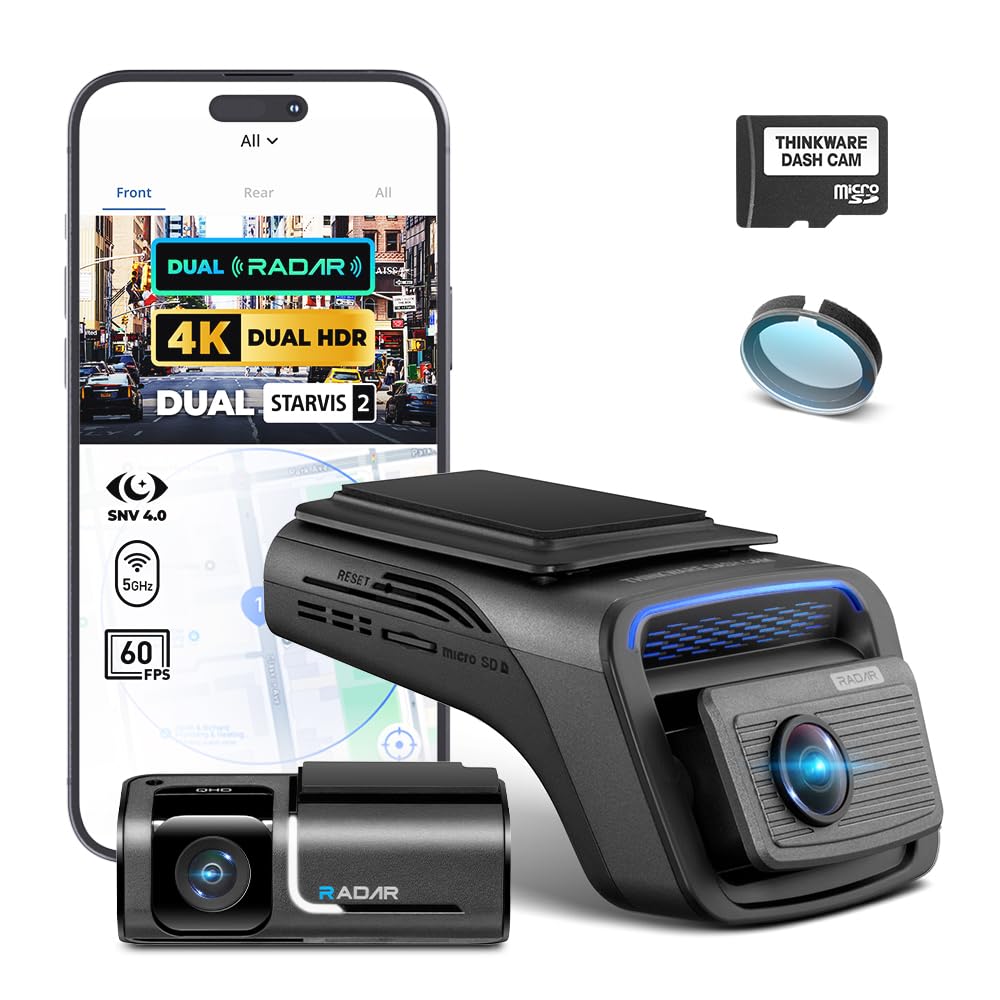
A radar eye that wakes the camera for passing motion, plus real-time safety warnings on the road.
Most parking modes run on a motion sensor. This one runs radar. The advanced radar parking mode detects motion and wakes the camera to record a 20-second clip, and energy-saving features extend coverage without draining your battery. That is the premium pitch: parked coverage that does not lean on your car battery the way a constant recorder does. On the road, it records 4K front and 2K rear on Sony STARVIS 2 sensors with an Ambarella processor, and WDR plus smart auto-exposure balance harsh light.
Event capture is precise. Motion and impact sensors trigger a 20-second file that includes 10 seconds before and 10 seconds after the incident, so the clip has context on both sides of the moment. Forward collision and lane departure warnings, plus GPS speed-camera notifications, round out the safety side. A 64GB microSD card is included and it accepts up to 512 GB. Dual-band 2.4GHz and 5GHz Wi-Fi with quick pairing via Dash Cam Link handles the phone connection.
Owners describe clear video and an impressive resolution, and installation as quick and straightforward. The lens coverage is the point to check against your needs: the front lens takes in 147.2 degrees, which is narrower than the 170-degree fronts on several picks above. This is a two-channel front-and-rear system, so there is no interior or side camera.
The premium arguments
- Radar parking mode wakes on motion with a 20-second clip and energy-saving coverage
- 4K front and 2K rear on Sony STARVIS 2 sensors with an Ambarella processor
- Event files include 10 seconds before and after, plus collision and lane-departure alerts
Where it is narrower
- 147.2-degree front lens is a tighter view than 170-degree fronts on other picks
- Two channels only — no cabin or side coverage
Worth considering for: buyers who prioritize battery-friendly radar parking watch and on-road safety alerts over wide lens coverage.
Pass if: you want the widest front angle or interior coverage — this one trades width for radar and alerts.
Know the Specs
Channel count and field of view
Channels are how many lenses record at once. A two-channel system is front and rear; three adds a cabin view; four adds side lenses for 360-degree coverage. Field of view is the angle one lens sees, in degrees — a 170-degree front lens catches more lanes than a 147.2-degree one, while a four-lens setup reaches 360 degrees or more overall. More channels mean more evidence but a longer cable install.
Card ceiling and loop recording
The card ceiling is the largest microSD the camera accepts, from 128 GB up to 1 TB here. Loop recording overwrites the oldest open up file when the card fills, so a bigger ceiling and a bigger included card both mean more days of retained footage. A G-sensor locks impact clips so they survive that overwrite cycle.
Supercapacitor vs battery
A supercapacitor stores power for a short burst and is built to tolerate temperature swings — the BOTSLAB and 70mai specs list ranges like -20℃ to 70℃ and 14°F to 140°F. A lithium battery cell, like the one listed on the Icesky model, stores more energy but ages faster in heat. For a windshield that bakes, the capacitor is the more heat-tolerant choice.
Parking mode and the hardwire kit
Parking mode keeps the camera recording while the car is off — time-lapse, impact detection, or radar wake in the THINKWARE’s case. It requires a separate hardwire kit on every model here that offers it, tapped into constant power. Plan the kit into your setup or the parked coverage will not run.
Common Questions
Do I need a hardwire kit for parking mode to work?
What is the difference between a 3-channel and a 4-channel dash cam?
How much footage will a 128GB card hold before it overwrites?
Will a dash cam drain my car battery in parking mode?
Can I use CarPlay and the dash cam Wi-Fi at the same time?
Do these cameras survive summer heat on a windshield?
What does the G-sensor actually do on these cameras?
Is 4K really better than 1080P for reading licence plates?
Can I watch the cameras live from my phone while I am away?
Do these dash cams include a memory card in the box?
The Bottom Line
The strongest all-rounder for most drivers is the TERUNSOUl 4K 3-Channel, because it pairs three simultaneous channels with a 128GB card already installed and a 512 GB ceiling. If your worry is a rear-end hit and you want 4K on both ends, the Aputeta 4K+4K Dual delivers matching front and rear resolution. For riders in the cabin, the 70mai T800E adds switchable infrared inside the car. And if battery-friendly radar parking watch is the priority, the THINKWARE U3000 PRO answers that call. Whichever you mount, add the hardwire kit so the parked protection you paid for actually runs.
How we choose
We do not accept paid placement. Every pick is matched to a real buyer and a real use-case; we do not hands-on test units.
Sources
Specifications: manufacturer listings and product documentation. Review insights: verified customer reviews, as of November 2026. Pricing: not shown on this page (it changes often); check the current price via the retailer link.
As an Amazon Associate, Tactical Gear Guy earns from qualifying purchases. This does not affect which products we feature.