Specs are compiled from manufacturer listings and verified buyer reviews and can change over time — please confirm the key details on the product page before buying.
You want a watch that survives a rock scrape, keeps its bearings when your phone dies, and doesn’t beg for a charger mid-hike. That last part is the real filter. An outdoor watch lives or dies on its battery and its navigation, and the eleven picks below are the ones that hold up on both. The Garmin Instinct 2X Solar Tactical Edition takes the top spot, and the reason is simple: sunlight keeps it running, and the built-in flashlight plus ballistics calculator (a tool that works out bullet drop for long-range shooting) make it a genuine field tool rather than a fitness tracker in a tough case.
This guide is built by comparing the manufacturers’ published specifications and the patterns across verified customer reviews, so you get each pick’s real strengths and trade-offs instead of marketing spin.
Some of these run on a solar lens, some use a rechargeable cell, and one winds itself from the motion of your wrist. That difference changes how you treat the watch every day, so read the battery column before anything else. Here are the top rated outdoor watches that earn their place on a real trail.
Top Picks


How To Choose The Best Top Rated Outdoor Watches
Most buyers shop this category by screen and strap color, then get surprised six months later when the battery quits halfway through a long day out. The order that actually matters is battery source, then navigation accuracy, then the case and glass that decide whether the thing survives a fall. Work through those three in order and the rest of the spec sheet matters far less.
Decide how the watch gets its power
Solar models here, including the Garmin Instinct and fenix lines plus the Casio Pro Trek, stretch runtime by converting light through a lens over the display. The catch is that the solar figure usually assumes a set amount of direct sunlight each day, and a sleeve or a cloudy week cuts that down. A rechargeable watch like the Amazfit T-Rex 3 Pro or the Apple Watch Ultra 4 needs a cable but behaves the same in the dark. The Timex Expedition North Titanium Automatic sits in a third camp entirely — a 21-jewel automatic movement winds from wrist motion, so it has no charging routine at all.
Match GPS accuracy to where you actually walk
Multi-band GPS, sometimes called dual-band, pulls from more than one satellite frequency so the position holds steadier under dense tree cover, in canyons, and between tall buildings. Watches like the fenix 7X Pro, Instinct 3 Solar, COROS Nomad, and T-Rex 3 Pro all list that capability under different names. If you mostly walk open ridgelines and marked trails, a standard GPS fix is fine and you can put the savings into battery instead.
Read the case and glass before the features list
The case material tells you what the watch shrugs off. Fiber-reinforced polymer and titanium both show up on this list — polymer keeps weight down, titanium adds stiffness and a premium feel. Glass matters just as much: sapphire crystal resists scratching far better than standard mineral glass, which is why the Timex, Apple Watch Ultra 4, Enduro 3, and fenix 7X Pro all call it out. Water ratings run from 100 meters on several models up to 10 ATM on the Instinct 3 Solar and T-Rex 3 Pro, and those figures describe pressure resistance, not diving depth for recreational use.
Do not ignore the display type
Two screens dominate. A memory-in-pixel (MIP) display like the one on the COROS Nomad sips power and stays readable in direct sun, which is why battery claims on those watches run into weeks. An AMOLED panel like the T-Rex 3 Pro’s 3000-nit screen is brighter and more colorful but drinks more juice. Neither is better — MIP is built for a ten-day trek, AMOLED for someone who wants a vivid face on their wrist.
Side-by-Side Comparison
| Model | Best For | Power Source | Battery Claim | Case / Glass | Amazon |
|---|---|---|---|---|---|
| Garmin Instinct 2X Solar Tactical★ Best Overall | Field use and emergency prep | Solar + rechargeable | Unlimited in smartwatch mode with 3 hrs sun/day | 50 mm fiber-reinforced polymer | Amazon |
| Casio Pro Trek PRG340B-3Budget Sensor Pick | Sensor-driven hiking on a tighter budget | Tough Solar | — | Bio-based resin case | Amazon |
| Garmin Instinct 2 SolarBest for Smaller Wrists | Smaller wrists and everyday wear | Solar + rechargeable | 48 hrs in GPS mode with solar | Fiber-reinforced polymer, Gorilla glass | Amazon |
| COROS Nomad | Anglers and long unsupported days | Rechargeable | 22 days daily, 50 hrs GPS | Polymer and aluminum bezel | Amazon |
| Timex Expedition North Titanium Automatic | Never charging a watch again | Automatic movement | No battery | 41 mm titanium, sapphire crystal | Amazon |
| Casio PRW6600Y Pro Trek | Analog feel with full sensor suite | Tough Solar + atomic timekeeping | — | 100M water resistance | Amazon |
| Apple Watch Ultra 4 | Staying connected off-grid | Rechargeable | 45 hrs Max Extended Workout | Titanium case, sapphire crystal | Amazon |
Detailed Reviews
1. Garmin Instinct 2X Solar Tactical Edition
Our pick — 4.5+★ from 650+ verified ratings; the strongest balance of quality and price.
A solar watch that also carries a flashlight and a ballistics calculator in a 50 mm case.
If your outdoor day involves navigation, a headlamp you forgot, and a week away from an outlet, this is the pick. Garmin builds it to U.S. military standard 810 for thermal, shock, and water resistance, so dropping it on rock or leaving it in a hot truck is inside the design brief. The case is fiber-reinforced polymer at 50 mm — big enough to read at a glance with gloves on, light enough that the polymer keeps it off your wrist’s radar.
Sunlight is what keeps this watch going. The Power Glass lens over the dial produces 50% more energy than the standard Instinct 2 solar watch, and Garmin rates it for infinite battery life in smartwatch mode when it sees 3 hours of direct sunlight at 50,000 lux per day (lux is a measure of light brightness). In plain terms, a normal bright day on the trail tops it up, and navigation stays live. Multi-band signal reception (it locks onto several satellite frequencies at once) delivers more accurate positioning than single-band devices, which is the difference between the trail junction and the deer path beside it. A 3-axis compass and barometric altimeter (a sensor that reads altitude from air pressure) round out the navigation.
The tactical additions are what push it ahead of the standard Instinct line. A built-in LED flashlight with variable intensities and strobe modes lights your way at night, and the SOS strobe mode commands attention in an emergency. The ballistics calculator is a niche tool, but if you shoot, it turns the watch into a field companion. What wins people over most is the durability — the review pages read like a list of abuse survived, from theme parks to hunting seasons. The honest catch is the size: at 50 mm with a 26 mm band, it wears large on a narrow wrist, and the solar top-up assumes you actually get that sun.
Where it earns the crown
- Solar charging rated for unlimited smartwatch-mode runtime with 3 hours of 50,000-lux sun per day
- MIL-STD-810 thermal, shock, and water resistance in a fiber-reinforced polymer case
- Built-in LED flashlight with strobe and SOS modes for night travel and emergencies
- Multi-band GPS for tighter positioning than single-band watches
Worth knowing first
- The 50 mm case and 26 mm band wear big on smaller wrists
- The ballistics calculator only earns its place if you actually shoot
- Infinite runtime depends on real direct sunlight, not shade or a sleeve
Reach for this if: you want one watch that navigates, lights the trail, and only rarely touches a cable.
Think twice if: your wrist runs small — the 50 mm case will feel like a dinner plate.
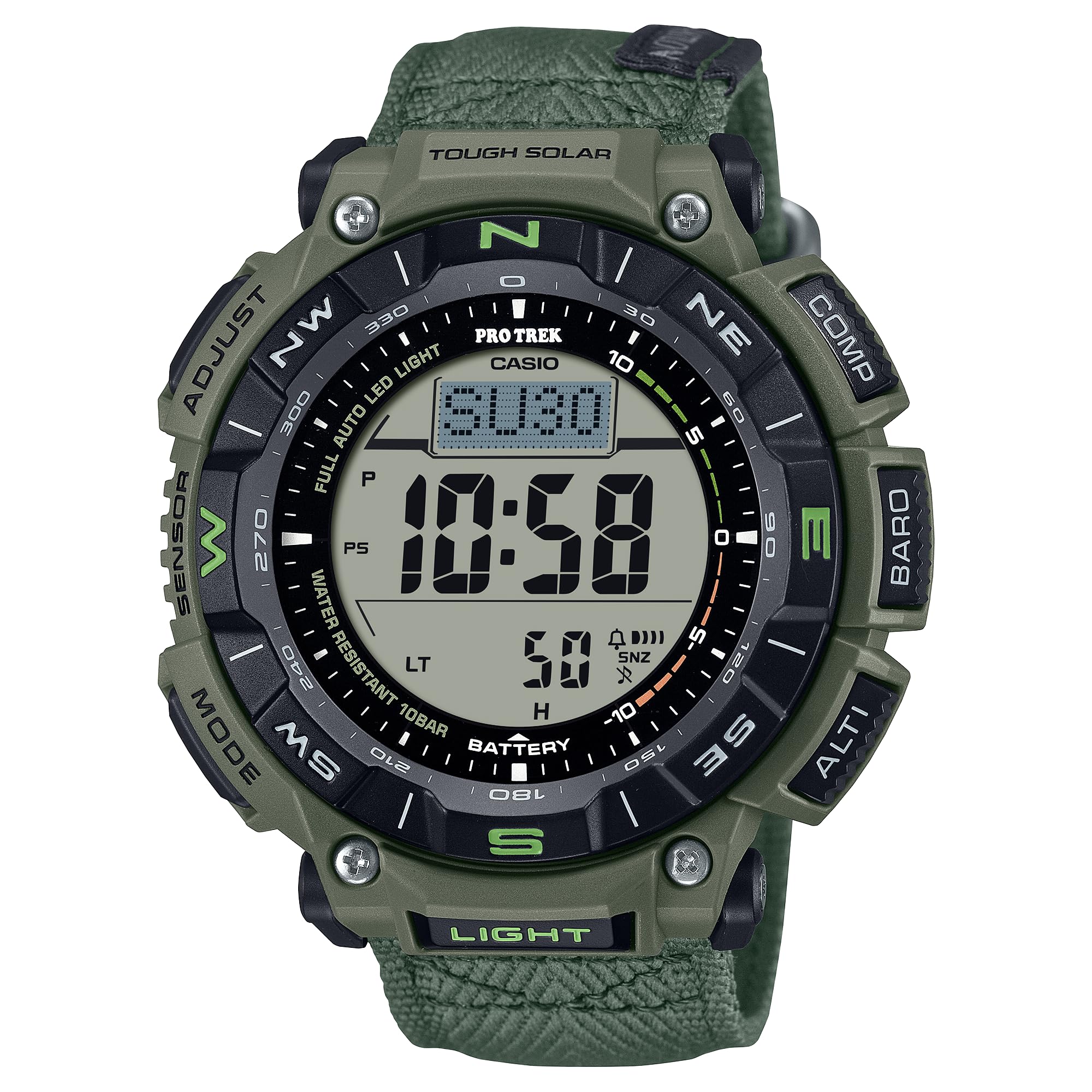
2. Casio PRO Trek PRG340B-3 Solar-Powered Outdoor Watch
Analog looks, digital sensors, and a body built from plant-based resin instead of oil-based plastic.
Casio’s Pro Trek line has always been the value route into real outdoor sensors, and this olive PRG340B-3 keeps that going. It runs on Casio’s Tough Solar system, so the dial’s solar cell feeds the battery from daylight and you skip the charger entirely. The triple sensor gives you compass, altitude/barometer, and thermometer readings from the case — the classic trio a hiker actually uses when a weather front rolls in fast.
Two details set it apart from the plastic-heavy competition. The case is bio-based resin, which Casio makes from renewable raw material, and the band is flame-resistant faux leather in olive green. That flame-resistant band is unusual in this price band and suits campfire duty well. Water resistance sits at 100 meters, which handles rain, river crossings, and a dunking without drama.
Here’s the honest part: this is a lean listing with little published spec depth, and Casio’s analog-digital hybrid display takes a moment longer to read than a pure digital screen. If you want GPS turn-by-turn, it isn’t here — this watch gives you compass and barometric readings, not route mapping. But for someone who wants genuine outdoor sensors and solar power in a watch that looks good off the trail too, it’s a lot of capability packed into an olive case.
Best for the analog crowd: solar power, a compass, and a barometer in a case that reads more like a field watch than a gadget. The bio-based resin and flame-resistant band are the two features worth knowing about before you buy.
Go here if: sensors and solar matter more to you than GPS routing.
Look elsewhere if: you need maps or route guidance on the wrist.
3. Garmin Instinct 2 Solar
The Instinct formula trimmed down for wrists that find the 2X too much watch.
This is the smaller-sized member of the Instinct family, and that’s the whole pitch. Same rugged build philosophy, less bulk. Garmin rates it to 100 meters of water resistance and gives it a fiber-reinforced polymer case with scratch-resistant Corning Gorilla glass over the dial, so it takes knocks without showing them. The silicone band runs 22 centimeters, and the graphite colorway stays out of the way on casual days.
Battery is the reason to pick solar. Garmin claims unlimited runtime in smartwatch mode with all-day wear and 3 hours of the same 50,000-lux direct sunlight per day, and up to 48 hours in GPS mode with continuous sun. TracBack routing is the feature hikers end up loving most — it drops a breadcrumb trail so you can retrace your steps back to the car without second-guessing turns. Multi-GNSS support pulls from GPS, GLONASS, and Galileo together for a more reliable fix than a single constellation.
Buyers report talking about looks first and battery second, which tells you this reads as a regular watch until you need it not to. Recharging lands around once a month for most wear patterns. The fair caveat: owners mention that accuracy, reliability, and value reports come back mixed rather than glowing, so expect a solid everyday performer rather than a flawless one — and the small display takes some getting used to if you’re stepping down from a large-screen model.
What the data backs up
- Smaller build than the 2X, easier on narrower wrists
- Solar charging rated for unlimited smartwatch mode with 3 hrs of 50,000-lux sun daily
- TracBack routing puts a return path on your wrist
- 100-meter water rating with Gorilla glass
Fair warnings
- Accuracy and reliability feedback lands mixed
- Smaller screen is a step down from the big-case models
The fit call: buy this if the 50 mm Instincts felt oversized on your arm.
The trade: you give up some screen real estate in exchange for that smaller case.
4. Garmin Instinct 3 Solar, 50mm

Screen and navigation strengths
- 3000-nit AMOLED panel stays readable in harsh glare
- Dual-band GPS from six satellite systems plus offline maps
- Diving certification to 45 meters and 10 ATM rating
- Built-in two-color flashlight with Turbo Mode and SOS
Where it needs care
- No solar charging — it’s a rechargeable watch
- Durability reports come back mixed, so guard the case
Made for: bright-light adventurers and divers who want a vivid face and real maps.
Not for: the set-and-forget crowd who never want to pack a charging cable.
5. COROS Nomad GPS Outdoor Smartwatch
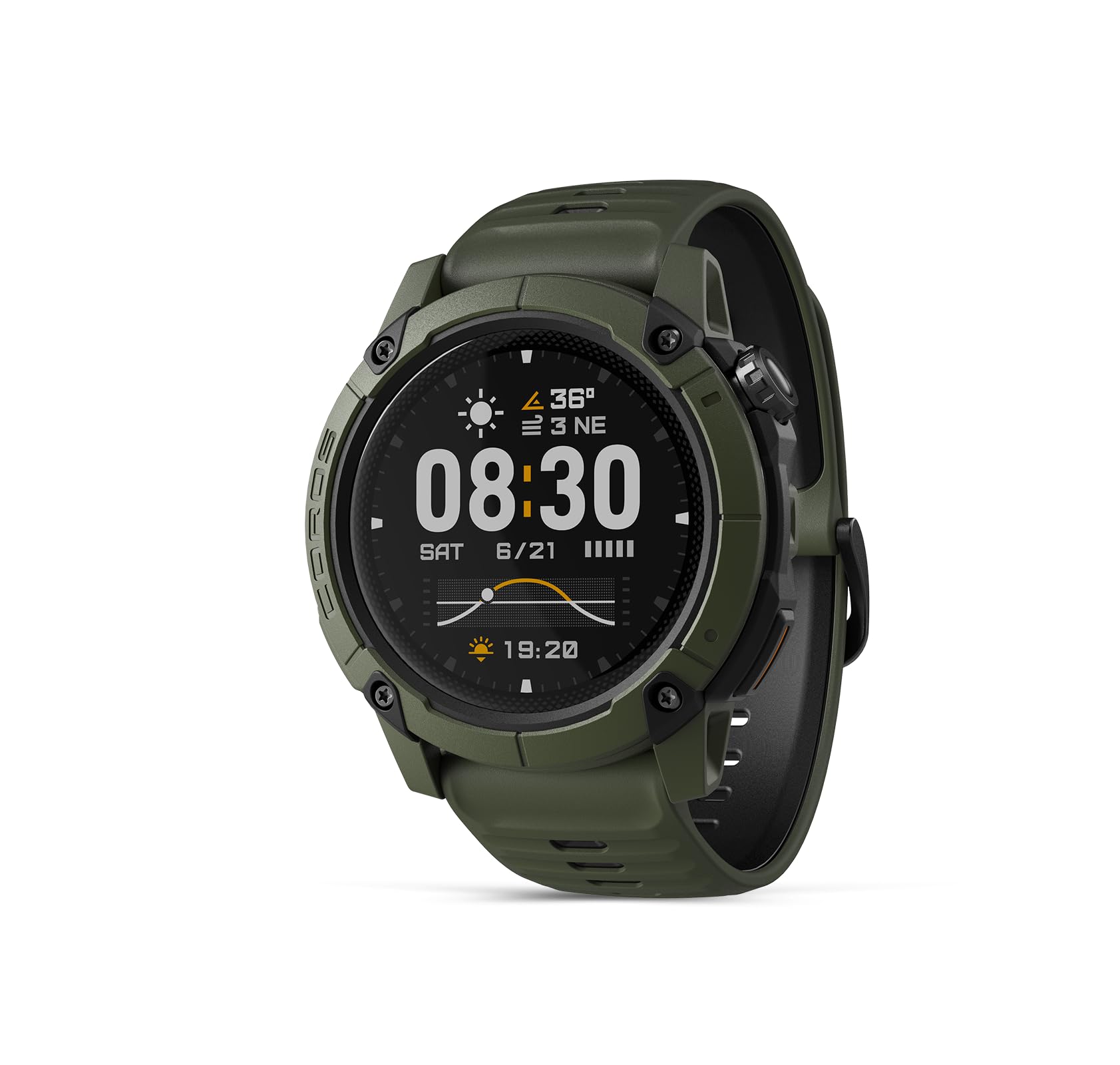
Built around tides, moon phase, and a fishing log — the least generic watch on this list.
COROS aimed this one at a specific buyer: the person who spends long days on water or trail and wants the watch to know what the sky is doing. Real-time and forecasted data covers sunrise, tides, and moon phase, and you can log catches and mark key spots as you go. That feature set is why it’s the angler’s pick in this lineup — no other watch here tracks tides, moon phase, and catches.
The hardware backs the mission. A dual-layer polymer and aluminum alloy bezel keeps weight down, and the 1.3″ Memory in Pixel (MIP) screen gives high contrast in direct sun with deep color in low light. Battery life is rated at 50 hours in GPS mode and 22 days of daily use — enough for a multi-day trip without a power bank. Free pre-loaded global maps carry street names, and Back-to-Start navigation plus safety alerts cover the wrong-turn and weather-scare moments.
The Adventure Journal is the quirky standout. You can record voice notes, tag locations, add photos, and transcribe voice-to-text memos inside an activity, so your fishing spot coordinates and the story behind them live in one place. Owners rate it as performing well with superb battery and practical features that stack up against the bigger-name competition. The trade-off is familiarity — if you’re used to Garmin’s ecosystem, the interface feels new and takes a day to learn.
The catch this watch solves: tides, moon phase, and a catch log in one place, backed by 22 days of daily-use battery and 50 hours of GPS. No other pick here tracks fishing data at all.
The honest limit: it’s a rechargeable watch, and the 1.3″ MIP screen trades color punch for sunlight readability.
Build a boat bag around this if: you fish, hunt, or roam and want environment data plus a location log.
Pass if: you want a watch that feels like your existing Garmin from day one.
6. Timex Expedition North Titanium Automatic 41mm

The only watch here that never needs a battery, a cable, or a ray of sun.
A 21-jewel automatic movement winds itself from the motion of your wrist, so there’s no charging routine at all — wear it and it runs. For a lot of outdoor buyers, that alone is worth more than any app. The case is true titanium at 41 mm, shock-resistant, and topped with a scratch-resistant, anti-reflective sapphire crystal. Water resistance is rated to 200 meters, well beyond what a weekend kayaker or a downpour will ever ask of it.
The design leans field watch rather than smartwatch, which is the point. A black dial on a black strap keeps it understated, and the 41 mm size sits in the balance for daily wear on most wrists. The strap is a quick-release Ecco DriTan leather band that Timex makes with water-saving technology. Customers note responding most to the build quality — the titanium body and sapphire (a scratch-resistant crystal) pairing at this level feels like more watch than the sum of its parts, and it handles real work without complaint.
Now the fine print. A mechanical movement is not a GPS watch, so you get none of the navigation, health tracking, or sensor data the Garmin and Amazfit models pack in. The automatic also needs wrist time — leave it on a shelf for a few days and it will stop. And the timekeeping and noise feedback comes back mixed, which for a mechanical watch usually means accuracy within mechanical tolerances rather than quartz precision. If that trade is fine with you, no watch here is simpler to live with.
Why the traditionalists love it
- 21-jewel automatic movement — no charging, ever
- True titanium case with sapphire crystal and anti-reflective coating
- 200-meter water resistance
- 41 mm footprint that suits daily wear
What you give up
- No GPS, sensors, or health tracking
- The movement stops if it sits unworn for days
- Mechanical accuracy varies rather than locking to a quartz standard
The purist’s choice: a titanium field watch with sapphire glass and no charging habit to keep.
The sacrifice: every navigation and health feature on this list disappears in exchange for that simplicity.
7. Casio PRW6600Y Pro Trek

Compass, altimeter, barometer, thermometer, and a solar cell — a full instrument cluster on your wrist.
This is Casio’s analog Pro Trek at its most complete. The compass, altitude/barometer, and thermometer sensors cover the three readings most hikers and hunters actually use, and Casio’s Tough Solar system keeps the battery topped up from daylight so you’re not hunting for a charger. Atomic timekeeping syncs the watch to a radio time signal, which means it corrects itself rather than drifting. Add a 1-100 second stopwatch, countdown timer, and world time and you’ve got a serious field instrument.
Water resistance sits at 100 meters, enough for swimming and sustained rain. The analog hands give it a traditional look that reads as a nice watch when you’re not on a trail, and the sensor functions are straightforward to trigger. Owners praise the compass and barometer/thermometer features especially, and describe the whole thing as comfortable to wear with simple controls.
The honest trade-off is that you’re paying for analog craftsmanship and sensor ability rather than GPS navigation. There’s no route mapping here, and the analog hand layout means you have to cycle through modes rather than glance at a digital map. If you want compass, altimeter, and barometer readings in a watch that dresses up, this delivers; if you want turn-by-turn on a screen, look at the fenix or the COROS.
Instrument first, tracker second: the compass, altimeter, barometer, and thermometer are the star turns, backed by atomic self-correction and solar power. It’s the most traditional-feeling sensor watch on this list.
Choose this when: sensor readings and analog styling beat route mapping in your book.
Look past it if: you need preloaded maps or GPS routing.
8. Garmin fēnix 7X Pro Sapphire Solar

The only watch here that can call for help when there’s no cell signal at all.
Most outdoor watches tell you where you are. The Ultra 4 can get you rescued. Built-in satellite communications let you text emergency services when you have no cell service or Wi-Fi, and the watch detects a hard fall or severe car crash and responds. That safety layer is why this one belongs on a serious outdoors list despite its smartwatch roots. A tough titanium case and sapphire crystal display hold the hardware, water resistant to 100 meters.
Battery is multi-day: up to 45 hours of Max Extended Workout tracking, and a fast charge that gives up to 18 hours of use from just 15 minutes on the charger. Precision dual-frequency GPS handles distance running, triathlons, and mountain biking, with Pacer, Heart Rate Zones, custom workouts, and training load. Cellular freedom means calls, music streaming, and AirPods playback without your iPhone anywhere near you.
Health tracking is where it pulls ahead of the analog sensor watches: HRV measured as often as every five minutes, background heart rate readings every five seconds, an overnight Vitals app, sleep score, and blood oxygen readings. Owners call it a great upgrade with a vivid look and strong performance. The honest note is cost — value-for-money feedback comes back mixed, and the battery, while multi-day, still expects a charger far more often than the solar Garmins above.
Why it earns a slot
- Built-in satellite communications for emergency texts off-grid
- 45 hours of Max Extended Workout tracking, with up to 18 hours of use from a 15-minute fast charge
- Precision dual-frequency GPS for running and triathlon
- HRV measured as often as every five minutes
What to weigh
- Value-for-money feedback is mixed at this premium tier
- Needs regular charging far more than the solar picks
For iPhone users going remote: satellite SOS, cellular freedom, and serious health data in one wrist device.
For everyone else: if you don’t carry an iPhone, the solar Garmins serve you better.
Know the Specs
Solar charging figures
When a watch lists solar charging, the number next to it almost always comes with conditions. The 50,000-lux figure that appears on the Garmin models describes bright, direct sunlight — roughly what you get on an exposed face at midday with no cloud and no sleeve covering the dial. That matters because a watch under a jacket cuff all winter is not harvesting anything. Treat the solar figure as best-case, not a guarantee.
Multi-band vs. single-band GPS
Multi-band GPS pulls signals from more than one satellite frequency at once, which steadies the position fix under tree cover and among buildings. It costs a little more battery, which is why some Garmin models use SatIQ to switch bands automatically. A single-band fix is fine on open ground. If your trails run through dense forest, this one spec is worth paying attention to.
MIL-STD-810 and ATM ratings
MIL-STD-810 is a U.S. military test standard covering thermal, shock, and water resistance, so a watch built to it has been tested against drops, temperature swings, and moisture. ATM stands for atmospheres and describes pressure resistance — 10 ATM on a watch like the Instinct 3 Solar or T-Rex 3 Pro means it handles swimming and surface water sports, while 100-meter ratings on the Casio and Garmin models cover similar use. Neither figure means you should press buttons at depth.
MIP vs. AMOLED displays
A Memory in Pixel (MIP) screen, like the one on the COROS Nomad, uses very little power and reads clearly in bright sun, which is why battery claims on those watches stretch into weeks. An AMOLED panel, like the 3000-nit screen on the T-Rex 3 Pro, is brighter and more colorful but draws more from the battery. Pick MIP for long unsupported trips, AMOLED for a vivid face and a charger you can reach every night.
Common Questions
How long does an outdoor watch battery actually last on a trip?
Is solar charging on an outdoor watch worth it?
Do I need multi-band GPS for hiking?
What does 10 ATM water resistance mean for swimming and diving?
Is a titanium case better than polymer for an outdoor watch?
Can I read an outdoor watch screen in bright sunlight?
Does an automatic watch like the Timex Expedition North need winding?
Can the Apple Watch Ultra 4 work without an iPhone?
How often will I need to charge a GPS outdoor watch?
What is a barometric altimeter and why do hikers want one?
The Bottom Line
For most people heading outdoors, the top rated outdoor watches winner is the Garmin Instinct 2X Solar Tactical Edition because it pairs unlimited solar-charged runtime with a flashlight, multi-band GPS, and a military-standard case — a genuinely complete field tool rather than a fitness tracker in a tough shell. If preloaded maps and training depth matter more than tactical extras, the Garmin fēnix 7X Pro Sapphire Solar is the mapping specialist. And for anyone who wants a watch that never touches a cable, the Timex Expedition North Titanium Automatic winds itself and asks nothing of you.
Wherever you land on this list, the deciding factor is the same: pick the power source and navigation level that match how you actually travel. The solar models reward time in open sun; the rechargeable ones reward a habit of charging; the automatic rewards simply wearing it. Get that one match right and you won’t be shopping for another watch for years.
How we choose
We do not accept paid placement. Every pick is matched to a real buyer and a real use-case; we do not hands-on test units.
Sources
Specifications: manufacturer listings and product documentation. Review insights: verified customer reviews, as of November 2026. Pricing: not shown on this page (it changes often); check the current price via the retailer link.
As an Amazon Associate, Tactical Gear Guy earns from qualifying purchases. This does not affect which products we feature.