Specs are compiled from manufacturer listings and verified buyer reviews and can change over time — please confirm the key details on the product page before buying.
Here is the short answer: a Type 2 life jacket is a near-shore vest designed to turn most wearers face-up in the water. For kids, most families should start with the Stearns Child Heads-Up vest; for adults, the BLUESTORM Stratus 35. The most common mistake is shopping by weight alone. Type 2 vests are cut to a chest size, and a vest that rides up around the ears is not protecting anyone. Get the chest measurement right and the rest gets simple.
This guide is built by comparing the manufacturers’ published specifications and the patterns across verified customer reviews, so you get each pick’s real strengths and trade-offs instead of marketing spin.
Every pick below carries a U.S. Coast Guard Type II stamp, which means it is designed to help turn a wearer face-up rather than simply keep them afloat. You will see foam vests built for constant wear and inflatables built for freedom of movement. The honest difference between a good pick and a bad one usually depends on chest fit, buckle security, and whether the vest is comfortable enough to actually stay on. This breakdown of the type 2 life jacket market covers both families and adult paddlers.
Top Picks


How To Choose The Best Type 2 Life Jacket
A Type 2 vest lives or dies on fit. Buoyancy numbers look reassuring on a listing, but if the vest slides up toward your chin when you float, the flotation is in the wrong place. The U.S. Coast Guard approves these vests for near-shore use, where rescue is usually close at hand — think lakes, bays, pools, and calm coastal water. That is different from an offshore Type 1 vest, which is built for open water and long survival time.
Measure the chest, not just the weight
Inflatable vests publish a chest range for a reason. The BLUESTORM models fit chest sizes between 30 inches and 56 inches, which covers most adult bodies in one shell. Foam child vests work the other way — they are split by weight bands, and the O’Neill vest is rated for 30 to 50 pounds with a chest size up to roughly 24 inches. Check both numbers. A heavy child with a small chest can end up in a vest that gaps at the shoulders.
Foam or inflatable — pick by how you’ll wear it
A foam vest is always on and always buoyant. You clip it, zip it, and forget it, and it needs nothing but a rinse. An inflatable stays flat until you hit the water, then the CO2 cylinder fires automatically. That makes it far less bulky in a kayak seat or on a paddleboard. The trade-off is maintenance — you must inspect the cylinder and the pull cord before each trip, and a spent cylinder needs replacing.
Look hard at the straps and the crotch strap
Adjustable webbing holds a vest down where it belongs. On the O’Neill child vest, a lined crotch strap specifically reduces riding-up, which is the exact failure that pushes a child vest into their face. Adult foam vests rely on a full waist belt plus side adjusters. Inflatable vests use a wide waist belt and a slider to lock the fit. Wide webbing and quick-release buckles beat thin straps every time — they hold tension better and come off cleanly in an emergency.
Side-by-Side Comparison
| Model | Best For | Rated Weight / Chest | Buoyancy | Construction | Amazon |
|---|---|---|---|---|---|
| Stearns Child Heads-Up★ Best Overall | Young children in pools and lakes | Up to 30 lbs | Not stated | Nylon shell, PE foam | Amazon |
| O’Neill Child SuperliteTop Performer | Active kids, boating and wakeboarding | 30–50 lbs, chest up to 24″ | Not stated | Coated polyester, polyethylene foam | Amazon |
| Hardcore 2-Pack May West | Budget adult pair for guests | Adult universal | Not stated | Polyester shell | Amazon |
| BLUESTORM Stratus 35 | Anglers and paddlers who want free arms | Chest 30″–56″ | 35 lbs | Inflatable, nylon, CO2 auto | Amazon |
| BLUESTORM Atmos 40 (Green) | Rough water and offshore work | Chest 30″–56″ | 40 lbs | Inflatable, nylon, CO2 auto | Amazon |
Detailed Reviews
1. Stearns Child Life Jacket, Heads-Up Flotation, Youth PFD
Our pick — 4.5+★ from 350+ verified ratings; the strongest balance of quality and price.
The vest built around a single idea: keep a small child’s face out of the water.
A lightweight 5.28 ounces is what you feel when you lift this child vest — which matters because a heavy foam jacket on a small kid becomes a fight at the pool gate. The defining feature is the integrated neck float under the chin, a horseshoe of foam that pushes the head back so a young swimmer ends up face-up without anyone’s help.
This vest is built for the shoreline: a nylon outer shell, a PE foam core (a firm foam that floats), and size bands for children under 30 pounds. Bright green and gray panels help you spot your child in a crowded swim area. A top rescue loop gives you a fast grab, and a lined crotch strap stops the jacket from creeping up into the armpits and cheeks. Contoured arm openings let a toddler keep paddling, which is the difference between a vest they tolerate and one they refuse.
The sizing is the part to read twice. This particular vest tops out at a 30-pound recommendation, and it works best on the very small end — the fit is genuinely snug on a 16-pound nine-month-old and tightens up fast as kids grow. If your child is already near the top of that band, step up to the O’Neill below. What wins parents over is the build itself, the most-praised thing about this vest by a wide margin, followed by confidence in the Coast Guard approval. That crowd favorite reputation rests on 4.5+ stars across 300+ ratings.
What earns its keep
- The heads-up neck float promotes face-up positioning, which is the whole point of a Type II vest
- 5.28 ounces means it slips into a beach bag and never tires a small wearer
- Crotch and leg strap keeps the jacket down instead of riding up into the face
- Top rescue loop makes a quick grab easy for an adult in the water
Where it stops fitting
- The 30-pound ceiling is real — heavier children will feel it strain at the shoulders
- Universal fit means no true size adjustment for a narrow or wide chest
Right vest for: a first-time swimmer under 30 pounds who needs float-assisted face-up help in a pool or calm lake.
Move on if: your child is pushing that 30-pound mark — you want the 30-to-50-pound O’Neill instead.
2. O’Neill Child Superlite USCG Approved Life Vest
The minimal-bulk child vest that lets a kid actually swim, not just float.
At 12 ounces versus 5.28 ounces for the Stearns, that extra mass buys a proper chest cut for bigger kids. It is rated from 30 to 50 pounds, so it picks up right where the Stearns leaves off, and the coated polyester shell over polyethylene foam gives it a durable, slick outer that sheds water.
The design philosophy here is low bulk. Anatomically cut flotation means the foam is shaped around a child’s torso instead of boxed around it, so arms swing freely for paddling, wakeboarding, or waterskiing. Heavy-duty 1-inch webbing belts with quick-release buckles hold the fit tight, and the vest is built to sit snug — deliberately, because a loose vest is a dangerous vest.
That snugness is also the honest catch. The listed chest limit is about 24 inches, and the manufacturer is upfront that it runs small and may not fit every child inside the weight range. Measure the chest before ordering. Get it right and the fit is the thing people talk about, in both directions — most kids are happy, but a fair number of parents found it tighter than expected across the chest and shoulders. Build quality draws the most praise overall, and the vibrant turquoise, berry, lime, and white colorway helps you spot your kid in a busy swim area. 4.5+ stars across 900+ ratings backs all of that up.
Worth the measurement: a low-bulk 30-to-50-pound vest with a coated polyester shell and 1-inch quick-release webbing is exactly what an active kid needs for watersports, and it will not tangle their arms.
The honest limit: that snug cut and the 24-inch chest cap mean a stocky child can be inside the weight band and still be too broad for the vest — so the tape measure, not the bathroom scale, should decide.
Buy this one if: you have an active 30-to-50-pound kid with a chest under roughly 24 inches and you want freedom of movement over maximum padding.
Skip the upsizing gamble: this is not a vest to buy “with room to grow,” because the shell will not stretch to meet a bigger chest.
3. Hardcore Water Sports Keyhole Vest 2 Pack
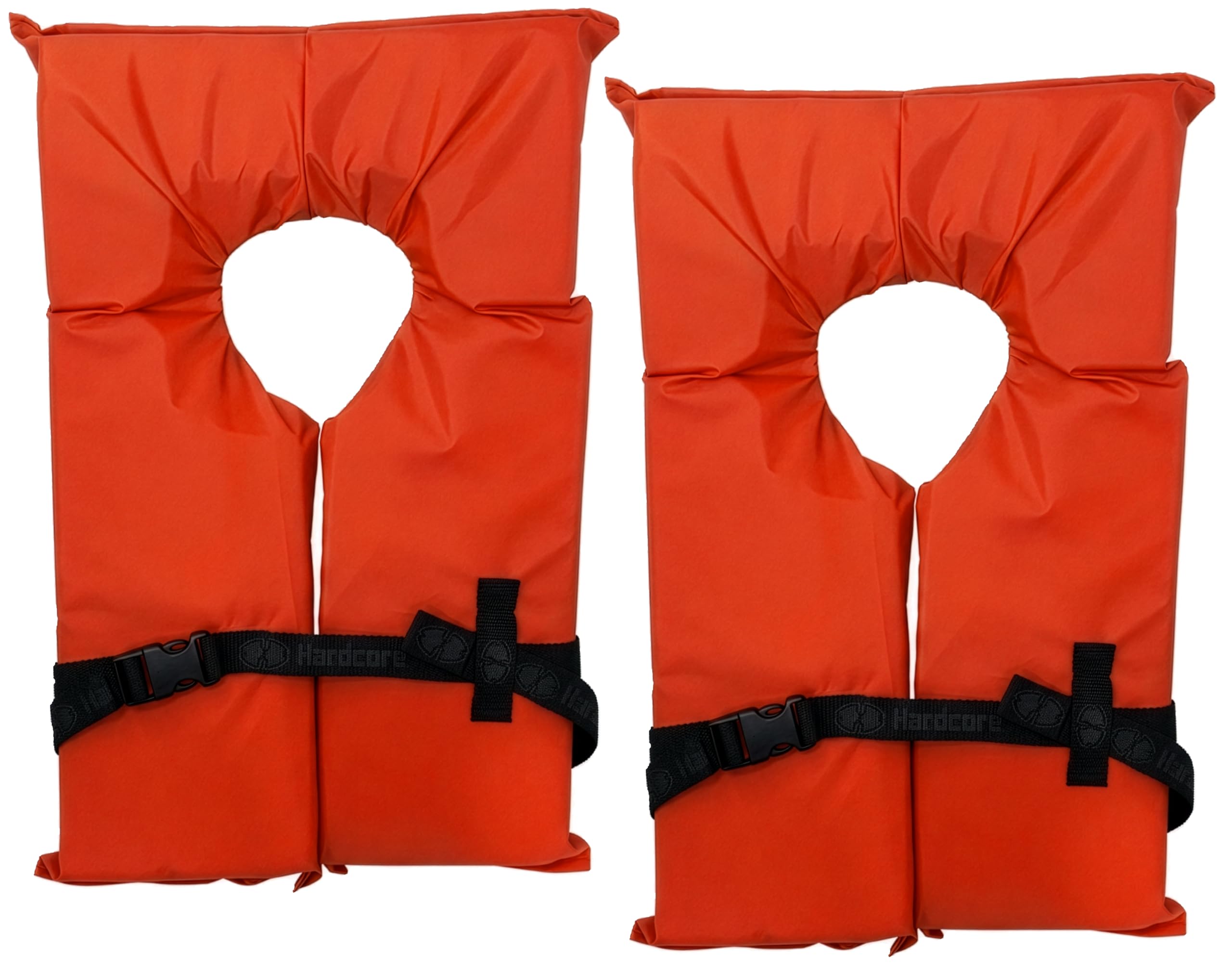
Two adult vests in one box — the guest-boat answer in high-visibility orange.
Here is the case for pairing instead of single-buying: a boat with four adults on board needs four vests, and buying one at a time never quite keeps pace with the guest list. This box gives you two adult Type II keyhole vests in bright orange, the classic May West horseshoe shape that has been the standard near-shore flotation design for decades.
Each vest weighs in at 1.4 pounds, with a polyester shell and adjustable buckle closure. The keyhole cut is the practical detail — foam wraps the neck and chest in a horseshoe while leaving a gap at the throat, so the vest lies flat against the body and stays put without choking the wearer. High-visibility orange is deliberate too: it is the color that stands out against grey water and dark hulls.
These are adult universal, so treat them as one-size-fits-most rather than a tailored fit. Adjustable straps and buckles let you snug them down, but a very small or very large adult will feel the compromise. They are also foam vests, meaning bulky and always-on — the right call for a spare set stowed under a seat, the wrong call if you want to paddle in one all day. What they do well is simple and honest: put compliant flotation on two bodies in one box.
Why a spare set makes sense: two adult Type II vests with adjustable buckles and a high-visibility shell cover the passengers your boat picks up on the water, not just the person who packed the bag.
Set your expectation: universal sizing on a foam horseshoe means these are comfortable enough for a lake crossing, not for a full day of paddling — the bulk is the price of always-on flotation.
Pick this pair for: the boat bag, the rental cabin, or any situation where you need compliant adult flotation for two and want vests that never need re-arming.
Look elsewhere if: you are buying for one specific body and want a tailored fit — a sized foam vest or a chest-ranged inflatable will sit better.
4. BLUESTORM Stratus 35 Inflatable Life Jacket PFD

A 35-pound inflatable that sits flat until the moment you need it.
The 35 in the name is the number to know: 35 pounds of buoyancy, which the maker rates at 2.5x the buoyancy of a Type III foam vest. That lift comes from a vest that packs down flat while you cast or paddle instead of bulking up your chest.
Inflation is dual-path. Fall in and the CO2 cylinder fires automatically on water contact — one cylinder ships in the box and it is replaceable afterward. You can also pull the “jerk to inflate” cord by hand, or use the back-up oral tube if the cylinder has already been spent. Fitting is universal via dual side adjusters, and the listed chest range is 30 to 56 inches, which spans adult small through XXL in one vest.
The details are built for a long day on the water. A soft polyester collar wicks moisture away from the neck, a 2-inch waist belt with a large slider locks the fit down, and a big zippered front pocket holds sunglasses, pliers, licenses, or sunscreen. What wins people over most is the build quality — the stitching, shell, and hardware earn more trust than any single feature. Comfort and freedom of movement follow close behind, and owners consistently report the paddling motion stays unrestricted. 4.5+ stars across 100+ ratings.
The case for going inflatable
- 35 lbs of buoyancy in a shell that stays flat while you cast or paddle
- Three inflation routes — automatic on immersion, manual ripcord, or oral back-up
- 2-inch waist belt with adjustment slider covers chest sizes 30 to 56 inches
- A large zippered front pocket keeps pliers and sunscreen off your lap
What you take on
- It only floats once inflated — a foam vest is buoyant the second you put it on
- The cylinder and ripcord need checking before each trip, and a spent cylinder must be replaced
- Some wearers find it a touch bulky around the neck once inflated
Best match for: the angler or paddleboarder who wants full arm and shoulder movement and does not mind a pre-trip cylinder check.
Not your vest if: you want flotation you never have to maintain — foam is the simpler choice for a casual swimmer.
5. BLUESTORM Atmos 40 Inflatable PFD

Extra lift for the days when the water is not calm and help is not close.
This vest carries 40 pounds of buoyancy versus 35 pounds on the Stratus above, and those extra pounds matter most when you are in rough water or offshore where rescue may not be close. That is precisely the scenario this vest is built for, and it is the reason the maker mentions commercial fishermen in the description.
The Type 2 behavior is the core of it: the vest is designed to turn most wearers face-up once inflated, not just keep their head above the surface. Inflation runs the same three ways — automatic on water immersion via a replaceable CO2 cylinder (one ships in the box), manual via the pull tab, or oral through the inflation tube under the top cover. Universal adult fitment spans chest sizes 30 to 56 inches, so one shell covers a wide range of bodies.
Where this one asks something of you is comfort. The most-discussed topic on this vest is how it feels and how much it weighs, and the answer is split — plenty of buyers find it genuinely comfortable and not overly heavy, while others feel the bulk. It is not a vest built around softness; it is built around lift and face-up turning. Quality of construction is the clearest point in its favor, and the high-visibility green shell keeps you visible in low light. 4.5+ stars across 100+ ratings.
What the extra lift buys: 40 pounds of buoyancy and a face-up turning design put this a step above a standard foam vest for offshore and rough-water use.
Where it asks patience: the fit and comfort are the honest variable here — some wearers notice the bulk more than others, so try it over the layers you actually boat in.
Reach for this if: you fish or boat in open, choppy water and want the extra 40-pound lift and face-up turn working in your favor.
Think twice if: you want a vest that disappears on your body — this one prioritizes flotation over a barely-there feel.
Know the Specs
Type II Classification
A Type II life jacket is a near-shore buoyant vest designed to turn most wearers face-up in calm water, and it is the middle rung between an offshore Type I and an inshore Type III. The distinction is about where you use it, not how well it floats — Type II is approved for lakes, bays, and protected coastal water where rescue is usually close. Inflatables carry the same Type II label as foam vests, so the classification tells you about the design intent, not whether the vest has air or foam inside it.
Buoyancy in Pounds
Buoyancy is the upward lift a vest provides once it is inflated, and it is measured in pounds. The BLUESTORM inflatables list 35 pounds for the Stratus and 40 pounds for the Atmos models — the maker rates the 40-pound Atmos at twice the buoyancy of a Type III foam vest. More lift helps in rough water and for heavier adults, but it does not replace a proper fit. A high-buoyancy vest that rides up still fails you. Foam vests do not publish an inflated buoyancy number; their flotation is built into the foam itself.
Chest Size vs. Weight Rating
Child vests are sized by weight band, adult inflatables by chest measurement. The O’Neill child vest is rated 30 to 50 pounds with a chest limit around 24 inches, while the adult BLUESTORM shells cover chest sizes 30 to 56 inches. Weight alone is a rough guide, because two kids at the same weight can have very different chests. Measure the chest and check the weight band together, and if the two numbers disagree, size to the chest for safety.
Automatic vs. Manual Inflation
An automatic inflatable fires its CO2 cylinder the moment the vest contacts water, so it inflates even if you are knocked unconscious by a capsize. Manual inflation requires you to pull the “jerk to inflate” cord yourself, which you cannot do if you are incapacitated. Every inflatable here offers automatic, manual ripcord, and oral-tube inflation in one vest, so you have a back-up if the cylinder is spent. The catch is maintenance — you must inspect the cylinder and cord before each outing and replace any fired cylinder.
Common Questions
Is a Type 2 life jacket the same as a Type II PFD?
Can I use a Type 2 vest for kayaking?
How do I measure for a child Type 2 life jacket?
How long does an inflatable life jacket last before I replace it?
Will a Type 2 life jacket turn me face-up automatically?
Do I need to replace the CO2 cylinder after it fires?
Is a foam Type 2 vest or an inflatable better for kids?
How should a Type 2 life jacket fit around the chest?
What is the difference between the BLUESTORM Stratus 35 and the Atmos 40?
Can a Type 2 life jacket be used for offshore boating?
The Bottom Line
For most families, the type 2 life jacket to start with is the Stearns Child Heads-Up, because the integrated neck float is the closest thing to automatic face-up positioning you can buy for a small swimmer. If your child has outgrown that 30-pound band, the O’Neill Child Superlite pushes the range to 50 pounds with lower bulk for active kids. And for adults, the BLUESTORM Stratus 35 is the one to reach for when you want freedom of movement and a pocket for your gear. One final nudge: the Stearns earns its setup on 4.5+ stars across hundreds of owners, which is the kind of track record you want under a child.
How we choose
We do not accept paid placement. Every pick is matched to a real buyer and a real use-case; we do not hands-on test units.
Sources
Specifications: manufacturer listings and product documentation. Review insights: verified customer reviews, as of November 2026. Pricing: not shown on this page (it changes often); check the current price via the retailer link.
As an Amazon Associate, Tactical Gear Guy earns from qualifying purchases. This does not affect which products we feature.