Specs are compiled from manufacturer listings and verified buyer reviews and can change over time — please confirm the key details on the product page before buying.
A solar panel’s sticker wattage is the least reliable number on the box. What decides whether your battery actually fills is the cell type, the busbar count, and how the panel behaves when a tree branch throws shade across it. That is the whole game here: matching a panel’s real-world output to how you plan to mount and use it. Below are eight panels that hold up under that scrutiny, sorted by what each one does best.
This guide is built by comparing the manufacturers’ published specifications and the patterns across verified customer reviews, so you get each pick’s real strengths and trade-offs instead of marketing spin.
The picks below cover rooftop, portable, and expandable kits so you can match one to your setup — these are the top rated solar panels worth your money.
Top Picks


How To Choose The Best Top Rated Solar Panels
Start with the battery or power station you already own, not the panel. A panel’s maximum voltage and amperage have to land inside what your charge controller or power station will accept, or you are buying watts you cannot use. Once that matches, the rest is about how much room you have and how much shadow you fight.
Cell generation and busbar count
N-type cells are the newer generation and tend to hold output better in heat than P-type. Busbars are the thin metal strips that collect current from the cell; more of them — 16BB versus the older 9BB or 10BB — spreads the load and cuts the risk of hot spots where a damaged cell overheats. A panel rated 25% efficiency simply converts more of the sunlight that hits it into usable power than a lower-rated one of the same size.
Bifacial and anti-shade designs
A bifacial panel has a transparent backsheet, so it collects light bouncing up from a white roof or bright ground as well as direct sun. Anti-shade designs split the panel into independent halves or add bypass diodes, so one shaded section does not drag the whole panel down. If your mounting spot catches afternoon shadow, this feature earns its keep more than a higher wattage rating would.
Rigid rooftop versus folding portable
Rigid glass-and-aluminum panels are built to bolt down and stay put, and they usually carry a longer performance warranty. Folding panels trade some of that permanence for a carry handle and a folded footprint that fits in a truck bed or a closet. Match the form to the job: a fixed van roof wants rigid, a weekend camper wants folding.
Side-by-Side Comparison
| Model | Best For | Max Power | Efficiency | Weight | Amazon |
|---|---|---|---|---|---|
| Callsun N-Type 16BB 200W Bifacial★ Best Overall | Van and RV roofs | 200 watts | 25.6% | 23.8 pounds | Amazon |
| ZOUPW 100W PortableBest for Power Stations | Power station charging | 100 watts | 23.5% | 9.5 pounds | Amazon |
| Renogy 100W PortableLightest Carry | Packable camping power | 100 watts | 25% | 7.3 pounds | Amazon |
| Callsun 2×100W N-Type Kit | Tight-space mounting | 200 watts | 25% | 11.4 pounds | Amazon |
| ECO-WORTHY 400W 4-Pack | DIY 12V/24V systems | 100 watts each | 25% | 23.8 pounds | Amazon |
| Renogy ShadowFlux 200W | Shaded rooftops | 200 watts | 25% | 23.8 pounds | Amazon |
| JJN 100W Monocrystalline | Budget starter panel | 100 watts | 23% | 13.7 pounds | Amazon |
| DOKIO 100W Suitcase | Grab-and-go 12V charging | 100 watts | High Efficiency | 10.1 pounds | Amazon |
Detailed Reviews
1. Callsun N-Type 16BB 200W Bifacial Solar Panel
Our pick — 4.5+★ from 500+ verified ratings; the strongest balance of quality and price.
The 200-watt panel that keeps working when half of it is in shadow.
At 25.6%, this panel has the highest conversion efficiency in the lineup, thanks to N-type cells and 16BB busbars (the metal strips that collect current across each cell). Those two choices together mean more of the light that lands on the panel becomes charge in your battery, and less of it leaks away as heat or resistance. For a van roof where every square inch is spoken for, that ratio is the whole reason to pay attention.
The bifacial build is the second lever. A transparent backsheet catches light bouncing back off a pale roof or bright ground, which the maker says can lift total output. Add the TwinCell split — two independent halves, so shade on one side does not kill the other — and the panel behaves far better in a real campsite than a plain single-module unit would. It draws 8.43 A at 23.74 volts, numbers that matter the moment you start matching a charge controller.
Reviewers report output climbing past the 200W rating in strong sun, consistent with a bifacial N-type panel harvesting reflected light. The trade-off is size and weight. At 51.3 inches long and 23.8 pounds, it is roughly 2.2 times the footprint of the DOKIO suitcase and about 2.4 times the weight — fine bolted to a van, wrong for carrying to a ridge. Pre-drilled back holes and an IP68 junction box make the mounting side straightforward.
Where it pulls ahead
- 25.6% N-type efficiency leads every panel here
- Split half-module design keeps one side charging when the other is shaded
- Bifacial backsheet harvests reflected light from a pale roof
- IP68 junction box and tempered glass rated for long outdoor duty
What you give up
- 23.8 pounds of panel means permanent mounting, not portability
- 51.3-inch length needs a genuine van or RV roof to sit on
- A 200-watt unit demands a controller sized to match its 8.43 A output
Built for: the owner who has a fixed roof to fill and wants the most charge per square foot of glass.
Pass if: your plan involves folding a panel into a backpack each morning — this is a bolt-down component.
2. ZOUPW 100W Portable Solar Panel for Power Station
Five connector types in one cable is the reason this panel gets picked over its rivals.
Most folding panels ship with a four-in-one cable and leave you hunting for the one adapter your power station needs. This one carries five: DC8020, XT60, Anderson, DC7909, and DC5521, which between them cover the common Jackery, EcoFlow, Anker, and Bluetti input sockets. If you own a newer power station with a proprietary plug, that single detail can be the difference between using the panel on day one and waiting on an adapter order.
The cells are Grade A+ monocrystalline at 23.5% efficiency, paired with an ETFE coating (a tough laminated film over the cells) that resists heat and passes light well. IP67 means it survives rain and splashes, and the controller pocket is zippered to keep moisture off the electronics. Two kickstands angle it to 45 degrees, which the maker says captures more sun than laying it flat — useful on short winter days when every minute of harvest counts.
At 9.5 pounds with a magnetic carry handle, it folds to a compact pack size and sets up by unfolding and snapping the legs into place. Reviewers repeatedly praise the charging speed, describing a power station going from 84% to full in about twenty minutes. The catch is that your station’s input ceiling caps the panel: a 60W-limited station will only ever pull 60W from a 100W panel, so check that number before you buy.
The connector advantage: shipping all five plug types in the box removes the most common setup stall for power-station owners, and the 10-foot cable gives you room to chase the sun.
Reach for this if: your rig is a Jackery, EcoFlow, Anker, or Bluetti and you want to plug in without buying extra adapters.
Check first: your station’s maximum input wattage — it sets the real ceiling on how fast this panel can charge you.
3. Renogy 100W Portable Solar Panel for Power Stations
Seven point three pounds is the lightest folding panel here, and it still hits 25% efficiency.
Pack weight is where folding panels quietly punish you, and this one sidesteps it. At 7.3 pounds it is lighter than the ZOUPW’s 9.5 and the DOKIO’s 10.1, and it folds to a slim pack that tucks into a truck cab or a closet shelf. The 25% N-type efficiency matches the Callsun rooftop panel’s tier, so you are not giving up conversion quality to save that weight — the maker notes it beats the 22.5% of a standard 9BB panel.
The build is aimed at weather you cannot control. IP67 waterproofing with a hail-resistant ETFE coating means it handles storms and snow, and the maker rates it for temperatures from -40°F to 185°F. Output comes at 5.66 A, and you get direct charging ports for small devices: one USB-C PD at 45W max and two USB-A at 18W and 15W. That means your phone or tablet can top up straight off the panel without a power station in the middle.
Here is the honest wrinkle: the panel ships with MC4 output cables only, and the four-in-one adapter cable for power stations is a separate purchase. Owners who already run MC4 gear will not blink; anyone expecting a universal plug in the box should factor that in. Folded size and a kickstand setup round out a panel that is built for the sailor, camper, or overlander who counts grams.
What seals it: you get full 25% N-type cells plus IP67 sealing at the lowest carry weight in the group, and the USB-C PD port lets you charge a phone without any extra hardware.
The one snag: the four-in-one station adapter is sold separately, so budget for that cable if your power station needs it.
My call: the folding panel to buy when your pack already feels heavy, and you want the higher-efficiency cells without the bulk.
Look elsewhere if: you refuse to buy an adapter cable — the ZOUPW ships all five connectors in the box.
4. Callsun N-Type 2×100W Solar Panel Kit
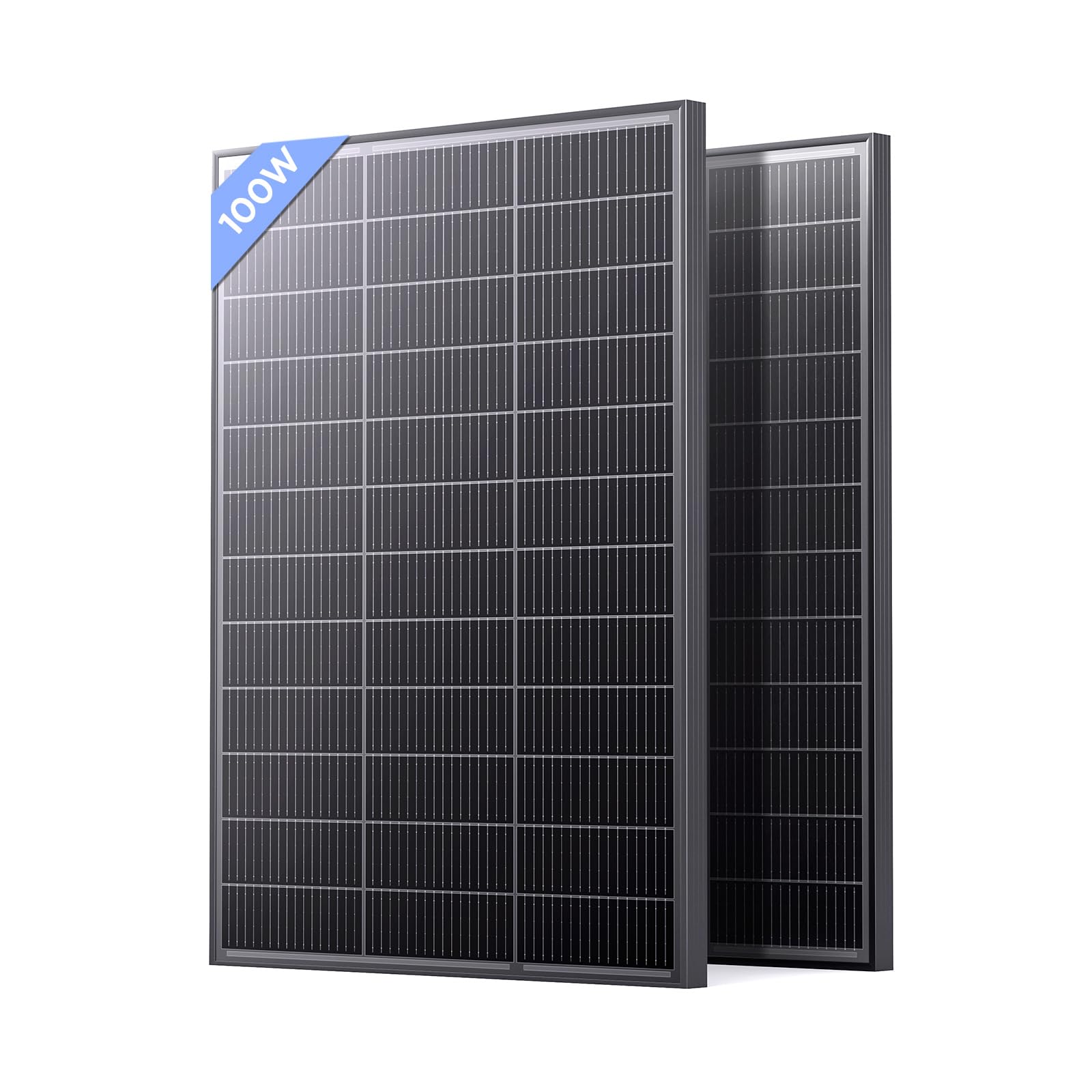
Two 100-watt panels at 31.1 inches long solve the roof that one big panel cannot fit.
A single 200-watt panel runs 51.3 inches; two of these run 31.1 inches each and combine to the same 200 watts. That is the whole argument for this kit. If your van roof is chopped up by vents, a skylight, or a fan, splitting the array into two smaller rectangles lets you actually use the leftover gaps instead of staring at one panel that will not clear the obstacles. The 25% N-type cells with 16 busbars match the Callsun rooftop panel’s tech, and each unit weighs 11.4 pounds.
Heat tolerance is built in through a low temperature coefficient of -0.3%/°C, which means output drops gently as the panel warms rather than falling off a cliff. The glass is 3.2mm low-iron tempered, the frame is corrosion-resistant aluminum alloy, and the IP68 rating plus reinforced corner guards speak to rooftop duty. Wind and snow load ratings are listed at 2400 Pa and 5400 Pa, and the maker covers it with a 25-year guarantee to keep 84.5% output.
What owners notice most is quality — the build earns the strongest praise, with performance right behind it. The panels cope with partial shade and low light better than the plain single-module designs, and one recurring note is output that rises above nameplate in full direct sun. Just plan your wiring: two panels mean you need to connect them in series or parallel to suit your controller, and this is a bare-panel kit without mounting hardware.
Why the split wins: two 31.1-inch panels thread into roof spaces a single 51.3-inch unit never would, and both carry the same 25% N-type cells as the top pick.
Know before you mount: this is a panel-only kit — no brackets, no controller, and you supply the series or parallel wiring for your system.
Suits you if: your mounting surface is broken up by hardware and you need to fit 200 watts around it rather than over it.
Not for: the buyer who wants a complete plug-in solution — you are supplying the mounts and the wiring.
5. Renogy ShadowFlux 200W Solar Panel
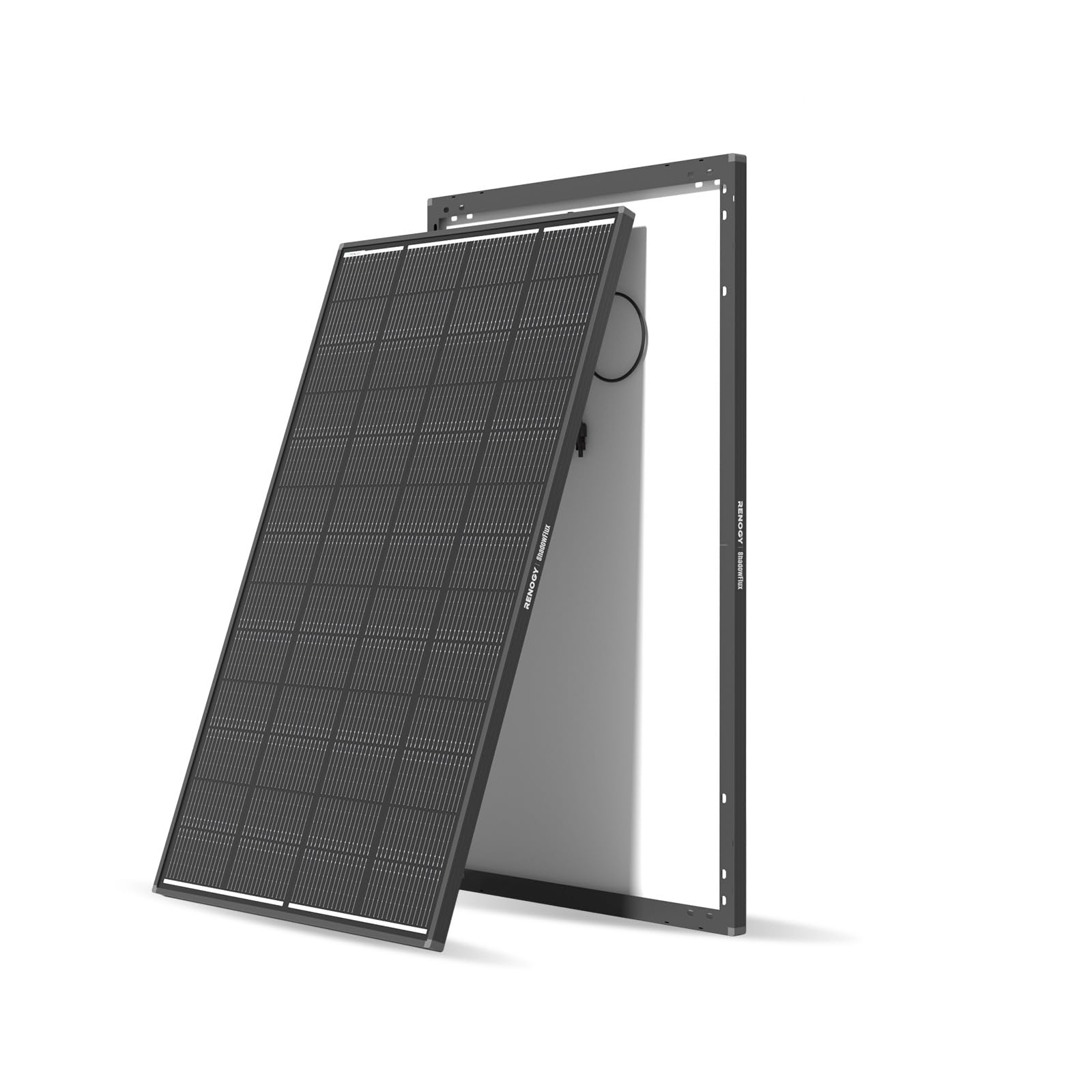
ShadowFlux is built for the roof that loses the sun behind a tree every afternoon.
Shade is the silent killer of rooftop solar, and Renogy designed this panel around it. The ShadowFlux anti-shading tech reduces hot-spot risk when leaves, branches, or vent shadows fall across the glass, so the panel keeps producing instead of choking. Add the N-type 16BB cells at 25% efficiency and you get a 200-watt panel that behaves far more gracefully in a compromised spot than a standard module.
The geometry works in its favor too. Renogy says this panel runs 7% smaller and 10% more compact than PERC panels, which matters when your roof is measured in inches. Maximum voltage is 36.5 volts, and the frame carries an ≥ IP67 rating with an encapsulation material chosen for water-vapor resistance. It is rated to shrug off snow, rain, and small hail, and the maker backs it with a 5-year output warranty on top of a 25-year output commitment to 80%.
Owners confirm the anti-shade claims, repeatedly reporting output in partial shade and under an RV port well above what a shaded 200W panel would normally produce. The trade-off is price position: this sits at the premium end of the rigid panels, and there is no bifacial backsheet to capture reflected light the way the Callsun rooftop panel does. You are paying for shade tolerance and compactness, not rear-side harvest.
The shift in thinking: if you have been avoiding a rooftop panel because of a shade issue, this is the design that makes a shaded roof viable again.
What it is not: there is no bifacial backsheet here — you are buying anti-shade performance and a tighter footprint instead.
Pick it when: a tree, a vent stack, or a neighboring roofline throws shadow on your mounting spot several hours a day.
skip it if: your roof is full sun all day — a bifacial panel will harvest more for the same watts.
6. ECO-WORTHY 400W N-Type 4-Pack Solar Panels
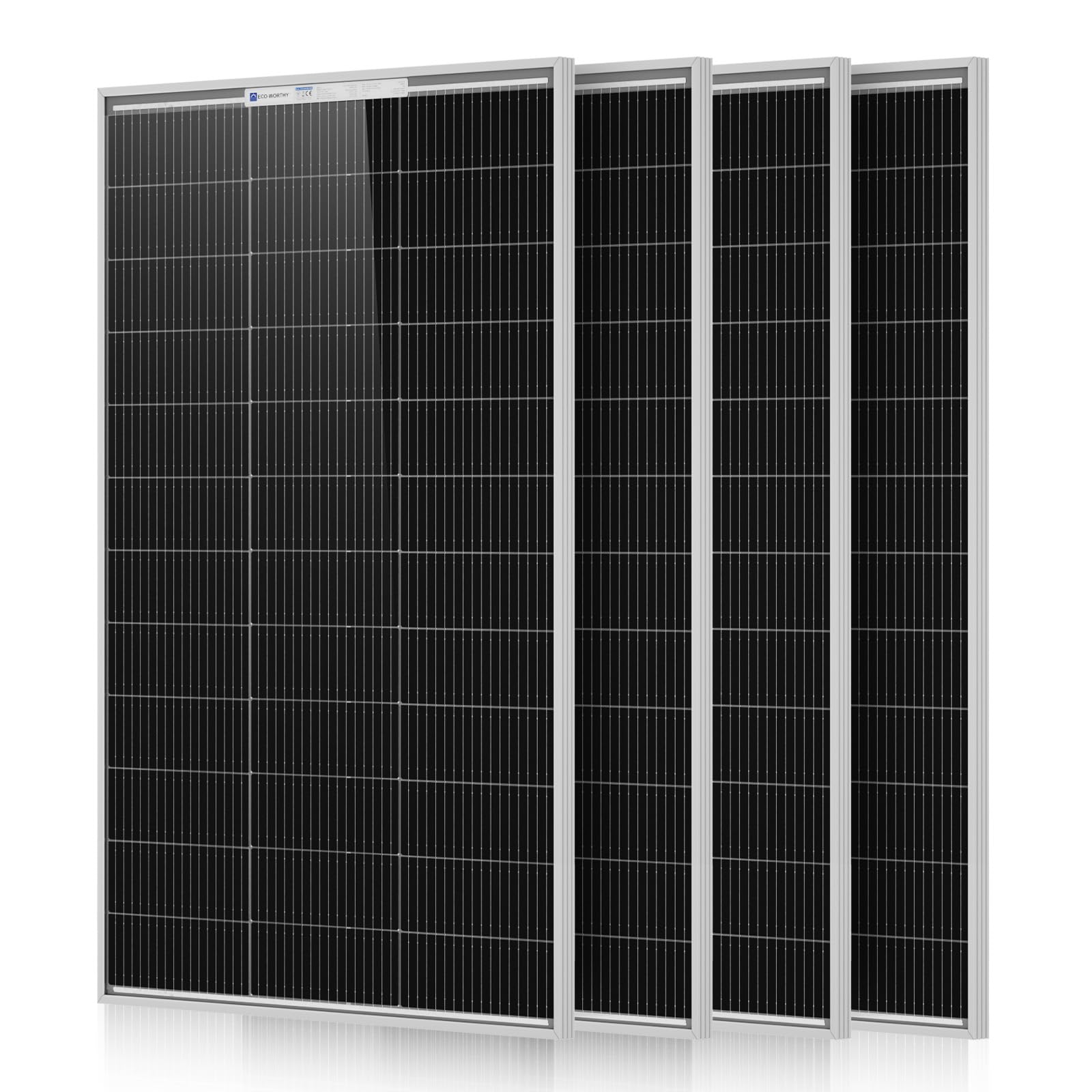
Four panels, 400 watts total, and a build beginners can bolt down.
This is the expandable option: four separate 100-watt N-type panels you can lay out across a shed roof, a cabin wall, or a ground mount. Each one carries 16BB busbars and 25% efficiency, and every panel has 35-inch cables with MC4 connectors for plug-and-play linking. Bypass diodes sit pre-installed in a waterproof IP68 junction box, which cuts the power loss when shade drags one panel down and keeps the others working in low light.
Installation is the part beginners worry about, and this kit is built to reduce that friction. The panels are light, come with pre-drilled back holes, and use connectors that click together without soldering. A 1.18-inch edge profile gives extra room for heat to dissipate and leaves space for bracket hardware. They suit 12V or 24V battery charging for home, garden, RV, boat, and agriculture setups, and you can add them onto an existing array.
Owners praise build quality and performance most, with value for money close behind — several report a noticeable drop in their electricity bill. One honest note sits in the power-output comments: some buyers see the full advertised wattage while others measure only 50 to 60 watts per panel, often a wiring or controller-matching issue rather than a cell fault. The kit also ships in two boxes, so wait for the second before you start planning a layout.
Reasons it earns its place
- Four 100W panels give you 400W of adaptable layout across an awkward surface
- Pre-installed bypass diodes keep low-light and shaded sections from killing the array
- IP68 junction boxes and a 1.18-inch edge for heat dissipation
- Pre-drilled holes and MC4 connectors suit a first-time DIY install
The honest side
- Power output is mixed in owner reports — some see full wattage, some far less
- Arrives split across two boxes, so assembly waits on the second delivery
- You supply the controller, brackets, and wiring for the full system
Best match for: the DIY builder wiring a 12V or 24V setup who wants room to spread four panels out.
Weigh this: check your charge controller and wiring first — the low-output reports tend to trace back to mismatched setup, not the cells.
7. JJN 100W Monocrystalline Solar Panel

The entry panel that still delivers usable amps and a serious warranty.
Twenty-three percent efficiency from Grade A+ monocrystalline cells does not lead this pack, but it is a solid foundation for a first rigid panel. At 100 watts it produces 6.42 A at 20.8 volts, and the maker estimates up to 500Wh of daily output across five hours of direct sun. For a starter battery-charging setup or a small off-grid array, that is a sensible, low-risk entry point.
The build is where the value shows. A black corrosion-resistant aluminum frame is rated to withstand wind loads of 2100Pa and snow loads of 5100Pa, and the IP65 junction box with IP67 connectors keeps water out of the connections. Pre-drilled mounting holes make it easy to bolt to a roof or bracket, and the 13.7-pound weight means one person can handle it. Its 30-year transferable power-output warranty is the longest in this lineup.
Owners praise build quality above all, with power output close behind — several report 80–90% of rated output, including 3.7A in medium sunlight. The one thing to size honestly is durability: reports range from panels holding up for a couple of years to some failing earlier. Treat it as a solid budget panel with a great warranty rather than a premium long-haul component, and you will be pleased.
The case for it: 23% cells, weather ratings to 2100Pa wind and 5100Pa snow, and a 30-year output warranty make this a low-cost way to start.
Set expectations: long-term durability is the mixed report here, so buy it as a budget panel backed by a long warranty, not as a premium fixture.
Go for this if: you want a first rigid panel and a long warranty without spending premium-tier money.
Think twice if: you need proven decades-long durability — that is the one area this panel’s reports diverge.
8. DOKIO 100W Portable Solar Panel Suitcase
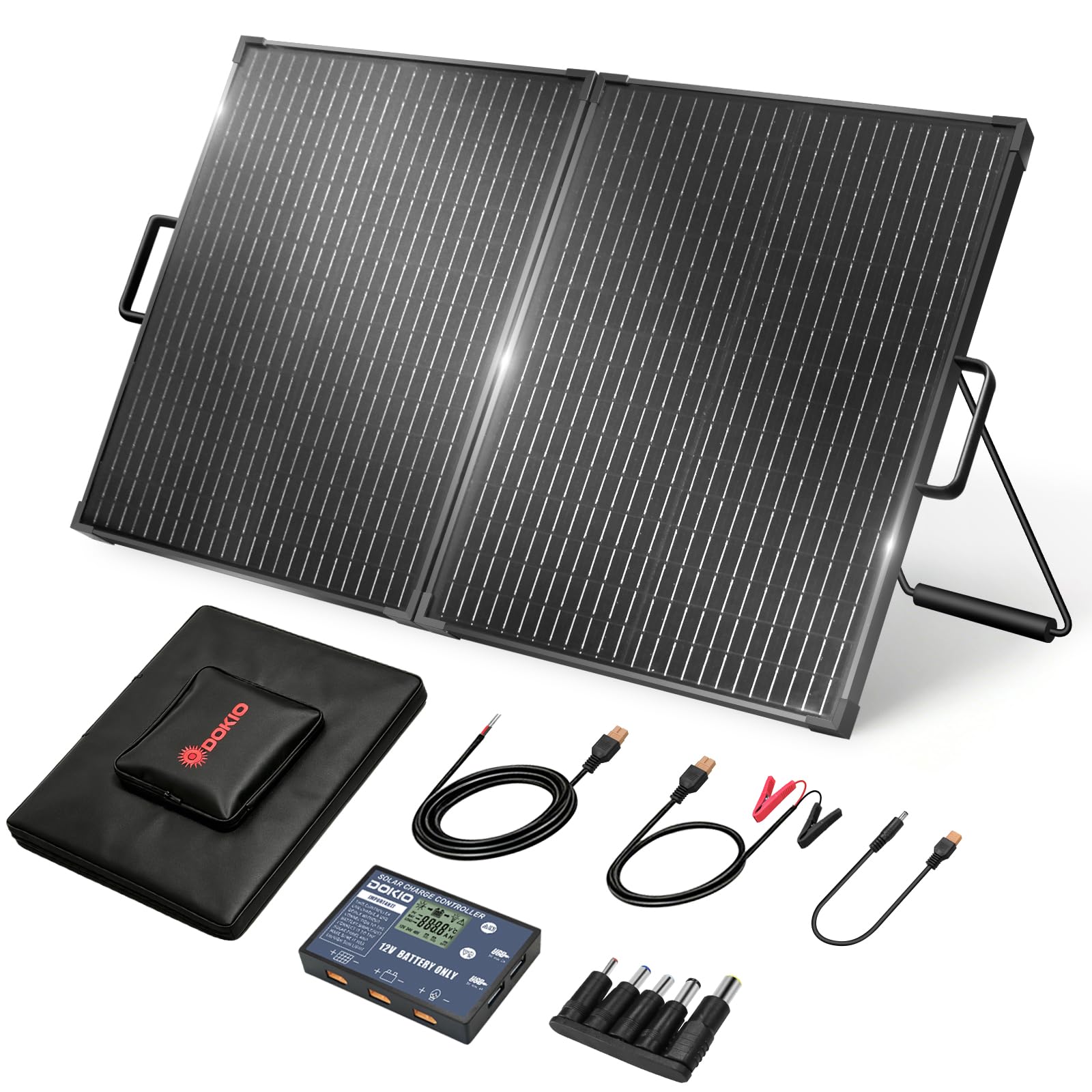
Alligator clips and a built-in controller make this the least fussy way to charge a 12V battery.
No adapter hunt, no controller to buy separately — you unfold this suitcase, clip the leads to your battery, and it charges. The built-in PWM controller handles the safety side with protection against reverse polarity, overcharging, short-circuits, and reverse current, and there are 5V 2A USB ports for topping up a phone at the same time. For someone with a boat battery or a camper van that sits idle, that simplicity is the selling point.
The 9.8-foot cable is longer than most here, which lets you park the panel in the sun while the battery stays shaded and cool. An adjustable bracket angles the panel toward the light, and the maker notes output is best at 90 degrees to the sun. At 10.1 pounds it is heavier than the Renogy’s 7.3 and the ZOUPW’s 9.5, but the rubber handle makes the carried weight manageable. It produces 5.56 A at 18 volts.
Buyers report it recharging partially drained 12V batteries in about six hours, and praise the easy setup and included storage bag. The recurring gripe is the frame and stand — some find them flimsy, so treat the bracket as something to handle with care rather than muscle. It is backed by a 25-year transferable power-output warranty, though the base manufacturer warranty is listed at one year, so read the two apart before you assume full coverage.
The real draw: a built-in controller and alligator clips mean the panel works with a bare 12V battery the moment you unclip the case.
Handle with care: the frame and stand are the part owners flag as less sturdy, so be gentle setting the angle.
It fits: the camper or boater charging a 12V battery who wants zero setup — unfold, clip, done.
Go premium instead if: you want a lighter folding panel with higher-efficiency N-type cells and a more solid stand.
Know the Specs
Efficiency percentage
This is how much of the sunlight hitting the panel becomes usable electricity. A 25% panel turns a quarter of the incoming light into power, while a 23% panel turns slightly less of it into charge. Higher efficiency usually means more watts from the same footprint, which matters most when roof space is tight. It does not mean the panel is fragile — it means the cells are better at their job.
N-type versus P-type cells
These are two generations of silicon cell. N-type tends to hold output better as the panel heats up and degrades more slowly, which is why most of the higher-efficiency panels here use it. P-type is the older, cheaper option. If two panels are the same wattage, the N-type one usually gives you more consistent power in summer heat.
Busbar count (9BB, 10BB, 16BB)
Busbars are the thin metal fingers that carry current off each cell. More of them — 16BB versus 9BB or 10BB — spread the current across more paths, which lowers resistance and reduces hot spots where a damaged spot overheats. Practically, it means steadier output and less risk of a single cell dragging the panel down over time.
IP rating (IP65, IP67, IP68)
The first digit is dust protection and the second is water. IP65 handles water jets, IP67 survives brief immersion, and IP68 handles longer submersion. For a roof-mounted panel, a high rating on the junction box matters most, because that is where moisture finds its way into the wiring. The cell surface is glass; it is the box and connectors that need the protection.
Bifacial and anti-shade designs
A bifacial panel has a see-through back so it gathers light reflected up from a pale roof or bright ground, adding to the direct harvest. Anti-shade designs work differently: they split the panel or add bypass diodes so a shaded section does not stall the whole unit. If your install catches shadow, anti-shade helps more; if your surface is bright and reflective, bifacial adds more.
Voltage and amperage match
These two numbers decide compatibility with your charge controller or power station. Voltage is the push, amperage is the volume of current, and your controller has limits on both. A panel that exceeds what your controller accepts will either be throttled or refused. Always compare the panel’s maximum voltage and amperage to your equipment’s input range before you mount anything.
Common Questions
Will a 200W panel actually produce 200 watts?
Do I need a charge controller with these panels?
What does bifacial mean and does it help on a van roof?
Will a folding panel charge my Jackery or EcoFlow power station?
How much roof space does a 200W panel need?
Can I leave a portable solar panel out in the rain?
What is the difference between N-type and P-type cells?
Do these panels work on cloudy days?
Can I add more panels to an existing solar setup?
How long do these panels last?
The Bottom Line
If you have a fixed roof and want the most charge per square foot, the Callsun 200W Bifacial is the panel to beat — 25.6% N-type cells, a split anti-shade design, and reflected-light harvest make it the strongest all-rounder here. When your power station needs to plug in without an adapter hunt, the ZOUPW 100W and its five connector types get you charging on day one. And if a tree throws shadow across your spot every afternoon, the Renogy ShadowFlux 200W is engineered for exactly that compromised roof. Match the panel to your surface, your controller, and your carry weight, and any of these will turn sunlight into a battery that stays full.
How we choose
We do not accept paid placement. Every pick is matched to a real buyer and a real use-case; we do not hands-on test units.
Sources
Specifications: manufacturer listings and product documentation. Review insights: verified customer reviews, as of November 2026. Pricing: not shown on this page (it changes often); check the current price via the retailer link.
As an Amazon Associate, Tactical Gear Guy earns from qualifying purchases. This does not affect which products we feature.