Specs are compiled from manufacturer listings and verified buyer reviews and can change over time — please confirm the key details on the product page before buying.
How much of the cleaning do you want to stop doing yourself? That is the real question behind a top rated robot vacuum and mop. Suction power matters far less than dock capacity and navigation reliability. A robot that empties itself for weeks and maps your rooms without bumping into furniture saves you more time than one with a bigger Pa number (a measure of suction strength) and a small dust bag.
This guide is built by comparing the manufacturers’ published specifications and the patterns across verified customer reviews, so you get each pick’s real strengths and trade-offs instead of marketing spin.
Below you’ll find eight machines ranked by what they actually do well, from budget-friendly workhorses to premium docks that wash and dry their own mop rollers. Each pick lists the exact suction, runtime, and dock capacity so you can match one to your floor type. Our top rated robot vacuum and mop picks cover every home size and budget tier.
Top Picks
How To Choose The Best Top Rated Robot Vacuum and Mop
A robot vacuum and mop is two machines sharing one body, and that changes how you should judge one. The vacuum half needs enough suction to pull hair and crumbs out of carpet fibers, while the mop half needs a tank, a pad or roller, and a way to keep the water from soaking your rugs. Pick a dock with a big enough bag and you touch the robot once every few weeks.
Focus on dock capacity before suction numbers
The self-emptying dock’s dust bag is what creates the hands-free window, and capacities here run from 2.5L up to 4L in this lineup. A larger bag means fewer trips to the trash, which matters most if you have shedding pets or wall-to-wall carpet. Big suction ratings are only useful if the robot actually empties itself afterward — otherwise you trade vacuuming for bin-dumping every couple of days.
LiDAR versus camera navigation
LiDAR is a laser rangefinder built into the robot — a spinning sensor that measures distances to walls and furniture so the machine maps your rooms in the dark. It is the difference between a vacuum that cleans your whole floor plan in orderly rows and one that wanders. If your home has multiple levels, look for a model that saves several maps so it does not rebuild the layout every time you move it upstairs.
Mop pad versus self-washing roller
A basic mop pad drags a wet cloth across the floor, and once it is dirty it just pushes that grime around. A roller mop scrubs with continuous pressure and can be rinsed with clean water while it works — that is the feature budget models simply do not have. If you only mop occasionally on sealed hardwood, a pad setup is fine. If you have kitchen tile and dried spills, a self-washing roller scrubs them off instead of smearing them.
Side-by-Side Comparison
| Model | Best For | Suction | Runtime | Dock Capacity | Amazon |
|---|---|---|---|---|---|
| Robot Vacuum and Mop by Azomabox★ Best Overall | Hands-free daily cleaning | 8000Pa | 180 minutes | 2.6L | Amazon |
| VONKO Robot Vacuum and MopMulti-Floor Pick | Multi-floor homes with pets | 8000Pa | 180 minutes | 2.5L | Amazon |
| Tikom L8000 PlusLongest Bag Life | Weeks between emptyings | 6000Pa | 150 minutes | 3L | Amazon |
| DREAME D20 Air Plus | Big bag, fewer trash runs | 20,000Pa | 150 minutes | 4L | Amazon |
| Kilgone SDL40 | Mixed carpet and hard floor | — | 150 minutes | 2.5L | Amazon |
| ECOVACS DEEBOT T90 PRO OMNI | Sticky kitchen grime | 30,000Pa | 200 minutes | 3.2L | Amazon |
| eufy E25 | Pet hair and carpet depth | 20,000Pa | 125 minutes | 2.5L | Amazon |
| roborock Qrevo Edge 2 | Low-clearance furniture | 25,000Pa | 188 minutes | — | Amazon |
Detailed Reviews
1. Robot Vacuum and Mop 8000Pa
Our pick — 4.5+★ from 850+ verified ratings; the strongest balance of quality and price.
The hands-off workhorse that asks you to touch it once every couple of months, not every day.
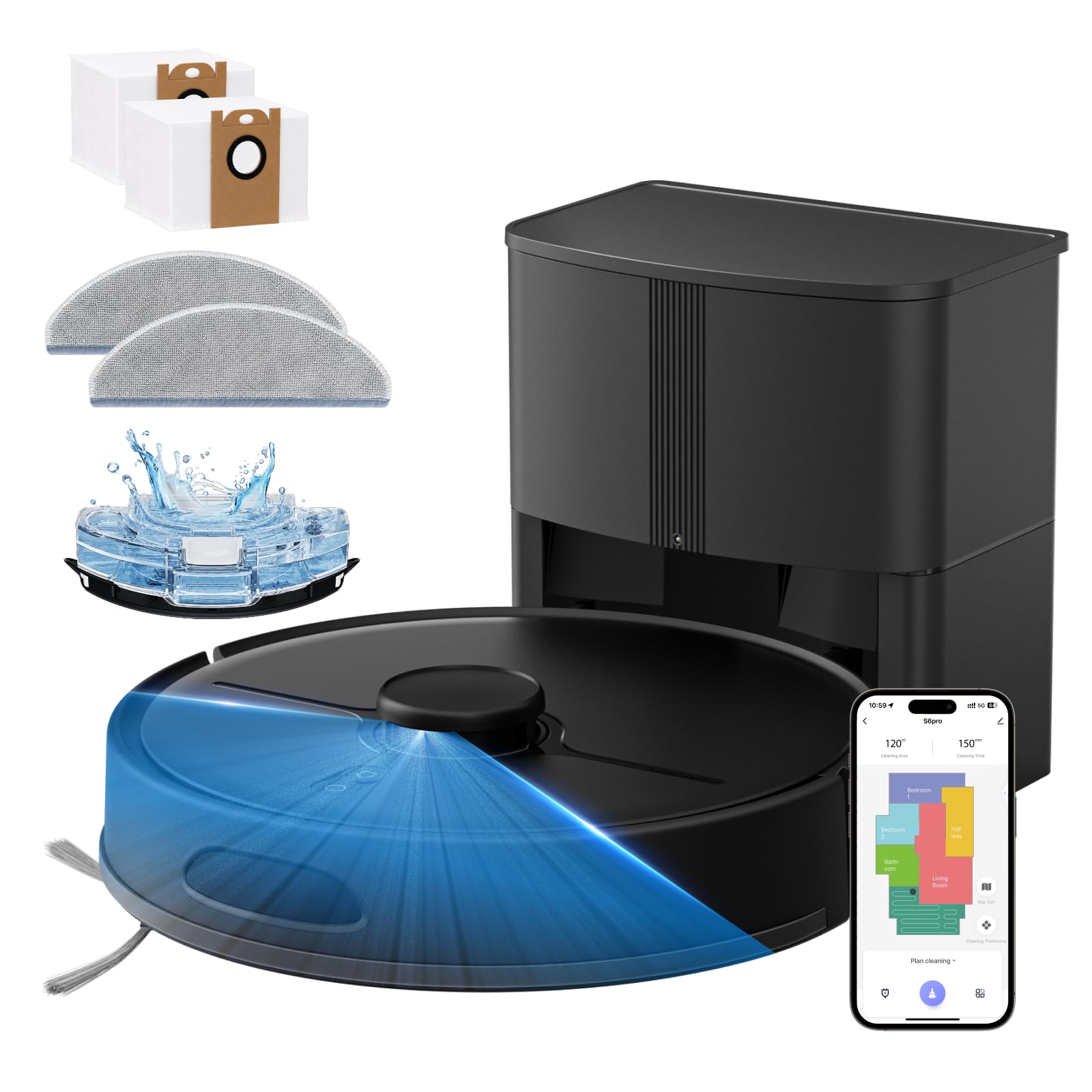
You get up to 70 days of self-emptying from a 2.6L sealed dust bag (2.6 liters of dust storage that traps dirt instead of flinging it back into the air). That 70-day window is what makes this one the top pick. You set it loose, and it dumps its own bin into the bag. In a busy household with a shedding dog, that is the difference between daily bin duty and forgetting the machine exists for weeks at a time.
The 8000Pa suction pulls pet hair, crumbs, and cat litter out of hardwood, tile, and carpet. A floating V-shaped anti-tangle brush helps keep long hair from wrapping the roller, which is the usual reason these machines lose power over time. LiDAR (the laser sensor that measures distances so the robot can map your rooms) builds accurate routes even in low light, and it saves up to 5 maps so a two-story home stays organized. There is also a 270ml water tank with three flow levels for simultaneous vacuuming and mopping on sealed hard floors.
Owners keep coming back to the design quality in their write-ups, and that reliability is what earns the top spot. A brushless motor (no carbon brushes, so less wear), a 12.2-inch cleaning path, and a 180-minute runtime let it finish most floor plans on a single charge. The catch is the bag, not the bin. You are buying into sealed-bag replacements rather than a washable bin, so factor that into long-term ownership. Also note this runs on 2.4GHz Wi-Fi only (the older, slower Wi-Fi band).
Why This One Wins
- 2.6L sealed bag with up to 70 days of hands-free emptying
- 8000Pa suction handles pet hair and carpet debris
- 180-minute runtime finishes most homes on one charge
- Five saved maps for multi-level layouts
The Honest Trade-offs
- Sealed bags are consumables you will keep buying
- 2.4GHz Wi-Fi only — no 5GHz support
- 270ml mop tank is modest for whole-home mopping
Reach for this if: you want the shortest path to genuinely hands-free floor care without jumping into premium pricing.
Think twice if: you would rather rinse a bin than buy replacement bags.
2. VONKO Robot Vacuum and Mop
Five floors of saved maps and a three-and-a-half-inch body that slides under furniture.
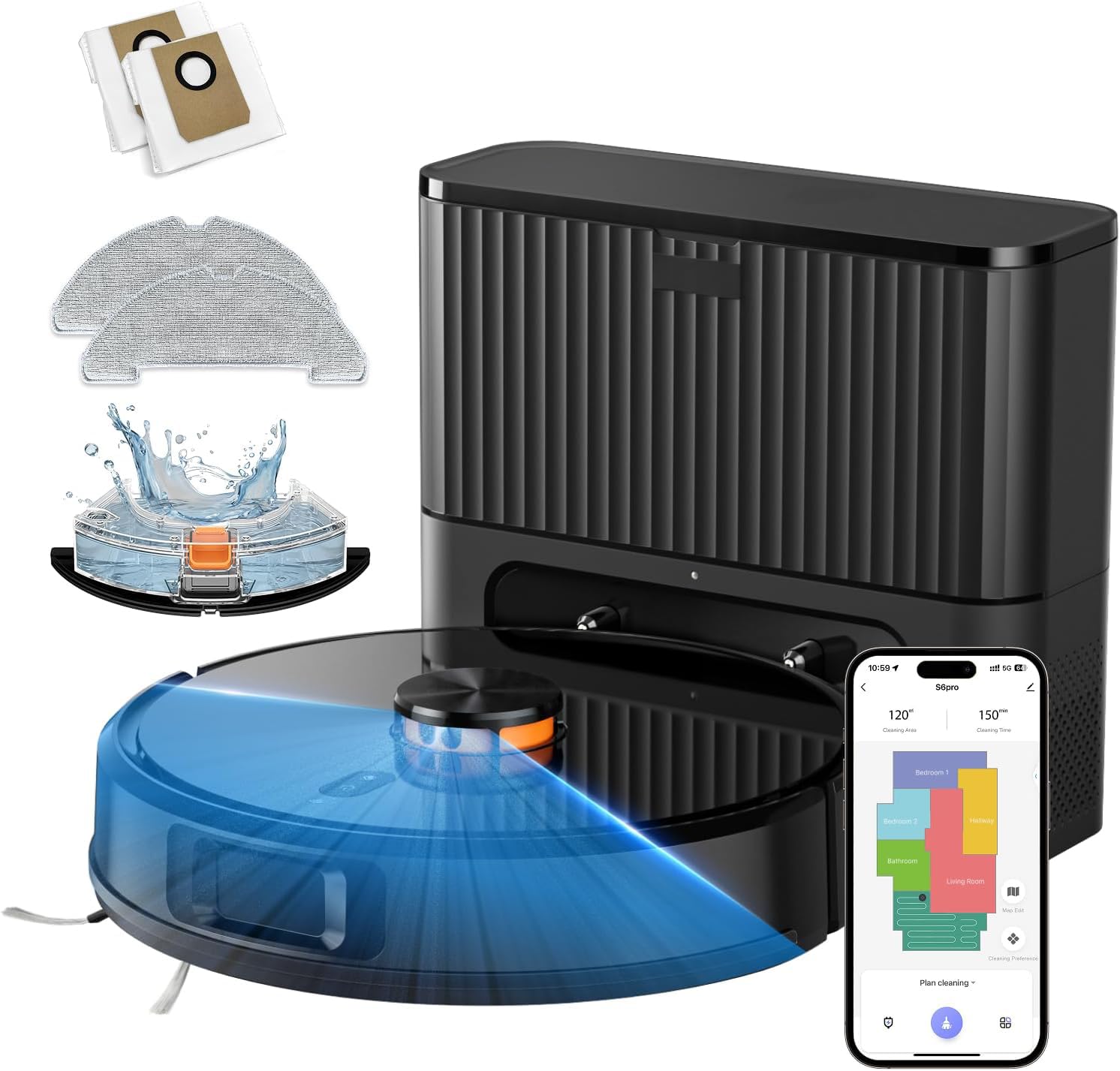
If your house has stairs, this is the pick built around you. It stores layout maps for up to 5 floors, so carrying it upstairs does not trigger a fresh mapping run from scratch. Room customization, cleaning areas, and no-go zones all live in the app, and the whole thing is 12.05 inches across and 3.86 inches tall — low enough to duck under a sofa skirt without drama.
It matches the Azomabox pick on suction at 8000Pa and on runtime at 180 minutes, and it edges ahead on hands-free interval if you count the two dust bags in the box (one installed, one spare). The 2.5L station keeps itself emptied for up to 60 days. You also get a spare mop, spare side brushes, and two HEPA filters in the package, which softens the consumable cost that comes with any self-emptying dock.
Versus the top pick, the VONKO holds 2.5 liters to the Azomabox’s 2.6 liters — a small capacity gap that mostly disappears because the VONKO ships with that extra bag. Both give you 180 minutes, and both run LiDAR mapping. Where this one separates itself is spares in the box and that near-four-inch profile. The honest limit: it is a pad-style mop rather than a scrubbing roller, so dried-on kitchen stains need a second pass. Voice control is limited to Alexa.
The multi-story case: five saved maps plus a 3.86-inch body make this the most practical pick for a home with stairs and low furniture to get under.
Where it bends: pad-based mopping will not scrub set-in stains the way a roller system does, and Alexa is the only voice assistant listed.
The right buyer: a two- or three-story home that needs one robot to learn every level and slide beneath the couch.
Look elsewhere if: your main mess is dried food on tile that needs real scrubbing pressure.
3. Tikom Robot Vacuum and Mop
A 3L dustbag that buys you roughly three months between trash trips.
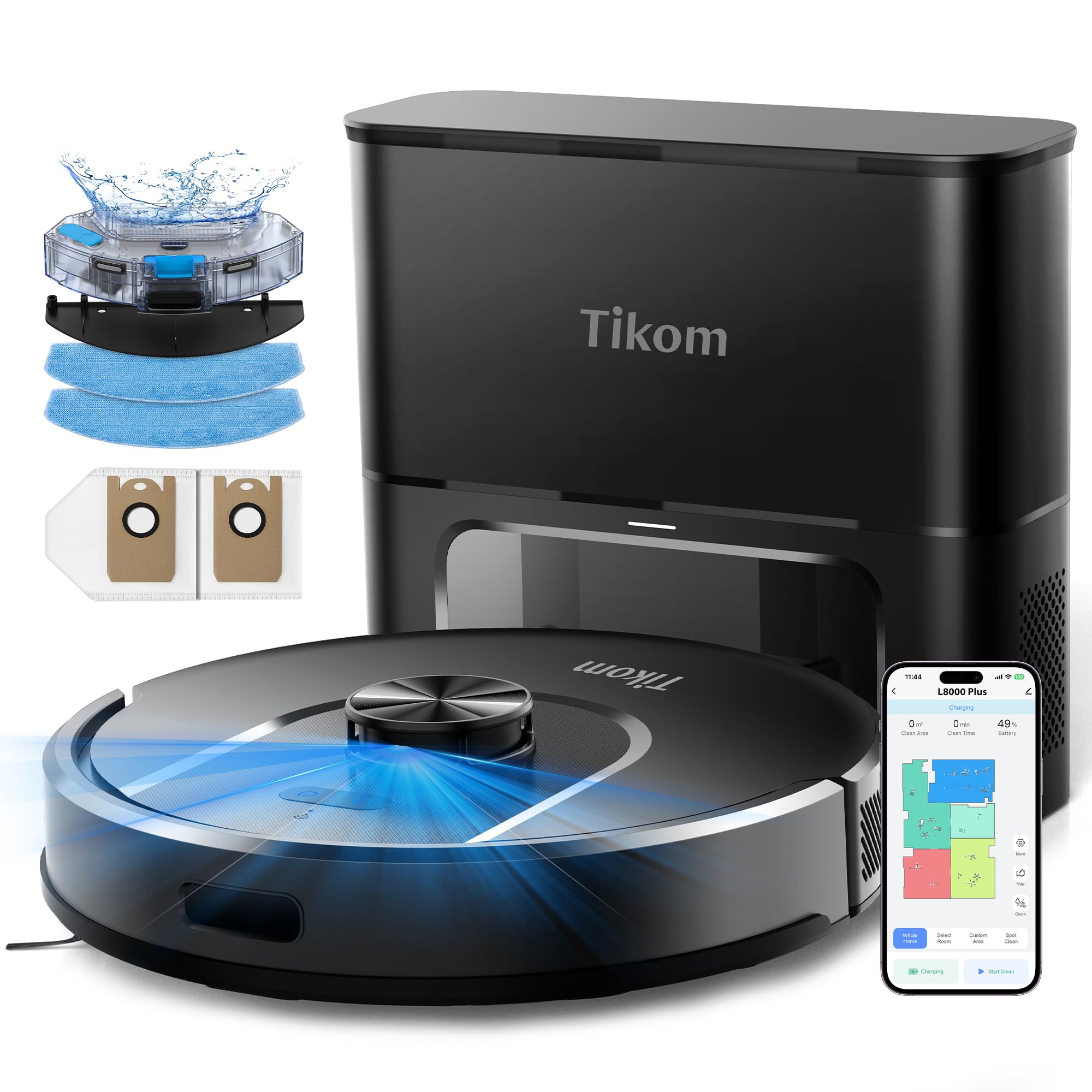
For anyone who measures a robot vacuum in how rarely they have to think about it, the Tikom’s 3L self-emptying dustbag is the headline. That is advertised as 90 days of debris before you swap a bag — the longest hands-free window in the value tier of this guide. Cleaning performance is the trait that carries this model’s reputation, and it is easy to see the point: the machine adjusts itself up to 6000Pa max suction automatically when it rolls onto carpet.
The mop side is where Tikom thought ahead. You get 3 suction levels and 3 water flow settings, and the app lets you build no-mop zones and virtual walls so it does not drag a wet pad across your rug. In mop mode you remove the mop holder (or set a no-go zone) to keep carpet dry. LiDAR scans a full 360° and saves up to 5 multi-floor maps. It also connects on both 2.4GHz and 5GHz Wi-Fi, which the Azomabox and VONKO cannot claim.
Runtime lands at 150 minutes in gentle suction mode — 30 minutes short of the VONKO’s 180 — but auto-recharge-and-resume picks up exactly where it left off, so a larger floor plan still finishes in one session. Stability shows up as the most-discussed mixed aspect here, so treat placement on the dock as something to get right the first time. Its footprint is also the deepest in the lineup on one dimension at 13.5 inches long by 13.2 inches high.
What Buyers Get Behind
- 3L bag rated for 90 days before an empty
- Carpet sensor ramps suction to 6000Pa on its own
- 2.4GHz and 5GHz Wi-Fi support
- Auto-recharge and resume mid-clean
Worth Knowing Before You Buy
- 150-minute runtime in gentle mode is mid-pack
- Dock placement affects stability — set it on level ground
- Wet-pad mopping needs no-mop zones on carpet
Built for: a household that wants to forget the vacuum exists for a full season at a time.
Less ideal if: you need the longest per-charge runtime for a very large single floor.
4. DREAME D20 Air Plus Robot Vacuum and Mop

A 4L self-sealing bag turns four months of floor care into zero trash trips.
Here is a spec that actually changes your routine: 120 days between dust bag swaps. The 4L sealed bag is the largest in this lineup and self-seals to lock in 99.9% of allergens, so emptying does not puff dust back into the room. Stack that against the 2.5L bag on the VONKO or the 2.6L on the Azomabox top pick — the DREAME holds noticeably more between changes, and the gap is the reason to pick it.
The cleaning head is built for hair. A main brush that pulls hair in as it rotates pairs with an anti-tangle side brush, so long strands in a pet household stop wrapping the roller and sapping suction. Suction itself is rated at 20,000Pa — a big step above the 8000Pa machines above — and an electronic water tank with adjustable flow goes from a light refresh to a deeper wash. LiDAR mapping works in total darkness and avoids obstacles without bumping them.
Edge-to-corner cleaning is claimed to hug baseboards and tight corners, cutting missed spots. The honest part is the score: at 4.0+ stars, this pick sits below the other value models here, and the review pattern points at a slightly rougher polish than the top three. It is also the tallest unit listed at 18.55 inches, which matters for where you park the dock. Connect it on 2.4GHz Wi-Fi only, and note this one is built for USA use.
The bag math: 4 liters and 120 days is the longest hands-free stretch in this guide — the single strongest reason to buy this machine. You empty it roughly four times a year instead of every day.
The honest caveat: the polish trails the class leaders, and the dock is a tall unit at 18.55 inches, so measure your closet or corner first.
Choose this when: minimizing bag changes is your priority and you are comfortable with a slightly less refined machine.
Rather skip it if: you want the highest-rated pick in the budget tier and a compact dock footprint.
5. Kilgone SDL40 Robot Vacuum and Mop Combo

A turning cleaning path that sweeps corners other robots drive straight past.
The Kilgone’s defining trick is how it moves. Instead of straight back-and-forth rows, it follows a turning cleaning path designed to reach the corners and edges that grid-cleaning robots miss. On a floor plan with hallways, bedrooms, and a living room all connecting, that coverage matters more than raw suction numbers. The 2.5L dust bag handles up to 90 days before a change, roughly four bag swaps for the year.
Carpet and hard floor are both covered in one pass, and the anti-tangle main and side brushes are built to keep long hair from wrapping — a real concern if you have a long-haired household or multiple pets. On a full charge it runs up to 150 minutes. When it runs low it returns to charge and then continues from where it stopped, so a bigger floor plan still gets cleaned in one run. First-time setup takes a 5GHz or 2.4GHz connection, and it maps up to 5 zones, navigating accurately even in dim light at night.
Against the Tikom, both offer 150-minute runtime, and both hit 90 days of self-emptying with a 2.5L or 3L bag. Where the Kilgone pulls ahead is mixed-floor handling and that corner-hunting path. Both work with dual-band Wi-Fi. Its body sits at 3.64 inches tall and 12.59 inches across, so it fits under lower furniture than most of the value crowd. The trade-off is a modest 300ml water tank that suits light mopping more than deep whole-home wet cleaning.
What Earns It a Spot
- Turning path reduces missed corners on multi-room floors
- 2.5L bag rated for up to 90 days
- Anti-tangle brushes for long hair and pets
- 5GHz and 2.4GHz Wi-Fi at setup
Where It Gives Ground
- 300ml water tank suits light mopping only
- No numeric suction spec published for direct comparison
- 150-minute runtime, not the longest in its tier
Suits you if: your home is mostly mixed flooring with corners and hallways that a straight-line robot keeps missing.
Better for someone else if: you want to mop a large hard-floor area with plenty of water on board.
6. ECOVACS DEEBOT T90 PRO OMNI Robot Vacuum and Mop
Thirty thousand pascals of suction, and a roller mop that scrubs with clean water instead of smearing dirt.
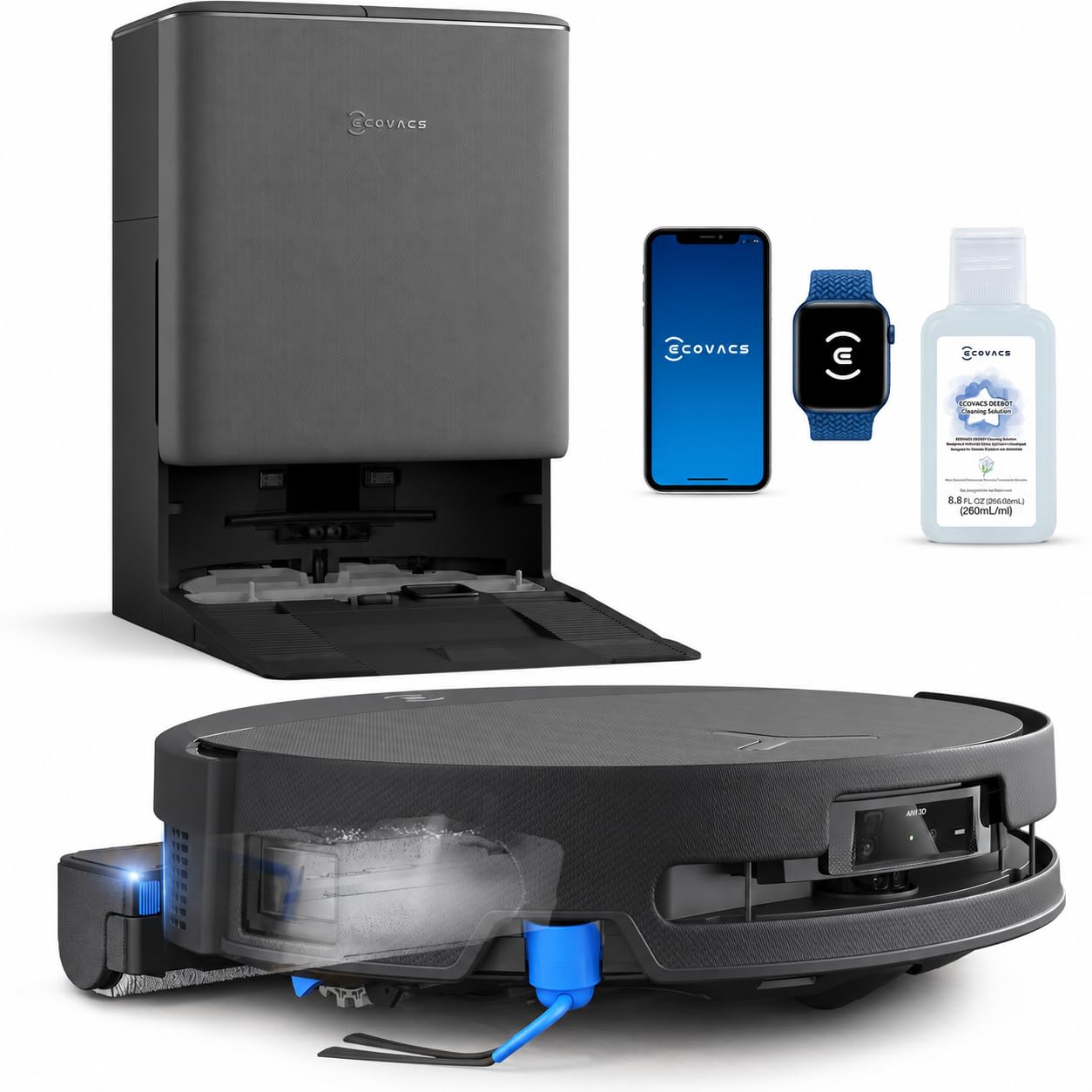
The T90 PRO OMNI is the first pick in this guide built to actually scrub. Its OZMO ROLLER 3.0 uses a 10.6-inch self-washing roller with continuous pressurized scrubbing — not a flat pad that re-soils your floor as it goes. That roller is why it scrubs dried sauce off tile instead of smearing it. The dock auto-adjusts mop washing up to 167°F based on room and soil level, then dries the roller with 145°F hot air so you are not left with a damp, sour-smelling mop attachment.
At 30,000Pa, BLAST suction is the highest rating in this lineup and pulls dust, pet hair, and crumbs out of carpet in one pass. TruEdge 3.0 extends the roller 0.6 inches past the body to scrub right up against baseboards — the dust line a spinning side brush can never reach. ZeroTangle 4.0 uses airflow to steer hair into the suction path and guard against wrapping. There is also a 0.6-inch roller lift to keep carpets dry, plus a Carpets First mode that vacuums rugs dry before the mop touches hard floors.
This model also wins on smart features. A built-in RGB camera supports two-way video calls and one-tap pet search, and AGENT YIKO handles one-command cleaning. Runtime reaches 200 minutes — the longest here except the roborock’s 188 and the eufy’s 125 falling short of it — and PowerBoost charging tops the battery up during wash cycles. The honest read is that battery life trends mixed among reviewers, and obstacle avoidance gets a mixed verdict too, so clear small cables before a run. It also connects on 2.4GHz Wi-Fi only.
The scrubbing case: a 10.6-inch self-washing roller plus 167°F dock washing is the real answer to sticky kitchen tile and dried sauce.
The trade-off: battery life and obstacle avoidance both split opinion, so a tidy run area is worth the five minutes of prep.
This one is for: hard-floor kitchens and any home where sticky spills are the recurring mess.
Consider the roborock instead if: your floor is cluttered with cables and low furniture the robot has to dodge and squeeze beneath.
7. eufy E25 Robot Vacuum and Mop
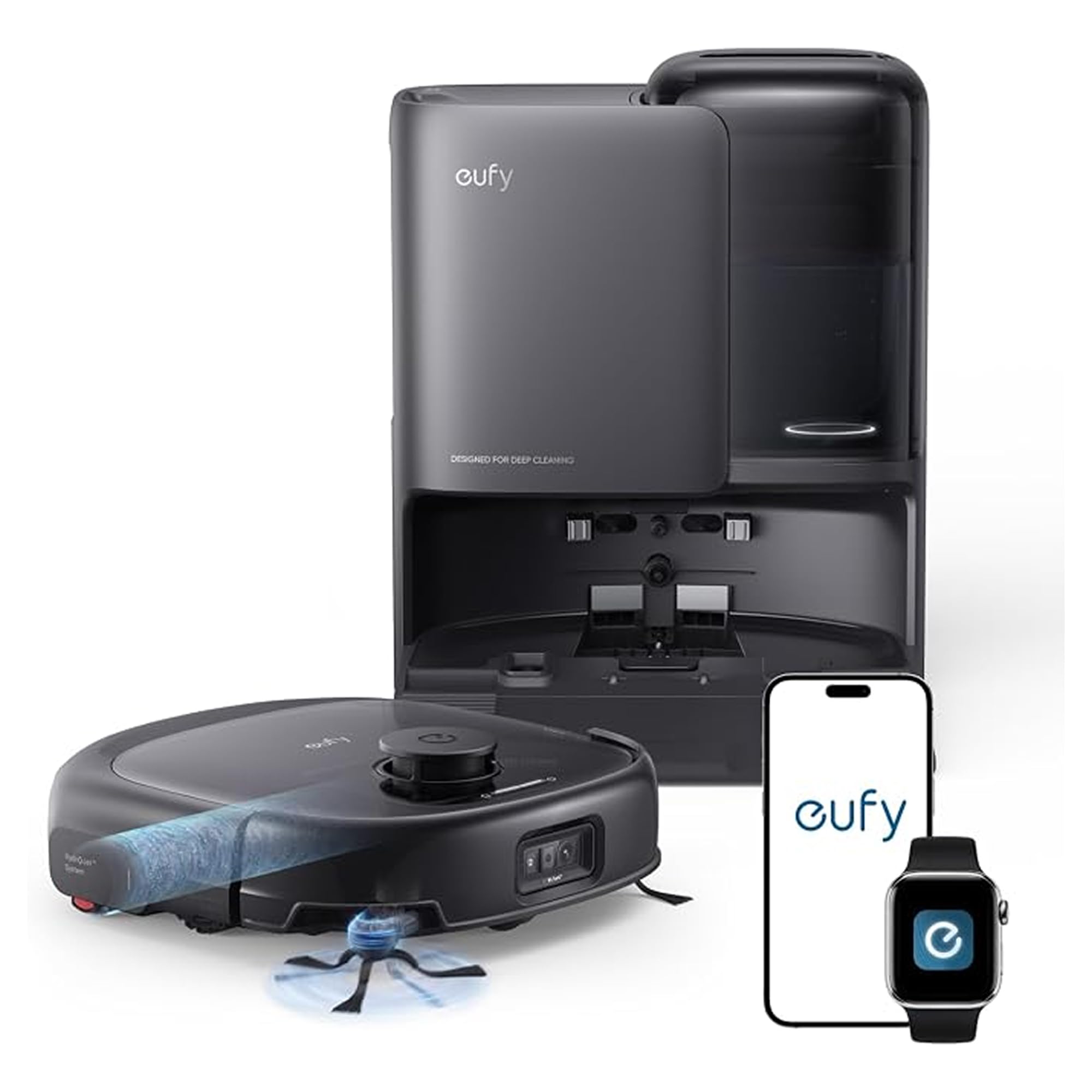
Fur, kibble, and a mop that gets rinsed with clean water twice every second.
If fur is the mess in your house, the E25’s DuoSpiral anti-tangle brushes are the feature to read first — they are designed so hair and fur are guided away from the roller instead of wrapping it. A CornerRover arm reaches out to scrub along baseboards, furniture legs, and tight corners, and it handles hard floors, wood, tile, and short carpet. Anti-tangle brushes plus a CornerRover arm make this the pet-household pick.
The HydroJet mop system refreshes its roller with clean water two times per second, so it is not dragging yesterday’s coffee across the kitchen floor. That is how it reaches tough stains like coffee and sauce without cross-contamination. The all-in-one station auto-empties into a 3L bag rated at about 75 days, self-washes the roller, hot-air dries it at 50°C, and refills its own water. Setup needs no drilling and is ready in 5 minutes, and it remembers up to 5 floor plans with auto floor switching.
The numbers worth knowing: 20,000Pa suction lifts embedded dirt from carpet, and the mop lifts 10.8mm to keep rugs dry — a genuine protection step when you have short carpet near a kitchen or bath. It climbs 21mm thresholds, meaning it rolls over most doorway lips without a rescue mission. Laser-guided navigation plus a 125-minute runtime covers a large home in one pass, and it runs at ≤61dB in max mode. Two limits to plan around: 2.4GHz Wi-Fi only, and a 125-minute runtime that trails the 180 and 188-minute machines above on very large single floors.
The pet-house edge: DuoSpiral anti-tangle brushes plus a CornerRover arm and 10.8mm mop lift make this the most fur-focused setup in the guide.
The honest limit: 125 minutes is the shortest runtime among the premium picks, and there is no 5GHz Wi-Fi option.
Best matched to: a shedding household on a mix of short carpet and hard floor where hair wrap is the daily fight.
Pause before buying if: you need the longest runtime to clean a very large open floor in one go.
8. roborock Qrevo Edge 2 Robot Vacuum and Mop

It slides under a bed at 3.14 inches tall and retracts its own navigation tower to get there.
Most robots cannot follow you under a low bed or a tight sofa, and this one is engineered around that single gap. At 3.14 inches thin, its lidar sensor physically retracts via the RetractSense Navigation System as it slips beneath furniture, and a dToF range finder measures the overhead clearance first to know when to duck. The 100° Vision Module keeps it positioned accurately in confined spaces. No other pick here retracts its lidar tower to fit under low furniture.
It also cleans edges aggressively. The FlexiArm Arc side brush extends out to reach walls, corners, and toe-kick areas down to 0.98 inches, sweeping debris away rather than leaving dust bunnies behind. Suction is rated at 25,000Pa — below the T90 PRO OMNI’s 30,000Pa but above anything in the value tier. Reactive AI pairs structured light, an RGB camera, and an LED light to recognize and avoid over 280 types of objects, and it boosts cleaning on heavily soiled patches, triggering re-washes where needed.
The dock does serious housekeeping: 176°F hot water mop washing, a soaking mode for deeper cleaning, 131°F warm air drying, 65-day auto dust emptying, and warm water auto-refilling. SmartPlan 3.0 recognizes room types and boosts suction on high-traffic spots while quieting itself during do-not-disturb hours. The honest downside is ease of use, which splits opinion — the app can be fiddly to program at first. It also runs 2.4GHz Wi-Fi only and, as the premium option here, is the most expensive commitment in the lineup.
Where It Shines
- 3.14-inch body with a retracting lidar tower clears low furniture
- 25,000Pa suction with Reactive AI avoiding 280+ object types
- 176°F hot-water mop washing plus 131°F drying in the dock
- 65-day auto dust emptying with warm water auto-refill
What to Expect
- App programming feels fiddly at first for many owners
- 2.4GHz Wi-Fi only
- Heaviest dock of the group at 27.1 pounds to position
Go for this if: low-clearance furniture, tight corners, and a full smart-dock routine matter enough to pay premium for them.
pass on it if: you want a simple app setup and the highest-rated pick instead — the premium here buys features, not a better score.
Know the Specs
Suction in Pa
Pa (pascal) measures how hard the vacuum pulls air, and the range here runs from 6000Pa up to 30,000Pa. Higher suction lifts more embedded dirt and pet hair out of carpet fibers, so a 25,000Pa or 30,000Pa machine handles deep carpet where an 8000Pa unit might need a second pass. On bare hardwood, the differences are far smaller — a value-tier 8000Pa model still clears crumbs and pet hair reliably. Match the number to your flooring, not to the biggest figure on the box.
Dock Capacity and Hands-Free Days
The self-emptying dock’s dust bag holds debris so you do not touch the robot’s bin. Bag sizes in this lineup go from 2.5L up to 4L, and the advertised hands-free windows range from 60 days to 120 days. A bigger bag means fewer trash trips, which is the real hands-free benefit. Factor in that these are sealed consumable bags — some models include a spare in the box while others do not, so account for replacements across years of ownership.
Runtime and Auto-Resume
Runtime is how long the robot cleans before it needs a recharge, and this guide covers 125 minutes up to 200 minutes. A bigger home with a lot of carpet needs the longer end, especially in a higher suction mode where the battery drains faster. Models with auto-recharge-and-resume return to the dock, recharge, and then pick up exactly where they left off, so a mid-clean stop does not leave half the house untouched. That feature matters more than the raw runtime for large floor plans.
Wi-Fi Band Support
Many robot vacuums connect only on 2.4GHz Wi-Fi, while some support both 2.4GHz and 5GHz. A 5GHz connection can be snappier for app control in a home with many connected devices, but 2.4GHz-only models still work fine — many smart-home networks are run on 2.4GHz by design. Check what your home router offers before assuming the band is a dealbreaker. A few picks here also list voice control through Alexa, Google Assistant, or Siri.
Common Questions
Do robot vacuum and mop combos actually clean carpet well?
How often will I need to change the dust bag in a self-emptying base?
Will a robot vacuum and mop fit under my sofa or bed?
Can I use a robot mop on hardwood floors without damaging them?
What is the difference between a mop pad and a self-washing roller mop?
Do I need 5GHz Wi-Fi for a robot vacuum?
How long does a robot vacuum run on a single charge?
Will a robot vacuum and mop get tangled in pet hair?
Can I control a robot vacuum with my voice?
Does a self-emptying base need special maintenance?
The Bottom Line
For most homes, the smartest top rated robot vacuum and mop buy is the Azomabox 8000Pa with the 70-day self-emptying station because it pairs a 2.6L sealed bag, LiDAR mapping, and 180-minute runtime without pushing into premium pricing. If you have stairs, the VONKO saves maps for up to 5 floors and matches the 180-minute runtime. And for dried kitchen spills on tile, the ECOVACS DEEBOT T90 PRO OMNI — with its 10.6-inch self-washing roller and 167°F hot-water dock — is the one to reach for.
How we choose
We do not accept paid placement. Every pick is matched to a real buyer and a real use-case; we do not hands-on test units.
Sources
Specifications: manufacturer listings and product documentation. Review insights: verified customer reviews, as of November 2026. Pricing: not shown on this page (it changes often); check the current price via the retailer link.
As an Amazon Associate, Tactical Gear Guy earns from qualifying purchases. This does not affect which products we feature.