Specs are compiled from manufacturer listings and verified buyer reviews and can change over time — please confirm the key details on the product page before buying.
Panorama stitching punishes sloppy gear. If your tripod head does not rotate on a truly flat plane, the software has to guess at frame edges and you get ghosted seams, stepped horizons, and a wasted afternoon of retakes. The fix is simple to name — you want a head that pans in a clean 360° circle, a base you can level before you start, and legs steady enough that frames overlap exactly where you planned. This guide separates tripods that genuinely pan from tripods that merely tilt.
This guide is built by comparing the manufacturers’ published specifications and the patterns across verified customer reviews, so you get each pick’s real strengths and trade-offs instead of marketing spin.
What follows is nine tripods sorted by what each one does best: fluid-drag video heads with scaled bowls, live better than a loose ball head for horizon-locked sweeps. The one detail most beginners skip — a built-in level — decides whether the whole sweep stays flat. Choosing the best tripod for panoramic photography starts with knowing which head geometry your stitching software can actually trust.
Top Picks


How To Choose The Best Tripod for Panoramic Photography
Two tripods can look identical folded up and behave nothing alike once you start a sweep. For panorama work, the head does the heavy lifting. Your legs just need to hold still while the head rotates in a flat circle, which is why the pan mechanism and the level are the first things to check.
Pan head versus ball head for a stitched image
A fluid pan head (a head built to rotate smoothly on one horizontal axis) keeps your camera parallel to the ground for the whole sweep. A ball head (a sphere that lets the camera move in every direction) is more flexible for stills. If the ball head has a separate pan base and a 360° scale, it can still do a panorama — but you must level it before you turn.
Why the bubble level and bowl base matter
A bubble level is a small spirit gauge that tells you when the head is flat. A 75mm bowl base is a curved socket that lets the head tilt slightly inside the legs so you can correct uneven ground without moving the legs. Together they let you set a flat plane before the first frame, so every frame in the sweep lines up.
Matching the load capacity to your gear
Load capacity is the weight of camera, lens, and head the legs can hold. A telephoto lens on a full-frame body puts real torque on the mount, so give yourself headroom above the stated limit. If your setup is light, you can trade some capacity for a smaller folded size and a lighter carry.
Side-by-Side Comparison
| Model | Best For | Head Type | Max Height | Max Load | Amazon |
|---|---|---|---|---|---|
| NEEWER TP74★ Best Overall | Best Overall | Pan Head | 187 cm | 17.6 lb / 8 kg | Amazon |
| JOILCAN 85″Best Reach | Tallest reach | Ball Head | 85 inches | 35 lbs | Amazon |
| K&F Concept T255A3Top Performer | Horizontal column | Ball Head | 73.23 inches | 22.04 lb / 10 kg | Amazon |
| SmallRig CT210 | Leveling base | Video Head | 192 cm | 6 kg / 13.2 lb | Amazon |
| SmallRig AD-01 | Value fluid head | Fluid Head | 186 cm | 8 kg / 17 lb | Amazon |
| SIRUI Traveler 7A | Travel compact | Ball Head | 65.55 inches | 17.6 lbs | Amazon |
| K&F Concept 68″ Carbon | Lightest carry | Ball Head | 68 inches | 22.04 lb / 10 kg | Amazon |
| NEEWER TP75 | Adjustable damping | Fluid Head | 189 cm | 22 lb / 10 kg | Amazon |
Detailed Reviews
1. NEEWER TP74 Video Tripod
Our pick — 4.5+★ from 600+ verified ratings; the strongest balance of quality and price.
A 75mm bowl, a printed 360° scale, and fluid drag that sweeps a horizon without a single hiccup.
The TP74 is the pick because its pan head is built for exactly this job. It rotates the full 360°, tilts from -75° to +90°, and sits on a ø3″ (75mm) bowl with a 360° scale — a marked ring that lets you line up frame overlap by degrees instead of guessing. That scale is what turns a video head into a panorama tool: you pan a set increment, shoot, and the next frame drops in the same place every time.
Sturdiness is where the TP74 earns its money. The double tandem aluminum legs (two tubes per leg, paired for rigidity) are rated to hold 17.6lb/8kg, and the mid-level spreader plus nonslip rubber feet keep the whole frame planted. Owners call the pan steady and free of jerk or vibration. Build quality and sturdiness dominate the feedback, backed by 4.5+ stars across 600+ ratings. When you need a long exposure in the middle of a sweep, that stability is what keeps a stitched frame from smearing.
This tripod wins overall because it balances features rather than chasing one flashy number. The QR plate (quick-release plate) locks in 1s and works in two modes — one for DJI RS2, RS3, and RS3 PRO gimbals, one for Manfrotto 501PL and 504PL plates — so you can move from tripod to gimbal without re-rigging. Threads run 1/4″ and 3/8″, plus a 1/4″ hole on the head for a monitor or mic. At 10.9 pounds folded to 36 inches, the TP74 is nearly three times the weight of the travel tripod below and almost twice its folded length. That mass buys rigidity, but it only pays off when you set up from a car.
What earns the top spot
- 360° pan with a printed scale for repeatable frame overlap
- 75mm bowl base plus bubble level for a flat plane on uneven ground
- 17.6lb/8kg capacity on double tandem aluminum legs
- Dual-mode QR plates cover DJI RS gimbals and Manfrotto 501PL/504PL
Where it gives you pause
- 10.9 pounds and 36 inches folded — a car-to-shoot tripod, not a hike tripod
- Adjustability and weight show up as the mixed points in owner feedback
Buy it when: you shoot planned landscapes and architecture and want a scale you can trust for stitched frames.
Think twice if: you plan to carry it on long backcountry walks — the folded size and 10.9 pounds push toward the compact picks further down.
2. 85″ Camera Tripod Monopod
Eighty-five inches of height, a dedicated pan lock, and a carry weight you can lift with two fingers.
If your panorama needs elevation — a rooftop cityscape, a seascape over a railing, a crowd shot where eye-level means the back of someone’s head — the JOILCAN’s 85-inch maximum height is the reason to pick it. It goes where the shorter tripods above cannot: over obstacles, above fences, and up high enough to clear a tripod-averse foreground. The independent pan lock rotates the head 360° for a sweep, and the ball lock tilts +90°/-70° for overhead frames.
The headline trade is weight against height. This tripod reaches 85 inches but weighs only 3.8 pounds, and folds to 18.5 inches — which against the NEEWER TP74 above is 2.9x lighter than its 10.9 pounds and about 1.9x shorter than its 36-inch fold. The 28mm aluminum leg tubes and the 38mm ball head are sized to shore up that lightness, and the manufacturer fits it to a 35 lb load, far more than most camera-plus-lens kits. In practice that means the JOILCAN also doubles as a spotting-scope or binocular stand when the panorama is done.
The honest caveat is on the head. A ball head pans fine once it is level, but it does not give you a printed degree scale the way a dedicated pan head does, so overlap is by eye. Also, some owners find the tripod’s many locks need a deliberate hand to set firm — the adjustment controls are the recurring mixed note. Still, owners rate wind stability and build value highest, matching its 4.5+ stars from 700+ ratings. For a tall, light panorama rig you can carry in one hand, it is the sensible pick.
The elevation math: 85 inches of height, 35 lb max load, 3.8 lb carry weight, 18.5-inch fold — an unusual bet on reach over mass.
What you give up: no degree scale on the pan base, so frame overlap relies on your eye and your stitching software’s tolerance.
Choose it for: panoramas shot from a height, or trips where you carry the tripod in one hand and the camera bag in the other.
Pass if: you want a scaled, instrument-like pan base for precise degree-per-frame sweeps.
3. K&F CONCEPT 73 inch Camera Tripod
The transverse column turns this into a top-down panorama rig, with the ball head swinging a full 360°.
Most tripods point the camera at the horizon. The K&F T255A3 gives you a column that swings from 0 to 180 degrees and rotates 360° horizontally — a transverse column, meaning a center post that can be angled sideways and swept around. For panorama shooters, that opens flat-lay compositions, tabletop sweeps of a map or product spread, and overhead shots of a landscape below a balcony edge. The 28mm ball head rotates 360° for the horizontal sweep itself.
Where this one outperforms the SmallRig CT210 above is pure load confidence. The K&F is rated to 22.04lb / 10kg, and the SmallRig tops out at 6 kg / 13.2 lb — the K&F holds the heavier camera-and-lens rig without you worrying about the ball head sagging mid-sweep. Height runs from 22.4″ up to 73″ over five flip-lock leg sections, and the legs open at three angle settings so you can fight a slope.
It also travels honestly. 4.12lb / 1.87kg is a genuinely carryable weight for an aluminum tripod that holds 22.04lb / 10kg, and it folds down to 16.93″ / 43cm — short enough for a daypack. The post also unscrews into a monopod. The fair warning: durability comes up as a negative theme in owner feedback, with pieces reported breaking under normal use, though quality and stability are the positives most often named. Treat the flip locks and the column joint with care and the T255A3 rewards you; force it and it is the weak point. 4.5+ stars from 600+ ratings.
The panorama open up: a column that ranges 0–180° on a 360° swing turns flat-lay and overhead scenes into stitched anchors instead of awkward crop-and-hope shots.
One honest downshift: durability is the recurring concern in feedback — the moving parts are what to nurse, and the column joint is the part to be gentle with.
Reach for this if: your panoramas involve a tabletop, a flat lay, or a downward angle you want to sweep in a clean circle.
Look elsewhere if: you want a tripod built to take a beating without special care.
4. SmallRig CT210 Video Tripod
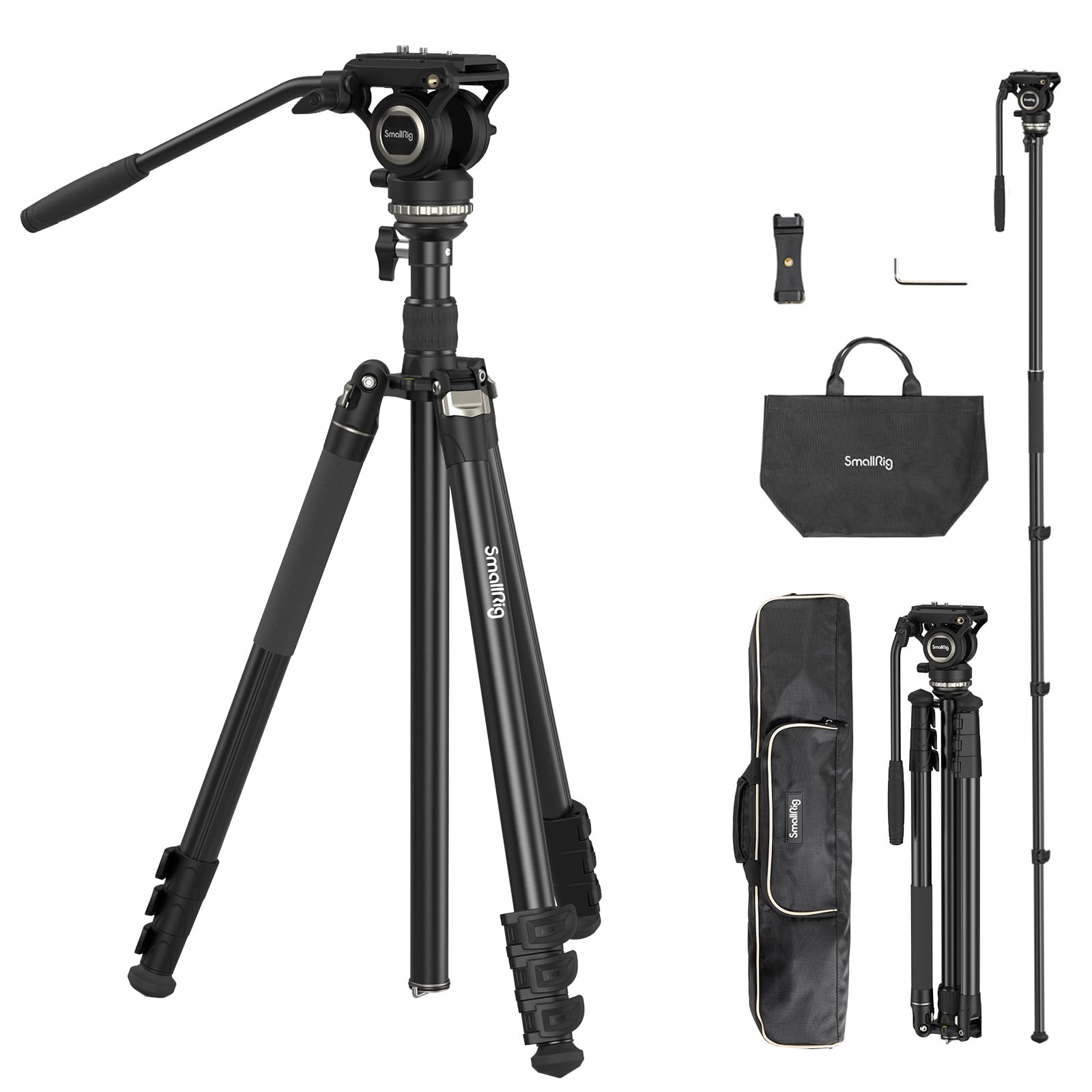
A built-in ±15° leveling base lets you flatten the horizon without fumbling with the legs.
Leveling is the quiet hero of any panorama, and the CT210 makes it a one-knob job. The head sits on a leveling base with a ±15° tilt range — a bowl that lets the head tilt slightly inside the legs so you can dial the horizon flat after setup. From there the fixed-damping fluid head rotates 360° and tilts 90°/-65°. The fixed damping means the pan resistance is preset, not adjustable, which keeps the motion smooth and keeps your framing from drifting between frames.
For a travel video tripod, the height and reach are strong: it extends from 29cm / 11.5 in up to 192cm / 75.6 in on four legs with quick-release locks, and one leg detaches into a monopod. That 192 centimeters actually edges out the NEEWER TP74’s 187 centimeters — a few centimeters that matter when you shoot down into a crowd or over a low barrier and need the camera just above the line you are crossing.
The build is 2.5kg / 5.5lb of aluminum folding to 61cm / 24.0 in. Owners single out build quality and sturdiness, and one panorama shooter says it stands firm for panoramic frames. Ease of use lands as the mixed note — some find the quick-release and lock routine worth a learning curve. At 4.5+ stars from nearly a hundred ratings, the CT210 is a specialist’s pick: buy it for the leveling base, not for huge payloads.
The one feature that changes your workflow: the ±15° leveling base means a flat horizon becomes a two-second adjustment instead of a leg-length fight.
Who this is not for: heavy-rig shooters — the 6 kg ceiling is tighter than the K&F’s 10 kg, so a long telephoto on a full-frame body wants a beefier mount.
Made for: mirrorless video shooters who sweep panoramas and hate fussing with leg lengths to level a horizon.
Look past it if: your kit runs heavy or you want to adjust pan resistance rather than accept a fixed setting.
5. SmallRig AD-01 Video Tripod
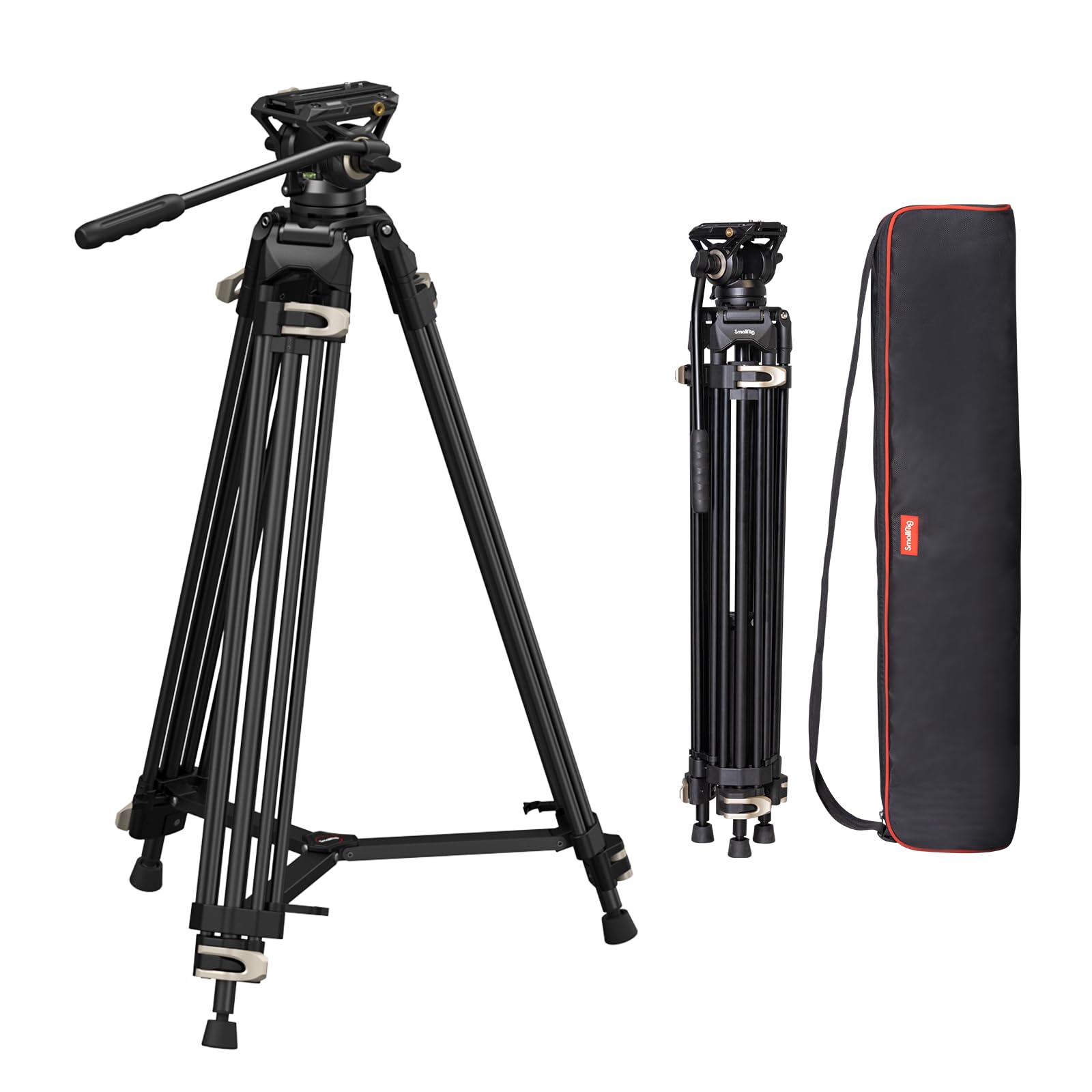
The working photographer’s fluid head — 17 pounds of load, a 75mm bowl, and damping built into both axes.
The AD-01 suits shooters who want fluid-head behavior for stitched video pans without paying a premium-tier price. It runs a 360° horizontal and +90°/-60° vertical head with a built-in damping and balancing system, and a 75mm bowl bottom for leveling. For a panorama, that means smooth, even pan speed and a flat starting plane. The aluminum double-row tubes and the built-in bubble level support stability on uneven terrain. Owners flag quality and value as what wins them over, and 4.5+ stars from 700+ ratings backs the long-term picture.
The height range runs from 85cm / 33in up to 186cm / 73in, with a stated 8kg / 17lb max load. That is more capacity than the SmallRig CT210 above carries and close to the NEEWER TP74’s 8kg, so the AD-01 can take a bigger camera-and-lens kit without the “is it going to hold?” hesitation. The side-pressed quick release plate open up with a push of the side button for fast camera swaps, and a built-in wrench on the plate lets you snug it together without a tool bag. It ships with a carrying bag and both a 1/4″-20 and 3/8″-16 screw.
The trade-offs worth knowing: the tripod weighs 8.8 pounds, so it is a car-to-location kit, not a hiking partner. And the adjustability and stability notes come up as the mixed themes — a couple of buyers report one leg not holding, and some want it to go lower than 85cm. For most shooters that is manageable; if you regularly shoot ground-level sweeps, the minimum height is the limit to check. 4.5+ stars from 700+ ratings.
Where it wins
- Fluid head with damping on both pan and tilt axes for smooth sweeps
- 75mm bowl bottom plus bubble level for a level horizon
- 8kg / 17lb load capacity — room for heavier camera-and-lens kits
- Side-pressed quick release for fast camera swaps; wrench built into the plate
What to weigh first
- 8.8 pounds is a heavy carry — set it up, do not hike with it
- Minimum height of 85cm / 33in rules out ground-level sweeps
Solid choice for: a photographer who wants directional pan-and-tilt control with enough load headroom for a heavier body and lens.
Skip if: low-angle ground-level panoramas are your signature shot — the 85cm floor does not go low enough.
6. SIRUI Traveler 7A Camera Tripod

A 4.16-pound travel tripod whose E-10 head swings a full panorama on an Arca-Swiss release.
The Traveler 7A is the pick for the photographer who shoots panoramas on the road rather than from the car. It folds to 480mm / 18.9″ on four retractable legs and weighs 1.89kg / 4.16lb — light enough to lash to a daypack. But light does not mean flimsy here: the E-10 is a panorama ball head with an Arca-Swiss compatible quick release plate, so the head rotates for a sweep and drops onto a standard Arca-Swiss mount. Owners praise its build quality and sturdiness, and 4.5+ stars from 100+ ratings make it the highest-rated pick here.
Adversity check: the platform is rated to 17.6 lbs, which comfortably covers a full-frame body with a moderate zoom. Height runs from 480mm / 18.9″ up to 1665mm / 65.55″ via a 2-section invertible center column — the invertible column lets you drop the camera lower than the leg base for low sweeps. There is also a detachable monopod conversion by attaching the leg to the center column, a hook under the column for hanging a bag to add stability, and a 1/4″-to-3/8″ convertible mounting screw for heads and cameras.
The clear limit is height: 65.55″ against the JOILCAN’s 85″ is a substantially shorter tripod, and against the K&F 90″ below it is shorter still. If your panorama needs to shoot over a crowd or a wall, the SIRUI will feel short. Weigh that against 4.16 pounds and a 65.55″ maximum. The Traveler 7A is not the highest-reach or highest-load tripod here; it is a genuinely portable panorama platform for travel where the rig needs to be light, and it is the highest-rated of the nine for a reason.
The travel argument: 4.16 pounds, 18.9-inch folded size, 17.6 lb capacity, Arca-Swiss panorama head — the package makes sense for a one-bag shooter.
The catch to size up front: 65.55 inches of maximum height is the shortest working height here, so climbing over foreground obstacles is not its game.
Best matched to: a photographer who wants an Arca-Swiss panorama head and a sub-5-pound tripod for location travel.
Not the one for: shooters who need top-of-head height above 65.55 inches — the taller picks in this guide cover that.
7. K&F Concept 68″ Carbon Fiber Camera Tripod

Carbon fiber at 2.93 pounds, yet rated to hold 22.04 pounds — the lightest panorama platform here.
Carbon fiber is the whole story. The legs of this K&F are made of carbon fiber, which is why the tripod comes in at only 2.93lbs while it is still rated to 22.04lbs / 10kg of load. That is the same load rating as the aluminum K&F T255A3 above, at a fraction of its 4.12lb / 1.87kg heft — and if you care most about carrying weight on a trail or a long walk between panorama locations, that gap is the entire buying decision. It folds to 42cm / 16.5 inch, small enough to strap to a pack.
The head rotates 360° for the sweep. It is a 28mm ball head, not a fluid pan head, so it needs to be leveled before you shoot — one more reason a built-in level or a careful setup matters. The 25mm tube diameter and 5-section spiral-locking legs run from 20.47″ up to 68″ of working height, with three angle levels for uneven ground. It also converts to a monopod with the central axis screw, and the 1/4″ quick-release screw fits most DSLRs, projectors, and telescopes, with a phone mount as an add-on.
What owners appreciate is the same thing the spec sheet claims: it is light, portable, and good value for travel. The 68-inch maximum height is about the same as the SIRUI’s 65.55 inches — shorter than the height-driven picks — and the ball head gives you flexibility rather than instrument-grade pan dampening. So it is not the tripod for a long, slow, damped video sweep. It is the tripod for the hike-in landscape panorama where every ounce of your pack counts, and at 4.5+ stars from 700+ ratings it has the track record to stand there. If you want carbon-fiber lightness with a real load ceiling, this is the one.
The weight equation: 2.93 pounds of carbon fiber holding 22.04 pounds of gear — the spread between carryable and hulking.
The comfort-to-sweep trade: the head is a ball head, so sweat less precision between frames than a damped pan head gives you.
Right for: backpackers and travel shooters who want a light panorama platform without dropping to a tiny load rating.
Wrong for: shooters who need damped pan motion for smooth multi-frame sweeps — a fluid head serves that better.
8. NEEWER TP75 Video Tripod

Two damping knobs — one for pan, one for tilt — let you tune the drag to your sweep speed.
The TP75 is the control-freak’s fluid head. Where fixed-damping heads give you one motion feel, this one gives you two separate controls: a side knob for tilt drag and a bottom ring for pan drag, each turned clockwise to stiffen and counterclockwise to loosen. For panorama work that is the difference between a pan that feels glued to your hand and a pan that feels like it is fighting you. The head also runs 360° pan and +90°/-75° tilt, with a 75mm bowl base and a bubble level to keep frames straight.
Since it is the same NEEWER family as the overall pick, the TP75 also shares the dual-mode QR plate — one mode for DJI RS2, RS3, RS3 PRO, RS4, and RS4 PRO gimbals, one for Manfrotto 501PL and 504PL plates — with a top-drop lock that seats in 1s. The maker notes it is not compatible with the RS5. Capacity is 22lb / 10kg, higher than the SmallRig AD-01’s 8kg / 17lb and near the top of this group, so a heavier rig is not a worry.
Not everything is smooth. The TP75 weighs 5.48kg and folds to 36.6 inches, and it demands a car for transport — it is by far the heaviest tripod here. Owner feedback flags the adjustability and the weight alike: some find it light enough, some grumble. Stability and smooth panning come in as the strengths, and 4.5+ stars from 400+ ratings is a solid base. If you want tunable pan dampening for careful stitched video, the TP75 is the specialist’s option here; if you want a tripod you can carry, look to the carbon-fiber or SIRUI picks above.
what separates it
- Separate pan and tilt damping knobs let you tune the drag
- 360° pan and +90°/-75° tilt on a 75mm bowl with a bubble level
- 22lb / 10kg load capacity in the aluminum build
- Dual-mode QR plates for DJI RS gimbals and Manfrotto plates
What to plan around
- Heaviest tripod in this guide at 5.48kg, and folds to 36.6 inches
- Not compatible with DJI RS5 gimbals
Go for this: when you want to dial pan drag by hand for stitched video sweeps and do not mind carrying a heavy rig.
Stay away if: you need portability or an RS5 gimbal workflow — both count against this one.
Know the Specs
Pan head versus ball head
A pan head rotates on one dedicated horizontal axis, which is why it keeps the camera level for a sweep. A ball head lets the camera move in every direction and is more flexible for stills, but for a panorama you have to level it first. A head with a printed 360° scale — like a 75mm bowl head — lets you pan a set number of degrees per frame, so the stitching software sees consistent overlap.
Load capacity and camera weight
Load capacity is the maximum rig weight the legs and head can hold, stated in pounds or kilograms. A camera-and-lens combo plus the head sits inside that number; a long telephoto pushes it harder because the weight sits far from the mount. Give yourself headroom above the stated limit, and use the heaviest lens you plan to shoot when you check the ceiling.
Common Questions
Do I need a fluid head or a ball head for panoramic photography?
What does the 75mm bowl base on a tripod actually do?
How tall should a tripod be for a wide panorama?
Can a ball head tripod shoot a 360° panorama?
How much weight can these panorama tripods hold?
Is a heavy tripod more stable for long sweeps?
What is a transverse center column used for?
Can I use these tripods with a phone or gimbal setup?
Does a carbon fiber tripod make a difference for travel panoramas?
Why does my stitched panorama show a wavy horizon?
The Bottom Line
The strongest overall pick is the NEEWER TP74, because its 75mm bowl, 360° scale, and fluid pan head give you a repeatable degree-by-frame sweep with 17.6lb/8kg of capacity behind it. If your panoramas are shot from height over a railing or a crowd, the JOILCAN 85″ reaches 85 inches at 3.8 pounds of carry weight. And for the backpacker who wants a flat-lay or overhead sweep without hauling an anchor, the K&F Concept 68″ Carbon Fiber holds 22.04lb/10kg at only 2.93lbs. Whichever you pick, level the head before the first frame — that single habit does more for a clean stitch than any upgrade after the fact.
How we choose
We do not accept paid placement. Every pick is matched to a real buyer and a real use-case; we do not hands-on test units.
Sources
Specifications: manufacturer listings and product documentation. Review insights: verified customer reviews, as of November 2026. Pricing: not shown on this page (it changes often); check the current price via the retailer link.
As an Amazon Associate, Tactical Gear Guy earns from qualifying purchases. This does not affect which products we feature.