Specs are compiled from manufacturer listings and verified buyer reviews and can change over time — please confirm the key details on the product page before buying.
You want 2TB of fast storage that plugs straight into your laptop, phone, or console — and you do not want to pay extra for a slow drive in a nice shell. The catch most buyers hit is that a “2TB USB SSD” label says nothing about real speed: the same capacity can move files at 500MB/s or 2,000MB/s, and the port on your own device decides which one you actually get. This guide ranks each drive by its interface, rated transfer rate, build, and the trade-offs behind its shell.
This guide is built by comparing the manufacturers’ published specifications and the patterns across verified customer reviews, so you get each pick’s real strengths and trade-offs instead of marketing spin.
Speed claims only count when your port matches, so every drive below is rated by the interface it actually needs. Here is how to pick a usb 2tb ssd that delivers the transfer rate you are paying for.
Top Picks


How To Choose The Best USB 2TB SSD
The single biggest mistake in this category is buying capacity and assuming speed comes with it. It does not. A 2TB drive is only as fast as the slowest link in a short chain: the drive’s own controller, the cable, and the USB port on your computer or phone. Get those three aligned and a 2TB drive rated at 1,050MB/s moves a 100GB card in under two minutes. Get them wrong and you are paying premium money for a drive running at a third of its rating.
Match the drive’s interface to your port first
USB 3.2 Gen 2 (often printed as 10Gbps) is the safe, near-universal standard, and drives built to it typically quote around 1,050MB/s. USB 3.2 Gen 2×2 (20Gbps) is twice the theoretical bandwidth, but it needs a host port that specifically supports 20Gbps. Many laptops and most phones do not. A 20Gbps drive on a 10Gbps port still works — it just runs nearer the 10Gbps ceiling. So if you cannot confirm a 20Gbps port, a well-built 10Gbps drive is the smarter buy.
Read the speed claim like a skeptic
Published figures are sequential read and write — a best-case, large-file scenario measured on ideal hardware. Short version: those numbers tell you the ceiling, not your daily average. Small files, a nearly full drive, and long sustained transfers all pull real speed down. A drive that quotes “up to 2,000MB/s” is describing its peak; a drive that quotes a sustained figure across the whole capacity is describing what you will actually feel. When a listing gives you both, trust the steady number over the shiny one.
Decide what “portable” means for you
A pocket drive lives in a bag, a jacket, or a camera case, so the shell matters as much as the chip. Look for an IP rating (a two-digit code for dust and water protection — IP65 means dust-tight and protected against water jets) if you shoot outdoors. A drop rating in feet or meters tells you how far it is tested to survive a fall. If it stays on a desk, a lighter aluminium body with good heat dissipation is the better trade — heat is what slows a fast SSD down during long transfers, so a metal shell that spreads heat is doing real work.
Side-by-Side Comparison
| Model | Best For | Interface | Rated Speed | Capacity | Amazon |
|---|---|---|---|---|---|
| Samsung T7 Shield★ Best Overall | Rugged everyday carry | USB 3.2 Gen 2 | Up to 1,050 MB/s | 2TB | Amazon |
| Vansuny 2TB PortableBest Value | Budget photo/video backup | USB 3.1 Gen2 | Up to 500 MB/s | 2TB | Amazon |
| MOVE SPEED SP05Most Versatile | Dual-port phone transfers | USB 3.2 + Type-C | Up to 560 MB/s | 2TB | Amazon |
| SSK 20Gbps (B0F43F46VG) | Fast editing on a 20Gbps port | USB 3.2 Gen2x2 | Up to 2,000 MB/s | 2TB | Amazon |
| MOVE SPEED Vpro | Thumb-drive format, no cable | USB 3.2 Gen 2 + Type-C | Up to 1,090 MB/s | 2TB | Amazon |
| fanxiang 2TB | Fastest per unit of size | USB 3.2 Gen2*2 | Up to 2,000 MB/s | 2TB | Amazon |
| PNY RP60 | Clipped to a camera bag | USB 3.2 Gen2x2 | Up to 2,000 MB/s | 2TB | Amazon |
| SSK Portable (B0CL96YTLQ) | Sustained 20Gbps work | USB 3.2 Gen2X2 | Up to 2,000 MB/s | 2TB | Amazon |
| Lexar ES3 | Cool-running office backup | USB-C/USB-A | Up to 1,050 MB/s | 2TB | Amazon |
| Samsung T9 | Heavy creator workloads | USB 3.2 Gen 2×2 | Up to 2,000 MB/s | 2TB | Amazon |
| Lexar Go w/Hub | Building a phone video rig | USB 3.2 Gen2 | Up to 1,050 MB/s | 2TB | Amazon |
Detailed Reviews
1. Samsung T7 Shield Portable SSD 2TB
Our pick — 4.5+★ from 16,000+ verified ratings; the strongest balance of quality and price.
An IP65-rated 2TB drive with drop protection to 9.8 feet.
The T7 Shield earns its place at the top because it balances the two things that break other portable drives: speed and survival. That gap is the whole story of this drive: you pay for a 10Gbps interface that nearly every modern laptop and phone already has a port for.
The rugged side is where it separates from the rest of the field. It carries an IP65 rating — dust-tight and protected against water jets — plus drop protection from falls up to 9.8 feet. In practice, that means a rain-soaked camera bag and a fumbled handoff do not cost you the shoot. Compatible with PC, Mac, Android, gaming consoles, and iPhone 15/16, with the SSD cable included on the C-to-C side. The palm-sized body fits a jacket pocket, so the drive travels with you instead of staying in a drawer.
What wins people over is the transfer consistency — it holds its rated pace across big single files and long backups alike, which is what separates a 1,050 MB/s rating from a peak-speed sticker. The honest tension in this listing is between reliability and value: some owners weigh the drive against cheaper budget-tier alternatives and feel the gap, while others find firmware and encryption extras worth the premium. Neither camp is wrong — it is the classic fit question. If your port is 10Gbps or lower, this drive extracts every bit of that; if you specifically need 20Gbps sustained 2,000 MB/s work, the SSK 20Gbps and fanxiang options further down are built for that lane.
Faithful to the spec sheet
- IP65 dust and water resistance plus drop protection to 9.8 feet — a genuine outdoor carry drive
- Up to 1,050/1,000 MB/s read/write over USB 3.2 Gen 2, roughly 88% ahead of the 560 MB/s budget options
- USB-C to C cable included and compatible with PC, Mac, Android, consoles, and iPhone 15/16
- Palm-sized body that actually fits a pocket
Where it draws the line
- Top out around 1,050 MB/s — the 20Gbps picks hit 2,000 MB/s on matching hardware
- Owners split on value for money versus cheaper alternatives
- You need a 10Gbps port to see the rated speed at all
Go with this if: you shoot outdoors, carry the drive daily, and want a 10Gbps performer that survives the ride.
Step up instead: chase a 20Gbps drive if you know your machine has that port and you work with sustained multi-gigabyte transfers.
2. Vansuny 2TB Portable External SSD
A metal-bodied 2TB drive that trades top speed for a smaller price tag.
Start with the number that sets this pick’s place: up to 500 MB/s read and 450 MB/s write over USB 3.1 Gen2. That is roughly half the 1,050 MB/s the Samsung T7 Shield delivers — meaningful if you move huge video projects daily, minor if you mostly back up photos and documents. The metal case does real work here too, spreading heat so the drive does not cook during long transfers, and it is small enough to sit in your palm.
The package is refreshingly complete for a value-tier pick: a Type-A to Type-C cable, a Type-A to Type-C adapter, and a storage bag, so you can plug into an older USB-A laptop or a newer USB-C device without buying anything extra. Compatibility reaches Windows, Mac OS, and Android, and it supports PCs with USB ports plus the latest laptops and phones with a Type-C port. The listing also flags shockproof, waterproof, and wear-resistant traits, though treat those as everyday toughness rather than a certified IP rating.
Here is the honest read: the photo, video, and file-transfer crowd finds it portable and quick enough, and for photographers, gamers, and video editors doing routine backups it does the job. The tension is the speed ceiling — it is a 500 MB/s drive, not a 2,000 MB/s one, so it suits a workflow that values storage volume over blistering pace. If you edit 4K footage off the drive itself, look higher up this list. If you archive and shuttle files, this one wins on the price-to-capacity math.
What the metal buys you: faster heat dissipation than a plastic shell, which keeps transfers stable on longer jobs. The 500 MB/s ceiling is the trade — fine for backups, tight for live editing.
Packaging that punches up: adapter, cable, and bag included means zero extra accessories to buy.
Reach for this if: you want serious storage volume in a solid metal body for photo and video backups.
Look elsewhere if: your work involves editing large 4K files directly from the drive — the 500 MB/s ceiling will feel tight.
3. MOVE SPEED 2TB Solid State Drive
One slider, two ports — USB-A when the old laptop demands it, USB-C when the phone does.
The party piece is mechanical, not electronic: a push-pull slider that clicks between USB-A and USB-C in one motion, so you never lose a cap or have to fish for an adapter. If you bounce between an older work laptop with USB-A and a phone or tablet with USB-C, this drive is a bridge that lives in your pocket. The zinc alloy shell is built to take gym bags and travel, and the read speed rating sits at 560 MB/s — in the same ballpark as the Vansuny above and a clear step below the 1,050 MB/s Samsung T7 Shield.
Speed on this one is best judged by what it moves, and the operating picture is genuinely versatile: it plugs into iPhone, Android, laptops, and even PS5, with a braided lanyard you can clip to keys or a bag. The consistent theme is easy data shuttling — the iPhone-to-Windows crowd finds it the simplest way to move files across platforms. Storage capacity is what owners talk about most, and speed comes second, which tells you this drive is chosen for its capacity-plus-convenience combo rather than chasing benchmark records.
The recurring caveat is heat. Sustained transfers can make the metal body noticeably warm — that is the price of the compact zinc shell doing its heat-spreading job, and it is the honest trade for a design this pocket-friendly. Reliability and value get mixed reads too, so go in with realistic expectations: this is a versatile, convenient 2TB carrier, not a top-speed editor’s drive. Buy it because you value the dual-port slider and cross-device simplicity, and you will get exactly that.
The convenience factor
- Push-pull slider clicks from USB-A to Type-C in one motion — no lost caps or adapters
- Plugs into iPhone, Android, laptops, PS5, and more with a clip-on braided lanyard
- Zinc alloy shell built for gym bags and travel
The honest trade
- 560 MB/s ceiling is well behind the 1,050 MB/s class
- Sustained transfers can warm the metal body noticeably
- Reliability and value draw mixed owner feedback
Pick this when: your week jumps between a USB-A work laptop and a USB-C phone, and you want one drive that handles both without fuss.
Think twice if: you need top-tier speed for editing — the 560 MB/s rating is a convenience-first figure.
4. SSK 2TB Portable SSD, USB 3.2 Gen2x2 20Gbps

A 20Gbps-spec drive with two cables in the box and a bright blue activity light.
The headline number is 2,000 MB/s, reached over USB 3.2 Gen2x2 — the 20Gbps lane. That is nearly double the 1,050 MB/s you get from a Gen 2 drive like the Samsung T7 Shield, and it changes what is practical: editing footage straight off the drive instead of copying it to your internal disk first. The listing is unusually frank about the fine print, too — other ports, including Thunderbolt, cap the drive at 10Gbps, so the full speed needs a matching 20Gbps host. That honesty is worth trusting.
The bundle is a nice touch. You get a 20Gbps USB-C cable for the fast lane and a 10Gbps USB-A cable for backward compatibility with older machines, so the SSD crosses between computers, phones, tablets, and gaming hosts without a scavenger hunt. On the data-protection side it carries S.M.A.R.T. health diagnostics (a self-monitoring system that reports drive condition) and adaptive TRIM, which keeps write speeds consistent and stretches the drive’s working life. A blue LED shows transfer activity so you are less likely to yank the drive mid-write.
Owners describe it as performing flawlessly and reasonably fast, with backup speed singled out as the standout — and it lands in a plastic-and-zinc-alloy body that stays pocketable. The one honest watch item is heat: fast 20Gbps transfers generate warmth, and the listing’s own advice is to eject safely rather than pull the drive mid-task. Get the port match right and this is a serious editor’s drive. Use it on a 10Gbps machine and you still get a solid Gen 2 performer, just not the headlining 2,000 MB/s.
Why it earns the speed badge: 2,000 MB/s over USB 3.2 Gen2x2, with both a 20Gbps USB-C and a 10Gbps USB-A cable included — the connector situation is solved before you open the box.
The port reality check: the full 2,000 MB/s needs a 20Gbps host, and the listing itself notes Thunderbolt and other ports cap it at 10Gbps. Fast does not mean it warms gently — be patient and eject safely.
Suit your setup with: a machine that actually has a 20Gbps USB port and a workflow that moves big files often.
Do not buy for: a phone or older laptop — you would be paying for speed that port cannot carry.
5. MOVE SPEED 2TB Flash Drive
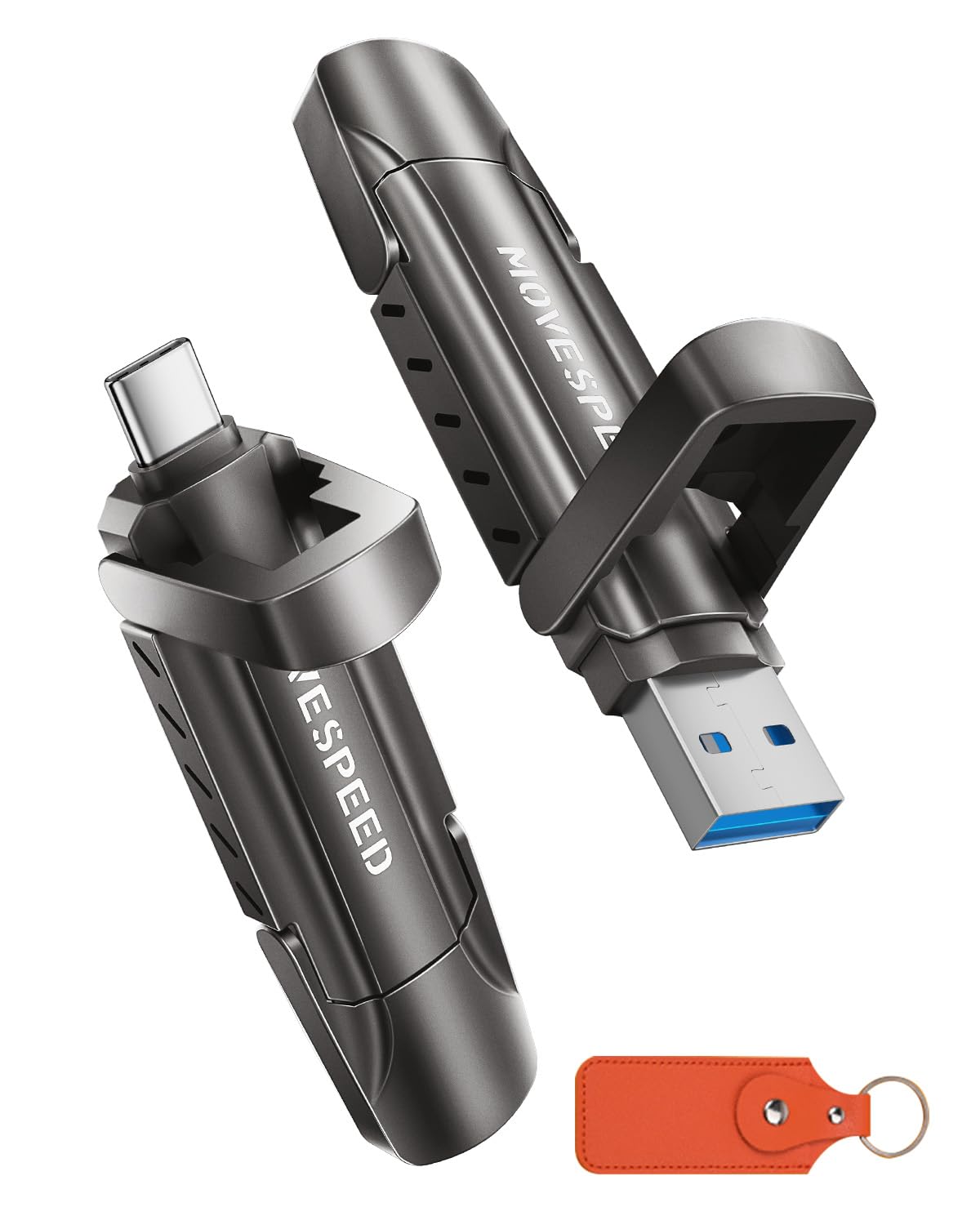
A 2TB drive the size of a thumb drive that plugs straight into your phone.
This is the pick for anyone who has ever wished a portable SSD would just plug into a phone with no cable to lose. It is a thumb-drive-format SSD rated up to 1,090 MB/s read and write — right alongside the 1,050 MB/s Samsung T7 Shield and far ahead of the 500–560 MB/s budget group. The listing claims full speed across the entire 2TB with no slowdown during large transfers, an upgraded heat-dissipation design, and an SSD-class chip inside a zinc alloy case. Plug it into an Android phone, an iPhone 15/16/17, a laptop, or a car audio system, and it works without software or fuss.
Speed is what owners notice most about it, followed closely by build quality — the metal enclosure reads as solid in the hand, and the keychain leather case keeps it clipped and ready. The dual interfaces cover both USB 3.2 Gen 2 and Type-C, so cross-device transfers between phone and computer are the whole reason it exists. Apple ProRes-style 4K capture from an iPhone 15 lands directly on the drive, and a 1GB file moves in about a second by the maker’s claim. For a creator who wants to dump a card’s worth of clips without a dongle chain, this is the simplest shape in the whole group.
The trade-off to know is heat during sustained heavy use — a compact thumb body has less room to spread it, and that is the honest cost of the no-cable form. Reliability and value get mixed reads, and connectivity draws some mixed feedback, so treat it as a convenience-first drive rather than a workstation. If your priority is the physical convenience of a drive that dangles off a keyring and plugs in without a cable, nothing here comes closer; if you need sustained all-day throughput for big edits, a cabled 20Gbps drive is the safer call.
Why it wins the pocket test
- Thumb-drive format rated up to 1,090 MB/s — no cable to lose, plugs direct into phone or laptop
- Dual USB 3.2 Gen 2 and Type-C ports for cross-device transfers
- Zinc alloy case plus a keychain leather case for carry
The honest caveats
- Compact body runs warm under sustained heavy transfers
- Reliability and value get mixed owner feedback
- Not built for all-day workstation-grade throughput
Best match for: the phone-first creator who wants a 2TB drive dangling off a keyring, ready to absorb clips in seconds.
Not the tool for: sustained multi-hour edits where a cabled 20Gbps drive runs cooler and steadier.
6. fanxiang 2TB External SSD

An aluminum-bodied 20Gbps drive that weighs almost nothing for the speed it carries.
Weigh this against the field on paper and it is a lot of speed in a very small package: sequential read and write up to 2,000 MB/s and 1,800 MB/s over USB 3.2 Gen 2*2, in a body that measures 85*50*8.6mm and weighs 1.6 ounces. That is the same peak as the SSK 20Gbps and a big step over the 1,050 MB/s Samsung T7 Shield — which is precisely why the aluminum unibody matters. A hard-working 20Gbps drive needs somewhere to shed heat, and the metal casing spreads it while acting as shock-resistant armor for the data inside.
The portability angle is real, not decorative. The 1.6-ounce body slips into a pocket or a bag compartment and vanishes, and the 2-in-1 cable covers both USB Type C-to-C and Type C-to-A so you are not hunting adapters. Compatibility runs wide — Windows, Android, Mac OS, PC, laptop, Mac, Android devices, PS5/PS4(Pro), Xbox, some OTG smartphones, iPhone 15 and 15 Pro — and it supports “Windows to Go” if you carry a bootable workspace. The 5-year service or 1024TBW pledge (a total-bytes-written endurance rating) is a promising signal for a drive you plan to lean on for years.
On the fine print: the listing is clear that the SSD performs even better on a device with a 20Gbps USB interface, so the 2,000 MB/s figure assumes that host. Owners point to compact size and portability as the things they appreciate most, with Xbox storage getting a specific shout-out. For a traveler who needs fast, featherweight storage that handles games and video files alike, this is a smart fit — just confirm your port first, because on a 10Gbps machine it runs nearer that ceiling.
Speed-to-weight champion: up to 2,000/1,800 MB/s read/write in just 1.6 ounces and 8.6mm thin — you barely feel it in a pocket for a drive this quick.
The host-port condition: the 2,000 MB/s only unfurls on a 20Gbps USB interface. Broad device support, but the headline speed is a matched-hardware reward.
The right call for: travelers and console users who want very fast 2TB storage they can forget they are carrying.
Hold off if: your laptop is stuck on 10Gbps — you would carry a race car in first gear.
7. PNY RP60 2TB USB 3.2 Gen 2×2 Type-C Portable SSD

A ruggedized 20Gbps drive with a belt-loop clip and backup software in the box.
The RP60 pairs two things that rarely sit together in this category: a full 20Gbps interface — sequential read and write up to 2,000/1,800 MB/s with a matching USB 3.2 Gen2x2 host — and a ruggedized body engineered to resist water, dust (IP65), and accidental drops up to 3m/9.8ft. That drop rating matches the 9.8 feet of the Samsung T7 Shield, while the speed reaches the 2,000 MB/s ceiling of the SSK and fanxiang drives. For a field shooter who wants both toughness and pace, that combination is the reason to look here.
The portability detail is smart: a clip loop lets the drive hang from a belt loop, backpack, or camera bag, so it travels with the gear instead of rattling loose in a pocket. The rubberized outer shell adds grip and protection while keeping the whole thing compact and light. It connects to smartphones, tablets, laptops, and desktops over USB Type-C, and the package includes Acronis True Image Data Protection software for backup and recovery — a nice pre-loaded safety net. Backed by a 3-Year Limited Warranty with US-based support.
Owners find it works well and is very fast, and reliability leads what they highlight — a sensible thing to hear about a drive this ruggedized. The honest caveat is the software and warranty math: the 3-year term is shorter than the 5-year coverage on the Lexar Go and fanxiang picks, so if long-term coverage matters to you, weigh that. And like every 2,000 MB/s drive here, it only hits full pace on a 20Gbps host port. Clip it on, shoot the day, and let the software cover the backups — that is the RP60’s whole pitch.
What sets the RP60 apart: IP65 ruggedness plus drops to 3m/9.8ft, in the same drive as a 2,000 MB/s Gen2x2 interface — tough and quick together.
Worth checking: the Acronis backup software is a genuine freebie, but the 3-year warranty is the shortest among the premium picks. Coverage, not speed, is the decision here.
Ideal for: the camera-bag photographer who wants to clip a tough, fast 2TB drive onto the strap and forget it.
Second-guess if: you prioritize the longest warranty — the 3-year term trails the 5-year drives here.
8. SSK Portable SSD 2TB

Built to hold its 20Gbps pace, with S.M.A.R.T. monitoring and a silver aluminum shell.
The distinguishing claim here is not top speed but sustained speed. This SSK is rated up to 2,000 MB/s over USB 3.2 Gen2X2, and it uses an SLC cache design — the listing describes allocating 25% of the available capacity as high-speed cache — to keep that 20Gbps pace steady rather than spiking and dropping. It runs on a “Ultra” chip and premium 3D NAND, and the aluminum enclosure helps push heat out during long jobs. For anyone copying huge folders repeatedly, that consistency is the real value versus a drive that only spikes on a short test.
The spec sheet also answers a question every 2TB buyer eventually asks: why does Windows show less than 2TB? The listing explains the ~1863GB Windows figure and the 7%–10% gap as an algorithm difference between how Windows (1024MB per GB) and the drive (1000MB per GB) count, while macOS shows the full 2TB. That is a helpful bit of transparency. It ships with both a USB-C to USB-A (10Gb/s) cable and a USB-C to USB-C (20Gb/s) cable, and supports OTG for phones, plus S.M.A.R.T. monitoring and TRIM to keep write speeds consistent over time.
The honest watch-out is heat and connectivity: owners praise the quality and speed and quick out-of-the-box performance, but the drive can run warm, and some report it disconnecting easily — so a snug, stable connection matters. This is a performance-first drive that rewards a careful setup and a matching 20Gbps port. If you want a silver aluminum body that prioritizes steady throughput for photography and design work, it fits; if you want a simpler plug-and-forget experience, the cabled-but-rugged Samsung T7 Shield is the calmer pick.
Made for the long transfer
- SLC cache design aimed at keeping 20Gbps write speed steady, not just on short bursts
- USB-C to C (20Gb/s) and USB-C to A (10Gb/s) cables both included
- Clear explanation of the Windows ~1863GB vs macOS 2TB capacity gap
- S.M.A.R.T. monitoring and TRIM for long-term health and steady writes
Where it asks for care
- Runs warm during extended transfers
- Some connection-stability feedback — keep the port snug
- Full 2,000 MB/s needs a 20Gbps host
Made for you if: you copy large folders repeatedly and value steady throughput over headline spikes.
Consider the calmer option: if easy plug-and-play matters more than sustained speed, a ruggedized drive is friendlier day to day.
9. Lexar 2TB ES3 External SSD, 1050MB/s Read, USB-C

A tidy Gen 2 drive that keeps cool with graphite sheets and plugs in with one 2-in-1 cable.
This is the no-drama office and everyday drive. It is rated up to 1,050MB/s read and 1,000MB/s write — the same Gen 2 class as the Samsung T7 Shield, well ahead of the 500–560 MB/s budget picks — in a 2TB package that flips between USB-C and USB-A with a single 2-in-1 cable. The listing’s speed framing versus mechanical hard drives is its own claim, but the practical point is simple: big backups finish quickly and files open without a wait. Plug-and-play across PC, Mac, tablet, and smartphone means no setup before you work.
The engineering detail worth knowing is the heat management. Built-in double-layer graphite sheets spread and conduct heat away, so the drive stays cooler during fast transfers than a plain plastic shell would allow. It is also rated drop-resistant up to 2 meters, with dust-resistant and water-resistant traits in its spec sheet, so it survives an office desk tumble or a splash. Owners describe it as reliable and easy to use, working smoothly with a MacBook Pro, and the fast-backup angle is where it shines — big libraries move in a fraction of the time a spinning drive would take.
The honest limit is the ceiling: at 1,050 MB/s it is a Gen 2 drive, so the 20Gbps picks above can roughly double its pace on matching hardware. That is fine if your machine tops out at 10Gbps anyway — which most do. Cooler running and steady behaviour make it the better long-term companion for routine backups and document work. If you value quiet reliability over peak speed and want one cable to fit every port in the house, this is the sensible pick.
The cooling angle: double-layer graphite sheets conduct heat away during fast transfers, so the drive keeps its composure on sustained backups instead of slowing from the heat.
One-cable convenience: the 2-in-1 USB-C/USB-A cable means every PC, Mac, tablet, and phone in the room is a plug away. The 1,050 MB/s ceiling is the trade.
Best for: the everyday user who backs up a house full of devices and wants quiet reliability with one cable that fits them all.
Skip if: you specifically need 20Gbps editing speed — this tops out with the Gen 2 class.
10. Samsung T9 Portable SSD 2TB

The creator’s workhorse — sustained 2,000 MB/s with a thermal system that holds the pace.
If you edit off the drive rather than copy to it first, the T9 is built for exactly that. It carries sustained read and write speeds up to 2,000 MB/s over USB 3.2 Gen 2×2, matching the SSK and fanxiang drives at the 20Gbps ceiling and nearly doubling the 1,050 MB/s Samsung T7 Shield. The “sustained” part is the point: the listing stresses it holds speed during longer processes, backed by a Dynamic Thermal Guard that controls heat to keep the SSD at working temperatures even under heavy use. That is the difference between a fast test result and a fast workday.
Compatibility runs from desktops and cameras to gaming consoles, and it supports iPhone 15 Pro Res 4K at 60fps video with the included cable. The Magician Software adds firmware updates, hardware encryption, and continual drive-health monitoring — a genuine management layer rather than a token extra. The palmable body is compact enough to disappear in a bag, and the form factor is built to take the wear of daily creative work. For a videographer shipping projects on deadline, that reliability of pace is what you are buying.
Where it gets honest: value for money, compatibility, and durability all draw mixed feedback, and some Mac configurations are noted as smooth while others are not, so check your specific machine. The 2,000 MB/s figure also assumes a matching 20Gbps host. Set against the T7 Shield, this is the faster and more thermally serious drive for heavy creator workloads; the T7 Shield is the more rugged, weather-ready one. If you live in an editing timeline all day, the T9’s sustained-speed focus is the reason to pick it.
Built for the long edit
- Sustained up to 2,000 MB/s read/write over USB 3.2 Gen 2×2, held during longer processes
- Dynamic Thermal Guard controls heat under heavy, continuous use
- Magician Software for firmware updates, encryption, and health monitoring
- Suppfers iPhone 15 Pro Res 4K at 60fps video with the included cable
What to weigh first
- 2,000 MB/s needs a matching 20Gbps host port
- Value for money, compatibility, and durability draw mixed owner feedback
- Some Mac setups report smooth results, others do not — confirm yours
Choose it when: you edit video and copy huge files all day and want the pace to hold from first clip to last.
Another route: if weather and drops are your real worry, the rugged Samsung T7 Shield trades top speed for outdoor toughness.
11. Lexar 2TB Go Portable SSD

A 2TB drive that doubles as a four-port USB-C hub for a phone-first shooting rig.
Most drives on this list just store files. This one wants to be the hub of a mobile video setup. The core is an ultra-compact 2TB SSD rated up to 1,050MB/s read and 1,000MB/s write — the Gen 2 class shared with the Samsung T7 Shield — that weighs just 13g and measures only 1.71″ x 0.98″ x 0.32″. That means you can run it bare in a pocket, or dock it into the included hub and suddenly gain four USB-C ports for microphones, lights, power banks, and more. For an iPhone-based creator, that is a studio that fits in a pouch.
The ProRes angle is the headline: the drive captures Apple ProRes 4K 60fps video directly, letting you shoot straight to the drive from an iPhone 15 Pro/Pro Max or above. The hub can pass up to 30W of power through to your setup, so long shoots keep their accessories fed while the SSD works. The drive itself is IP65-rated for dust and water resistance and drop-resistant up to 1 meter, and an included silicone case adds a layer of protection — matching the T7 Shield’s IP65 grade while adding the hub and a lighter build. The Lexar App handles photo and video backup from your phone, and the drive is backed by a 5-year warranty.
The one honest trade is speed class: at 1,050 MB/s it is a Gen 2 drive, so the 20Gbps picks higher up can reach 2,000 MB/s on matching hardware. But that is the wrong comparison for what this is built to do — this drive is about feet-on-the-ground convenience for phone video, not chasing the last megabyte per second. Owners describe it as excellent quality worth the money, with the compact size and phone-storage relief singled out. If your studio is a phone, a ring light, and a shotgun mic, nothing else here assembles that kit as cleanly.
The rig-in-a-pouch idea: a 13-gram 2TB SSD that docks into a 4-port USB-C hub with up to 30W pass-through — shoot ProRes straight to the drive while your mic and light stay powered.
The one thing to accept: 1,050 MB/s is Gen 2 pace, not the 2,000 MB/s of the 20Gbps drives. You are buying the studio shape, not the speed record.
Fit for: the iPhone videographer who wants a 2TB drive, a hub, and a powered accessory setup in one ultra-compact kit.
Elsewhere if: you do not shoot on a phone — the hub value evaporates and a plain drive serves you better.
Know the Specs
Interface Speed (Gen 2 vs Gen 2×2)
This is the lane your drive runs in, and it caps everything. USB 3.2 Gen 2 (a 10Gbps standard) is the near-universal choice and typically pairs with drives quoting around 1,050 MB/s. USB 3.2 Gen 2×2 (20Gbps) doubles the bandwidth, which is how drives like the Samsung T9, SSK 20Gbps, and fanxiang reach 2,000 MB/s. The catch: Gen 2×2 only runs at full speed when the port on your computer supports 20Gbps. On a 10Gbps port, a 20Gbps drive still works but runs nearer 10Gbps — so match the drive to the port you actually own.
Read vs Write and “Up To” Speeds
Read speed is how fast you pull files off the drive; write speed is how fast you put them on. Backups and card dumps depend on write, while opening and editing files depends on read. Listings quote “up to” figures because those are peak, sequential, large-file numbers on ideal hardware. Real speed drops with small files, a nearly full drive, and long sustained jobs. A drive that advertises a steady figure across the whole capacity — like the SLC-cache approach on the SSK — is telling you more about daily feel than a top-line peak.
Heat, Cache, and Why Speed Sags
Fast SSDs generate heat, and heat is the enemy of sustained speed. A metal or aluminum shell spreads that heat so the drive keeps its pace; graphite sheets, as on the Lexar ES3, conduct it away; SLC cache reserves a slice of capacity as a fast buffer to hold write speed up. All of these are the same fight: keeping the drive cool and fed so a long transfer does not slow to a crawl. When a compact thumb-style drive runs warm under heavy use, that is physics, not a defect — give it airflow and a break between huge jobs.
Capacity Math and Durability Ratings
A “2TB” drive often shows about 1863GB on Windows, which alarms new buyers. It is a counting difference — Windows treats 1GB as 1024MB, the drive uses 1000MB — and macOS typically shows the full 2TB; SSK’s own listing spells this out. Separately, look for durability codes: IP65 means dust-tight and protected against water jets, a drop rating in feet or meters tells you what it is tested to survive, and TBW (total bytes written) hints at how much data the drive is designed to handle over its life.
Common Questions
Will a 20Gbps USB 2TB SSD work on my older laptop?
Why does my 2TB SSD show less than 2TB on Windows?
Can I edit videos directly off a portable SSD instead of copying first?
Will a USB 2TB SSD work with my iPhone 15 or 16?
Is an external SSD better than a USB thumb drive for 2TB?
How much speed can an IP65 rugged drive lose compared to a plain one?
Do these drives need external power or a special cable?
Can I use a USB 2TB SSD with a PS5 or Xbox console?
What is TBW and does it limit how long my SSD lasts?
Is 1,050 MB/s fast enough or should I insist on 2,000 MB/s?
The Bottom Line
For most people, the usb 2tb ssd that hits the best balance is the Samsung T7 Shield — up to 1,050/1,000 MB/s over a near-universal 10Gbps interface, IP65 dust and water resistance, and drop protection to 9.8 feet in a palm-sized body. For everyday carry on a 10Gbps port, it is the safe buy. If you know your machine has a 20Gbps port and you edit large footage, reach for the Samsung T9 and its sustained 2,000 MB/s with thermal control to match. And if your studio is a phone, a light, and a mic, the Lexar Go with Hub builds that rig into one ultra-compact kit. One quick honesty beat before you commit: even the best pick here cannot outrun your port, so confirm your interface speed first and buy to that, not to the biggest number on the label.
How we choose
We do not accept paid placement. Every pick is matched to a real buyer and a real use-case; we do not hands-on test units.
Sources
Specifications: manufacturer listings and product documentation. Review insights: verified customer reviews, as of November 2026. Pricing: not shown on this page (it changes often); check the current price via the retailer link.
As an Amazon Associate, Tactical Gear Guy earns from qualifying purchases. This does not affect which products we feature.