Specs are compiled from manufacturer listings and verified buyer reviews and can change over time — please confirm the key details on the product page before buying.
If one room in your house never gets the air the rest of it does, a vent booster fan is the fix — a small fan that sits in the register or duct and pushes heated or cooled air the last stretch into the room. The real decision depends on one number: how much air it moves, measured in CFM (cubic feet per minute — the volume of air the fan shifts each minute). Register models typically land around 120 to 200 CFM, while inline duct fans climb past 400. Below are nine fans that genuinely work, sorted by what each does best.
This guide is built by comparing the manufacturers’ published specifications and the patterns across verified customer reviews, so you get each pick’s real strengths and trade-offs instead of marketing spin.
Each pick lists its airflow rating in CFM (cubic feet per minute — how much air it moves), its noise figure in decibels (dB — how loud it runs), and the duct size it fits. That lets you match a fan to your own vent before you spend a cent.
Top Picks

How To Choose The Best Vent Booster Fan
Start with the duct hole, not the fan. A register booster fan replaces the grille sitting over your vent, so the hole underneath has to match the fan’s stated opening. A 4″ x 10″ model will not drop into a 6″ x 12″ cutout, no matter how much air it moves. Pull the old grille, measure the metal rectangle in the floor or wall, and buy to that figure.
Register fan or inline fan?
A register booster fan sits in the room-facing vent opening and pushes air through a grille you look at every day. An inline duct fan sits inside the ductwork itself, usually in a basement, attic, or behind a wall, and moves far more air — the Toolazy inline model pushes 405 CFM while register units cluster near 120 CFM. If your problem is one weak vent in a finished room, a register fan is the simple answer. If a long duct run is starving several rooms, an inline fan works harder at the source.
What noise level you can live with
Decibels are a scale where roughly 18 dB is close to a whisper and 60 dB approaches a normal conversation. The quietest register fans here are rated at 18 dBA (the A-weighted version of that scale, adjusted to how human ears hear it). Several models let you drop to a lower speed at night, which is the real-world way people sleep next to one.
Controls that save you walking over
A thermostat-triggered fan turns itself on when the HVAC system heats or cools, so you are not flicking a switch every season. A remote, an app, or voice control through Alexa or Google Home adds convenience but is not required for the fan to work. What matters first is whether the control lets you set a temperature and a speed and then forget it.
Side-by-Side Comparison
| Model | Best For | Airflow (CFM) | Duct / Vent Size | Noise | Amazon |
|---|---|---|---|---|---|
| Toolazy 6 Inch Inline Duct Fan★ Best Overall | Whole-run duct boosting | 405 CFM | 6″ round duct | 31 dBA | Amazon |
| VEVOR Register Booster FanBudget Smart Pick | Budget smart control | 120 CFM | 4″ x 10″ register | ≥18 dB | Amazon |
| VELLEE Quiet Register Booster FanMost Proven | Quiet all-round register fan | 120 CFM | 4″ x 10″ register | 18 dBA | Amazon |
| VIVOHOME Register Booster Fan | Larger vents, directed airflow | 120 CFM | 6″ x 12″ opening | below 18 dB | Amazon |
| Suncourt Register Booster Fan (HC600) | Floor vents, auto on/off | 200 CFM | 6×12 and smaller floor vents | — | Amazon |
| AC Infinity AIRTAP T4 | Smart app and voice control | 130 CFM | 4″ x 10″ opening | — | Amazon |
| AC Infinity Automatic Booster Duct Fan 4″ | Auto inline duct boosting | 230 CFM | 4″ round duct | 60 dBA | Amazon |
| Tjernlund DB-2 Duct Booster | Retrofit into round or shallow duct | 275 CFM | 5–8″ round, or rectangular down to 3.25″ | — | Amazon |
| Tjernlund RB12 Register Booster Fan | 4 x 12″ floor registers | 75 CFM | 4″ x 12″ register | — | Amazon |
Detailed Reviews
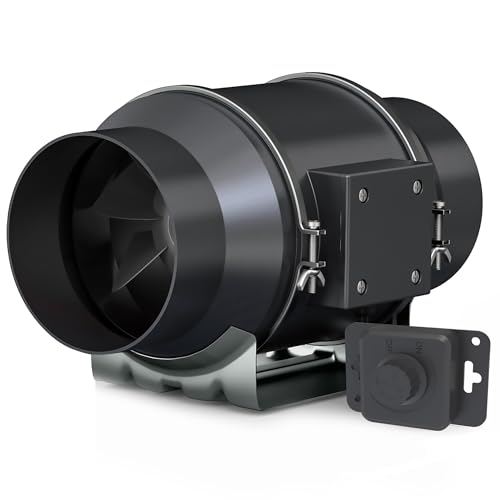
1. Toolazy 6 Inch Inline Duct Fan 405 CFM
Our pick — 4.5+★ from 100+ verified ratings; the strongest balance of quality and price.
The one that moves more air than anything else here by a wide margin.
If a long duct run is the reason your room stays flat, this is the pick that solves it at the source. It pushes 405 CFM through a 6-inch round duct — compare that to the 120 CFM a typical register fan manages, and you can see why inline fans are the heavy-mover category. Set it in the ductwork feeding a grow tent, a basement, a bathroom run, or a crawl space, and it pulls air through with real force.
The part that matters day to day is the dial. An included knob controller runs the fan from 0 to 100% with PWM control (pulse-width modulation — a way of throttling a motor smoothly instead of in clunky steps). The maker describes it as running with zero hum or electrical noise, and the 8.2 ft controller cord lets you mount the dial within reach while the fan sits in an awkward spot. At 31 dBA it is quiet enough to run in a living space rather than hidden away.
Build-wise you get an EC motor (electronically commutated — a motor type that holds speed efficiently) rated to 3000 rpm, dual sealed ball bearings for continuous operation, and ETL Listing for safety. What wins people over most is how quiet and solid it feels for the air it moves — the noise level and build quality are the two things owners bring up again and again. A laundry-drying rescue and matching the original airflow are the kinds of notes that show up in the reviews.
Where it earns the top slot
- 405 CFM through 6-inch round duct — far more push than any register fan on this list
- 0-100% variable dial with an 8.2 ft cord so the control sits where you can reach it
- 31 dBA keeps it livable, and dual sealed ball bearings support 24/7 running
- Complete kit: fan, controller, 4.9 ft power cord, and mounting hardware included
The honest catches
- It’s an inline duct fan, not a drop-in register unit — it goes inside 6-inch round ductwork
- At 6.6 pounds it needs proper mounting, not a shelf-rest
- Compatible with 6-inch carbon filters, so it is aimed at grow and HVAC setups, not a single floor vent
Right for you if: your problem lives in the ductwork — a grow tent, basement, bathroom, or crawl space that needs serious air exchange.
Not the one for: a single weak bedroom vent where you want to drop a fan into the existing floor grille.
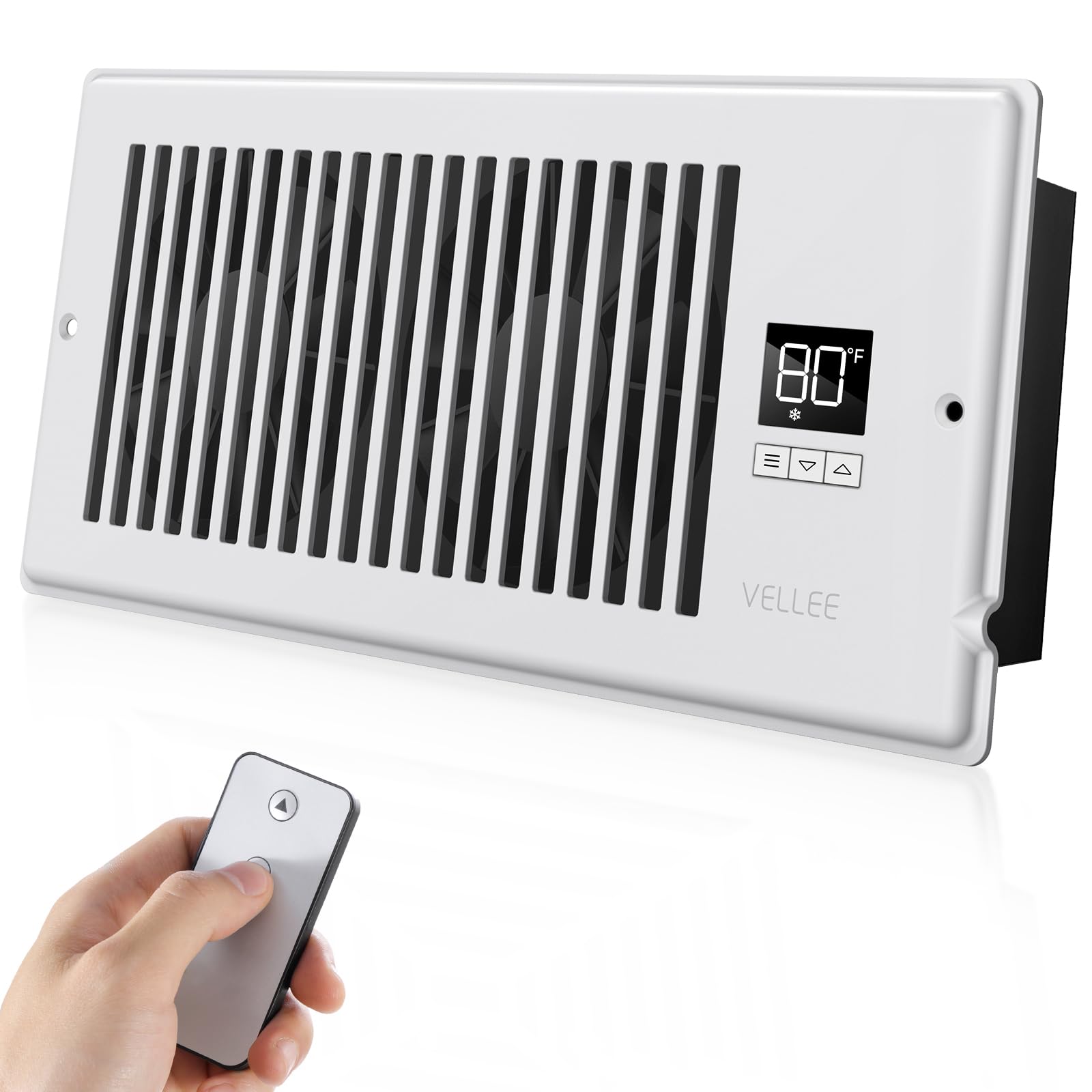
2. VEVOR Register Booster Fan with Remote and Thermostat
A register fan that reads the room temperature and adjusts itself while you stay on the couch.
This one is built for the person who wants the fan to think for them. Its LCD controller carries a temperature sensor that triggers the fan to change airflow based on the room temperature you set, so it saves power and stops you fiddling with buttons. The included remote works up to 26 ft, which covers a whole bedroom or den, and the aluminum frame in white with a powder-coated finish blends into most decor.
Airflow lands at 120 CFM with 10 adjustable speeds, and the 6W PWM DC motor is designed to sip power rather than gulp it. The maker rates it at ≥18 dB, close to a whisper on the lower speeds. It fits a standard 4″ x 10″ register only, and screws come in the box so you can plug it in and go.
The honest trade-off is the mixed word on noise and airflow — some owners find it quiet and effective at overcoming weak airflow, others say it is pretty noisy and moves less air than they hoped. Setup also draws a few complaints. The function side is where it shines: it works well, it’s easy to install, and owners describe it cutting room temperature by at least 5 degrees. Treat the noise expectation honestly and you’ll likely be fine.
The value read: for a budget register fan with a programmable thermostat and a 26 ft remote, this covers the smart-control basics without asking much.
The catch to weigh: the noise and airflow don’t satisfy everyone, and set-up takes more patience than the plug-and-play options. If you want guaranteed quiet, step up to a model built around a low-decibel rating.
Reach for this if: you want thermostat-triggered airflow and a remote on a tight budget for a 4″ x 10″ register.
Look elsewhere if: whisper-quiet running is your top priority or your vent is any size other than 4″ x 10″.
3. VELLEE Quiet Register Booster Fan 4″ x 10″
The register fan that quietly turns a sweltering room into a liveable one without waking you.
Performance is the thing that wins people over here, and it earns it. A high-sensitivity temperature sensor paired with a custom-designed smart chip starts and stops the fan to your settings automatically, holding your room closer to the temperature you want without you doing anything. Airflow runs up to 120 CFM, and the high-static-pressure PWM motor pushes it while keeping noise as low as 18 dBA on quieter speeds — 10 levels to dial in.
Setup is deliberately simplified. The remote is minimalist, the steps are refined from feedback of 1,000 initial users, and you do not need a professional. One detail to plan around: it has to be plugged into an outlet, and the wall adapter plus 12 ft cord come included. That is the honest limit many register fans share — they are not duct-powered.
On the numbers people actually feel, the effect is real: rooms down by a 20-degree swing in one case, cooler air drawn from a register and circulated through the space, and a fan owners call worth the money. The size note matters most before you buy — measure the duct opening, not the vent cover face, and confirm the neck (9.72″ x 3.93″, 1.96″ insertion depth) fits past any inward taper. The face (11.54″ x 5.51″) needs to fully cover the hole.
Why it climbs this list: strong real-world temperature results, quiet running, and setup steps tightened to be easier than the competition in its class.
The measured caveat: size is unforgiving. This fits a 4″ x 10″ duct opening only, and the maker is upfront that a duct system which isn’t properly sealed or insulated may not see the comfort gain you expect.
Pick this one when: you have a 4″ x 10″ opening and want the most proven quiet register fan with automatic temperature control.
Pass on it when: your duct opening doesn’t match, or your ducts are leaky enough that no booster will fix the room.
4. VIVOHOME Register Booster Fan 6″ x 12″
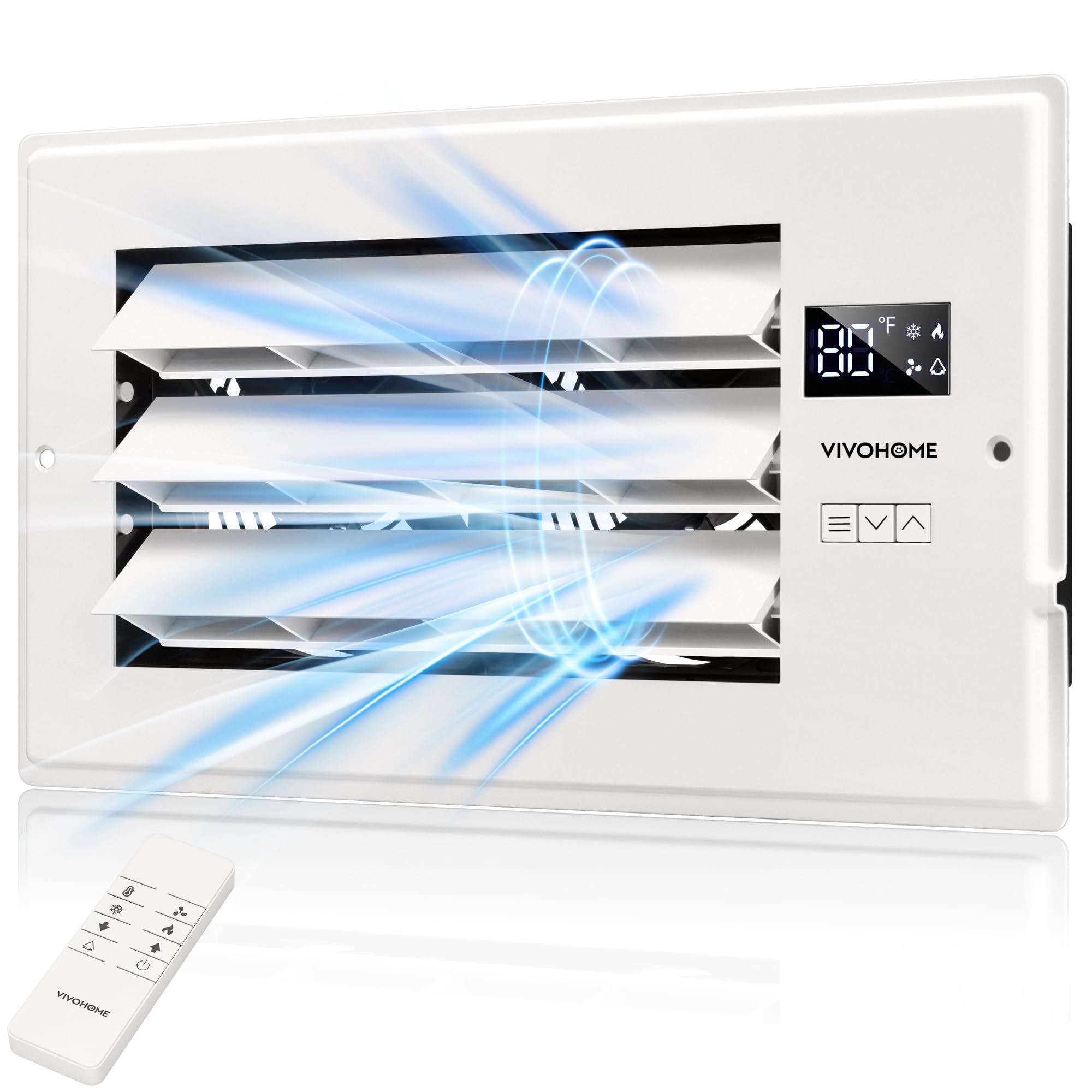
Built for the big 6″ x 12″ vent, with louvers you can aim where you want the air.
Most register fans are sized for a 4″ x 10″ hole. This one is not — it fits openings from 11.8″ to 12.6″ long and 5″ to 7.6″ wide, with at least 2.2″ of depth. That makes it the answer for a large floor, wall, or ceiling vent that the smaller models can’t cover. Measure the opening before you order, because 6″ x 12″ is a different cutout than 4″ x 10″.
The airflow features are where it earns attention. Adjustable louvers swing from 60° to 120°, or you can set auto-swing for full room coverage — directing the heated or cooled air exactly where you want it. There are 10 speeds on the remote, an EC motor rated below 18 dB, and a fan-only mode that keeps air moving after your AC shuts off at night. You can leave the louvers open for ventilation or closed to hold treated air in.
Functionality is what owners praise most, and quality follows close behind. It integrates cleanly with air conditioning in normal use and lifts airflow in rooms that felt stuck. A memory recall that restores your settings after a power outage and a child safety lock are the kind of small touches that matter more the longer you own it. Its 2.6-pound aluminum-and-ABS body installs on floors, walls, or ceilings.
What earns it a place
- Fits the larger 6″ x 12″ opening that smaller register fans can’t touch
- Adjustable louvers (60°-120°) plus auto-swing aim air precisely
- 10 speeds with a remote and a below-18 dB rating on quiet settings
- Memory recall after an outage and a child lock add everyday convenience
Weigh these before buying
- Limited to 6″ x 12″ openings — the wrong fit for a standard 4″ x 10″ vent
- Temperature control, noise, and installation all divide opinion in owner feedback
- Needs a nearby outlet; the cord isn’t duct-routed
Best matched to: a home with a large 6″ x 12″ register that needs airflow aimed in a specific direction.
Think twice if: your vent is the common 4″ x 10″ size, or you need the quietest possible unit and installation simplicity.
5. Suncourt Register Booster Fan for Floor Vents (HC600)
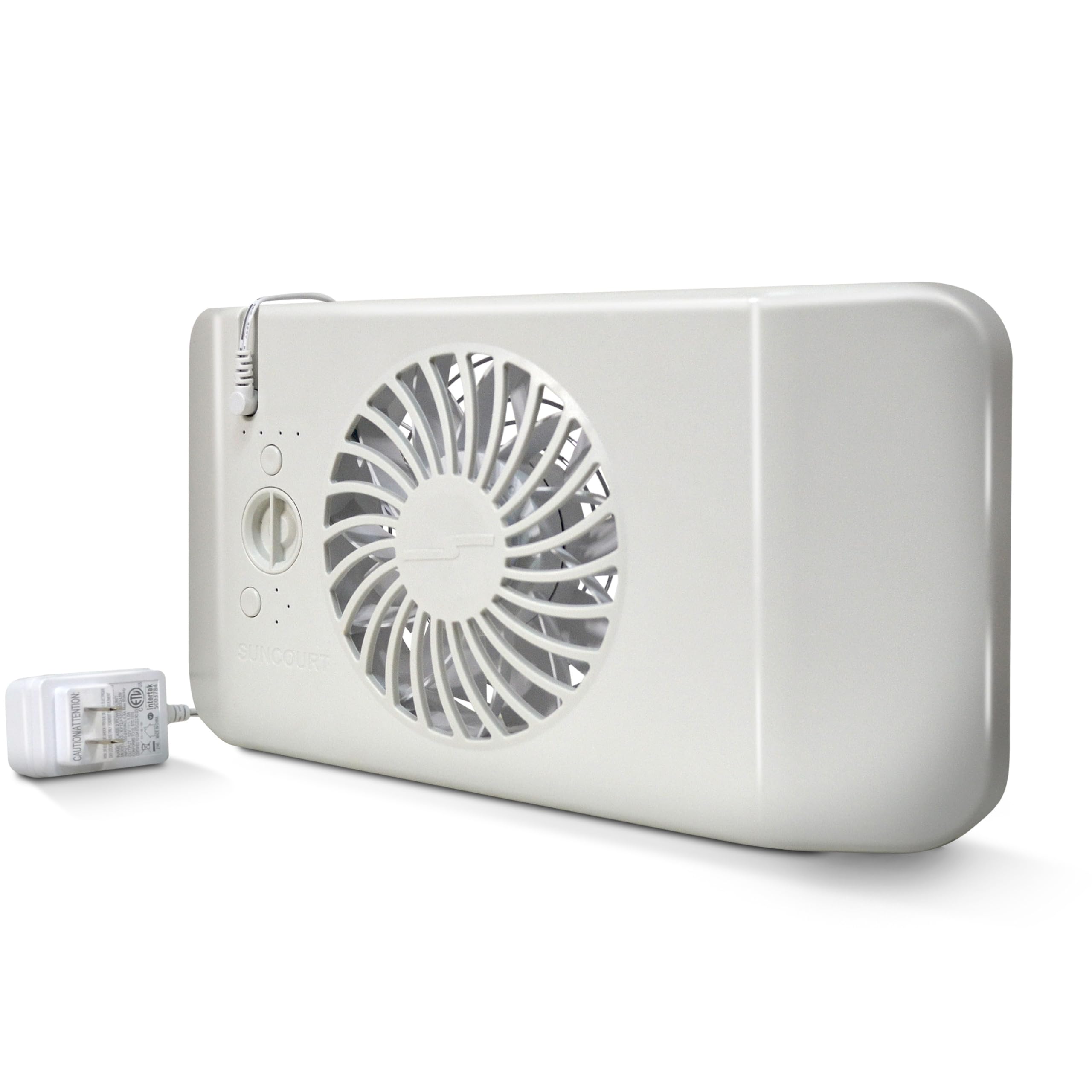
Drops into a floor vent and reads the pressure change to switch itself on.
That range is what makes it a floor specialist: measure the inside of the duct opening, not the cover, and it drops in for a flush, low-profile fit.
Tool-free setup is the selling point that keeps the install simple. Patented smart sensing turns the fan on automatically when your HVAC heats or cools, so there are no switches, thermostat wiring, or seasonal resets. You set it in the register, plug the 6-ft cord into a standard outlet, and it does the rest across 8 adjustable speeds. The maker credits it with increasing airflow up to 300% without HVAC modifications or extra ducting.
Performance is the word that repeats most in the feedback, with temperature control right behind. Owners describe rooms sitting 3 to 4 degrees cooler than normal once it’s running. The noise question divides people — some find it rather quiet, others say it’s a little loud — so set expectations for a fan that pushes this much air. It’s American-made and backed by a 3-year warranty, using flame-retardant, thermally protected materials.
The real selling point: 200 CFM in a floor vent drop-in, with auto on/off sensing that needs no thermostat wiring or switches.
The honest size of it: the noise on high is a genuine split, and the 6-ft cord needs an outlet close to the floor vent. If you need whisper-quiet at top speed, this isn’t that fan.
Fits your home if: you have floor vents up to 6×12 and want strong automatic airflow without calling a contractor.
Keep looking if: your vent is in a wall at 4″ x 10″, or you want the quietest possible register fan.
6. AC Infinity AIRTAP T4 Register Booster Fan

The register fan that talks to your phone, your voice assistant, and your HVAC system.
Nobody here matches it on control. The LCD display shows real-time room temperature and gives you customizable cooling and heating triggers, fan speeds, and timers. The included IR remote handles quick changes, it connects to Alexa or Google Home, and the app adds smart alerts, data charts, and advanced automations. If you like your home gear talking to each other, this is the vent fan built for it.
Underneath the smarts, it moves 130 CFM through a 4″ x 10″ duct opening with dual-ball-bearing fans driven by a PWM-controlled motor. The 12-foot cable gives you room to reach an outlet. It is designed exclusively for that 4″ x 10″ opening, so confirm the duct size before you order.
What owners rave about is the performance — equalizing bedroom temperatures and pulling hot or cold air from ducts is exactly what it’s bought for, and it delivers. In large rooms with limited vents, the boost is described as roughly doubling the volume of air. It’s also the most-reviewed fan in this group by a wide margin, which tells you how many people have put it through real seasons. The quiet side is more of a split, so plan for some fan noise when it works hard.
The standout spec: 130 CFM plus app, voice, and IR control across a 4″ x 10″ opening — the deepest control set in the group.
The one to know: noise draws mixed feedback, and the air gains happen at the register, not at a long duct run the way an inline fan would tackle it.
The right buy for: a 4″ x 10″ register where you want app scheduling, voice commands, and temperature-triggered automations.
Not your fit if: you want a silent fan at every speed, or your duct opening isn’t 4″ x 10″.
7. AC Infinity Automatic Booster Duct Fan 4″ Inline

An inline fan that senses pressure change and starts boosting without you touching a switch.
A differential pressure switch is the clever bit — it detects the change when your HVAC kicks in and activates the fan automatically, so there’s no manual adjusting. The switch can mount in any position, which improves directional airflow flexibility in tight duct runs. It fits a 4″ round duct and moves 230 CFM on five fan speed levels driven by a PWM-controlled EC motor.
This is the pick for ductwork, not a floor grille. It sits inside the run to ensure heating or cooling actually reaches the far end, with dual ball bearings for sustained operation. The trade-off is noise: it’s rated at 60 dBA, closer to a normal conversation than a whisper. That’s the price of 230 CFM in a 4-inch duct, so hide it in a basement or mechanical space rather than beside a bed.
Reliability is what people praise most here, with the auto function and easy installation close behind. The airflow is described as genuinely strong — moving air effectively through ducts and cutting clothes drying time noticeably in real use. Value and pressure control draw a few more divided opinions, so set expectations that this is a workhorse inline fan rather than a quiet-room fan.
Where it pulls ahead
- Pressure switch auto-starts the fan when HVAC air moves — no manual adjusting
- 230 CFM across five PWM-controlled EC motor speeds
- Mounts in any position for flexible directional airflow
- Dual ball bearings support continuous inline operation
Where it costs you
- 60 dBA — closer to a normal conversation than a whisper
- Inline only, for 4″ round duct, not a drop-in register
- Pressure control and value divide opinion in owner feedback
Best for: a 4″ duct run in a basement or utility space where automatic boosting matters more than quiet.
Skip if: you need it beside a bedroom or in a finished room where 60 dBA will bother you.
8. Tjernlund DB-2 Duct Booster 275 CFM
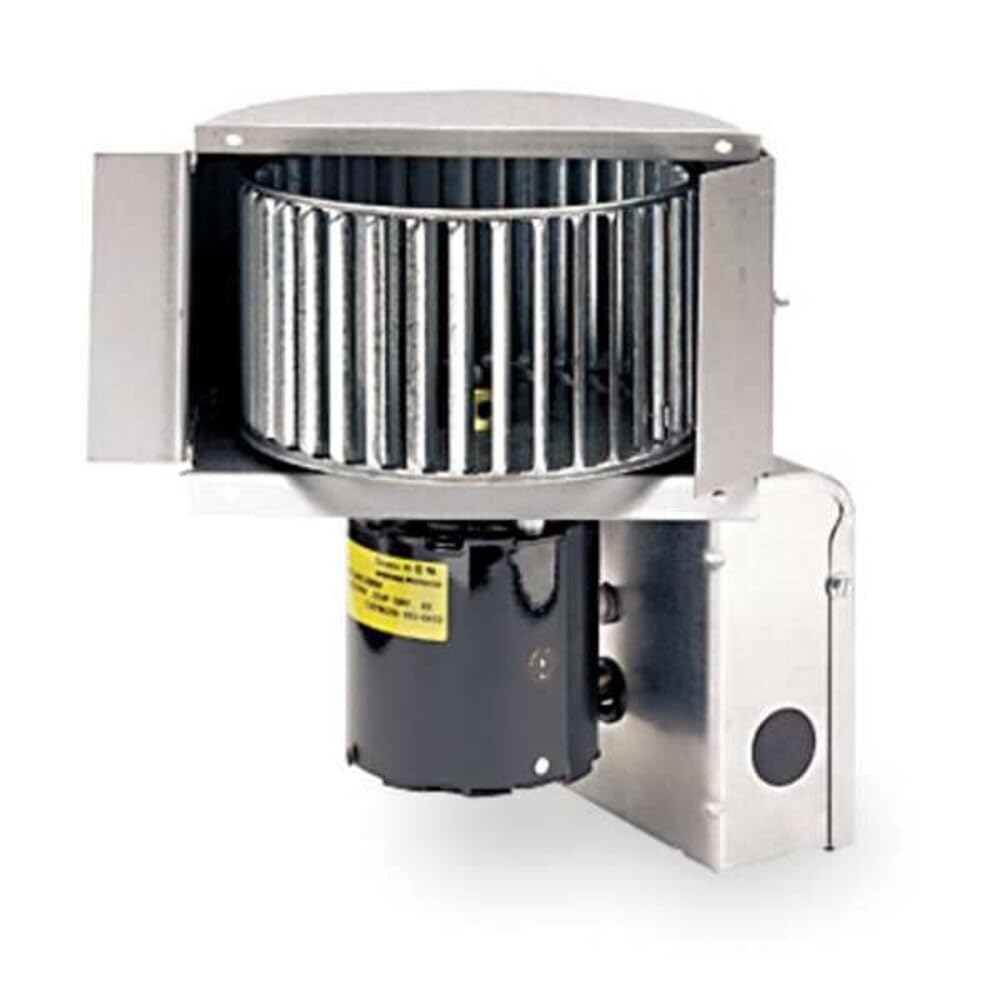
Fits round or shallow rectangular duct and toasts along at 275 CFM.
The fit is what makes it useful. It slots into 5 to 8 inch round duct, and it also fits rectangular duct as shallow as 3.25 inches — a range that covers old homes where the ductwork isn’t a tidy round tube. It’s rated to 200F, so it handles the heat side of the HVAC system, and it’s made in the United States with a galvanized steel finish that speaks to durability.
Airflow sits at 275 CFM, which puts it between the register fans near 120 CFM and the big inline models pushing past 400. That’s a sensible middle for a single branch line that needs a steady push. It installs as a built-in unit in the duct run, controlled with a touch-button controller.
Reliability carries it, and quality follows — owners describe it working well with a furnace and going in without fuss. The airflow and noise side splits: some say it moves a considerable amount of air and runs super quiet, others say it doesn’t provide much boost and can be noisy. Heat output and durability draw a few more mixed notes. It’s a solid retrofit for an awkward duct layout rather than a miracle worker for a system with bigger problems.
The case for it: one of the few fans that fits both 5–8″ round duct and rectangular duct as shallow as 3.25″, at a 275 CFM middle-ground rating and 200F heat tolerance.
The catch: airflow and noise both divide opinion, and it’s a duct-installed unit, so it suits someone comfortable working inside the ductwork, not a renter dropping a grille in.
Well suited to: older homes with shallow rectangular or 5–8″ round duct that needs a built-in boost on one branch.
Reconsider if: you want a quiet, drop-in register fan or your duct only needs a light lift.
9. Tjernlund RB12 Register Booster Fan 4 x 12″
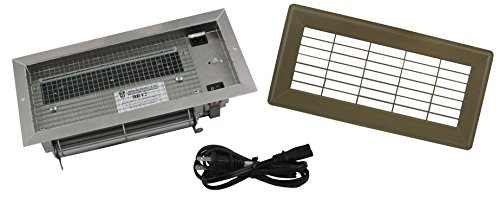
A 4 x 12″ floor register fan with a paintable grill and a screened blower.
The 4 x 12″ size separates it. If your vent is a long, narrow floor register rather than the common 4″ x 10″, this is built for that opening with a flush mount. It runs at 75 CFM (cubic feet per minute — how much air it moves) and 1,800 rpm (revolutions per minute — how fast the fan spins), which is a gentler push than the bigger register fans here — enough for a single room’s vent, not a whole-house fix. The blower wheel is screened to protect small fingers and block debris, and it plugs into a standard 120V outlet.
The details you live with: it’s made in the USA, comes with a paintable commercial-grade grill so it can match your floor, and includes a 6-ft power cord. The maker credits it with being 50% quieter than prop-style fans — a comparison that matters if your current booster rattles. It’s a brown grill, so plan on paint if your decor calls for it.
Functionality is what owners use it for, and it delivers — it works instantly on install and moves a lot of air for its size, with temperature drops described in the neighborhood of 9 degrees in real use. Noise is the more divided subject, as it is for most register fans, and fit requires the right cutout. For a 4 x 12″ vent you can’t match with a standard 4″ x 10″ unit, it’s one of the few real options.
Why owners keep it: it fits the 4 x 12″ opening, plugs into 120V, comes with a paintable grill, and screens the blower for safety.
The honest limit: 75 CFM is modest next to the 120-200 CFM register fans here, noise divides opinion, and the fit has to match your specific cutout. It’s a quiet-room fixer, not a whole-home answer.
The one to grab if: your floor vent is 4 x 12″ and a standard 4″ x 10″ fan simply won’t fit.
Better to look on if: you need maximum airflow for a large room, or your vent is any size other than 4 x 12″.
Know the Specs
CFM — the airflow number that decides the job
CFM stands for cubic feet per minute, the volume of air a fan moves each minute. A register fan often moves around 120 CFM, while inline duct fans climb from the 200s into the 400s. Match the CFM to what you’re trying to fix: one weak room vent usually needs a register fan in the 120-200 CFM range, while a long duct run feeding several rooms often calls for an inline fan. More CFM is not automatically better — it usually brings more noise.
Decibels — what the fan sounds like at night
A decibel (dB) is a measure of sound loudness. The dBA figure is the same scale adjusted to how human ears actually perceive sound, so it’s the number worth comparing. Roughly 18 dBA is close to a whisper, while 60 dBA approaches a normal conversation. Most register fans here rate near or below 18 dBA on their quieter speeds and climb with speed. If the fan shares a bedroom, check the dBA figure and favor a model with adjustable speeds so you can drop it low at night.
Duct and register size — the fit you can’t fudge
Register booster fans are sized by the duct opening, not the grille face you see in the room. A 4″ x 10″ fan needs a 4″ x 10″ hole; a 6″ x 12″ fan needs a larger one. Inline fans instead match round duct diameters, such as 4-inch or 6-inch. Before buying, pull the old cover and measure the opening, including the depth, so the fan neck clears any inward taper. A wrongly sized fan simply won’t seat.
Thermostat and pressure control — the set-and-forget layer
A thermostat-triggered register fan starts and stops based on the room temperature you set. An inline fan with a differential pressure switch instead starts when it senses the change in duct pressure as the HVAC kicks in. Either way, the goal is the same: air that boosts automatically when the system runs, without you flicking a switch each season. Remote, app, and voice control add convenience on top of that core behavior.
Common Questions
Will a vent booster fan fit my register if I only know the grille size?
Is a register booster fan or an inline duct fan better for a cold room?
How loud is a quiet vent booster fan at night?
Do I need an electrician to install a register booster fan?
Can a booster fan lower my room temperature noticeably?
What’s the difference between thermostat control and pressure-switch control?
Can I use an inline duct fan as a vent booster fan?
Do vent booster fans work with both heating and cooling?
Why doesn’t my booster fan seem to push much more air?
Can a vent booster fan run all day?
The Bottom Line
For most homes the best vent booster fan depends on where the problem lives. If a single weak room vent is the whole story, start with the VELLEE Quiet Register Booster Fan — it pairs solid temperature results with quiet running and a 4″ x 10″ fit that covers most registers. If you want the smartest control, the AC Infinity AIRTAP T4 adds app, voice, and IR control through that same 4″ x 10″ opening. And when the issue is buried in the ductwork rather than the vent, the Toolazy 6 Inch Inline Duct Fan is the one to reach for, with 405 CFM that no register fan here comes close to.
The honest nudge: the AC Infinity AIRTAP T4 wins on sheer review volume, but the higher-rated quiet pick is the VELLEE — check your duct size first, then buy the fit, not the marketing.
How we choose
We do not accept paid placement. Every pick is matched to a real buyer and a real use-case; we do not hands-on test units.
Sources
Specifications: manufacturer listings and product documentation. Review insights: verified customer reviews, as of November 2026. Pricing: not shown on this page (it changes often); check the current price via the retailer link.
As an Amazon Associate, Tactical Gear Guy earns from qualifying purchases. This does not affect which products we feature.