Specs are compiled from manufacturer listings and verified buyer reviews and can change over time — please confirm the key details on the product page before buying.
If you have a wet patch on the lawn or a water bill that keeps climbing, you want a tool that lets you hear the leak before you dig — and the Superior AccuTrak VPE PRO is the pick that turns an invisible hiss into a sound you can walk toward. A water leak listening device works like a doctor’s stethoscope for plumbing: it picks up the faint rushing or hissing noise water makes as it escapes a pressurized pipe, amplifies it, and lets you follow the volume up to the exact break. This guide covers five real options, from handheld kits that fit in a toolbox to professional survey units that map an entire underfloor system.
This guide is built by comparing the manufacturers’ published specifications and the patterns across verified customer reviews, so you get each pick’s real strengths and trade-offs instead of marketing spin.
You will see which unit suits a homeowner hunting a slab leak, which one a plumber can lean on daily, and which are overkill for a single job. The right pick here saves you from breaking concrete on a hunch. Everything below is filtered through the real question: which water leak listening device actually finds the leak without wasting your afternoon.
Top Picks

How To Choose The Best Water Leak Listening Device
The core job is simple: catch the noise a pressurized pipe makes when water escapes, and follow that noise to the source. What separates one unit from another is how well it hears a small leak, how cleanly it filters out background noise, and how precise its pinpointing gets. Skip any of those three and you end up with a detector that beeps vaguely and sends you digging in the wrong spot.
Sensor type and how the sound reaches your ears
Most units fall into two camps. A contact probe sits directly on a pipe, valve, or wall and picks up vibration through solid material — ideal for exposed plumbing and indoor lines. An ultrasonic sensor or ground microphone catches airborne or ground-borne sound through the floor or turf, which is what you need for underground pipes and slabs. Some kits ship both, which is why a professional kit costs more than a handheld locator.
Frequency range and amplification
Leaks hiss across a band of frequencies, and the faint ones sit in a narrow slice. A detector with an adjustable frequency setting lets you tune into the band where the leak is loudest and mute the rest. A wide range, like the 1-10000Hz sweep on the PQWT L2000, gives you more room to hunt. A narrow fixed band works fine for obvious leaks but struggles on slow weeps.
Noise cancelling and the visual readout
Real sites are noisy. A headset that blocks outside sound, plus a signal bar or numeric display that rises as you get closer, is often the difference between a confident find and a guess. Watch for a unit that shows you a number or graph, because your ears alone can be fooled by pumps and traffic.
Side-by-Side Comparison
| Model | Best For | Sensor Type | Frequency / Range | Weight | Amazon |
|---|---|---|---|---|---|
| Superior AccuTrak VPE PRO★ Best Overall | All-round pro kit | Ultrasonic | 0 Hz to 4 kHz audio output | 5.3 pounds | Amazon |
| PQWT PQ125A (B0FPFRQ2CS)Top Performer | Wall and narrow-space work | Dual membrane resonance (DMR-H40 / DMR-V59) | 0.5 meters depth | 5 kg | Amazon |
| PQWT PQ125A Sewer (B0FPCLW5NT) | Easy touchscreen operation | Dual membrane resonance (DMR-H40 / DMR-V59) | 0.5 meters depth | 5.35 kg | Amazon |
| Redants RX006 | Metal and PVC pressure lines | Vibration sensor (dual-size sensors) | Four frequency settings | — | Amazon |
| PQWT L2000 | Deep outdoor ground scans | Single medium sensor | 1-10000Hz / 1640 feet | 0.75 kg main unit | Amazon |
Detailed Reviews
1. Superior AccuTrak VPE PRO Ultrasonic Leak Detector
Our pick — 4.0+★ from 20+ verified ratings; the strongest balance of quality and price.
The complete pro kit that hears a leak, then shows it on a bar graph so your ears and eyes agree.
What makes this the top pick is the way it converts the inaudible into something you can actually use. The VPE PRO takes ultrasonic sound (the high-pitched noise a leak makes that sits above what human hearing catches) and shifts it down into a 0 Hz to 4 kHz audio range, so you hear the leak as a natural hiss through the noise-blocking headphones. That shift is the whole trick — you are not straining to hear a whistle, you are listening to a sound your brain easily tracks.
Then there is the visual side. A 10-element bar graph lights up as you get closer to the leak, giving you a quick read even when a pump or traffic is drowning out the audio. The kit itself is complete: the detector, a battery, a touch probe for contact work on pipes and valves, a waveguide, the noise-blocking headphones, and a large carry case. At 5.3 pounds it is a benchtop-grade tool you carry by the handle, not a pocket gadget.
The honest trade-off is that this is a serious professional instrument, and the buyer feedback reflects that split. The crowd verdict sits at 4.0+ stars across a modest base of owners — happy pros who lean on it daily, and a few who found the learning curve steeper than expected. If you want a plug-and-point handheld, this is more tool than you need. But for someone who wants to hear the leak, confirm it with a visual, and move on, it earns the top spot.
What it gets right
- Ultrasonic sound shifted to 0 Hz to 4 kHz audio so leaks are easy to hear
- 10-element bar graph gives a visual read when audio alone is unclear
- Full kit: detector, battery, touch probe, waveguide, headphones, hard case
- Contact probe handles pipes and valves; waveguide targets airborne leaks
Where it asks more of you
- Heavier at 5.3 pounds — a carry-by-handle tool, not a pocket unit
- Pro-grade learning curve; not a plug-and-point device for a one-time homeowner
Reach for it if: you are a plumber or serious DIYer who wants audio plus a visual signal on every job.
Pass if: you need a cheap single-use locator for one hidden leak behind a wall.
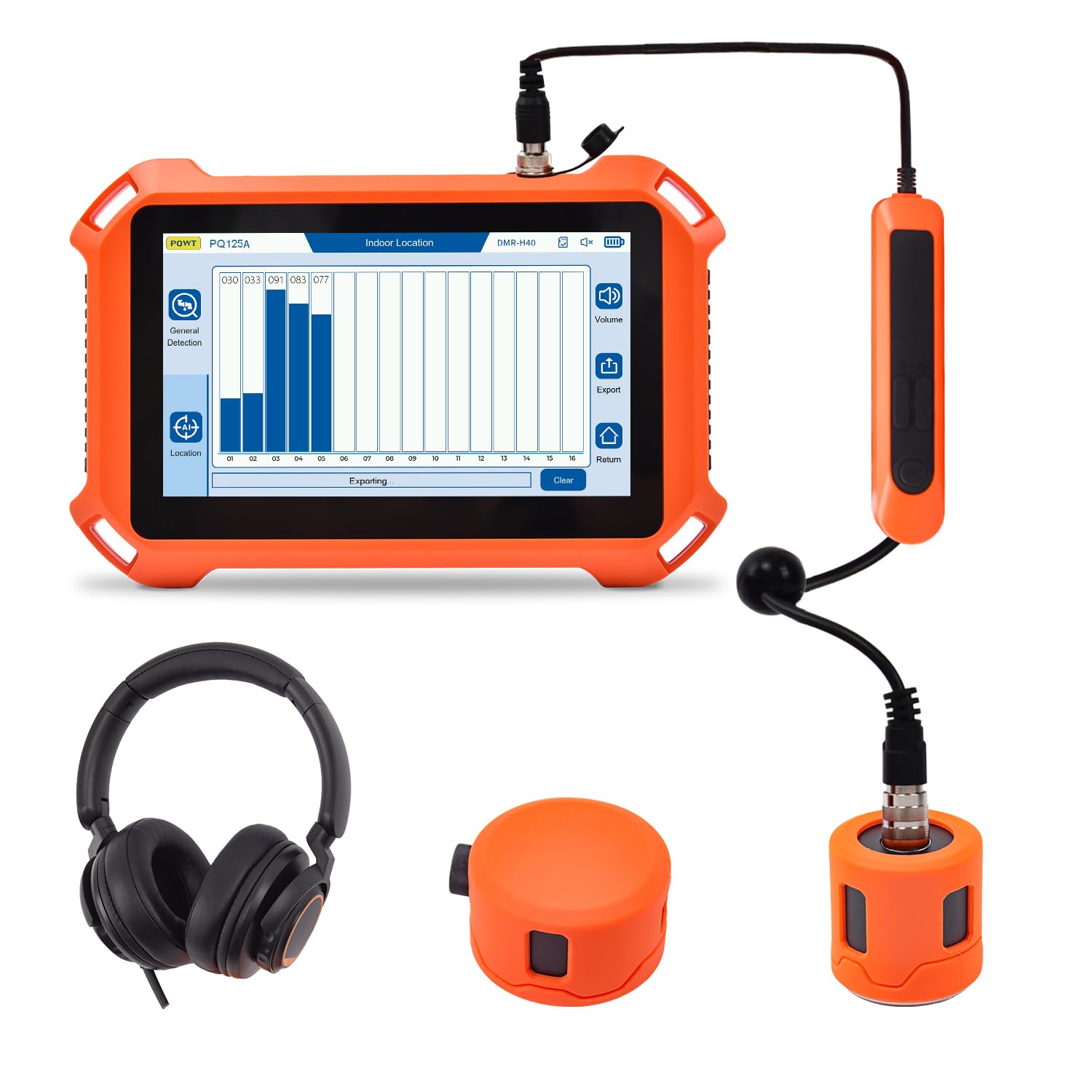
2. PQWT PQ125A Underground Water Leak Detector
Two sensors and one very precise number: this is the wall-and-floor specialist that pins a leak to within a hand’s width.
The detail that matters most here is the 10cm accuracy of its Location Mode (a setting that homes in on a single spot rather than scanning broadly). That means it does not just tell you a leak exists — it points you to a spot roughly the size of a sheet of paper, which is exactly what you need before cutting into a wall. A General Detection Mode lets you sweep a large area first, saving time, before you switch to pinpointing.
Its two sensors split the work by surface. The DMR-H40 handles walls and narrow spaces, while the DMR-V59 is meant for indoor pipe leakage. Both use a dual membrane resonance design (a piezoelectric element that responds to the faint high-frequency tremors of escaping water), so the unit reacts to leaks your ears would never catch. It is built around an adjustable handle for people of different heights, and the IP54-rated case (splash and dust resistant) tolerates rough sites. It ships with a two-year manufacturer warranty on the host and speaks 12 languages.
Compared with the smaller handheld locator further down, this one is far heavier and bulkier — a 5 kg unit that travels in a case, not a pocket. That bulk buys you the two sensors and the fine precision, so the trade is portability for pinpoint accuracy. If you do wall-and-floor diagnostics regularly, that trade is worth it.
The precision payoff: Location Mode accuracy to within 10cm turns a fuzzy “somewhere in this wall” into a marked spot you can act on, and the two-sensor setup covers both vertical walls and indoor lines.
The trade you accept: at 5 kg with an adjustable handle and a case, it is a transport-and-set-up tool rather than a quick grab-and-go checker.
Best matched to: a technician who works walls and floors and needs an exact spot to open up.
Think twice if: you want to carry one unit up a ladder in a pocket — the size and weight will push back.
3. PQWT PQ125A Underground Water Leak Detectors

The PQ125A twin aimed at first-timers, with a touchscreen that coaches you through the find.
What sets this version apart is the interface. Its factory-built touchscreen walks you module by module with on-screen guidance and error pop-ups, so someone who has never chased a leak can still work the device. In Location Mode it captures signals from sixteen points and holds them in a data-collection box on screen, then compares the strengths so you can see — not guess — where the leak sits.
The sensing is the same dual membrane resonance setup as its sibling, with the DMR-H40 and DMR-V59 sensors using a double-layer piezoelectric ceramic membrane tuned to a specific frequency. That tuning lets it catch leak sounds inaudible to the human ear. It is a 5.35 kg unit that runs on a nonstandard battery and ships with a host, headphones, charger, USB cable, strap, control handle, both sensors, and a carry case.
This is the one I would hand to an anxious homeowner who wants the guidance baked in. The general-then-location workflow means you sweep the room, then narrow down, which suits pressure-pipe hunting in homes and sewers. It carries a two-year warranty on the host and lifetime maintenance, and it speaks 12 languages. The caveat is practice: the touchscreen guidance is helpful, but you still need a quiet moment and a steady hand to read the signal swings correctly.
Choose this when: you are new to acoustic detection and want the screens to teach you as you go.
Look past it if: you already know the workflow and would rather skip the hand-holding for a faster read.
4. Redants RX006 Underground Pipe Leak Detector

Honest about its limits up front — this one is tuned for real flow, not the faintest drip.
Start with the caveat, because it is the most useful thing the maker tells you: this unit is not for drip leaks. A slow seep makes too little sound to locate reliably, and the device works best when a leak has enough flow to create a detectable signal. If the noise is weak, the standard field move is to pressurize the pipe, which makes the leak louder and easier to pick up. Knowing that up front saves you from misreading a quiet result as a bad tool.
On the right job it is well equipped. You get two sensors of different sizes to suit different environments, a high-definition LCD that shows the detection value (the higher the number, the closer you are), and noise-cancelling headphones for clear audio in loud spots. Four frequency settings switch with one click to match metal pipe, PVC pipe, noisy sites, and low-flow leaks. The frame is high-strength aluminum alloy with an engineering-grade ABS shell, built to take knocks on site.
The owner feedback is a fair picture of a working instrument: it functions like a charm for most, while the tracking itself draws mixed notes — which fits a tool that shines on flowing leaks and struggles on whispers. It is a sensible middle pick if your problem is a rushing pipe, not a slow weep behind a wall.
Strong points on the job
- Two different-size sensors adapt to varied detection environments
- Numerical LCD reading climbs as you near the leak
- Four one-click frequencies match metal, PVC, noisy sites, and low flow
- Aluminum alloy frame and ABS shell resist knocks and wear
Honest limits
- Explicitly not built for drip leaks — a weak signal may read unclear
- Tracking accuracy draws mixed results, so pressurize the pipe for a better read
Made for: a flowing leak in an exposed or accessible pressure line where a clear signal exists.
Not the pick for: a hidden slow drip that makes almost no noise — no listener will catch that reliably.
5. PQWT L2000 Water Leak Detector for Outdoor Pipe

Built for the yard, not the wall: five meters of ground-penetrating reach with a huge frequency sweep.
This is the outdoor specialist. Its detection depth reaches 5m (about sixteen feet under the surface), which is the number to fix on if your leak is buried under a lawn, hardened ground, or a mud patch. It ships with a single versatile medium sensor rather than a pair, built to perform on all outdoor surfaces — the trade being it is not the wall-and-indoor specialist the dual-sensor kits are.
The way it works is both audio and visual: it captures the sound of a leak through the sensor, processes it, and shows the data as a spectrum and signal bars on screen while playing the audio through headphones. That double read is how you confirm a leak by ear and by eye. The frequency range stretches 1-10000Hz, giving you a wide band to hunt a faint leak. The main unit weighs 0.75 kg, it has a long battery life of 15 hours on standby, charges by 5V USB, and tolerates a wide operating temperature range from -20℃ to +50℃.
It is the deepest-reach unit here and priced accordingly, which makes it a specialist buy rather than a first tool. The owner response sits at 3.0+ stars, so go in with grounded expectations: it is a reliable outdoor ground scanner for buried lines, not a miracle worker for a faint indoor seep. If your leak is out in the yard, this is the reach you need.
Where it goes deep
- Detection depth to 5m for buried outdoor lines under grass or hardened ground
- 1-10000Hz frequency range gives a wide band for faint leaks
- Screen shows spectrum and signal bars so you can read as well as listen
- 0.75 kg main unit, 15-hour standby battery, 5V USB charging
- Handles -20℃ to +50℃ operating temperatures
The catch to know
- Single medium sensor — not the wall-and-indoor pairing the dual-sensor kits offer
- A deep-outdoor specialist, so it is the wrong tool for an indoor drip
Worth it for: buried outdoor leaks under turf or hardened ground where you need real depth.
Turn away if: the leak is behind a wall or under a floor indoors — this unit is aimed at the yard.
Know the Specs
Frequency range and why it matters
A leak hisses across many frequencies, and the faint ones sit in a narrow slice. A detector with a wide range or adjustable setting lets you tune into the band where the leak is loudest and mute the rest. The PQWT L2000’s 1-10000Hz sweep gives a broad hunting ground, while the Redants and RQG units step through four settings. More range is not automatically better — the ability to pick the right band on the day is what counts.
Detection depth for underground pipes
Depth tells you how deep under the surface the sensor can still catch a leak signal. A unit rated to 5m, like the PQWT L2000, is built for buried outdoor lines under a yard. The PQ125A models list a 0.5-meter maximum range, aimed more at indoor and near-surface work. Match the depth to your problem — deep means outdoor; walls and indoor lines favor a contact or dual-sensor unit.
Contact probe vs ground microphone
A contact probe sits on a pipe or valve and listens through solid material, so it is ideal for exposed plumbing. A ground microphone or ultrasonic sensor catches sound through the air or turf, which is what you want underground. Handheld kits often include a touch probe for walls and a waveguide for airborne leaks. If you work both, a kit with both attachments saves you from buying two tools.
Noise cancelling and visual readouts
Real sites hum with pumps, traffic, and footsteps. A headset that blocks outside sound keeps the leak audio clean, and a signal bar or numeric display that climbs as you approach gives a second confirmation. The VPE PRO’s 10-element bar graph and the RQG’s numeric display use that same climb-toward-the-leak logic. Trust the visual when the audio gets muddy.
Common Questions
Will a leak listening device find a slow drip behind a wall?
How deep can a water leak listening device detect underground?
What is the difference between a contact probe and a ground microphone?
Do I need headphones to use a leak detector?
How do I know which direction to move toward the leak?
Can a leak detector tell a water leak from a sewer or gas leak?
Is an ultrasonic detector better than an acoustic one?
How long does the battery last on a leak detector?
Can I use a leak detector on PVC as well as metal pipe?
The Bottom Line
For most people hunting a water leak, the water leak listening device that earns the top spot is the Superior AccuTrak VPE PRO, because it turns the leak into audio you can hear and a bar graph you can see, with a touch probe and waveguide to cover pipes and airborne leaks. If your leak sits behind a wall or under a floor indoors, the PQWT PQ125A pins it to within 10cm. And for a buried leak out in the yard, the PQWT L2000 reaches 5m down — the depth you need when the pipe is under turf or concrete.
How we choose
We do not accept paid placement. Every pick is matched to a real buyer and a real use-case; we do not hands-on test units.
Sources
Specifications: manufacturer listings and product documentation. Review insights: verified customer reviews, as of November 2026. Pricing: not shown on this page (it changes often); check the current price via the retailer link.
As an Amazon Associate, Tactical Gear Guy earns from qualifying purchases. This does not affect which products we feature.