Specs are compiled from manufacturer listings and verified buyer reviews and can change over time — please confirm the key details on the product page before buying.
You already know the machine is unhappy — the noise changed, the housing hums a little hotter, and the whole motor starts to feel rough under your hand. What you need is a number instead of a hunch, and that is the entire job these instruments do. Below you will find the picks that measure vibration properly, from a handheld meter you can slip into a tool bag to a wired analyzer that logs hundreds of readings.
This guide is built by comparing the manufacturers’ published specifications and the patterns across verified customer reviews, so you get each pick’s real strengths and trade-offs instead of marketing spin.
Top Picks

How To Choose The Best Vibration Monitoring Equipment
Buy the meter that matches the fault you are chasing, not the biggest spec sheet. A maintenance tech checking a fan once a month needs something completely different from an engineer trending a gearbox every week.
Start with the three measurements, not the brand
Acceleration (how violently the housing is slamming, in m/s²) catches the fast, sharp problems. Velocity (how fast the housing is moving, in mm/s) is the classic overall-condition reading for rotating machinery. Displacement (how far it travels, in µm or mm peak-to-peak) suits slower machines where the whole shaft visibly rocks.
A meter that gives you all three covers far more ground than a single-parameter tool. If it only reads one, you will eventually meet a fault you cannot see.
Check the frequency range against your machines
Bearings and gear meshes generate vibration at higher frequencies than the shaft itself. A meter topping out in the low hundreds of hertz will never show you early bearing wear; one that reaches into the kilohertz range will. Look at the high-frequency figure in the specs and ask whether it covers the equipment you actually maintain.
Dual-mode meters that switch between a structural low range and a high-frequency range are the practical answer for mixed fleets — you flip a switch instead of buying a second instrument.
Decide if you need memory and software
Spot checks need no memory; a reading you write on a clipboard is enough. But the moment you want to compare this month against last month, you need stored readings and a way to move them to a PC. Meters with internal memory and a USB or PC link turn a diagnostic tool into a trend tool.
Mounting matters as much as electronics. A magnetic external probe that returns to the same spot on a bearing housing gives you a comparable reading next time — the same sensor, the same angle, the same contact pressure.
Side-by-Side Comparison
| Model | Best For | Velocity Range | Weight | Frequency / Sampling | Amazon |
|---|---|---|---|---|---|
| PM63A Vibration Meter Handheld★ Best Overall | Everyday field spot-checks | 0.1–199.9 mm/s RMS | 4.8 ounces | — | Amazon |
| AS63B Digital Vibration MeterBest Value | Factory and HVAC inspections | 0.1–199.9 m/s measured scale | 1.58 pounds | — | Amazon |
| EVB-02 Wi-Fi Vibration & Motion Sensor | R&D and remote logging | — | 120 g | up to 6.66kHz | Amazon |
| PM633C Digital Vibration Meter | Detailed on-screen analysis | 1–850 mm/s RMS | 8 ounces | 30Hz–14KHz | Amazon |
| Industrial Vibration Meter VM-428 | Rough machinery and bearings | 1–850 mm/s RMS | 7.8 ounces | 30Hz–14kHz | Amazon |
| Extech 407860 Heavy Duty Vibration Meter | Acceptance checks and trending | to 200 mm/s (7.87 in/s) | 14.1 ounces | — | Amazon |
| Fluke 805 FC Vibration Meter | Consistent readings across users | — | 13.7 ounces | — | Amazon |
Detailed Reviews
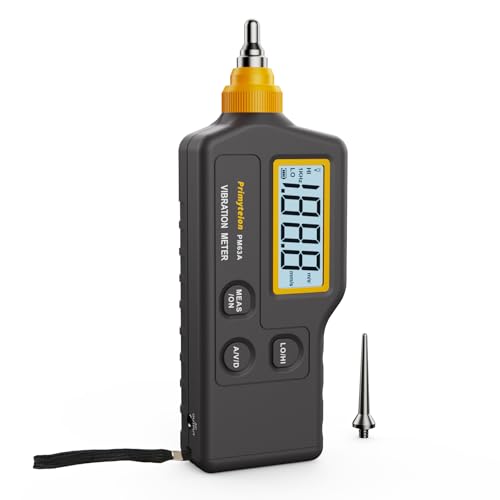
1. PM63A Vibration Meter
Our pick — 4.5+★ from 20+ verified ratings; the strongest balance of quality and price.
4.8 ounces of meter that reads three fault types and fits in a jacket pocket.
If you maintain motors, fans, compressors, gearboxes or pumps and you want one instrument in your bag, this is the one to start with. It reads acceleration from 0.1 to 199.9 m/s² peak, velocity from 0.1 to 199.9 mm/s RMS and displacement from 0.001 to 1.999 mm peak-to-peak — three different fault views from one handheld device.
The sensor doing that work is a piezoelectric ceramic accelerometer of the shear type, a small crystal element that turns housing movement into voltage. Verified accuracy is ±5% plus 2 digits, which is a normal tolerance for a field meter rather than a lab instrument. What you get from that is a defensible number for looseness, resonance and bearing wear, spotted before the failure rather than after it.
At 4.8 ounces versus the PM633C at 8 ounces, it hangs in a pocket or a small pouch all day without dragging. The runtime claim is 20 hours of continuous use — enough for repeated walk-rounds on a single charge. Primyteion ships a long and short probe, the battery, a calibration report and a carrying case in the box, which means you are not hunting for accessories before your first inspection.
Loads Of Meter For The Money
- Reads acceleration, velocity and displacement on one device
- Weighs 4.8 ounces, lighter than the PM633C at 8 ounces
- 20-hour continuous runtime suits full shift walk-rounds
- Ships with calibration report and carrying case
Where It Stops
- Accuracy of ±5% plus 2 digits is field-grade, not lab-grade
- The maker publishes no frequency range, so high-frequency bearing detail is unstated
- No PC software or data logging in the listed contents
Reach for this: a maintenance tech who wants three measurements, a calibration paper trail and a two-digit-ounce meter in one purchase.
Look elsewhere: if you need trend logging over months or detailed high-frequency bearing analysis — the PM633C or the Fluke cover that ground.
2. AS63B Digital Vibration Meter, LCD Portable Vibrometer
The straightforward shop-floor vibrometer that does the three basics and nothing fussy.
For HVAC work and routine motor checks, this is the sensible entry point. One handheld device covers acceleration, velocity and displacement, so you can identify imbalance, looseness, misalignment and bearing wear without carrying a scope or calling in a specialist.
The large LCD (the screen that shows your reading) is the part that matters on a noisy factory floor, because you can read it without leaning into the machine. A compact meter also means faster inspections — Walfront pitches this squarely at maintenance engineers and technicians working in factories, workshops and the field.
It runs on standard batteries rather than a rechargeable pack, which suits a meter that sits in a toolbox between inspections.
Built for routine rounds: the three modes plus a readable screen make this a practical daily-carry meter for anyone who walks the same machines on a schedule and just needs repeatable numbers.
The catch: the listing gives no frequency range or stated accuracy figure, so if your job includes diagnosing high-frequency bearing faults, the PM633C and VM-428 publish the numbers you need and this one does not.
Best fit: HVAC technicians and in-house maintenance teams who want one simple meter for spot readings.
Step up to a higher tier: if your reports require documented ISO severity ratings or stored trend data.
3. EVB-02 Wi-Fi Vibration & Motion Sensor

A stick-on sensor that streams vibration data over Wi-Fi and keeps logging when it cannot.
This is a different animal from the handheld meters above. It mounts with adhesive, captures motion on three accelerometer axes and three gyroscope axes, and reports fine detail down to 0.000061 g and 0.0044 °/s. That resolution is the point: you are profiling motion, not just catching a rough-running motor.
The frequency ceiling is where it beats the handheld field tools — up to 6.66kHz, well above the 1KHz velocity and displacement band on the PM633C and VM-428. Sampling that high matters when you are studying impact events, bearing harmonics or a prototype that rattles at speed.
The 5000 mAh Li-ion battery (a rechargeable pack rated for roughly 80 hours of continuous use) charges over USB-C. Wi-Fi mode streams live, and AP Mode logs locally with no extra gateway or software required — useful in a test cell with no network. There is a catch worth knowing up front: live graphs and the analytics on evbdata.com are a subscription, so the smart side of the system carries an ongoing cost. It also maxes out at 5 volts supply, which is how a small rechargeable sensor is meant to run.
Why engineers like it: a 6-axis IMU (an inertial sensor that tracks acceleration and rotation together) gives you both linear shock and angular motion in one small adhesive-mounted unit.
What to plan for: the cloud analytics sit behind a subscription, and one unit is one sensor — multi-point coverage means buying more of them.
Worth it for: R&D labs, test rigs and anyone who needs timestamped streaming data rather than a single number on a screen.
Not the tool for: a tech doing a two-minute motor check — a handheld meter is faster and simpler for that.
4. PM633C Digital Vibration Meter, Measurement Analysis
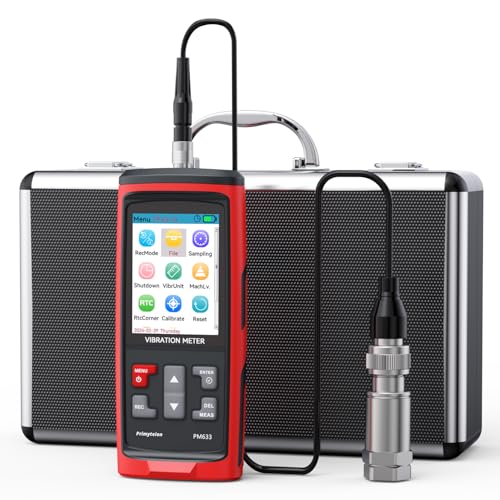
Three hundred and ninety-seven thousand stored readings and an ISO severity scale on a color display.
This meter gives you more measurement range than the PM63A. A piezoceramic shear-type accelerometer (a sensor that measures vibration by shear force) feeds readings of acceleration from 0.1 to 300 m/s² peak, velocity from 1 to 850 mm/s RMS and displacement from 1 to 3300 µm. Its stated accuracy is ±1.5% plus 2 digits — a tighter figure than the PM63A’s ±5%, so your trend data drifts less over time.
The frequency window runs 30Hz to 14KHz across high and low modes, with acceleration covered from 20Hz to 12KHz and velocity and displacement from 20Hz to 1KHz. In plain terms, you can hear the fast, faint bearing signals that sit far above the shaft speed. Add a built-in ISO vibration severity rating and you can tell an operator at a glance whether the machine is fine or needs attention soon.
The color TFT screen (a full-color display rather than a plain segment readout) shows max, min and average figures plus line graphs. You also get machine grade selection, an auto high/low speed line switch, adjustable sampling time, screen brightness and low battery indication. At 8 ounces it is 3.2 ounces heavier than the PM63A, and it sits taller in the case. Storage runs to 397000 readings, transferable to PC software for records — the calibration report is in the box.
What The Numbers Buy You
- ±1.5% plus 2 digits accuracy, tighter than the PM63A’s ±5% plus 2 digits
- 30Hz–14KHz range covers structural and high-frequency bearing work
- Built-in ISO severity rating for instant pass or fail readouts
- Stores up to 397000 readings and exports to PC software
Fair Warnings
- 8 ounces versus the PM63A’s 4.8 ounces, so it is the heavier walk-round choice
- The PC software needs a download and setup before you get data off the meter
- Temperature reading is part of the package, not a separate thermometer
Pick this if: your reports need ISO ratings, trend files and a tighter accuracy spec than a basic field meter gives.
Stay with the PM63A if: you only ever want a quick number and never plan to log anything.
5. Industrial Vibration Meter VM-428 Analyzer
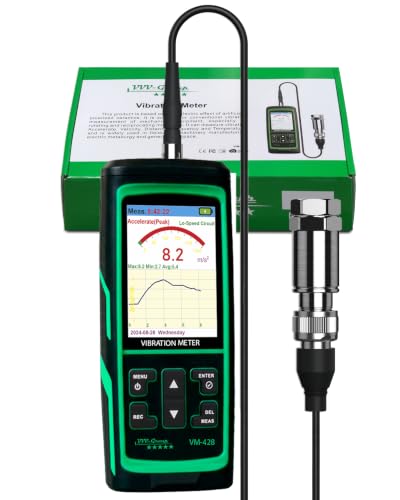
The analyzer that puts the sensor on a cable so hard-to-reach bearing housings still get read.
A fixed probe only works where you can hold the meter square against the machine. The VM-428 moves the measurement point onto an external piezoelectric shear-type probe with a magnetic base, so you can plant it on a gearbox or motor housing and take a stable, repeatable reading without contorting your arm. That cabled probe is the feature that makes it the most versatile meter in this lineup.
The parameter list is broad: acceleration 0.1–300 m/s² peak, velocity 1–850 mm/s RMS, displacement 1–3300 µm peak-to-peak, frequency 30Hz–14kHz and temperature. A dual frequency circuit lets you switch between a low mode for structural vibration and a high mode for the signals tied to mechanical wear and bearing condition. A built-in ISO machine condition rating helps you read the severity of a velocity level without doing the comparison in your head.
You can store large datasets in internal memory and export them over USB to PC software for documentation and trend comparison. The backlit color LCD shows values, graphical trends and max, min and average figures. At 7.8 ounces it is roughly half the weight of the Extech’s 14.1 ounces, so you can carry it all day without fatigue. Its 5.91 x 3.94 x 1.97 inch package is bulkier than the Extech’s 2.4 x 1.6 x 5.9 inch body, so check your tool bag before committing. One honest limit, straight from the maker: this is a periodic diagnostic tool, not a permanently installed monitoring system and not a multi-channel lab spectrum analyzer.
The field argument: a cabled magnetic probe plus high-frequency mode plus USB export is a genuinely capable diagnostic kit for rotating machinery, and the weight makes long inspections easier.
Know your scope: buy it for scheduled condition checks — if you need continuous 24/7 monitoring, this is not that product.
This one is for: technicians diagnosing motors, turbines, pumps and compressors who need the sensor on a lead.
Wrong tool if: you expect a permanently wired, always-on monitoring system.
6. Extech 407860 Heavy Duty Vibration Meter
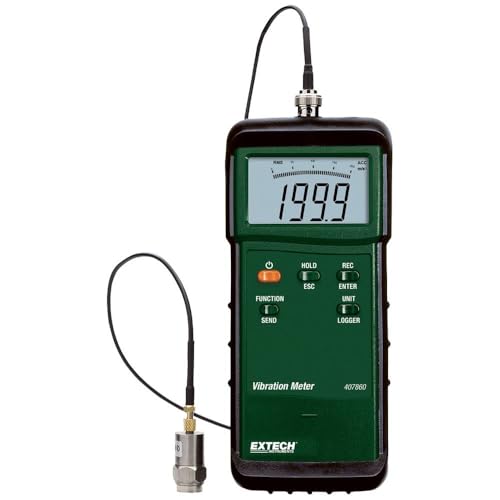
Built for the tech who has to prove a machine is better after the rebuild.
Acceptance checks and rough-running troubleshooting are where this meter earns its keep. It reads acceleration to 200 m/s², velocity to 200 mm/s and displacement to 2 mm — three separate quantities, each surfacing a different class of fault.
The detail that separates it from cheaper handhelds is the dual detection mode. It reports both RMS (an average-type figure) and peak (the highest spike), because a vibration number means nothing against a standard or against last month’s reading unless you know which detection produced it. That single feature is what makes real trend comparison possible.
Mounting is equally deliberate. The sensor sits on a 39 in cable and attaches magnetically or on a stud, so it lands square on a bearing housing and returns to the same place next time. Memory stores up to 500 readings automatically or manually, with recall, and downloads to a PC with the optional Windows-compatible software. At 14.1 ounces it is nearly twice the VM-428’s 7.8 ounces, so it is a bench-and-belt meter rather than a pocket one.
The trend-first design: RMS and peak modes plus a repeatable magnetically mounted sensor is exactly the setup you want for comparing a machine against itself over time.
Budget for the software: the Windows-compatible package that pulls data to a PC is optional, so the full trend workflow needs that extra purchase.
Choose it when: you sign off on rebuilds and need before-and-after numbers that stand up to scrutiny.
Skip the extra if: you only want a single current reading — a lighter handheld covers that.
7. Fluke 805 FC Vibration Meter
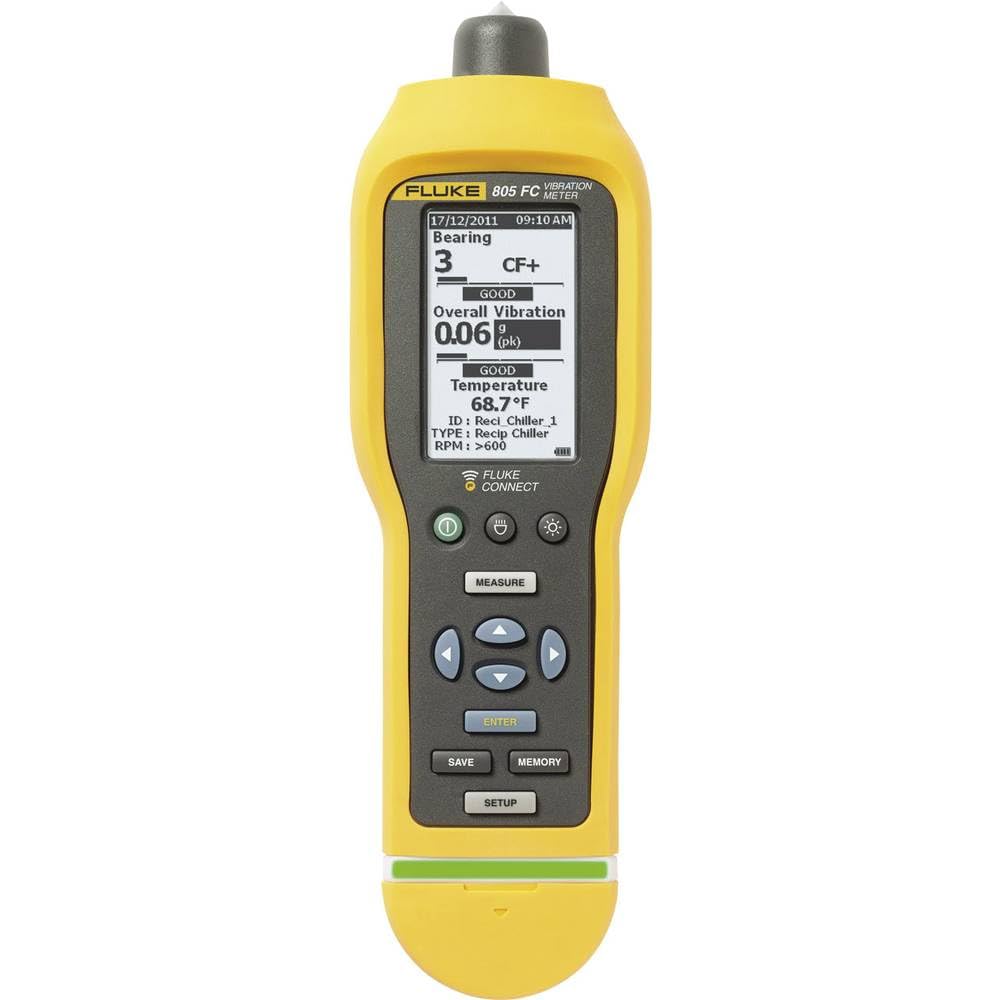
Built so two different techs get the same number off the same bearing.
The hardest part of vibration measurement is not reading the meter — it is getting a repeatable reading. Press the probe at a different angle or push harder and your number changes. Fluke’s answer is an innovative sensor design that minimizes the variation caused by device angle and contact pressure, which is why this is the meter to buy when several people share one instrument.
It also holds consistent data quality at both low and high frequency ranges, so a reading taken in one band is as trustworthy as the other. On top of the raw figure sits a four-level severity scale that grades urgency for overall vibration and for bearing condition, which turns a raw number into a decision an operator can act on.
Power comes from 2 AA alkaline batteries, and the unit carries a 300 milliamp amperage capacity. At 13.7 ounces it is the same sort of bench weight as the Extech’s 14.1 ounces — this is a tool you carry deliberately, not a pocket meter. Running cost is deliberately boring: AA batteries are everywhere, so a dead meter never ends a shift.
Why Teams Standardize On It
- Sensor design reduces angle and contact-pressure variation between users
- Four-level severity scale grades urgency for overall vibration and bearings
- Consistent data quality at low and high frequency ranges
- Runs on 2 AA alkaline batteries, easy to restock
Weigh Before You Buy
- 13.7 ounces is a belt-and-bench meter, not a pocket one
- The listing publishes no velocity or acceleration range figures
- Highest-tier spend, so it only pays off if consistency across users matters to you
The case for it: shared instruments and mixed-experience teams get the most from the angle-independent sensor and the four-level severity scale.
The case against: a solo tech doing simple spot checks gets the same basic reading from a far simpler meter above.
Know the Specs
Acceleration, Velocity and Displacement
These are the three ways to describe the same shaking. Acceleration (m/s²) captures sharp, fast events — the kind that point at a failing bearing or a loose mount. Velocity (mm/s) is the general health figure for rotating machinery and is what ISO severity scales are built around. Displacement (µm or mm peak-to-peak) suits slower machines where the shaft visibly swings. A meter that reads all three gives you three different fault views; one that reads a single parameter leaves you guessing on the other two.
Frequency Range and Sensor Type
Frequency range (in Hz or kHz) tells you how fast a vibration the meter can actually see. A meter topping out in the low hundreds of hertz will miss early bearing wear, which shows up at higher frequencies — the PM633C and VM-428 reach 14KHz and the EVB-02 reaches 6.66kHz. Sensor type matters just as much: a piezoelectric shear-type accelerometer (a sensor that measures vibration by shear force) is the standard for handheld diagnostics. An external probe on a cable lets you place it squarely on a housing you cannot reach with the body of the meter.
Common Questions
What is the difference between acceleration, velocity and displacement readings?
Do I need a meter with a frequency range above 1KHz for bearing problems?
Can a handheld vibration meter replace a permanently installed monitoring system?
Why do RMS and peak readings of the same machine differ?
Does pressing the probe at an angle change my vibration reading?
How many readings can these meters store for trend analysis?
What does the ISO vibration severity rating on a meter actually show?
Is a Wi-Fi vibration sensor better than a handheld meter?
What accuracy figure should I expect from a field vibration meter?
Can I mount a vibration sensor permanently on a machine?
The Bottom Line
For most people maintaining rotating machinery, the pick to start with is the PM63A Vibration Meter — it reads acceleration, velocity and displacement, ships with a calibration report, and weighs 4.8 ounces so it lives in your bag. When you need ISO severity grades, a 30Hz–14KHz range and stored readings, the PM633C is the step up. And if the sensor has to reach a housing you cannot press a meter against, the VM-428 with its magnetic external probe is the one to reach for.
How we choose
We do not accept paid placement. Every pick is matched to a real buyer and a real use-case; we do not hands-on test units.
Sources
Specifications: manufacturer listings and product documentation. Review insights: verified customer reviews, as of November 2026. Pricing: not shown on this page (it changes often); check the current price via the retailer link.
As an Amazon Associate, Tactical Gear Guy earns from qualifying purchases. This does not affect which products we feature.