Specs are compiled from manufacturer listings and verified buyer reviews and can change over time — please confirm the key details on the product page before buying.
You already own a helmet, a harness, and a rack of cams. You can layer up for cold hands, but cheap lenses that fog on the third pitch or slide off your nose mid-crux can end a summit push faster than numb fingers. The short answer: buy sunglasses rated UV400 first, then worry about tint, weight, and whether they play nice with your helmet. Every pick below is verified UV400, and one note up front — this list uses flexible, human-like matching, so a few picks run a size up or down from what you typed into the search bar; the nearest same-type fit is there to serve the same purpose.
This guide is built by comparing the manufacturers’ published specifications and the patterns across verified customer reviews, so you get each pick’s real strengths and trade-offs instead of marketing spin.
Glacier travel and mid-day sport routes both throw reflected light at your face from angles a baseball cap cannot block, and the frames here were picked with that in mind. Read on for the UV400 sunglasses for climbing that keep glare out of your eyes while staying put on the approach.
Top Picks


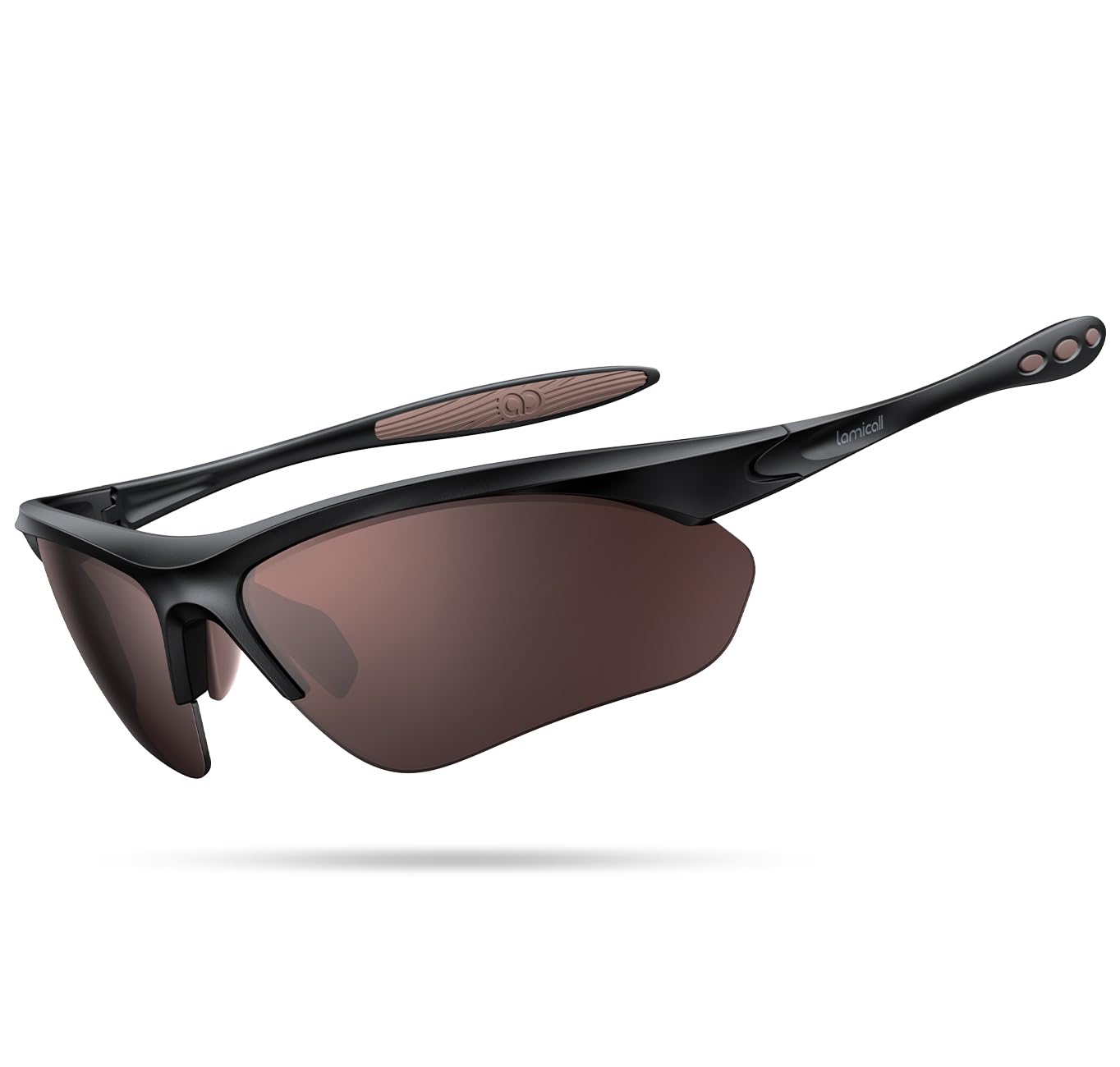
How To Choose The Best UV400 Sunglasses for Climbing
Altitude changes the problem. At sea level a dark lens is mostly a comfort item. On rock and snow you are catching light off two surfaces at once, and your eyes are the only protection layer you cannot add a fleece to. So the order of priority goes protection first, then hold, then tint.
Start with the UV400 label and the transmittance number
UV400 means the lens stops UVA and UVB radiation up to 400 nanometres — the end of the ultraviolet spectrum. Anything less leaves high-altitude UV reaching your eye. Picks here list it plainly: the suoso pair claims 99% UV400 shielding, while the Lamicall and BangLong advertise 99.9%, and the KAPVOE claims 99.99% UVA/UVB filtering. Read the number, not the badge on the box.
Transmittance is the second dial — how much visible light the lens lets through. The Julbo Camino’s Spectron 4 lens transmits only 5% of visible light, which is a glacier-spec tint. The KAPVOE sits at the other end with a CAT.0 to CAT.2 range that shifts as light changes.
Helmet fit lives in the arms and the bridge
Climbing helmets sit lower on the brow than bike helmets, and long arms push the frame forward until the bridge floats off your nose. The X-TIGER runs 14.5 cm arms and a 25 mm bridge — the widest bridge here. The suoso runs much shorter arms at 12.5 cm. If your helmet has a thick front pad, shorter arms seat the glasses better.
Lockdown beats style every time
Look for rubber on the contact points. The suoso uses hydrophilic nose pads and temple arms that grip harder as you sweat. The TIJN ships two nose pads at 9.77 mm and 12 mm so you can change the bridge height. Rubber on the nose pads and temple arms is what keeps the frame on your face through a hard move.
Weight you will feel on pitch five, not pitch one
A light frame barely registers for the first hour and starts to matter on a long day. The X-TIGER frame weighs 19.2 g. The Lamicall comes in at 22 g. Both disappear under a helmet strap; a heavier frame starts pressing behind the ears.
Side-by-Side Comparison
| Model | Best For | UV Rating | Frame Weight | Lens Style | Amazon |
|---|---|---|---|---|---|
| X-TIGER Polarized 3-Lens Set★ Best Overall | All-round climbing kit | UV400 | 19.2 g | 3 interchangeable lenses | Amazon |
| suoso Sports PolarizedBest Grip | Sweaty, high-grip days | 99% UV400 | — | Polarized fixed | Amazon |
| Lamicall 22g PolarizedFeatherweight Pick | Long days, light frame | 99.9% UV400 | 22 g | Polarized fixed | Amazon |
| BangLong Wide Fit | Broad faces, wide view | 99.9% UV | 27.22 g | Polarized gold mirror | Amazon |
| Photochromic Safety ANSI Z87.1 | Mixed work and sport days | UV400 | 0.64 oz | Photochromic, side shields | Amazon |
| KAPVOE K63 Photochromic | Changing light on route | UV400 (99.99%) | — | Photochromic CAT.0-CAT.2 | Amazon |
| TIJN Vanta Wraparound | Adjustable bridge fit | UV400 | — | UV coating fixed | Amazon |
| Flux AVENTO Polarized | Glare off road and water | UV400 | — | Polarized Cat 3, semi-rimless | Amazon |
| Julbo Camino Spectron 4 | Glacier and snow travel | 100% UVA/B/C | — | 5% transmittance, side shields | Amazon |
Detailed Reviews
1. X-TIGER Polarized Sports Sunglasses
Our pick — 4.5+★ from 7,000+ verified ratings; the strongest balance of quality and price.
Three lenses in one case means you stop guessing the light before you rack up.
Weather on a big wall has a habit of changing between the approach and the first belay. This set covers that swing with a clear lens, a black polarized lens, and a Revo (mirror-coated) lens, all sitting in the same 19.2 g TR90 frame — TR90 being a flexible nylon-based plastic that bends instead of snapping when you stuff the glasses in a pack. Swap the lens at the base, and you stop carrying two pairs.
It is the crowd favourite here, holding 4.5+ stars across 7,000+ owners, and owners single out the TR90 frame’s build quality above everything else. That frame is also the widest-bridged of the mainstream picks at 25 mm, and the arms run 14.5 cm — longer than the suoso’s 12.5 cm, which is a real difference when you are sliding them under a helmet strap and need them to stay seated. The 9-layer coated lenses add scratch and impact resistance on top of the UV400 claim, so rock chips and a pack full of metal hardware are less of a worry.
The honest catch sits in durability chatter and the interchangeable design itself. Lenses you pop in and out by hand are inherently a handling job, and swapping on a windy ledge is a two-hands-and-no-gloves operation. If you would rather fit and forget, a fixed-lens pair is simpler — but nothing else here gives you three tints in one frame.
What earns the top spot
- Three lens options (Revo, clear, black polarized) cover bright rock, flat light, and dusk
- 19.2 g frame you forget about mid-route
- 25 mm bridge and 14.5 cm arms seat a wide range of faces under a helmet
- Accessory kit includes EVA case, pouch, cloth, myopia insert, and black legs
- TR90 frame flexes under pack compression instead of cracking
Where it asks for care
- Swapping lenses needs both hands and clean fingers
- Durability is the mixed note in owner feedback, so treat the hinges kindly
Go here if: you climb in shifting light and want one case that covers sun, shade, and the walk down.
Pass if: you want a lens you never have to touch — a fixed photochromic does that job with less fuss.
2. suoso Sports Polarized Sunglasses for Men and Women
Built for the sweaty belay — the rubber grips harder the wetter it gets.
Hydrophilic is the word that matters here. It means the rubber on the nose pads and temple arms absorbs moisture and grips more firmly as you sweat, rather than going slick the way bare plastic does. On a hot crag with chalk on your fingers and salt on your brow, that is the difference between glasses that sit still and glasses you keep pushing up with a knuckle.
The lens claim is 99% UV400 shielding against UVA and UVB, paired with a scratch-resistant TAC lens — TAC being a layered acetate film that keeps polarized optics light and thin. The frame is a flexible TR90 plastic, and the wrap-around shape hugs the face. Arms come in shorter at 12.5 cm than the X-TIGER’s 14.5 cm, which suits helmets with a thick front pad where longer arms would push the frame off your brow.
Where this one gives you pause is face shape. It is a wrap-around cut, and wrap styles either sit right or they do not, so check the measurements against your own head before committing. The upside is a snug fit that stays put through intense movement, and a dark tint with bright colourways that people actually enjoy wearing off the wall too.
Grip that earns its keep: the hydrophilic pads and temple arms are the defining feature here — they are what keep the frame planted during hard moves, and comfort behind the ears holds up on long days.
One fit note: the wrap-around shape is unforgiving if your face is narrow, so measure the 12.5 cm arm length against your helmet first.
The right call for: hot, humid climbing where sweat is the enemy and you want the frame locked down.
Think again if: you prefer an open, non-wrapping frame that sits further from the eye.
3. Lamicall 22g Polarized Sports Sunglasses
Half a frame, all the coverage, and almost nothing on your nose.
Twenty-two grams is the number on the box, and it lands 2.8 g heavier than the X-TIGER’s 19.2 g frame — close enough that neither announces itself on a route, but worth knowing if you are chasing the absolute lightest. The half-frame cut keeps the lens off your cheeks, which matters when you are breathing hard on a steep section and do not want glass fogging from your own exhale.
The lens blocks 99.9% of UVA and UVB and cuts glare off water and road, which is where a polarized lens earns its money on the approach drive. Silicone nose pads and adjustable temple tips are the anti-slip story, and the frame is TR90 again — flexible, bends without snapping. The kit is complete: hard case with a clip, microfiber cloth, storage bag, and a polarization test card so you can prove the lens is genuine.
What holds this back is scale. It is a newer model with a smaller owner base than the top two, so long-term durability on the hinges is less proven. That is a reason to be fair rather than cautious — the build reads solid, and the wraparound shape gives you a wide field of view for spotting holds and hazards.
The lightness argument: 22 g in a bend-don’t-break TR90 frame, with a half-frame lens that leaves room to breathe and a polarized cut that flattens glare on the drive in.
Worth knowing: the silicone nose pads and adjustable tips do the holding, so a poor factory adjustment is the main thing to fix on day one.
Made for: climbers who want a genuinely light frame and a hard case that survives a rucksack.
Less ideal for: anyone who wants a decades-long track record before buying.
4. BangLong Wide Fit Polarized Sport Sunglasses

For the climber whose last three pairs pinched at the temples.
Frame width is the spec that solves the problem nobody talks about: glasses that squeeze the sides of your head leave red marks and slide forward all day. This pair runs 150 mm across the frame with 75 mm lenses, a 55 mm lens height, and a 20 mm nose bridge. Compare that 20 mm bridge to the X-TIGER’s 25 mm and you see this is built for a different head shape — a narrower bridge on a very wide frame.
Protection is 99.9% UVA and UVB blocking through TAC polarized lenses with a scratch-resistant coating, and the wrap-around design blocks dust and sand as well as side glare. That side coverage is the part that matters on a windy ridge, where grit and reflected light both sneak in around an open frame. The TR90 frame bends without breaking and carries 27.22 g, the heaviest on this list — a fair trade for the extra plastic needed to build something this wide.
The caveat is straightforward. This is a very new listing with a small owner base, so there is little long-term feedback to lean on. Fit is also a one-way bet: 150 mm is wide, and if your head is on the smaller side, this frame will overhang your face and the eye position will drift off-centre.
The width is the whole point: 150 mm frame with 75 mm lenses, a wrap that cuts side glare and blowing grit, and a full accessory set including a lanyard and polarization test card.
The trade: 27.22 g is the heaviest frame here, and the wide cut only pays off on a genuinely broad face.
Reach for these if: standard frames leave dents at your temples and you want full side coverage on exposed routes.
Look elsewhere if: your face is narrow — the 150 mm width will swim on you.
5. Photochromic Safety Sunglasses, ANSI Z87.1
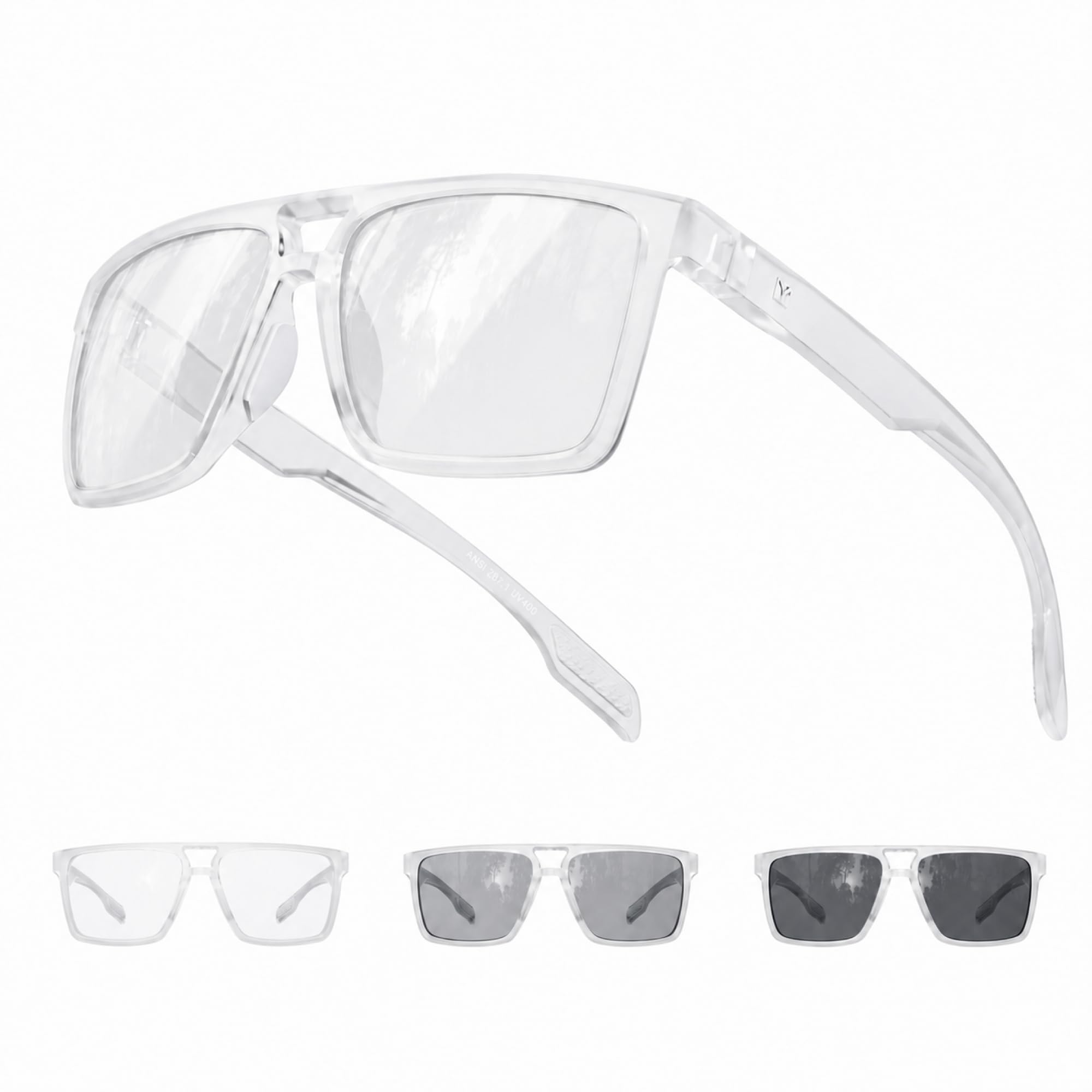
The only pair here rated as safety eyewear — good if your day job and your weekend overlap.
ANSI Z87.1 is the American standard for protective eyewear, which is a different promise than a sports lens makes. Polycarbonate lenses meet that bar here, and the side shields pop off when you want a normal look and clip back on when grit and debris are flying. If you go from a job site to a crag in the same afternoon, this saves you carrying two pairs.
The lenses are photochromic, meaning they darken under UV and lighten again indoors, and they carry UV400 protection along with an antifog treatment. Weight is 0.64 oz — the lightest thing on this list by a wide margin. Fit feedback is warm on comfort and hold, with the frame staying put without pinching.
Here is the trade-off you need to hear clearly. The tint is the most-discussed topic in owner feedback, and it runs mixed — the lenses cut harsh glare, but they do not go as dark as the listing suggests. On a bright glacier at noon you will want more tint, not this. The anti-fog and transition behaviour also draw some disagreement. Think of this as a work-and-casual pair that handles moderate sun, not a high-altitude lens.
Why it has a place
- ANSI Z87.1 polycarbonate rating is genuine safety eyewear, not just sport styling
- Removable side shields adapt the pair between work and recreation
- 0.64 oz weight is the lightest here
- Antifog treatment and photochromic darkening handle changing light
The honest gap
- Tint tops out lighter than advertised — not built for full glacier glare
- Transition and antifog performance split owner opinion
A fit for: climbers who also need rated eye protection on the job and want one pair to cover both.
Not for: snow and high-altitude routes where the lens needs to go genuinely dark.
6. KAPVOE Photochromic Cycling Sunglasses K63
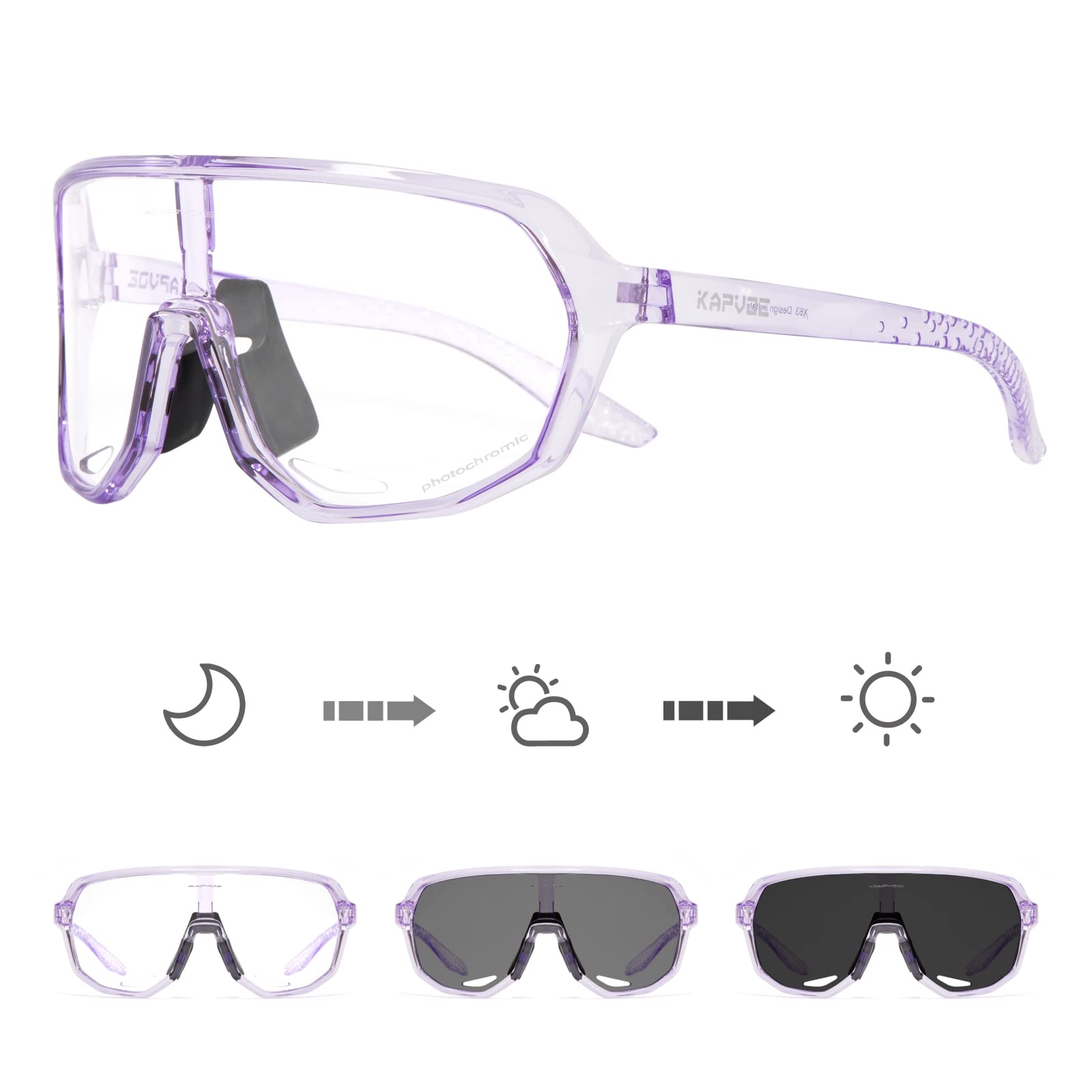
One lens that follows the sun from first light to the walk-off at dusk.
The PC photochromic lens moves across a CAT.0 to CAT.2 range, which is category-speak for light tint through medium tint. It darkens as UV exposure rises and clears as the light fades, so a dawn start and a late descent do not demand a lens swap. If you have ever squinted through a fixed dark lens in a shaded gully, this is the fix.
The lens is fixed rather than interchangeable, which is the opposite trade from the X-TIGER’s three-lens kit. Vent openings cut into the lens push air across the surface and help clear fog during hard efforts and temperature swings, and that is exactly where a climbing lens proves itself on a cold belay. The TR90 frame with a soft rubber nose pad keeps contact comfortable through movement, and the UV400 rating comes with a 99.99% UVA/UVB filtering claim.
Two honest limits. The range stops at CAT.2, so this is not a glacier lens; think bright-but-not-blinding. And the tint transition is the split opinion in owner feedback — during the day it does its job, but some find it does not darken as far as promised. Fit is also mixed, so measure before you buy.
What it solves: a single auto-tinting lens across CAT.0 to CAT.2 with lens venting for fog and a fixed mount that never asks you to fiddle on a ledge.
Set expectations: CAT.2 is the ceiling, and the darkening response is where opinions divide.
Pick it for: long routes where the light shifts hour by hour and you want to leave the spare lens at home.
Choose something else if: you need a full glacier-dark tint — the Julbo below goes far darker.
7. TIJN Sports Sunglasses UV400 Wraparound, Vanta
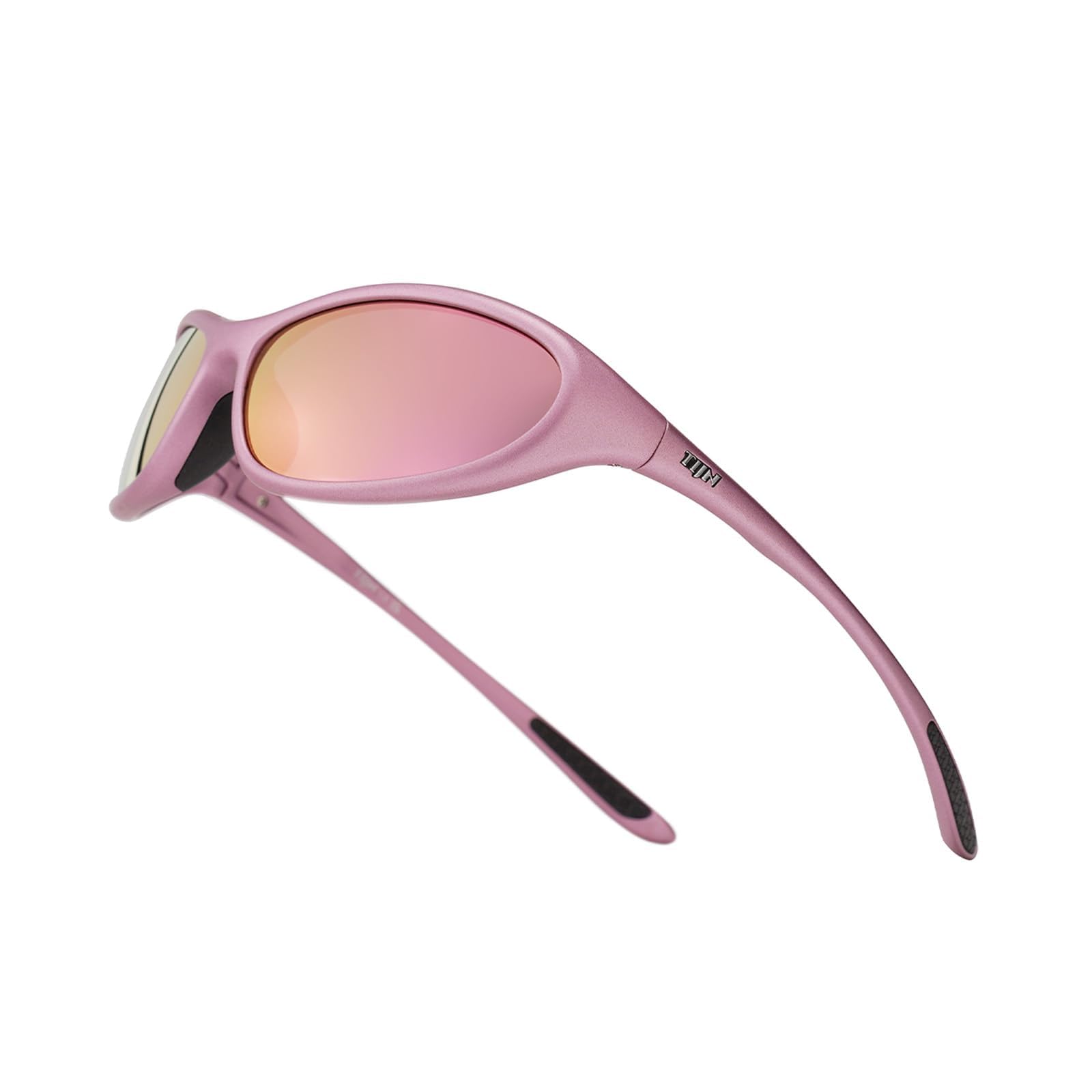
Swap the nose pad, change the bridge height — rare tuning at this level.
Most frames give you one bridge height and hope. This one ships with two removable nose pads, at 9.77 mm and 12 mm, so you can raise or lower the lens position to clear your cheekbones or drop it away from a brow pad. Add the 17 mm bridge — narrower than the BangLong’s 20 mm and the X-TIGER’s 25 mm — and you have a frame aimed at faces the bulk of the market ignores.
The wraparound curvature widens your field of view and cuts wind and side light, and the TR90 frame keeps weight off so rubberized temple tips can bite into the skin behind your ears. It also comes in Medium and Large, which is a second lever most competitors skip entirely. UV400 protection arrives as a coating on the lens.
Be straight about the risk: fit is the mixed note in owner feedback, and a few buyers find the shape simply wrong for their face. That is not a defect — it is a fit mismatch, and the two size options plus two nose pads exist precisely to narrow those odds. The value question also splits opinion, so it is fairly priced only if the fit lands.
The tuning story: two removable nose pads at 9.77 mm and 12 mm plus Medium and Large sizing gives you four fit combinations before you ever adjust a temple.
Buy carefully: check the frame measurements against your face shape — this is a fit-sensitive frame, not a forgiving one.
Best for: climbers who have bounced off one-size frames and want real adjustability at the bridge.
Look past it if: you want to buy blind without measuring — the fit feedback is genuinely mixed.
8. Flux AVENTO Polarized Semi-Rimless Sports Sunglasses

A semi-rimless build with a hidden brace, so it looks light but holds steady.
Semi-rimless frames usually flex and creep. This one adds a support layer behind the lenses so the lower edge stays stiff while the top stays open — a small design decision that shows up as stability on a moving approach. The TAC polarized Cat 3 lens cuts glare off road, water, and wet rock while keeping colours natural instead of muddy.
Fit holds through activity; the frame stays planted during jogging and there is no light leaking in around the sides, which is the anti-glare claim doing real work rather than a spec on a page. Quality and general build are the strongest themes in owner feedback, and the pair comes with a hard case, soft pouch, and microfiber cloth — a full storage kit rather than a bag and hope.
The catch is that this is a general-purpose outdoor lens rather than a climbing-specific one. There are no side shields and no glacier tint, so on a snowfield or a windy ridge it will not seal the way the Julbo does. Durability draws some mixed notes too, which argues for the hard case being used rather than skipped.
Where it shines: genuine TAC polarized optics in Cat 3 with a semi-rimless support layer that resists the flex typical of the style, plus a complete hard-case kit.
The limit: open sides mean wind and reflected snow light can still reach the corners of your eyes.
Right for: approach trails, driving to the crag, and general outdoor days where glare is the main enemy.
Skip for: full glacier conditions that call for side shields and a much darker lens.
9. Julbo Camino Glacier Sunglasses with Removable Side Shields

Five percent light transmission and side shields — this is snow-and-ice eyewear.
The Spectron 4 lens lets just 5% of visible light through. That is a genuinely dark lens built for strong glare, and it carries 100% UVA, B and C protection with an anti-reflective coating and a mirrored flash finish that filters more light again. On a bright glacier or a snow-covered summit ridge, this is the pair that stops the squint.
The removable side shields are the second half of that story. They block sunlight bouncing in at high elevation and keep wind and debris out, then pull off when the terrain turns to rock and you want airflow. Arms run 13.5 cm with a 15 mm bridge — a narrower bridge than most here — and the standard fit is meant to suit most face sizes. Julbo has made mountain eyewear since 1888, and this line carries a lifetime warranty.
Two honest notes. Glare reduction draws mixed feedback — while the lens blocks a lot of light, some find it nowhere near dark enough for their eyes on full-sun snow. Build quality also generates a few critical remarks, so inspect the hinges on arrival. The half-frame cut is deliberate for field of view, but it does mean less coverage than a full wrap.
Built for altitude: 5% visible light transmission, 100% UVA/B/C protection, removable shields, and a mirrored finish that adds filtration on the brightest days.
The fine print: mixed views on whether it goes dark enough, and build notes mean a quick check on delivery is smart.
Go premium for: glacier travel, mountaineering, and ski days where you need the darkest lens and side coverage.
Overkill if: your climbing is summer rock below the snowline — a CAT.2 or polarized pair will serve you better.
Know the Specs
What UV400 actually means
UV400 is a lens rating, not a tint level. It means the lens blocks ultraviolet radiation up to 400 nanometres, which covers the UVA and UVB bands that reach your eyes at altitude. A dark lens without UV400 protection can fool your pupils into opening wider while letting more UV through — so check the rating before the colour. Some listings here state a percentage instead: 99% on the suoso, 99.9% on the Lamicall and BangLong, 99.99% on the KAPVOE. The higher the number, the more of the UV band the lens stops.
Photochromic vs interchangeable vs fixed
A photochromic lens darkens and clears on its own as UV changes — the KAPVOE shifts across CAT.0 to CAT.2, and the ANSI safety pair works the same way. An interchangeable set like the X-TIGER gives you three separate physical lenses you swap by hand. A fixed lens is what it is: the suoso, Lamicall, BangLong, TIJN, Flux AVENTO, and Julbo all keep their tint permanently. Auto-tinting is the least fuss; interchangeable is the most versatile in extreme light change.
Lens categories and transmittance
Lens category runs from CAT.0 (very light) to CAT.4 (very dark glacier). The Julbo’s Spectron 4 transmits 5% of visible light, which is deep into the dark end for high glare. The KAPVOE tops out at CAT.2, a medium tint good for mixed sun. Match the category to your terrain — a CAT.3 or 4 lens on a shaded forest route can leave you unable to read footholds.
Frame weight and grip
Frame weight is listed in grams, and every gram counts on a long day. The X-TIGER sits at 19.2 g, the Lamicall at 22 g, and the BangLong at 27.22 g — all light enough that a snug strap keeps them in place. Below about 22 g you stop noticing the frame; heavier, and a poor fit starts pressing behind the ears. Grip comes from rubber on the nose pads and temple arms — hydrophilic rubber grips harder when wet, which is why the suoso’s pads are the star of its show.
Common Questions
Will these sunglasses fit under a climbing helmet?
Are polarized lenses good for climbing?
What is the difference between UV400 and a dark tint?
Do photochromic lenses get dark enough for snow and ice?
How should I clean polarized and photochromic lenses?
Are these sunglasses safe for daytime driving to the crag?
Do the interchangeable lenses on the X-TIGER scratch easily?
What does ANSI Z87.1 mean on the safety pair?
What does the CAT number on a lens mean?
Do the TIJN nose pads really change how the glasses sit?
The Bottom Line
For most climbers the best uv400 sunglasses for climbing choice is the X-TIGER Polarized Sport 3-Lens Set, because three tints in one 19.2 g frame cover the light changes a real route throws at you, and it remains the crowd favourite at 4.5+ stars across 7,000+ owners. If sweat and slip are your problem, the suoso Sports Polarized grips harder the wetter it gets. Should your target be a glacier or a snow-covered summit ridge, the Julbo Camino brings 5% transmittance and removable side shields — the darkest lens in this lineup. Match the lens category to the terrain you actually climb — CAT.2 for summer rock, CAT.4 for glacier glare.
How we choose
We do not accept paid placement. Every pick is matched to a real buyer and a real use-case; we do not hands-on test units.
Sources
Specifications: manufacturer listings and product documentation. Review insights: verified customer reviews, as of November 2026. Pricing: not shown on this page (it changes often); check the current price via the retailer link.
As an Amazon Associate, Tactical Gear Guy earns from qualifying purchases. This does not affect which products we feature.