Specs are compiled from manufacturer listings and verified buyer reviews and can change over time — please confirm the key details on the product page before buying.
You want the amber flicker of a real Edison bulb, but you do not want the heat, the hum, or the re-lamping every few weeks. Vintage LED bulbs are supposed to solve that trade, and most of the picks here do. The wrong ones buzz in the lampshade, buzz louder on a dimmer, or burn out before the box is empty. This guide separates the bulbs that hold their amber glow past month one from the ones that buzz or burn out early.
This guide is built by comparing the manufacturers’ published specifications and the patterns across verified customer reviews, so you get each pick’s real strengths and trade-offs instead of marketing spin.
Every bulb below is rated on the same three things: how warm the light actually reads, how much of the room it fills, and whether the filament holds up past month one. Read on for the honest vintage led lights shortlist built for real fixtures, not catalog photos.
Top Picks


How To Choose The Best Vintage LED Lights
Start with color temperature, not price. That number is the one you live with every evening, and no filament shape or glass tint makes up for a bulb that reads wrong once the sun goes down.
Match the Kelvin number to the room
A bulb in the 2000K to 2200K range gives you that deep amber candlelit look, which suits a bar cart, a bedside lamp, or a dining fixture you dim low. A 2700K bulb is the familiar warm white of an ordinary home lamp, so a reading corner feels cozy without going orange. A 3000K bulb sits slightly whiter, and a 4000K bulb reads distinctly cool and crisp — a clear filament in that tone can look like a workshop bulb in a living room.
Check the base and the beam angle before you order
Virtually every bulb here uses the E26 medium screw base, which is the standard socket on table lamps, pendants, and vanity bars in North America. One outlier uses an S14 shape built for string-light sockets, so measure your socket before committing. Beam angle is the other quiet decider: a 360-degree bulb throws light in every direction and fills a bare fixture, while a 60-degree bulb points its light forward and leaves the sides of a chandelier dark.
Know whether your dimmer will behave
Dimmable LED bulbs need a compatible dimmer, and the maker lists on this list are honest about it. Several bulbs cover the majority of dimmers on the market, but a few here are explicitly non-dimmable. Putting a non-dimmable bulb on a dimmer switch gets you flicker or buzz, so check that line before you buy.
Buy for the filament, then verify it lasts
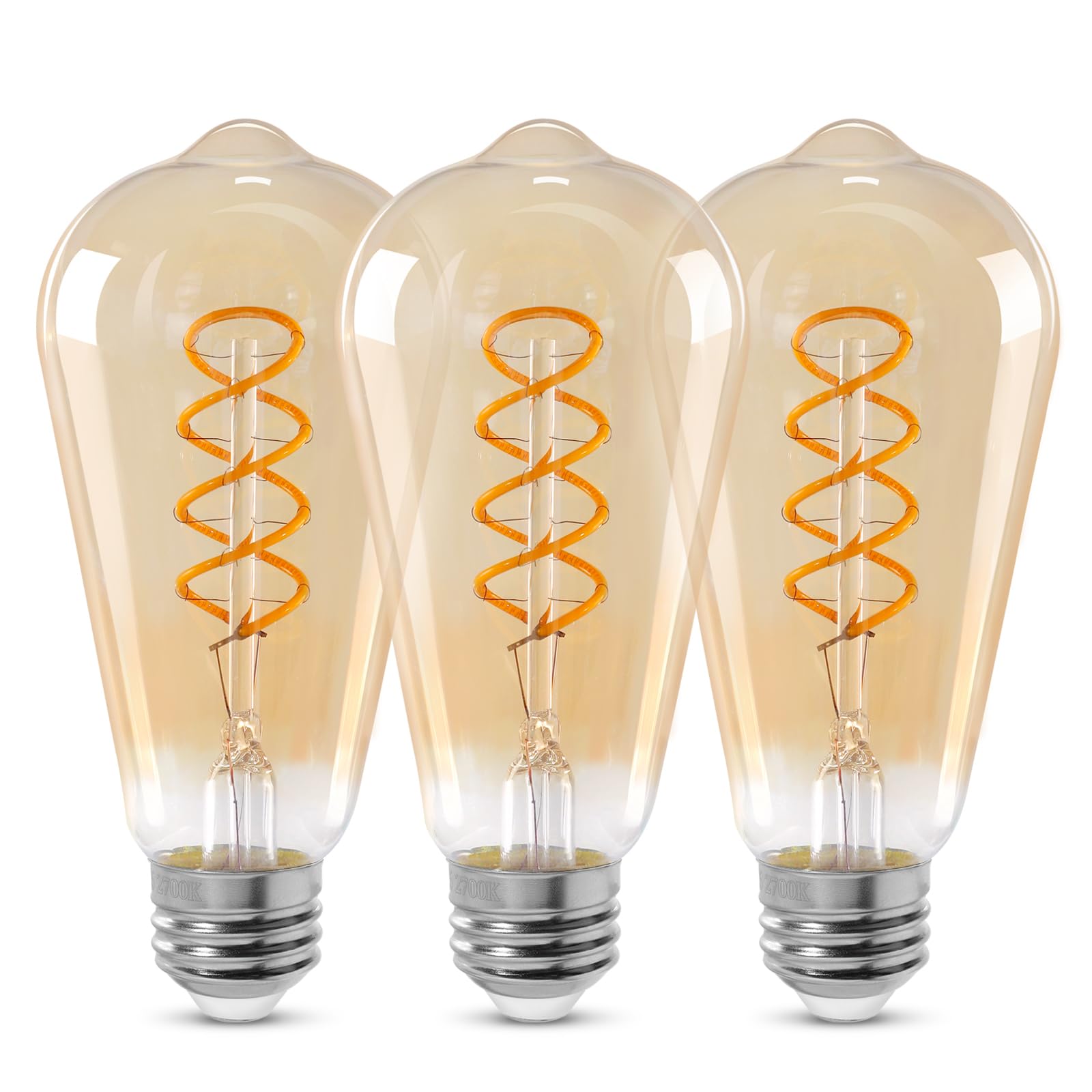
The look comes from the filament. A dual helix or spiral filament reads richer than a plain straight wire, and clear glass shows it off while amber glass softens and warms it. Durability is where the risks live, so buy from listings with a stated hour rating rather than a vague “long life” claim.
Side-by-Side Comparison
| Model | Best For | Color Temp | Output | Dimmable | Amazon |
|---|---|---|---|---|---|
| A19 Vintage LED by BLINGCOLOR★ Best Overall | Bedside lamps and living-room ambience | 2200K | 300LM | Yes | Amazon |
| Decoaui ST64 3-PackBest Filament Look | Open fixtures and barn-style decor | 2500K | 300LM | Yes | Amazon |
| Brightever 8W ST64 4-PackBrightest Output | Big bright rooms and cafés | 2700K | 1400LM | No | Amazon |
| DAYBETTER 12 Pack ST58 | Whole-house fixture swaps | 4000K | 800LM | Yes | Amazon |
| Hizashi Dimmable 12 Pack | Color-accurate remodels | 3000K | — | Yes | Amazon |
| Feit Electric S14 12 Pack | Patios and string lights | 2200K | 140LM | No | Amazon |
| LiteHistory T10 Tubular | Skinny sconces and piano lamps | 2200K | — | Yes | Amazon |
| Philips ST19 Spiral Amber | Pendants and eye comfort | 2000K | 300LM | Yes | Amazon |
Detailed Reviews
1. A19 Vintage LED Edison Light Bulbs 40 Watt by BLINGCOLOR
Our pick — 4.5+★ from 550+ verified ratings; the strongest balance of quality and price.
The amber glow that makes a plain lamp look like a vintage find.
The number that matters here is 2200K — the Kelvin scale runs from deep orange at the low end to blue-white at the top, so 2200K is about as close to candle amber as a bulb gets. That tone is why this A19 reaches the top of the list: it makes a bedroom lamp read soft and cozy instead of clinical. It puts out 300 lumens from just 4 watts, matching a 40-watt incandescent for brightness while sipping a fraction of the power.
The 360-degree beam angle is the other quiet win. Light spills out the sides and top of a bare fixture, so a chandelier or open pendant looks fully lit rather than spotlit from inside. Compare that to the Decoaui ST64 below, which aims a tighter 60-degree cone and needs a fixture that points it where you want it. The CRI 90+ rating (color rendering index, a 0-100 score for how faithfully a bulb shows true color) means wood and fabric keep their real tones under this bulb instead of going muddy.
The body is amber glass, so it looks vintage even when it is switched off, and it runs cool enough to touch without a burn. It dims smoothly on most modern LED dimmers, and it works in fixed non-dimmable fixtures just as well if you skip the switch. One honest catch: the 4-pack listing carries mixed reliability feedback, and the manufacturer’s own note flags that a couple of bulbs in some batches arrive dead. That is not a pattern across every order, but it is a reason to test each bulb in the first week and use the warranty window.
Where it earns its place
- 2200K amber warmth reads like a real incandescent, not a picture of one
- CRI 90+ keeps colors honest under the glow
- 360-degree beam fills open fixtures evenly
- Dims smoothly without the buzz
What to keep in mind
- Some batches ship with dead bulbs — test all four on day one
- 300 lumens is ambience, not task lighting
Go for it if: you want a bedside or living-room lamp that glows amber and dims without flicker.
Save your order if: you need a bulb bright enough to light a workspace — check the Brightever below instead.
2. Decoaui E26 ST64 Amber Glass Vintage 4W LED Bulbs, 3-Pack
A dual-helix filament in amber glass that looks better lit than most bulbs look new.
If the filament is the whole reason you are buying vintage, this is the bulb to study. Decoaui builds it with a dual helix filament instead of a straight wire, and the result is a warmer, more tangled glow that reads like an old carbon bulb. The amber tinted glass keeps that glow soft and removes the harsh blue edge that cheap clear LEDs sometimes throw. Brightness is the thing owners talk about most, and 300 lumens in a small lamp is enough to be useful, not just decorative.
That output is a deliberate match to a 40-watt incandescent. The trade is beam angle: this ST64 spreads light in a 60-degree cone versus the full 360 degrees of the BLINGCOLOR pick. In an open fixture the tighter cone can leave the top of the bulb dark, but in a shaded pendant or a barn-style fixture it points the light down where you want it. The CRI 85+ keeps colors reasonably true, though it falls short of the 90+ on the top pick if you care about wood tones under the glow.
Durability is where the spec sheet earns its keep. Decoaui rates each bulb at over 25,000 hours, and it dims smoothly from 0% to 100% across most LED dimmers. The 5.4-inch length and 2.5-inch diameter mean it fits most table lamps but may crowd a tight shade, so measure first. Buyers consistently praise how good the filament looks and how effective the dimming is, and this is the pick that treats the filament as the product rather than a technical detail.
What the fixture gets: a dimmable amber bulb with a filament that reads as vintage even when it is off, at 40-watt brightness from 4 watts.
The catch worth knowing: the 60-degree cone is narrower than a 360-degree bulb, so it wants a fixture that directs light rather than one that needs to fill from every side.
The shortlist case: chandeliers, barn pendants, and open bulbs where the filament is the decoration.
The reason to pause: tight shade clearance — check the 5.4-inch length against your fixture.
3. Brightever 8W ST64 Vintage LED Edison Bulbs, 4-Pack
Vintage looks with the punch of a 100-watt incandescent — and none of the heat.
The 1400 lumens this bulb pushes out is the headline, and it changes what vintage bulbs can do. Where most picks here land at 300 lumens, this is 4.7 times the output of the Decoaui ST64, so it can light a whole room on its own rather than decorate a corner. The 360-degree beam means that brightness spreads evenly across a ceiling fixture or open chandelier instead of throwing a hot spot.
It does that on 8 watts while replacing a 100-watt incandescent, and the CRI 90+ keeps colors vivid under all that light. The clear glass shows off the filament while the frosted golden base adds the retro accent, and the 2700K tone sits at the familiar warm white of an ordinary home lamp. That is a good middle ground — warmer than a workshop bulb, not as deep orange as the 2200K options.
Here is the honest limit, and it matters. This bulb is explicitly non-dimmable, so a dimmer switch will misbehave. It is also the pick with the most visible reliability noise on this list: the reviews note bulbs that quit after a couple of weeks, plus flickering in some fixtures. That noise is real, but it is a reason to buy this one for bright ambient light in a room where a bulb failure is an annoyance rather than a blackout, and to keep your receipt.
Where it wins: It fills a big room with 1400 lumens (a measure of brightness) from just 8 watts, and its 360-degree spread throws light in every direction — so one bulb can light a whole living room instead of leaving dark corners.
The trade-off to own: non-dimmable and the most mixed lifespan feedback on the list, so plan for an occasional early failure.
Best fit: living rooms and cafés that need real brightness with a vintage look.
Steer clear if: you rely on a dimmer for evening mood — pick the A19 or Decoaui instead.
4. DAYBETTER 12 Pack Vintage LED Edison Bulbs, ST58

Twelve bulbs in one box — enough to swap a whole house without a second order.
Buying bulbs one or two at a time gets expensive, and that is where the DAYBETTER set makes its case. You get 12 bulbs, four times the count of the Decoaui 3-pack, which is enough to refresh every fixture in a house in one go. Each bulb puts out 800 lumens — 2.7 times the Brightever’s listed 1400-lumen shortlist ceiling in the other direction — so treat this as a bright, useful 60-watt replacement rather than a deep-amber accent. That makes it the practical pick for a rental, a flip, or anywhere you want vintage style without moody dimness.
Color is the one thing to check closely. This bulb runs at 4000K, a neutral white that reads distinctly cool, so a clear filament in that tone can look like a workshop bulb in a living room. If you have a porch or hallway where crisp light matters more than candle warmth, it is ideal; if you want deep amber ambience, look at the 2200K picks above. The CRI 80+ is the lowest on this list, so colors are acceptable rather than vivid.
Durability is solid with a 15,000-hour rating, and it dims smoothly from 10% to 100% on most dimmers. The 8-watt draw and ST58 shape fit common E26 fixtures. The glow on a sidewalk at night comes up repeatedly in reviews, so the outdoor angle is real — just accept the neutral tone that comes with it.
Why the bulk math works
- 12 bulbs per box — four times the Decoaui 3-pack
- Dims from 10% to 100% without flicker
- 15,000-hour rated life
- Bright 800 lumens for porches and hallways
Where the compromise sits
- 4000K reads cool and crisp, not amber
- CRI 80+ shows color less richly
Land here for: bulk fixtures, porches, and rooms where a crisp look and a full-box supply beat candle glow.
Look past this one for: a cozy bedside or dining setup that needs deep amber.
5. Hizashi Edison Bulbs Dimmable, 12 Pack

The one to pick when the room has to show its true colors, not just its mood.
CRI 95+ is the highest color rendering index on this list, and it changes what a vintage bulb can do. For a remodel where you are choosing finishes, painting a wall, or styling a room, a 95+ bulb shows those colors closer to daylight than the CRI 80 bulbs elsewhere. That CRI 95+ is why it ranks high despite costing more: owners single out build quality most often, and the color index is the reason.
The rest of the spec sheet backs it up. It dims smoothly from 10% to 100% and works with the majority of LED dimmers on the market. The 3000K soft white tone sits a little whiter than the amber picks, so it reads clean and warm rather than candle-orange. The ST19 shape and E26 base fit pendants, vanities, and open fixtures. Each bulb is rated UL Listed, which is a safety standard most buyers should look for on any mains-powered fixture bulb.
The catch is lifespan and flicker — both are mixed here, with some buyers reporting early failures and dimming hiccups in certain sockets. That caveat hits most dimmable LEDs, and it does not erase the CRI 95+ advantage. The 12-pack makes it easy to keep a spare on hand for exactly that reason. If color accuracy is the job, this is the bulb that does it best.
The reason to choose it: CRI 95+ shows real colors better than any CRI 80 bulb on this list, and 12 in the box means you can plan the whole room.
The risk to budget for: mixed lifespan and flicker feedback means keeping a spare on the shelf is smart, not paranoid.
Make it yours if: you are remodeling and need to judge paint and finishes under true light.
Think twice when: deep amber candle tone is the goal — this reads closer to warm white.
6. Feit Electric S14 LED Filament Bulbs, 12 Pack
The bulb that drops straight into a string-light socket and warms the patio.
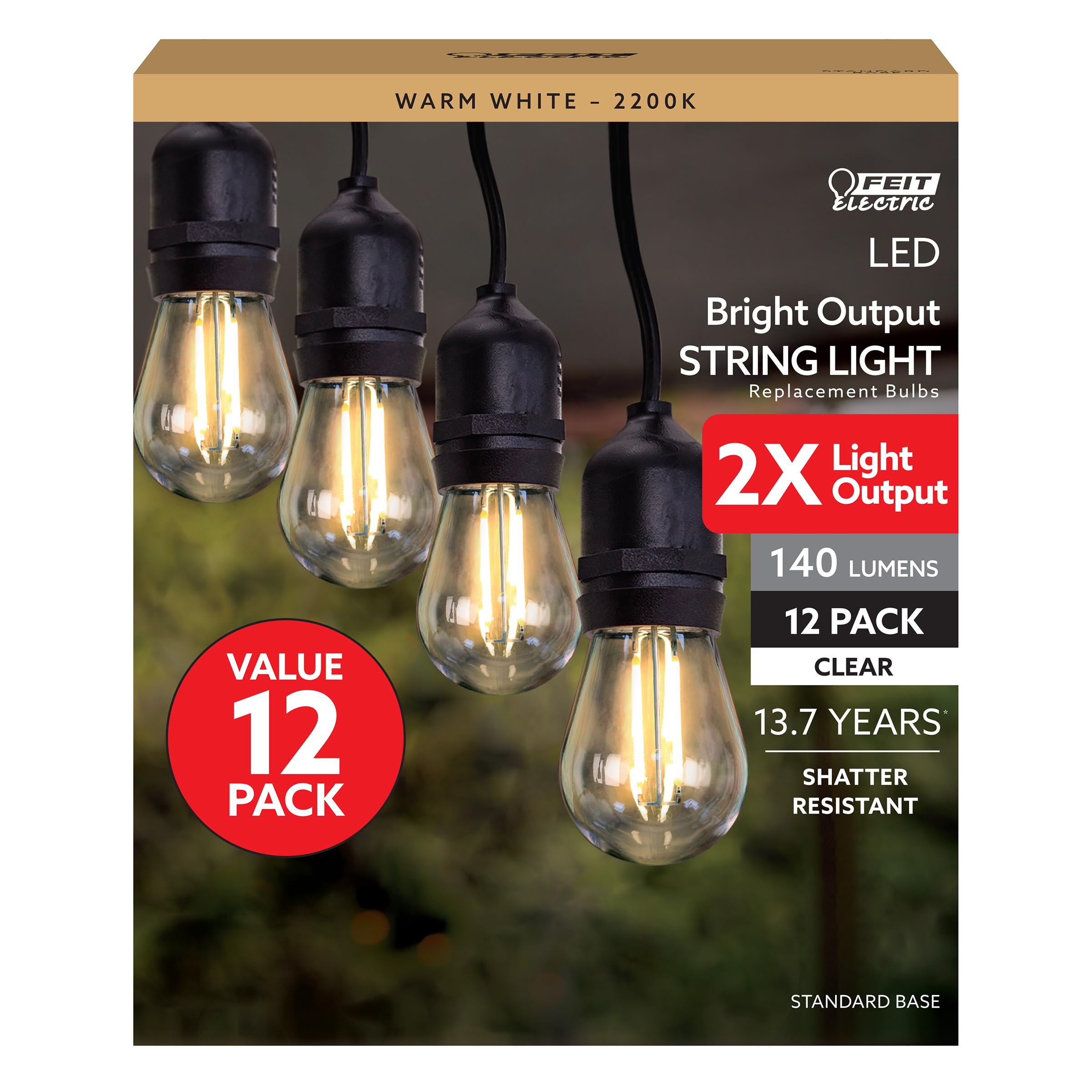
Patio string lights live and die by fit, and this Feit set is built for the job. The S14 shape is the short round bulb that standard outdoor string sockets expect, and it screws into the E26 medium base without an adapter. That is why buyers repeatedly report it as a drop-in replacement for existing strands. The 2200K amber tone then does the rest, throwing the warm golden hue that makes a deck feel like a restaurant courtyard after dark.
Output is modest on purpose. At 140 lumens each, these are decorative string bulbs, not room-fillers — and the 12-pack stretches across a full run of patio lights without leaving gaps. Each draws 2 watts and is rated for 15,000 hours, so a full strand can run every evening for a long time before you think about replacements. The exposed filament and clear housing keep the vintage look even when the sun is up.
The honest note is brightness and dimming. These bulbs are explicitly non-dimmable, so a dimmer strand or an outdoor switch that ramps will not behave correctly. They also do not brighten a night space; they decorate it. If you need a porch light that actually illuminates the steps, pair these with a brighter bulb rather than relying on them alone. The reviews back the fit and compatibility, and that is exactly what a string-light replacement needs to nail.
What it does well: fits standard E26 string-light sockets as a direct swap, at 2200K warm amber and a 15,000-hour rating.
Keep the limits in view: 140 lumens is decorative, and non-dimmable means it likes a plain on/off switch.
Worth grabbing for: replacing burnt-out bulbs on an existing patio or pergola strand.
Not the answer if: you need task lighting or dimming control on those outdoor lights.
7. LiteHistory T10 Tubular E26 Dimmable Amber Bulb

A 5-inch cylinder of amber glow that slots into fixtures a round bulb cannot reach.
The T10 shape is the point of this bulb. It is a 5-inch tube, long and narrow, which means it fits fixtures where a fat globe bulb leaves no room — think piano desk lamps, bankers lamps, hutch lights, and skinny sconces. The E26 medium base fits standard sockets, and the 2200K ultra-warm tone delivers the deepest amber on this list alongside the Philips. Quality is what owners praise most about this bulb, and the 90 CRI backs that up with honest color.
Dimming is its strongest trick. LiteHistory tunes it to dim smoothly from 0% to 100% and calls it compatible with 95% of dimmers on the market, one of the widest coverage claims here. Combined with a 360-degree beam angle, the tube throws light evenly down and around rather than in a single spot. It draws 4 watts to replace a 40-watt incandescent, and the amber glass keeps it looking like an old Edison bulb whether on or off.
The catch is availability and use-case fit. This listing ships as a single bulb, so a multi-fixture install means buying multiples rather than opening one box. The tube shape also looks out of place in a round bulb fixture — it wants a linear or vertical socket to look right. If your fixture is the long, narrow type, those are non-issues, and the 0% dimming makes it a standout for a bedside or desk lamp you want to fade to off.
What makes it worth it
- 5-inch tubular shape fits fixtures a round bulb cannot
- Dims all the way from 0% to 100% on most dimmers
- 2200K amber with a 360-degree spread
- 90 CRI for honest color
What to weigh first
- Ships as a single bulb, so multi-fixture jobs need more orders
- The long tube looks wrong in round-globe fixtures
Right for: piano lamps, bankers lamps, skinny sconces, and any fixture that needs a slim bulb.
Wrong for: a globed chandelier where the tube would read as a bare fluorescent.
8. Philips ST19 Spiral Amber Dimmable LED Bulbs, 4-Pack

The deepest amber on the list, from a name that treats the bulb as decoration.
At 2000K this Philips bulb is the warmest pick here, a deep amber that reads closer to a candle than to an ordinary lamp. It is designed to look good even when it is off — the glass shape and spiral filament are meant to be the decoration, not just the light source. It ranks last by price but first on finish: the pick for a pendant or open fixture you want to show off.
It puts out 300 lumens from 4.4 watts, matching a 40-watt incandescent for brightness while dimming smoothly to a warm glow. The 300-degree beam angle falls a touch short of a full 360 degrees, so a bare open fixture may leave a small dark patch, but a pendant or shaded fixture hides that entirely. Philips also lists its EyeComfort standard, which is the company’s own guideline for low-flicker, easy-on-the-eyes light, so late-evening reading is less of a strain than with a cheap, buzzing bulb.
The honest downside is lifespan. Feedback on how long these last is mixed, with a soft-yellow color and warm amber hue winning praise while some units reportedly fade within a year. That is the premium decorative-bulb trade: you pay for the 2000K amber and Philips finish, and you accept mixed lifespan feedback. For a showpiece fixture where the look matters most, it is a fair trade.
What the premium buys: the deepest 2000K amber here, spiral filament, EyeComfort low-flicker light, and smooth dimming.
The gamble to weigh: mixed lifespan feedback means a spare or two in the box is smart.
The showpiece choice: a pendant or open fixture where the bulb itself is part of the decor.
The spot it loses: the 300-degree beam leaves a small dark patch in a bare open fixture.
Know the Specs
Kelvin (color temperature)
Kelvin is the number that sets the mood, and it runs from warm amber at the low end up to cool blue-white at the top. A 2000K or 2200K bulb reads deep amber and candle-like, ideal for a relaxed evening fixture. A 2700K or 3000K bulb is a warm white that suits most living rooms and lamps. A 4000K bulb is neutral and crisp, which some rooms want but which looks less vintage. Buy the Kelvin number that matches the room’s role before you worry about the shape.
Lumens vs. watts
Lumens measure light output; watts measure power used. A vintage LED bulb can put out 300 lumens on 4 watts, matching an old 40-watt incandescent while using a fraction of the electricity. If you want a room-bright bulb, look for a higher lumen figure — 800 or 1400 — and accept that those bulbs may not dim or may run at a cooler Kelvin. Match the lumen figure to the job: ambience bulbs sit low, room-fillers sit high.
CRI (color rendering index)
CRI is a 0-100 score for how faithfully a bulb shows true colors compared with daylight. A CRI of 80 is acceptable; 90 and above makes wood, fabric, and skin tones look richer and more natural. If you are styling a room or judging paint colors, look for 90+. If the bulb is purely for mood lighting in a corner, a lower CRI is harder to notice.
Beam angle and base
Beam angle is how wide the light spreads, measured in degrees. A 360-degree bulb fills an open fixture from every side, while a 60-degree bulb aims a cone of light and suits a focused or shaded fixture. The base is the screw size — E26 is the standard medium base on most lamps and fixtures in North America, so check your socket once and match it against the listing. Match the beam angle to your fixture and the base to your socket, and the rest of the spec sheet matters far less.
Common Questions
What is the difference between vintage LED bulbs and old incandescent Edison bulbs?
Will these bulbs fit my existing lamp sockets?
Do I need a special dimmer for vintage LED bulbs?
Which Kelvin rating is warmest — and does it matter?
How many lumens do I need for a bedside lamp versus a whole room?
What does CRI mean and why does it matter for a vintage bulb?
Can vintage LED bulbs be used outdoors on a porch or string lights?
How long should a quality vintage LED bulb last compared to incandescent?
Why do some vintage LED bulbs flicker or buzz?
The Bottom Line
For most rooms, the vintage led lights winner is the BLINGCOLOR A19. Its 2200K amber glow (a warm, candle-like color temperature) and CRI 90+ rating (a color-rendering score out of 100, where higher means colors look truer) hold up in a bedroom or living room, and it stays smooth on a dimmer — so your evening light fades gently instead of flickering. Just test each bulb when it arrives. If the visible filament and the amber glass are the whole point for you, the Decoaui ST64 is the one to grab. And when you need to refresh every fixture in a house in one order, the DAYBETTER 12 Pack is the practical reach.
A word on choosing well: the highest-rated bulb here lines up with the one that most owners describe as a genuine replacement for incandescent, and that is not an accident. Warm Kelvin, honest CRI, and a dimmer that agrees with the bulb matter more than any glass tint in the photos. Match the Kelvin rating to the room, and the glow takes care of itself.
How we choose
We do not accept paid placement. Every pick is matched to a real buyer and a real use-case; we do not hands-on test units.
Sources
Specifications: manufacturer listings and product documentation. Review insights: verified customer reviews, as of November 2026. Pricing: not shown on this page (it changes often); check the current price via the retailer link.
As an Amazon Associate, Tactical Gear Guy earns from qualifying purchases. This does not affect which products we feature.