Specs are compiled from manufacturer listings and verified buyer reviews and can change over time — please confirm the key details on the product page before buying.
Buying a furnace is mostly a math problem wearing a ductwork costume. Get the BTU output (the amount of heat the unit can produce) and the AFUE rating (the percentage of fuel it turns into usable heat) right, and the rest is cabinet width and airflow. Get them wrong and you either freeze in a cold snap or pay for heat that escapes up the flue. The picks below cover 60,000 BTU through 120,000 BTU, 80% through 96% AFUE, all in upflow or horizontal configuration.
This guide is built by comparing the manufacturers’ published specifications and the patterns across verified customer reviews, so you get each pick’s real strengths and trade-offs instead of marketing spin.
Every unit here does the same basic job: push warm air through a house. The differences live in efficiency, staging, and cabinet width. This breakdown of the top rated home furnaces sorts those differences out for you.
Top Picks

How To Choose The Best Top Rated Home Furnaces
A furnace is not a plug-in appliance. It is a permanent part of your house’s heating and ventilation system, and it has to match the ductwork already sitting in your basement or closet. Three numbers decide almost everything: BTU output, AFUE percentage, and cabinet width in inches.
Start With BTU Output, Not Price
BTU (British Thermal Unit) is a measure of heat energy. A 60,000 BTU furnace is sized for a smaller or well-insulated home. A 120,000 BTU unit is built for a large house in a cold climate. Oversizing is a real problem — a furnace that is too big heats fast, shuts off, and cycles constantly, which is loud and wears parts down. Undersizing means the unit runs nonstop on the coldest nights and never quite catches up. Match the BTU figure to a proper load calculation on your home, not to a guess.
AFUE Percentage And What It Costs You In Venting
AFUE (Annual Fuel Utilization Efficiency) is the share of gas energy that becomes heat in your rooms instead of going out the exhaust. An 80% unit sends roughly a fifth of its fuel up the flue as waste heat. A 96% unit sends far less. The catch most buyers miss: high-efficiency 96% furnaces normally vent through PVC pipe because the exhaust gas is cool enough, while 80% units use a metal flue. If your home has no path for PVC venting, that single detail can change the whole install.
Single-Stage Versus Two-Stage Gas Valves
A single-stage furnace has one heat output — full blast or off. A two-stage gas valve lets the furnace run at a lower output for mild days and step up to full output when it gets genuinely cold. That gentler low stage tends to mean longer, quieter run cycles and steadier room temperature. Two-stage models usually cost more up front, but they are the ones buyers with cold-climate homes tend to favor.
Upflow, Horizontal, And Why Downflow Is A Different Model Line
Every furnace on this list is upflow or horizontal. Upflow means air enters at the bottom and exits the top, which suits a basement or closet install. Horizontal lays the unit on its side for a crawlspace or attic. None of these will install as a downflow (air in at the top, out at the bottom) — for that you need a model number starting with GD9, which is a separate product line. Confirm your duct layout before you buy.
Cabinet Width Has To Fit The Space You Have
Cabinet width in inches drives whether the unit slots into your existing plenum and return drop. The picks here range from 14 inches up to 24.5 inches wide. A wider cabinet usually means more airflow capacity, but it also needs the physical room and matching ductwork. Measure twice.
Side-by-Side Comparison
| Model | Best For | Heating Output | AFUE | Staging | Cabinet Width | Amazon |
|---|---|---|---|---|---|---|
| Goodman GR9S800803BN★ Best Overall | Most homes, best all-around | 80,000 BTU | 80% | Single-stage | 17.5 in | Amazon |
Detailed Reviews
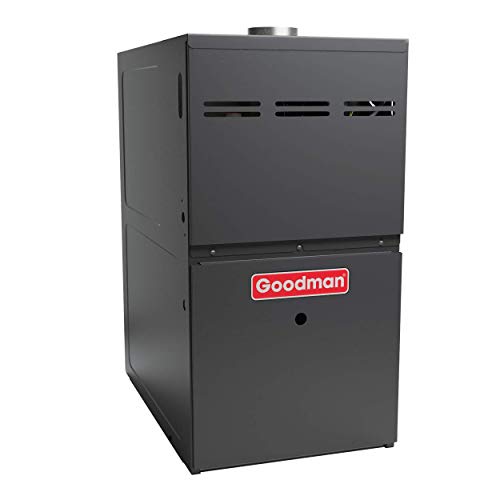
1. Goodman GR9S800803BN Furnace
Our pick — 4.5+★ from 50+ verified ratings; the strongest balance of quality and price.
The 80,000 BTU workhorse that fits the most basements and the most budgets.
This furnace keeps showing up in real installs because it fits where most homes need it: 80,000 BTU of heating output (a measure of heat delivered per hour) at 80% AFUE (annual fuel utilization efficiency — the share of gas turned into heat), in a 17.5-inch-wide cabinet that slots into standard plenum drops (the duct connection on top of the furnace). That 80,000 BTU figure suits a mid-size house in a mixed climate — enough output for a genuine cold snap, not so much that the unit short-cycles (turns on and off too often) itself to death.
The multi-speed ECM motor is where the day-to-day comfort lives. ECM stands for electronically commutated motor, which is a blower that can vary its speed instead of running flat-out. You get better airflow control across the house and less blower noise than a fixed-speed motor. It is not a two-stage gas valve — the burner is single-stage, full output or off — so the quiet comes from the blower side, not the flame side.
Weigh it against the smaller 60,000 BTU model in this same line and the difference is stark: this one is 175 pounds to that unit’s lighter build, and it delivers 80,000 BTU against 60,000. Bigger heat, bigger unit. The catch is installation — it is upflow or horizontal only, and a downflow duct layout means you need a GD9-prefix model instead. Accessories like the thermostat, linesets, and LP conversion kit are sold separately, so budget for those on top.
Where it wins
- 80,000 BTU output covers most mid-size homes without oversizing
- Multi-speed ECM motor improves airflow and trims blower noise
- 17.5-inch cabinet fits standard plenum widths
- R32-ready and aluminized steel primary heat exchanger
What to plan around
- Upflow and horizontal only — no downflow installs
- Thermostat, linesets, and LP kit sold separately
- Not available for installation in California
Reach for this if: you have a standard upflow basement or closet and want proven 80,000 BTU heat in a 17.5-inch footprint.
Look elsewhere if: your ductwork runs downflow, or you need the lower fuel waste of a 96% AFUE unit.
2. Goodman GR9S800804BN Furnace
Same 80,000 BTU muscle as the top pick, with the longest warranty story in the line.
This model pairs 80% AFUE with a 10-year unit replacement warranty, a combination rare at this efficiency tier. It carries the same 80,000 BTU output and 17.5-inch cabinet as the Best Overall pick, plus a warranty that goes beyond standard parts coverage: a 10-year unit replacement limited warranty stacked on the 10-year parts limited warranty, provided a qualified installer does the work and you register the unit online within 60 days of installation. That means if the unit fails within 10 years, the maker covers a replacement unit, not just the parts.
Verified reviews consistently praise its build quality and reliability, with owners reporting straightforward installation and years of trouble-free operation. That matches what a long-running natural gas furnace should do: fire up, hold temperature, and stay out of your way for years.
Against the 96% efficient 80,000 BTU model further up this list, this one gives up efficiency points (80% AFUE versus 96%) but keeps the metal-flue venting most older homes already have. The honest trade-off is the single-stage gas valve — full output or nothing — so on mild days it cycles harder than a two-stage unit would. Accessories still sell separately.
Warranty edge: the added unit replacement coverage is the real differentiator here, and it rewards a proper professional install and on-time registration.
Sizing note: at 80,000 BTU in a 17.5-inch cabinet, this is the safest direct swap for a standard mid-size home with existing metal flue.
Best for: homeowners replacing an existing 80,000 BTU 80% furnace who want maximum warranty protection for the same footprint.
Skip if: you are chasing the lowest fuel waste — the 96% AFUE models above do that better.
High efficiency and two-stage heat in a compact 60,000 BTU package.
If your home is smaller or tightly insulated, 60,000 BTU is the number that matters. This unit pairs that output with a 96% AFUE rating and a two-stage gas valve — the efficiency of a premium furnace with the gentler low-stage heating that keeps rooms steady instead of cycling. The multi-speed ECM blower moves up to 1200 CFM of air, which is plenty for a well-planned residential duct system.
It is Energy Star rated, vents through PVC as a 96% unit, and runs on 115 VAC single-phase 60 Hz power. The Low NOx designation matters if your air-quality district regulates nitrogen oxide emissions — check your local rules before ordering any furnace.
The trade-off versus the 80,000 BTU 96% single-stage model is output: this one gives less peak heat but adds two-stage comfort and a smaller load. For a drafty, large home this may run short on the coldest nights. For a modest or upgraded home, it is the right size and the right efficiency. At 110.9 pounds, it is a manageable one-crew lift compared to the larger cabinets.
Go with it if: you have a smaller or insulated home in a regulated air district and want two-stage comfort at 96% AFUE.
Look at higher output if: your house is large or leaks heat — you will want 80,000 BTU or more.
4. Goodman 9div class=”whk-pro-con-block”>
What to weigh
- 34,120 BTU is modest heating output
- Requires 230/208-volt power
- Electric resistance heat can cost more to run than gas
The right call for: a mobile home, addition, or gas-free property that needs electric heat in a compact cabinet.
Not for you if: you have gas service and a large home — an 80,000 BTU gas furnace delivers far more heat.
Know the Specs
BTU Output: The Heating Number That Matters
BTU (British Thermal Unit) measures heat energy — roughly how much warmth the furnace can deliver per hour. A 60,000 BTU unit suits a smaller or well-insulated home. A 120,000 BTU unit is built for large homes in cold climates. Too big and the furnace short-cycles; too small and it never catches up on the coldest nights. Match BTU to a load calculation on your actual house, not to a rough guess based on square footage alone.
AFUE Percentage: Efficiency That Shows Up On The Flue
AFUE (Annual Fuel Utilization Efficiency) is the share of gas energy converted to usable heat. An 80% furnace wastes about a fifth of its fuel out the exhaust. A 96% unit wastes far less. The practical difference also shows in venting — high-efficiency units typically vent through PVC because their exhaust is cooler, while 80% units use a metal flue. Confirm which venting your home can support before choosing an efficiency tier.
Single-Stage Versus Two-Stage: How The Burner Behaves
A single-stage furnace runs at one heat output, full or off. A two-stage gas valve adds a lower setting for milder weather and steps up to full output when needed. That low stage means longer, quieter run cycles and steadier room temperature. Two-stage models cost more up front, but they are the ones buyers in cold climates tend to favor for daily comfort.
ECM Motor And CFM: Airflow You Can Feel
ECM (electronically commutated motor) is a blower that can vary its speed instead of running flat-out. Better airflow control means more even heating across rooms and less blower noise. CFM (cubic feet per minute) is the airflow volume the blower moves — 1200 CFM suits a standard residential layout, while 1600 to 2000 CFM is for larger systems with matching ductwork. Cabinet width and CFM go together: a wider cabinet supports more airflow.
Cabinet Width: Measure Before You Order
Cabinet width in inches decides whether the unit fits your existing plenum and return drop. The picks here run from 14 inches up to 24.5 inches. A wider cabinet handles more airflow but needs the physical space. This is the single most common reason a replacement install goes sideways, so measure your existing cabinet and duct opening before you commit to a model.
Upflow, Horizontal, And Downflow Models
Upflow means air enters at the bottom and exits at the top — good for basements and closets. Horizontal lays the unit on its side for crawlspaces and attics. Neither can be installed as a downflow (air in at top, out the bottom). For downflow you need a model number starting with GD9, which is a separate product line. Confirm your duct layout before buying.
Common Questions
What BTU furnace do I need for my home size?
What is the difference between 80% and 96% AFUE furnaces?
Can these furnaces be installed as a downflow?
Is two-stage heating worth the extra cost over single-stage?
Do I need a thermostat or LP conversion kit separately?
How do I know if my home has a Low NOx requirement?
What is the difference between an electric furnace and a gas furnace?
What cabinet width do I need for a furnace replacement?
What does the warranty cover and what do I need to do to keep it?
Can a high-efficiency furnace save enough to justify the higher equipment cost?
The Bottom Line
For most homes the winner is the Goodman 80,000 BTU 80% Single-Stage (GR9S800803BN) — 80,000 BTU at 80% AFUE in a 17.5-inch cabinet that fits standard installs, with a multi-speed ECM motor for quieter, more even airflow. If you want the extra protection of a 10-year unit replacement limited warranty on top of the parts coverage, the GR9S800804BN is the same 80,000 BTU platform with the longer warranty story. And for a cold-climate home that wants the full package — 96% efficiency plus a two-stage valve in a standard-width cabinet — the GR9T960803BN is the one to reach for. The single most important step before you buy any of them: measure your plenum width, confirm your flue type, and run a real load calculation on your house.
How we choose
We do not accept paid placement. Every pick is matched to a real buyer and a real use-case; we do not hands-on test units.
Sources
Specifications: manufacturer listings and product documentation. Review insights: verified customer reviews, as of November 2026. Pricing: not shown on this page (it changes often); check the current price via the retailer link.
As an Amazon Associate, Tactical Gear Guy earns from qualifying purchases. This does not affect which products we feature.