Specs are compiled from manufacturer listings and verified buyer reviews and can change over time — please confirm the key details on the product page before buying.
Legally, your side windows have to let a set amount of light through — and a tint shop’s word is not proof. A window tint tester is a small handheld reader that slides over the glass and shows the visible light transmission percentage in seconds, so you know whether your film is legal before an inspector tells you it is not. The picks below differ mainly in one thing: whether they read visible light only, or tack on UV and infrared rejection too.
This guide is built by comparing the manufacturers’ published specifications and the patterns across verified customer reviews, so you get each pick’s real strengths and trade-offs instead of marketing spin.
You will see how slot width decides what glass a meter can actually clamp onto, why accuracy figures matter more than brand names, and what separates a shop-grade reader from a pocket checker. Here is the honest shortlist of the best window tint tester for your glovebox or your bay.
Top Picks


How To Choose The Best Window Tint Tester
The first thing to settle is where you will use it. A pocket checker for your own car has different demands than a reader that gets handed around a tint bay all day. Get the slot width and the accuracy figure right, and the rest is preference.
Match the slot to the glass you actually own
The slot is the gap the glass slides into. A 6mm open slot swallows roll-down side glass up to 6mm thick, which covers most passenger cars. An 8mm slot takes thicker filmed glass and is the safer bet if you work on a mixed fleet. Buy a meter whose slot is narrower than your glass and it simply will not seat.
Accuracy decides close calls
Legal tint limits are tight, so a reader that drifts a few points can call a legal window illegal. A ±2% accuracy figure means the reading can sit that far either side of the true value, so a window sitting right on the line is still a judgement call. For anything you plan to argue with an inspector about, that tighter number is the one to pay for.
Visible light alone, or all three bands
VLT is the percentage of visible light that makes it through — the number the law cares about. UV rejection and IR rejection tell you how much ultraviolet and infrared the film blocks. If you are selling film, those extra two readings help you demonstrate the product. If you just want to know whether you will pass, VLT alone answers it.
Battery, calibration and case
Most of these run on a coin cell or AAA cells, and several self-calibrate on power-up so long as the slot is empty. A hard case matters more than it sounds — the optical sensor is the whole product, and a cracked face means a dead meter.
Side-by-Side Comparison
| Model | Best For | Measurement Bands | Slot / Fit | Battery | Amazon |
|---|---|---|---|---|---|
| Tint Meter Inspector II TM2000★ Best Overall | Inspectors who need a defensible reading | UV, R, G, B, IR | — | Included | Amazon |
| RockRose LS162Bench Standard | Pro bays checking absorbing films | VLT, UV 365nm, IR 940nm | 8 mm slot | 4 AAA (not included) | Amazon |
| Digital Window Tint Meter TM-26 | Installers verifying a job | VLT, UVR, IRR | 8 mm (1/3 inch) slot | — | Amazon |
| Portable Solar Tester Meter | Filmed glass and window tint checks | UV, IR 950nm, VR 550nm | 8 mm slot | Not included | Amazon |
| GOYOJO GT116 | One meter for car and home glass | VLT, UV, IR | 8 mm slot | — | Amazon |
| Lunorivo VLT Tester | Repeat checks across a whole fleet | VLT, 0–100% range | Foam-lined slot | 1 CR2032 (included) | Amazon |
| Ayamuba Auto-On VLT Tester | Pocket carry and quick side-window checks | VLT | 6 mm open slot | 1 CR2032 (included) | Amazon |
Detailed Reviews
1. Tint Meter Inspector II TM2000
Our pick — 4.5+★ from 250+ verified ratings; the strongest balance of quality and price.
The one you want in the room when somebody questions your reading.
This is the meter with paperwork behind it. The TM2000 is traceable to NIST standards — the US institute that keeps measurement reference values — which means the reading can be checked back against a known source rather than taken on faith. For a police department or an inspector writing a citation, that traceability is the entire point. Laser Labs says the TM2000 is used by police departments worldwide.
It reads across UV, R, G, B and IR radiation, and it does so from inside or outside the window. Owners praise it for repeatable readings job after job, with no fuss. The R, G and B channels are the unusual part here — most meters on this list stop at visible light plus UV and IR, so this reads the light spectrum in finer slices.
The kick you will feel is the price. Some owners flatly call it a junk product for what it costs, and that sentiment shows up as the one mixed note in an otherwise happy body of feedback. It is also a 3.2-ounce unit built around a reference-grade sensor, so handle it like the instrument it is. At 4.5+ stars across 290+ ratings, it earns its top spot on NIST traceability rather than on price.
Where it earns the top slot
- Traceable to NIST standards, so the reading stands up to scrutiny
- Reads UV, R, G, B and IR — finer spectrum detail than a plain VLT meter
- Works from inside or outside the glass
- Battery included, plus a 1 year warranty on material and workmanship
- Assembled in the USA by Laser Labs
The trade-offs before you commit
- Premium spend for a handheld reader
- A pocketable 3.2-ounce unit that deserves careful handling and a safe place to live
- Overkill if you only ever want a yes-or-no legality answer
Right tool for: inspectors, shops and anyone who may have to defend the number they wrote down.
Harder to justify when: you are checking one car once and just want a rough VLT figure.
2. RockRose Portable Car Window Tint Meter LS162
Three wavelengths, one insert, and numbers that stay on screen when you pull the glass out.
Run a tint bay and you want all three figures at once. This meter gives you visible light transmittance across 380–760 nm in CIE photopic terms, UV rejection at 365 nm, and IR rejection at 940 nm, displayed together the moment the sample goes in. Resolution sits at 0.1%, and accuracy is better than ±2% on colorless, uniform transparent materials. That is a far tighter spec than the simple auto-on checkers further down this list.
The 8mm slot takes window film, filmed glass and automobile side glass up to 8mm thick. It weighs 165 g with a segment LCD, and the HOLD button locks the reading after you pull the sample clear — handy when you are writing up a job and cannot hold the film and the pen at once. Owners single out the build quality and the repeatable numbers it turns in.
One detail decides whether this is the right meter for you: the 940 nm infrared peak is specified for absorbing films. Metallic or reflective films want the LS162A at IR 1400 nm instead. Also budget for 4 AAA alkaline cells, which are not in the box, and know it shuts itself off after 3 minutes idle. A genuine shop tool at a mid-range spend — buy it for the film types you actually handle.
What the wavelengths buy you: Three separate bands show whether a film is blocking heat or just darkening the glass, which is the difference between a cheap film and a good one.
Check your film type first: Absorbing film only at 940 nm. If your shelf is full of reflective metals, this is the wrong variant of an otherwise strong meter.
Made for: installers and film distributors verifying visible transmittance and UV/IR rejection before and after a job.
Think twice if: you mostly handle metallic or reflective films, which need the IR 1400 nm model.
3. Digital Window Tint Meter TM-26
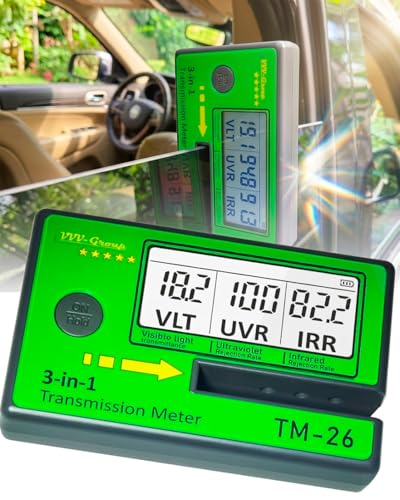
Accuracy is the headline here, and the feedback backs it up.
Slide side glass into the 8mm slot and the TM-26 returns transmission data alongside ultraviolet rejection and infrared rejection, all shown as percentages. It self-calibrates every time you switch it on, provided the 8mm (1/3 inch) slot is left completely empty during startup. There is no warm-up ritual beyond that. Accuracy is what the buyer feedback leads with, and rightly so — a meter that repeats the same number twice is worth more than one that flatters.
For a customer standing in your bay, the HOLD function is the quietly useful part. Tap the power button after inserting the sample and the measured values stay on the display while you turn the meter around to show them. That turns a private reading into a demonstration, and it is why detailing studios and dealerships gravitate to this shape of tool.
Read the fine print on what it will not do. This is an optical transmission meter, not a thickness gauge. It will not measure glass thickness, coating thickness, plastic or polycarbonate panels, laminated windshields, or loose film samples held on their own. The sample has to be filmed glass in the slot and no thicker than 8mm. A one-button meter at mid-range money, backed by a 4.5+ star standing across 130+ ratings.
What it does beautifully: Accurate, repeatable readings with a single button and a startup self-check you cannot forget to run.
The limit worth knowing: A laminated windshield or a loose sheet of film will not give you a meaningful number — this meter wants installed side glass.
Go here if: you verify finished tint installs and want to show the customer the figure on screen.
Look elsewhere if: your checks involve windshields, bare film, or anything thicker than the 8mm slot.
4. Portable Solar Tester Meter, UV IR Rejection Meter

Three meters folded into one plastic case, at the lightest weight of any multi-band pick here.
UV transmission, IR transmission and light transmittance all come out of the same 8mm testing slot. The wavelengths are UV 365nm, IR 950nm and VR 550nm, which is a slightly different infrared peak from the RockRose’s 940 nm — note if you are trying to match readings against someone else’s bench. At 5.8 ounces it slips into a bag without dragging on your shoulder.
The working method is simple and well thought out. Power it on, wait for 100, 0.0 and 0.0 to appear on screen, drop the sample into the opening, and all three transmission values show at once. The data-lock function holds those figures for reading afterwards. It handles film, filmed glass, window tint and side windshield, so it covers demonstration and inspection work as well as a straightforward personal check.
Two practical notes before you order. It runs on batteries that are not included, and the self-calibration sequence is part of its accuracy — skip the wait for the zero display and the numbers will not mean much. Just under the price of the TM-26, it is the pick for someone who wants all three bands without paying the premium tier.
The value read: Three-band measurement, a data lock, and an 8mm slot for a budget-leaning spend — nothing in the spec list feels cut down.
The catch: No batteries in the box, and the calibration screen has to finish before you test anything.
Worth grabbing if: you want UV, IR and visible light readings in one light, portable unit.
Pass on it if: you need a meter with cells in the box and zero setup ritual.
5. GOYOJO Window Tint Meter GT116
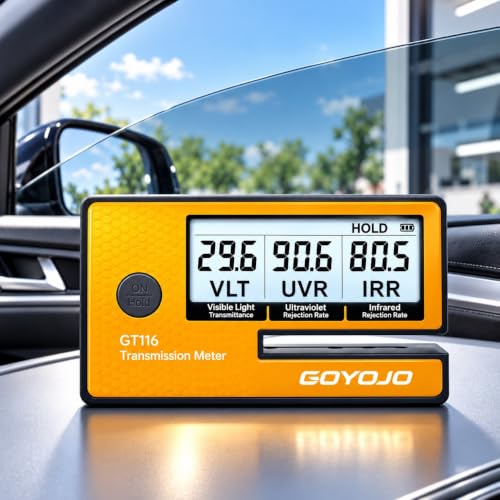
One reader that covers the car, the office and the patio doors without changing tools.
Most meters on this list are aimed at a car bay. This one reads visible light transmission, UV and IR rejection, then tells you it is equally at home on residential and commercial window film. That matters if you have a house full of film and a car in the drive — one tool, one set of numbers, no second purchase. The 8mm measuring slot takes most standard automotive and architectural glass.
Readings come up digitally and quickly on the handheld body, which weighs 9.9 ounces. Compare that with the Ayamuba pocket checker near the bottom of this list, which comes in at 2 ounces — a 5.0x gap in weight for a much larger and more capable class of tool. The package measures 7.6 x 4.29 x 1.65 inches against the Ayamuba’s 5.39 x 3.62 x 1.93 inches, so it takes noticeably more drawer space.
Here is the honest caveat. There is very little buyer evidence behind this one yet, so you are going on the manufacturer’s specification rather than a track record of owner experience. If you want a meter with a long history of use behind it, the TM-26 or the TM2000 give you more to lean on. If you want one affordable three-band reader for windows of every kind, this is a sensible way to spend.
Spread across a whole property: Auto film, home film and shop glass all take the same 8mm slot and give the same three readings.
Thin track record: A new listing means fewer verified owners to learn from than the older picks here.
Best home for it: a household or small operator checking tinted glass of several different types.
Hold off if: you would rather buy a meter with years of shop use documented behind it.
6. Lunorivo Digital VLT Tester, 0–100% Range
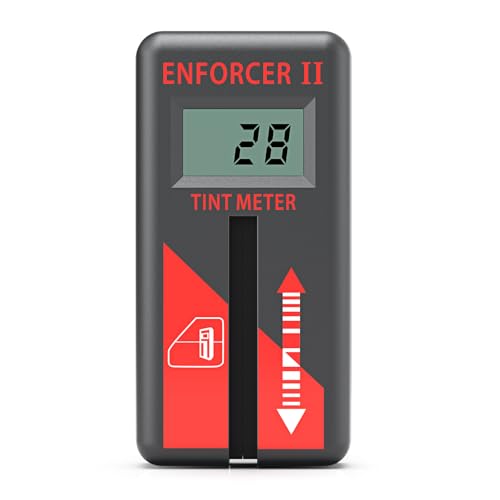
Built for the fourth car of the afternoon, not just the first.
Calibrated optics hold ±2% accuracy across the full 0–100% VLT range, so it reads dark privacy glass and lighter films on the same scale. Slide it over a roll-down window and the digital figure appears in about 4 seconds, with no buttons to press. A 60g body drops into a glove box, tool kit or pocket without you noticing it is there. Rated 4.5+ stars across 30+ ratings, it is the best-rated VLT-only meter here.
The detail that protects your work is the foam lining inside the testing slot. Soft foam against the glass helps reduce scratch risk on freshly installed film, and the snug fit cuts down dust and stray light that would otherwise muddy the reading. For a shop doing daily installs, that is the difference between checking a window and risking it.
The maker rates it for up to 1,000 measurements, aimed at daily shop volume rather than one job a year. Two reference tint samples come in the kit for confirming the meter is behaving, along with a protective carrying case and manual. One thing to respect: use it in shaded or normal light. Strong direct sunlight can skew the optical reading, so test in the bay rather than out in the glare.
Why it suits daily volume
- ±2% accuracy held across the entire 0–100% VLT range
- Foam-lined slot helps protect film and keeps stray light out
- About 4 seconds per reading, no buttons, self-explanatory
- Two reference samples, a case and a manual in the box
- 60g and pocket-sized for carrying between jobs
What to keep in mind
- Visible light only — no UV or IR rejection readings
- Direct sunlight can throw the optical reading off
- Newer listing with a limited body of owner feedback
Suits you if: the job is repeat VLT checks and you want a fast, scratch-conscious meter that lives in the glove box.
Not your meter if: you need UV or IR rejection figures alongside the tint darkness reading.
7. Ayamuba Auto-On Digital VLT Tester
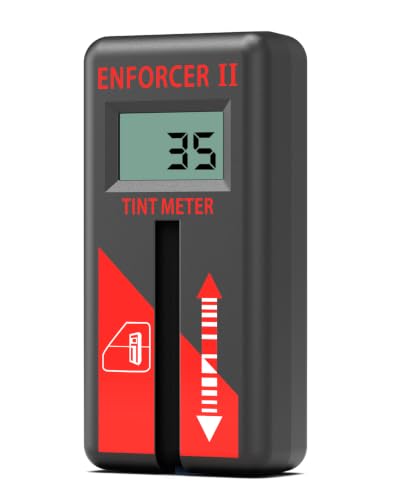
The lightest thing on this list, and it turns itself on when it touches glass.
At 2 ounces and around 60g in the hand, this is the one you genuinely forget is in your pocket. Nothing to switch on, nothing to hold down. Place it on compatible roll-down side glass and it wakes up, reads VLT within seconds, then shuts itself off when you lift it away. The 6mm open-slot design fits side window glass up to 6mm (0.24 in.) thick.
The accuracy figure is ±2% under proper use conditions, and the whole kit arrives ready to run: one CR2032 cell is included, along with a hard storage case and two reference samples for practice and quick operational checks. For verifying a tint after installation, a maintenance check or a pre-purchase inspection, that is everything you need.
Be realistic about the 6mm limit. If your car runs thicker filmed glass, the slot will not seat properly and you want one of the 8mm meters above instead. And keep in mind this reads VLT only — no UV or IR numbers, which is the trade for its weight and its budget-friendly spend. Rated 4.5+ stars across 40+ ratings, it is the pick when pocket carry is the whole job.
Built for: a driver who wants a legal-check tool in the glove box and never wants to press a button.
Skip the 6mm slot if: your side glass with film on it runs thicker than 0.24 in.
Know the Specs
VLT (Visible Light Transmission)
The percentage of visible light that passes through the glass. Your local tint law is written around this number, which is why it is the one figure every meter on this list produces. A reading of 0–100% covers everything from near-black privacy glass to clear film.
Slot Width in mm
The gap the glass slides into. A 6mm slot fits glass up to 6mm thick; an 8mm slot takes thicker filmed glass. Pick a slot narrower than your glass and the meter will not sit flat, which throws the reading off entirely.
±2% Accuracy
How far the displayed number can sit from the true value. On a window close to a legal limit, a wider accuracy window makes the pass-or-fail call genuinely uncertain, so this figure matters most when the stakes are high.
UVR and IRR
Ultraviolet rejection and infrared rejection percentages. UV is the part that fades interiors; infrared is the heat. Neither is usually written into a tint law, but both tell you whether the film is doing real work beyond darkening the glass.
IR Wavelength (940nm vs 1400nm)
The specific infrared wavelength a meter tests at. Absorbing films are measured around 940nm, while metallic and reflective films need the 1400nm variant. Testing the wrong film type at the wrong wavelength gives you a number that does not reflect its heat performance.
Auto-Calibration
Some meters zero themselves when switched on, but only if the slot is empty. Wait for the baseline display before inserting any sample — a calibration run with glass already in the slot bakes the error in.
Common Questions
Will a window tint tester work on my windshield?
What VLT percentage is legal for car windows?
Do I need UV and IR readings or is VLT enough?
How do I know the meter is reading accurately?
Can a tint tester measure the film before it goes on the glass?
Why does my reading change in direct sunlight?
What battery does a window tint tester use?
Will a 6mm slot fit my tinted side window?
Is a more expensive tint meter more accurate?
Can I use one of these on architectural window film at home?
The Bottom Line
For most buyers, the best window tint tester is the Tint Meter Inspector II TM2000, because a NIST-traceable reading is the one thing that settles an argument about legal tint. If you work a bay and handle absorbing films, the RockRose LS162 gives you VLT, UV and IR at once with a data hold for showing customers. And for a no-button legality check that lives in the glove box, the Ayamuba Auto-On VLT Tester is the one to reach for.
How we choose
We do not accept paid placement. Every pick is matched to a real buyer and a real use-case; we do not hands-on test units.
Sources
Specifications: manufacturer listings and product documentation. Review insights: verified customer reviews, as of November 2026. Pricing: not shown on this page (it changes often); check the current price via the retailer link.
As an Amazon Associate, Tactical Gear Guy earns from qualifying purchases. This does not affect which products we feature.