Specs are compiled from manufacturer listings and verified buyer reviews and can change over time — please confirm the key details on the product page before buying.
Buying an underwater video light is not a lumens contest. A tight, hot-centered beam can claim a huge number and still wreck your footage, because it burns one patch of reef white while the rest of the frame stays dark. What actually makes footage usable is even coverage — a wide flood beam, a color temperature that matches daylight, and a depth rating you can trust on the dive you actually plan to do.
This guide is built by comparing the manufacturers’ published specifications and the patterns across verified customer reviews, so you get each pick’s real strengths and trade-offs instead of marketing spin.
You will see which lights flood a frame cleanly, which run long enough for a two-tank day, and which mounting hardware fits a camera rig or a GoPro. Every claim below traces back to that light’s published specs and owner reviews, so you can match a light to your depth and rig.
Top Picks

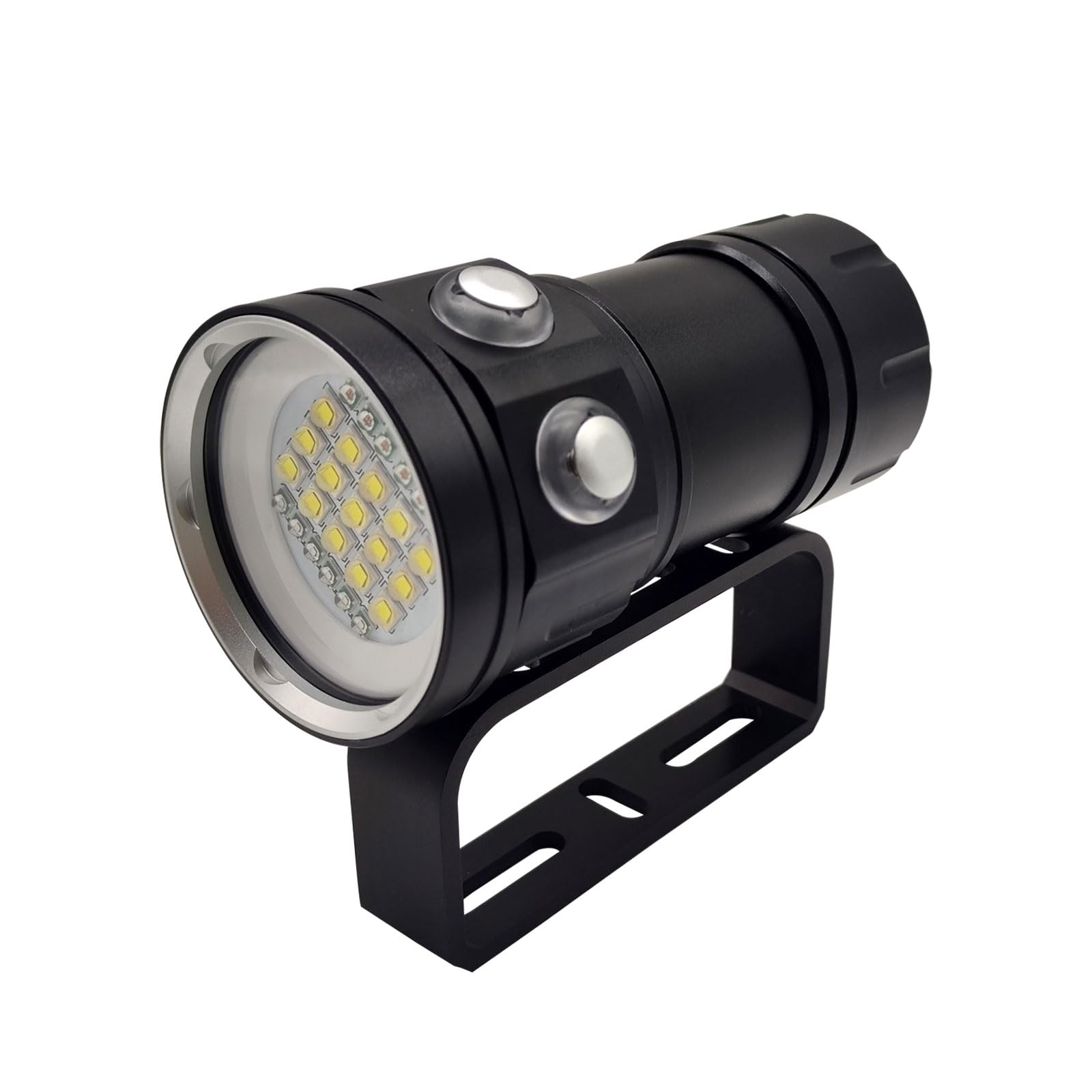

How To Choose The Best Underwater Video Light
Start with the shot you want, not the number on the box. Video wants a flood — a wide, even wash of light across the whole frame. A narrow spot beam is built for pointing at things and signaling, and it will leave black edges around your subject no matter how bright it is.
Beam angle decides whether your footage looks professional
A 120° beam spreads light across a wide field, which is why almost every light on this list uses it. That width is what stops the classic hot-spot problem: one blown-out white patch in the middle of the frame with grey mush at the edges. Wider still exists — a 150° flood throws light even further out to the corners, at the cost of a softer center.
Depth rating: read the meter number, not just the letters
An IPX8 rating tells you the light survives immersion, but it does not tell you how deep. The manufacturer’s own meter figure does. A light rated to 80 meters covers most recreational diving comfortably; one rated to 70 meters or beyond covers wreck and cave work too. Check that number against your deepest planned dive, then leave yourself a margin.
Color temperature and the red/blue question
Water eats red light first, so video shot deep comes out blue-green without help. A 6500K white lamp is the daylight-standard fill light, while 5500K–6000K runs slightly warmer and can render skin and coral more naturally in clear water. Red and blue LED modes let you light skittish sea life without spooking it, and the red especially earns its keep on night dives.
Runtime and battery style — the thing divers actually get burned by
Bright light drains a battery fast, so output and runtime fight each other. Several lights here list a long runtime on low mode and a much shorter one at full brightness — and full brightness is what you actually use on a night dive. Next, pick your power source: a built-in rechargeable pack (you charge it by cable, which is simpler) or a light that takes loose 18650 cells (a standard rechargeable battery you swap between dives, but you buy and manage them yourself).
Mounting: does it actually attach to your rig?
Most of these ship with a ball joint, the standard connector for camera arms, and several note it rotates a full 360 degrees so you can aim the light without unclamping anything. If you film on a GoPro, check that the light’s mount is compatible before you buy. A wrist strap matters for hand-held shooting on a night dive.
Side-by-Side Comparison
| Model | Best For | Max Output | Beam Angle | Depth Rating | Amazon |
|---|---|---|---|---|---|
| ORCATORCH D530V★ Best Overall | Balanced all-round video light | 1200 lumens | 120 degrees | IP68 | Amazon |
| Flylin Diving FlashlightMost Output | Maximum output on a budget | 18000 lumens | 120 degrees | 100 meters | Amazon |
| LetonPower Sealion B15Best Mid-Range | Tri-color reef shooting | 8000 lumens | 120 degrees | 80 meters | Amazon |
| LetonPower Sealion B24 | Step-up tri-color video | 9000 lumens | 120 degrees | 80 meters | Amazon |
| Noctilume N15 | High color-rendering fill light | 6000 lumens | 120 degrees | 80 meters | Amazon |
| TrustFire DF50 | UV and red creative lighting | 6500 lumens | 150 degrees | 70 meters | Amazon |
| LetonPower Sealion L12 | Long low-mode runtime | 8000 lumens | 120 degrees | 120 meters | Amazon |
| LetonPower Turbo S | Deep-rated turbo output | 10000 lumens | — | 100 meters | Amazon |
| LetonPower Sealion L24 | Top-tier output and depth | 12000 lumens | 120 degrees | 120 meters | Amazon |
Detailed Reviews
1. ORCATORCH D530V 1200 Lumens Underwater Video Light
Our pick — 4.0+★ from 90+ verified ratings; the strongest balance of quality and price.
A 120° flood that lights the whole frame evenly, with no blown-out center
If you film reefs and small close-up subjects instead of pointing a spot into the distance, the D530V is the cleanest tool here. It gives you 1200 lumens (a measure of brightness) of 6500K cool white light (6500K is daylight-balanced color, so footage looks natural, not blue) through a 120° flood beam (a wide spread, not a narrow spot). That is exactly what video wants: an even wash that covers the frame edge to edge instead of punching a bright hole in the middle. You aim it, and the whole shot is lit.
OrcaTorch built the switching for water specifically. The titanium alloy side switch locks with a 5-second hold and open up with a double-press, so it does not fire in your gear bag or clip itself on mid-descent. The power display reads in green, orange, red, and flashing red against fixed thresholds, so you know before you splash whether you have a full dive in the tank. Over-discharge protection and thermal control round out the electronics — this light is designed to be trusted twice a day, not once.
The ball joint bracket is the quiet win. It gives a 360-degree rotating connection that mounts either on the light or on an underwater action camera, so the light becomes part of your rig rather than a hand-held afterthought. What wins people over across the listing is the wide, hot-spot-free spread — the phrase “evenly illuminating subjects” turns up in the feedback again and again, and it matches what the 120° spec promises. The honest framing is that 1200 lumens is a fill-light number, not a turn-the-reef-daylight number. In clear tropical water with a camera nearby, that is plenty; deep in murk, you would want more. It is the highest-scored light in this group, and it earns the top slot on consistency rather than on headline output.
What earns it first place
- 120° flood beam spreads an even wash with no hot spot in the center of frame
- 6500K cool white matches daylight so underwater color reads true without a color-correction filter
- Switch locks in 5 seconds and open up with a double-press, so it never fires accidentally in a dive bag
- Built-in ball joint rotates 360 degrees and mounts to the light or an action camera
- Over-discharge protection and intelligent thermal control guard the battery and emitter
Where it tops out
- 1200 lumens is fill-light territory — fine beside a camera, thin in low-visibility water
- Color-temperature readouts and power-level mode markers are the only guidance; you manage the rest
Best suited to: a camera-first diver who wants even, correctly colored footage without fiddling with the light mid-dive.
Think twice if: you dive muddy water and want a wall of raw output — the Flylin doubles the beam width’s neighbors on brightness, not this one.
2. Flylin Diving Flashlight
18000 lumens of 120° flood for lighting the far wall of a wreck
One number makes the Flylin impossible to ignore: 18000 lumens. Set that beside the ORCATORCH D530V’s 1200 lumens and the advertised output gap is 15.0x. The Flylin’s 120° flood beam (a wide spread) reaches an illumination range of 50 meters and stays usable down to 100 meters underwater. So it is built for the diver filming the far wall of a wreck, not the coral an arm’s length away.
The LED mix is unusually thoughtful for a video light. It runs 15 white XML2 emitters (the bulbs that make the light) alongside 6 red XPE R5 and 6 blue XPE R5, split across 7 modes. White gives you full flood for footage, while red and blue let you light night-active sea life without washing it out in white light. The body is aluminum alloy with an anti-abrasive coating and a stated 1.5-meter anti-drop rating (it is rated to survive a 1.5-meter drop). The switch works by long-press, which separates the white modes from the red and blue set — so you are not cycling through all seven to get back to flood.
Two things a buyer needs to plan around. The light is powered by four 18650 batteries that are not included, so you supply and manage your own cells. And the 100-meter depth figure carries the IPX8 label — the meter number is the one that means something, and it is a serious one. The catch is runtime honesty: the listing’s brightness praise is real and consistent, but owners also flag battery life as the weak point. Treat it as a bright burst light for a camera rig and carry spare cells, not as an all-night hand-carry.
The reverse-angle play: most lights sacrifice runtime for output; the Flylin pairs a 50000-hour emitter lifespan with over-heat and land high-temperature protection so it protects itself on deck as well as in the water. A 4.0+/5 score still lands it in the top half of this group despite a small rating base.
Go for it if: your priority is searing brightness for distant subjects and you are happy running 18650 cells.
Pass if: you want a light that charges by cable and never needs batteries managed.
3. LetonPower Sealion B15
White, red, and blue LEDs in one 8000-lumen, 80-meter body
The Sealion B15 is the most obviously practical light in this group for a diver who wants all three color options in one tool. It delivers 8000 lumens through white 6500K, plus blue and red LED modes, all spread over a 120° beam. That white 6500K again gives you daylight-balanced footage, while the red and blue add depth to a night shoot without spooking the catch.
LetonPower is unusually specific about its build testing. Every B15 gets a pressure test equivalent to 80 meters underwater before it ships, and the high-strength casing is specified to resist long-term saltwater corrosion. The charge indicator reads blue above 30%, red between 5% and 30%, and flashing red below 5%, so it warns you before a dive rather than during one. A test report and a depth number are the two things you want from a light headed for salt water, and this one has both.
What wins people over is the output, and it shows up where it counts. The consensus is that the beam does its best work in dark crevices and rock overhangs, where a bright 120° flood turns a black hole into something a camera can read. The recurring note on battery life is fair and worth sizing: it is listed as mixed rather than glowing. If you buy it, plan a charger: the light ships with a ball joint, wrist strap, and two spare O-rings, but not a charger.
The rig-friendly build: 120° coverage plus a supplied ball joint and wrist strap makes it ready to shoot straight from the box, and the two replacement O-rings are the maintenance item most divers forget to bring.
Reach for it when: you want three colors and a properly pressure-tested body without jumping to the premium tier.
Look past it if: you need maximum runtime at full brightness for long sessions rather than short bright ones.
4. B24 Dive Light

The B15’s tri-color layout with 1000 more lumens of white output
If you have already scanned the B15 above, think of the B24 as the same architecture with the output turned up. It lists 9000 lumens of white 6500K light, plus blue and red, through the same 120° beam. For the diver whose lighting budget leans brighter than the mid-range B15, that extra ceiling buys you better reach on a wall or reef at the outer edge of your frame.
Where the two siblings differ is the spec sheet, and it is worth checking closely. The B24 shares the B15’s pressure-test claim — tested to 80 meters before shipping — and the same long-term saltwater corrosion resistance. The charge indicator works on the same blue, red, and flashing-red thresholds. The package is the same too: ball joint, wrist strap, two spare O-rings, and an instruction manual.
The feedback that carries the B24 is all about the beam. Buyers describe a strong, even wash of light, which is what you want when the camera is pointed at a textured reef or a corroded hull. Where quality came back mixed, the fair read is that this is a step up in output, not in build, from the B15 — the casing is the same class. There is one practical note worth catching before purchase: like several lights here, it does not include a charger, so you sort that out separately. A camera-first diver will find it earns its place; a hands-free night diver may want a wrist strap rig in the bag.
Where it fits: a natural middle step for someone who wants the B15’s tri-color flexibility with room to throw a brighter frame. 4.0+/5 confirms most buyers leave satisfied.
Choose it when: 9000 lumens of 6500K white with blue and red looks like the right ceiling for your camera setup.
Skip if: the B15 already covers your output needs — the difference here is lumens, not features.
5. Noctilume N15 6000 Lumens Dive Light
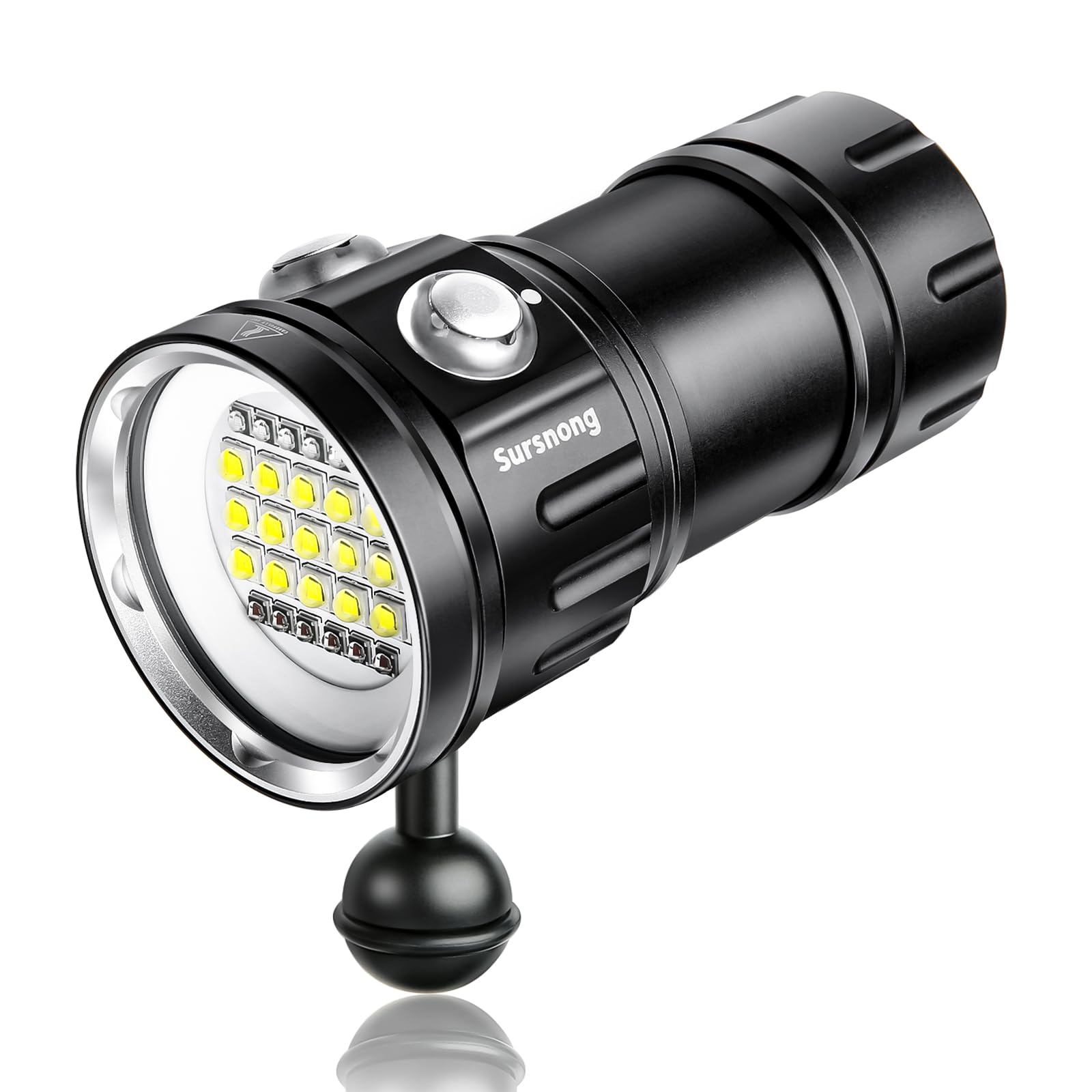
A 90 CRI emitter with three white brightness levels for accurate coral color
The N15 is the light for the diver who cares about how coral actually looks on camera. It carries a 90 CRI rating — that is color rendering index, a scale for how faithfully a light shows true color — and 6000 lumens of 6500K white through a 120° beam, with blue and red alongside. You get three brightness levels on the white: high, medium, and low, so you can match the light to the ambient with some control instead of blasting one setting at everything.
The build is aimed squarely at salt water. The housing is high-strength aluminum alloy, rated to withstand 80 meters of deep-sea corrosion. The box leans into maintenance, with a hard-shell rainproof storage bag and a spherical support. It also comes with a portable lanyard. The brand tells you to wash it with fresh water and dry it thoroughly after every dive, and to keep the O-rings (the rubber seals that keep water out) greased with silicone — that habit is what keeps a sealed light sealed.
Two realities to plan for. The light does not include a charger, and the listing explicitly says it has no charging port, so you supply your own. Battery life is stated at 6 hours. If you intend to carry spare cells, the maker specifies pointed rechargeable batteries without a protection chip — a specific requirement note before you buy extras.
The color-first pick: if your underwater work lives or dies on natural skin tones and coral hues in a video edit, the 90 CRI plus adjustable white output makes this the clearer choice in the group.
It suits: the shooter who grades footage later and wants the cleanest color profile to work from.
Weigh the trade: no charger included and a specific battery-spec requirement to satisfy.
6. TrustFire DF50 Scuba Diving Light, 6500 Lumens

150 degrees of flood plus invisible UV light for coral that glows
The DF50 is the widest flood on this list at 150 degrees, and that is its whole reason to exist. Six XM2 U3 emitters throw 6500 lumens of 6000K white light across that spread, which means the beam reaches into the corners of a wide frame that a 120° light would leave dark. On a night dive over a broad reef, this is the light that lights the whole scene rather than a circle in the middle.
The extra LEDs are the real story. It carries three XE-3535 red LEDs at 620nm wavelength and three XPE UV LEDs at 395nm. The red is a night-dive workhorse — it lets you see without whitewashing everything, and it is specifically built for red-sensitive fish. The 395nm UV is what makes fluorescent corals glow on camera, a trick few lights here can do. It runs from a customized rechargeable pack with a Type-C cable, so a power supply is all you need to keep going, and the four-level battery indicator tells you where the charge sits.
Depth is 70 meters, backed by a diving pressure system rated for that. That is the least deep in this group, and note if your diving runs deep. The feedback splits honestly: brightness is clearly the star, with a wide even wash on the reef and the red mode praised for night diving. Reliability and battery life both read mixed, with some reporting solid two-dive sessions and others hitting failures. That puts it in the class of “buy for what it uniquely does — wide flood plus UV — and treat it as a tool to maintain,” not as an indestructible flagship.
The creative option: 620nm red plus 395nm UV on one body is rare, and a 150° flood is the widest here, so this is the pick for fluorescent coral and night footage.
Best for: night divers and coral shooters exploiting UV and red light.
Consider the depth: 70 meters is below several lights here, so plan your sites accordingly.
7. L12 Dive Light

The long-runner that survives 120 meters of pressure
This is the light for the technical-leaning diver who wants depth and runtime in the same body. The L12 passed a 120-meter extreme pressure test on every unit before shipping, which is the deepest rating in this group alongside the L24. It puts out 8000 lumens of 6000K white with blue and red options over a 120° beam. There is also one detail most lights miss: the shell is a conductive-free design that avoids electrolytic corrosion, which is the slow chemical attack that eats lesser housings in salt water.
Runtime is where the L12 makes its case. It lists 10 hours on low light and 1.5 hours at full brightness, and the Type-C interface lets you swap a spare battery and get straight back in the water. That is the difference between a charger and a recharge cycle when you are on a boat between dives. The mode set is the broadest here, spanning constant, SOS, strobe, floodlight, dive, video, and photo — so the tool adapts to what you are shooting.
The feedback on runtime is strong, with accounts of two full 50-60 minute dives from a single charge, and buyers call it reliable and easy to use. The mode list is long, which is a plus on a boat and something you’ll want to learn before your first descent so you are not hunting for video mode under water. The 1-year after-sales coverage is stated on the listing. Its compatible-devices line notes GoPros and underwater cameras, so it slots into a video rig rather than sitting hand-held.
The endurance angle: 10 hours of low mode and a 120-meter rating make it the pick for long shallow sweeps and deep drops alike. 4.0+/5 puts it among the reliable mid-group.
Pick it for: dive days that need runtime over raw peak brightness, with charging between dives sorted.
Know going in: the mode menu is the busiest here, so learn the switches before you go in.
8. LetonPower TS S

Big output, a titanium alloy switch, and a light built for clear water
The Turbo S runs an imported COB wick — a chip-on-board emitter that packs many small LEDs into one bright panel — at 10000 lumens. Its white light sits between 5500K and 6000K, which the maker points out is close to the sun at noon, and that warmth pays off in the reproduction of living creatures and the refraction of underwater objects. In clear water it is the light the maker explicitly says to trust, because color cast matters more than raw output.
The body is built for depth: every unit passed a 100-meter underwater pressure test before leaving, the shell is high-strength and non-conductive to resist electrolytic corrosion, and the switch is titanium alloy. You get white, red, and blue in one tool. Runtime is 12 hours on weak light and 3 hours at strong light, charged through Type-C, and a dual LED indicator layout shows remaining power at a glance — so you know before you finish the tank.
The honest note here is about water quality. The maker’s own framing is that the excellent color reproduction shows best in reasonably clear sea water; murk is where a turbo light starts working against you. It is the mid-tier technical pick in this lineup, with a 100-meter rating to match the L12’s shorter range and a warmer color temperature than the 6500K crowd. If your dives are wreck and cave in good visibility, this fits.
The technical builder: a titanium switch and 100-meter pressure test put it in wreck-diving territory, while the 5500K-6000K white keeps footage warm and lifelike.
It is built for: clear-water technical diving where warm, accurate color beats a cool cast.
Plan the water: murky visibility is the one condition the maker warns against.
9. LetonPower Sealion L24

The big-bright top of the LetonPower stack
This is the last word in output on this list: 12000 lumens of 6500K white, with blue and red alongside, all through a 120° beam. It pairs that brightness with the same 120-meter pressure test as the L12 — every unit passed a 120-meter extreme underwater test before shipping — so it is a deep-capable light, not just a bright one. High-strength shell, saltwater-resistant, and a conductive-free design to ward off electrolytic corrosion.
Runtime splits the same way the other LetonPower lights do: up to 8 hours in low mode and 70 minutes at full brightness. That full-brightness number is the one to plan around on a night dive. When the power indicator dims, the built-in Type-C port takes a charge and gets you ready for the next descent without a battery swap. The 120° flood keeps the wide wash, which is the shape your camera wants.
Buyers report that the beam itself is the highlight — a wide, even wash that lights large areas. Reviewers also note its reliability, including use with GoPro cameras for underwater video, and describe the color reproduction as natural. Battery life gets mixed reports, which is fair for a 12000-lumen body: the output is the point. It sits at the top of the LetonPower range and scores 3.5+/5 — solid, but that rating rests on a larger base of reviews than the mid-tier picks, which is where a bit of inconsistency creeps in. Pick it for the highest output LetonPower makes in this class, and go in knowing the type of light you are getting.
The output ceiling: 12000 lumens plus a 120-meter test rating makes it the most powerful light here on both fronts. If lighting a large area at depth is the job, it has the numbers.
Made for: the diver who wants maximum LetonPower output and deep-water confidence in one light.
The honest trade: 70 minutes at full brightness means managing runtime on a long night dive.
Know the Specs
Lumens and beam angle
Lumens measure the total light a lamp emits, but they tell you nothing about distribution. A 120° beam throws that light wide; a 150° beam goes wider still. For video you want the wide spread, because the camera frame is wide. A high-lumen light with a narrow beam will blow out one patch and leave the rest dark, which is why this list favors flood designs. Lumens still matter for reach — more lumens push usable light further into the water.
IP rating and depth in meters
The IPX8 rating means the light survives being submerged, but it does not state a depth. The manufacturer’s meter figure is the real number: 70 meters, 80 meters, 100 meters, or 120 meters. Match it to your deepest planned dive with margin to spare. A 100-meter rating covers most recreational diving and then some. A lower rating like 70 meters still covers most reef and wreck rec dives, but it narrows your safety margin on technical drops.
Color temperature and CRI
Light color is measured in Kelvin. 6500K reads as cool daylight, matching the color standard video editors expect as a baseline. 5500K–6000K reads slightly warmer, and in clear water can render skin and coral more lifelike. CRI, the color rendering index, measures how faithfully a light shows true color — a 90 CRI rating is high, and is why a lower-lumen light can still out-perform a brighter one for stills and video grading.
Battery: built-in pack versus loose cells
Two battery philosophies run through this list. Built-in rechargeable packs charge by cable (Type-C on several here) and skip the cell management, but you can’t swap between dives. Loose-cell lights take standard batteries you supply — swappable between dives, but you own the charging and the spares. Runtime figures usually give a long low-mode number and a much shorter full-brightness number; the full-brightness number is the one to plan a night dive around.
Common Questions
Will a 120° beam be wide enough to cover my video frame?
Is IPX8 enough to prove a dive light is safe at depth?
Can I use these lights above water without damaging them?
Do these lights come with a charger and battery?
How long does the battery actually last at full brightness?
Can I mount these lights on a GoPro or camera rig?
What is the difference between the red and blue light modes?
Which is better for video — 6500K or a warmer 5500K light?
Do I need to maintain a dive light after every saltwater dive?
Is more lumens always better for underwater video?
The Bottom Line
For most people filming underwater, the underwater video light winner is the ORCATORCH D530V. Its 120° flood and 6500K white light give you even, correctly colored footage without a hot spot — and it is the highest-scored pick here on a strong base of owner feedback. If you shoot distant subjects and want raw output, the Flylin pushes 18000 lumens to a 100-meter depth. For fluorescent coral and night work, the TrustFire DF50 has the widest 150° flood with 395nm UV (ultraviolet light that makes coral glow) on board. And if you need the most output LetonPower makes in this class, the Sealion L24 pairs 12000 lumens with a 120-meter rating. Whichever you pick, the pattern holds: a wide, even beam beats a bigger lumen number on the box.
How we choose
We do not accept paid placement. Every pick is matched to a real buyer and a real use-case; we do not hands-on test units.
Sources
Specifications: manufacturer listings and product documentation. Review insights: verified customer reviews, as of November 2026. Pricing: not shown on this page (it changes often); check the current price via the retailer link.
As an Amazon Associate, Tactical Gear Guy earns from qualifying purchases. This does not affect which products we feature.