Specs are compiled from manufacturer listings and verified buyer reviews and can change over time — please confirm the key details on the product page before buying.
If your house runs out of hot water every morning, the fix is a whole home on demand water heater — a wall-mounted unit that heats water as you use it instead of storing it in a tank. The catch is that fuel type, flow rate, and venting decide everything, and picking wrong means cold showers or a costly reinstall. This guide compares real models across gas and electric, with the exact numbers that matter.
This guide is built by comparing the manufacturers’ published specifications and the patterns across verified customer reviews, so you get each pick’s real strengths and trade-offs instead of marketing spin.
You’ll see which units serve a big family, which suit a small home, and which need a serious electrical panel before you buy. Here is what genuinely separates the strongest whole home on demand water heater options from the rest.
Top Picks

How To Choose The Best Whole Home On Demand Water Heater
Start with what your house already has. A gas line and a vent path open up one family of units. A spare slot in the electrical panel opens up another. Get that answer first, and half the market drops away cleanly.
Match the flow rate to how your family lives
Flow rate is measured in GPM — gallons per minute of hot water the unit can deliver. One shower draws roughly 1.5 to 2 GPM, so a busy home running two showers, a dishwasher, and a washing machine at once needs headroom. A 5.3 GPM unit suits steady smaller households; a 9.5 or 11 GPM unit keeps pace with three or four water points running together.
Understand the fuel trade-off
Gas units burn natural gas or propane and can heat a large volume quickly, but they need venting and a gas supply. Electric units skip venting entirely, yet they pull serious amperage — some models want several dedicated breakers and a heavy household service. Factor the install cost, not just the unit.
Gas vs electric: the real deciding factor
A gas tankless heater needs a vent pipe routed outside and, for indoor installs, a proper flue. An electric tankless heater needs nothing but power and water, which makes it easier to tuck into a closet. The electrical draw is the catch — check your panel’s total capacity before committing to a high-kilowatt electric model.
Side-by-Side Comparison
| Model | Best For | Flow Rate | Heat Output | Fuel Type | Amazon |
|---|---|---|---|---|---|
| Rinnai V53DeP Propane★ Best Overall | Compact outdoor installs | 5.3 gpm | 81 KW | Propane | Amazon |
| APUS Natural Gas 140,000 BTUBest Value | Zero-cold-water tech | 6.8 gpm | 140000 BTU | Natural Gas | Amazon |
| GASLAND Gasmart E CE686NGTop Performer | High-flow gas value | 7.6 gpm | 199000 BTU | Natural Gas | Amazon |
| Rheem RTEX-24 | Small-home electric | 5.9 gpm | 24 KW | Electric | Amazon |
| ThermoMate 36kW | Large-family electric | 8.8 gpm | 36 KW | Electric | Amazon |
| Ecosmart ECO 36 | Budget electric power | 6 gpm | 36 KW | Electric | Amazon |
| Westinghouse HW180A0G-NG | Smart WiFi gas | 7.9 gpm | 180000 BTU | Natural Gas | Amazon |
| Stiebel Eltron Tempra 29 Plus | Precision electric control | 3 gpm | 28800 watts | Electric | Amazon |
| Rheem RTG Series 9.5 GPM | Multi-bathroom gas | 9.5 gpm | 199900 BTU | Natural Gas | Amazon |
| Noritz NRC66DVNG | Quiet condensing gas | 6.5 gpm | — | Natural Gas | Amazon |
| Rinnai RX199iN | Biggest whole-home output | 11 gpm | 199000 BTU | Natural Gas | Amazon |
Detailed Reviews
1. Rinnai V53DeP Propane Tankless Water Heater
Our pick — 4.5+★ from 450+ verified ratings; the strongest balance of quality and price.
A compact propane unit that keeps two showers and a dishwasher running without flinching.
Run three or four water points on propane and this Rinnai keeps up. It delivers 5.3 gallons per minute (GPM — the flow of hot water the unit can sustain), so a shower, the dishwasher, and the washing machine can all draw at once. Its 81 KW heat output (kilowatts — a measure of heating power) is the headline figure here, and it is a big one. Next to the Rheem RTEX-24 electric heater at 24 KW, this Rinnai carries 81 KW — a 3.4x gap in raw heating power. That gap is why gas earns its place in bigger homes.
The unit is designed for outdoor installation, with a compact footprint 7.9 inches deep and 13″W by 30″H, so it tucks against a wall where a tank would never go. Rinnai rates the heat exchanger for a limited 15-year warranty, with 5-year parts and 5-year labor. Register the product within 90 days of installation, or the labor warranty drops to 1 year. Owners consistently praise its reliability across everyday demand — it just keeps delivering hot water.
The recurring gripe is temperature control. Several owners find the factory setting defaults to 120°F and want a hotter baseline. Expect to spend a few minutes at setup dialing it where you want it. Professional installation is recommended, and budget for the propane and vent work that comes with any gas unit.
Where it earns its keep
- 5.3 GPM handles two showers plus an appliance at once
- 81 KW heat output — far more raw heating power than the 24 KW Rheem RTEX-24
- 15-year heat exchanger warranty with prompt registration
- Compact 7.9-inch depth suits tight outdoor wall space
What to plan around
- Defaults to 120°F, so set your preferred temperature early
- Propane and venting work add to the install bill
- Labor warranty falls to 1 year without 90-day registration
The verdict: A propane home with steady multi-point demand gets endless hot water from a unit that hides on an outdoor wall.
Think twice if: you want the simplest possible install — an electric model skips the vent and gas line entirely.
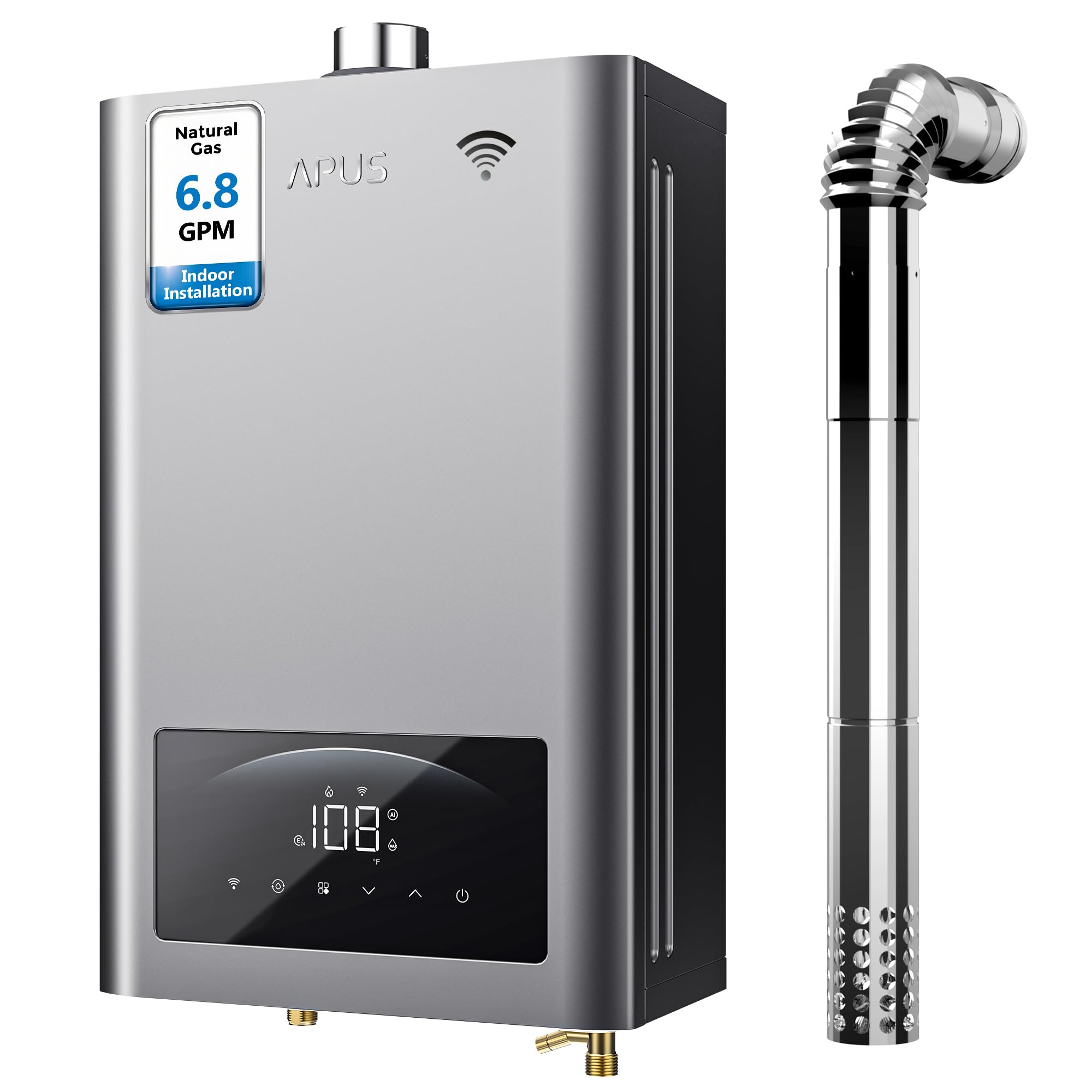
2. APUS Natural Gas Tankless Water Heater, 140,000 BTU
Built to kill the cold-water wait with a built-in circulation pump and a phone app.
For a four-to-five-point home that hates the ten-second cold burst before the shower warms, the APUS has a real answer. Its Zero Cold Water single-circulation setup keeps hot water moving so the tap arrives warm. A built-in booster pump raises flow up to 130% for a maximum of 6.8 GPM, and the 140,000 BTU burner feeds a copper heat exchanger.
Against the GASLAND Gasmart E at 199,000 BTU, this APUS runs 140,000 BTU — a meaningful step down in heating muscle, which matters most in cold climates with cold incoming water. The trade is a lower output for a smaller, lighter unit. On the smart side, you set 95–140°F on the LED display or through the Tuya app, with ±1°F control and remote status alerts. Standard 120V AC powers the pump, sensors, and controller.
Honesty check: heat output opinions split. Some owners get an endless supply; others find it not hot enough, especially where ground water runs cold. Install experiences are generally positive, and the foot-print is compact at 7.09 inches deep. It carries a 2-year manufacturer warranty, shorter than the 15-year heat exchanger coverage on the Rinnai above — so weigh the app features against that shorter term.
Smart-home upside: App control, ±1°F precision, and a booster pump are features you will not find on every value gas unit — handy for monitoring and preheating.
Climate caution: In deep-cold regions the 140,000 BTU output can feel light, and the manual tells you to fully drain the unit before freezing weather or long idle periods.
Reach for this if: you want app control and zero-cold-water tech at a mid-range tier in a milder climate.
Look elsewhere if: you live where incoming water is icy and need every BTU of heat you can get.
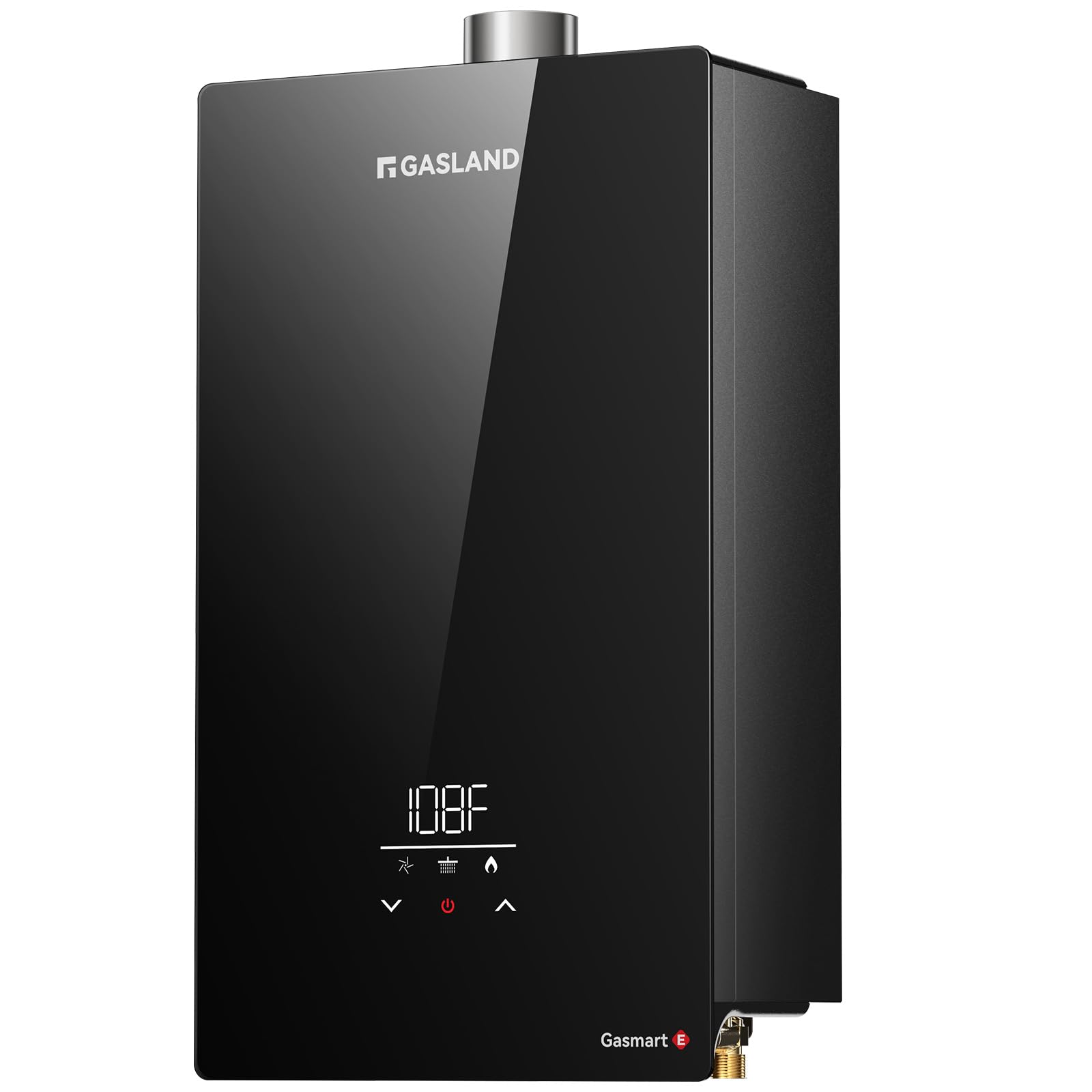
3. GASLAND Gasmart E 199,000 BTU Tankless Water Heater
The high-flow workhorse: 7.6 GPM of gas-fired hot water from a suitcase-sized box.
Big houses on natural gas get a genuine capacity jump here. The GASLAND delivers 7.6 GPM, and that beats the Rinnai V53DeP’s 5.3 GPM — 7.6 versus 5.3 in the same unit of measure. Its 199,000 BTU burner is also a hefty step above the APUS at 140,000 BTU, which is the difference you feel when multiple taps open at once. It is CSA certified with overheat, flame-out, and freeze protection built in.
The efficiency claim is worth spelling out. With a UEF (Uniform Energy Factor — a standard score for how much of the fuel becomes hot water) of 0.8, the maker compares it to a 50-gallon tank at 0.6. That is the honest pitch, and it points to real savings over a stored-tank heater, since a tankless unit heats only when a tap is open. Installation is a mixed bag: some buyers find it straightforward, others report thin instructions, so a qualified installer smooths the path.
One thing to know physically — this is a heavier, chunkier unit than the electric options. It weighs 37.5 pounds and runs 7.28 inches deep. Compared with the Rheem RTEX-24 at 17.8 pounds and 3.5 inches deep, the GASLAND is roughly double on both counts, so plan the wall mount accordingly. Performance and heat output are what most buyers come away praising.
The case for it
- 7.6 GPM outruns the Rinnai V53DeP’s 5.3 GPM for multi-tap homes
- 199,000 BTU gives strong heating headroom
- UEF 0.8 efficiency, well above a standard tank
- CSA certified with freeze, flame-out, and overheat protection
The honest trade-offs
- Heavier and deeper than electric rivals — plan the mount
- Instruction quality is inconsistent, so installer expertise matters
- Needs a gas supply and vent path
Pick this one if: you have a large gas household where several hot-water points fire at once and you want maximum flow.
Skip the wall-bracket hassle if: you need the lightest unit possible — the electric options save real weight.
4. Rheem RTEX-24 24kW 240V Electric Tankless Water Heater

No gas line, no vent pipe — just power and water for a slim, closet-friendly install.
The simplest path to endless hot water lives here. The RTEX-24 delivers up to 5.9 GPM with 24 KW of heat, and it needs no venting at all, so it slides into a closet or utility nook without a flue. Its digital thermostat lets you set temperature in 1-degree increments from 80°F to 140°F. Reviewers single out its performance as the standout strength.
The install math is the part to study before you order. This model needs 240V single-phase power, three 40-amp double-pole breakers, three sets of #8 AWG copper conductors with ground, and a recommended minimum 200-amp household service. If your panel is small or already full, that is a real added cost. Compared with a gas unit like the Rinnai V53DeP at 81 KW, this Rheem runs 24 KW, so it suits a smaller or tighter-demand home rather than a big multi-shower family.
Heat generation splits opinion: some say it warms water fast, others find it does not reach their target temperature on very cold incoming water. At 17.8 pounds and 3.5 inches deep, it is the lightest, slimmest unit in this lineup, and the leak warranty runs 5 years with 1-year parts.
Install-day reality: The ventless design is a real convenience, but three 40-amp breakers and a 200-amp service mean you must check the panel first — no skipping that step.
Sizing sense: At 5.9 GPM this fits a small-to-mid home on electric, not a house running four showers together.
Best fit: an electric-only home with a solid panel that wants quick, vent-free installation and space savings.
Hold off if: your electrical service is under 200 amps or you need to feed several showers at once.
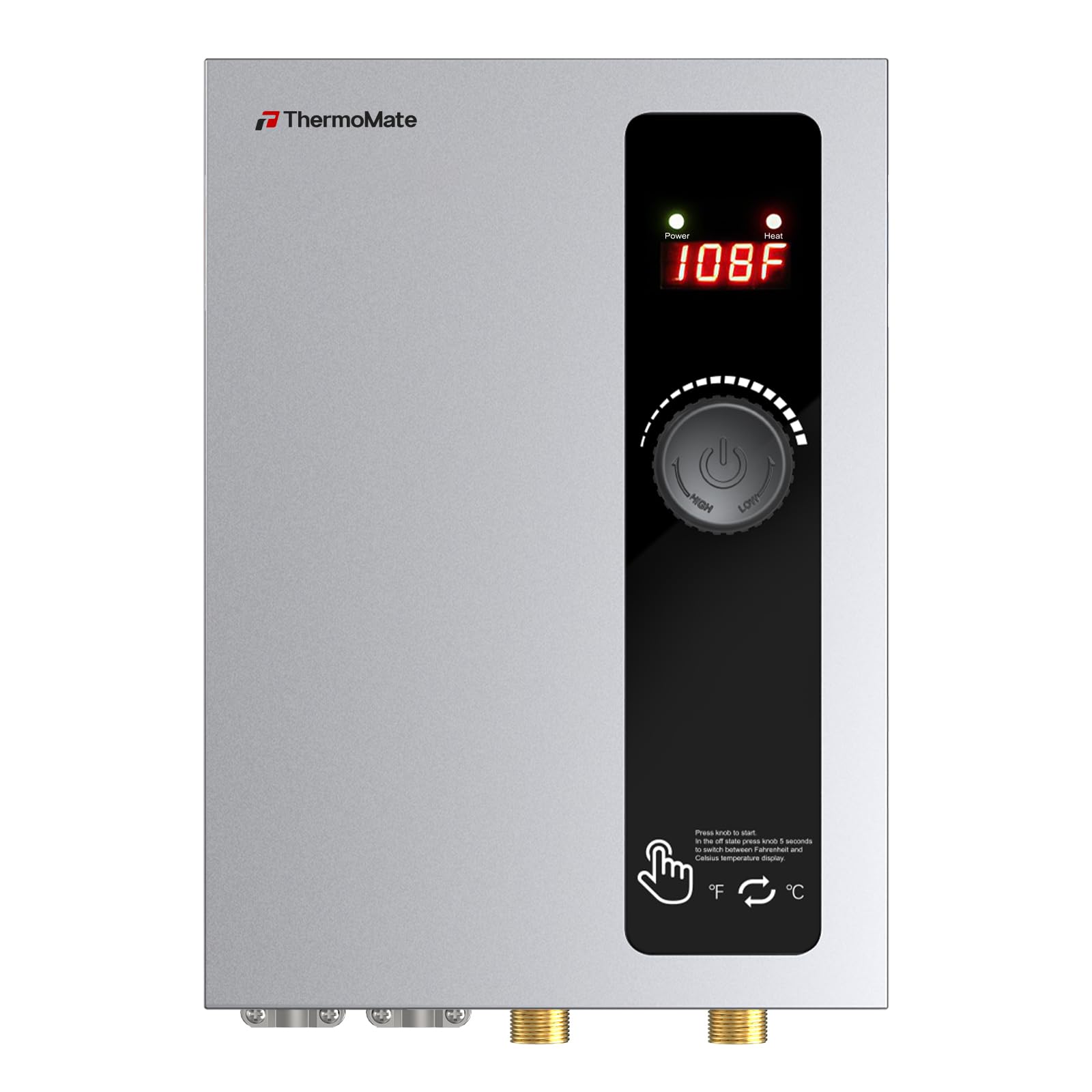
5. ThermoMate 36kW Tankless Water Heater Electric Max 8.0 GPM
A big-family electric unit that keeps four showers and the laundry running together.
Large electric households get real capacity here. The ThermoMate runs 36 KW and delivers a listed flow rate of 8.8 GPM, with the maker quoting an estimated 7.03 GPM at a 35°F rise — that rise figure is the honest way to read water output. It is designed to feed four showers, a kitchen, and a laundry room at once. Self-modulating technology (the unit adjusts power to match demand in real time) trims waste, and the maker cites 99.8% heating efficiency with up to 60% savings versus a traditional tank.
Buyers report performance that exceeds expectations, plus energy efficiency they see reflected in lower electric bills. Installation is described as straightforward, with helpful drawings that head off confusion. Temperature is adjustable from 80°F to 140°F in 1-degree steps through a digital display. ETL certification, automatic dry-fire shutdown, overheat protection, and anti-freezing round out the safety side.
The catch with any 36 KW electric heater is the panel and wiring demand — this is not a plug-in appliance, and a qualified electrician plus adequate service is a must. It is a stainless-steel body at 27 pounds and 4.41 inches deep, so it mounts neatly on a utility-room wall once the wiring is in place.
Why buyers like it
- 36 KW feeds four showers plus laundry and kitchen together
- Maker cites 99.8% heating efficiency and up to 60% savings vs a tank
- Self-modulating power use matches real-time demand
- ETL certified with dry-fire and overheat protection
What to weigh
- High kilowatt draw needs a strong panel and an electrician
- Electric output scales with incoming water temperature
Go here if: you have a big all-electric home and want to keep four water points flowing at once.
Check first if: your electrical service can carry a 36 KW load — this one asks a lot of the panel.
6. Ecosmart ECO 36 36kW 240V Electric Tankless Water Heater

Entry-level electric power with a digital display and a modest 6 GPM ceiling.
The ECO 36 targets budget-minded electric homes that still want serious wattage. It runs 36 KW at 240V with a 6 GPM flow rate, and the maker rates it 99.8% energy efficient. A digital output temperature display makes setting easy, and the unit uses 3/4-inch NPT pipe fittings. It needs 4 x 40 A breakers, so the electrical service check matters as much here as on any 36 KW model.
The trade-off against the ThermoMate is flow. The ThermoMate lists 8.8 GPM; this ECO 36 lists 6 GPM, both electric and both 36 KW, which tells you the flow you actually get depends heavily on incoming water temperature. Owners praise performance and often call installation surprisingly easy, but heating results split — some get super-hot water, others want more heat. Durability is likewise mixed, with some reporting long service and a few flagging early failures.
Physically it is friendly: 18.4 pounds and a slim housing, made of copper and stainless steel, with a limited lifetime warranty on the unit. If the budget is the priority and demand is moderate, this covers the basics competently.
Value read: A 36 KW electric heater with a lifetime warranty and easy install at an entry tier — a sensible starting point.
Sized expectation: At 6 GPM, plan for a smaller household. If durability and heat margin top your list, the higher-tier picks give you more.
Worth it for: a budget electric install with modest demand and a panel that already carries 4 x 40 A breakers.
Step up if: you routinely run three or more hot-water points — the flow ceiling is lower here.
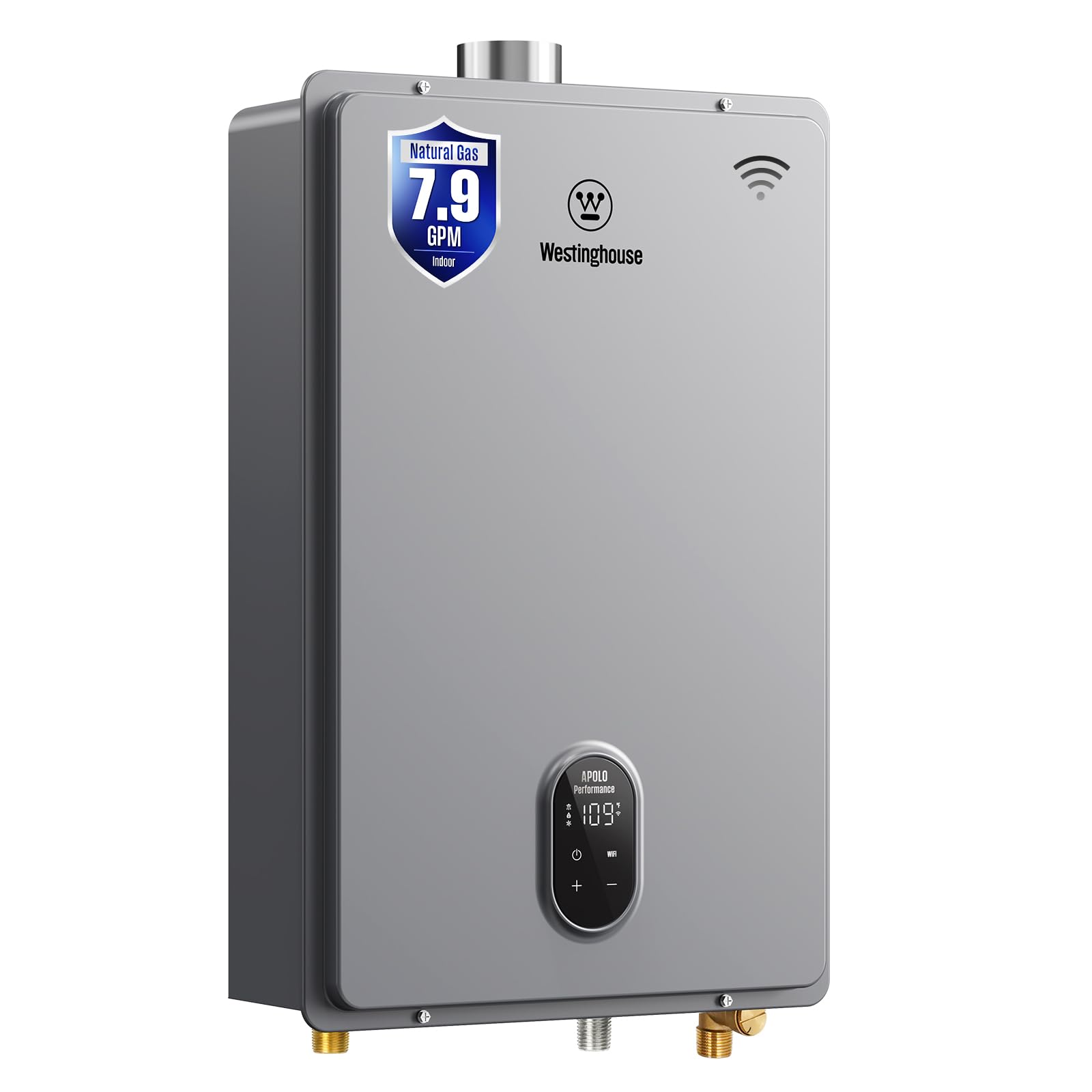
7. Westinghouse Tankless Water Heater Gas Indoor, 7.9 GPM
Runs three showers at once and takes commands from your phone or your voice.
Homes with weak or fluctuating water pressure should read this one closely. The Westinghouse fires at a minimum activation flow of just 0.53 GPM and keeps working at pressure as low as 15 PSI, which makes it a practical choice for well systems, older plumbing, or low-flow fixtures. Output is up to 7.9 GPM and 180,000 BTU, enough for three showers together, and it is CSA certified for indoor gas installation.
The smart layer is the standout. Built-in WiFi lets you adjust temperature, watch operating status, and get fault alerts through an app or by voice, with no extra accessories. Advanced self-modulating tech holds temperature within ±1°F. Compared with the GASLAND at 199,000 BTU, this Westinghouse sits at 180,000 BTU — slightly less peak heat, but the WiFi control and low-flow sensitivity are what set it apart.
Where it wobbles is temperature consistency: some owners mention swings rather than the steady ±1°F the spec promises. Owners rate functionality and installation as the strong points, and the unit is backed by a 2-year limited warranty with 5 years on the heat exchanger. Standard 3/4″ NPT plumbing and 120V AC power are required for the install.
What stands out: The 0.53 GPM activation flow and 15 PSI operation are built for homes that struggle with pressure — a real problem-solver for well systems.
The honest caveat: Temperature consistency is the weak spot for a minority; the ±1°F figure sits alongside reports of swings, so set expectations there.
Made for: a smart-home gas household on a well or low-pressure system that wants app and voice control.
Consider a different pick if: rock-steady temperature is your top priority and pressure is not an issue.
8. Stiebel Eltron Tempra 29 Plus Electric Tankless Water Heater
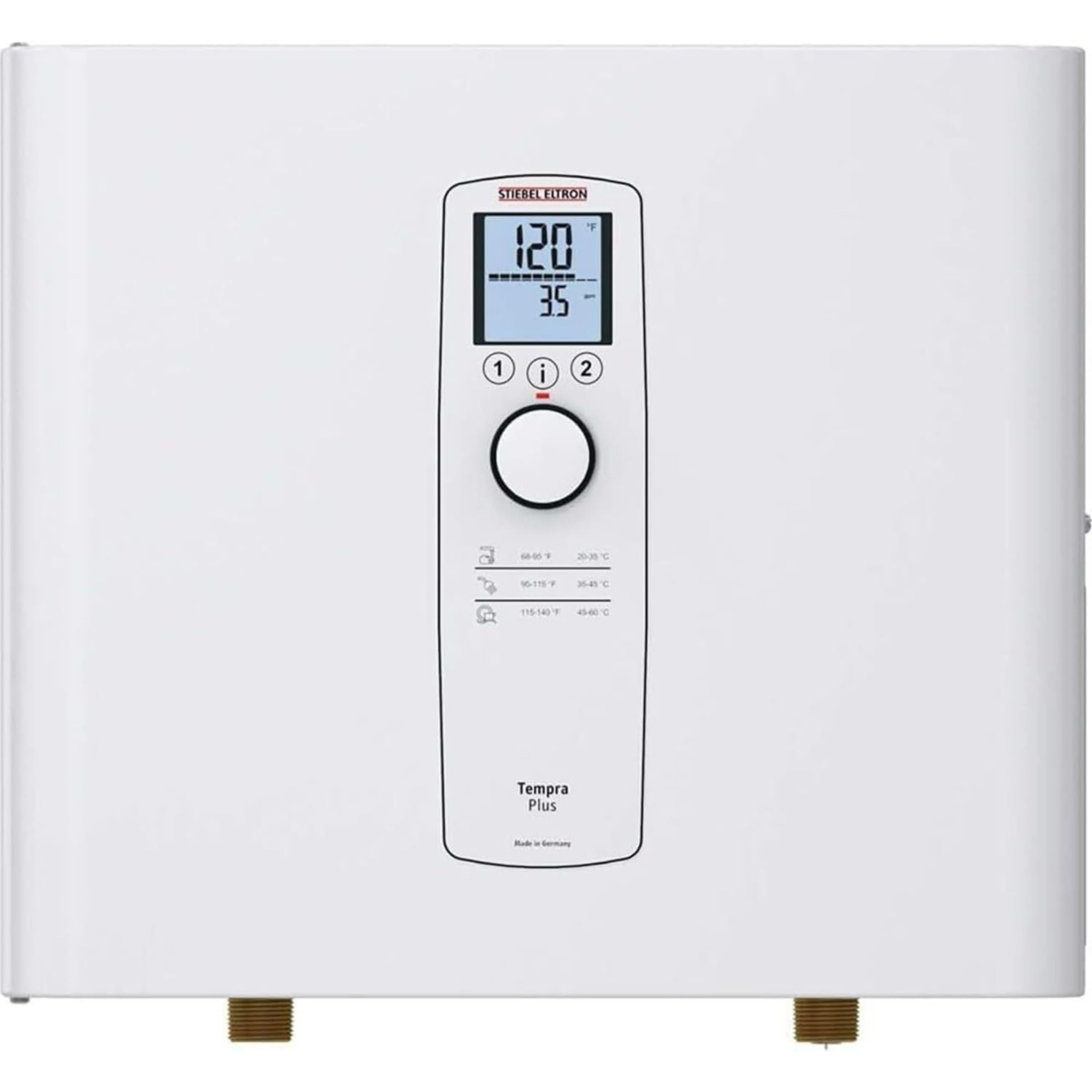
German-built precision with memory presets — but check your electrical service twice.
The Tempra 29 Plus is the electric unit for someone who values control and build quality over raw flow. It draws 28,800 watts at 240 volts (or 21,600 watts at 208 volts) and needs 3 separate dedicated 40-amp breakers with 8 gauge copper wiring plus a minimum 200-amp service. Two temperature memory presets let you jump between personalized settings. The manufacturer cites up to 34% energy and cost savings in whole-home use.
Here is the sizing truth that trips people up. The listed flow rate is 3 GPM, which is lower than the other electric models here — the RTEX-24 lists 5.9 GPM, the ThermoMate 8.8 GPM. That makes this a strong fit for one or two fixtures at a time rather than a whole house running four showers. Advanced Flow Control helps by managing output across climate conditions, but the GPM ceiling is what it is.
Owners find performance solid and installation manageable, with temperature control the often-noted trade-off: some see water reach target within 30 seconds, others report it landing hot or cold. Durability and reliability draw more split opinion than the top-tier picks. No venting is needed, and at 19 pounds it is lighter than most gas units, though it needs serious amperage behind it.
Strengths worth noting
- Two temperature memory presets for personalized settings
- Maker cites up to 34% energy and cost savings
- German-made build, no venting required
Plan carefully
- 3 GPM flow is lower than most electric rivals here
- Needs 3 x 40 A breakers and a 200-amp service
- Temperature consistency is a common trade-off note
Choose this if: you want precision presets and premium build for a one- or two-fixture draw.
Think again if: you need to run the whole house at once — the 3 GPM ceiling is the limiter.
9. Rheem RTG Series 9.5 GPM Natural Gas Tankless Water Heater
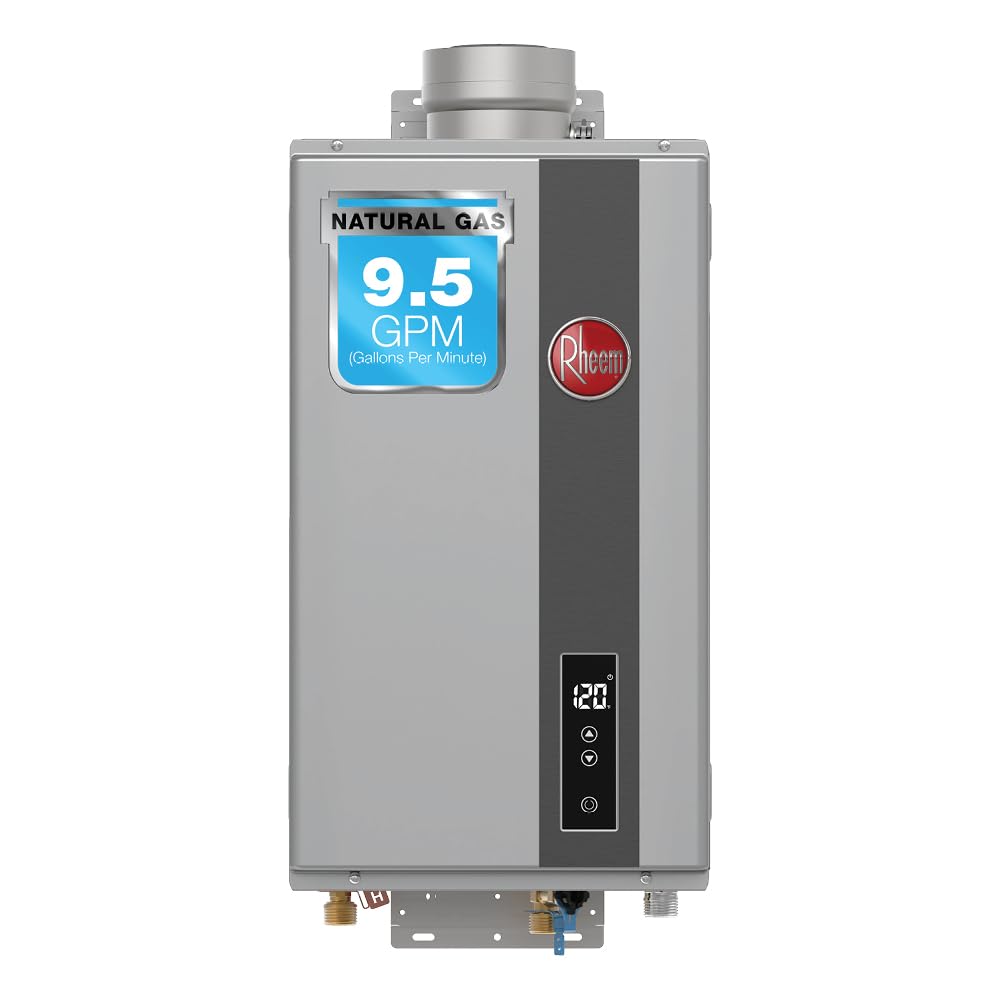
A multi-bathroom gas unit built to keep three or four showers running together.
Multi-bathroom homes get the flow they need here. The RTG Series pushes 9.5 GPM at a 35°F rise with 199,900 BTU/hr of output, sized for three to four simultaneous showers. A 0.82 UEF (Uniform Energy Factor, the standard efficiency score) and the maker’s estimate of up to 34% savings versus a 50-gallon electric tank make the running-cost case. Digital LED control holds ±1°F, with freeze protection and flame failure protection built in.
Against the GASLAND at 7.6 GPM, this Rheem’s 9.5 GPM leads on flow — both by the same GPM measure — which is the point for a busy family. It is non-condensing, so installation uses a direct vent system and should be handled by a pro. The heat exchanger carries a 15-year warranty, with 5 years on parts and 1 year on labor.
The most common gripe is noise — this unit runs louder than some owners expect in a quiet home. Energy efficiency splits opinion too. But hot water is abundant, and it heats fast. At 46.5 pounds and 10.27 inches deep it is a substantial wall mount, so plan the location with sound and support in mind.
The flow story: 9.5 GPM ahead of the GASLAND’s 7.6 GPM is the reason a four-shower home looks here first.
Sound note: Noise is the recurring complaint — if the unit goes near a bedroom or living space, weigh that before placement.
Ideal for: a large natural-gas family home that runs three or four showers and wants strong flow with a 15-year heat exchanger warranty.
Pause if: the install spot is close to quiet living areas — this one is not the hushed type.
10. Noritz NRC66DVNG Indoor Condensing Direct Tankless Water Heater

A condensing gas unit you can vent with ordinary PVC pipe and barely hear running.
If you want an easier install in a mid-size gas home, start here. The Noritz is a condensing unit — it recovers extra heat from the exhaust for higher efficiency — and it vents with Schedule 40 PVC pipe and fittings (a common plastic pipe rated for this use), which is often simpler and cheaper to route than metal flue work. It puts out 6.5 GPM (the maker’s item name lists 6.6 GPM) of natural gas heat, and it includes a remote thermostat and a 6-foot power cord.
Owners most enjoy the everyday experience: it handles multiple fixtures and appliances at once without issue, runs quietly, and keeps delivering endless hot water. It is a high-quality build with low NOx operation. The catch is warm-up — heated water takes a few moments to arrive at the tap, which is normal for a tankless design but worth knowing if you expect instant. Value for money draws disagreement among owners.
The heat exchanger warranty runs 12 years, with 5 years on parts and 1 year on labor. At 38 pounds and 10 inches deep, it mounts cleanly on a utility wall. If quiet operation and easy PVC venting top your list, this earns a look.
What convinces people
- Condensing design vents with Schedule 40 PVC pipe
- Runs quietly and handles multiple fixtures at once
- 12-year heat exchanger warranty
- Remote thermostat and 6-foot power cord included
Keep in mind
- Hot water takes a few moments to reach the tap
- Value for money draws divided reactions
- Condensing install still wants a qualified pro
Suits you if: easy PVC venting and quiet operation matter more than lightning-fast arrival at the tap.
Maybe not if: you expect hot water the instant you open the valve — a brief warm-up lag is normal here.
11. Rinnai RX199iN Condensing Smart Sense Tankless Water Heater

The big-house flagship: 11 GPM for seven fixtures and a UEF of 0.98.
If your home has seven water points and everyone showers at once, nothing else here matches this. The RX199iN provides up to 11 GPM, described as seven fixtures at once, from a unit the size of a small suitcase. Its UEF of 0.98 is the highest listed efficiency factor in this lineup, and the 199,000 BTU output keeps a large household supplied. A Quick Flush feature simplifies maintenance flushing.
Customers note quick heat times with no running out, and energy savings that show up as meaningful monthly reductions in electricity bills. Many describe it as super quiet, though some find it no quieter than a traditional tank. Both the RTG Series at 9.5 GPM and this Rinnai’s 11 GPM are for big homes; this one goes furthest. WiFi control is available through a separate Controlr module, which is not included.
Professional installation is recommended, and the residential warranty is a limited 15-year on the heat exchanger with 5-year parts and 5-year labor — dropping to 1-year labor if the product is not registered within 90 days. At 55 pounds it wants a solid mount. The 0.98 efficiency and the ceiling-topping flow are what justify the premium tier.
The high-end case
- 11 GPM for up to seven fixtures at once
- UEF 0.98 — the highest efficiency factor in this lineup
- Quick Flush feature simplifies maintenance
- 15-year heat exchanger warranty with timely registration
Before you buy
- WiFi control needs the Controlr module — not included
- Labor warranty falls to 1 year without 90-day registration
- 55 pounds needs a sturdy wall and pro install
The flagship fit: a large home that needs seven fixtures and cares about top-tier efficiency and reliability.
Only worth it if: you will actually use the capacity and the efficiency — smaller homes gain little from the top tier.
Know the Specs
Flow Rate (GPM)
GPM stands for gallons per minute — the hot water the unit can deliver continuously. One shower draws roughly 1.5 to 2 GPM, so a home running two showers plus an appliance needs a higher figure. A 5.3 GPM unit covers a steady smaller household, while a 9.5 or 11 GPM unit keeps three or four water points flowing. Higher GPM generally means more capacity to serve more fixtures at once.
Heat Output (BTU and kW)
Gas units are rated in BTU (British thermal units — a measure of heat energy), and electric units in kW (kilowatts). Higher numbers mean more heating power for cold incoming water and heavy demand. A 199,000 BTU gas unit and a 36 KW electric unit sit at the high end; a 24 KW electric or 140,000 BTU gas sits more toward mid-demand. Match the number to how many fixtures run at once and how cold your ground water gets.
Common Questions
How many showers can a whole home on demand water heater run at once?
Do I need a special vent for a gas tankless heater?
Can an electric tankless water heater run on my existing panel?
Is a gas or electric whole home on demand water heater better?
What does UEF mean on a tankless water heater?
Why does my tankless heater take a few seconds to deliver hot water?
Do these units work with low water pressure or a private well?
Can I install a whole home on demand water heater myself?
What temperature range can I set on these heaters?
Will a condensing model really save more on energy?
How long do these tankless heaters last and what warranty comes with them?
The Bottom Line
For most households, the whole home on demand water heater winner is the Rinnai V53DeP. Its 81 KW propane output and 5.3 GPM flow handle two showers plus an appliance at the same time, and a 15-year heat exchanger warranty backs it. Have a large gas home and want maximum flow? Grab the Rinnai RX199iN at 11 GPM for up to seven fixtures. And for a big all-electric house that runs four showers together, reach for the ThermoMate 36kW.
Match fuel type and GPM to your home before anything else, so measure your demand first and pick from there. One honest nudge: if endless hot water across several showers is the goal and you have the gas line for it, the higher-flow models are where the real upgrade lives.
How we choose
We do not accept paid placement. Every pick is matched to a real buyer and a real use-case; we do not hands-on test units.
Sources
Specifications: manufacturer listings and product documentation. Review insights: verified customer reviews, as of November 2026. Pricing: not shown on this page (it changes often); check the current price via the retailer link.
As an Amazon Associate, Tactical Gear Guy earns from qualifying purchases. This does not affect which products we feature.