Specs are compiled from manufacturer listings and verified buyer reviews and can change over time — please confirm the key details on the product page before buying.
Your phone dying at dusk on a grey trail day is the problem to solve. You need a panel that keeps pushing charge into your phone even when the sun is weak. A trekking solar charger is a foldable panel that turns daylight into USB power for your phone, power bank, or GPS. It does not store energy, so what matters is how many watts actually reach your device on a real trail day. Below, the panels that keep charging in thin light are separated from the ones that stall the moment a cloud slides over.
This guide is built by comparing the manufacturers’ published specifications and the patterns across verified customer reviews, so you get each pick’s real strengths and trade-offs instead of marketing spin.
Every pick below is a sunlight-only panel, so the honest first question is what happens to your output at 4 p.m. on a cloudy ridge. The panels that lead this list hold efficiency under low light and shrug off rain spray — everything you want in a trekking solar charger.
Top Picks


How To Choose The Best Trekking Solar Charger
The single most useful thing to understand before you buy: a solar panel is a sunlight converter, not a battery. It sends power straight to your device while the sun is out. If you want to charge after dark, you need a power bank in the chain, and the panel’s job is to refill that bank during the day. Shop by realistic output, weight, and weather sealing — not by the biggest number printed on the fold.
Wattage is a ceiling, not a promise
A 30W panel only hits 30 watts in strong, direct sun with the panel aimed square at it. Every degree of angle, every wisp of cloud, and every bit of heat pulls that number down. That is normal physics, not a fault. A panel rated at 25.4% conversion efficiency (the share of sunlight it turns into usable electricity) holds its output better in thin light than a cheaper cell. That matters more on a trek than a big wattage figure that only shows up at noon in July.
Weight and folded size decide if it comes with you
The lightest panels here fold small enough to slip into a backpack side pocket. A panel that weighs closer to 2 lb starts to feel like a luxury you leave in the car. Weigh your phone’s daily drain against the panel’s folded footprint before you commit.
Read the IP rating and check the junction box
IP67 means the panel survives dust and a dunk in water for a short time. IPX5 and IP65 cover rain spray and light weather but not immersion. One detail the ratings do not always capture: on some panels the junction box (the little block where the ports sit) is not fully waterproof even when the panel surface is. If you plan to hang it through a storm, know which part is sealed.
Dual ports and smart chips earn their keep
Two ports let you top up a phone and a power bank at once. A smart chip inside regulates current so a tablet or bank does not cut in and out as cloud passes. Ports that support USB-C PD and QC3.0 fast-charging standards push more power into compatible devices instead of trickling.
Side-by-Side Comparison
| Model | Best For | Max Power | Efficiency | Weight | Amazon |
|---|---|---|---|---|---|
| ELECAETNA 30W HPBC★ Best Overall | All-round trail pick | 30W | 25.4% | 0.5 kg | Amazon |
| FlexSolar 10W IP67Featherweight Pick | Featherweight backup | 10W | 24% | 10.56 ounces | Amazon |
| 15W Smart Display PanelLive-Read Display | Monitoring output live | 15W | 23.5% | 13.12 ounces | Amazon |
| SOLUPUP 30W Foldable | Two devices at once | 30W | 23% | 2.4 lb | Amazon |
| FlexSolar 30W ETFE | Weather resistance | 30W | 24% | 1.3 pounds | Amazon |
| BigBlue 20W Kickstand | Campsite angle-and-go | 20W | 24% | 1.71 lbs | Amazon |
| Renogy 30W E.FLEX PRO | Shade tolerance | 30W | 22.4% | 1.2 pounds | Amazon |
| 30W Digital Voltage | Reading live wattage | 30W | 23.5% | 13.12 ounces | Amazon |
| BigBlue 25W Ultra-light | Lightest 25W option | 25W | 25.4% | 0.84 lbs | Amazon |
Detailed Reviews
1. ELECAETNA 30W HPBC Portable Solar Panel
Our pick — 4.0+★ from 550+ verified ratings; the strongest balance of quality and price.
Half a kilogram of panel that keeps pushing watts when the clouds roll in.
The reason this takes the top spot is efficiency under bad light. ELECAETNA uses HPBC solar cells (a newer cell design that loses less output to heat and cloud) and rates them at 25.4% conversion efficiency. Compare that to the SOLUPUP 30W at 23% — the same maximum wattage, but the ELECAETNA clings on harder to every watt when the sun is thin. In practice that means your phone keeps creeping up in charge on an overcast afternoon rather than flatlining until the sky clears.
It also handles the abuse a trek throws at it. The ETFE laminate coating is rated IP68, which is the top end of the waterproof scale — dust tight and able to survive a dunk. It weighs 0.5 kg, light enough to clip to the outside of your pack with the two included carabiners, and it folds down small. You get a USB-C and a USB-A QC3.0 port so you can run a phone and a power bank together.
The honest catch is that no panel this size stores anything. If you need a charged phone at midnight, a power bank has to ride in the chain and get filled by day. Buyers report a steady 20W from the USB-C port, even under cloud. It holds 4.0+ stars across 500+ ratings.
What earns it the crown
- 25.4% HPBC conversion holds output in low light and heat
- IP68 ETFE coating — dust, water, and flame resistant
- 0.5 kg with dual QC3.0 USB-C and USB-A ports
What to keep in mind
- No built-in battery, so a power bank is needed for night charging
- 30W is a ceiling that needs direct, square-on sun
Go for it if: you want the most output per gram and a panel that does not quit in cloud.
Pair it with: a power bank, because the panel itself holds no charge for after dark.
2. FlexSolar 10W 5V USB Foldable Solar Panel Charger IP67
The panel you will actually forget is in your pack until you need it.
At 300 g (0.66 lbs) and folding to 7.6 x 8.8 x 0.7 inches, this is the lightest full-waterproof option here, and that is its whole argument. On a long thru-hike where every ounce is counted, a 10W panel that rides unnoticed in a side pocket beats a heavier panel that stayed home. The catch is wattage. It is 10W against the ELECAETNA’s 30W — a real 3.0x gap — so it is a top-up tool, not a fast charger.
It is honest about what it can do. The single USB-A port pushes 5V/2A and handles phones, tablets, small power banks, smartwatches, and flashlights — low-wattage gear. There is no storage, and it is upfront that the junction box is not waterproof even though the panel surface is IP67. Keep the port block out of standing water and it holds up. The monocrystalline A+ cells hit a 24% conversion rate, decent for the size.
Expecting too much from 10W is what trips people up. In direct sun it works well, and the dual carabiners (two clip hooks) make it easy to hang. But a few owners mention it will not charge at all in poor conditions, while others report a 25% gain in 2 hours. Treat it as a fair-weather trickle charger for one small device and it does its job.
Weighs nothing, asks little: the 300 g build and 3-fold design make it the easiest panel to carry, and the 24% cell efficiency is strong for a 10W unit.
The 10W reality: it is a single-device top-up charger — plan on a power bank if a full phone charge is the goal.
Best for: minimalists and long-distance hikers who want a near-weightless backup for one phone.
Look elsewhere if: you need to revive a dead tablet or fill a big power bank fast.
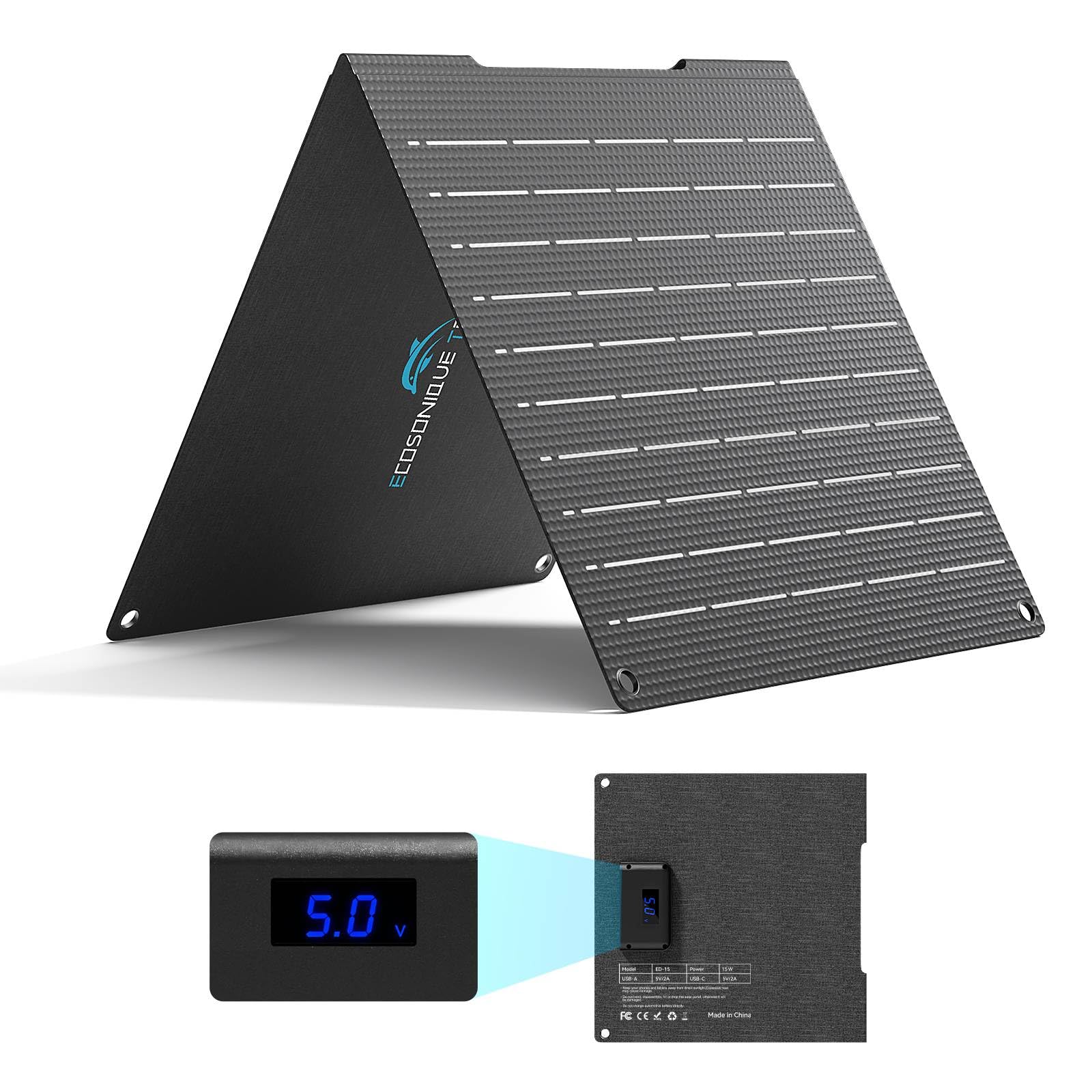
3. 15W Portable Small Solar Panel Charger Smart Display
A panel that tells you exactly when you have caught the sun.
Most solar chargers leave you guessing whether you are getting good light. This one puts a digital display on the front that reads live power, voltage, and current, so you can turn and tilt the panel until the number climbs. It is the most useful troubleshooting tool in this list for a first-timer, because you stop blaming the panel and start chasing the best angle.
The cells are 23.5% efficient monocrystalline under an ETFE coating that shrugs off scratches and heat, and it outputs 15W. At 13.12 ounces it is heavier than the FlexSolar 10W — 24% more weight — but you get 5W more power and the display for it. Dual USB-C and USB-A ports let you run a phone and a small device at once, with protection against overcharging and overheating.
What wins buyers over here is simply that it works. It slips into a backpack side pocket, holds up to backpacking conditions, and the readout makes it easy to find a good spot. The recurring gripe is charge speed — the display makes the shortfall visible, and some find it will not charge at all in weak sun. A 1-year warranty backs it up.
The case for the display: seeing real-time watts takes the guesswork out of panel placement and is a genuine edge for a beginner learning how sun angle works.
Mind the 15W ceiling: it is a one-phone panel, and the display will honestly show you its limits in cloud.
Reach for this if: you like seeing proof of what the panel is doing and want a compact 15W unit for a phone and a gadget.
Skip the readout if: your priority is raw wattage — the ELECAETNA does 30W at less than half this weight.
4. SOLUPUP 30W Foldable Solar Panel Charger IPX5

Two devices charging at once from one book-sized fold on the trail.
If you carry both a phone and a power bank, the dual ports here are the reason to look. It has USB-A plus USB-C outputs and a smart chip that keeps current steady, so a tablet or bank does not cut in and out as you move. The monocrystalline cells hit 23% efficiency and the whole thing folds to 7.87 x 10.63 inches — book size — at 2.4 lb.
It is sealed to IPX5, which covers rain spray and dust but not a dunk, and it ships with a storage bag that shades your phone from direct sun while it charges. The adjustable stand aims the panel at the sun and the carabiners clip it to a pack. This is a panel built for backpacking, hiking, and emergency kits, and it works with iPhone, iPad, Samsung, and Android over USB-C.
The trade-off is heft. At 2.4 lb it is the heaviest 30W pick here, and the 23% efficiency trails the ELECAETNA’s 25.4%. Cloud and overcast cut its output like any panel, which the maker notes is physics, not a defect. What wins people over is the dual-port convenience and steady handshake with banks and tablets; the gripe is that it does not charge quickly in weak light.
Where it shines
- Charges two devices together over USB-A and USB-C
- Storage bag and adjustable stand add trail flexibility
- Solid value and build for backpacking use
The trade-offs
- 2.4 lb is the heaviest 30W panel in this lineup
- IPX5 spray protection, not immersion-rated
- 23% efficiency sits below the top pick
Pick this for: hiking trips where a phone and a power bank both need topping up from one panel.
Think twice if: you are counting grams — a lighter 30W option is in this list.
5. FlexSolar 30W Solar Charger ETFE with QC3.0
Built to keep charging through the rain that ends everyone else’s day.
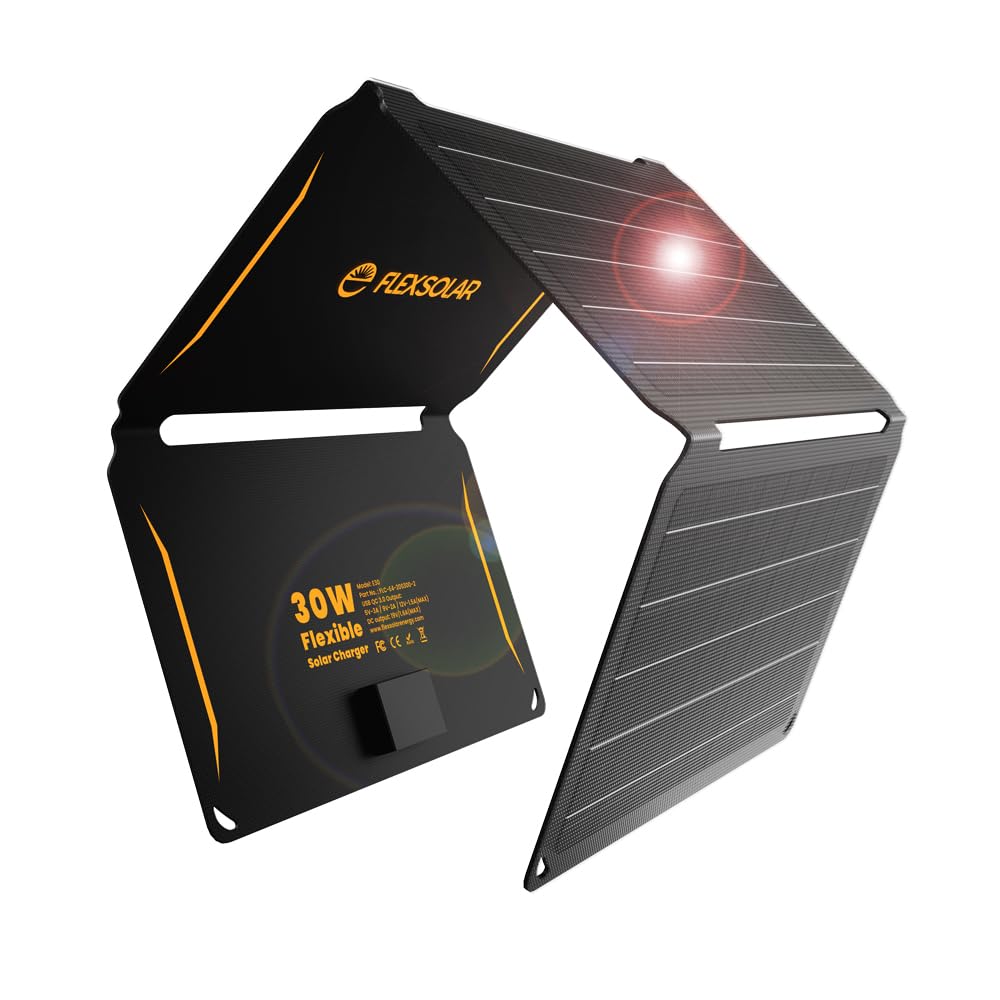
The headline on the FlexSolar 30W is durability in bad weather. It is IP67 rated, and the ETFE laminate carries a slightly concave-and-convex texture that increases the surface contact with sunlight, which the maker ties to its 24% conversion rate. Monocrystalline silicon laminations handle heat and wear, and the ETFE surface is tougher than a plain PET coating. If your treks run into unpredictable weather, that sealing is the feature that earns it a slot.
It gives you USB-A and USB-C ports with a smart chip that matches charging speed to the device, so phones, cameras, and tablets all get a sensible current. Folded size is 12.36 x 7.99 x 1.5 inches and it weighs 1.3 pounds, with two hanging holes and dual carabiners for a pack, tent, or tree.
Be realistic about sunlight. Cloud or any cover slows it, and the maker’s own fix is to reopen the panel and replug the device if charging stalls. It is a capable 30W panel rather than a miracle worker. What you are paying for is the weather sealing and the 2-year warranty, not the fastest possible trickle.
Sealed and sturdy: IP67 protection plus a 2-year warranty makes this the pick for wet, high-altitude, or four-season trips.
Sunlight only: cloud cuts output and it has no battery, so pair it with a bank if you need power after dark.
Made for: trekkers who expect rain and want a 30W panel that keeps working through it.
Less ideal if: you want the very lightest or most efficient 30W panel — this one prioritizes sealing.
6. BigBlue 20W Solar Panel Charger with Kickstand

A kickstand that tilts the panel into 25% more sunlight than lying flat.
You can spend a lot on cells and then waste it by laying the panel flat on the ground. BigBlue’s answer is a built-in kickstand, and by the maker’s figure it absorbs 25% more sunlight than a flat-laid panel. For a campsite where you set up and stay put, that angle adjustment is free watts. The 20W output and 24% monocrystalline efficiency are solid for a phone-and-tablet load.
The build leans on one-piece lamination of ETFE, UV-resistant EVA, and efficient cells — ETFE being more corrosion- and fire-resistant than a PET surface. It is IP65 rated, which handles occasional rain and dust but not a soaking. Folded it measures 8.66 x 8.74 x 1.57 inches at 1.71 lbs, with USB-A and USB-C ports each pushing 5V/2.4A and a smart chip that reads the device and matches its draw.
Two things to know before you commit. It cannot store electricity and it cannot charge a device that is sitting in the shade while the panel is in the sun — the ports are on the panel, so the device has to be near it. And 20W is a middle-of-the-pack figure against the 30W panels here. Set it up with the kickstand facing the sun and it earns its keep.
Why campers like it
- Kickstand absorbs 25% more sunlight than a flat-laid panel
- ETFE, EVA, and monocrystalline build with 95% light transmittance
- Dual USB-A and USB-C ports at 5V/2.4A each
Before you buy
- No battery storage — daytime charging only
- 20W sits below the 30W panels in this list
- IP65 handles light weather, not immersion
Ideal for: basecampers who set the panel down and leave it angled at the sun all afternoon.
Not for: hikers chasing maximum wattage per gram — there are lighter, stronger 30W picks here.
7. Renogy 30W Portable Solar Panel Charger
Partial shade stops most panels cold — this one keeps 75% of its output.
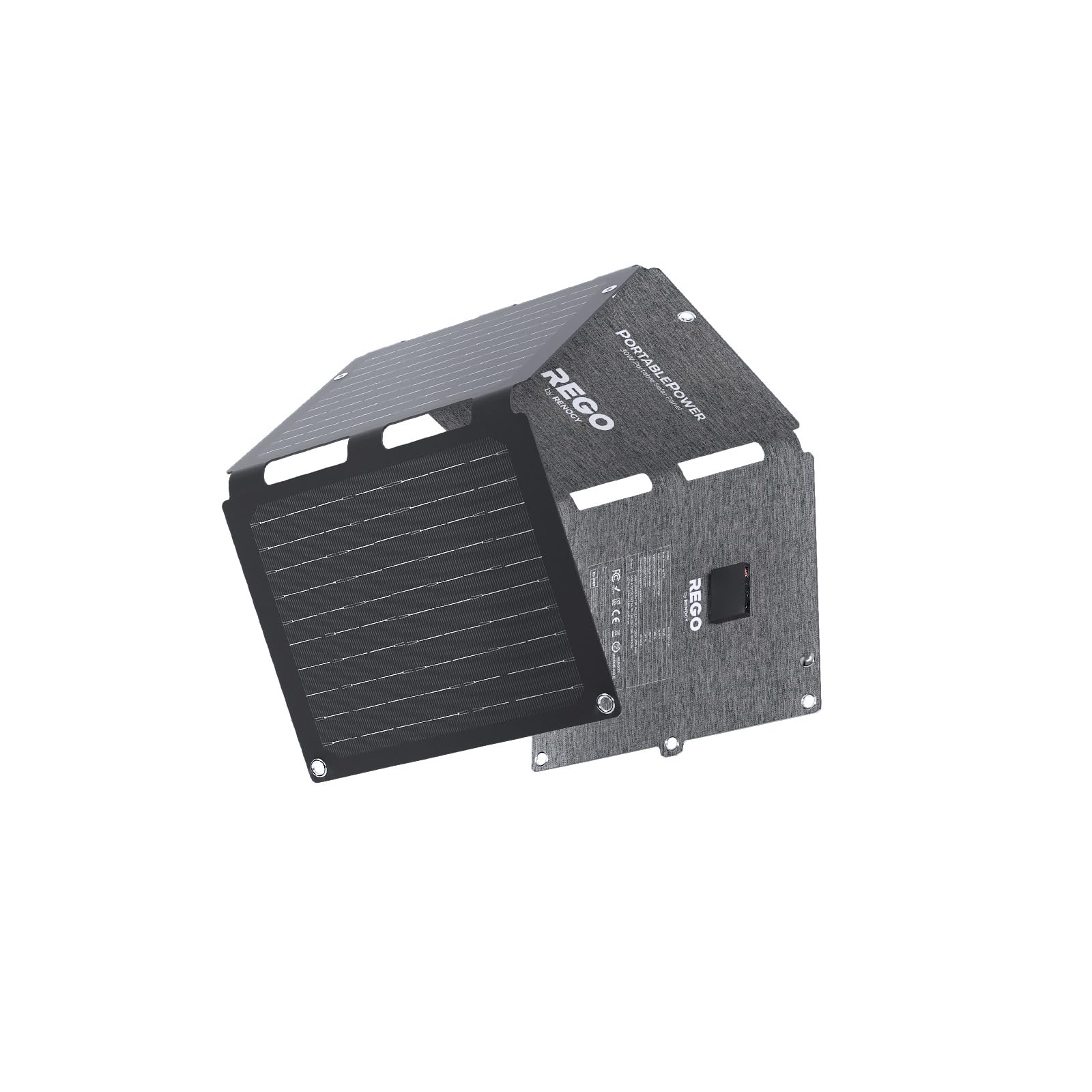
Shade is the quiet killer of trail charging, and Renogy attacks it head-on with a full parallel design. The maker claims at least 75% output with one section blocked, so a branch over a corner does not kill the charge. That is the single most useful trait for real-world camping, where you rarely get a clear, unobstructed sky patch all day.
It is light and versatile too. At 1.23 lbs (as light as a water bottle) and folding to a laptop-size 10.55 x 8.86 x 0.71 inches, it packs easily. Outputs cover USB-C PD3.0 at 20W max and USB-A QC3.0 at 18W max, plus a 30W DC output for small power stations. Efficiency is 22.4%, and it is IP67 rated against rain and dust with scratch-resistant polyester over monocrystalline cells.
Setup is the easy part: 6 reinforced metal hanging holes and 4 carabiners let you hang it off a pack, tent, or tree in seconds. The honest note is that 22.4% efficiency trails the top pick’s 25.4%, so in full clear sun it is not the most aggressive converter here. The shade tolerance is what you are buying — and for backcountry camping it pays off.
The shade edge: the parallel connection holds at least 75% output with one panel blocked, so a wandering shadow does not end your charge.
Efficiency note: 22.4% is the lowest conversion rate on this list, so full-sun output is a step behind the leaders.
Choose it when: your camp sits under tree cover and shade tolerance matters more than peak conversion.
Pass if: you always have an open sky and want the highest raw efficiency.
8. 30W Portable Solar Panel Charger with Digital Voltage
A 30W panel that shows you live wattage so you can chase the best light.
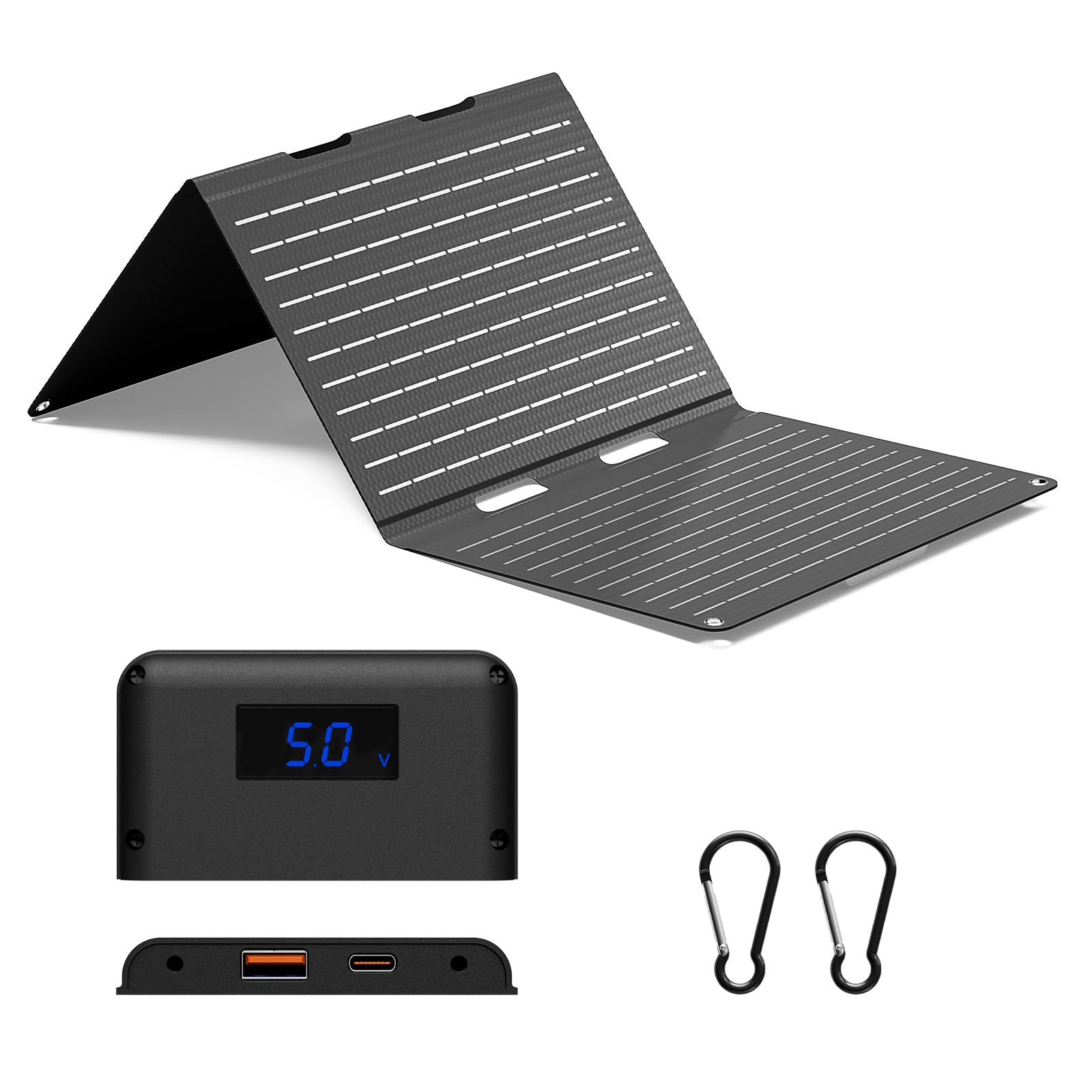
Here you get 30W of output paired with a digital display that reads live wattage, voltage, and current. That combination is useful: a bigger panel wants the best possible angle, and the readout tells you exactly when you have found it. The 23.5% monocrystalline cells sit under an ETFE surface that wipes clean and holds up outdoors, and the whole thing is IP67 rated for dust and water.
It packs light at 1.7 lb and folds to roughly 11.98 x 8.27 x 0.99 inches, so it drops into a pack for backpacking, hiking, or road trips. USB-C and USB-A ports connect phones, tablets, GPS units, cameras, and power banks, and there is a smart touch: when a connected device’s battery passes 90%, output is dialed back to help extend battery life. A 1-year warranty backs it.
Remember it stores nothing — this is a sunlight-only panel, so pair it with a power bank if you want saved charge for later. The display is the real differentiator here and the reason to choose it over a plain 30W fold, since it turns “is this working?” into a number you can read.
What you get
- 30W with 23.5% cells and an IP67 ETFE surface
- Live wattage and voltage display for aiming the panel
- Smart output reduction past 90% battery to protect device life
Keep in mind
- No built-in battery storage
- 1.7 lb is mid-weight, not the lightest 30W here
Worth it for: data-minded trekkers who want 30W and a live readout to aim it precisely.
Trade-off to accept: you carry 1.7 lb for the display and 30W, versus 0.5 kg for the lighter top pick.
9. BigBlue Ultra-light Portable 25W Solar Panel Charger

iPad-sized when folded, 0.84 lbs in your pack, and 25.4% efficient.
This is the combination pick: it packs down to 4.65 x 6.42 x 1.38 inches — the size of an iPad — and weighs just 0.84 lbs, yet it squeezes 25 watts out of N-type solar cells (a cell type rated at 25.4% conversion efficiency, meaning 25.4% of the sunlight hitting it becomes power). That matches the top pick’s efficiency figure while dropping nearly half the weight, so for a 25W frame you get a panel that disappears into a daypack. Dual USB-A (5V/2.4A) and USB-C (5V/3A) ports let it power two devices at once under direct sun.
The N-type cells have no metal lines on the front, so they catch more sunlight and stay cooler, which helps conversion. The build layers ETFE coating, UV-resistant EVA, and high-efficiency cells over a solid baseplate to resist hidden cracks — a real concern for a panel that gets folded and stuffed repeatedly. It comes with carabiners and a strap for hanging off a pack or tent.
Where it lands is the balance between weight and watts: 25W is above the 10W and 15W panels but a step under the 30W leaders, and it is far lighter than the heavier 30W options. If you want maximum output per gram without a two-pound pack penalty, this is the one.
Weight-to-watts winner: 0.84 lbs and 25.4% efficiency is the best carry-to-output ratio here, and the iPad-sized fold fits a daypack easily.
The 25W middle: it is not the biggest panel, so if raw 30W top-end power is the goal, look at the leaders above.
Right for: ultralight backpackers who want strong efficiency and dual ports at under a pound.
If you truly need 30W: step up to a 30W panel and accept the extra weight.
Know the Specs
Conversion Efficiency (the percent figure)
This is the share of the sunlight hitting the panel that becomes usable electricity. A panel rated 25.4% turns more of each sunbeam into charge than one rated 22.4%. That gap shows up most on cloudy or angled days, when every bit of captured light counts. Higher efficiency often means you can go smaller and lighter for the same output.
Wattage (the W on the box)
Watts are the panel’s maximum output under strong, direct sun. A 30W panel charges faster than a 10W panel in ideal light, but neither hits its rating in cloud or at an angle. Match wattage to what you carry — 10W tops up a phone, 30W can refill a power bank or tablet given sun and time.
IP Ratings (the waterproof code)
The IP number tells you how well the panel resists dust and water. IP67 survives dust and a brief dunk; IP65 and IPX5 handle rain spray and light weather but not immersion. Check whether the junction box where the ports sit is sealed, because on some panels it is not even when the surface is water-resistant.
Weight and Folded Size
These decide whether the panel rides with you. The lightest here are near a water bottle’s weight and fold into a daypack side pocket. Heavier panels of the same wattage trade convenience for build. If you are counting grams, a lighter panel with slightly lower wattage often wins over one that stays in the car.
Common Questions
Will a trail solar panel charge my phone on a cloudy day?
Do I need a power bank with a solar panel charger?
What does IP67 versus IP65 actually mean for a solar panel?
How many watts do I need to keep a phone topped up on a hike?
Why does my solar charger slow down in the shade or heat?
Can I charge a power bank as well as my phone at the same time?
Does a foldable solar panel still work if one section is covered?
How should I angle the panel for the most charging power?
Will a solar panel charge a dead phone from zero?
How long should a foldable solar panel last?
The Bottom Line
The strongest of these trekking solar charger picks is the ELECAETNA 30W HPBC, because it pairs the highest conversion efficiency here at 25.4% with an IP68 shell (fully dust-tight and able to survive being dunked in water) and a 0.5 kg frame — more usable output per gram in the light you actually get on a trail. If grams are your obsession, the BigBlue 25W Ultra-light matches that efficiency figure at 0.84 lbs. And if your camp lives under trees, reach for the Renogy 30W, whose parallel design keeps at least 75% output when one section is shaded. The ELECAETNA’s 4.0+ stars across 500+ ratings back up its low-light performance.
How we choose
We do not accept paid placement. Every pick is matched to a real buyer and a real use-case; we do not hands-on test units.
Sources
Specifications: manufacturer listings and product documentation. Review insights: verified customer reviews, as of November 2026. Pricing: not shown on this page (it changes often); check the current price via the retailer link.
As an Amazon Associate, Tactical Gear Guy earns from qualifying purchases. This does not affect which products we feature.