Specs are compiled from manufacturer listings and verified buyer reviews and can change over time — please confirm the key details on the product page before buying.
You want a pan that sears hard, goes from burner to oven, and never flakes a coating into your dinner. An uncoated stainless steel pan does exactly that — but only if the layers are thick enough and bonded all the way up the sides. The pans below are the ones worth your counter space, sorted by what they actually do well.
This guide is built by comparing the manufacturers’ published specifications and the patterns across verified customer reviews, so you get each pick’s real strengths and trade-offs instead of marketing spin.
Below you will find clad construction explained in plain terms, the heat ceilings that matter for oven and broiler work, and honest notes on sticking so you know what bare steel really demands. Here is the practical shortlist of the best uncoated stainless steel pan for searing, sautéing, and everyday stovetop cooking.
Top Picks


How To Choose The Best Uncoated Stainless Steel Pan
Skip the marketing language and check three things: how the metal is layered, how hot the pan can safely go, and whether the handle stays cool while you work. Those three decide nearly everything about how an uncoated pan behaves on your stove.
Ply count and full-rim cladding
A “ply” is one bonded layer of metal. Tri-ply usually means a stainless cooking surface, an aluminum core, and a stainless outer shell — the aluminum is the part that spreads heat. Five-ply adds more aluminum layers, and pans like the KitchenAid and Heritage Steel picks use that thicker stack to hold heat steadier from the center out to the rim. The detail buyers miss is whether the layers run all the way up the sides or only across the base. Full cladding means the wall of the pan heats too, which matters when you sear a thick steak and want the edges browned, not just the middle.
Oven-safe temperature and broiler limits
Your oven-safe number is the ceiling for finishing a pan-seared chop or a frittata under heat. Most pans here top out at 500°F, which covers normal roasting and baking. The Heritage Steel and Made In pans climb to 800°F, and the Viking reaches 600°F — room for broiler work and very hot oven finishes. Remember the handle: a stainless handle that is safe in the oven still gets hot, so a dry towel or glove is part of the deal.
Induction compatibility and cooking surface size
Induction burners only heat magnetic metal, so a pan needs a magnetic base layer to work on one. Every pan in this list is listed as induction compatible, which means you can move it between a gas range and an induction hob without buying twice. Then check the cooking surface, not just the rim-to-rim diameter. The Made In lists a 12.5-inch total diameter with a 9.5-inch cooking surface — that inner number is the flat area your food actually touches, and it tells you whether four burgers fit or only two.
Handles, weight, and everyday handling
Weight is the trade nobody mentions until they are lifting a loaded pan one-handed. The KitchenAid 10-inch weighs 2.5 pounds, while the Babish 12-inch with its lid runs 6.9 pounds — a big difference when you are tipping out a stir-fry. Look for a stay-cool or Y-shaped handle design and double-riveted attachment. Rivets are the metal pins holding handle to pan, and a sealed, riveted join is what keeps a pan from loosening over years of washing.
Side-by-Side Comparison
| Model | Best For | Construction | Oven Safe | Size | Amazon |
|---|---|---|---|---|---|
| KitchenAid 5-Ply Clad 10 Inch★ Best Overall | All-round searing and braising | 5-ply clad | 500°F | 10 inch | Amazon |
| T-Fal Pro Tri-Ply 8 InchSmall-Batch Specialist | Eggs and single servings | Tri-ply, NSF certified | 500°F | 8 inch | Amazon |
| Duxtop Tri-Ply 10 InchStraight-Sided Workhorse | Stir-fry and quick meals | Whole-clad tri-ply | 550°F | 10 inch | Amazon |
| T-Fal Pro Tri-Ply 12 Inch | Big batches and family meals | Tri-ply, NSF certified | 500°F | 12 inch | Amazon |
| Babish Tri-Ply 12 Inch with Lid | Moist-heat braises and searing | Tri-ply, 18/8 steel | 500°F | 12 inch | Amazon |
| Viking 3-Ply 12 Inch | High-heat oven finishes | 3-ply, 18/8 steel | 600°F | 12 inch | Amazon |
| Heritage Steel Eater Series 10.5 Inch | USA-made buy-it-once cooking | 5-ply fully clad | 800°F | 10.5 inch | Amazon |
| All-Clad D3 12 Inch | Chef-style searing control | Tri-ply, bonded | 600°F | 12 inch | Amazon |
| Made In 12 Inch with Lid | Serious home cooks upgrading | 5-ply stainless clad | 800°F | 12 inch | Amazon |
Detailed Reviews
1. KitchenAid 5-Ply Clad Frying Pan 10 Inch
Our pick — 4.5+★ from 950+ verified ratings; the strongest balance of quality and price.
Five layers of metal, a brushed base that shrugs off scuffs, and a 10-inch size that fits any burner.
The layer stack is the whole story here. Three aluminum layers sit between two sheets of stainless steel, and that sandwich runs from base to rim instead of stopping at the bottom. What that gives you is steady heat across the entire cooking surface — a hard sear in the middle without a pale ring near the edge. It is oven safe to 500°F, so you can start a pork chop on the burner and move the whole pan into the oven to finish.
The build is genuinely heavy-duty. Buyers report the clad body holds its shape instead of warping, the usual failure point on thin stainless pans. The black stainless handles are dual-riveted — meaning each one is pinned at two points — and the sealed rims keep water out of the layer stack, so the pan is listed as dishwasher safe. A brushed base on the outside hides the scuffs that polished pans collect after a few months.
At 2.5 pounds it is lighter than the 6.9-pound Babish 12-inch, which matters when you are lifting a loaded pan to plate. The trade-off is capacity: this pan lists 5 liters, but with a 10-inch footprint you are cooking two chicken breasts or a single large steak, not a family batch. Be honest with yourself about how much food hits the pan on a normal weeknight.
What holds up under weekly use
- Five-ply clad walls carry heat to the rim, so edges brown along with the center
- Sealed rims plus a dishwasher-safe rating mean less hand-scrubbing
- Brushed exterior base keeps the pan looking presentable despite wear
- Dual-riveted stainless handles stay firm and go oven-to-table
Where it asks something of you
- Bare stainless needs a proper preheat and a film of fat, or food will cling
- 10 inches is a one-or-two-portion surface for most searing
Pick this if: you want a single pan that sears on the stove and finishes in the oven, built to shrug off years of washing.
The limit to accept: it is a two-person searing surface, not a batch cooker — bigger households should look at the 12-inch pans below.
2. T-Fal Pro Tri-Ply Frying Pan 8 in
An 8-inch pan at 1 kg — a one-omelet workhorse you can flip with one wrist.
Eight inches is the size that gets overlooked and then used every morning. This one handles two eggs, a small cut of meat, or a single fried pancake without leaving half the surface empty. The construction is tri-ply bonded all the way to the rim, so the sides heat along with the base and you do not get an undercooked band around the edge of your omelet.
Two practical details stand out. It carries NSF certification, a third-party mark for food-equipment sanitation and construction quality — not a marketing sticker. And it has built-in measuring marks on the interior wall, so you can pour stock or cream straight into the pan without reaching for a cup. At 1 kg it is the lightest pan on this list, which is exactly what you want when you are shaking a skillet over a live flame.
Where it falls short is surface area. It is the smallest pan here, and it will not brown a pound of ground beef without a crowded, steaming result. Sticking is the other recurring note, though that is true of every bare stainless pan and often traces back to a pan that was not hot enough before the food went in. The honest read: this is a companion pan, not your only one.
What buyers keep praising: the overall build quality is the thing people come back to talk about, and it is the most-discussed positive in the feedback — with cleaning ease close behind.
The size question: treat it as your egg and small-protein pan. For steaks and full dinners, the 12-inch T-Fal below covers the same construction in a bigger footprint.
Reach for this when: breakfast is a daily ritual and you want one pan that heats fast, weighs little, and measures as it cooks.
Pass if: you need a primary pan for family portions — 8 inches will crowd anything bigger than two servings.
3. Duxtop Tri-Ply Stir Frying Pan 10 Inch
Straight walls and a drip-free pour lip — built for tossing vegetables, not just searing meat.
Most frying pans flare outward at the wall. This one stands straight up, which changes how you cook: you can toss food by shaking the pan instead of chasing it over the edge, and you get 3 quarts of working volume out of a 10-inch pan. The pour lip is shaped to let liquid off cleanly, so pan sauces go onto the plate instead of down the outside of the pan.
The metal is whole-clad tri-ply, meaning the layers run continuously through the base and up the sides rather than being pressed onto a disc. That is what stops the hot-spot problem — the patch of scorched garlic in the same spot every time. It goes to 550°F in the oven, a step above the 500°F ceiling on several pans here, and the glass lid is rated to 400°F if you add one. It is also freezer safe for storing leftovers in the pan.
At 2.5 pounds and bare stainless inside and out, it is a plain pan that asks for plain care. The handle is riveted and designed to stay cool on the stovetop, and the whole thing is dishwasher safe. The honest caveat: the straight-sided shape is superb for stir-fry and sautés but less ideal for sliding a fried egg out in one piece.
The case for the shape: owners single out the heavy-gauge tri-ply build as the reason it will keep going for years, and the pan draws praise for behaving evenly on both induction and glass-top ranges. That versatility is why it earns the middle slot.
One thing to plan around: the straight wall means you will not be flipping an omelet by flicking the pan. Use it as your sauté and stir pan and keep a flared skillet for eggs.
Best for: anyone who cooks vegetables and stir-fries more often than they fry eggs — the straight wall and pour lip do real work.
Think twice if: a sliding-release egg pan is your priority, since the tall wall makes that awkward.
4. T-Fal Pro Tri-Ply Fry Pan 12 inch
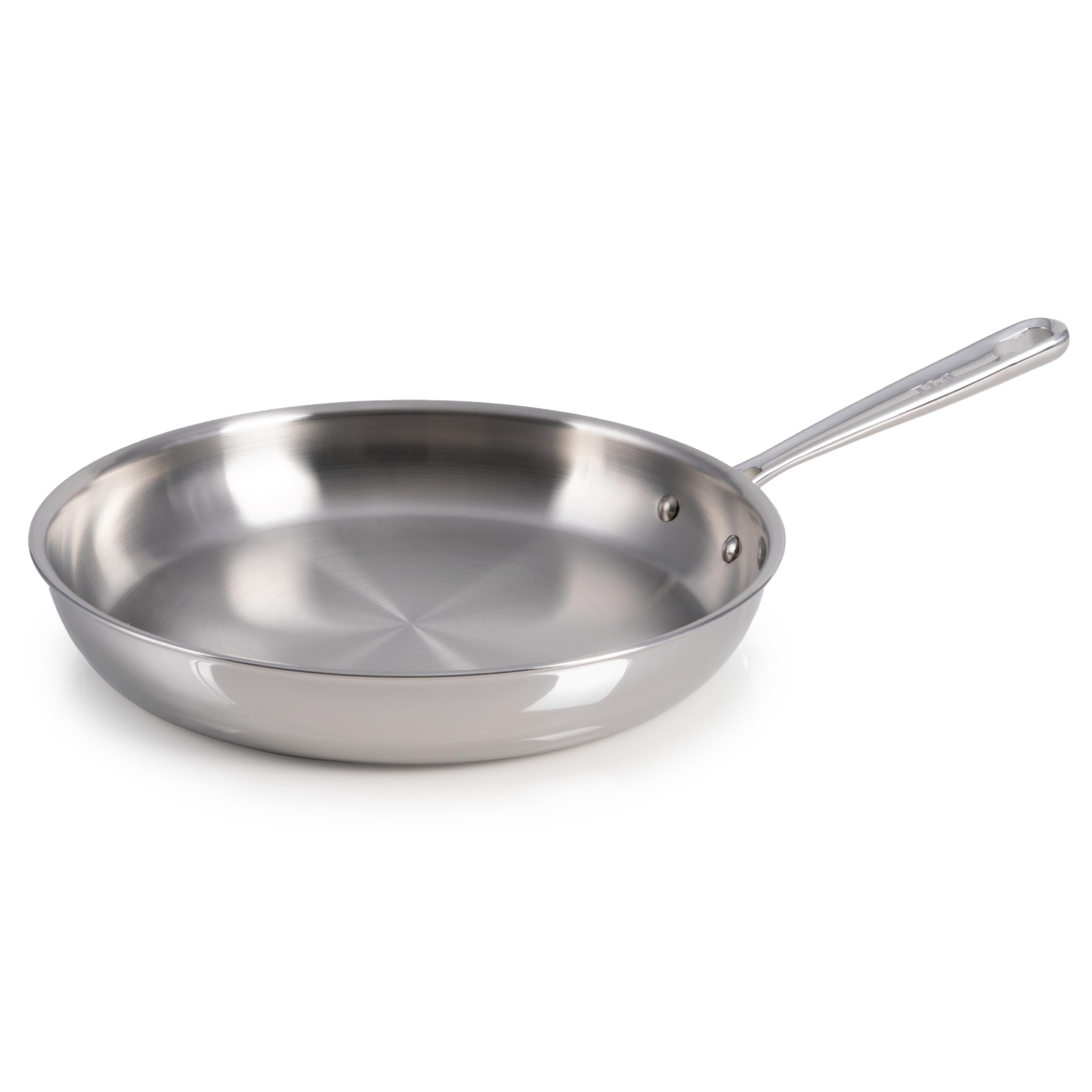
A 12-inch surface that fits four to six burgers at once — the batch-cooking answer to a 10-inch pan.
Size is the whole reason this pan exists. The 12-inch surface is listed for cooking 4 to 6 hamburgers at the same time without overcrowding, which is the difference between a sear and a steam. It is built on the same tri-ply bonded construction as its 8-inch sibling, bonded all the way to the rim and certified by NSF for professional-standard construction.
Where it differs from the bigger pans above is weight. This one lists 2.31 kg, while the T-Fal 8-inch sibling sits at 1 kg — it is a substantially heavier pan because there is far more steel and aluminum in the larger body. That weight is your friend for heat retention and your mild annoyance when you are tilting it to spoon out pan sauce. The 1.2-liter listed capacity is noticeably smaller than the KitchenAid’s 5 liters, so treat the flat surface as your cooking area, not the volume number.
The mirror-finish exterior and cast riveted handle give it a clean look, and the interior measuring marks save you reaching for a measuring cup mid-cook. It is oven safe to 500°F. Cleaning splits opinion: some find it simple, others find bare steel takes more maintenance than a coated pan, which is fair — steel pans need a quick scrub and dry, not a wipe.
Why it earns a spot
- 12-inch surface browns four to six burgers without stacking
- Heat spreads evenly to the rim on tri-ply construction
- Built-in measuring marks keep the cooking liquid measured
- NSF certification backs the build claim
Honest friction points
- At 2.31 kg it is a handful when loaded with food
- Bare steel demands a scrub-and-dry routine after each use
Choose it for: family dinners where four patties need to sear at once, or anyone who regularly cooks for more than two.
Look elsewhere if: you want a light pan to shake one-handed, or you refuse to hand-dry a skillet.
5. Babish 12-Inch Tri-Ply Stainless Steel Frying Pan with Lid

Comes with its own tight-fitting lid, so the same pan that sears also braises.
Most frying pans here are open-top. This one ships with a stainless lid that traps heat and moisture, which opens up a second cooking mode: sear a chicken thigh skin-side down, then clamp the lid on and let it finish through. The lid is the reason to look at this pan over a plain skillet of the same size.
Underneath, the pan is tri-ply (three bonded layers) with an 18/8 stainless steel cooking surface over a smooth aluminum core. The 18/8 label means the steel’s chromium and nickel mix — the standard food-grade blend that resists corrosion, so the surface holds up to daily cooking. The Y-shaped handle is double-riveted and built to spread heat away from your grip, so a long sear does not end with a scorched palm.
Here is the catch, and it is a real one: at 6.9 pounds this pan weighs 2.8 times what the 2.5-pound KitchenAid does. Add a lid and a full pound of food and you are lifting close to nine pounds with one hand. That is the trade for a 12-inch cooking surface that heats evenly and retains temperature. Owners describe a sturdy pan that performs well on induction — planted on the burner, less so when you are plating.
The lid does real work: steam-and-sear in one vessel means fewer dirty pans. Set the lid aside and it is a straightforward 12-inch tri-ply skillet, oven safe to 500°F.
Weigh it before you buy: 6.9 pounds empties out to close to nine pounds loaded. If wrist strain is a concern, the 3.5-pound Viking below may suit you better.
Good match for: cooks who want one pan to sear and then cover, without buying a separate braiser.
The honest snag: that 6.9-pound body plus a lid makes one-handed lifting a chore.
6. Viking 3-Ply Stainless Steel Fry Pan, 12 Inch

A 600°F oven and broiler rating on a 12-inch pan that weighs just 3.5 pounds.
That temperature number is the standout. Most pans here stop at 500°F, and broiler work is off the table at that ceiling. This Viking goes to 600°F and is listed as broiler safe, which means a steak finished under direct overhead heat is on the menu. The 3-ply construction delivers even heat and holds temperature once it is there, so the pan does not sag when cold food hits it.
The weight is the pleasant surprise. At 3.5 pounds it is lighter than the 6.9-pound Babish 12-inch, and it carries a 2-quart capacity. The 18/8 stainless exterior and flat cooking surface make it induction ready, and the whole pan is dishwasher safe. The handle is built with an ergonomic curve meant to ease wrist pressure, which pays off on long searing sessions.
Sticking is the recurring theme in buyer feedback on this pan, and it is the one honest note to size properly. Some owners mention clean release, others fight it. That split usually depends on preheat discipline — a bare stainless pan needs a minute or two of heat before the oil goes in, and the food needs to sit still until it releases on its own. Get that routine down and the pan earns its keep. Cleaning is a strong point, drawing consistent praise from buyers.
What earns trust: build quality leads everything customers note about this pan, with easy cleaning right behind it.
The preheat tax: bare 18/8 steel is unforgiving if you rush it. Give it a genuine two-minute warm-up and a slick of high-smoke-point oil before anything touches the surface.
Built for: broiler finishing and high-heat oven work on a 12-inch surface, without the heft of a lidded pan.
The honest cost: that bare steel surface will stick if you skip the preheat — it rewards technique, not speed.
7. Heritage Steel Eater Series 10.5 Inch Frying Pan

Five plies, an 800°F oven ceiling, and no chemical coatings anywhere in the build.
This is the pan for anyone who is buying once and wants the details documented. The 5-ply stack uses three aluminum layers sandwiched between stainless steel, fully cladded on both the base and the sides. That means the wall of the pan heats with the bottom, so a thick pork chop gets color on its vertical edges instead of only on the contact face.
The coating question gets answered directly here: the pan is listed as made without PFAS, PFOA, PTFE, PFOS, ceramic sol-gel, nanoparticles, lead, or cadmium. It is a bare, high-quality clad stainless surface and nothing else. It is rated to 800°F in the oven and is broiler safe, which is the highest ceiling on this list. The handles are built to stay cool on the stovetop, and the rounded pan lips pour without dripping.
At 3 pounds and 10.5 inches, it is a manageable pan for a two-person kitchen, with a 3-quart listed capacity. The maker is a family-owned craft manufacturer that has focused on clad stainless cookware for over 40 years, and the pan is made in the USA with global materials and backed by a lifetime warranty. Reviewers point out top-notch heat retention and even cooking, with the pan staying flat through long use.
Why it justifies the premium: fully clad 5-ply walls, an 800°F rating, and a documented no-coating build are three things you rarely find in one pan.
Before you commit: 10.5 inches is closer to a two-portion pan than a batch cooker. For big skillets, the 12-inch picks above and below suit larger households.
Right for: cooks who want an American-made bare-steel pan with a lifetime warranty and the highest oven rating here.
Not for: anyone feeding four from one skillet — the 10.5-inch surface keeps you to smaller batches.
8. All-Clad D3 Stainless Steel 12″ Fry Pan, Made in the USA
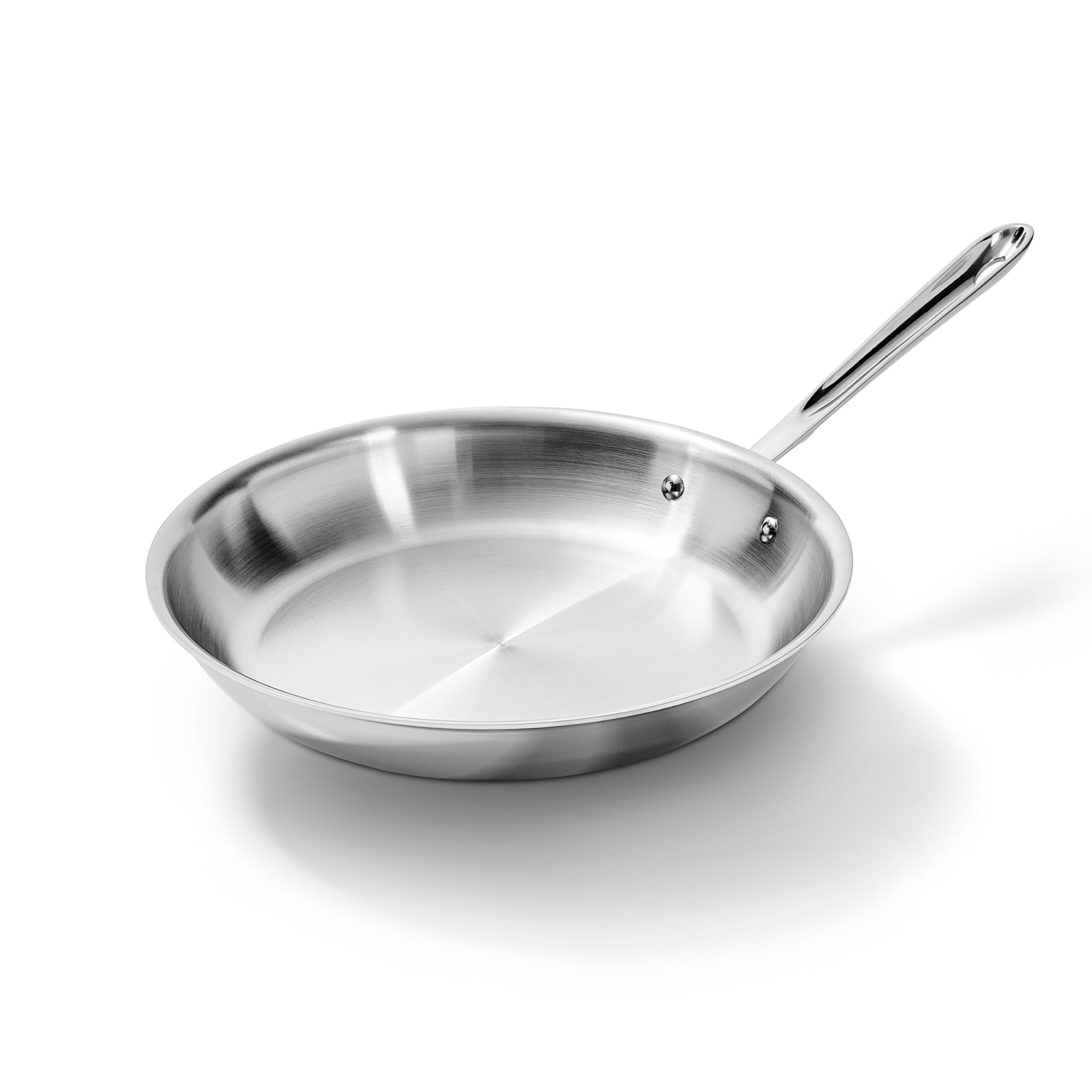
The bonded tri-ply pan that professional kitchens reached for first, in a 12-inch searing size.
All-Clad built the first fully bonded tri-ply cookware, and this D3 pan is that design in a 12-inch size. The aluminum core runs through the base and sides, delivering fast, even heat and a stainless surface that takes a hard sear. It is oven and broiler safe to 600°F and works on any stovetop, including induction. Made in the USA at the company’s Pennsylvania factory since 1971.
The handle is shaped for a chef’s underhand grip — you hold it from below with your fingers under the curve rather than wrapping over the top. That grip gives you balance and precision when you are tilting the pan to baste. The flared edge pours cleanly without dribbling down the outside, and the polished finish is the look most people picture when they say stainless skillet.
Two notes to weigh. First, this pan is handwash only — the maker does not list it as dishwasher safe, unlike the KitchenAid and Duxtop picks. Second, sticking divides feedback here just like it does on the other bare pans: some cooks report nothing sticks, others find food clinging to the bottom. Both are the same surface behaving the same way — the difference is preheat and fat. Owners praise the build’s quality and durability above all.
The chef’s-handle advantage: an underhand grip plus a flared pour edge makes pan-basting and sauce work feel controlled rather than clumsy.
Worth knowing: handwash only, and the value question gets mixed feedback relative to the cheaper tri-ply pans in this list. You are paying for the original bonded design.
Suits: cooks who want the benchmark 12-inch searing pan and do not mind washing it by hand.
The trade-off: no dishwasher cycle, and a price that reflects the name more than the spec sheet.
9. Made In Cookware 12-Inch Stainless Steel Frying Pan With Lid
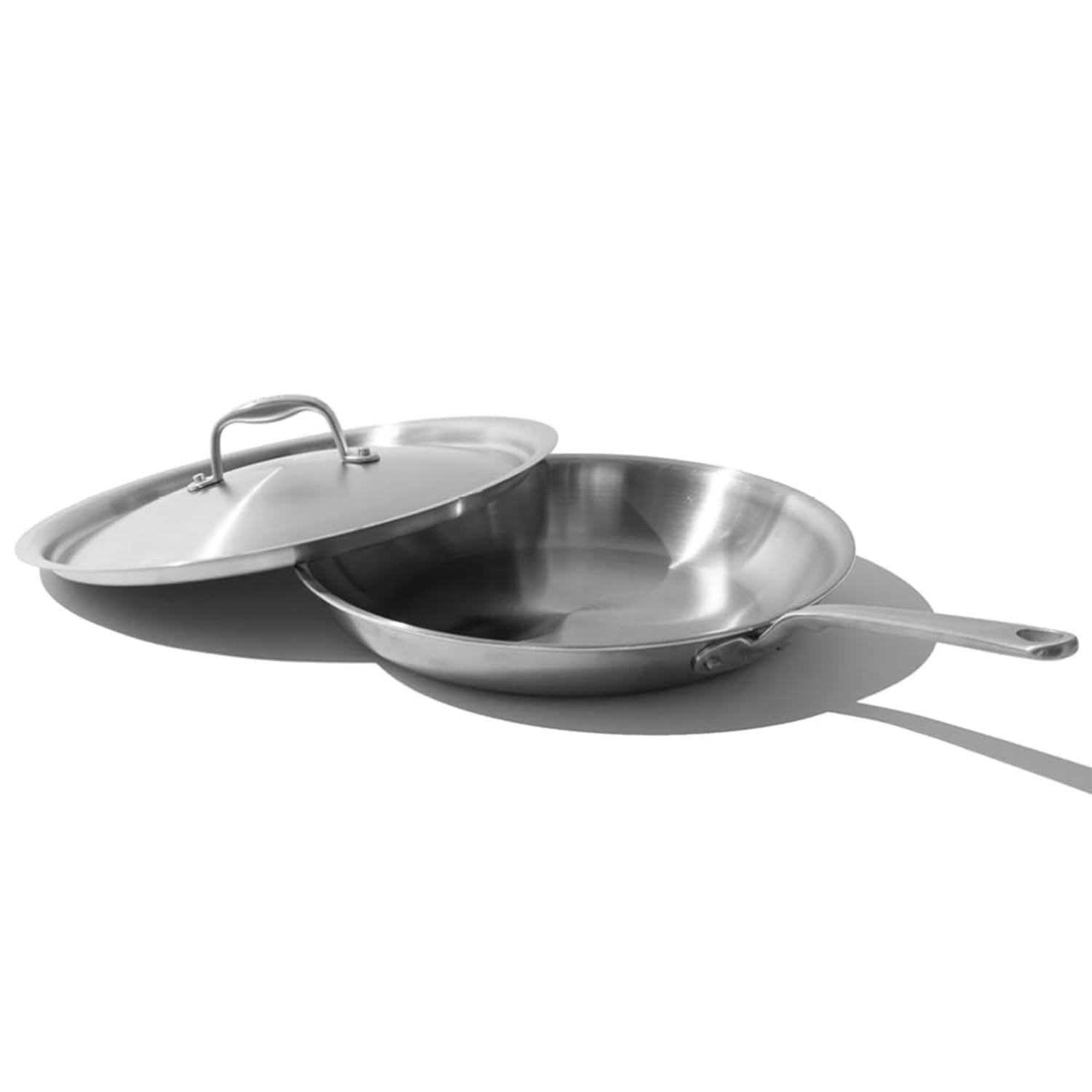
A 9.5-inch cooking surface, an 800°F ceiling, and a lid — the full upgrade package.
Read the surface number before you read anything else. The pan is 12.5 inches across at the rim, but the flat cooking area is 9.5 inches, with a 1.75-inch depth. That is the number that tells you what actually fits: a whole fish, a couple of steaks, or a batch of vegetables, in a pan with enough depth to hold a light braise. It comes with a lid, so the sear-and-cover routine is built in.
The build is five layers of premium metal for heat distribution, with a top layer of 430 stainless steel — a magnetic grade, which is why it works on induction. The stainless-clad construction is fully bonded for responsive heat control, and the pan is oven safe to 800°F. Crafted in Italy, with a stay-cool handle riveted in stainless steel for the long haul.
Feedback on this pan is warm on the cooking side: quality, even heat, easy cleaning, and an attractive stainless micro finish all come up, and the handle genuinely stays cool to the touch. The honest resistance is the investment — it sits at the top of this group, and it is the kind of purchase you justify by cooking on it five nights a week rather than by features alone. The depth also means it is not a shallow crepe pan; you will notice the taller wall when you slide a fish fillet out.
What the upgrade buys you
- 9.5-inch flat cooking surface at 1.75-inch depth fits whole fish and light braises
- 800°F oven rating and an included lid extend the cooking range
- Stay-cool handle and 430 stainless top layer for induction
- Crafted in Italy with a documented 5-layer build
What to weigh honestly
- Top-tier price makes it a considered purchase, not an impulse buy
- The tall wall means less slide-out ease for delicate fillets
The pick for: a serious home cook upgrading a whole kitchen and wanting one 12-inch clad pan with a lid and the highest oven ceiling here.
Slow down if: you cook small portions — the 9.5-inch surface and tall wall reward batch work, not single servings.
Know the Specs
Ply construction and cladding
A ply is one bonded metal layer. Tri-ply typically means stainless steel over an aluminum core over stainless steel, and the aluminum does the heat-spreading work. Five-ply adds more aluminum layers to hold heat steadier. The cladding question matters just as much: full cladding means the layers run up the sides, so the walls heat too and food browns at the edges. Base-only cladding heats only the floor of the pan, which shows up as a pale ring around your sear.
Oven-safe temperature and broiler rating
This is the ceiling for oven finishing. A 500°F rating covers roasting, frittatas, and pan-to-oven chicken. A 550°F or 600°F rating presses into high-heat oven work and broiler finishing, and 800°F gives you room for both. Broiler-safe is a separate claim to check, because overhead heat is more intense than ambient oven heat. None of these numbers cover the handle — a stainless handle in a hot oven still needs a glove or a dry towel.
Cooking surface versus pan diameter
The rim-to-rim diameter and the flat cooking surface are different measurements. The Made In lists 12.5 inches overall with a 9.5-inch cooking surface, and that inner figure is where your food sits. A flared pan loses flat area up the curve of the wall; a straight-sided pan keeps more usable floor. If you are deciding between a 10-inch and a 12-inch pan, compare the flat surface, not the listed size.
Weight and handle design
Weight tells you how the pan behaves in your hand and on the burner. Lighter pans in the area of 1 kg to 3.5 pounds are easy to shake and tilt; a pan around 6.9 pounds feels planted but is tiring one-handed when loaded. Handle design matters for safety: double-riveted attachment keeps the handle locked to the body, a stay-cool or Y-shaped design spreads heat away from your grip, and a curved ergonomic shape reduces wrist pressure during long searing.
Common Questions
Will a bare stainless steel pan work on an induction cooktop?
Why does food stick to my uncoated stainless pan?
Is tri-ply or 5-ply better for even heating?
Can I put an uncoated stainless steel pan in the dishwasher?
How hot can I take these pans in the oven?
How do I stop eggs sticking to a bare stainless skillet?
Are uncoated stainless pans really non-toxic?
What size frying pan should I buy first?
How do I keep a stainless pan from warping?
Do I need a lid for a stainless frying pan?
The Bottom Line
The strongest all-rounder is the KitchenAid 5-Ply Clad 10 Inch: three aluminum layers run base to rim for edge-to-edge searing, and the sealed rims make it dishwasher safe. If you want a bigger searing surface with a chef-shaped handle, the All-Clad D3 12 Inch delivers 600°F oven and broiler safety on a 12-inch pan. And for cooks who want the highest oven ceiling here alongside an American-made build, the Heritage Steel Eater Series 10.5 Inch takes the 800°F rating and a lifetime warranty with it.
Both bare-steel realities apply no matter which you pick: preheat the pan properly, keep a film of fat between food and metal, and scrub-and-dry after each use. Do that and a bare stainless pan will outlast every nonstick skillet you have thrown away. Decide by the surface you cook on most — 8 or 10 inches for one or two portions, 12 inches for a family — and buy the one whose oven ceiling matches how you actually finish your food.
How we choose
We do not accept paid placement. Every pick is matched to a real buyer and a real use-case; we do not hands-on test units.
Sources
Specifications: manufacturer listings and product documentation. Review insights: verified customer reviews, as of November 2026. Pricing: not shown on this page (it changes often); check the current price via the retailer link.
As an Amazon Associate, Tactical Gear Guy earns from qualifying purchases. This does not affect which products we feature.