Specs are compiled from manufacturer listings and verified buyer reviews and can change over time — please confirm the key details on the product page before buying.
Any mini mic can clip to your collar and call itself wireless. The pick that actually saves your video is the one that still holds a clean signal when you turn your back to the camera, keeps your voice clear next to a running espresso machine, and plugs straight into your iPhone without an adapter hunt. That is the whole buying decision — distance, battery, and a clean receiver connection — and it is the lens this list uses.
This guide is built by comparing the manufacturers’ published specifications and the patterns across verified customer reviews, so you get each pick’s real strengths and trade-offs instead of marketing spin.
One honest note before the picks: this list uses flexible, human-like matching for the wireless requirement, so not every pick is the exact model number you searched — the nearest same-type option serves the same job. Below, the wireless mini microphone for iphone picks that hold up on a real shoot.
Top Picks
How To Choose The Best Wireless Mini Microphone for iPhone
Most buyers come to this category assuming the headline range number decides everything. It doesn’t. The two things that ruin real recordings are a dropped signal when you turn away from the camera, and a receiver that won’t seat cleanly in your iPhone’s port. Get those two right, then check battery and mounting, and almost any decent mini mic will serve you.
Match the connector to the phone in your hand
Plug-in receivers come in USB-C and Lightning flavors, and they are not interchangeable. A USB-C receiver fits newer iPhones, iPads, and most Android phones. A Lightning receiver is what older iPhones need. Check your own charging port before you buy, because a beautiful mic with the wrong receiver plug is a paperweight for your shoot.
Read the noise figure, not just the mic count
Signal-to-noise ratio, measured in decibels (dB), tells you how far your voice sits above the electronic hiss. A higher figure means a cleaner voice in a quiet room. Some picks in this list publish 70 dB, some 80 dB. That is a real difference when you record indoors with no background music to hide the floor noise.
Think about how you’ll wear it and how long you’ll shoot
Clip, magnet, or pendant — each one behaves differently on a jacket, a t-shirt, and a moving body. And battery life splits sharply here. Some transmitters run hours on their own, while charging cases push total run time into the dozens of hours for multi-day shoots. Both are fine, as long as you know which you are buying.
Side-by-Side Comparison
| Model | Best For | Wireless Range | Battery Life | Transmitter Weight | Amazon |
|---|---|---|---|---|---|
| Hollyland Lark M2 (Combo)★ Best Overall | Overall pick for solo creators | 1000ft | 40H | 9g | Amazon |
| DJI Mic Mini (2 TX + 1 Mobile RX)Top Performer | Best upgrade for fussy audio | 300m | 11.5h | 10g | Amazon |
| Hollyland Lark M2 (Camera RX + USB-C)Most Versatile | Best for hybrid creators | 1000ft | 40H | 9g | Amazon |
| Insta360 Mic Air | Best for the minimal kit | 300m | 10h | 7.9g | Amazon |
| MAONO Wave T5 | Best for voice-preset control | 300m | 30H | 9g | Amazon |
| SmallRig S70 | Best for two-person shoots | — | 48H | 8.6g | Amazon |
| KUKIHO Wireless Lavalier (DX12) | Best for all-day talk videos | 164ft | 80h | — | Amazon |
| BOYA V30 | Best for windy outdoor audio | 328ft | 36H | 10.5g | Amazon |
| EZColoris M6-2 in 1 | Best for two-person entry rig | 65ft | — | — | Amazon |
Detailed Reviews
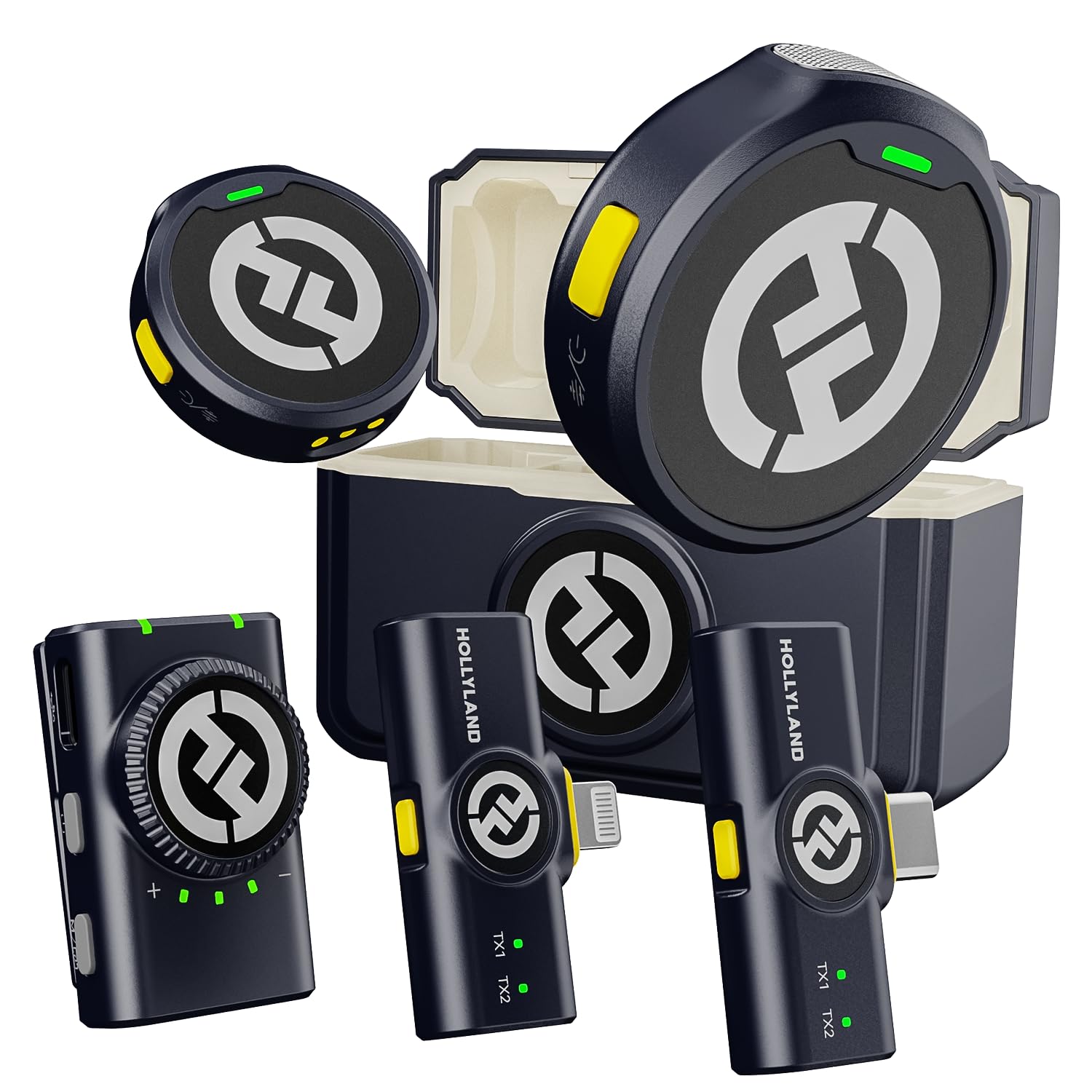
1. Hollyland Lark M2 Wireless Lavalier Microphone
Our pick — 4.5+★ from 750+ verified ratings; the strongest balance of quality and price.
A 9g transmitter with a 1,000ft line-of-sight leash and an Apple-certified receiver.
For a solo creator who films long-form vlogs and interviews, the Lark M2 Combo is the least fussy thing on this list. The transmitter is just 9g — light enough to sit on a collar without pulling your shirt out of shape. And the receiver plugs straight into the phone with no cable in between.
The range is the headline. Hollyland claims a 1,000ft line-of-sight spread, while the EZColoris M6 claims 65ft in the same category. Line-of-sight means a clear straight path, so trees and walls still cut into it. But for a wide outdoor shot where you want to wander well past your phone, this is the pick that lets you.
On audio the Lark M2 runs 48kHz/24-bit, a common pro sample target, with a 70dB signal-to-noise ratio and a 115dB maximum sound pressure level — how much loud it can take before clipping. The one-click yellow button switches noise cancellation on and off right on the transmitter. And what wins people over is the sheer quality read: the general build and audio get the most praise of any spec here, with sound quality right behind. It holds a 4.5+ star average across a large pool of iPhone-first buyers.
What earns it the top spot
- 1,000ft line-of-sight range leaves room to roam on wide shots
- 9g transmitter stays nearly invisible on clothing
- MFi-certified Apple chip means it plays nicely with the iPhone
- Pre-paired at the factory, so it records the moment you unbox it
- 40-hour total battery with the charging case
Where it asks a little of you
- Mono-to-stereo switching only works over the 3.5mm camera jack, not the phone
- The 3,000-ohm impedance and studio features are more than a casual phone vlogger needs
Reach for it if: you want one system that handles phone vlogs now and grows into camera work later.
Look elsewhere if: you only ever shoot close to the phone and want to spend less on range you won’t use.
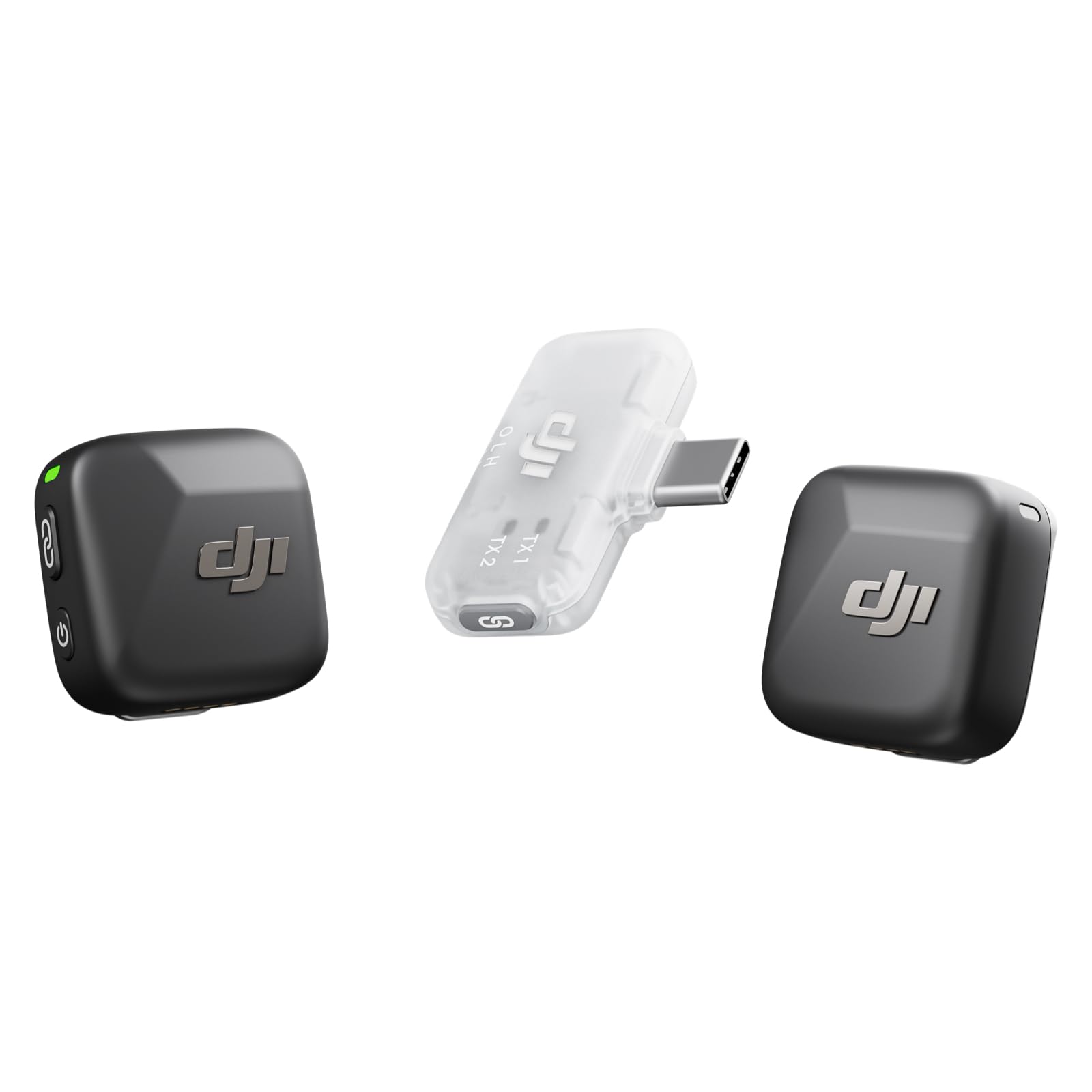
2. DJI Mic Mini (2 TX + 1 Mobile RX)
DJI’s pocket-sized transmitter, tuned to cut noise in two strengths instead of one.
If your audio has ever come back crunchy from a busy street, the Mic Mini’s noise handling is the reason to care. It offers two noise-cancellation levels: Basic for a quiet room, Strong for a noisy environment. That is a real advantage over a single on/off button when you record in mixed conditions.
The transmitter is 10g, ultralight and comfortable to wear for a full interview. Range tops out at a claimed 300m, which gives you plenty of leash in open outdoor settings. And two transmitters plus a mobile receiver run up to 11.5 hours, enough for a long day of interviews on one setup.
Automatic limiting is the quiet feature that saves bad takes — it lowers the volume when your input gets too loud so the recording doesn’t clip. DJI buyers consistently rate sound quality and reliability highly, and often single out the compact size. The catch here is the receiver ecosystem: this mobile version is built for USB-C phones and Android at the top of its range, so an older Lightning iPhone needs a different match.
Why it leads on noise: two cancellation strengths plus automatic limiting give you more room to save a rough recording than a single-mode mic.
The trade-off worth knowing: the 300m transmission figure is line-of-sight focused, so a wall between you and the receiver still bites.
The confident buy: a two-person crew that wants polished vocals without an engineer.
Not your pick if: you shoot on an older Lightning iPhone and need that exact port.
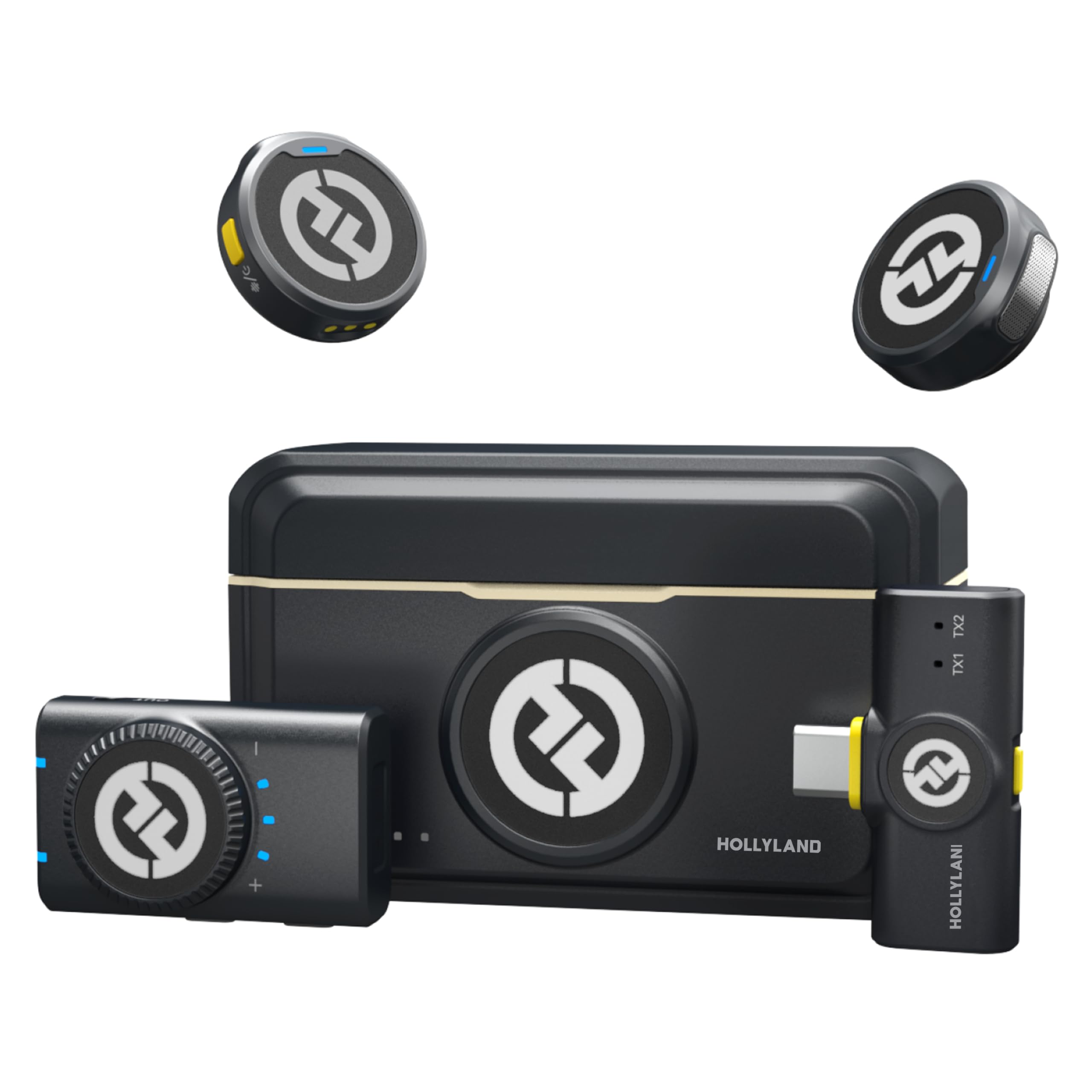
3. Hollyland Lark M2 (Camera RX + USB-C RX)
The same featherweight Hollyland build, now with a camera receiver in the box.
Same 9g transmitter as the Combo, same 1,000ft line-of-sight range and 48kHz/24-bit audio. What changes is the bundle: this set ships with a camera receiver plus a USB-C receiver, so it bridges your iPhone and a DSLR or mirrorless camera in one kit. For a hybrid creator that is the point.
Battery is a 40-hour total with the charging case — up to 10 hours per charge with noise cancellation off, and each case charge tops the set back up. A high-gain LDS antenna is built to shrug off interference from your own body, which is why the signal holds when you walk away rather than drop out.
Buyers praise the clear recorded voice first and the easy setup second. On raw figures, the BOYA V30 beats the Lark: the Lark’s signal-to-noise ratio (a measure of how much background hiss you hear) is 70 dB versus 80 dB, and its max sound pressure level (the loudest sound it can take before distorting) is 115 dB versus 120 dB. The Lark answers back with range and a camera-ready kit.
The reasons it earns its place
- Camera and USB-C receivers in one box, so you cover phone and camera
- 1,000ft line-of-sight range for wide outdoor framings
- Pre-paired and plug-and-play right out of the case
- UAC support lets you plug into a computer with no external sound card
Worth weighing before you buy
- The 70dB signal-to-noise ratio trails the BOYA V30’s 80dB
- Mono and stereo switching is only available through the 3.5mm camera jack
Go for this one: if you bounce between iPhone vlogs and a camera rig and want one mic set to cover both.
Pause if: you want the lowest noise floor per dollar — the BOYA nudges ahead on that figure.
4. Insta360 Mic Air (1 TX + 1 RX)

A coin-sized transmitter light enough to forget, at 7.9g.
The Mic Air is the lightest transmitter in this whole roundup at 7.9g, and it shows. It sits on a collar and essentially disappears. The kit is minimal — one transmitter, one USB-C receiver, a windshield, and a carry case — which suits travel where bag space is the enemy.
Audio runs at 48kHz sampling with noise cancellation and a windshield included for outdoor shoots. The range is a claimed 300m and battery is 10 hours with the receiver and noise cancellation off. A neat extra: you can trigger video, noise cancellation, or mute right from the transmitter, so you aren’t reaching for your phone mid-shot.
The Mic Air only records in mono — two transmitters would share one channel. The mounting system is where it draws mixed opinions; the magnetic clip is fine for interviews and street content but not built for hard sports. Its sound quality and voice clarity are what carry it. If your shoots are calm and you want the smallest possible footprint, it fits.
The obvious fit: travelers and street creators who want the smallest possible transmitter and don’t need stereo.
The honest limit: mono-only recording and a mount that isn’t meant for active movement.
5. MAONO Wave T5 Wireless Lavalier Microphone

Four built-in voice presets for anyone who hates editing EQ afterward.
Most mini mics hand you a raw recording and walk away. The Wave T5 ships four one-tap filters — Vocal Enhancer, Brightness, Warmth, and Magnetic Radio — so you can pick a tone before you even open your editing software. For a solo creator who records straight to social, that saves a whole step.
The numbers are solid too. It records true 48kHz/24-bit audio with an 80dB signal-to-noise ratio and a 120dB maximum sound pressure level, so sudden loud moments stay clean rather than cracking. Noise control is adjustable across 3 modes and 14 levels through the Maono Link App, and the 300m range holds to 100m even when the transmitter is behind your back.
Hollyland says the frequency-hopping link holds steady when you turn away or walk off. Battery runs up to 9 hours per transmitter and 30 hours total with the charging case. Buyers rate overall quality and voiceover-friendly sound highest, with value for money and ease of use just behind. One practical note: pairing is a manual two-step, and the app-level noise tuning rewards a few minutes of setup.
Why the presets matter: four voice filters let you shape tone on the fly, so a cooking or vlog take sounds finished without post-editing.
What to plan for: the 3-mode, 14-level noise tuning lives in the app, so budget a setup session before your first shoot.
Pick this if: you want polished voice tone without touching an editor and will use the app to tune noise levels.
Pass if: you want pure plug-and-record with zero app involvement.
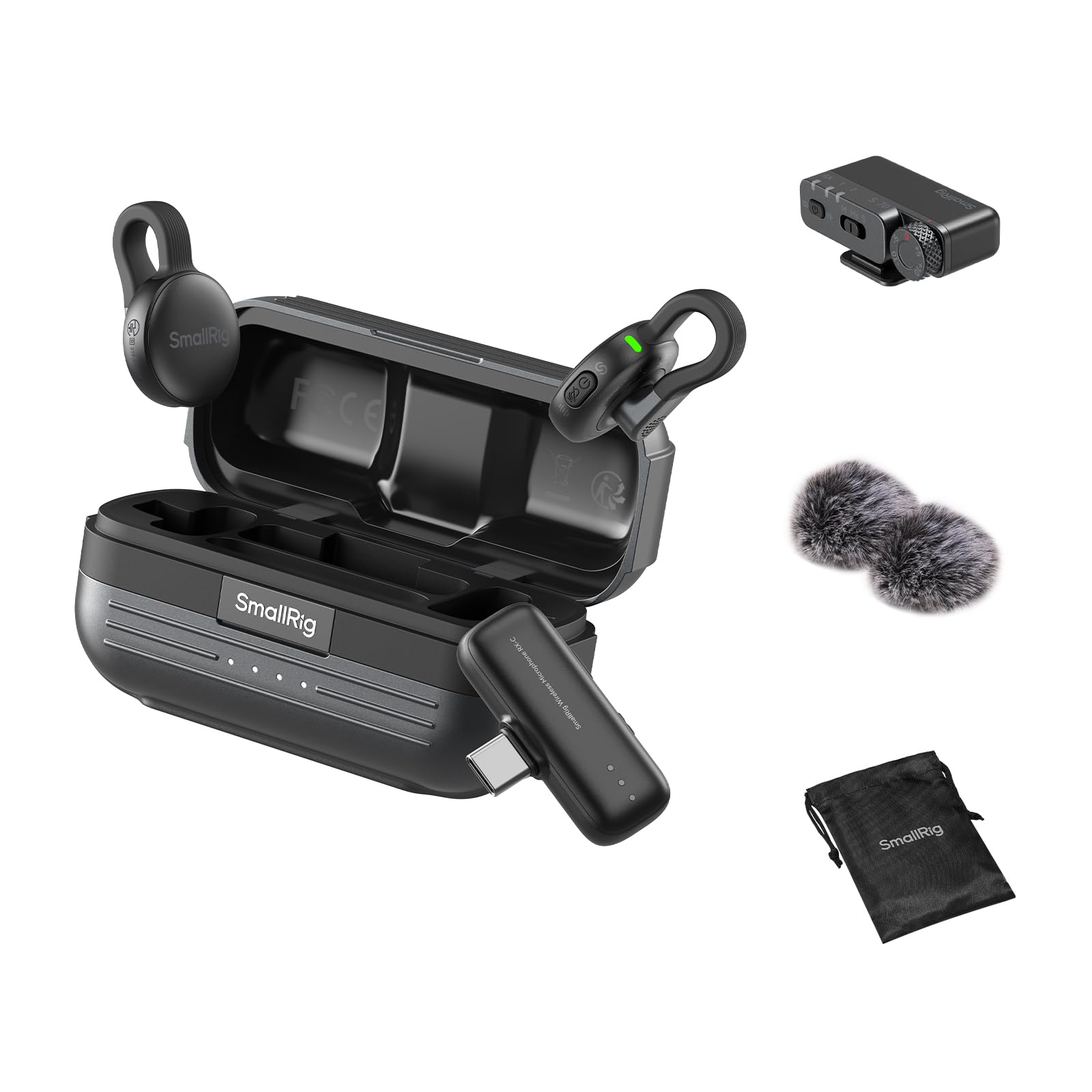
6. SmallRig S70 Wireless Mic (2 TX + 2 RX + Charging Case)
Two transmitters, two receivers, and a case built for the road.
Two hosts, one shoot, and no switching mics between takes — that is the S70’s whole reason for being. It ships with two transmitters plus two receivers, one USB-C and one 3.5mm jack, so it handles an iPhone and a DSLR in the same session. For a podcast or interview duo, that is a flexible rig.
The transmitter weighs 8.6g with a nickel-titanium memory metal clamp that stays nearly invisible on clothing. You get 48kHz/24-bit audio on the ATS3031 chip, with 3 noise reduction modes, 5 gain levels, and 3 mixing options. Nine preset EQ equalizers, tuned with input from a Grammy-winning engineer, shape different voices.
Battery is 8 hours per charge and 48 hours total with the case, enough for a couple of shooting days. Buyers single out the professional feel, the clear voice pickup, and the discreet clip-on design. Reliability is genuinely mixed, so it is not the safest bet for a critical one-take shoot, but for a controlled two-person setup it earns its keep.
The standouts
- Two TX and two RX cover two speakers and two devices at once
- 8.6g transmitter with a silicone-like memory-metal clamp
- 9 preset EQ filters tuned for voice
- 48-hour total battery with the charging case
Worth knowing
- Reliability feedback is mixed, so test before a critical one-take
- Not compatible with Pocket 4P or Insta360 Luna Ultra
Built for: a two-person podcast or interview that needs both speakers covered and both phone and camera connectors.
Skip the gamble if: you record single, un-repeatable takes and want the most proven reliability above all.
7. KUKIHO Wireless Lavalier Microphone (DX12)

The 80-hour battery case that keeps your mic alive through a full content weekend.
If battery anxiety is your thing, the KUKIHO DX12 is built to end it. It offers 80 hours of battery life versus the BOYA V30’s 36 hours in total run time. It also charges while you use it, so a long livestream doesn’t have to end for a power top-up. For a creator who records for hours, that’s the feature that matters most.
You get a phone-friendly connection: it plugs into iPhone, iPad, and Android, and adapters for iOS and USB-C ports are included. Range is 164ft in open areas, so you can set the camera down and still move around the room. Sound pickup is 360-degree omnidirectional (it hears from all directions), so a moving subject stays captured without you chasing the balance, and two mini mics let two people share one recording.
Noise cancellation runs through DSP chips to tame background rumble, and the receiver plugs straight in with no Bluetooth or app. Buyers rate overall quality highest, with noise cancellation a close second. Two things land in mixed feedback though: the sound-quality read leans softer and reliability is less consistent, so it is a strong everyday pick rather than a critical-take tool.
The right call for: marathon recording days and two-person talking-head videos where battery and plug-and-play matter most.
Think twice if: you need the cleanest possible sound on a once-only shoot.
8. BOYA V30 Wireless Lavalier Microphone
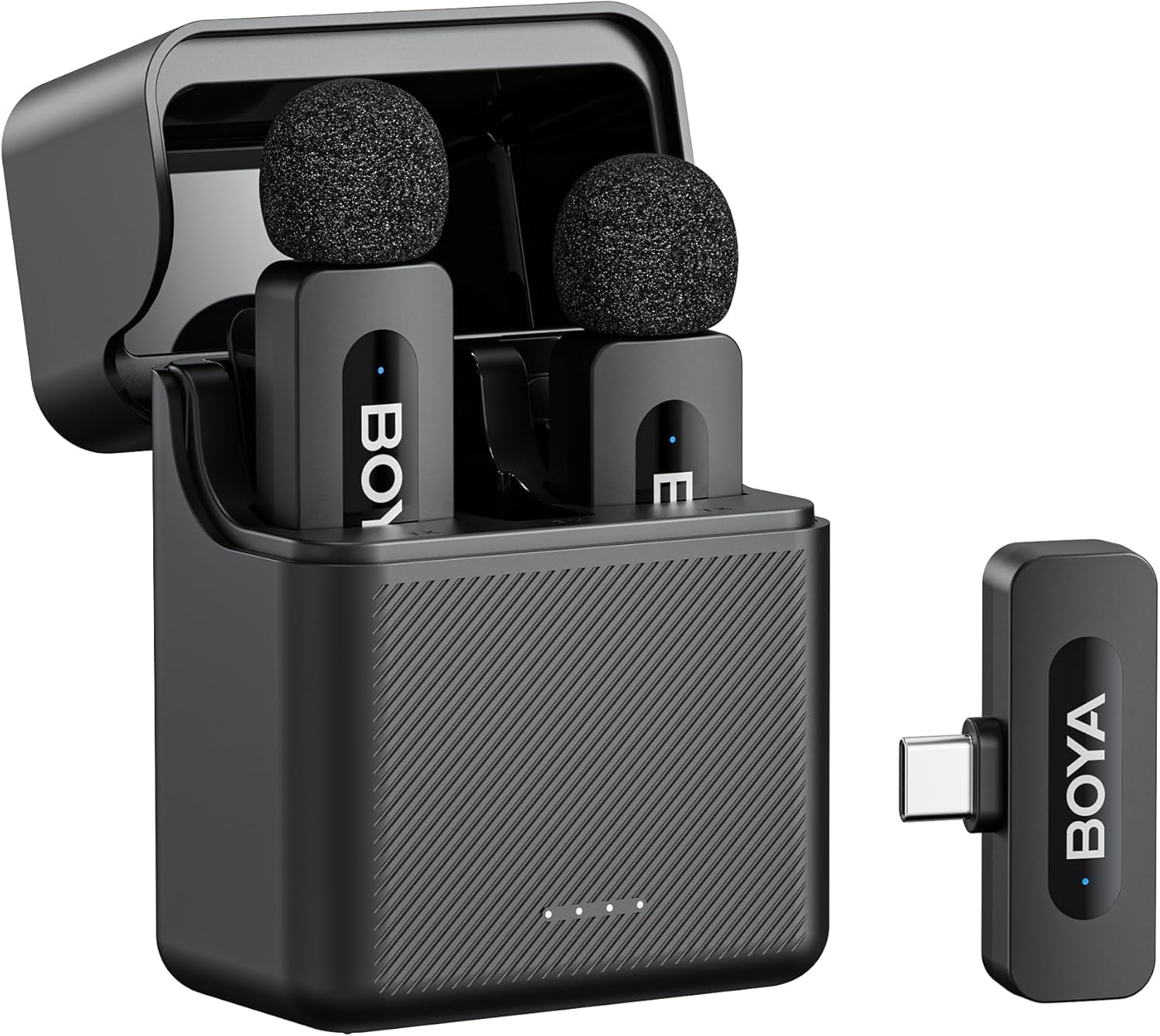
Dual-mode noise cancellation and a foam windscreen for outdoor recording.
Wind is the quiet killer of outdoor audio, and the BOYA V30 addresses it directly with one-click noise cancellation plus a dense windproof foam cover. On raw audio specs it is the strongest in this roundup: an 80dB signal-to-noise ratio against the Hollyland Lark M2’s 70dB, and a 120dB maximum sound pressure level against the Lark’s 115dB. Cleaner floor and more headroom for loud moments.
The transmitter weighs 10.5g — a touch heavier than the Lark’s 9g, but still comfortable for a long wear. Range is a claimed 328ft through 2.4GHz wireless. A 360-degree rotatable clip lets you angle the mic onto clothing for hands-free capture, and playback works straight from the phone’s built-in speaker without unplugging the receiver.
Battery is 9 hours per charge with a 95mAh cell, and the charging case lifts total run time to 36 hours. What buyers describe is clarity that makes a noticeable difference in recordings, with automatic connection that just works for virtual meetings. The catch is simple: it is a USB-C receiver, so an older Lightning iPhone needs a different kit.
The audio edge: the 80dB noise floor and 120dB headroom beat the Hollyland Lark M2 on both figures.
Check your port: this is a USB-C receiver, so verify your iPhone uses USB-C before ordering.
Grab it for: outdoor shoots and windy environments where a clean floor and a windscreen matter.
Keep looking if: your iPhone still charges over Lightning.
9. EZColoris M6-2 in 1 Wireless Lavalier Microphone
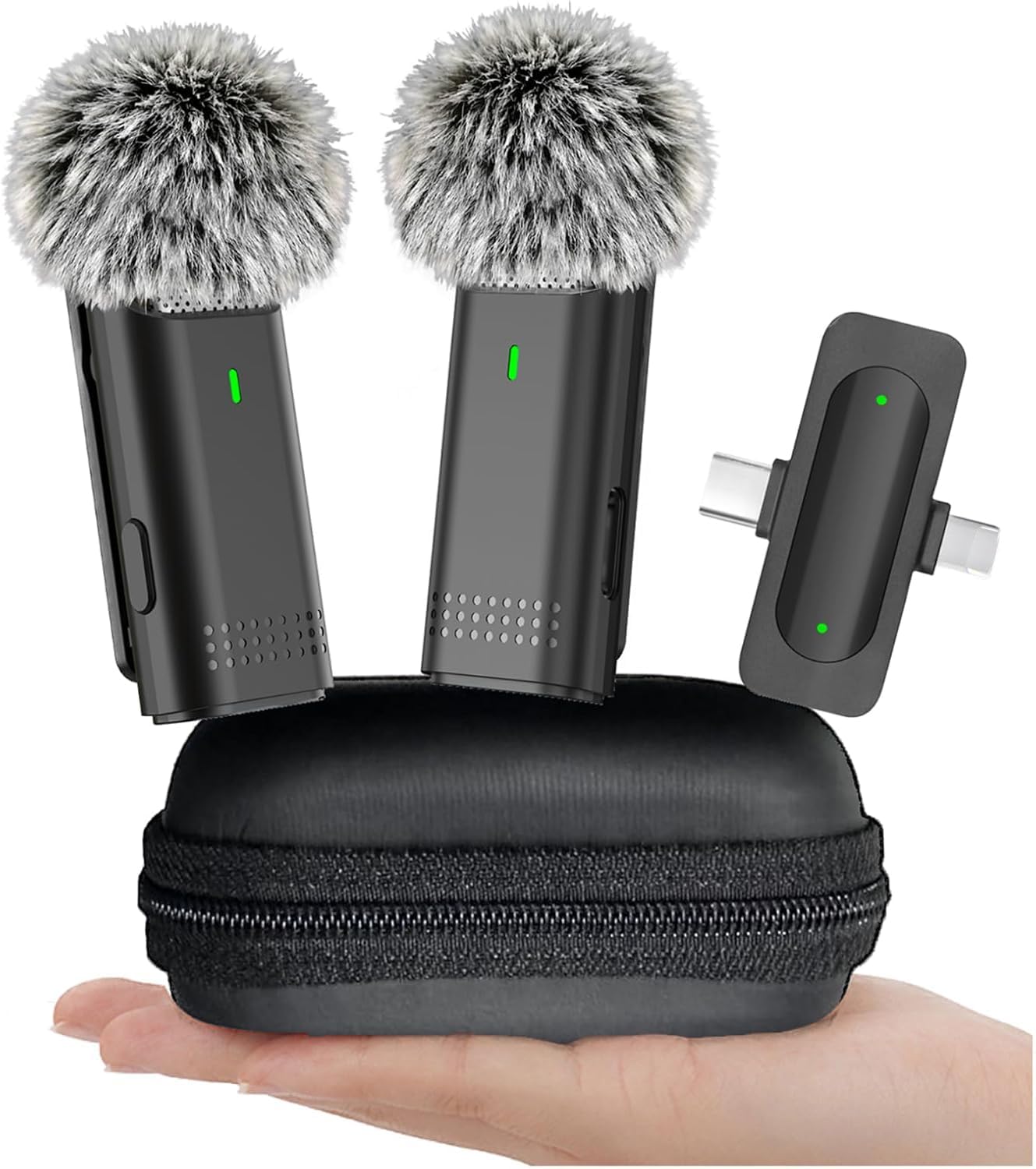
Two transmitters for two speakers, with a one-second mute you can trust.
For a beginner creator who films two people close to the camera, the M6 is the easy entry ticket. It gives you a 2-in-1 kit: one receiver and two transmitters, so you don’t juggle mics between hosts. Sound runs at 16-bit/48kHz through an omnidirectional condenser, and one-tap noise cancellation cuts background clutter.
Range is 65ft in open areas over 2.4GHz, and that is the number to think about. The Hollyland Lark M2 claims 1,000ft by comparison — no contest if you like to walk far from the phone. But for a talking-head framed feet from the camera, 65ft leaves you plenty of room. The mute is a nice touch: press once for about a second and a clear red LED confirms it, so you aren’t muting blind.
You get a windscreen that outperforms a plain foam one on outdoor takes, plus USB-C and Lightning cables and a storage pouch. The whole point is that there is no app and no pairing dance — it connects and records. What buyers flag most is how simple it is to run; the recurring gripe is that reliability can waver, so treat it as an indoor starter rig rather than a rugged field mic.
Where the value lives
- 2-in-1 kit covers two speakers at once
- One-second mute with a clear red LED indicator
- No app, no pairing — plug in and record
- Windscreen beats a standard foam cover outside
Mind the limits
- 65ft range is short next to long-leash picks
- Reliability feedback is mixed — best for controlled indoor shoots
The starter pick: a two-person indoor setup where you want plug-and-play and a two-mic kit in one box.
Outgrow it fast if: you record outdoors at distance or need field-grade reliability.
Know the Specs
Signal-to-noise ratio (dB)
This is the gap between your voice and the electronic hiss in the mic. A higher figure, like 80dB, means a quieter floor and a cleaner voice in a silent room. A lower figure lets more hiss creep in when there is nothing to mask it, which you notice on interviews with no background music. Look for 70dB or more for talking-head work.
Maximum sound pressure level (dB)
This is how loud a sound the mic can take before it starts distorting. A 120dB limit handles a laugh or a shouted line without cracking. A 115dB limit is close behind. Either is enough for normal speech, but the higher headroom matters when your recording might spike suddenly.
Wireless range
Range is measured line-of-sight, meaning a clear straight path with no walls or trees in between. A 1,000ft figure can shrink a lot indoors. That is why a mic rated for far less still works fine when you stand a few feet from the phone. Match the range figure to how far you actually move, not to the biggest number on the box.
Battery life and charging cases
Transmitter run time and case total are different numbers. A transmitter might run 9 hours on its own while the case lifts the full set to 30 or 40 hours across multiple charges. For long shoots, the case figure is what keeps you recording without hunting for a wall socket. Check both so you aren’t surprised mid-shoot.
Common Questions
Will a USB-C mic work with my older Lightning iPhone?
How far away can I stand from my iPhone before the audio drops?
Do I need an app or Bluetooth to connect a mini mic to my phone?
What is the difference between mono and stereo recording on these mics?
How many hours can I record before the battery runs out?
Will these mics cut out background noise like a café or a busy street?
Is it better to clip the mic on or use a magnet or pendant?
Can I record two people at once with a mini mic kit?
What does 48kHz/24-bit mean for my recordings?
Does the receiver block my phone’s charging port?
The Bottom Line
For most creators shooting on an iPhone, the wireless mini microphone for iphone winner is the Hollyland Lark M2 Combo because it pairs a 9g transmitter with a 1,000ft line-of-sight range and an Apple-certified receiver that simply works. If cleaner noise handling and preset voice tuning matter more, grab the MAONO Wave T5. And for budget-minded two-person shoots, the EZColoris M6 is the one to reach for. One last nudge: the Lark M2 Combo earns the front spot because its build and audio quality are the most-praised traits in its own buyer feedback — a solid anchor for a first serious mic.
How we choose
We do not accept paid placement. Every pick is matched to a real buyer and a real use-case; we do not hands-on test units.
Sources
Specifications: manufacturer listings and product documentation. Review insights: verified customer reviews, as of November 2026. Pricing: not shown on this page (it changes often); check the current price via the retailer link.
As an Amazon Associate, Tactical Gear Guy earns from qualifying purchases. This does not affect which products we feature.