Specs are compiled from manufacturer listings and verified buyer reviews and can change over time — please confirm the key details on the product page before buying.
If your house has cold rooms and warm rooms, the fix is rarely a bigger furnace flame — it is getting the warm air to every corner evenly. That is why the picks below are sorted by how well they move air and how much heat they keep from the flue, not by how loud the BTU number is. You will see gas furnaces and heat-pump systems side by side, so you can match a unit to your climate and your existing ductwork before you call an installer.
This guide is built by comparing the manufacturers’ published specifications and the patterns across verified customer reviews, so you get each pick’s real strengths and trade-offs instead of marketing spin.
Start with the airflow and efficiency ratings first, because those two numbers decide whether a system feels even and quiet — here is what matters most in the best whole house heating systems.
Top Picks

How To Choose The Best Whole House Heating Systems
Shopping for a whole-house system is nothing like buying a plug-in heater. You are choosing the appliance that will sit in a closet, crawlspace or side yard for years, and the installer will wire it into your ducts, gas line and thermostat. Get the layout or the airflow wrong and no amount of heat output rescues the far bedroom.
Match the cabinet layout to the space you actually have
Gas furnaces here are built for upflow or horizontal mounting — that is, air flows up through the unit or sideways through it. They cannot be flipped to blow downward, so if your ductwork runs under the floor you would need a different model family beginning with GD9. Packaged units put the whole system in one outdoor cabinet, which suits homes without a furnace closet.
Read the AFUE rating before the BTU rating
AFUE is the percentage of fuel energy that comes out as useful heat. An 80% unit sends the rest up the flue; a 96% unit captures more of it. Higher efficiency usually means a different venting setup, so it is a question for your installer as much as your wallet.
Ask about airflow, not just temperature
A multi-speed ECM motor is an electronically controlled blower that varies its speed, so it moves air gently instead of blasting it. That variable speed is what keeps room temperatures even and the blower quiet.
Side-by-Side Comparison
| Model | Best For | Heating Capacity | Efficiency | System Type | Amazon |
|---|---|---|---|---|---|
| Goodman GR9S800803BN★ Best Overall | Even, quiet warmth on a mid-range budget | 80,000 BTU | 80% AFUE | Gas furnace, upflow/horizontal | Amazon |
| Goodman GR9T961004CNTwo-Stage Comfort | Two-stage comfort in a mid-size cabinet | 100,000 BTU | 96% AFUE | Gas furnace, upflow/horizontal | Amazon |
| Senville Central Heat Pump | Cold-climate heating plus cooling in one | 36,000 BTU | Cold Climate Energy Star | Mini-split heat pump | Amazon |
| Goodman GLZS4BA3010 System | Ditching gas or propane entirely | 30,000 BTU | 14 SEER | Split heat pump + air handler | Amazon |
| Goodman GPH1442H41 | Single-cabinet outdoor installs | 42,000 BTU | 14 SEER | Packaged heat pump | Amazon |
| Goodman GLZS4BA3610 System | Bigger homes on a heat-pump setup | 36,000 BTU | 15 SEER2 | Split heat pump + air handler | Amazon |
| Goodman GLZS4BA4210 System | Multi-position flexibility plus a thermostat | 42,000 BTU | 15.2 SEER2 | Split heat pump + air handler | Amazon |
| Goodman GPHH36031 | One-box replacement for a packaged system | 5 tons | 13.4 SEER2 / 6.7 HSPF2 | Packaged heat pump | Amazon |
Detailed Reviews
1. Goodman GR9S800803BN Furnace
Our pick — 4.5+★ from 50+ verified ratings; the strongest balance of quality and price.
A mid-size furnace that keeps the blower quiet while it spreads heat evenly.
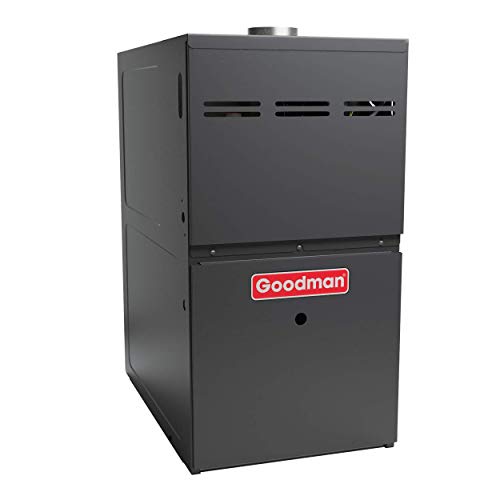
The thing that wins people over on this one is build quality, and it is the machine that makes the most sense for most homes on this list. It puts out 80,000 BTU of heat (a BTU is the standard measure of heating power) while sitting in a 17.5-inch-wide cabinet — narrow enough to slide into a standard utility closet. The 80% AFUE rating means four-fifths of the gas becomes household heat, with the rest leaving through the flue.
A multi-speed ECM motor is the part you will actually notice day to day. It is a blower that changes speed instead of running flat-out, so it can push warm air through long duct runs without a hard roar. Set-up tends to be the easy part — hooking up the gas line, power and thermostat is the sequence that comes up again and again as straightforward.
Understand the layout limit before ordering. This unit is for upflow or horizontal mounting and cannot be turned into a downflow furnace; if your ducts run below the floor, look at a model starting with GD9. Linesets, thermostats and LP conversion kits all sell separately, so budget for those as part of the install.
Where it earns its spot
- 80,000 BTU of output in a 17.5-inch cabinet — fits most utility closets without a rebuild
- Multi-speed ECM blower spreads heat evenly and keeps noise down
- Replaces older GMES and GM9S model numbers, useful on a straight swap
- Simpler hookup: gas, power and thermostat connections
What to plan around
- Upflow or horizontal only — no downflow conversion
- Accessories like thermostats and LP kits cost extra
- 80% AFUE means more heat escapes the flue than a 96% unit
Go for this if: you want a proven 80,000 BTU furnace with a quiet multi-speed blower and a closet-friendly footprint.
Look past it if: your ductwork is under the floor or you want the fuel savings of a 96% AFUE unit.
2. Goodman 60,000 BTU 80% Efficiency Furnace (GR9S800603AN)
Captures 96% of the gas as heat — and weighs 114 pounds doing it.
Efficiency is the whole point here. At 96% AFUE, almost all of the gas you pay for turns into heat in the rooms. Compare that with the 80% models above, which send a fifth of the fuel up the flue. Over a long heating season in a cold state, that gap is the difference between a furnace that works hard and one that works smart.
Weight tells a useful story too. The 80,000 BTU 80% model weighs 175 pounds; this 96% version of the same output weighs 114 pounds. That lighter build is partly the different heat-exchanger design that high-efficiency furnaces use. The multi-speed ECM blower carries over, so airflow stays gentle and the noise floor stays low.
Reliability is the trait owners talk about most — units that fire right up and keep firing. It rated 4.0+ stars across 60+ ratings, and performance follows closely behind reliability in what buyers discuss. The catch is the venting: a 96% furnace typically needs a different flue setup than an 80% unit, so confirm that with your installer before ordering. Upflow or horizontal only, and accessories sell separately.
The case for it: the highest-efficiency gas furnace on this list at 80,000 BTU, lighter than the 80% model and built for owners who want lower gas waste.
What to verify first: the venting route — a high-efficiency furnace may not slot into an old flue without changes.
Pick this when: gas bills matter and your installer can handle the high-efficiency venting path.
Stay with the 80% model if: your existing flue is fixed and you do not want to touch it.
3. Goodman 96% AFUE Two-Stage 100k BTU Furnace (GR9T961004CN)
Two heating stages mean it runs low and long instead of blasting on and off.
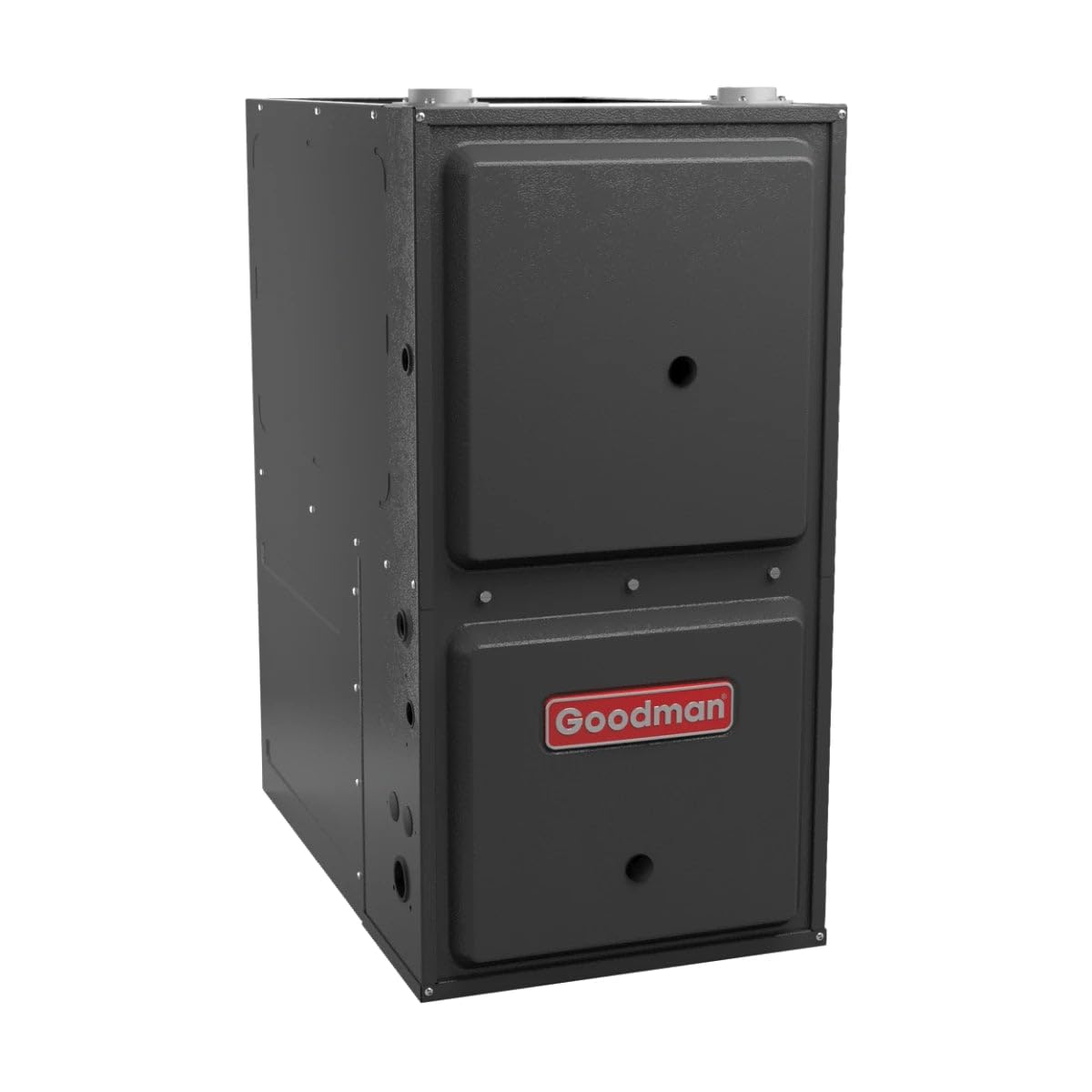
Most furnaces have one flame size: full on or off. This one has two, so it can hold a steady low burn on mild days and ramp up only when the temperature really drops. That low-and-long burn keeps room temperatures even instead of swinging between too hot and too cold.
The 96% AFUE rating puts the fuel savings right up with the high-efficiency 80,000 BTU model, and the multi-speed ECM motor keeps the noise down while it works. It carries an Energy Star certification, which is a useful marker when you compare units side by side.
Effectiveness is what stands out in the feedback — a 100k BTU furnace that cuts run time noticeably for owners stepping up from an older unit. Quality and ease of installation both come up alongside it. It rated 4.5+ stars across 40+ ratings. The limit to know: this is a Low NOx natural gas model, upflow or horizontal only, and LP conversion and venting kits are sold separately.
Why it stands out
- Two-stage operation holds a gentler, more even heat
- 96% AFUE with multi-speed ECM blower and 1600 cfm airflow
- Energy Star certified
- 100,000 BTU in a mid-size 21-inch cabinet
What you should know
- Low NOx natural gas design — check local rules
- No downflow configuration
- Venting and LP kits add to the install
Best for: homeowners who want steady, two-stage warmth and the fuel savings of a 96% AFUE furnace.
Not the fit if: you need a downflow layout or live somewhere that restricts Low NOx units.
4. Senville 3 Ton Central Heat Pump, Inverter
One inverter system that cools in summer and heats down to well below freezing.
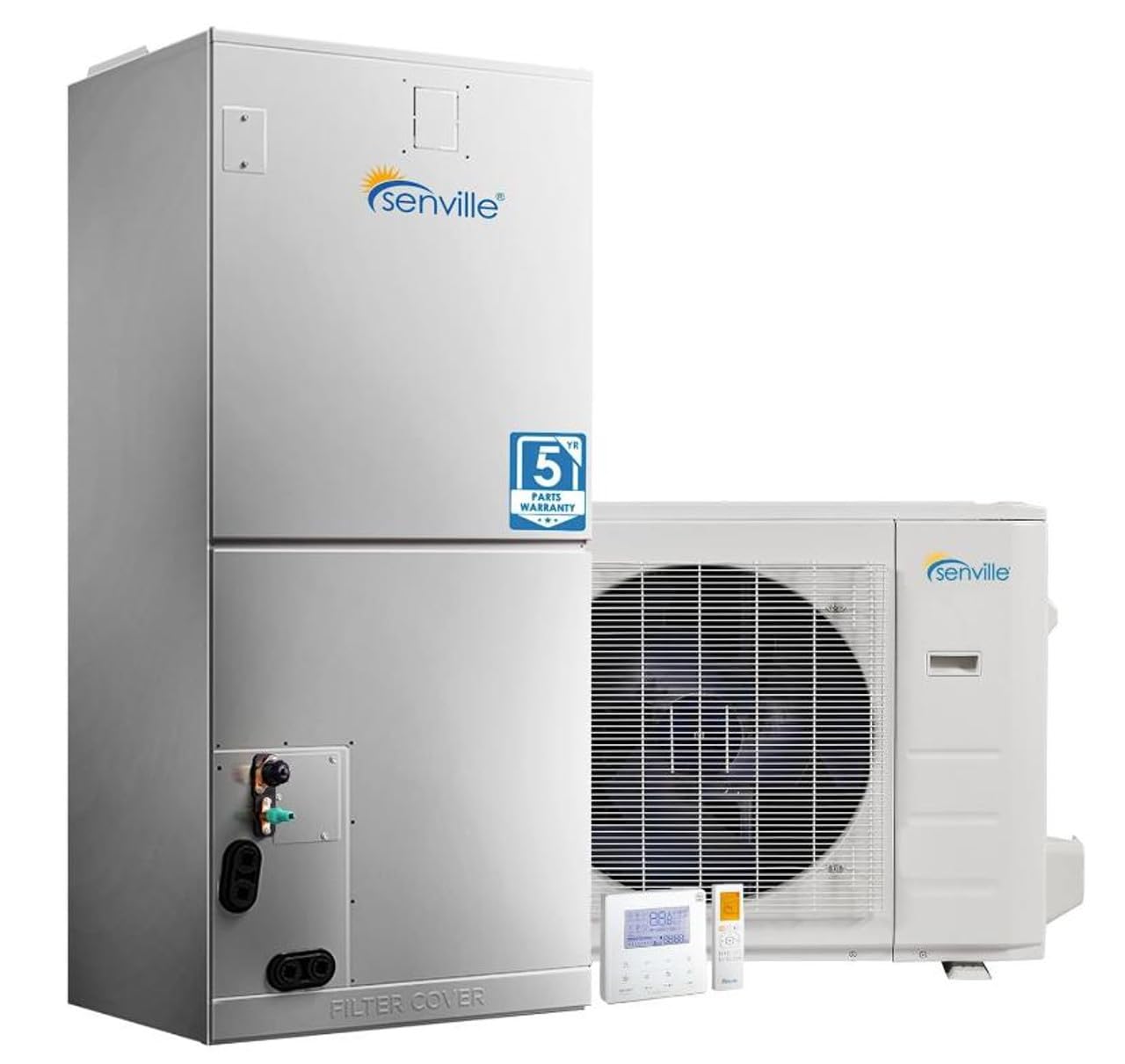
Here is the number to anchor on: this heat pump keeps working in temperatures as low as -22F (-30C). That cold-weather range is why a heat pump earns a spot on a heating list. A heat pump moves warmth rather than burning fuel, and this Senville model pairs a 36,000 BTU capacity with an inverter compressor that varies its speed to hold a steady temperature instead of cycling hard.
It also cools — up to 2,000 square feet — so you get summer air and winter warmth from one outdoor unit. Rated a Cold Climate Energy Star, it is built for places where the mercury drops. A 10-year warranty on the compressor and 5-year warranty on parts back it up, and the annual energy figure listed is 6,400 kilowatt hours per year.
Installation is the part buyers tend to rate well, and cooling performance follows close behind. Where the picture gets mixed is reliability — most units run fine, but the feedback carries both sides. Note that Senville recommends a licensed professional; this is not a do-it-yourself job. The 3-ton size also means it is a whole-home choice, not a single-room fix.
Strong at
- Heating in cold conditions down to -22F (-30C)
- 36,000 BTU capacity covering up to 2,000 square feet
- Inverter compressor holds a consistent temperature
- 10-year compressor and 5-year parts warranty
Worth weighing
- Reliability feedback runs mixed — some units fine, others with issues
- Requires a licensed professional to install
- Mini-split form factor means a separate head or ducted setup
Right for: households that want heating and cooling from one system and live in a cold climate.
Not right if: you want a simple gas furnace swap or a do-it-yourself install.
5. Goodman GLZS4BA3010 Heat Pump System

A two-piece system for homes that want to skip gas and propane entirely.
This is a matched pair — the GLZS4BA3010 outdoor heat pump and the AMST30BU1300 multi-position air handler — sold as a complete split-system base. The heat pump is a 2.5-ton, 14 SEER single-stage unit, and the air handler is built from corrosion-resistant aluminum with grooved tubing for better heat transfer. If your goal is to stop paying for gas or propane, this is the setup to look at.
It is R-32 refrigerant, pre-charged for 15 feet of tubing, and comes with service valves, gauge ports and inspection points to make the installer’s life easier. The air handler has rigorous helium pressure testing behind it, which is the kind of detail that matters in humid spaces. It carries a 10-year parts warranty when a qualified installer installs it and you register online within 60 days.
One honest heads-up: Goodman notes you will want a heat kit if you live in a cold climate. That is the accessory that adds backup warmth when outdoor temps drop. It needs a licensed installer, and thermostats, heat kits and outdoor sensors sell separately. For downflow ductwork an optional kit is required.
The value read: a matched heat pump and air handler at 2.5 tons and 14 SEER, with a 10-year parts warranty once registered.
What to budget for: a heat kit for cold climates and any thermostats or sensors — none are in the box.
A fit for: mild-climate homes going gas-free, or anyone replacing an older Goodman heat pump and air handler pair.
Think twice in deep cold: the heat kit requirement means extra gear to buy and install.
6. Goodman 3.5 Ton 14 SEER Package Heat Pump (GPH1442H41)

Everything in one outdoor cabinet — no indoor furnace closet needed.
A packaged heat pump puts the compressor and the indoor blower into a single unit you set outdoors. That single-cabinet design suits homes with no furnace closet, or a packaged-system swap that avoids rebuilding the house. This one is a 3.5-ton unit at 14 SEER with 42,000 BTU of cooling power, and it heats and cools in the same box.
Goodman builds in a factory-installed bi-flow liquid line filter dryer to keep moisture out of the refrigerant circuit, plus an aluminum fin coil and a permanently lubricated condenser fan motor. Those are the parts that wear over time, so having them addressed in the design matters for a system that lives outside. The scroll compressor is the same style used across the industry for quiet, reliable running.
What owners notice most is how quickly a packaged unit comes to life — up and running within hours of arrival is the kind of first-day experience that gets repeated. It rated 4.5+ stars across 20+ ratings. This one is a standalone cabinet that weighs 400 pounds, so plan for a delivery that needs real handling, and confirm your duct connections and placement with an installer.
What buyers like
- Single outdoor cabinet — no indoor air handler needed
- 42,000 BTU at 14 SEER heating and cooling in one unit
- Factory-installed filter dryer and corrosion-resistant coil
- Heats and cools across the year
What to plan for
- 400-pound unit needs careful delivery and placement
- Best suited to homes with existing packaged ductwork
- Professional install recommended
The pick for: homes with a packaged unit already, or spaces where no indoor air handler will fit.
Wrong choice if: you have a standard split system with a furnace closet — the standard split offers more flexibility.
7. Goodman GLZS4BA3610 Heat Pump System

A step up in efficiency and capacity from the 2.5-ton system, at 15 SEER2.
Three tons and 15 SEER2 is a sensible middle ground for a home that needs more warmth than a 2.5-ton heat pump can deliver but is not ready for the biggest systems here. It pairs the GLZS4BA3610 heat pump with the AMST36CU1300 air handler, both R-32, and handles 36,000 BTU of capacity. SEER2 is the updated efficiency measure, so 15 SEER2 tells you it is a modern-efficiency unit.
One specific detail to file away: this system uses the HKSC/HKSX series of heat kits, not the HKR series. That matters for the installer and for anyone adding backup heat for colder months. Linesets, thermostats and LP conversion kits all sell separately, so they are extra line items on the estimate.
This is the right size for a mid-size home going gas-free or replacing an old split heat-pump system. The R-32 refrigerant is the current standard, and the split-system layout is what most homes already have ducts for. It rated 4.0+ stars across 60+ ratings. The heat kit detail is the thing to get right — an incompatible kit will not work.
Best for: mid-size homes that need 3 tons of heat-pump capacity and want a modern 15 SEER2 unit.
The catch to note: heat kits are the HKSC/HKSX series only, so confirm that part before the installer starts.
A good match if: your home is between the 2.5-ton and 3.5-ton sizes and you have split-system ductwork.
Look past it if: you need the higher efficiency or capacity of the 3.5-ton model.
8. Goodman GLZS4BA4210 Heat Pump System
9-speed blower, upflow or horizontal left and right — built for awkward installs.
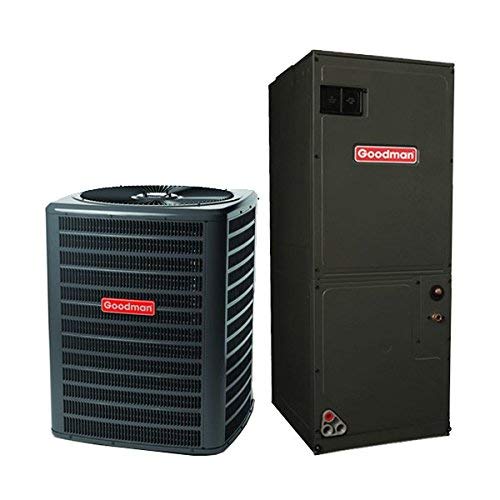
The air handler in this system can go in upflow, horizontal right or horizontal left, and its coil sits on a mounting track you can reposition. If your ductwork layout is unusual, that flexibility is the deciding feature. It pairs a 3.5-ton, 15.2 SEER2 heat pump with the AMST42CU1300 air handler, and it comes with a free thermostat included.
Inside the handler you get a direct-drive 9-speed ECM blower, which steps through nine airflow levels to match the load — that is the kind of fine control that keeps a house comfortable without blasting. It is R-32 only with factory-installed thermal expansion valves to tune cooling, plus appropriately sized evaporator coil tubes. The system is AHRI-certified under certificate number 215213860.
Reliability is the lead trait in the owner feedback, with smooth running and efficiency both coming up. It rated 4.0+ stars across 60+ ratings. A heat kit is advisable in cold climates, and thermostats, heat kits and outdoor sensors sell separately — even though this listing includes a free thermostat, so confirm what is in the box. Upflow and horizontal setups only; a downflow kit is an extra if you need it.
Where it delivers
- Upflow, horizontal right or left installs plus a repositionable coil track
- 9-speed ECM blower for fine airflow control
- 3.5 tons at 15.2 SEER2 efficiency
- Free thermostat included
Where to be careful
- Heat kit and outdoor sensor sold separately
- Downflow installs need an extra kit
- Confirm what the included thermostat covers
Made for: homes with awkward horizontal duct runs and buyers who want a thermostat thrown in.
Less suited to: anyone needing a downflow layout without buying the extra kit.
9. Goodman GPHH36031 5 Ton Packaged Heat Pump (R-32)
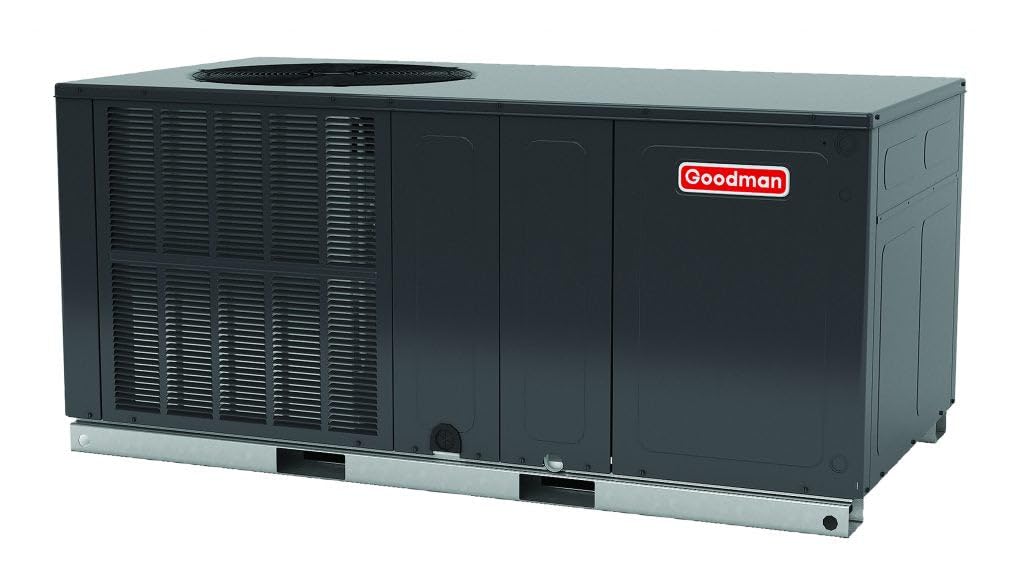
The biggest capacity here, in a single packaged cabinet rated 13.4 SEER2 and 6.7 HSPF2.
Five tons is a lot of heat pump, and this is the largest system on the list. It is a packaged unit — refrigeration circuit and blower in one outdoor cabinet — so it slots into homes that already use packaged ductwork. Goodman publishes this model at 13.4 SEER2 for cooling and 6.7 HSPF2 for heating. HSPF2 is the heating-efficiency rating for heat pumps; the higher it is, the more warmth you get per unit of electricity.
It is built as a direct replacement for the legacy GPHH36041 model, using R-32 refrigerant. That R-32 switch is part of a broader industry move to a lower-impact refrigerant, and it matters when you service the unit later. Goodman also notes that packaged heat pumps fall outside the split-A/C regional installation standards — local codes still apply, so check yours.
Here is the honest part: this one carries a lower 3.5+ stars across 10+ ratings, and it is the most specialized choice in the bunch. Thermostats, duct transitions and auxiliary heat accessories are not included, so the accessories list is the real cost of the install. Confirm the exact application, match and installation requirements with a licensed HVAC professional before ordering.
The standout: 5-ton capacity at 13.4 SEER2 and 6.7 HSPF2 in a single packaged unit that replaces the GPHH36041.
Plan around: the narrower review base and the accessory list — thermostat, duct transitions and aux heat all separate.
The one to choose for: large homes already set up for a packaged heat pump, especially a direct GPHH36041 replacement.
Not for you if: you have a split system or want the broader feedback of a mainstream pick.
Know the Specs
AFUE and SEER2 Ratings
AFUE is the percentage of gas that becomes household heat — 96% AFat 96% and 80% at 80%. Higher AFUE usually means a different venting setup, which is why it is worth confirming with your installer before you order. SEER2 and HSPF2 measure how efficiently a heat pump cools and heats; a higher SEER2 or HSPF2 means less electricity used per unit of comfort.
BTU Output and CFM Airflow
BTU is the heating power rating — 60,000 BTU suits a smaller home, 120,000 BTU a large one. CFM (cubic feet per minute) is how much air the blower moves. The 120,000 BTU furnace here pushes 2000 cfm, while the 100k BTU model moves 1600 cfm. Big output in a duct system that cannot carry the airflow will not warm the far rooms.
Upflow, Horizontal and Packaged Layouts
Upflow means air rises through the unit; horizontal means it moves sideways. The gas furnaces here handle both but cannot be flipped to downflow, so under-floor ductwork needs a GD9-family model. Packaged heat pumps house everything in one outdoor cabinet, which suits homes with no furnace closet.
ECM Blower Motors and Stages
A multi-speed ECM motor is an electronically controlled blower that steps through several speeds rather than running flat-out. Two-stage heating means the furnace has a low and a high flame, so it can hold an even temperature instead of swinging. Together, variable blower speed and two-stage heating keep temperatures steady and the blower quiet.
Common Questions
Can these furnaces be installed as a downflow unit?
What size furnace do I need for my house?
Is a heat pump better than a gas furnace for whole house heating?
Do I need a heat kit with a Goodman heat pump system?
What is the difference between SEER and SEER2?
What is the warranty on these Goodman furnaces and heat pumps?
Can I install a central heat pump system myself?
Are ther mostats and linesets included with these systems?
What does Low NOx mean on a gas furnace?
Should I choose a packaged or a split system?
The Bottom Line
For most homes, the whole house heating systems winner is the Goodman 80,000 BTU 80% Efficiency Furnace, because it balances 80,000 BTU of heat with a quiet multi-speed blower, a 17.5-inch cabinet and the strongest owner feedback of any furnace here. If you want the fuel savings and lighter build of a 96% AFUE unit, the Goodman 96% Efficiency Furnace is the one. And for homes going gas-free, the Senville 3 Ton Central Heat Pump covers heating and cooling in one, with cold-weather operation down to -22F (-30C). One nudge before you decide: measure your closet and confirm your duct layout, because the upflow-or-horizontal rule on every Goodman furnace here can rule out a whole model before the efficiency rating even comes into play.
How we choose
We do not accept paid placement. Every pick is matched to a real buyer and a real use-case; we do not hands-on test units.
Sources
Specifications: manufacturer listings and product documentation. Review insights: verified customer reviews, as of November 2026. Pricing: not shown on this page (it changes often); check the current price via the retailer link.
As an Amazon Associate, Tactical Gear Guy earns from qualifying purchases. This does not affect which products we feature.