Specs are compiled from manufacturer listings and verified buyer reviews and can change over time — please confirm the key details on the product page before buying.
You are setting up a room where a screen, a laptop, a speakerphone and a rat’s nest of cables all have to arrive together, work together, and roll out of the way afterward. A video conferencing cart has to do all three at once. The wrong one wobbles on carpet, catches on door thresholds, and sends you under the table for an outlet mid-meeting. Below are eleven rolling carts that actually hold conferencing gear, sorted by what each one is genuinely good at.
This guide is built by comparing the manufacturers’ published specifications and the patterns across verified customer reviews, so you get each pick’s real strengths and trade-offs instead of marketing spin.
The differences that matter are unglamorous: per-shelf weight capacity, how high the top surface adjusts, and whether the outlets travel with the cart. This page breaks down shelf ratings, VESA patterns, caster size and power setups so you can pick the best video conferencing cart for your room in one order.
Top Picks


How To Choose The Best Video Conferencing Cart
A conferencing cart has to do three jobs at once: hold a display steady, clear a doorway loaded, and carry its own power. It has to hold a display or projector steady while a camera and speakerphone sit at talking height, it has to roll through a doorway without being unloaded, and it has to carry its own power so you are not hunting for a wall outlet in the middle of a call. Match the cart to those three jobs — steady display, doorway clearance, onboard power — and the rest of the decision gets simple.
Start with the screen, not the shelves
If your cart has to carry a display, the mounting pattern decides everything. Screens hang on a VESA pattern — the four-hole square on the back measured in millimeters, given as width by height. A cart rated up to a 600x400mm pattern covers most large conference displays. A cart capped at VESA 75x75mm or 100x100mm is built for a monitor, not a 65-inch panel. Check the back of your screen before you check anything else.
Per-shelf capacity beats the headline number
A cart that says it holds 300 lbs is telling you the frame survives that load. It is not telling you one shelf does. Look for the per-shelf figure, because that is the number that matters when a projector, a mini PC and a speakerphone all land on one level. Steel legs and a real frame carry that load without flexing. Thin sheet-metal legs will bow over a season of daily use.
Wheels and brakes decide how it lives in the room
You want four swivel casters so you can steer the cart into a corner without a three-point turn. You want at least two locking brakes so it stays put while someone is typing on it or a camera is framing the room. Caster diameter matters on carpet: a 4-inch wheel rolls over a rug seam that a 2-inch wheel digs into. If your room is carpeted, size up on the wheels.
Power and cable routing
Built-in outlets mean one plug goes to the wall and everything else lives on the cart. Count the outlets against your gear: a laptop, a display, a speakerphone and a phone charger is already four. Grommets (the rubber-lined holes that let cables pass between shelves) and a cord wrap keep the whole thing from looking like a server closet. A long cord buys you placement freedom.
Side-by-Side Comparison
All five spec columns below use the same measurement across every row, so you can scan one column and see the trade-offs line up. Weight and capacity figures come straight from each manufacturer’s published data.
| Model | Best For | Weight | Footprint (W x D) | Shelf Capacity | Amazon |
|---|---|---|---|---|---|
| Oklahoma Sound PRC200★ Best Overall | Small rooms, clean installs | 37 lb | 18″W x 30″D | Four shelves | Amazon |
| Mount-It! Tall Mobile TV CartBest for Big Screens | Big-screen hybrid rooms | 33 lb | — | 22 lb AV shelf | Amazon |
| Pearington AVCART-01Classroom Standard | Classroom and library use | — | 24″W x 18″D | 110 lb per shelf | Amazon |
| POCHAR AV-JS | Long cable runs | — | 24.33″W x 18.35″D | 100 lb per shelf | Amazon |
| Outglee Mobile AV Cart | Lockable shared gear | — | 24.8″W x 18″D | 330 lb frame rating | Amazon |
| Rocelco VSTC | Heavy 70″ panels | 49.7 lb | — | 10 lb per shelf | Amazon |
| Mount-It! Computer Cart | Standing presenter station | — | — | — | Amazon |
| TooCust TCAVCART-001 | Wide drop-leaf desk | — | 46″W x 14″D | 110 lb | Amazon |
| Luxor AVJ42C | Sales-floor workhorse | — | 24″W x 28″D | Three shelves | Amazon |
| Luxor WPSDD3 | Locked storage plus workspace | — | — | Two drop leaves | Amazon |
| TARION Titanrig Cart | Field and studio shoots | 41.7 lb | 37.4″W x 22.83″D | 440 lb total | Amazon |
Detailed Reviews
1. Oklahoma Sound PRC200 Steel Premium Presentation Cart
Our pick — 4.5+★ from 100+ verified ratings; the strongest balance of quality and price.
Four shelves, six outlets and a swinging arm that lifts a projector to standing height.
This is the cart for a medium conference room where the gear lives on the cart permanently. The build is an 18-gauge steel frame (a thicker, stiffer gauge than the thin sheet metal on cheaper carts) under engineered wood shelves, powder-coated black. All four shelves are open and reachable, so a speakerphone, a codec box, a laptop and a spare headset each get a home. A six-outlet power strip is already mounted to the cart, which means one cord to the wall and everything else plugged in on board.
The feature you will actually use is the protruding shelf. It lifts from 19″ high to 39-1/2″ high, so the same cart works as a seated setup and as a standing presentation stand. Wheels are four 3″ casters that swivel, and the larger diameter is what lets it cross the seam between carpet and hard floor without catching. Built-in grommets route cables between shelves. It weighs 37 lb and measures 40-1/2″ high, 18″ wide and 30″ deep, so it is a genuinely compact footprint for a room where you cannot spare floor.
What wins people over is simply that it does its job — by a wide margin, functionality is the thing buyers talk about most. Assembly is the second most-discussed topic and it lands positive: the instructions are clear enough that most people get it together without a fight. Where it asks something of you is depth. At 30″ deep it is 12″ deeper than the Pearington below, which buys the wide shelf but crowds a narrow aisle. If your room is tight, measure the walking lane before you commit.
Where it earns the top slot
- Shelf height swings from 19″ to 39-1/2″ so one cart serves seated and standing setups
- Six-outlet strip is built in — no separate power brick to zip-tie on
- 18-gauge steel frame and wood shelves hold up to daily room-to-room use
- Compact 18″W x 30″D footprint leaves room for chairs
What it asks in return
- 30″ depth is the deepest pick here, so tight aisles get tighter
- 37 lb is heavier than the Mount-It! TV cart, which matters if you lift it into a vehicle
- No VESA mount — this holds gear on shelves, it does not hang a panel
Go this way if: you want one cart that stores the whole conferencing kit and rolls to standing height for a presenter.
Look elsewhere if: you need to wall-mount a 65-inch display or haul the cart up stairs weekly.
2. Mount-It! Tall Mobile TV Cart for 37-70 Inch Screens
Hangs a 70-inch panel and a webcam, then rolls the whole meeting to another room.
When the conference room needs a real display rather than a laptop propped on a shelf, this is the pick. It takes flat or curved panels from 37″ to 70″ up to 110 lbs, and it covers VESA patterns from 200×200 all the way to 600x400mm — that last pattern is the one big 65″ and 70″ panels use. The mount tilts ±10°, which is enough to kill the ceiling-glare reflection that makes video calls look washed out. It weighs 33 lb, which is 4 lb lighter than the Oklahoma Sound above, so one person can shift it alone.
Two shelves make it a genuine conferencing station rather than a TV stand. The mid-level AV shelf holds 22 lbs of cable box, mini PC or console. A dedicated top tray sits at camera height for a webcam or a small projector, which is exactly where you want the lens when everyone is seated. Four heavy-duty casters roll on hardwood, tile, carpet and hard outdoor surfaces, and two of them lock. Cable management channels run the cords down the back so a video call does not frame a waterfall of wires.
What buyers keep coming back to is the build. Quality is far and away the most-praised trait, with sturdiness right behind it — this thing feels solid once loaded. The honest caveat is stability and adjustability, which draw more mixed reactions: a tall mast carrying a large panel has some sway at the top, and getting the tilt dialed exactly where you want it takes a couple of attempts. Tighten the mount hardware properly and treat the height setting as a set-once job. Assembly runs 30–45 minutes with labeled parts and video instructions, and a lifetime warranty sits behind it.
The shelf math: 22 lbs on the AV shelf covers a streaming box, a laptop or a compact PC — but not a tower desktop plus a projector. If your kit is heavy, park it on a cart built for per-shelf loads.
Why it beats a fixed mount: no drilling and no wall damage, which makes it the practical answer for rented offices and rooms that get reconfigured.
The right call for: a hybrid room that needs a big panel, a camera at face height and the ability to relocate all of it.
Not the right call for: anyone who wants a rock-steady writing surface — this is a display stand first.
3. Pearington AV Presentation Cart with Adjustable Shelves
Three load-bearing shelves that each carry a projector’s worth of weight.
Load rating is where this cart separates itself. Each of the three adjustable steel shelves carries 110 lbs, which is 10 lbs more per shelf than the POCHAR below and a category apart from the 10 lb per-shelf figure on the Rocelco. That means a projector, a document camera and a stacked mini PC can share a level without the shelf sagging. An extra keyboard shelf slides out for a presenter who wants to type standing up.
The frame is alloy steel with a black finish, and the dimensions work in your favor on two axes. At 24″ wide it is 6″ wider than the Oklahoma Sound, and at 42″ tall it stands 1.5″ taller than that same cart. Footprint is 24″W x 18″D x 42″H. A four-outlet power strip with a 12-foot cord is attached to the side, and four swivel casters carry locking brakes. Everything from a monitor to a printer to a video projector has a place, which is what makes it a staple in classrooms, libraries, nursing homes and hospital training rooms.
Quality and sturdiness are the two things buyers praise most, and both land clearly positive — the steel reads as solid the moment it is loaded. Assembly is the most-mentioned topic overall and it splits: plenty of people put it together quickly, while others find the instructions harder to follow than they should be. Give yourself a clear hour and lay the parts out first. The other split is value, with some feeling it is a stretch for what arrives. Set that against the 110 lb shelf rating and the reasoning holds up.
Why it holds up in shared rooms
- 110 lbs per shelf handles a projector plus supporting gear on one level
- 12 ft cord reaches the outlet even when the cart sits mid-room
- Extra keyboard shelf suits a presenter who types while standing
- Solid steel construction across three adjustable shelves
Where to plan ahead
- Instructions divide opinion — allow a full hour for assembly
- Some buyers question the value at this tier
- No VESA mount, so it shelves a monitor rather than hanging a panel
Pick this one if: the cart lives in a classroom, library or training room and has to swallow heavy AV gear per level.
Pass if: you want a display bolted to a mast — that is the Mount-It! or Rocelco job.
4. POCHAR 3 Shelf Metal Utility Cart with Power Strip
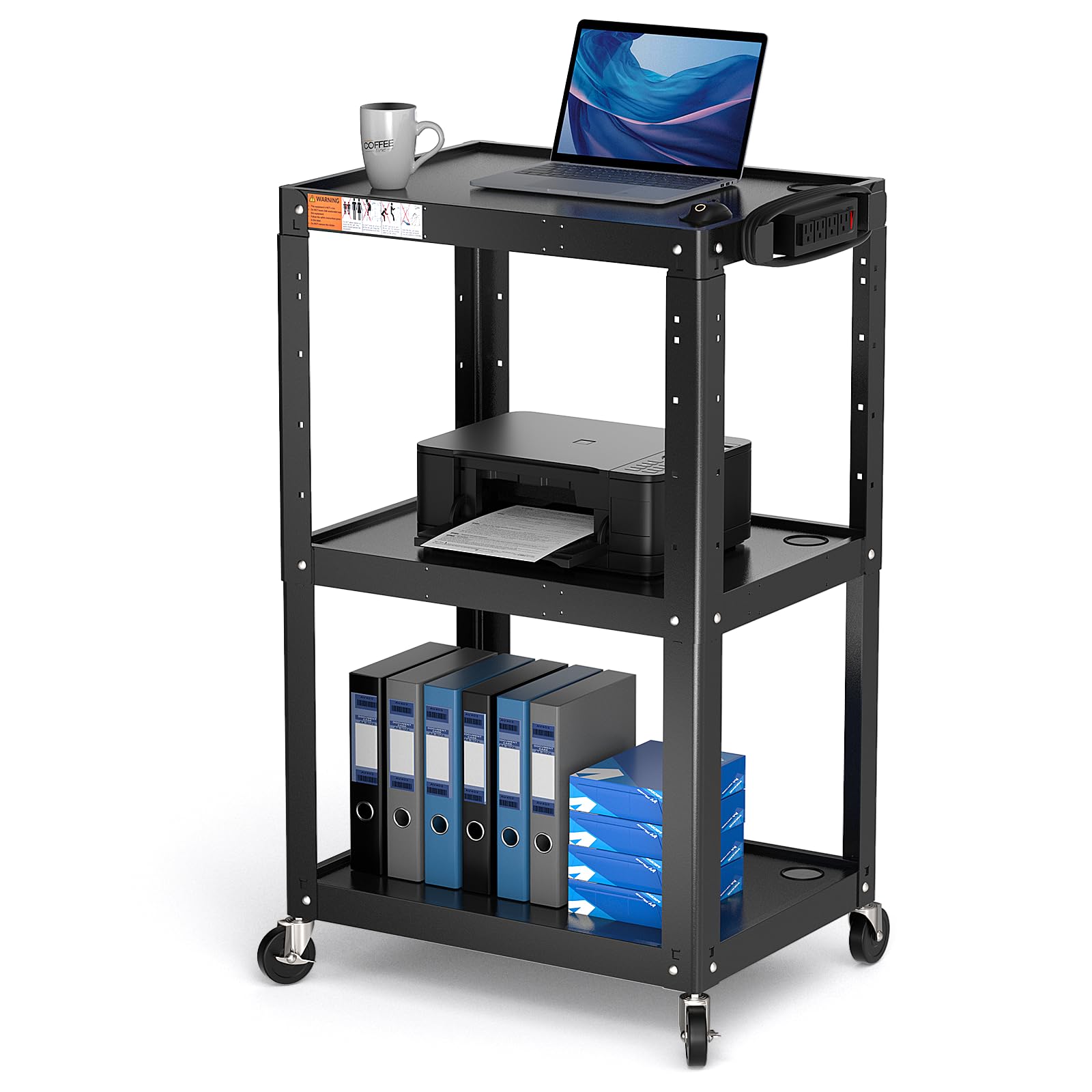
The cord is the story here — nearly ten feet of reach with the cart parked anywhere.
Most carts assume the outlet is behind them. This one assumes it is across the room. The built-in four-outlet strip runs off a 118.11″ cord, which covers a conference room where the only free socket is on the far wall. Add a cord management wrap on the shelf and the whole run stays tidy instead of pooling on the floor. If your meeting room was built before anyone thought about where to plug in a laptop, this solves the actual problem.
Underneath is cold-rolled steel rather than plastic — legs in 14-gauge steel (a heavier gauge than ordinary sheet metal, which is why the frame stays stiff under load). Total capacity is 300 lbs with 100 lbs per shelf, which is 10 lbs less per shelf than the Pearington above. Shelves adjust through pre-drilled holes from 24.5″ tall to 41″ tall, and you can build it as one, two or three tiers depending on how much you need. Four heavy-duty swivel casters, two with locks, do the moving. Footprint is 24.33″W x 18.35″D x 40.9″H and it is rated for indoor use.
Sturdiness is what earns the praise here — it is the trait buyers bring up most, and it tracks with the 14-gauge legs and steel construction. That said, this is the smaller-scale option on this list in terms of feedback volume, so treat it as a solid, straightforward cart rather than a long-proven workhorse. A one-year manufacturer warranty covers it. It also converts: drop a shelf and it works as a standing desk for a laptop-only call.
Built for awkward rooms: the 118″ cord is the longest reach on this list, and that is worth more than any other feature when the socket is badly placed.
One thing to check: the 24.5″ minimum shelf height means it will not tuck under a standard conference table when built as a single tier.
Reach for this if: your outlet is nowhere near where the cart needs to sit, or you want a cart that doubles as a standing laptop station.
Think again if: you need a VESA panel mount or more than three levels of storage.
5. Outglee Mobile AV Cart with Pegboard and Locking Cabinet
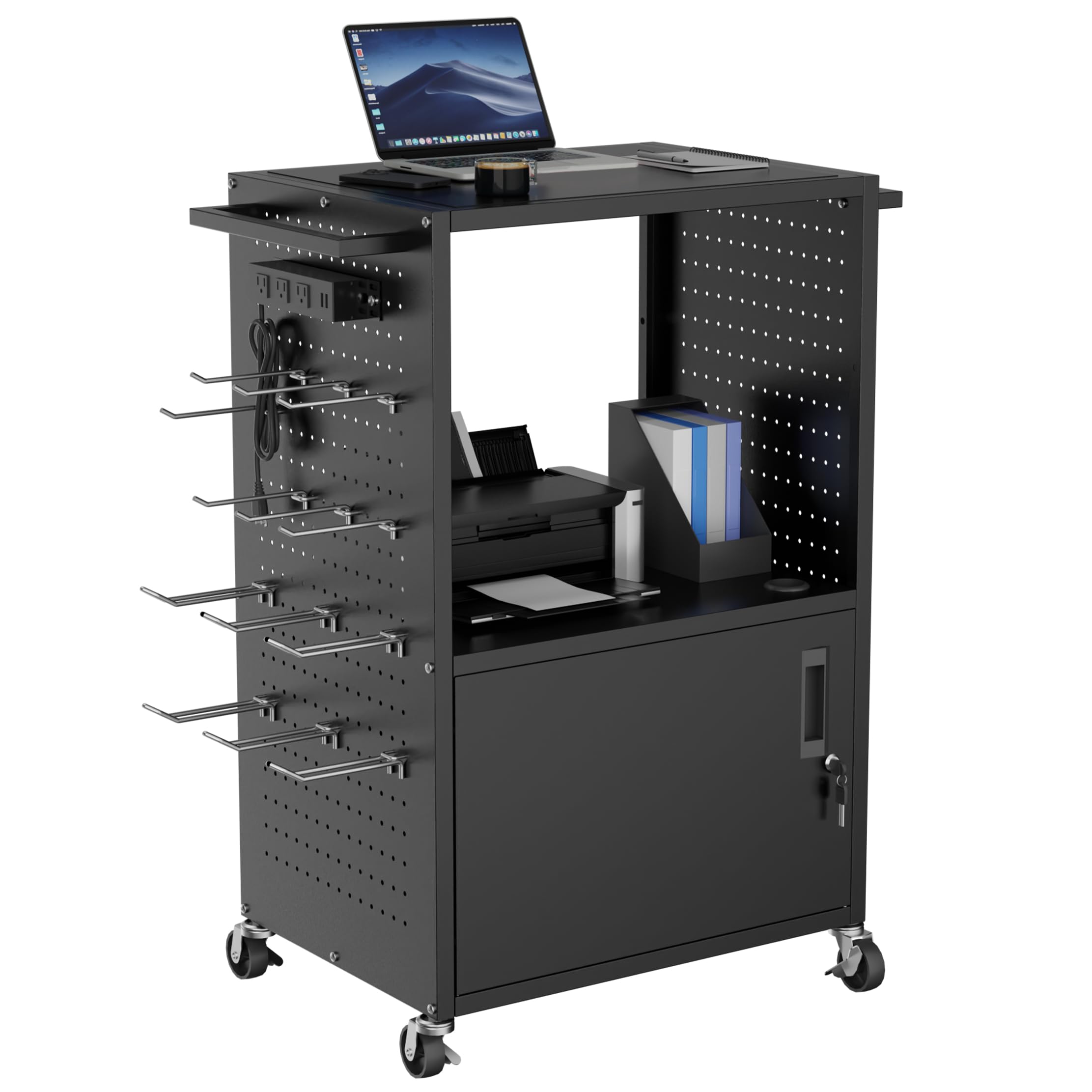
A cart that locks away the laptops between sessions and hangs the cables on a pegboard.
Shared rooms have a problem no other cart on this list solves: equipment walks. This one has an integrated lockable steel cabinet with two keys, sized for laptops and tablets, so gear stays put between sessions. That matters in clinics, shared classrooms and hot-desk offices. The frame is powder-coated alloy steel rated to 330 lbs, and the whole thing is 18″D x 24.8″W x 41″H with four 360-degree swivel casters, two of which lock for steady use.
The pegboard is the detail that keeps a mobile setup usable. A full panel with 12 adjustable hooks holds headphones, dongles, adapters and coiled cables within arm’s reach instead of buried in a bag. Power is built in — 3 AC outlets and 2 USB ports mean a laptop, a projector and a phone all charge from the cart with no extra strip to carry. An ergonomic push handle on the side lets you steer it with one hand while carrying a coffee in the other.
Buyers report it as sturdy and well made, with the frame holding firm once assembled rather than wobbling as it rolls. The one genuine friction point is assembly: instructions are the most-discussed subject and the feedback is split, with some finding it simple and others wishing the directions were clearer. Set aside time and follow the hardware order. Beyond that it is a well-built cart with a feature set nothing else here matches at a similar size.
The practical wins
- Lockable cabinet with two keys keeps laptops and tablets secured between meetings
- 12 adjustable pegboard hooks keep cables and adapters off the floor
- 3 AC outlets plus 2 USB ports run the whole kit without an add-on strip
- Side push handle and 360-degree casters make one-handed steering realistic
Where it needs patience
- Assembly instructions draw split feedback — plan a proper build session
- No VESA mount, so a large display still needs a different cart
- The cabinet takes up storage space you may want for shelf depth
The one to buy if: your gear lives in a shared space and needs to be locked up, organized and rolled out on demand.
Better elsewhere if: you want the cleanest, fastest build — the simpler three-shelf carts go together faster.
6. Rocelco VSTC Mobile TV Cart with A/V and Webcam Shelves

Built like a bid-spec school cart, with rubberized wheels that roll quietly.
The spec sheets say this cart is specified for purchase bids by school boards, and the build backs that up. It carries panels from 32″ to 70″ up to 100 lbs on a universal mount with patterns up to 600x400mm. Telescopic poles lift the top of the mount to 70″ from the floor, so a large panel can sit at real eye level rather than craning the room’s necks upward. Integrated cable management runs the wires down inside the frame instead of dangling behind the screen.
Wheel quality is the honest difference between this and cheaper carts. The casters are four 2.5″ rubberized wheels with a flip-down locking brake on each one, and the manufacturer points out that most other models ship with 2″ wheels. Half an inch of diameter changes how the cart crosses a carpet edge and how much noise it makes on a hard floor in a quiet room. Two shelves come included: a main component shelf at 19.7″W x 12″D for a laptop or DVR, plus a 10″W x 5″D top-hat shelf that adjusts in height for a webcam. Each shelf is rated 10 lbs.
This is the heaviest cart on the list at 49.7 lb, and that weight is the point — mass is what keeps a tall mast steady. It is not the cart you fold into a hatchback. The 10 lb per-shelf rating also means light gear only on the shelves, so plan the heavy items for a cart like the Pearington instead. It is the highest-rated pick here at 4.5+ stars, though the smallest sample of feedback, so it has less of a crowd behind it than the Pearington’s 400+ owners.
Steady where it counts: at 49.7 lb it is 16.7 lb heavier than the Mount-It! TV cart above — traded for a mast that stays planted while you tilt and lock the panel.
The shelf catch: 10 lbs per shelf covers a webcam and a laptop, nothing more. Pair it with a storage cart if you carry a full rig.
Choose it for: a large panel that needs to sit high, roll quietly, and stay planted on a hard floor.
Skip the shelf load: if you plan to pile a projector and a PC on it, use a cart rated for 110 lbs per shelf instead.
7. Mount-It! Computer Cart Mobile Desk Workstation

A rolling desk for the person who runs the call, not the wall the screen hangs on.
Most conferencing carts carry the display. This one carries the presenter. The monitor sits 63.5″ tall, so you stand at it rather than sit, and a full-sized keyboard and mouse tray pulls out at working height. The monitor mount fits screens up to 32″ on VESA 75x75mm or 100x100mm patterns, and the adjustable bracket lets you set the height. Steel construction and a stable base keep it from walking while you type.
The detail that makes it a workstation rather than a stand is the floating CPU holder with buckle straps. The desktop tower rides on the cart instead of sitting on the floor next to it, so everything moves as one unit. Four casters roll the setup from room to room without needing to break the cabling down, and the black gloss finish looks at home in an office rather than a stockroom. It is the pick if your conferencing lives around a laptop and a monitor rather than a big panel.
Mobility is the trait buyers bring up most, and it tracks — this is a cart you reposition constantly rather than park. The one real limit is footprint. It holds two 32″ monitors well, but the base is not built for a small room, and one buyer notes it is a poor fit for tight spaces. Measure your floor before you order. If your room is a converted closet, size down.
Right for a presenter
- 63.5″ standing height puts the monitor at eye level for a presenter
- Full keyboard and mouse tray makes it a real workstation
- CPU holder with buckle straps carries the tower, not the floor
- Rolls between rooms without breaking down the cabling
Before you order
- Base takes up floor and is not suited to very small rooms
- Caps monitors at 32″ with VESA 75x75mm or 100x100mm — no big panels
- No onboard power, so you still need a strip and a nearby outlet
The fit here is: a presenter who stands while driving the meeting and wants the tower rolling with them.
Wrong turn if: the room is tight or you need a cart that hauls a 65-inch display instead of a monitor.
8. TooCust Large Mobile AV Cart with Drop Leaves

Two fold-down wings turn a narrow cart into a 46-inch-wide working surface.
The problem this cart solves is the one where you need a wide desk for a two-screen setup, then need the same floor space back. Two drop-leaf shelves fold up on triangle hinges to create a 46″W x 14″D working area, wide enough for a projector, a laptop and a second screen at once. Fold them down and the cart shrinks to a narrow footprint that slips into a corner or a supply closet.
Storage is the other half. A lockable cabinet with 13.7″L x 24″W x 19″H of interior space holds most standard ATX, MicroATX and ITX computer hosts, so the PC rides locked inside instead of sitting exposed. The frame is heavy-duty steel with black powder coating, rustproof, and rated up to 110 lbs. Height adjusts from 36″ to 44″ in 2.5″ increments so you can dial in a work height. Power is 2 AC outlets and 2 USB ports on a 10-foot cord, with two grommet holes for cable routing. Four silent-roll casters, two with brakes, plus a handle finish the mobility story.
The caveats are practical rather than defects. The 14″ depth is shallow, so a large monitor base may overhang the drop leaves — measure the footprint of your screen before you count on it. This is also a newer model with a smaller feedback base, so the track record is thinner than the established carts above. The two-year warranty sits behind it, and the drop-leaf design is genuinely distinct from anything else here.
Why the wings matter: 46″ of width in use, folded to a narrow profile when not — that flexibility is the reason to choose it over a fixed three-shelf cart.
Measure first: at 14″ deep, the drop leaves are shallower than a standard monitor base wants, so check it fits before you set it up.
The right room for it: a multi-use office where the cart needs to spread out for a two-screen call and collapse afterward.
The wrong room: a permanent setup that never folds — a fixed steel cart is simpler and proven.
9. Luxor Multipurpose Adjustable Height Steel A/V Utility Cart
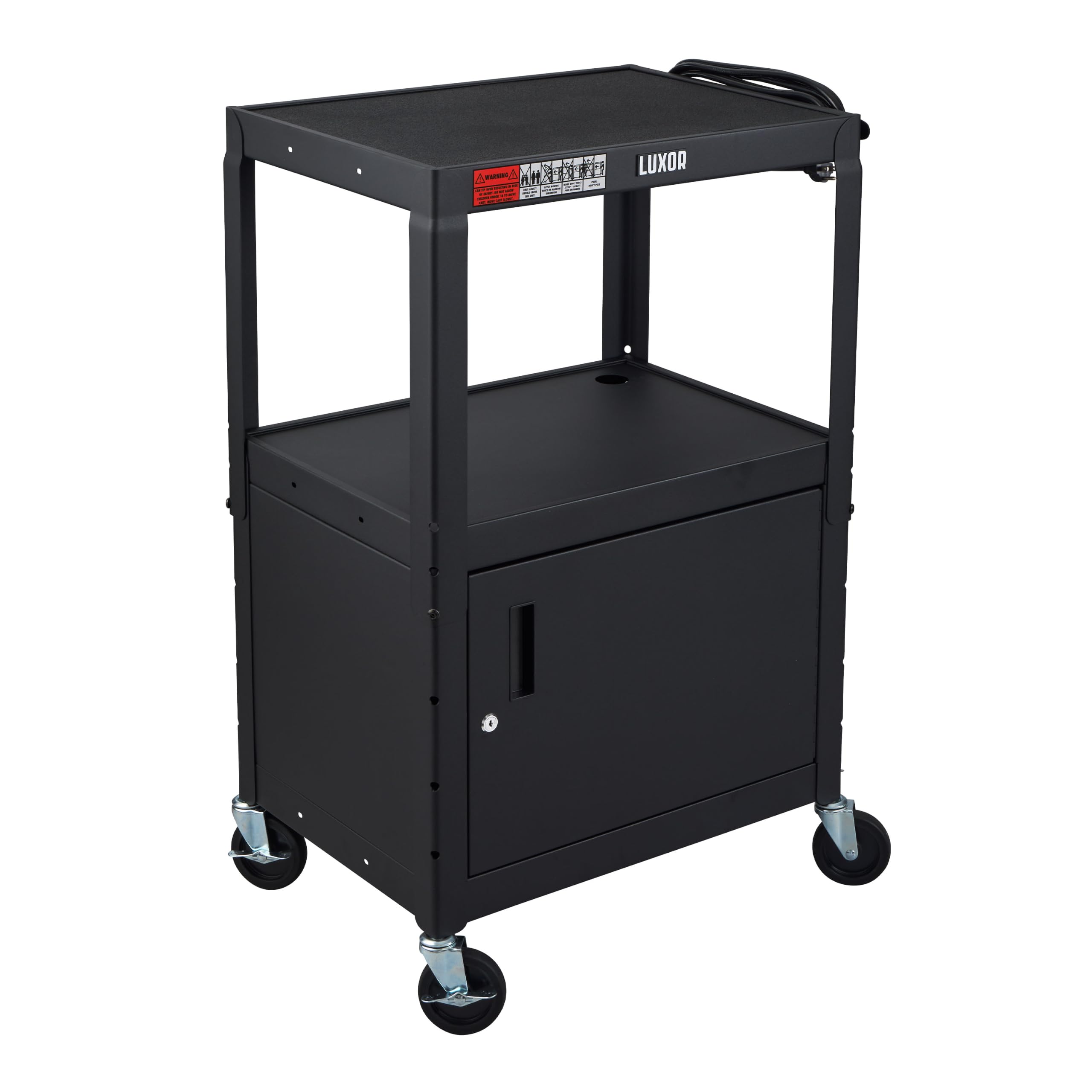
Four-inch ball-bearing casters and a fifteen-foot cord — built to be pushed all day.
If the cart is going to travel miles of floor over its life, the wheels are the part that fails first. This one runs four 4″ silent-roll, full-swivel ball-bearing casters with two locking brakes — the largest wheels on this list, and the ones that roll most smoothly over floor transitions. The 15-foot electrical assembly is UL and CSA listed, with a three-outlet strip and a cord plug snap, so it reaches across a show floor without an extension lead taped to the carpet.
Three shelves, adjustable height, a black alloy steel frame and a locking cabinet for stowing gear between shifts. Safety mats are included for the shelves so equipment does not slide. Dimensions are 28″D x 24″W x 42″H, and it is made in the USA. This is the cart that walks the sales floor with a monitor and a demo unit, or serves as a rolling workstation at a tradeshow booth.
Quality and sturdiness are what buyers praise most, and both land positive — the steel holds up to daily rolling. Smooth wheel performance comes up specifically too, which lines up with the 4″ ball-bearing casters. Assembly is more mixed, and a portion of the feedback flags hardware and ease of use, so budget an hour and check the bag of bolts. The 15-foot cord, the big casters and the locking cabinet do a lot of the heavy lifting for a cart at this tier.
What makes it roll
- 4″ ball-bearing full-swivel casters glide across floor transitions
- 15 ft UL and CSA listed electrical assembly with three outlets
- Locking cabinet keeps gear secure between shifts
- Safety mats on shelves stop equipment sliding
Be ready for
- Assembly draws mixed feedback and needs a full hour
- A portion of the hardware feedback is negative, so check the parts bag
- 28″ depth is on the deep side for a narrow aisle
Match it to: a sales floor or booth where the cart is pushed daily and nothing else gets that mileage.
Not for you if: you want a fast, tool-light build or a display hung at height.
10. Luxor WPSDD3 38″ Mobile AV Cart with Locking Cabinet

Twin locking storage spaces, twin drop leaves, and a pullout keyboard shelf.
This is the conferencing workstation that behaves like a small IT cabinet. A locking storage cabinet with an adjustable, removable shelf holds the bulk of the AV kit, and a separate locking storage drawer keeps the smaller pieces — remotes, adapters, patch cables — locked in their own space. Two locking points rather than one is the difference between a cart and a secure station. The build is wood with a laminate finish, in black and gray, and the top corners are rounded rather than sharp.
Workspace expands on demand. Two drop-leaf side shelves, each 13″W x 18.125″D, fold out for projectors, speakers and presentation materials, and fold down when the room is quiet. A retractable keyboard shelf measuring 16.375″W x 16.25″D gives a presenter a dedicated typing spot while keeping the main surface clear. Four 3″ full-swivel casters, two with locking brakes, move the whole thing, and the cart is backed by a 5-year limited warranty from a U.S.-based company.
Where this cart earns trust is the build. Quality and sturdiness are the two things buyers praise most, and both land positive — as one of the satisfied put it, it “won’t be easy to knock over.” Assembly is also positive, helped by the fact that it comes with the tools. The trade-off to weigh is material: wood and laminate instead of steel means it belongs in a dry office or classroom rather than a garage. For an indoor conference room, that also makes it the better-looking option.
Two locks, not one: a separate locking drawer for small supplies means you are not opening the whole cabinet every time someone needs a dongle.
Where it should live: wood and laminate construction suits offices and classrooms — keep it out of damp or rough spaces.
Choose it when: AV gear needs proper locked storage plus fold-out space that packs away between meetings.
Step past it if: the cart lives in a workshop or storage room where only steel will hold up.
11. TARION Titanrig Video Production Camera Cart

Nine-inch foam wheels and a 440-pound payload for people shooting on location.
This cart is built for crews rather than conference rooms, and the payload says it. It holds up to 440 lbs across three trays, which is enough for monitors, a camera rig and lighting kits in one run. The top shelf is thickly padded to protect optics and to survive long days on set. Multiple 1/4″ and 3/8″ side interfaces accept arms and accessories, and two clamps handle 1.1″ to 1.4″ (28-35mm) tubing for attaching light stands or Titanrig components.
Wheels are the headline. Four 9″ high-density PU foam casters are flat-free — no tire blowouts, no pressure checks before a shoot — and they swivel with foot brakes that lock them down. The foam dampens vibration, which is the whole point when delicate cameras and electronics ride on top. The cart folds tool-free: pull the quick-release strap and it collapses to roughly 40 x 24 x 14 inches at 41.7 lbs, small enough for most vehicle trunks. It measures 22.83″D x 37.4″W x 44.49″H in use.
What buyers praise most is functionality — it does the job it is sold for, and the versatility comes through too, with the mobile production use case landing well for field shoots. Weight capacity and durability both land positive. Maneuverability is the split one: nine-inch wheels are enormous for rolling, but they make the cart wide and heavy enough that tight corners need planning. A two-year warranty covers it, and the fold-flat profile is what makes it a genuine travel cart rather than a studio fixture.
- 440 lb payload handles monitors, camera rigs and lighting kits in one trip
- 9″ flat-free PU foam wheels damp vibration and never need inflating
- Folds tool-free to about 40 x 24 x 14 inches for a vehicle trunk
- 1/4″ and 3/8″ rigging interfaces plus clamps for 1.1″ to 1.4″ tubing
What you give up
- Maneuverability divides opinion — the big wheels make tight corners a planning job
- 41.7 lb folded weight is a two-person lift into a high trunk
- No built-in outlets, so power still comes from a separate strip
The clear match for: location shoots and studio floors where heavy gear has to move in one run and nothing can bounce.
Not the conference-room answer: no outlets, no VESA mount, and the footprint is larger than a standard meeting room wants.
Know the Specs
VESA Pattern and Screen Size
VESA is simply the four-hole spacing on the back of a display, given as width by height in millimeters. If your panel uses a 600x400mm pattern, your cart has to list that pattern or it will not bolt up. A cart limited to 75x75mm or 100x100mm is a monitor stand, not a display cart. Match the pattern and the listed screen range together, because a cart can fit the pattern and still be rated for a smaller panel.
Per-Shelf Load Versus Total Capacity
A total rating tells you the whole frame holds together under that load. A per-shelf rating tells you a single level will not bend. When a projector, a mini PC and a speakerphone land on one tray, the per-shelf number is the one that decides whether the shelf sags over a year. Look for both figures, and plan your heaviest item onto the level with the highest rating.
Caster Size, Type and Brakes
Caster is the industry word for a wheel in a swivel housing. Diameter decides how a cart handles a carpet seam — a 4-inch wheel rides over it while a 2-inch wheel digs in. Ball bearings make the roll smoother under load. At least two locking brakes are what let you type on the cart or frame a camera without the thing creeping.
Outlets, Cord Length and Cable Routing
A built-in strip means one plug to the wall and everything else charging on the cart. Count outlets against your gear before you buy. Cord length decides where the cart can park relative to the only free socket. Grommets and cord wraps keep the run tidy, and a tidy run is what stops a webcam from framing a tangle of cables.
Common Questions
Will a 65-inch display fit on a video conferencing cart?
How much weight can one shelf hold on these carts?
Do I need locking casters on a conferencing cart?
Will these carts roll over carpet?
Can I plug a laptop and a projector into the cart itself?
What is the difference between an AV cart and a mobile TV cart?
Is a steel cart better than a wood one for a conference room?
How long does assembly usually take on these carts?
Can a conferencing cart be used as a standing desk?
Do these carts need to be anchored to the wall for safety?
The Bottom Line
For most rooms, the video conferencing cart winner is the Oklahoma Sound PRC200 because it stores the whole kit across four shelves, powers it from a built-in six-outlet strip, and lifts the presentation shelf from 19 to 39-1/2 inches so one cart covers seated and standing setups. If the meeting lives around a large panel rather than a projector, grab the Mount-It! Tall Mobile TV Cart — it covers VESA patterns to 600x400mm and puts the webcam tray at face height. And for gear that has to stay locked between sessions, the Outglee Mobile AV Cart is the one to reach for, with a keyed steel cabinet and 12 pegboard hooks.
Two more worth flagging by need rather than by rank. If heavy AV equipment lands on a single shelf, the Pearington’s 110 lb per-shelf rating outruns everything else here. If the cart chases badly placed outlets, the POCHAR’s 118.11-inch cord solves a problem no other pick touches. Buy for the job in front of you, and skip the temptation to over-spec a cart for a room that only ever holds a laptop.
How we choose
We do not accept paid placement. Every pick is matched to a real buyer and a real use-case; we do not hands-on test units.
Sources
Specifications: manufacturer listings and product documentation. Review insights: verified customer reviews, as of November 2026. Pricing: not shown on this page (it changes often); check the current price via the retailer link.
As an Amazon Associate, Tactical Gear Guy earns from qualifying purchases. This does not affect which products we feature.