Specs are compiled from manufacturer listings and verified buyer reviews and can change over time — please confirm the key details on the product page before buying.
You want a blood pressure monitor you can actually pack in a carry-on and trust once you reach your destination. That means one thing above all: a monitor compact enough to travel but still built to give you a reading you can act on. The picks below range from a big-screen upper-arm unit that fits nearly every arm to slim wrist monitors that slip into a toiletry bag. We sorted them by how they hold up away from home and where they genuinely fall short, so you can pick the right one the first time.
This guide is built by comparing the manufacturers’ published specifications and the patterns across verified customer reviews, so you get each pick’s real strengths and trade-offs instead of marketing spin.
Below are the travel blood pressure monitors that actually earn a spot in your carry-on for their reliability and size.
Top Picks

How To Choose The Best Travel Blood Pressure Monitor
Your first decision is simple: wrist cuff or upper-arm cuff. A wrist cuff packs smaller and is easier to slip into a bag. An upper-arm cuff fits more arm sizes with a single cuff and leaves less room for positioning error on the road. Memory, app access and display size all matter less than a reading you can trust far from your doctor’s office.
Wrist cuff vs upper-arm cuff
A wrist cuff wraps around the wrist instead of the upper arm, so the monitor itself can be smaller and lighter. The trade-off is that wrist readings are more sensitive to how you hold your arm. A compact upper-arm cuff, like a model that adjusts from 8.7 to 16.5 inches, covers adults more broadly but takes up more room in a bag.
Cuff fit is non-negotiable
Check the cuff’s stated wrist or arm range before you buy. A cuff that is loose gives a weaker reading, so a monitor that fits your wrist precisely matters more than one that adds extra features you will not use. If your wrist falls outside the listed range, an upper-arm model is the safer path.
Memory, apps, and batteries
Memory lets you compare readings over time, and dual-user memory is handy if you and a partner share the device. Bluetooth app syncing turns those stored readings into a shareable log for your doctor. For travel, alkaline or rechargeable batteries matter — check what the monitor takes and whether batteries are included so it works the day you pack it.
Side-by-Side Comparison
| Model | Best For | Cuff Range | Memory | Power | Amazon |
|---|---|---|---|---|---|
| Paramed Upper Arm BP Monitor★ Best Overall | All-size cuff, big-screen simple setup | 8.7-16.5 in | 120 readings (2 users) | 4 AAA | Amazon |
| A&D Medical UB-543 WristBest Value | Multi-user households, gentle inflation | 5.3-8.5 in | 60 readings (per user) | 2 AAA (included) | Amazon |
| Windray Wrist BP MonitorSmallest Carry | Smallest and lightest to carry | Adjustable wrist | 120 readings (2 users) | 2 AAA | Amazon |
| Smartheart Wrist BP Monitor | Faster inflation-time readings | 5.5-7.6 in | 60 readings (2 users) | Included | Amazon |
| Greater Goods Bluetooth BP Monitor | Rechargeable, app-first tracking | Upper-arm cuff | 2 users, app log | Rechargeable lithium-ion | Amazon |
| MbH Bluetooth BP Monitor | Portable with IHB and AF detection | Adjustable cuff | 200 readings | 4 AAA | Amazon |
| Herz P1 Wrist BP Monitor | Big LCD and dual-user travel memory | 5.3-8.5 in | 2 x 120 readings | 2 AAA (included) | Amazon |
| OMRON 7 Series Wrist | App averaging and connected tracking | 5.3-8.5 in | 90 readings | 2 AAA (included) | Amazon |
| OMRON Gold Wrist | Dual-user capacity and morning readings | 5.3-8.5 in | 200 readings per user | 2 AAA (included) | Amazon |
Detailed Reviews
1. Paramed Blood Pressure Monitor
Our pick — 4.5+★ from 26,000+ verified ratings; the strongest balance of quality and price.
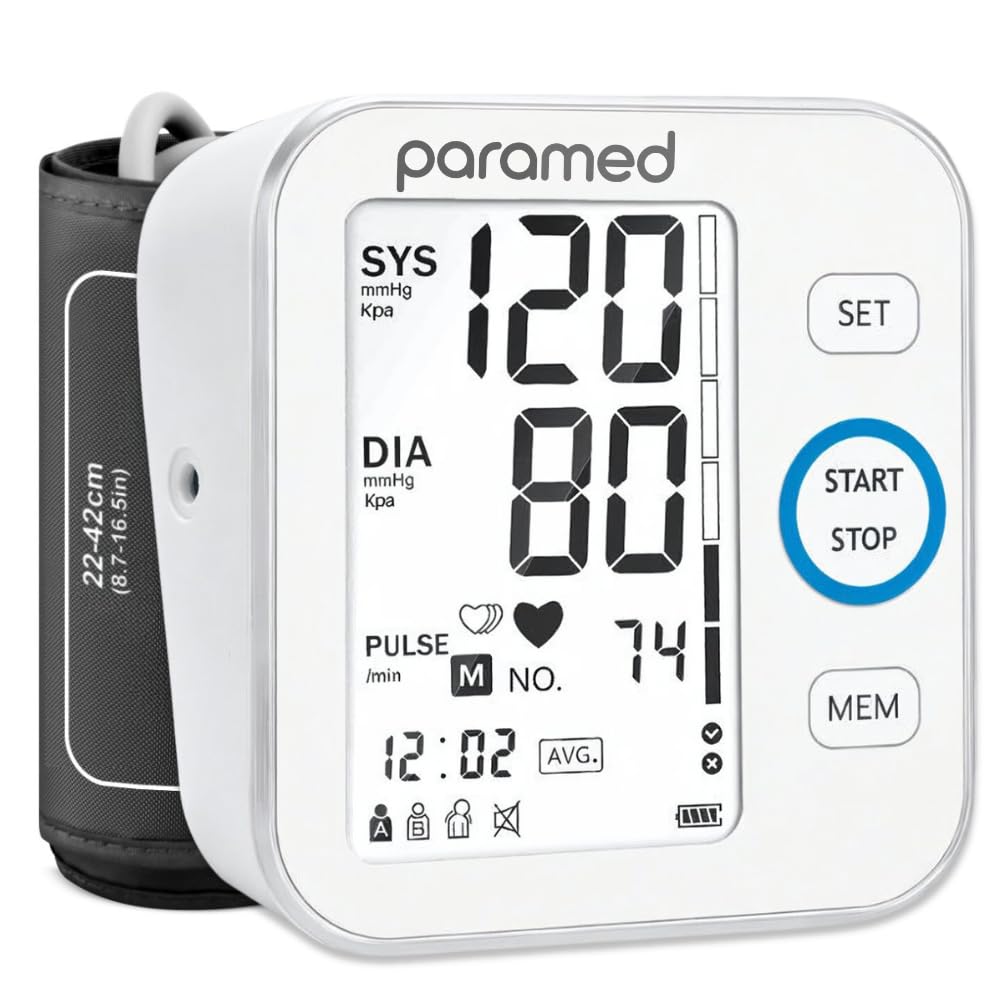
A single cuff that swallows nearly any arm, from thin wrists to wide biceps, with a screen you can read across a hotel room.
The Paramed wins on one thing: you can read the result without squinting. Its oversized LCD (the screen) shows big numbers and sits behind big buttons, so older parents and first-time users can run it alone. The cuff adjusts across an 8.7 to 16.5 inch range — a wider fit window than the wrist cuffs here, so one device can serve two very different arm sizes. If you want a cuff you barely notice on your wrist, this is not it.
It stores up to 120 readings split across 2 user profiles, and the voice broadcast reads your numbers out loud if you would rather not hunt the display. A date display and low-battery notice round out the travel basics. The whole thing runs on 4 AAA batteries (the device bag and batteries are included), so it works the day you unpack it. This is the crowd favorite here — 4.5+ stars across a huge base of owners — and quality and ease of use are the two things people bring up most.
The catch with an upper-arm unit is size: it measures 5.91 x 4.72 x 3.94 inches in the box, so it wants a little more bag room than a wrist monitor. The other honest note is that a small share of long-term buyers report the unit eventually stopping working reliably, so treat it as a durable everyday tool rather than a lifetime one. For the widest arm fit and the simplest big-screen experience, though, this is the one to beat.
What makes it the front-runner
- 8.7-16.5 in cuff covers more arms than any wrist model on this list
- Large LCD with oversized numbers and big buttons
- 120 readings across 2 user profiles, plus voice broadcast
- Device bag and 4 AAA batteries included
Where it asks a little more
- Bigger footprint than a wrist monitor — needs real bag space
- A small share of owners mention eventual reliability issues
The right call for: travelers who want one cuff that fits every arm and a big readable screen with zero setup fuss.
Think twice if: you need the absolute smallest monitor that disappears into a pocket — a wrist model below fits that bill better.
2. A&D Medical UB-543 Wrist Blood Pressure Monitor for Home Use
For two people sharing one compact cuff, this wrist model keeps each person’s readings in their own lane.
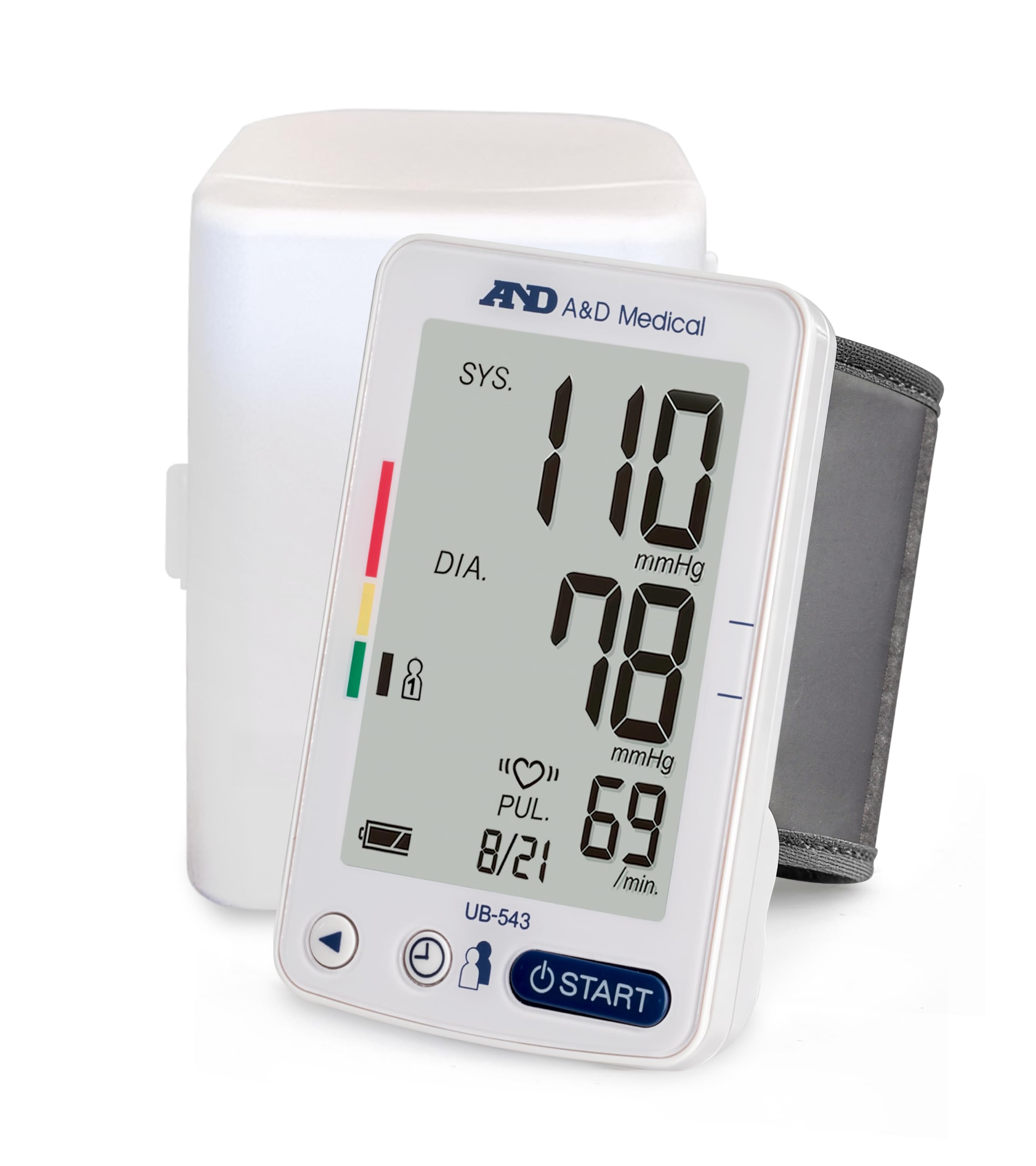
Strap this on your wrist and it inflates gently instead of clamping down hard, so a twice-a-day routine stays comfortable on the road. The cuff fits wrists from 5.3 to 8.5 inches, which covers most adult wrists. One-button operation and oversized numbers on the LCD (the screen) handle the rest. If your arm measures outside that 5.3 to 8.5 inch band, pick an upper-arm model instead.
It holds up to 60 readings per user for 2 users, so you and a partner keep separate histories on one device, and the monitor averages your measurements for you. The A&D Heart Track app lets you manually log unlimited readings to your phone if you like keeping a log. At 3.6 ounces it is the lighter carry of the two wrist monitors here, and it tosses into a bag with the included case and 2 AAA batteries.
The trade-off worth knowing: this is a low-volume listing with more mixed feedback on accuracy than the bigger wrist names here, and some units reportedly read off. If precise, repeatable numbers at home matter most, the OMRON models later on are the safer bet. But for a light, gentle-inflation wrist monitor for a pair of travelers, it does the job.
Two-user separation: 60 readings per profile for 2 users keeps couples’ histories apart without an app subscription.
Packability win: At 3.6 ounces with an included case and batteries, it throws into a toiletry bag and works immediately.
Good match for: couples who want a featherweight wrist monitor and separate memory banks for each person.
Hold off if: rock-solid accuracy is your top priority — this smaller listing draws more mixed accuracy notes than the established wrist brands.
3. Wrist Blood Pressure Monitor
The monitor that treats bag space as the enemy — tiny body, one button, and nothing extra to plug in.
If your carry-on is already full, this is the form factor to beat. It measures just 3.15 x 2.76 x 1.22 inches and weighs 4.16 ounces, so it slips into a side pocket or a dopp kit and you forget it is there until you need it. A single Start button fires the whole read, and the color-coded hypertension classification indicator makes the result readable at a glance: green for average, yellow for light, orange or red for middle to heavy.
It stores 120 readings for each of 2 users, rolling the oldest out when memory fills. The adjustable wrist cuff is designed to fit most wrist sizes, so it works across a couple of travelers. Just know it runs on 2 AAA batteries, which are not included — pack a set so it is ready when you arrive.
Here is the honest part that sets expectations: accuracy and reliability are the most-discussed topics for this model, and the feedback splits — some owners get clean readings, others report unreliable numbers and units that stop working. Its real strength is the tiny, one-button travel convenience; if you want it, plan to measure carefully, keep still, and mind that battery polarity. For a light packing-first pick at a budget-friendly price, it earns its spot.
Packs like a wallet: 3.15 x 2.76 x 1.22 inches and 4.16 ounces means near-zero bag penalty on a trip.
Read-at-a-glance colors: The hypertension indicator maps your result to green, yellow, orange, or red so you read the meaning, not just the numbers.
Reach for it if: pocket-sized portability is the deciding factor and you want a color-coded result in one button press.
Look elsewhere if: you need the most consistent readings — plan careful, still measurement if you pick this one.
4. Smartheart Adult Cuff Wrist Digital Blood Pressure Monitor

It reads your numbers while the cuff is still inflating, so your arm spends less time squeezed.
Most monitors pump up, then pause, then read. This one takes the measurement during inflation, which shortens the time your arm sits under pressure — a small comfort that adds up if you check twice a day on a long trip. The LED backlit display keeps the numbers visible in a dim hotel room, and one-button automatic inflation means there is nothing to fiddle with.
Memory holds 60 measurements for each of 2 people, with date and time stamps and a last-reading average to show the trend. A hypertension indicator and an irregular heartbeat icon flag what needs attention without you decoding the digits. It ships as a complete kit: monitor with attached cuff, storage case, batteries, English and Spanish instructions, and a results log.
The wrist cuff fits 5.5 to 7.6 inches — narrower than some here — so check your wrist before you commit, and an upper-arm cuff is wiser if you fall outside it. Reliability and battery life draw mixed notes on this listing, and a few units reportedly quit early, so it is a fit-and-verify purchase rather than a set-and-forget one. For travelers who dislike a long squeeze, the faster read is the draw.
Measure-while-inflating: Reading during cuff inflation cuts the time your arm is compressed — nice on repeated daily checks.
Narrower wrist fit: The 5.5-7.6 inch range is tighter than the 5.3-8.5 inch wrist monitors here, so measure first.
Suits you if: you have a mid-size wrist and want a faster reading that spends less time squeezing your arm.
Skip the wrist version if: your wrist falls outside 5.5-7.6 inches — step up to an upper-arm monitor instead.
5. Greater Goods Bluetooth Blood Pressure Monitor

No battery hopping on a trip — this one recharges and pipes unlimited readings straight to your phone.
The rechargeable lithium-ion battery is the whole reason to pick this upper-arm model for travel: you charge it before you go and stop cycling through disposable AAA cells mid-trip. A bright backlit display keeps the numbers readable, and it works with 2 users. The standout is Bluetooth syncing to the in-house Balance app for iOS and Android, which stores unlimited entries on your phone — a clean way to carry a whole history with you to share with a doctor.
It takes the reading as the cuff inflates, which shortens the squeeze, and the maker pitches the internal components as accurate. Set-up draws steady praise — owners find it simple to connect and the data easy to link between the monitor and app. This is the connected choice here rather than the featherweight one; at 10.4 ounces it is heavier than any wrist monitor on the list, so it travels as a small-cased kit rather than a pocket device.
If you live in an app and want your numbers tracked automatically, this is the smoothest fit. If you would rather not depend on a phone at all, the battery-free-from-app models above are simpler. The upside is a monitor that keeps running on a charge and builds a shareable log with no extra work from you.
Why the connected set will like it
- Fast-charging lithium-ion — recharge instead of swapping batteries
- Balance app stores unlimited readings on iOS and Android
- Two-user compatible with a bright backlit display
What to weigh first
- At 10.4 ounces it is the heaviest pick here — a bag item, not a pocket one
- Relies on the app for the full tracking experience
Built for: the phone-first traveler who wants a rechargeable monitor and an auto-synced log to hand a doctor.
Not the one if: you want the lightest possible carry — the wrist models up top win on packability.
6. MbH Bluetooth Blood Pressure Monitor

An ultra-light upper-arm cuff that squeezes 200 readings and abnormal-rhythm flags into a road-trip body.
This monitor earns its travel label: the maker pitches it as small and light enough for the office or the road, and it stores up to 200 readings so you can hand a full record to your doctor later. One-touch measurement also flags an irregular heartbeat and detects atrial fibrillation (an uneven heart rhythm). Bluetooth (short-range wireless) sends the data to the free MbH BP app on iOS or Android, so your history travels in your pocket.
The adjustable cuff is built to suit both adults and children, so it adapts across users rather than locking to one wrist size. Its upper-arm form means fewer positioning worries than a wrist cuff when you are measuring in a hotel chair. The maker claims clinically validated accuracy, but that is their wording, not a result per verified buyer reviews.
The trade-off is feedback volume: this is a lower-traffic listing and it is the lowest-rated pick here, so go in with realistic expectations on polish. If you want the extra rhythm detection and the big 200-reading memory and can accept a bit more gamble, it does a lot in a light frame. For the most widely praised reliability, the OMRON picks further down are the safer call.
More than a number: One-touch measuring adds irregular-heartbeat and atrial-fibrillation flags on top of the reading.
Light and loaded: Ultra-light body plus a 200-reading memory gives you a big log without weight.
Choose it for: rhythm-detection extras and a large 200-reading log in an ultra-light upper-arm frame.
Prefer the safer bet if: you want the most dependable everyday performance — this one sits lowest on owner ratings here.
7. Herz P1 Wrist Blood Pressure Monitor
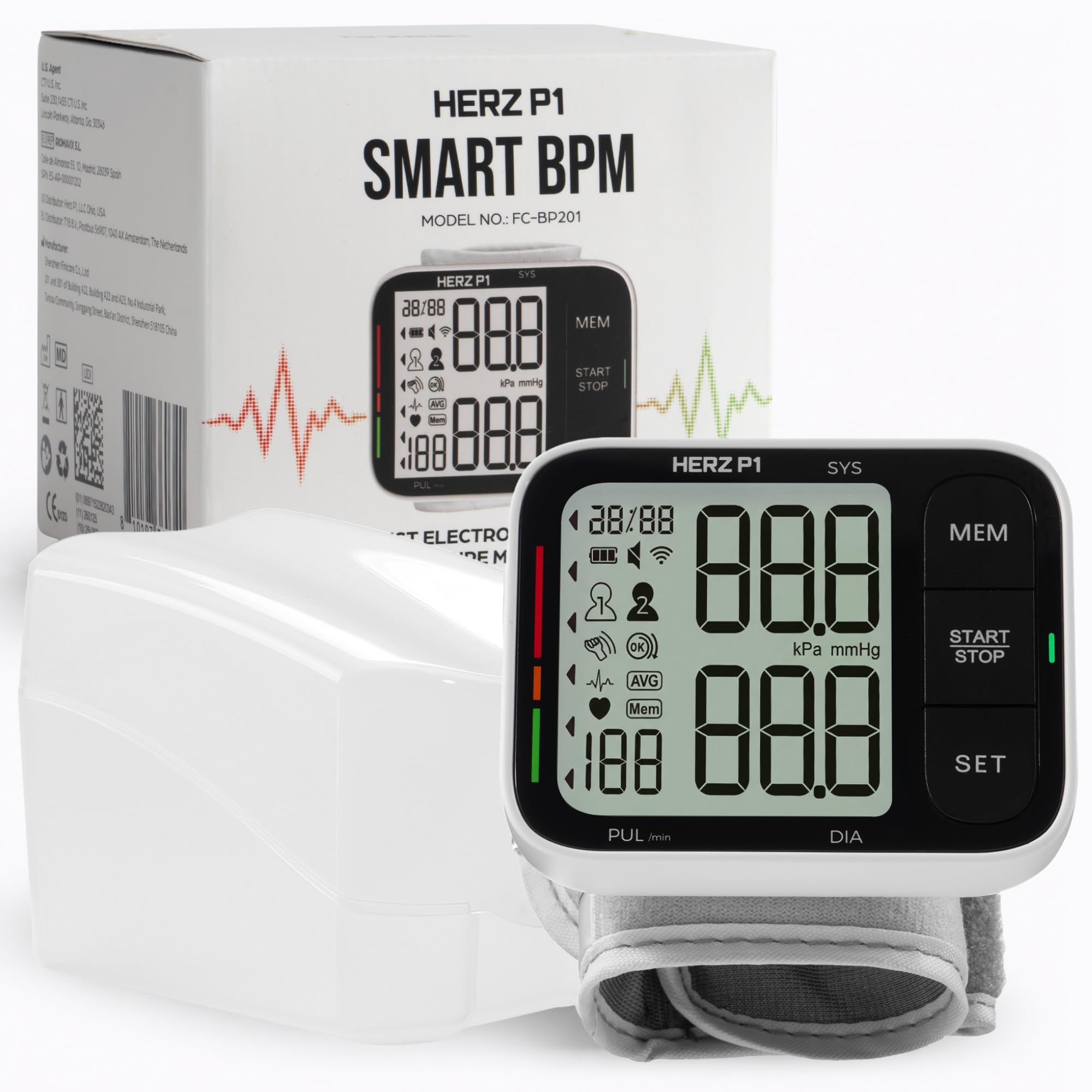
A wrist monitor that finally puts the numbers where you can read them — a big LCD with dual-user memory to match.
The screen is the hero here: a 51 x 46.68 mm LCD shows your systolic, diastolic, and pulse figures together in large numerals, so a quick glance in a hotel room tells you the whole story. It fits wrists from 5.3 to 8.5 inches — the same generous wrist window as the OMRON models — with a soft adjustable cuff and no bulky arm band to wrestle onto a chair arm. Readings take about a minute.
Memory stores 120 reading sets for each of two users, so partners track separate histories on one device with no app, phone, or subscription needed. It runs on 2 AAA batteries that are included, so it is ready straight from the box. A built-in cuff self-check and movement detection run before and during the read, and an irregular-pattern symbol flags anything unusual for awareness only.
Owners consistently report readings that match the numbers they get at a clinic. It is the priciest wrist pick of the mid group, so the value case rests on that big readable display and the dual-user memory. If you want to be able to read your own numbers unaided, this is the wrist monitor that makes it easy.
Read-it-easily screen: The 51 x 46.68 mm display shows SYS, DIA, and PUL together in big numerals — no decoding tiny digits.
Two users, no app: 2 x 120 readings keeps partners’ histories separate without a phone or subscription.
The pick for: travelers who want a wrist monitor whose big screen they can read without glasses and separate memory for two people.
Weigh this first: it is the priciest wrist model of the mid group — you are paying for the display and dual memory.
8. OMRON 7 Series Wireless Wrist Blood Pressure Monitor
The wrist monitor that smooths out a single wonky reading by averaging three into one trustworthy number.
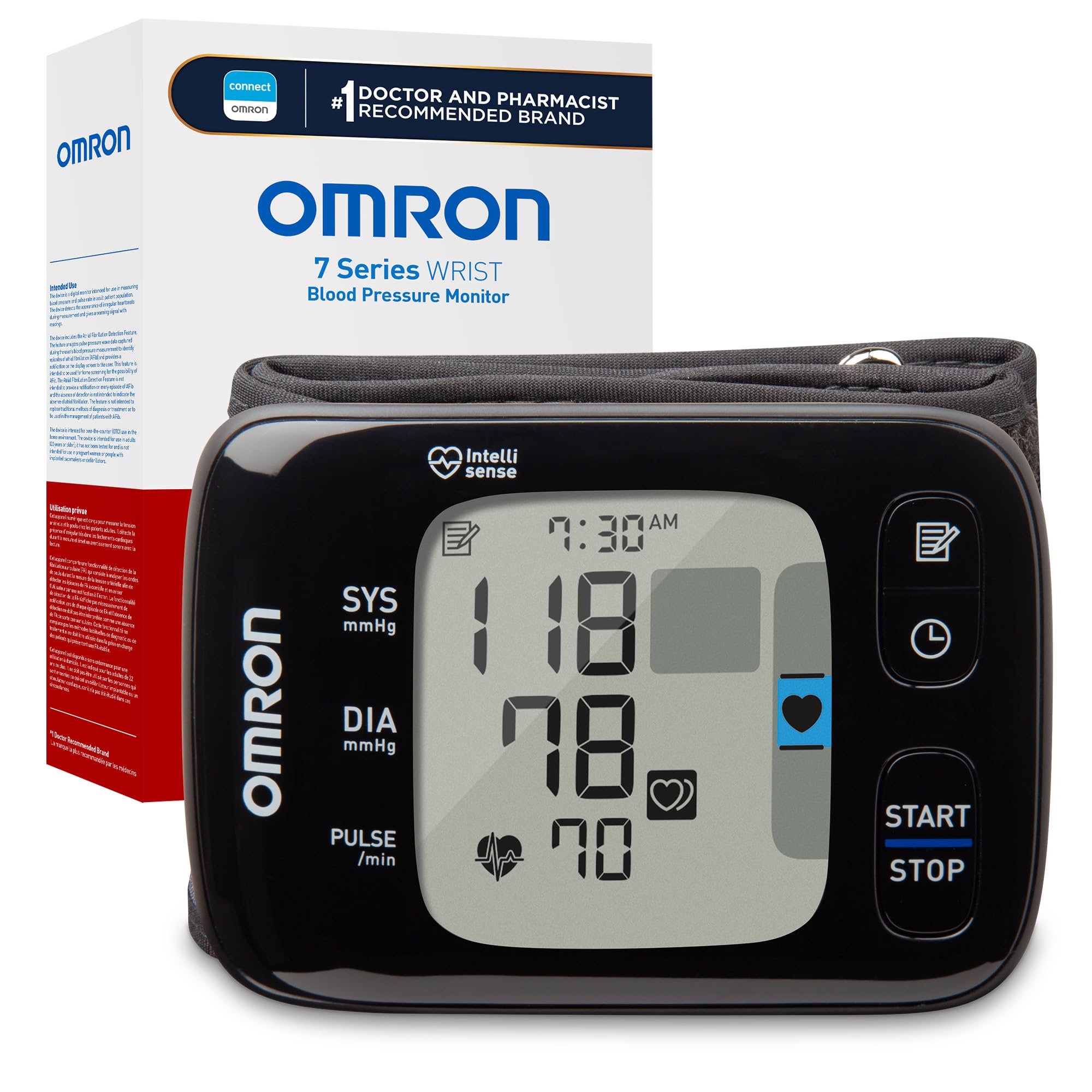
Advanced Averaging is the reason to look here: the monitor automatically averages up to 3 readings taken within a 10-minute window, so one bad press does not throw off your log. It stores up to 90 readings, and a hypertension indicator flags an improve result so you know when it is worth a closer look. The wrist cuff fits 5.3 to 8.5 inches, and it comes with a storage case, manual, quick-start guide, and 2 AAA batteries ready to go.
Bluetooth links it to the free OMRON connect app to store unlimited readings, track trends, and share reports with your doctor, and it works with Apple Health and Google Fit. It is the most established wrist name on this list, and owners praise how easy it is to use day to day. OMRON claims its brand is the most recommended by doctors and pharmacists — that is their wording, not a verdict per verified buyer reviews.
At 3.17 ounces it packs light and travels with its case. The honest note: Wrist readings still depend on how you position your arm, so sit still and brace your arm at heart level for the steadiest result. For a slim wrist monitor with averaged readings and a connected app, it is the dependable premium route — and the more popular OMRON Gold below adds capacity on top.
Why it earns the premium tag
- Advanced Averaging of up to 3 readings within 10 minutes
- OMRON connect app with Apple Health and Google Fit sync
- 5.3-8.5 in wrist cuff plus case and batteries included
The parts to keep in mind
- Wrist readings still need a still, heart-level arm position
- It stores 90 readings — the Gold model below holds more
Ideal for: travelers who want averaged, app-synced wrist readings from the most established name in the category.
Compare before you commit: if a bigger history and dual-user capacity matter, look at the OMRON Gold next.
9. OMRON Gold Wireless Wrist Blood Pressure Monitor
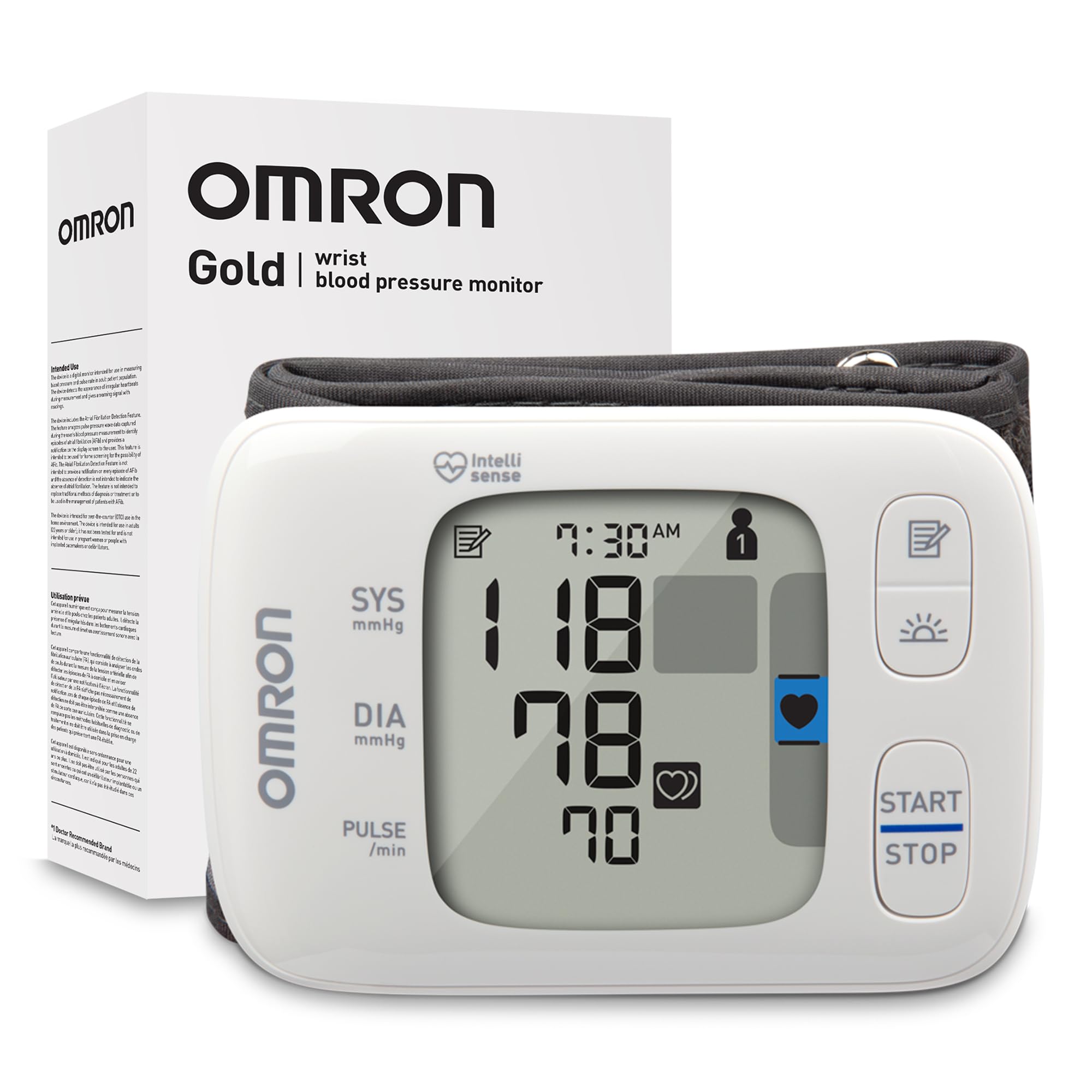
Double the memory of most wrist units — 200 readings for you and 200 for a partner, with morning-spike awareness baked in.
The Gold is the capacity champ on this list. It stores up to 200 readings for each of two users, which is far more history than the 90 readings on the OMRON 7 Series above. A High Morning Average Indicator checks for morning blood pressure spikes, and an Irregular Heart Beat indicator flags unusual rhythms during routine measuring. The cuff fits 5.3 to 8.5 inches, and a storage case, manual, quick-start guide, and 2 AAA batteries all come in the box.
Bluetooth syncs to the free OMRON connect app for unlimited readings, trend tracking, and shareable reports, with Apple Health and Google Fit support. Compact size is a theme owners appreciate — big enough for any wrist, small enough to pack. This is the most-reviewed wrist monitor here, so it is the crowd-tested choice for travelers who want a proven name and a big record.
The fair caveat: accuracy draws mixed notes, and a portion of customers note readings that drift from what they expect — wrist monitors generally reward careful positioning, so brace your arm at heart level and stay still. Readability is also a recurring gripe on this specific model, so if a big bright screen is a must, the Herz P1 above is the friendlier read. For sheer capacity and connected tracking from a trusted brand, it is hard to argue with.
History for two: 200 readings per user across a pair outlasts most wrist monitors for trend tracking.
Morning focus: The High Morning Average Indicator targets morning spikes specifically — a check many monitors skip.
Worth it for: travelers who want the biggest dual-user memory and app sync from the most-reviewed wrist name here.
Go a different way if: a large, bright display tops your list — the Herz P1 reads more easily.
Know the Specs
Wrist cuff vs upper-arm cuff
A wrist cuff is the compact option — it wraps the wrist and lets the monitor itself shrink, which is why wrist models like the OMRON and Herz units pack light. An upper-arm cuff wraps the bicep and typically fits a wider size range; the Paramed adjusts from 8.7 to 16.5 inches, the broadest arm fit here. Wrist readings are more sensitive to arm position, so either way you want your wrist braced at heart level and your body still.
Memory and dual-user tracking
Memory lets you compare readings over days and spot trends rather than judging a single number. Capacity ranges widely: 60 readings per user on the A&D and Smartheart, 90 on the OMRON 7 Series, and 200 per user on the OMRON Gold. Dual-user memory keeps two people’s histories separate on one shared travel device, which is worth having if you and a partner both monitor.
Power: batteries and recharging
Most travel monitors run on AAA cells — 4 AAA on the Paramed and MbH, 2 AAA on the wrist models. Check whether batteries are included so the unit works the day you unpack; the Herz, OMRONs, and A&D include them, while the Windray does not. The Greater Goods is the rechargeable option with a lithium-ion battery, so you top it up instead of buying disposables on the road.
Extras that earn their space
A hypertension indicator (a high-blood-pressure marker) codes your result so you read the meaning, not just the digits. An irregular-heartbeat or irregular-pattern flag notes anything unusual during the read, for awareness only. On the OMRON 7 Series, Advanced Averaging blends several readings into one, and Bluetooth app syncing turns stored numbers into a shareable log — handy when you want a full history for a doctor far from home.
Common Questions
Is a wrist blood pressure monitor accurate enough to trust while traveling?
Will a wrist monitor fit my wrist size?
How many readings do I need to store on a travel monitor?
Do these monitors work on regular AAA batteries?
Can I share one monitor with my partner on a trip?
What does the irregular heartbeat indicator actually do?
Is an upper-arm monitor or a wrist monitor better for travel?
Do I need the Bluetooth app to use these monitors?
How should I pack a blood pressure monitor for a flight?
What is Advanced Averaging on the OMRON 7 Series?
The Bottom Line
For most travelers, the winner is the Paramed Upper Arm Monitor. Its 8.7 to 16.5 inch cuff fits nearly any arm, the big LCD (screen) is easy on the eyes, and 120 readings across two profiles keep your history simple. If packability comes first, grab the Windray Wrist Monitor at 4.16 ounces with one-button color-coded results. Want the most connected, capacity-rich wrist option from the most-reviewed name here? The OMRON Gold, with 200 readings per user and app syncing, is the one to reach for.
How we choose
We do not accept paid placement. Every pick is matched to a real buyer and a real use-case; we do not hands-on test units.
Sources
Specifications: manufacturer listings and product documentation. Review insights: verified customer reviews, as of November 2026. Pricing: not shown on this page (it changes often); check the current price via the retailer link.
As an Amazon Associate, Tactical Gear Guy earns from qualifying purchases. This does not affect which products we feature.