Specs are compiled from manufacturer listings and verified buyer reviews and can change over time — please confirm the key details on the product page before buying.
The shoe that keeps you out of trouble on a tennis court is not the softest one. It is the one that holds your foot steady when you plant and cut sideways, because a hard court punishes every slide. If you only take one thing away: buy for lateral stability first, then comfort. This guide narrows the field to court-ready shoes built for real match play, and it separates the picks that lock your foot down from the ones that only feel good in the shop.
This guide is built by comparing the manufacturers’ published specifications and the patterns across verified customer reviews, so you get each pick’s real strengths and trade-offs instead of marketing spin.
Tennis asks your feet to stop hard, pivot, and push off again, so outsole grip and midfoot support matter more than any style detail. The list below ranks the strongest Top Shoes for Tennis by what actually holds up over a match.
Top Picks
How To Choose The Best Top Shoes for Tennis
A tennis shoe is a tool for stopping, not just running. The best ones grip the court surface, hold your foot centered during a sidestep, and shrug off the toe scuff that comes from dragging your front foot into a shot. When you shop, treat the outsole and the midfoot support as the two things you cannot compromise on, then sort the rest by how your own foot feels.
Start with the outsole and the court you play on
Hard courts eat through rubber, so look for a durable outsole compound and a tread pattern that grips without grabbing. The Wilson Rush Pro line uses a Duralast outsole built for hard courts, while the adidas Courtjam Control 3 runs an Adiwear outsole tuned for hard surfaces. If you play mostly on indoor or clay courts, a softer sole can feel better, but check the description rather than assuming.
Check the stability features before the cushioning
Your ankle is most at risk when you lunge sideways. A stability chassis, like the asymmetrical 4D Support Chassis in the Rush Pro Ace, is a midfoot cage that resists twisting so your foot stays planted. ASICS uses TRUSSTIC midsole support and DYNAWALL technology on the Gel-Resolution X for the same job. These parts are invisible on the shelf but they are exactly what keeps a hard stop from rolling your ankle.
Get the toe box right for your foot shape
Court shoes are built on different lasts, so fit varies more than with casual sneakers. A wide toe box gives your toes room to splay and helps if you have a broader forefoot. A close, performance fit gives a locked-in feel but can pinch, which is why several K-Swiss and ASICS models here suggest sizing up. Measure your foot, read the fit notes in each review, and err toward room if you blister on long matches.
Side-by-Side Comparison
| Model | Best For | Stated Weight | Outsole / Grip Tech | Stability Feature | Amazon |
|---|---|---|---|---|---|
| Wilson Rush Pro Ace★ Best Overall | All-court play with a roomy toe box | — | Duralast all-court, hard-court tuned | 4D Support Chassis + R-DST | Amazon |
| adidas Courtjam Control 3Sharp Cuts | Sharp cuts on hard courts | 2.43 pounds | Adiwear outsole | Adituff toe protection | Amazon |
| K-Swiss Court Express 2Support Feel | Supportive performance feel on a budget | 1 pound (package weight) | AOSTA II high-density rubber | Supportive performance-focused build | Amazon |
| Wilson Rush Pro Lite | Comfort-first play with a wide toe box | — | Curved sole, heel-strike to toe-off | Arch support for flexibility | Amazon |
| ASICS Gel-Resolution X | Baseline control and lateral stability | 1.44 pounds | Two-piece midsole court grip | DYNAWALL + DYNALACING | Amazon |
| ASICS Court FlyteFoam 3 | Durability and ankle support | 16 ounces | AHARPLUS rubber + PGUARD | MONO-SOCK construction | Amazon |
Detailed Reviews
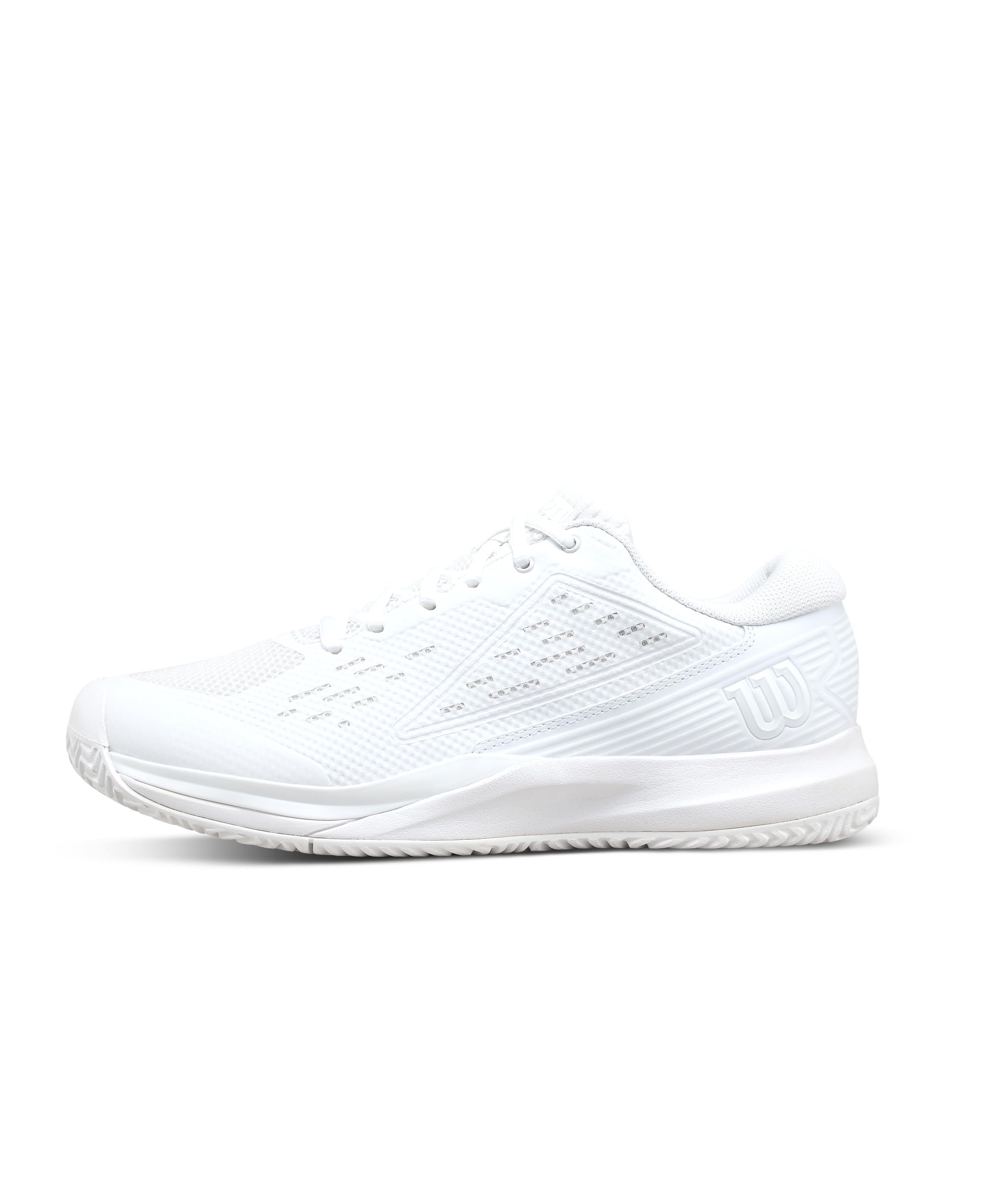
1. WILSON Men’s Rush Pro Ace Tennis Shoes
Our pick — 4.0+★ from 750+ verified ratings; the strongest balance of quality and price.
An all-court shoe whose 4D Support Chassis resists twisting when you plant and pivot.
If you want one shoe that covers recreational tennis and pickleball without a second thought, this is it. The Rush Pro Ace is the crowd favorite here at 4.0+ stars across 700+ ratings, and what wins people over is simple: it does the boring job of holding your foot steady while you pivot. Wilson builds the midsole around R-DST, a highly compressed EVA foam that puts spring back into each step, and wraps it in a 4D Support Chassis — an asymmetrical cage that runs heel to toe and resists the twisting that rolls ankles. In plain terms, when you plant for a forehand and the court tries to slide your foot outward, that chassis fights back.
Underneath sits the Duralast all-court outsole, which is the rubber layer tuned for hard-court wear. That matters because abrasive hard courts chew through softer soles, and a hard-court compound keeps the tread sharp longer. The upper is a breathable mesh that moves air while still supporting the foot, so your feet stay cooler through a long set. And the toe box is noticeably more spacious than the Rush Pro 4.0, which is a real advantage if your forefoot feels cramped in closer-cut court shoes.
What earns it the top spot
- A 4D Support Chassis that resists torsion during hard pivots — exactly the sideways stability tennis demands.
- Duralast outsole tuned for hard courts, good for players who mostly play on abrasive surfaces.
- Roomy toe box compared with the Rush Pro 4.0, so broader feet get relief.
- R-DST cushioning returns energy and softens heel landings.
- Reads as a do-everything shoe for both tennis and pickleball.
Where the fit runs out
- Long-term durability is the most debated point — some players wear through court shoes faster than others.
- The all-court build suits hard courts; it is not pitched at clay or grass specialists.
- Roomy toe box may feel loose if you prefer a pinched, race-tight fit.
Reach for this if: you play recreational tennis or pickleball on hard courts and want one stable, comfortable shoe without chasing specs.
Temper expectations if: you rack up heavy mileage weekly and want maximum outsole longevity — this is a value-tier all-court build, not a marathon trainer.
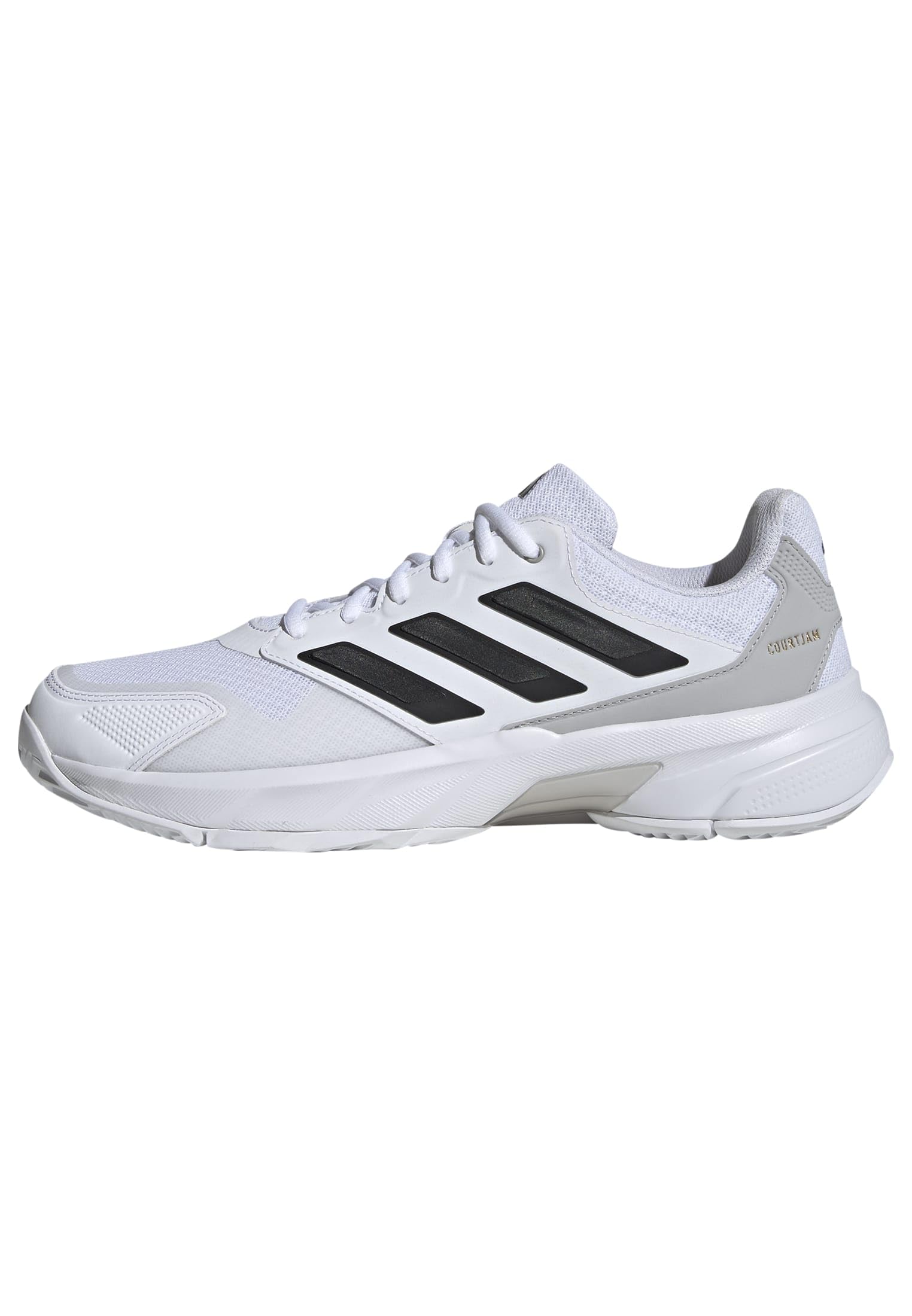
2. adidas Mens Courtjam Control 3 Tennis Sneakers Shoes – White
A cushioned hard-court shoe with an Adituff toe patch that resists scuffs from foot drag.
Here is the honest trade-off up front: this adidas shoe is the heaviest of the group by a wide margin, at 2.43 pounds. Compare that to the K-Swiss Court Express 2 at 1 pound on the package scale — a 2.4x gap in the numbers. Extra material soaks up shock and protects the toe, but you pay for it as a heavier foot to swing around. If your game is built on long, grinding rallies rather than pure speed, that weight buys you real protection.
The most useful feature for hard-court players is Adituff, a reinforced patch that wraps around the toe area. That is the exact spot where you scuff when you drag your front foot into a serve or a wide shot, so Adituff is the armor that keeps the upper from wearing thin there. The outsole is Adiwear, a durable rubber tuned for hard surfaces, so it grips and resists abrasion. And the mesh upper stays light and airy so heat escapes on hot afternoons. Bounce cushioning in the midsole adds rebound to sharp cuts and quick direction changes.
What owners agree on: comfort and stability land well — arch support gets called out, and the shoe is widely read as good value. The appearance draws a few double takes on court, which is a nice bonus for a shoe this functional.
The sizing question: opinions split, with some finding it true to size and others saying it runs small and narrow. That makes trying a half size up worth considering if you have a wider forefoot.
Best for: hard-court players who drag their toes and want a protected, cushioned shoe to absorb the beating.
Look elsewhere if: you want the lightest possible feel and prioritize speed over padding, since the extra material makes this the heaviest shoe on the list.
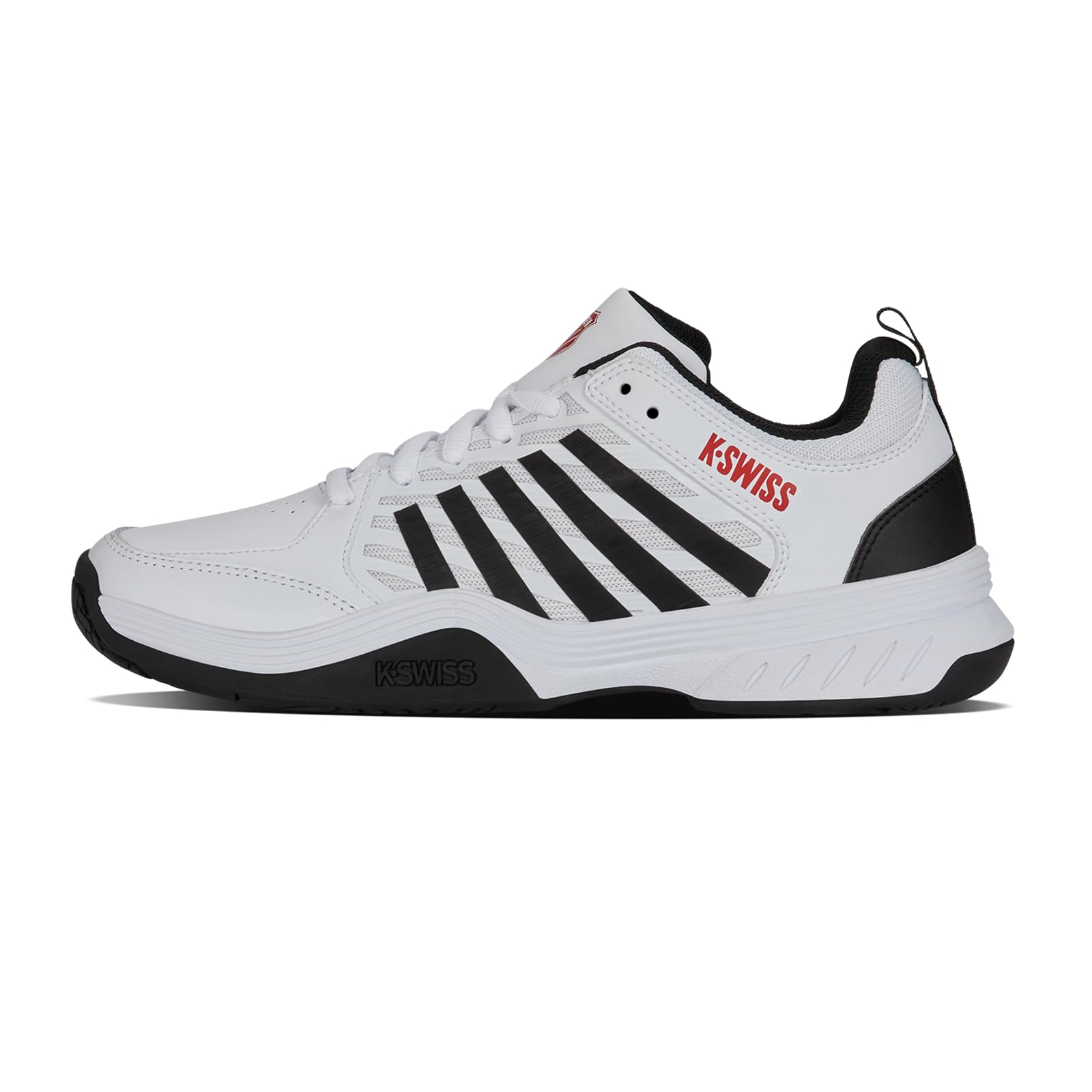
3. K-Swiss Men’s Court Express 2 Tennis Shoe
A light, firm court shoe that K-Swiss says to order a half to full size up.
The K-Swiss Court Express 2 is the lightest shoe in this set on the scales, at 1 pound on the package listing — far lighter than the adidas Courtjam Control 3 at 2.43 pounds. That low weight comes with a sleek, close fit that runs small. K-Swiss itself advises going up half a size to a full size, especially if you want extra toe room, and that guidance is the single most important thing to know before you order. Ignore it and a narrow forefoot becomes a blister.
What you get for the price is a supportive, performance-oriented build rather than a soft walking shoe. The AOSTA II high-density rubber outsole is the durable bottom layer designed to withstand regular training and match play, so it holds up to repeated court sessions. Positive feedback clusters around quality, appearance, and how the shoe supports you during lateral movements — the sideways push that defines tennis footwork.
The genuine bright spot: the value here is strong, with the shoe widely read as a good deal for a dedicated court model, and the supportive feel rewards players who want a firm, planted ride.
Where it can go wrong: comfort, fit, and durability all draw mixed opinions. The toe box can feel tight for some, and durability is the most debated issue. Treat the sizing advice seriously and this becomes a solid pick.
Pick it when: you want a light, supportive court shoe and are willing to order a half size up for toe room.
Skip the guesswork by: sizing up as K-Swiss recommends, since the close fit and tight toe box are the main reasons this one gets returned.
4. WILSON Men’s Rush Pro Lite Tennis Shoes

The roomiest Rush Pro, with a wide toe box and breathable mesh for casual play.
Where the Rush Pro Ace pulls you toward stability, the Lite leans hard toward comfort. The wide toe box is the headline — it gives your toes room to spread, and that is the detail most players notice first when they pull it on. Breathable mesh keeps air moving through the upper, and the arch technologies in the midsole add a bit of spring and flex. The curved sole rolls your foot from heel-strike to toe-off through all three phases of your stride, which makes walking the court feel smoother.
The trade-off you need to weigh is that a comfort-first build does not lock the foot down as firmly as the Ace’s chassis does. Stability here gets mixed marks, and durability is the other split point, with some players getting a few months out of a pair. If you play casual matches, drill sessions, and mixed doubles rather than all-out competitive baseline grinding, the smooth ride wins out. For social players who are on their feet a lot and value a soft, roomy fit, it is the friendlier shoe.
Why comfort-seekers like it
- A wide toe box that resists pinching on broader feet.
- Breathable mesh upper for airflow across the foot.
- Curved sole that guides a smooth heel-to-toe stride.
- Reads as strong value for a light, roomy court shoe.
What to keep in mind
- Stability is mixed — not the lockdown of the Ace’s chassis.
- Durability varies; some pairs wear sooner than others.
- Built for comfort over aggressive hard-court scrambling.
Made for: casual and social players who want a roomy, breathable shoe that feels easy on the feet.
Think twice if: you play hard competitive baseline tennis and need maximum lateral lock-down every point.
5. WILSON Rush Pro 4.5 Wide Toe Box
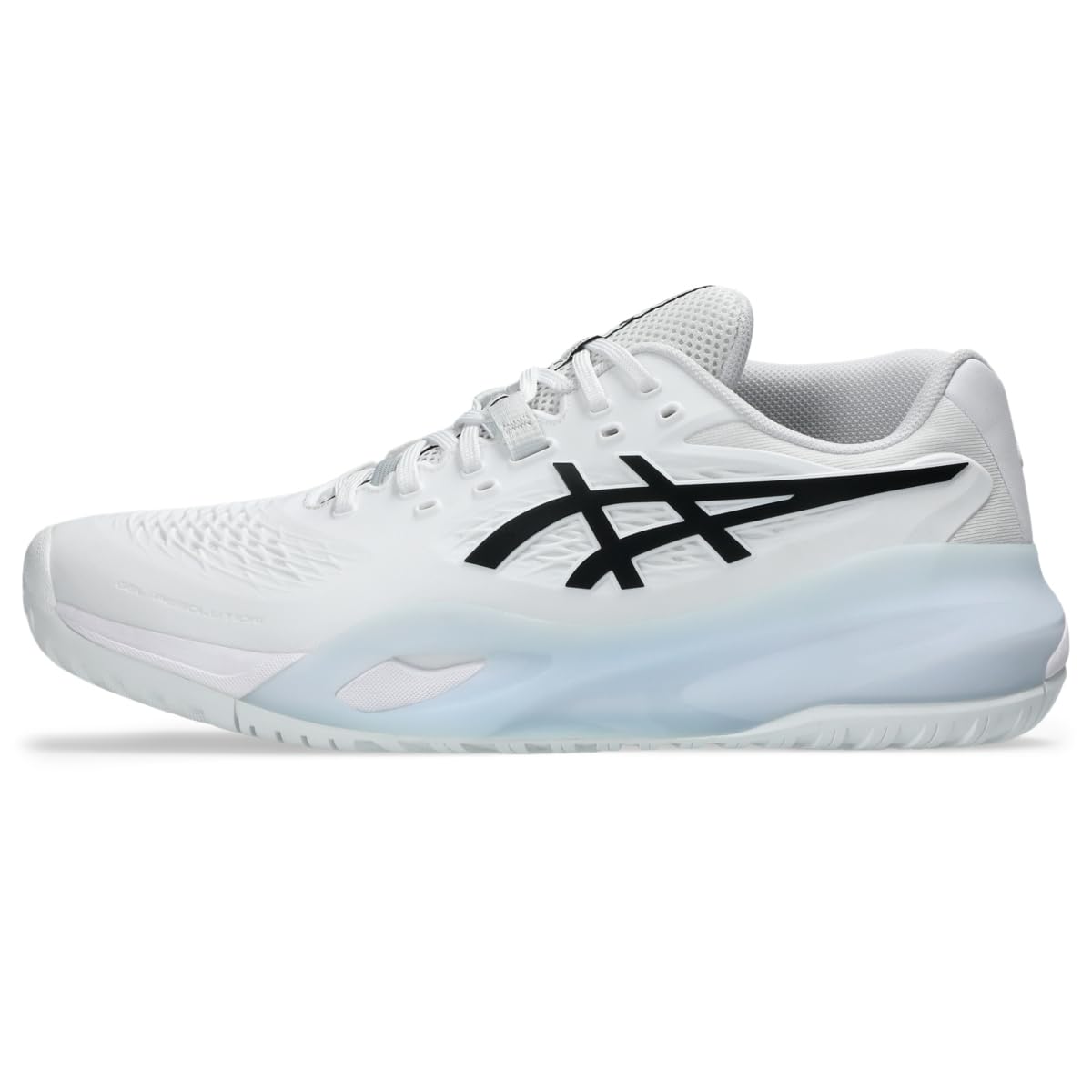
A firm baseline shoe whose DYNAWALL midsole resists rolling when you cover both corners.
The Gel-Resolution X is for the player who wins from the back of the court. Its DYNAWALL technology extends into the heel — a stability feature that stiffens the sides of the midsole so your foot does not roll when you cover both corners of the baseline. Pair that with DYNALACING, a lacing design built to hold firm when you need extra support, and the two-piece midsole that steadies your foot on landing. Positive feedback is strong on quality and stability, and it is frequently used for pickleball as well as tennis.
Where this shoe asks something of you is in the fit. It has a reputation for a tighter, stiffer feel, and the mixed feedback on comfort and width reflects that. Players who want a broken-in sensation right away may need to allow a little break-in time. The durability picture is mixed too, so heavy-mileage players should factor in how hard they play. For the committed baseliner who values a planted, locked-in ride and does not mind a firm feel, the trade is worth it.
The draw: advanced stability for players who control points from the baseline, with DYNAWALL and a two-piece midsole doing the ankle-protection work. Quality draws the strongest praise of the shoe.
The firm reality: this is not a plush shoe — fit runs tight and stiffness is a genuine characteristic. If you want immediate softness, look elsewhere; if you want lockdown, this is your shoe.
Choose it if: you are a baseline grinder who wants firm lateral stability and does not mind a snug, stiffer break-in.
Pass on it if: you prefer a soft, instantly comfortable shoe, since the firm fit and stiffness are the recurring fit note.
6. ASICS Men’s Court FlyteFoam 3 Tennis Shoes
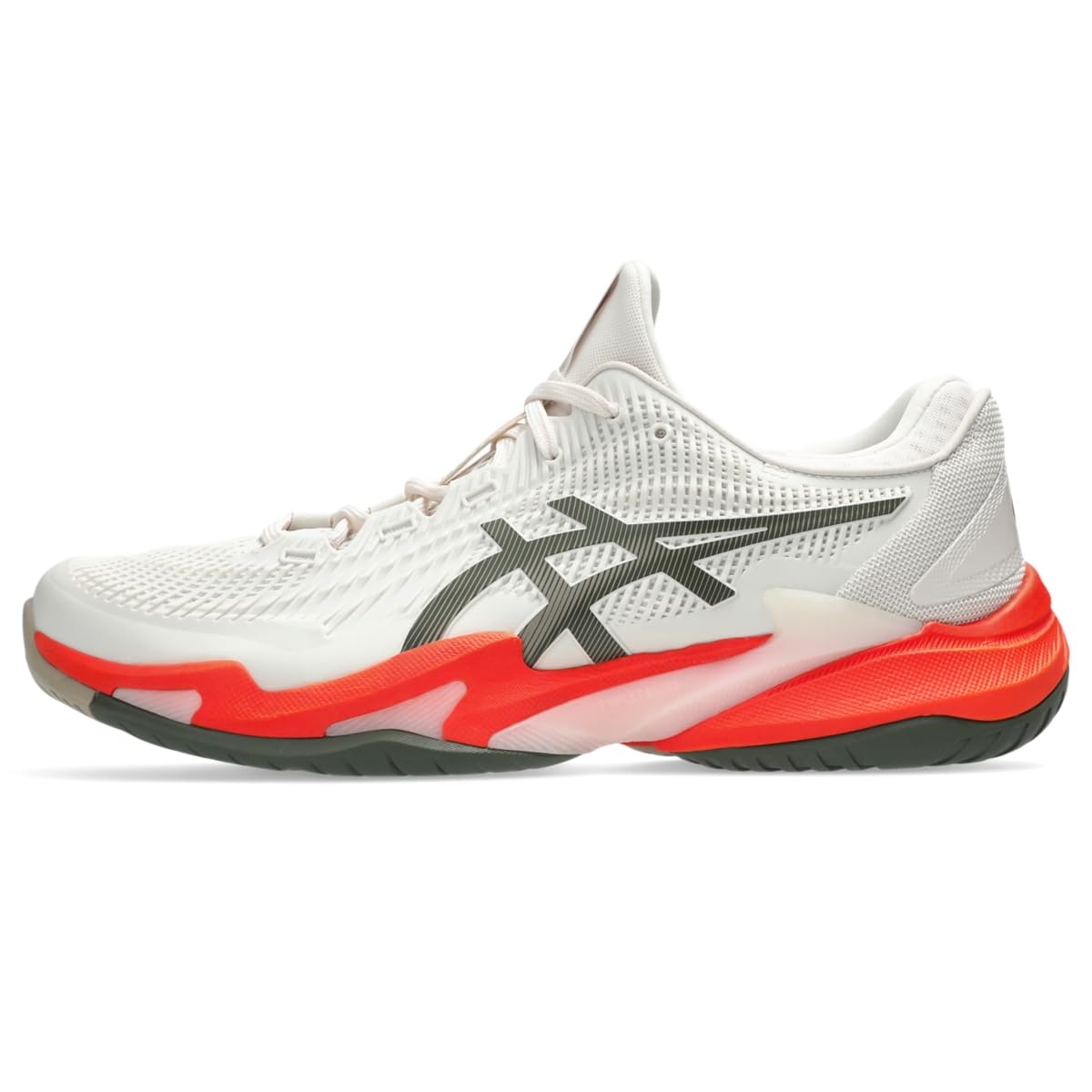
A hard-court shoe with AHARPLUS rubber and PGUARD toe and heel armor for long wear.
The Court FlyteFoam 3 is the durability play of the lineup, and it shows in the parts list. AHARPLUS is a rubber outsole compound meant to improve durability, and PGUARD adds reinforcement to the toe and heel — the two zones that wear fastest when you slide and drag. If you play often on rough hard courts and go through shoes quickly, that combination is the reason to consider this pair. Forefoot GEL technology absorbs impact and softens the feeling at footstrike, and the MONO-SOCK construction wraps the foot to improve stability.
Two more details stand out. TWISTRUSS in the midsole improves quickness and cutting motions, which helps when you change direction sharply. And the sockliner is made with a solution-dyeing process that ASICS states reduces water usage by approximately 33% and carbon emissions by approximately 45% compared to conventional dyeing — worth knowing if you care about the footprint. Ankles get a stable, supported ride, and it earns positive marks for durability and versatility. What divides buyers is fit and comfort: it runs narrow for some feet, and value opinions are split.
Strengths worth paying for
- AHARPLUS outsole plus PGUARD toe and heel armor for long wear.
- MONO-SOCK construction for a wrapped, stable feel.
- Forefoot GEL and FLYTEFOAM cushioning to absorb impact.
- TWISTRUSS midsole for quicker cuts and direction changes.
Where it splits opinions
- Runs narrow for some players’ feet.
- Fit and comfort are mixed rather than universally loved.
- Value is debated — some find it dear for the build.
Worth it for: frequent hard-court players who want reinforced durability and solid ankle support, and who have a standard-width foot.
Look elsewhere if: you have a wide forefoot or want a plush, roomy feel — the narrow fit is the main sticking point.
Know the Specs
Outsole compound and tread
The outsole is the bottom rubber and the tread pattern cut into it. On a tennis court it does two jobs: grip the surface so you do not slip, and resist the abrasion of hard courts that grinds softer rubber away. Durable compounds like Duralast, Adiwear, AOSTA II, and AHARPLUS are each designed for exactly this wear. A harder, tougher rubber lasts longer on abrasive surfaces but can feel less grippy on smooth indoor courts, so match the compound to where you actually play.
Midsole support and stability
The midsole is the foam layer between foot and outsole, and the support features built into it are what keep your foot from rolling during a sideways lunge. A stability chassis (like the 4D Support Chassis) is a midfoot cage that resists twisting, while TRUSSTIC and DYNAWALL perform a similar midfoot-support job by stiffening part of the sole. These are the parts a hard stop leans on. If you have tweaked an ankle before, put more weight on these features than on cushioning.
Upper ventilation and toe protection
The upper is the part that wraps your foot. Breathable mesh lets heat escape so feet stay cooler through long sets, which is why so many court shoes run an open mesh build. Toe protection — Adituff, PGUARD, and the like — reinforces the toe area where foot drag wears a shoe thin during serves and wide shots. If you drag your front foot, that reinforcement is the difference between a shoe lasting a season and showing holes early.
Fit, toe box, and sizing
Court shoes are built on different foot shapes, and the toe box — the front section around your toes — varies a lot. A wide toe box gives toes room to splay and suits broader forefeet but can feel loose on narrow feet. A close, performance fit gives lockdown but can pinch. When a maker advises sizing up, take it seriously: the K-Swiss Court Express 2 explicitly recommends going up half a size to a full size, and reviewers who skipped that step are the ones who complained of tightness.
Common Questions
Can I wear running shoes for tennis instead of court shoes?
Do tennis shoes run true to size or should I size up?
How long do tennis shoes usually last on a hard court?
What does a wide toe box actually do for my game?
Are these shoes suitable for pickleball as well as tennis?
What is the difference between a stability shoe and a comfort shoe?
Do these shoes work on indoor and clay courts too?
Is a wide toe box better for wide feet?
Should I worry about the weight of a tennis shoe?
Will a stability chassis stop me from rolling my ankle?
The Bottom Line
For most players shopping the top shoes for tennis, the Wilson Rush Pro Ace is the smartest place to start because it pairs a 4D Support Chassis with a hard-court outsole and a roomy toe box — the stability and durability that actually matter on the baseline. If you drag your toes and want reinforced protection, reach for the adidas Courtjam Control 3. And if durability is your priority on rough hard courts, the ASICS Court FlyteFoam 3 layers AHARPLUS rubber and PGUARD armor for the longest-wearing build on the list.
How we choose
We do not accept paid placement. Every pick is matched to a real buyer and a real use-case; we do not hands-on test units.
Sources
Specifications: manufacturer listings and product documentation. Review insights: verified customer reviews, as of November 2026. Pricing: not shown on this page (it changes often); check the current price via the retailer link.
As an Amazon Associate, Tactical Gear Guy earns from qualifying purchases. This does not affect which products we feature.