Specs are compiled from manufacturer listings and verified buyer reviews and can change over time — please confirm the key details on the product page before buying.
Hitting 12 mph is easy to advertise. Staying steady under you at that speed is the hard part. So this list focuses on one thing: which machines hold a full sprint without shaking, slipping, or running out of deck room. One note on how I built it: I matched products by flexible, human standards rather than an exact spec sheet. A machine rated 12 mph or higher qualifies here, even when the badge on the box says 12.4 or 12.5. Keep that in mind as you read, and a model number will not mislead you.
This guide is built by comparing the manufacturers’ published specifications and the patterns across verified customer reviews, so you get each pick’s real strengths and trade-offs instead of marketing spin.
You will see frame weight, motor size, belt length, and incline range spelled out in plain English for every pick, because those four things decide whether a fast treadmill feels solid or terrifying. Below you will find the picks worth your attention when you are shopping for a 12 mph treadmill.
Top Picks

How To Choose The Best 12 MPH Treadmill
A machine that hits 12 mph is a running machine, not a walking machine, and the parts have to be sized for that. The buyers who end up unhappy are almost always the ones who bought for top speed alone and ignored the deck or the motor. Here is what actually separates a solid runner from a shaky one.
Motor horsepower tells you what the belt can hold
Horsepower is how much load the motor can keep the belt moving under at speed. On this list you will see 3.0 HP up to 4.5 HP. A bigger motor generally means less strain during long runs and a belt that does not lag when your foot lands hard. If you plan to sprint intervals rather than jog, lean toward the upper end.
Deck length and belt width decide your stride
Deck length is the front-to-back running surface in inches, and a short one forces choppy steps at 12 mph. Short decks force choppy steps. Wider belts give you room to drift without catching the edge. Buyers over six feet should pay close attention here — a longer deck matters more than an extra screen feature.
Incline range is the quiet fitness lever
Incline lifts the front of the deck so you run uphill instead of on the flat. A 12% incline and a 20% incline are genuinely different workouts. More incline recruits more muscle and raises the effort without raising speed. If you are training for hills or races, this is the spec worth stretching for.
Check whether the extras come with a subscription
Some machines bundle guided workouts only with a paid membership. Others need no membership at all to run. Ask yourself upfront: do you want a trainer talking you through sessions, or a simple console? That single answer narrows the field faster than any spec.
Side-by-Side Comparison
| Model | Best For | Top Speed | Motor | Deck (L x W) | Amazon |
|---|---|---|---|---|---|
| Pro Runner X★ Best Overall | All-round home runner | 12 mph | 3.0 HP | 58″ x 20.5″ | Amazon |
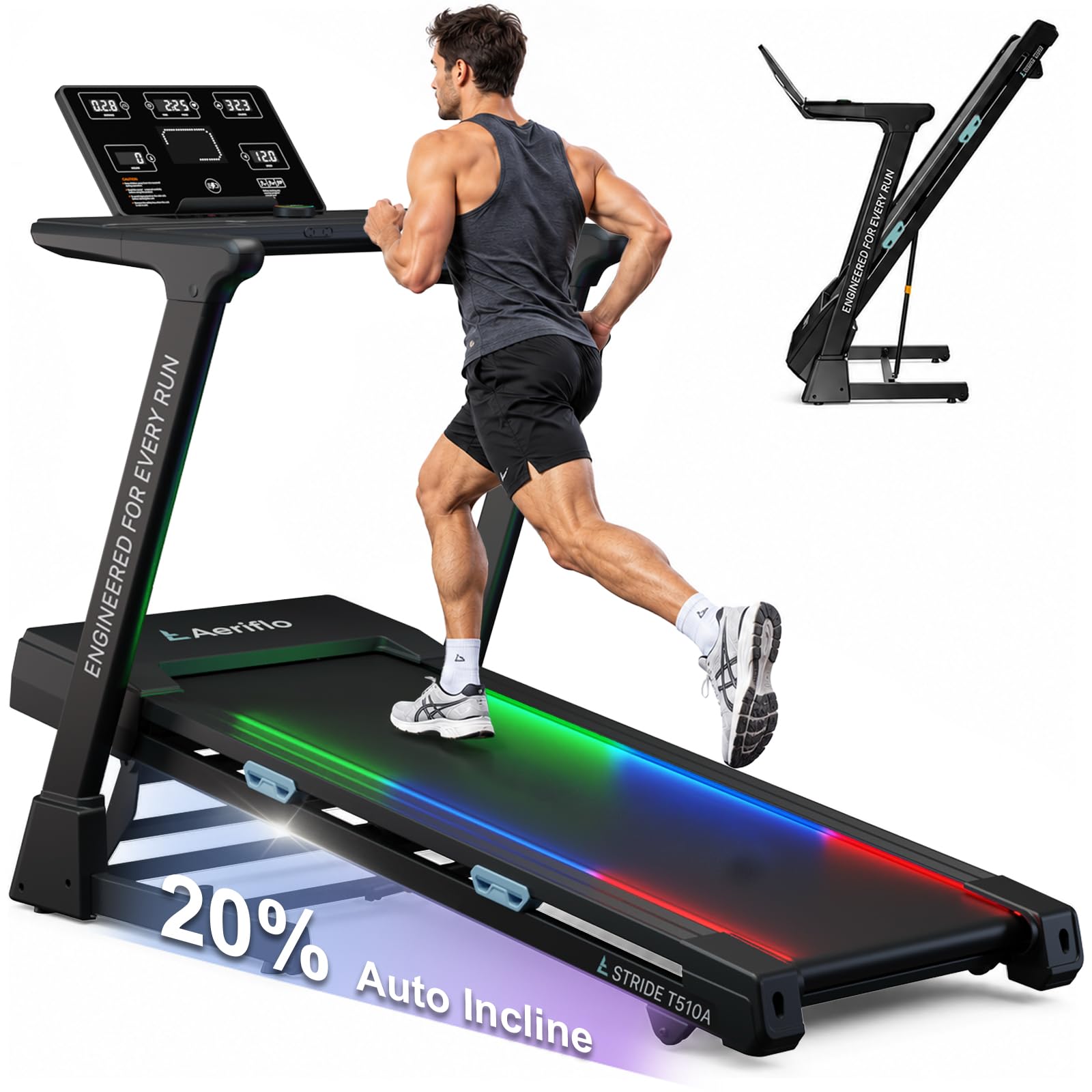
| Aeriflo X-T510ASteepest Hills | Steep-hill training | 12 mph | 3.5 HP | 55″ x 20″ | Amazon |
| ECHANFIT Heavy DutyBudget Powerhouse | Budget sprinting | 12 mph | 4.5 HP | 50″ x 20″ | Amazon |
| THERUN T15 | Apartment runners | 12 mph | 3.5 HP | 55″ x 20″ | Amazon |
| ProForm Carbon | Screen-led training | 12 mph | — | 60″ x 20″ | Amazon |
| UREVO Cyber Mega | Marathon prep | 12.5 mph | 4.0 HP | 51.18″ x 18.9″ | Amazon |
| NordicTrack T10 | Interactive household | 12 mph | 3.6 HP | 60″ x 20″ | Amazon |
| Horizon Studio Series | Interval training | 12 mph | 3.5 CHP | 60″ x 22″ | Amazon |
| NordicTrack Commercial 1750 | Connected runners | 12 mph | — | 60″ x 22″ | Amazon |
| Elite Runner X | Commercial-grade home gym | 12 mph | 4.0 HP | 62″ x 22″ | Amazon |
Detailed Reviews
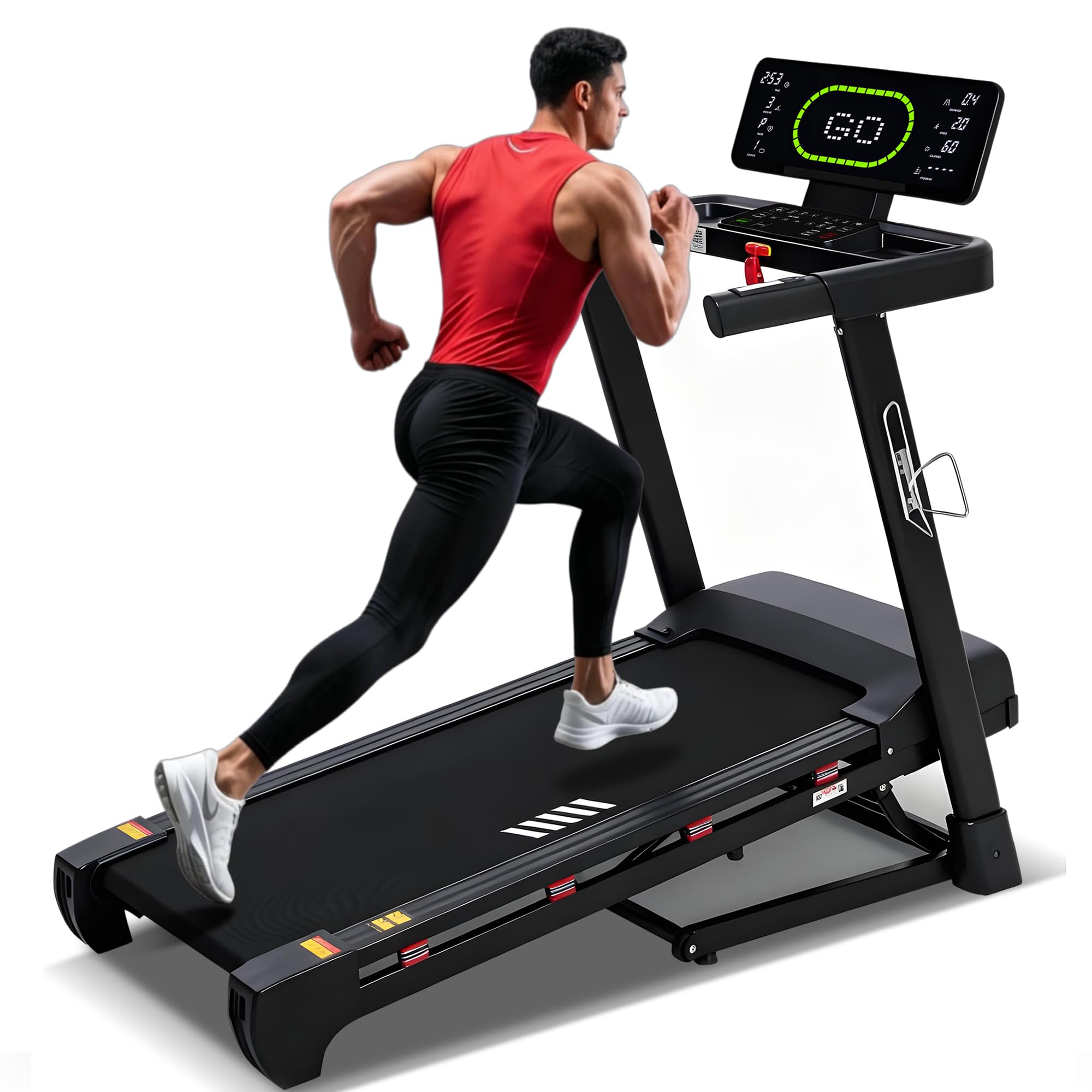
1. 3G Cardio Pro Runner X Treadmill
Our pick — 4.5+★ from 150+ verified ratings; the strongest balance of quality and price.
A folding runner that keeps its manners at full speed and holds a 350 lb rider.
The Pro Runner X is the pick that balances a compact footprint with a running surface you can actually use. It starts moving fast — the belt ramps from 0 to 12 mph in 18 seconds, which is what makes it usable for H.I.I.T intervals instead of long slow warm-ups. Your speed range runs.5 to 12 MPH with one-touch buttons, and incline goes from 0 to 15.
Underneath you is a 20.5″ x 58″ running belt and a heavy-duty Ortho Flex suspension designed to soften the first jolt of each footstrike. The 216 lb frame and 3.0 HP motor carry a max user weight of 350 lbs. Compared with the ECHANFIT in this list, it is the heavier machine — 216 pounds versus 128 pounds — and that extra steel is why it feels planted rather than springy.
What wins people over is the build and the quiet operation: it runs solid, assembles without drama, and holds up over time instead of loosening up. There is no membership requirement, so you get the built-in programs, fitness tests, and heart-rate control without a monthly bill. Folded it depends on 40″ L x 35″ W x 65″ H, so a spare corner will take it.
What makes it the top pick
- 0 to 12 mph in 18 seconds — real interval capability, not a slow ramp
- 350 lb user capacity on a 216 lb frame, so heavier runners are supported
- 20.5″ x 58″ belt with Ortho Flex suspension under the deck
- No membership required for the built-in programs and heart-rate control
- Lifetime frame warranty with 5-year parts coverage
The honest trade-offs
- Belt stability is the most-discussed weak spot — a few buyers report slipping, so check belt tension on arrival
- At 216 pounds it is not a machine you move alone up a stairwell
- 3.0 HP is the smallest motor among the strongest picks here
Reach for this if: you want one treadmill that folds away, takes a heavier runner, and still sprints cleanly between intervals.
Think twice if: your plan is daily marathon-distance training — the 3.0 HP motor asks more of itself than the bigger units here.
2. Aeriflo X-T510A Treadmill
Twenty percent incline is the number that puts this one in a different training bracket.
Most home treadmills top out their incline around 10 to 12%. The Aeriflo X-T510A goes to 20% with automatic adjustment, which turns a flat run into a climb you feel in your calves and glutes. For anyone training for hills, trails, or races with elevation, that extra range is the whole reason to look here.
It pairs that with a 12 mph top speed and a 3.5 HP motor, so the speed side is not compromised. The deck is 55″ x 20″ with a multi-layer anti-slip belt and a shock absorption system aimed at reducing impact through your knees and joints. Folded, it frees up about half your floor space, and a soft-drop hydraulic system lowers the deck hands-free so you are not wrestling it down.
The console side is generous for the tier: app connectivity through Kinomap and FitShow, wireless charging, dynamic LED lights, and Bluetooth speakers. You get a 5-year motor warranty and 2-year full machine coverage. One thing to plan for — at 178.6 pounds it is a two-person lift, and the deck and incline motor both want room behind the machine when it tilts up.
Where it earns its spot: a 20% auto incline on a 3.5 HP, 12 mph machine covers hill work and sprint work without asking you to buy two treadmills.
What to weigh first: that incline mechanism is one more moving part under load, so keep the deck clear and follow the lubrication schedule in the manual.
Built for hill chasers: if your training plan has climbs in it, this is the machine on the list that can simulate them properly.
Not the pick if: you only ever run flat — you would be paying for incline range you will not touch.
3. ECHANFIT Heavy Duty Treadmill
The biggest motor on this entire list sits on one of the lightest frames.
A 4.5 HP motor is what you find on machines aimed at sustained fast running, and here it is paired with a 500 lb capacity. That is the highest weight rating in this lineup. Speeds run 0.6 to 12 MPH with 20 levels of automatic incline, so you can build a full hill interval session without touching a dial mid-stride.
Where it differs from the Pro Runner X is sheer mass. This one weighs 128 pounds against the Pro Runner X’s 216 pounds, and its motor is the larger of the two at 4.5 HP versus 3.0 HP. A lighter frame is easier to move and fold — the folded footprint is 39″x30″x53″ — but it also means the machine leans more on its 8 spring dampers and 6 silicone cushions to soak up a hard landing.
The deck measures 50″ x 20″, the shortest running surface among the top picks here. Tall runners should measure their natural stride before committing. What wins buyers over is the build for the money — sturdiness and assembly come up as the standout positives, with quality drawing the most praise of any aspect. You also get 36 preset programs, Rounds Tracking that logs laps like a 400 m track, and Bluetooth speakers.
The spec that does the work: 4.5 HP driving a 500 lb-rated deck is genuinely unusual at this end of the market, and it means the belt keeps pace under a heavy runner.
The thing to know: 50 inches of deck is the tightest here. If you are tall or take long strides, a 55″ or 60″ belt will feel better at 12 mph.
Pick it for raw power per dollar: the largest motor and highest weight rating here, on a frame you can still fold and roll.
Pass if your stride is long: the 50″ deck asks shorter steps at top speed.
4. THERUN 20% Auto Incline Treadmill
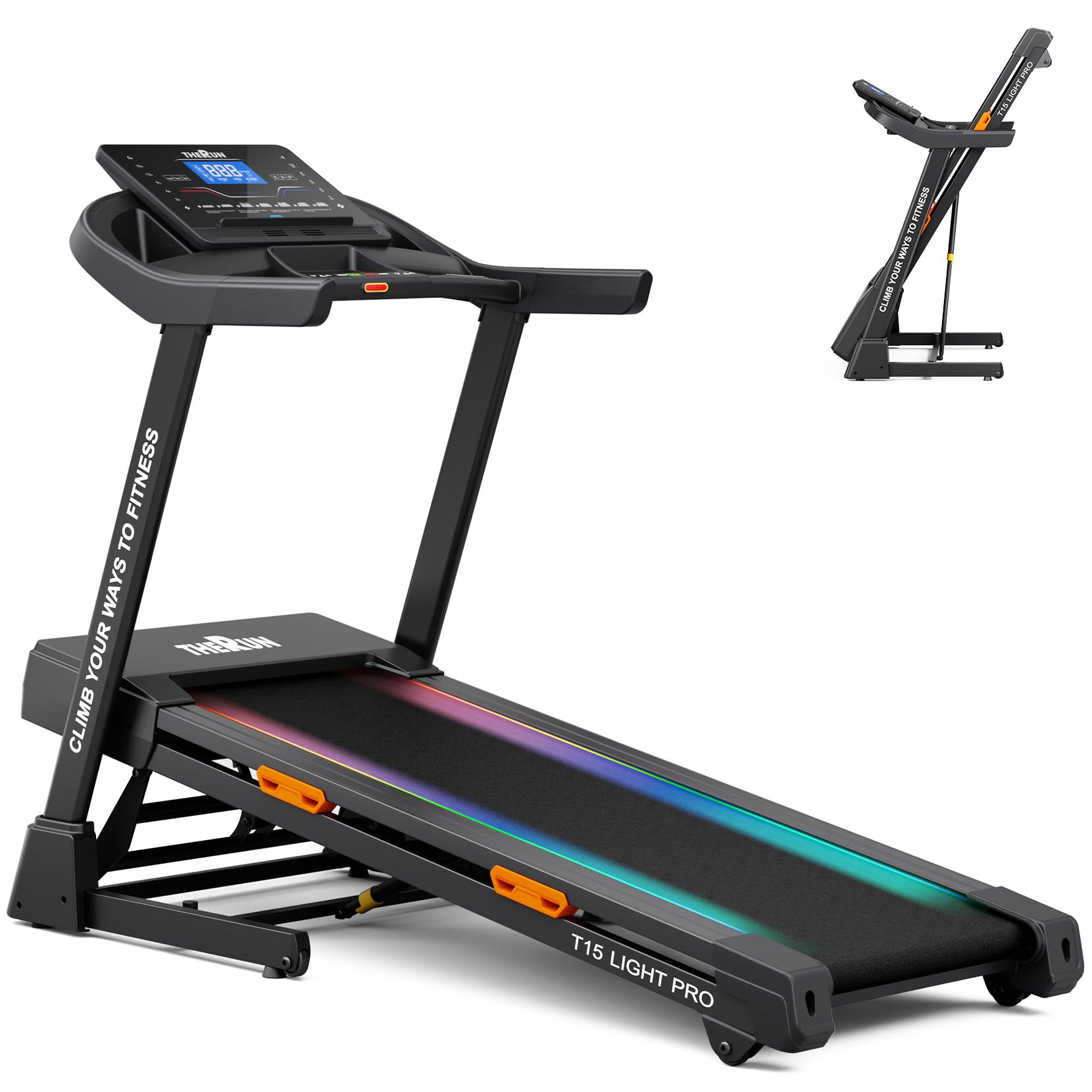
Built for people in tight spaces who still want a 12 mph belt and a real incline.
The THERUN T15 runs a 3.5 HP motor up to 12 mph on a 55″ x 20″ belt, and it handles runners up to 6’3″ and 300 lbs. If you live in an apartment, the part that matters most is that it moves and stores without a fight — owners consistently bring up its compact size and how easily it tucks away.
Incline goes to 20% automatically, the steepest of the mid-range picks. The console is the busy end of the spectrum: LCD display, built-in cooling fan, wireless charging, Bluetooth speakers, and cup holders. Side LED lights shift colour with your pace — green below 4 MPH, blue between 4.1 and 7.5, red above 7.5 — which is a small safety cue when someone walks into the room mid-sprint.
Three apps connect: Zwift, FitShow, and Kinomap. What buyers respond to most is the overall build quality and the reliability of the thing — it starts, it runs, it does not need fiddling. Setup is close to plug-and-play. The recurring gripe is the incline on long sessions, which some find slow to respond compared with the speed controls.
The right buy if: you are in an apartment or a small room and want a 12 mph, 20% incline machine that stores out of the way.
Look elsewhere if: you want a simple dial-only console — this one comes with LEDs, apps, and a fan to learn.
5. ProForm Carbon Treadmill

A 60-inch deck and a trainer that reaches over and changes the speed for you.
ProForm built this one around the iFIT ecosystem. With a membership, trainers control your speed and incline automatically, and the 7″ LCD display shows your miles, calories, and pace. A phone or tablet on the device shelf can drive the session instead. Sync works with Strava, Garmin, and Apple Health.
Speed reaches 12 mph and incline runs 0 to 12%. The running surface is 60″ x 20″ — the longest deck in this lineup alongside the NordicTrack T10 — and ProShox cushioning under the belt is there to soak up the landing. ActivePulse can adjust speed and incline using a Bluetooth heart-rate monitor (sold separately) so you stay in a target zone.
The frame folds and rolls away on a hydraulic foot bar. Buyers rate the build solid under running and describe it as quiet and easy to put together, and quality is far and away the most-praised trait. The incline is the most-discussed weakness — it is slower to respond than the speed. Factor in the membership cost if you want the auto-adjust features.
The iFIT angle: a 60″ deck plus automatic trainer control is a strong hook if you want to be pushed rather than plan your own sessions.
The honest catch: the guided workouts and auto-adjust need an iFIT membership. Without it, you have a plain 12 mph treadmill with a modest LCD.
Choose this one if: you will use iFIT and want a long deck with a trainer controlling pace.
Skip the membership path if: you would rather not pay monthly — the base console is serviceable but basic.
6. UREVO Cyber Mega Treadmill
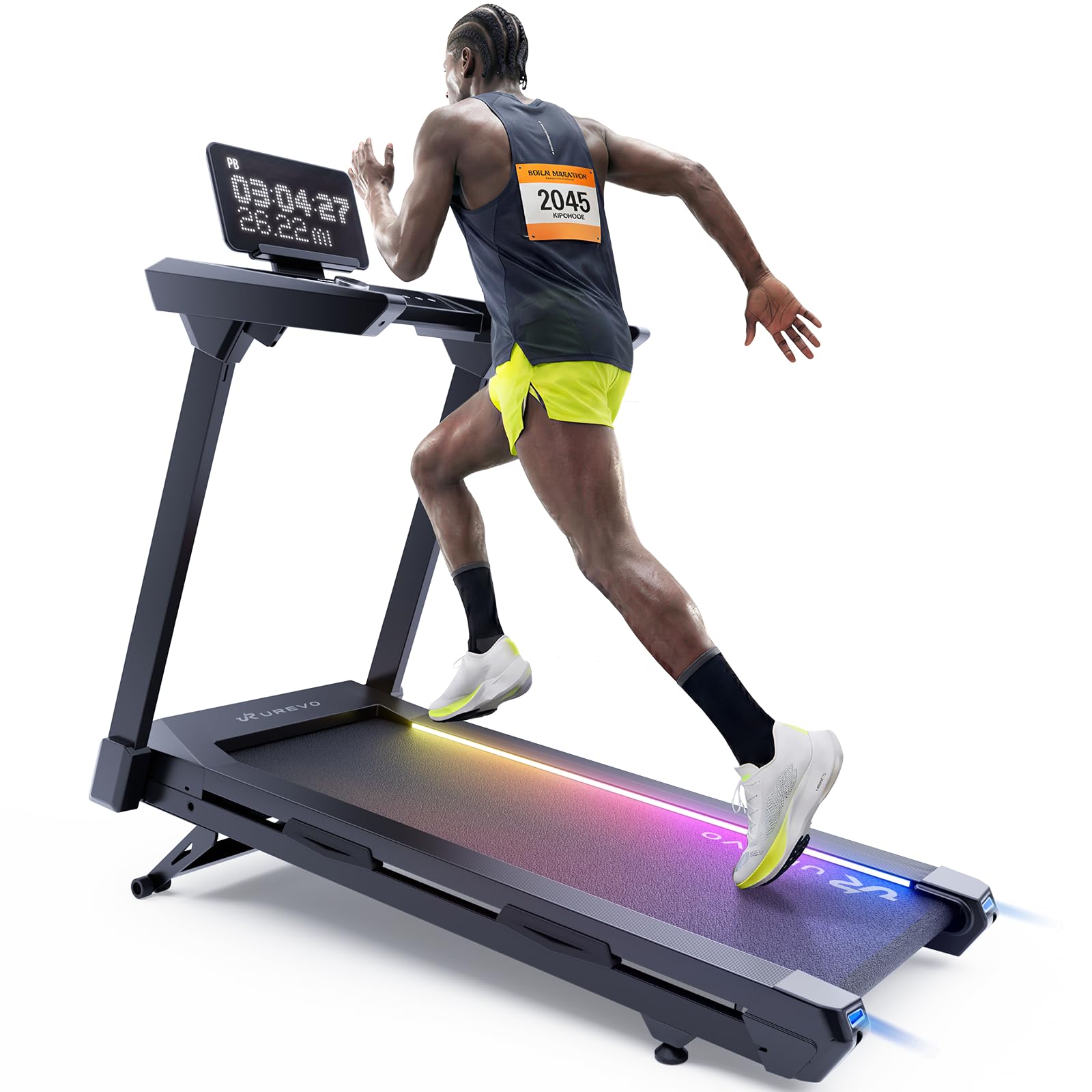
The only machine here that tops 12 mph, with a mode built around an actual marathon route.
UREVO’s headline speed is 12.5 mph, which edges past the 12 mph cap on most of this list. Its real distinction is the training mode: its Boston Marathon mode pairs the real course route with pace alerts, rankings, and a 12% auto incline for hill simulation. An AI coach app calls out your speed, distance, and pace as you go.
The motor is the interesting part. It uses a dual brushless 4.0 HP design, and UREVO claims this brushless design lasts ten times longer than traditional brushed motors. Treat that as the manufacturer’s claim rather than a measured figure. The practical payoff is quieter running, which is what buyers praise most beyond the build quality.
Be realistic about the deck: 51.18″ x 18.9″ is the narrowest running surface in this lineup. It suits a shorter, more controlled stride. Owners do mention mobility as the most-discussed caveat, and at this size that is worth checking against your storage plan. The frame folds down to a 62.2″ x 30.31″ x 10.83″ footprint when packed away.
For race prep: if you are training toward a specific marathon and want route simulation plus the fastest belt here, this is it.
Second-guess it if: you are broad-shouldered or have a long stride — 18.9″ of belt width is the tightest on the list.
7. NordicTrack T Series T10 Treadmill
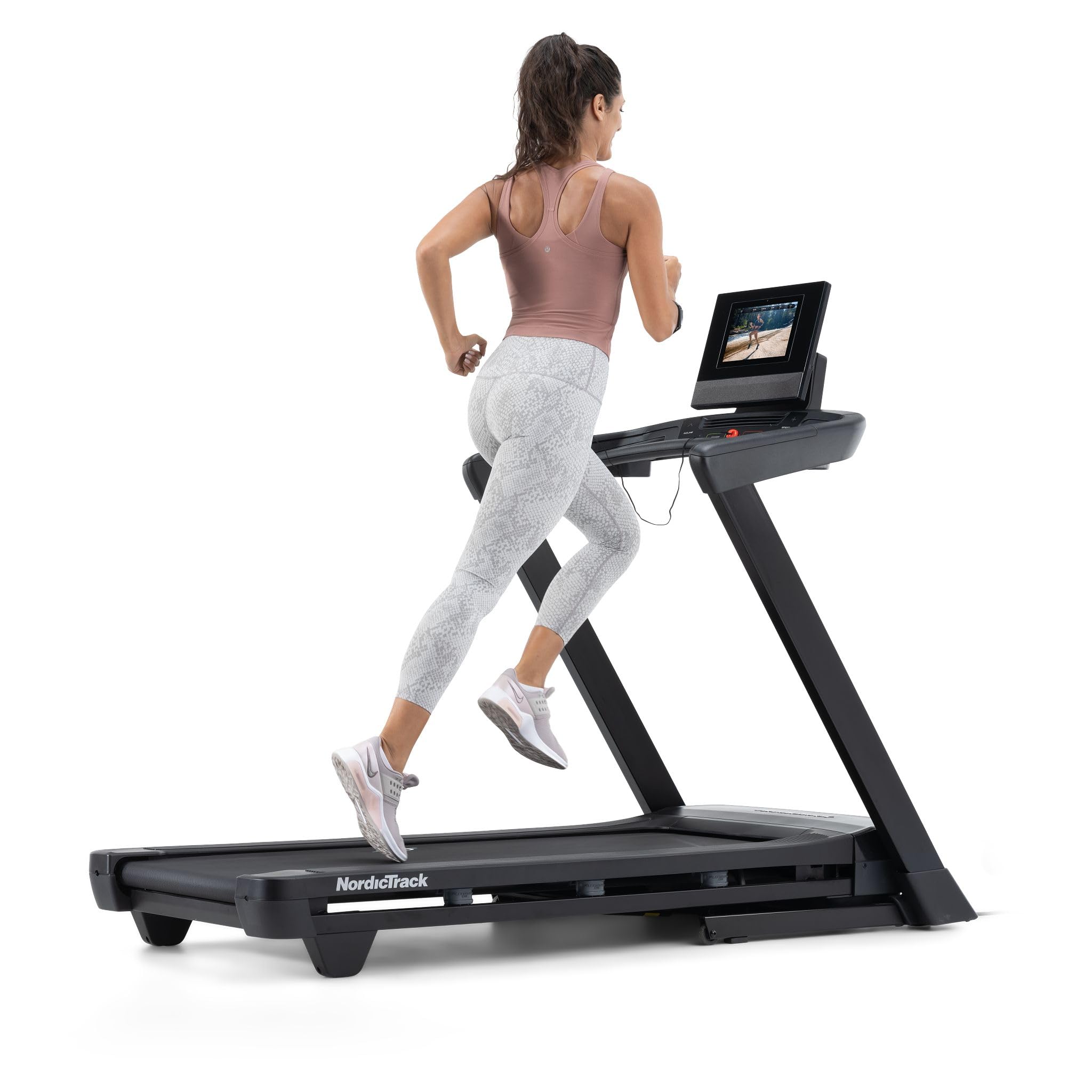
A 10-inch tilting screen, a 60-inch deck, and a cushioning system you can tune.
The T10 hits 12 mph with a 3.6 HP motor and a 0 to 12% incline. The 60″ x 20″ deck gives you real room to run, and the foldaway frame rolls out of the way between sessions. Its 10″ touchscreen tilts so you can follow a class off the machine, not just on it.
SelectFlex cushioning is the standout feature: you can dial it from soft to firm to match how your legs feel. That is unusual at this tier and worth real consideration if you have sensitive knees or just prefer a firmer push-off. An iFIT membership open up auto-adjusting speed and incline, streaming, and the AI coach, and the machine syncs with Strava, Garmin Connect, and Apple Health.
Quality is what carries this machine — it has the largest owner base on this list, and the build and appearance draw the bulk of the praise. Assembly splits opinion: some find it simple, others find it wants two people. Setup day is the moment to line up a helper rather than a spare hour.
The reasons it sells so widely
- 60″ x 20″ deck with a 12 mph top speed and a 3.6 HP motor
- SelectFlex lets you switch cushioning between soft and firm
- 10″ tilting touchscreen for on- and off-machine classes
- Foldable frame with a foot-bar release
Before you buy
- Assembly may require a helper — a common dividing line in feedback
- Touchscreen and auto-adjust features need an iFIT Pro membership
- This is the larger footprint end of the folding category
Matches you best when: more than one person in the house will use it — the tunable cushioning and large screen suit mixed tastes.
Less ideal if: you want no subscriptions and a plain console to understand at a glance.
8. Horizon Fitness Studio Series Treadmill

Twenty-two inches of belt width is the sort of spec you feel after mile one.
The Horizon Studio Series runs a 22″ x 60″ running surface with 3-zone Variable Response cushioning, which gives side-to-side room that most home treadmills do not. Speed goes 0.5 to 12 mph across an incline range of 0 to 15%. The frame is rated to 350 lbs.
QuickDial controls are the star of the console: you shift speed and incline without leaving your stride, and the jump between intervals stops feeling like a fumble. There are Interval Keys, one-touch speed, and incline buttons, plus 5K, Calorie, Distance, Fat Burn, Hill Climb, Manual, and Max Heart Rate programs. A RapidSync 3.5 CHP continuous-duty motor drives the belt, and Horizon claims it changes speed and incline 33% faster.
No subscription is required for anything here, which is the quiet advantage over the iFIT machines on this list. Buyers call it a gym-quality unit and praise the performance and sturdiness. Assembly splits people — some breeze through, others call it a long job — so budget the afternoon. The speed control is the most-discussed divergence: fast and responsive for most, occasionally needing a second input.
What the width buys you: 22 inches of belt means you can drift and recover without clipping the edge at 12 mph.
What to know before delivery: the assembled frame measures 76″ x 37″ x 63″, so measure your room with the deck down, not folded.
The pick for wide strides: broad runners and interval trainers who want 22″ of belt and no monthly fee.
Think hard if: you are short on floor space — this is one of the larger footprints here.
9. NordicTrack Commercial 1750 Treadmill

The 16-inch pivoting screen and the downhill decline range are what set it apart.
Most treadmills stop at flat. This one goes from a 12% incline down to a -3% decline, so you can run downhill and train the muscles that climbing ignores. Speed tops out at 12 mph, and the deck is a wide 22″ x 60″ — the same width as the Horizon, wider than the 20″ decks on most of this list.
The 16″ pivoting touchscreen is the largest display in this lineup. It swivels so you can follow yoga or strength classes off the machine, and with an iFIT Pro membership it streams shows and movies. RunFlex cushioning handles shock absorption, and SmartAdjust plus ActivePulse adapt speed and incline in real time during guided sessions.
This is the most connected machine here, and it expects you to be a subscriber. The iFIT Pro membership open up auto-adjust, streaming, and the AI coach, and the machine syncs with Strava, Garmin Connect, and Apple Health. Folded it depends on 37 x 77 x 65 inches. Check your ceiling clearance before you commit.
For the connected runner: a 16″ screen, downhill decline range, and 22″ of belt width for those who train with a subscription.
Move on if: a monthly membership is a deal you will not sign — the best parts of this machine live behind it.
10. 3G Cardio Elite Runner X Treadmill

The one machine here that behaves like club equipment, and the heaviest by far.
At 386 pounds, this is a fixed, non-folding machine with a 22″ x 62″ platform — the longest and widest deck on this list. A club-rated 4.0 HP motor with high torque moves it, and the max user weight is 400 lbs. It ramps from 0 to 12 mph in 18 seconds like its Pro Runner X sibling, with 1-touch speed from.5 to 12 MPH and elevation settings up to 15%.
That extra deck and frame weight are the entire point. Under a fast stride there is almost nothing to flex, and the Ortho Flex Shock Suspension under the platform is tuned for walking and running alike. A low 7.5-inch step-up height means you do not have to climb onto it. The 10.1″ LCD is modest next to the screens on the NordicTrack picks, but it keeps you informed without demanding a subscription — no membership is required.
Owners describe it as gym-quality from day one and note it runs quiet for its size, with long, sturdy hand rails. It assembles without much trouble and the operation is straightforward. The honest hesitation is value — some owners feel the asking price is steep for what is essentially a home machine, and it is the largest financial commitment here.
The commercial-grade case: 400 lb capacity, 4.0 HP of club-rated torque, and the longest deck here at 62 inches make this the choice for serious, heavy, high-mileage runners.
The weight you can’t fold: at 386 pounds and non-folding, this is a permanent installation. Plan the room before the delivery truck arrives.
Anchors a dedicated home gym: if you have the floor space and train hard and often, this is the machine that will not ask for mercy.
Not for you if: you rent, move often, or need a machine you can fold away — the fixed frame makes that impossible.
Know the Specs
Motor horsepower and how it relates to sprinting
Horsepower measures how much load the motor can sustain while the belt is moving. At 12 mph the belt has to keep pace with a real running stride, so an undersized motor feels like it sags when you land. On this list you will see 3.0 HP up to 4.5 HP. Larger motors tend to last longer under heavy use and stay quieter at speed. If you sprint in intervals rather than jog, this is the number to raise.
Deck length, belt width, and the room your stride needs
Deck dimensions are the running surface — length in inches front to back, width side to side. At 12 mph your feet move fast, so a longer deck prevents choppy, shortened steps and a wider deck keeps you from catching the edge. Runners over six feet should weight deck length over extra console features every time.
Incline percentage and what it changes
Incline lifts the front of the deck so you run uphill instead of on the flat. An incline range of 12% is common; a 20% range is a steeper hill and more work per step. More incline recruits more muscle and can raise calorie burn, but you will feel it in the first five minutes. Some machines also include a negative decline, which simulates downhill and works muscles plain incline leaves alone.
Subscription-free versus connected consoles
Some machines, like the Horizon and the 3G Cardio units, need no membership to use the built-in programs. Others, like the NordicTrack and ProForm options, open up guided workouts with automatic speed and incline only with a paid membership. Both are legitimate choices. Decide if you want a trainer deciding your pace or a simple console you set yourself.
Common Questions
Can a home treadmill really hold a 12 mph sprint without shaking?
How much deck length do I need at 12 mph?
Is a 20% incline better than a 12% incline for training?
Do I need a subscription to use these treadmills?
What does the belt capacity mean for a heavier runner?
Can I fold these treadmills and store them upright?
Will a 12 mph treadmill be too loud for an apartment?
How much room does a 12 mph treadmill need behind the deck?
Is a brushless motor better than a brushed motor on a treadmill?
Can I sync a treadmill workout to Strava or Garmin?
The Bottom Line
For most people shopping a 12 mph treadmill, the 3G Cardio Pro Runner X is the sensible center of this list — a 216 lb frame, a 350 lb user capacity, and an 18-second ramp to 12 mph that holds up in interval work, all with no membership required. If hill training is your goal, the Aeriflo X-T510A goes where the rest stop at a 20% auto incline. And if you want a machine that behaves like club equipment and you have a permanent spot for it, the 3G Cardio Elite Runner X with its 400 lb capacity and 62-inch deck is the one to reach for. Whichever you pick, check the deck length first — at 12 mph, your stride will tell you very quickly whether you got it right.
How we choose
We do not accept paid placement. Every pick is matched to a real buyer and a real use-case; we do not hands-on test units.
Sources
Specifications: manufacturer listings and product documentation. Review insights: verified customer reviews, as of November 2026. Pricing: not shown on this page (it changes often); check the current price via the retailer link.
As an Amazon Associate, Tactical Gear Guy earns from qualifying purchases. This does not affect which products we feature.