Specs are compiled from manufacturer listings and verified buyer reviews and can change over time — please confirm the key details on the product page before buying.
Stripping wallpaper is a two-step job, and almost every frustrating afternoon comes from skipping step one. You need to break the surface so heat or water can reach the adhesive underneath — then loosen that glue. The picks below cover both halves of that job, from steamers that do the heavy lifting to scoring tools that make the steam actually work. If you want the short answer: the BLACK+DECKER 2400 W steamer is the crowd favorite at 4.5+ stars across thousands of owners, and it earns that spot on a 4 litre tank and a large steam plate.
This guide is built by comparing the manufacturers’ published specifications and the patterns across verified customer reviews, so you get each pick’s real strengths and trade-offs instead of marketing spin.
Tank size, plate size, and blade shape each decide how a tool behaves on a real wall, so you can match the pick to the room you are stripping.
Below are seven picks — four steamers, two scorers, and one pole scraper — with the specs and trade-offs that matter for each.
Top Picks


How To Choose The Best Wallpaper Removal Tool
The mistake most people make is buying one tool and expecting it to do everything. Wallpaper removal is really two jobs: breaking the sealed surface, then softening the paste behind it. A steamer alone fights a vinyl coating that steam cannot get through. A scoring tool alone loosens nothing. Plan for both, even if you buy them separately.
Steam or score — which one do you actually need?
Steam does the loosening. Hot vapour softens the adhesive so the paper lifts in sheets instead of shreds. Scoring does the access work — tiny perforations let that vapour reach the glue in the first place. If your walls are covered in vinyl, multi-layered, or painted-over paper, you need a scorer before the steamer. Plain porous paper sometimes gives way to steam on its own.
Match tank size to the room, not the listing photos
A bigger tank means fewer refill breaks. The BLACK+DECKER carries a 4 litre tank rated for up to 60 minutes of runtime, while the IRONMAX holds 1 gallon and is rated for up to 180 minutes. That difference decides whether you finish a hallway in one session or keep stopping to top up. For a single small bedroom, a shorter runtime is fine. For a whole house, runtime is the spec that matters most.
Plate size and hose length control your reach
The steam plate is the flat pad you press against the wall. A larger plate covers more surface per press, which saves time on big flat walls. Hose length decides how far you can roam from the unit — a 10 foot hose lets you work along a wall without dragging the tank every few feet. Both the Moccha and the Goplus use a 10 foot hose, and the IRONMAX pairs 10 feet of hose with an 11 inch by 8 inch plate.
Blade shape matters more than blade size on ceilings
Overhead work is where most wallpaper jobs go wrong, because a flat scraper forces your wrist into an awkward angle. A bent chisel blade keeps the edge flat against a ceiling while your hands stay below it. The CHILI TOOLS scraper uses a 7 inch bent stainless blade at 1.8MM thickness for exactly this. If your job is walls only, a straight blade is easier to control.
Side-by-Side Comparison
| Model | Best For | Type | Tank / Blade Size | Runtime or Reach | Amazon |
|---|---|---|---|---|---|
| BLACK+DECKER 2400 W Steamer KX3300T-GB★ Best Overall | Whole-room stripping | Steamer | 4 litre tank | Up to 60 mins | Amazon |
| IRONMAX Wallpaper SteamerTop Performer | Large projects | Steamer | 1 gallon tank | Up to 180 mins | Amazon |
| Goplus Wallpaper Steamer | Value steaming | Steamer | 4.5 litres | 10 ft hose | Amazon |
| Moccha Wallpaper Stripper | Portable home use | Steamer | Water reservoir | 10 ft hose | Amazon |
| Zinsser PaperTiger 3-Head | Scoring before steam | Scoring tool | 3 heads, steel teeth | 8.75″L x 3″W | Amazon |
| Hyde 33210 Scoring Tool | Quick perforation | Scoring tool | 96 stainless teeth | — | Amazon |
| CHILI TOOLS 7″ Bent Chisel Scraper | Ceilings and overhead | Pole scraper | 7″ blade, 1.8MM | Fits extension poles | Amazon |
Detailed Reviews
1. BLACK+DECKER KX3300T-GB Wallpaper Steamer
Our pick — 4.5+★ from 4,500+ verified ratings; the strongest balance of quality and price.
A four-litre tank and a wide steam plate that carry a whole wall without a refill break.
The tank is the reason this one wins. Four litres of water is rated for up to 60 minutes of continuous steam, which is enough to work across a full room before you stop to top up. The large steam plate spreads that vapour over a bigger patch of wall, so each press covers more paper and you spend less time repositioning the pad. It handles vinyl, multi-layered, painted, and textured coatings — the stubborn finishes that defeat cheap units.
Weight lands at 5.4 pounds, and the comparison here is a real one: the IRONMAX steamer tips the scales at 4.4 pounds. That is a full pound less to haul up a ladder, and if you are working ceiling-height wallpaper the difference in your arm is noticeable. The BLACK+DECKER still beats it on tank size for medium rooms, since 4 litres vs 1 gallon is the trade you are making.
Two safety systems are worth calling out. Safety release valves stop the unit overheating, and a boil dry cut-out protects the element if the water runs low — the kind of protection that saves a steamer from an early grave when you are focused on the wall and forget the tank. Buyers report it strips vinyl and painted paper without stalling, which is why it holds 4.5+ stars across thousands of reviews.
What earns its place on the list
- 4 litre tank rated for up to 60 minutes of runtime per fill
- Large steam plate covers more wall per press
- Handles vinyl, multi-layered, painted and textured coatings
- Boil dry cut-out and safety release valves protect the element
Worth knowing before you order
- At 5.4 pounds it is a pound heavier than the IRONMAX steamer
- Needs a socket within reach for the whole session
Take this one home: you have a whole room or several walls to strip and want one machine that carries the session.
Think twice: you are doing ceilings only — the CHILI TOOLS pole scraper reaches overhead far more comfortably.
2. IRONMAX Wallpaper Steamer
Three hours of steam from a single gallon — the pick for a house full of old paper.
If your project is a whole house rather than one room, the runtime math decides it. A 1 gallon tank generates up to 180 minutes of steam, and the tank is engraved with low and high water lines so you can see exactly where you stand. Fill it once and you can work through a long afternoon instead of babysitting the reservoir. The steam hits 212°F, which is the point where wallpaper paste softens and lets go.
The plate measures 11 inches by 8 inches, and it sits on 10 feet of cool-touch hose. Ten feet of reach from a unit parked in the doorway is what lets you walk along a wall from ceiling to floor without relocating the machine. Both the tank and the plate carry cold-touch handles marked in red, which is a practical touch when the rest of the unit is hot.
Quality is the thing that gets talked about with this steamer, and the functionality backs it up. Odd as it sounds, the size of the unit is part of that reputation — at 4.4 pounds it is a pound lighter than the BLACK+DECKER, so holding the plate in one hand while you tear paper with the other stays comfortable for longer stretches. The maker bills it as a one-hand plate, two-hand job setup.
The honest trade-off: ease of use gets mixed reactions, mostly around the learning curve of managing heat and water level on a big tank.
Who this is for: anyone with a multi-room project where refills would otherwise eat the day.
Buy it if: runtime is your number one concern and you want the tank to outlast your energy.
Look elsewhere if: you want a lighter, faster warm-up for a single small room.
3. Moccha Wallpaper Stripper

Tap water, no chemicals, and two handles that make the tank easy to carry room to room.
Here is the appeal in one line: you fill it with tap water, wait, and the machine produces pressurised high-temperature steam that loosens the adhesive without a drop of chemical stripper. That is a real advantage in a bedroom or a nursery where you would rather not have solvent fumes hanging in the air. The working method is simple — hold the steam plate against the paper for about 10 seconds and the paper starts to give.
Two handles set this apart from most of the class. One sits on the reservoir, one on the steam plate, so you can carry the unit and control the pad without gripping a hot surface. It weighs 5.21 pounds and measures 14 x 13 x 10 inches, which puts it in the same size bracket as the BLACK+DECKER at 12.6 x 13.19 x 9.45 inches. The Moccha is the slightly larger footprint of the two, and it runs on 120 volts through a 10 foot hose.
Heating takes about 20 minutes, so plan your first cup of coffee around the warm-up rather than the other way round. Once it is up, the effectiveness is what carries this steamer — it goes through layers rather than stalling on the top coat. When the reservoir runs low, a safety power-off device cuts the heat, and the unit resets itself after it cools and produces steam again. That reset behaviour is worth knowing so a pause does not read as a breakdown.
The catch: that 20-minute warm-up is the slowest start on this list, and you will feel it if you are squeezing a small job into a short window.
Worth a look if: you want a fume-free stripper you can move between bedrooms and kitchens without a helper.
Give it a pass if: you want steam in five minutes flat and cannot spare the heat-up time.
4. Goplus Wallpaper Steamer

The biggest tank on the list outside the IRONMAX, with a water gauge you can read at a glance.
A 4.5 litre tank puts this steamer above the BLACK+DECKER’s 4 litres, and the visible exterior water level indicator means you never have to guess when to refill or when to stop. That gauge is a small thing that saves a lot of frustration on a long wall. You fill it with clean — preferably hot — water, wait roughly 25 minutes for heat-up, then hold the plate on the wall for about 10 seconds per section.
It reaches 212°F, the same working temperature as the IRONMAX, which is the threshold where adhesive releases. The 10 foot steam hose and rectangular plate let you work across a room without dragging the tank along, and a built-in handle on the plate allows one-handed operation so your other hand is free to pull paper. Two easy-grip handles on the body keep the carry comfortable.
A safety cut-out shuts the element down if the water runs low, and the unit self-resets and produces steam again within 5 to 25 minutes once you refill. That recovery window is worth building into your day — a dry tank costs you a tea break, not the job. It also does double duty as a general high-temperature cleaner for solid surfaces beyond wallpaper.
Reasons this earns a slot
- 4.5 litre tank holds more than the BLACK+DECKER’s 4 litres
- Exterior water level indicator removes the refill guesswork
- Built-in plate handle supports one-handed steaming
- Self-resets after a dry-tank cut-out
Where it asks for patience
- Roughly 25 minutes to heat up before the first press
- Recovery after a cut-out can take 5 to 25 minutes
Reach for this if: you want the largest tank in its price bracket and a gauge that tells you the truth.
skip it if: you are impatient with warm-up times and want steam fast.
5. Zinsser PaperTiger Wallpaper Removal Scoring Tool
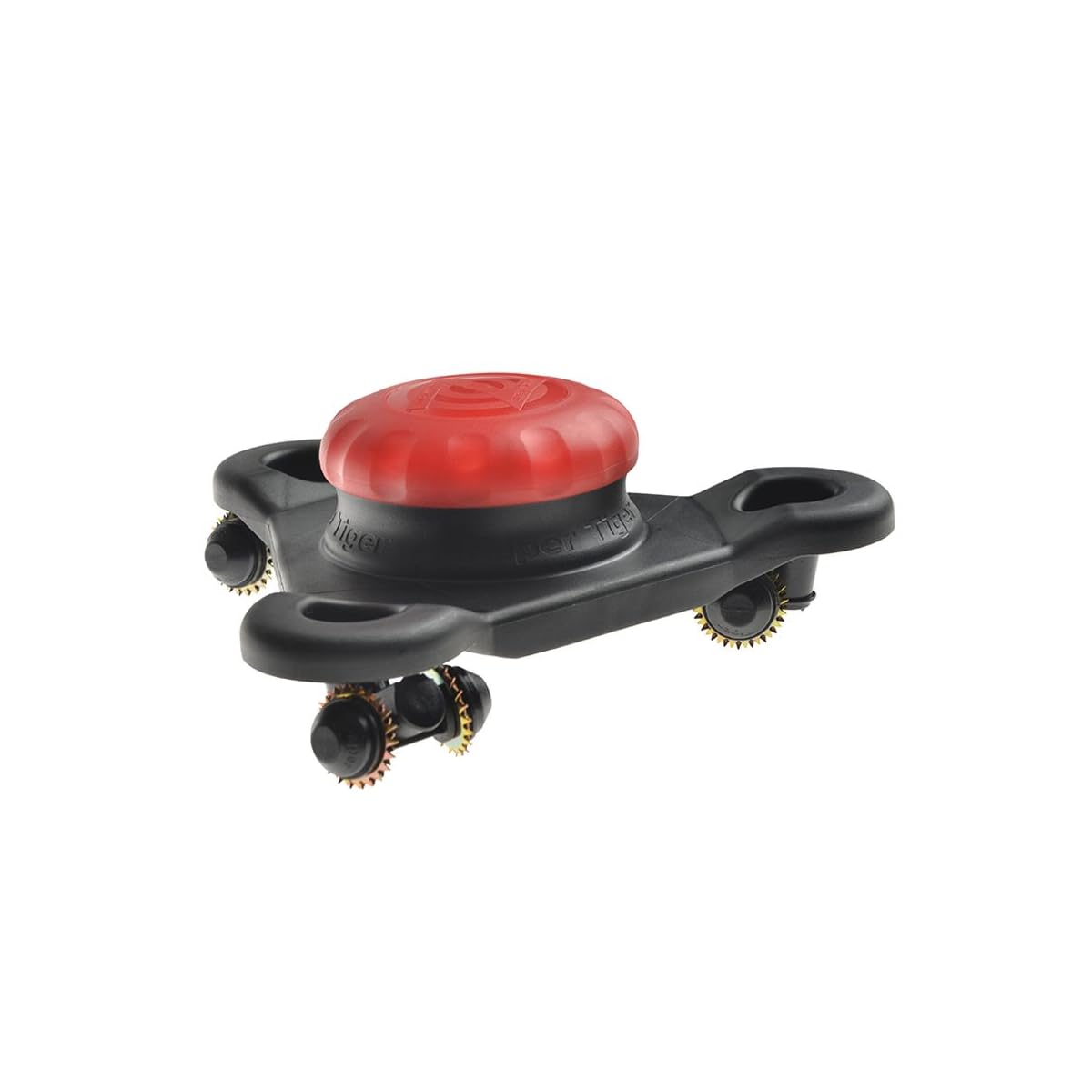
Three floating heads that perforate paper in one pass — the step most people skip.
This is the tool that makes the steamers work. It perforates the wallpaper so the stripper can penetrate and dissolve the adhesive underneath. Three free-floating, self-aligning heads follow the contours of the wall and put steel teeth through the surface in a fraction of the passes a single-head scorer needs. The maker states plainly that it eliminates steamers in some cases — on light paper, scoring plus a soak is sometimes enough.
It measures 8.75 inches long by 3 inches wide and weighs 5.28 ounces, light enough to work overhead for a full stretch without your arm complaining. Compare that against the CHILI TOOLS scraper at 9.7 inches long by 6.81 inches wide — the PaperTiger is the smaller, pocketable tool of the two, and it is built to be dragged over flat wall rather than pried at edges. Coverage is rated at 28 square feet, the area one tool handles comfortably.
Three heads cover a wall in a fraction of the passes a single-head scorer needs. Scoring is dull work, and a triple-head tool turns it into a two-minute sweep around the room. Ease of use and the time saved are the two notes that come up again and again. It is safe on all wall coverings when used with a firm circular scrub, so you can score vinyl and painted paper alike before you bring the heat.
Straight read: buy this before your steamer arrives, not after your first frustrating wall.
The limit: it loosens nothing on its own — it only opens the door for water or steam to do the work.
Yes for: vinyl, multi-layered, and painted-over paper that steam cannot reach on its own.
No for: porous plain paper that loosens with steam or water without any scoring at all.
6. Hyde 33210 Wallpaper Removal Scoring Tool

Ninety-six teeth and a fist-shaped grip — the cheapest way to open a wall before steaming.
A simple circular scrubbing motion is all this tool asks. Ninety-six stainless steel teeth cut through the wall covering so whatever loosener you use — steam or water — can get behind the paper and break the glue’s hold. It works on all types of wall covering, and the ergo-engineered soft grip is shaped to fit your fist so a full wall of scrubbing does not chew up your palm.
Ninety-six teeth open the surface in one circular scrub, so the steamer behind it meets less resistance. Scoring is the unglamorous half of wallpaper removal, and doing it properly here means the steamer does less fighting. Compare it to the Zinsser PaperTiger: the Hyde runs a single 96-tooth head rather than three self-aligning ones, at 8.75 inches by 3 inches on the PaperTiger side. The single head means more passes and more wrist work, but it is a fraction of the cost and gets the job started.
Here is the honest part. The durability of this tool draws real concern — it is the most-discussed subject in its feedback, and the consensus is that it rewards a light touch. Press hard into a stubborn patch and you risk the teeth. Treat the motion as a scrub, not a scrape, and keep the pressure light. Used as a light circular scrub rather than a hard scrape, it perforates a full wall without dulling the teeth.
Where it fits: a small job, a tight budget, or a backup scorer to keep in the toolbox.
Where it strains: heavy-handed use against thick multi-layer paper asks more of the teeth than a single-head tool likes.
Worth grabbing if: you want a low-cost scorer for a single room and will work it with a light scrub.
Better to step up if: you have a whole house of vinyl and want the triple-head speed of the PaperTiger.
7. CHILI TOOLS 7″ Bent Stainless Steel Chisel Pole Scraper

A bent blade that reaches overhead ceilings without folding your wrist backward.
Ceilings are the job that breaks most wallpaper projects, and this scraper exists to fix exactly that. The blade is bent into a chisel shape so it sits flat against a ceiling while your hands stay comfortably below it. It is built from Japanese stainless steel 420J2 — a corrosion-resistant, hardened, and tempered grade — so the edge holds up to heavy-duty scraping rather than rolling over on the first stubborn patch.
The blade is 7 inches wide at 1.8MM thick, which is a lot of scraping surface per stroke on a ceiling or a high wall. It measures 9.7 inches by 6.81 inches overall, versus the Zinsser PaperTiger at 8.75 inches by 3 inches — the CHILI is the beefier tool, and it is built for prying rather than perforating. The ABS threaded handle fits CHILI long extension poles, so you can add reach for overhead work instead of climbing.
On old plaster ceilings, the bent 7-inch blade keeps its edge flat against the surface stroke after stroke. Sturdiness and build quality are what it is known for, since the specialised grind keeps the edge from bending or breaking under load. It handles paint, glue, putty, and wallpaper, so it earns a place beyond the wallpaper job too. Made in Taiwan by CHILI, at a quarter of a kilogram — light enough to swing all afternoon.
The honest note: the pole is sold separately, so budget for an extension handle if your ceilings are high.
The real value: a bent chisel blade is the difference between a ceiling job you finish and one you abandon.
Made for you if: your job involves ceilings, high walls, or any surface you would rather not stand on a ladder for.
Not your tool if: you only have flat waist-height walls and need a scorer to open the paper first.
Know the Specs
Tank capacity and runtime
The tank holds the water that becomes steam. More water means more working time before a refill. The BLACK+DECKER runs a 4 litre tank rated for up to 60 minutes, the Goplus holds 4.5 litres, and the IRONMAX carries 1 gallon rated for up to 180 minutes. If you are stripping a single room, a smaller tank is fine. For a whole house, runtime is the spec that decides whether you finish in one session.
Steam temperature
Steam needs to be hot enough to soften wallpaper paste so the paper releases. Both the IRONMAX and the Goplus reach 212°F, which is the working temperature for loosening adhesive. Below that, you are wetting paper rather than freeing it. Always check the rating before you buy if your walls have old, dried adhesive.
Steam plate size
The plate is the flat pad you press against the wall. A larger plate covers more surface per press, which saves repositioning on big flat walls. The IRONMAX uses an 11 inch by 8 inch plate. A bigger plate is an advantage on open walls and less useful in corners and around trim, where a smaller pad reaches more easily.
Hose length
The hose connects the tank to the steam plate, and its length sets your working radius. A 10 foot hose — used on the Moccha, Goplus, and IRONMAX — lets you walk along a wall without moving the unit. A shorter hose means dragging the tank every few feet, which slows a big job considerably.
Blade thickness and material
Scraper blades take the brunt of the prying. The CHILI TOOLS blade is 1.8MM thick stainless steel, hardened and tempered so the edge resists bending. Thicker, tempered steel holds an edge against glue and old paste; thin blades roll over. Stainless resists corrosion, which matters if you are working near water or damp walls.
Tooth count on scoring tools
Scoring tools perforate the wallpaper so steam or water can reach the adhesive. The Hyde carries 96 stainless steel teeth on a single head, while the Zinsser PaperTiger uses three self-aligning heads with steel teeth. More teeth and more heads mean faster coverage; a single head means more passes but a simpler tool with less to go wrong.
Common Questions
Do I need a scoring tool if I already have a steamer?
How long does a steamer run before I need to refill?
How hot does the steam need to be to loosen wallpaper paste?
Can a wallpaper steamer damage drywall or plaster?
What happens if my steamer runs dry mid-job?
Is a bent blade better than a flat one for ceilings?
Can these steamers be used for anything other than wallpaper?
Will a steamer work on multi-layered or painted wallpaper?
How heavy are these tools to hold at ceiling height?
Do I need an extension pole for the CHILI TOOLS scraper?
The Bottom Line
For most people stripping a room or two, the wallpaper removal tool worth starting with is the BLACK+DECKER 2400 W Wallpaper Steamer — a 4 litre tank, a large plate, and a reputation built on years of owners doing exactly this job. If your project is a whole house and runtime is king, grab the IRONMAX and let its 1 gallon tank carry the day. And for ceilings and overhead work where a steamer cannot reach comfortably, the CHILI TOOLS bent chisel scraper is the one to reach for.
Whichever way you go, remember the order of operations. Score first with the Zinsser PaperTiger if the surface is sealed, then steam it loose, then use a scraper to lift it clean. Score, steam, then scrape — in that order, a single room comes down in an afternoon instead of a weekend.
How we choose
We do not accept paid placement. Every pick is matched to a real buyer and a real use-case; we do not hands-on test units.
Sources
Specifications: manufacturer listings and product documentation. Review insights: verified customer reviews, as of November 2026. Pricing: not shown on this page (it changes often); check the current price via the retailer link.
As an Amazon Associate, Tactical Gear Guy earns from qualifying purchases. This does not affect which products we feature.