Specs are compiled from manufacturer listings and verified buyer reviews and can change over time — please confirm the key details on the product page before buying.
You are three miles up a trail with a bottle that is empty, a stream that looks questionable, and a filter that needs pumping, priming, or a PhD in plumbing. The fix is simpler than most gear shops admit: buy a bottle with the filter built into the body, so you fill, squeeze or press, and drink. Fill it, squeeze or press, and drink. Below you will find nine bottles that do exactly that, sorted by what each one is genuinely good at — speed, weight, capacity, taste, or surviving a drop onto granite.
This guide is built by comparing the manufacturers’ published specifications and the patterns across verified customer reviews, so you get each pick’s real strengths and trade-offs instead of marketing spin.
Some bottles purify a full load in seconds, some collapse to nothing in your pack, and a couple turn your drink into something you actually look forward to. Here is the honest breakdown of the nine filter bottles that earned a spot, sorted by speed, weight, capacity, taste, and durability.
Top Picks


How To Choose The Best Water Filtration Bottle for Hiking
The single question that sorts every bottle on this list is simple: are you filtering out bacteria and protozoa, or purifying viruses too? A filter traps dirt, sediment, microplastics, and the larger organisms like Giardia and Cryptosporidium. A purifier goes further and takes out viruses too. If you are drinking from a clear alpine stream in a high country, a filter is usually enough. If you are dipping into a river near farms, towns, or trailheads with heavy foot traffic, a purifier is the safer bet. Decide filter versus purifier first, then let weight and flow rate break the tie.
Filter or purifier — the difference that matters on a map
A hollow fiber membrane is a bundle of tiny tubes with holes so small that organisms get caught in them while water passes through. That is a filter. A purifier adds a step that neutralizes viruses, which are far smaller than bacteria. The GRAYL bottles on this list purify; several others filter. Neither is automatically better — a purifier that sits in the car because it is heavy protects nobody.
Flow rate: liters per minute versus real effort
Flow rate tells you how fast water moves through the membrane, measured in liters per minute. A squeeze bottle that pushes 2 liters per minute fills your mouth almost as fast as you squeeze. A straw-style bottle with a multi-stage filter can take noticeably more suction. Read the number, then think about whether you are willing to work for every mouthful on a steep climb.
Cartridge life and the cost of replacement
Every filter has a lifespan — some rated in liters, some in gallons, some in the number of press cycles. A longer-rated cartridge means fewer replacements and less waste, but it also usually means a heavier or larger filter. Write the number down and compare it to how much water you actually drink on a typical trip.
Weight and packed size on a long carry
A bottle that weighs a couple of ounces disappears into a vest pocket. A metal purifier bottle weighing over a pound is a deliberate trade for durability and hot-drink capability. Neither is wrong — match the bottle’s weight and packed size to the trip, not to the gear review you read last night.
Side-by-Side Comparison
| Model | Best For | Capacity | Weight | Flow / Treatment | Amazon |
|---|---|---|---|---|---|
| GRAYL GeoPress 24 oz★ Best Overall | All-round trail purifying | 24 fl oz | 15.9 oz | Purifies in 8 seconds | Amazon |
| Katadyn BeFree 1LFeatherweight | Ultralight fast sipping | 1 liter | 2.24 oz | 2 L/min | Amazon |
| LifeStraw Go Stainless SteelCold Keeper | Cold water all day | 24 oz | 1.1 lb | 2-stage straw filter | Amazon |
| SurviMate 5-Stage | Multi-stage taste cleanup | — | — | 0.01 μm UF + carbon | Amazon |
| Sawyer SP140 | Budget inline flexibility | 34 oz | 50 g | 0.1 μm absolute | Amazon |
| HydraPak Flux+ 1.5L | Big-capacity pack pocket | 1.5 liters | 143 g | 1 L/min | Amazon |
| ETA Alkaline | Municipal water and travel | 28 fl oz | 0.22 kg | NSF/ANSI 42 & 53 tested | Amazon |
| AXEN Collapsible 1000ml | Folding travel convenience | 1000 ml | — | 0.1 μm hollow fiber | Amazon |
| GRAYL GeoPress Ti | Titanium survival rig | 24 fl oz | 1.3 lb | Purifies in 8 seconds | Amazon |
Detailed Reviews
1. GRAYL GeoPress 24 oz Water Purifier
Our pick — 4.5+★ from 5,000+ verified ratings; the strongest balance of quality and price.
The press-and-drink purifier that turns a murky creek into a glass of water in the time it takes to count to eight.
Here is the number that decides the GeoPress question: 8 seconds for a full 24 fluid ounces. You scoop from the river, set the inner press inside the outer cup, push down, and the water that comes out the top has passed through a cartridge that removes viruses, bacteria, and protozoa. No pump, no hose, no straw to suck on. For a hiker who has ever stood over a stream working a hand pump until their forearm burned, that one number is the whole sales pitch.
The cartridge is rated for 65 gallons (250 liters), which is roughly a season of regular weekend trips before you swap it. That same cartridge also pulls out particulates, microplastics, and volatile organic compounds — the stuff that leaves water tasting like pond. On a long trip that means you are not rationing a bottle of clean water; you are making your own every time you cross a water source.
The catch is weight and effort. At 15.9 ounces the GeoPress is the heaviest plastic bottle on this list, and the push-down action takes real body weight to finish a press when your shoulders are already tired. Some routes don’t make sense with it — a trail run or a fast-and-light summer day where every ounce counts is where you feel that weight. But for a multi-day backpacking trip where you want certainty about what is in your water, the weight buys you a purifier that handles any source you can find.
What it brings to a trail
- Purifies 24 fl oz in 8 seconds with no pumping or sucking
- Removes viruses, bacteria, protozoa, and microplastics in one pass
- Replaceable cartridge rated for 65 gallons (250 liters)
- Works from a spigot, sink, lake, or muddy stream equally well
Where it asks more of you
- 15.9 ounces empty is a lot to carry for a day hike
- Pressing the filter down takes real force near the end of a load
- Occasional leaking around the threads if the cap isn’t fully seated
The smart pick for: backpackers and travelers who value certainty and speed over an ultralight rig, especially anyone drinking from unpredictable water.
Step up elsewhere if: your trips are short and fast and the 15.9-ounce shell would be a burden — the Katadyn below covers that ground.
2. Katadyn BeFree 1L Water Filter Bottle
At 2.24 ounces and a 2-liter-per-minute pull, this is the bottle your pack barely notices and your mouth barely works for.
Weigh the BeFree against the GeoPress and the gap is huge — 2.24 ounces versus 15.9 ounces. That is the difference between a bottle you forget is even in the side pocket and one that makes you think about your load on the climb. It has a 1-liter capacity, a 0.1-micron hollow fiber membrane, and a flow rate of 2 liters per minute, so a squeeze gives you a mouthful almost instantly. Ultralight hikers and trail runners built their whole kit around bottles like this for a reason.
The membrane handles sediment and fine particles, and the bottle collapses flat when empty — it vanishes into running shorts, a cycling jersey, or a vest pocket. No pump, no tablets, no setup. Cleaning is a shake-and-swish in clean water to restore flow, with no backflushing or disassembly. The 1,000-liter capacity on the filter means most hikers go a long time before they think about a replacement.
The honest trade-off is what it does not do. It filters — it does not purify viruses — so on a trail with heavy farm runoff or a lot of human traffic upstream, that is a gap worth knowing about. And a collapsible body is exactly as tough as it feels; treat it like the soft pouch it is, not like a bottle you can drop onto rock. If your trips are fast, light, and clean-water-focused, neither of those matters much.
What wins people over: the sheer speed of drinking. A squeeze bottle rated at 2 liters per minute means you fill and go rather than sitting down with a filter. Combine that with the 2.24-ounce weight and it is a hard combo to beat for long-mile days.
The practical limit: soft bodies and cold mornings. The bottle does not insulate, and dropping a full one onto sharp rock is a risk you accept when you choose collapsible over rigid.
Reach for this if: you measure your pack in grams and your water sources are clear alpine stuff where a filter is enough.
Look elsewhere if: you need virus-level protection or a bottle that shrugs off being dropped.
3. LifeStraw Go Stainless Steel Water Filter Bottle
A steel bottle that keeps your filtered water cold for hours, which on a hot exposed ridge matters more than any spec sheet admits.
Two things separate the LifeStraw Go from every squeeze bottle here: it is double-wall vacuum insulated, and its filter is rated to last up to 1,000 gallons (4,000 liters). That second number is enormous — most hikers will never replace that microfilter in normal use. The activated carbon filter that improves taste is rated for up to 26 gallons (100 liters), so that one does get swapped on a regular schedule. Think of it as a long-life membrane plus a shorter-life taste stage.
The filtration numbers are strong in every direction: it protects against 99.999999% of bacteria, 99.999% of parasites, and 99.999% of microplastics, plus chlorine, organic chemical matter, sand, dirt, and cloudiness. Drinking from a questionable source and having the result taste fine is the experience the bottle is built around. The stainless body is 1.1 pounds empty — heavy next to the collapsible options, but it is a bottle you can refill at a tap and carry all day without it getting warm.
Where it stumbles is durability at the straw. The plastic straw is the part that sees stress, and it is the weak link in an otherwise tough steel shell. Read the care instructions like they matter — this is a bottle you pack carefully, not one you toss in with the tent stakes. And at 1.1 pounds it is a deliberate choice for the hiker who wants cold water and a long filter life and is willing to carry for it.
Reasons hikers carry it
- Double-wall vacuum insulation holds cold for hours
- Microfilter rated up to 1,000 gallons (4,000 liters)
- Removes 99.999999% of bacteria and 99.999% of parasites
- Stainless steel body survives trail wear on the shell
The parts to watch
- The plastic straw is the stress point and has been known to break
- 1.1 pounds empty is a real carry penalty
- Carbon stage needs replacing far sooner than the main membrane
The bottle for: the day hiker or traveler who wants filtered water that still tastes cold and clean hours after the fill.
Know before you buy: the insulated steel weight and the straw’s fragility are the two things that shape how you treat this bottle.
4. SurviMate Purified Water Bottle
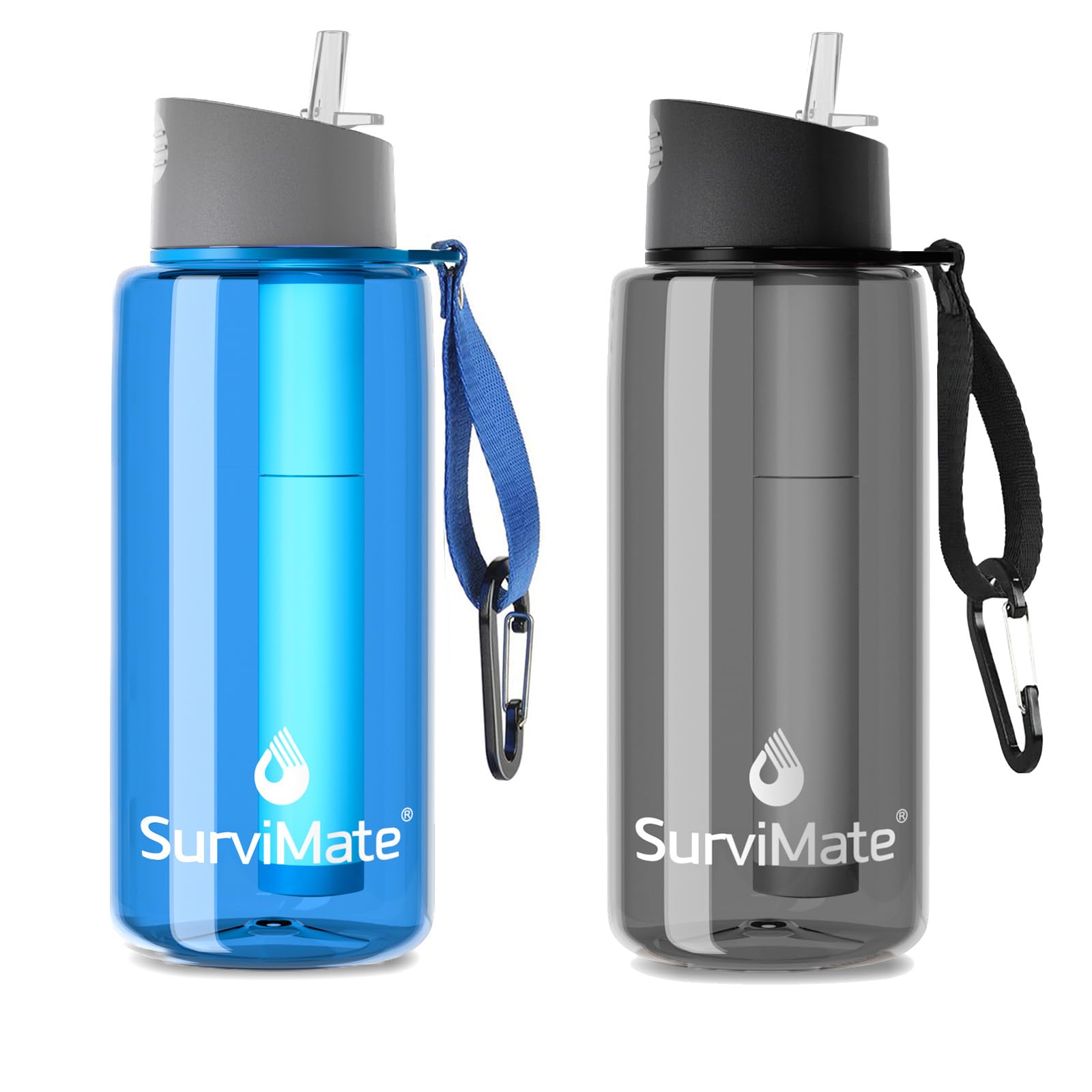
Five filtering stages stacked into a straw, plus a compass on the cap that makes it a genuine camping kit piece.
The SurviMate cleans your water in five stages inside the straw. A coarse screen catches big debris, a 0.01-micron hollow fiber UF membrane (a fine mesh that blocks tiny particles) filters out the small stuff, a sediment PP layer traps dirt, purification beads treat the water, and activated carbon fiber improves taste. The filter has passed NSF/ANSI 42 certification, a recognized standard for reducing chlorine and taste issues. That 0.01-micron figure is finer than the 0.1-micron membranes on several bottles here, so it catches smaller particles in a murky source.
The filter element is rated for up to 1,500 liters (396 gallons) — the maker says that is roughly the equivalent of about 3,000 single-use plastic bottles. Plan to swap the cartridge after that volume for best results. The tritan body (a clear, shatter-resistant plastic) is hand-wash only, so it does not go in the dishwasher. The built-in compass on the cap is a small thing that is genuinely useful on a bushcraft trip when you left the real one at home.
There is one real cost to five stages of filtration: it takes work to drink. The straw requires more suction than a standard bottle because the water is passing through all those layers. On the first use, the maker notes the water may look slightly black from carbon particles — that is normal and clears up. Blocking the silicone air hole next to the straw will stop the suction entirely, so keep a finger off it. If you are the type who wants water fast and easy, this bottle will ask more of you than a simple squeeze filter.
Why a serious camper picks it: the five layers and the 0.01-micron membrane, plus the 1,500-liter filter rating, make it a long-haul bottle for travel and backcountry. The tritan body feels less cheap than a soft pouch.
What you accept: the suction effort is the recurring experience — a bottle you sip deliberately and packed with care, not one you chug through after a run.
Built for: travelers and campers who want maximum filtration layers and a filter that lasts across many trips.
Look elsewhere if: high-effort suction would annoy you on every drink — a squeeze bottle or press-style purifier is a smoother experience.
5. Sawyer Products SP140 Water Bottle Filter

The affordable workhorse — a 34-ounce bottle with a filter that pulls out nearly everything and goes inline with a hydration pack.
Start with the weight that matters: the filter itself is 50 grams. Compare that to the HydraPak Flux+ at 143 grams, and the case for the Sawyer as a budget entry point starts to make sense. It is a 34-ounce BPA-free bottle with a 0.1-micron absolute hollow fiber membrane inline filter. The absolute rating is the key phrase — it measures the maximum pore size rather than an average, so what it claims to catch, it catches reliably.
The filtration claims are aggressive: removes 99.99999% of bacteria including Salmonella, Cholera, and E. coli; 99.9999% of protozoa including Giardia and Cryptosporidium; and 100% of microplastics. It fills from a river, lake, or faucet, and it is field maintainable with the included backwash syringe. The 63mm cap fits standard wide-mouth compatible bottles, and the filter can run inline with a hydration pack’s tubing — useful if you already carry a bladder.
The trade-offs show up in the details. It is a filter, not a purifier, so viruses are not part of what it stops. The standard model no longer includes the extra straws, which is a quiet change in the box. And the squeeze effort and taste are both things some hikers find wanting on this style of bottle. For the price of entry, though, it delivers a real filter with a serious set of removal ratings — which is exactly what a budget bottle should do.
Where the value shows up
- 0.1-micron absolute filter with strong removal ratings
- 50-gram filter keeps the weight low
- Backwash syringe included for field maintenance
- Works inline with a hydration pack’s tubing
Where it holds back
- Filters bacteria and protozoa but not viruses
- Squeeze effort and taste don’t suit everyone
- No extra straws included in the current model
Ideal first filter bottle: a hiker on a tight gear budget who wants real absolute-micron filtration and hydration-pack flexibility.
Not the right one if: you drink from water you don’t trust for viruses — pay for a purifier instead.
6. HydraPak Flux+ Water Bottle

The volume play — 1.5 liters in one soft body that rolls up to nothing when you are done with it.
It weighs 143 grams, which makes it noticeably heavier on paper than the Sawyer’s 50-gram filter, but you are paying that weight for the bigger reservoir and a filter rated for approximately 1,500 liters of fresh water. On a long exposed stretch with no water source, 1.5 liters on your back is a real difference in how far you can push.
The flow rate is 1 liter per minute, so a squeeze is a steady mouthful rather than a firehose — slower than the Katadyn’s 2 liters per minute, and the effort is noticeable on a hot day. The high-flow nozzle with a dust cover opens and closes one-handed, which is exactly what you want when your other hand is holding a trekking pole. The dual-layer film laminate construction with TPU and RF welded seams is designed to survive being stuffed into and pulled out of pack pockets all day.
Filtration is rated to remove 99.99% of E. coli and parasitic cysts, and the bottle compresses to pocket size when empty. The honest caveat is that this bottle has less of a track record than the long-running names on this list, so the volume and packability are the draw rather than a hundred-trip history. It is also a filter, not a purifier. For a hiker who wants maximum water per carry and does not want to stop at every stream, those limits are usually worth the trade.
The reason to pick it: a 1.5-liter reservoir that empties flat into a pack pocket is a specific answer to a specific problem — long carries between water sources with no weight penalty once you drink it down.
The trade-off in practice: the 1-liter-per-minute flow means slower fills than the fastest squeeze bottles, and the body is soft film rather than a rigid shell.
A fit for: backpackers who want the most water per carry and a bottle that packs down to nothing once it is empty.
Think twice if: you want fast flow at every stop or a rigid body that can take abuse.
7. ETA Alkaline Water Filter Bottle

A travel-first bottle with a sip-and-squeeze filter and a 9.5 pH alkaline target, built for tap water rather than alpine streams.
The ETA is the odd one out on this list, and it knows it. Its target is treated municipal water — the stuff from a hotel sink or a campground tap — and it is designed to pull out lead, arsenic, fluoride, and other dissolved contaminants while pushing the pH toward 9.5. It holds up to 28 fluid ounces (828 ml) and is tested to NSF/ANSI 42 & 53 international standards, which are recognized benchmarks for aesthetic and health-related contaminant reduction. If your hiking involves a lot of travel and cities, that is a different job than filtering a stream.
The mechanics take getting used to: you perform the brand’s “Sip & Squeeze” motion, squeezing the bottle from both sides while sipping through the straw, to force water through the IAMF filter. The maker is upfront that it feels tight at first because the filter is designed to create pressure for stricter filtration — you squeeze a little harder and find the rhythm. The filter is rated for up to 100 gallons of clean water, and the bottle is BPA-free and made in the USA.
The honest caveat is that “alkaline” and “removes radiological contaminants” are big claims, and this is a travel bottle rather than a trail purifier for a fast-running creek. Value is the other thing some hikers weigh carefully — it is one of the pricier options here and does not do the virus-removal job a GeoPress does. But for a trip that mixes a hotel room with a day hike, it is a bottle that handles both water sources without needing two pieces of gear.
Where it earns its place
- Tested to NSF/ANSI 42 & 53 standards
- 28 fl oz (828 ml) is the biggest carry on this list
- Handles municipal tap water, not just natural sources
- BPA-free and made in the USA
What to expect
- Sip and squeeze takes practice before it feels natural
- Filter rated for 100 gallons, less than several bottles here
- Premium price for a travel-focused bottle rather than a purifier
Right for: travelers who want a bottle for hotel taps and campground sinks with a certified filtration bench behind it.
Look elsewhere if: your water comes from a stream and you need virus-level purification.
8. AXEN Collapsible Water Bottle with Filter

A fold-flat TPU bottle with a screw-on filter that swaps onto any standard 42mm cartridge opening.
The AXEN’s party piece is compatibility: its filter cartridge is built for the industry-standard 42mm opening, so it fits major brands and the bottle accepts any standard 42mm replacement cartridge. That matters if you already own a filter or want the freedom to swap one out later without buying a whole new bottle. The 0.1-micron hollow fiber ultrafiltration membrane handles streams, lakes, and rivers, and the filter is rated for up to 1,000 liters — a long runway before you replace it.
The body is premium-grade TPU that folds down rather than holding a rigid shape, which is the point — it disappears into a daypack when empty and holds 1000ml when full. The cap is leak-proof, and the filter delivers clean water in seconds from a squeeze. Maintenance is a shake-and-swish in clean water to keep flow strong, with no backflushing tools required.
What is worth knowing is the track record: this is a newer bottle with a smaller review base than the names that have been on the trail for years. Feedback about the folding action is mixed — some users find it convenient, some find it awkward. It is a filter rather than a purifier, and the soft TPU body (a flexible plastic) is not built for being dropped onto rock. Treat it as a light, packable, cartridge-swappable option and it does its job well.
The appeal: the 42mm compatibility is the differentiator — a bottle that accepts standard cartridges means you are not locked into one brand’s filter supply. Combined with the 1,000-liter rating, that is a sensible long-term buy.
The honest reservation: the folding action and the body’s softness are the two things to expect, and neither is a flaw as long as you go in knowing it.
Worth a look: hikers who want a pack-flat bottle and the freedom to swap standard 42mm cartridges over time.
Better elsewhere if: you want a rigid body or a long review history before you commit.
9. GRAYL GeoPress Ti Titanium Water Filter Bottle
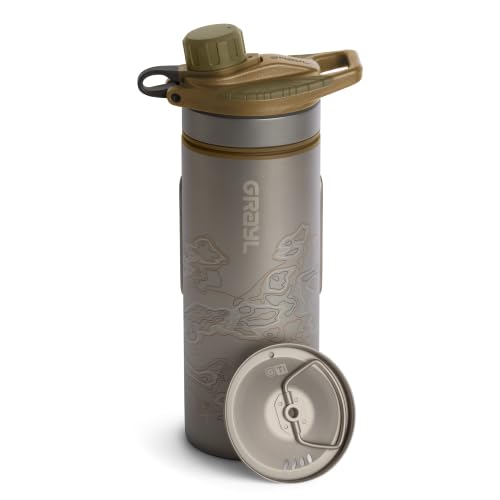
The expedition rig: a titanium purifier bottle that doubles as a pot you can set over coals or a camp stove.
The Ti takes the GeoPress formula and swaps the plastic shell for expedition-grade titanium. You get the same 8-second purification of a full 24 ounces, removing 99.99% of viruses and 99.9999% of bacteria — the virus removal is what separates a purifier from the filters on this list. A finely powdered activated carbon stage reduces microplastics and chemicals for cleaner taste and clarity. The cartridge is rated for 350 presses.
The titanium is the real headline, because it changes what the bottle can do. It withstands drops and can be heated safely over coals or a camp stove, which no plastic bottle on this list can. The Cook Lid turns it into a lightweight pot for boiling water or heating a meal — two tools in one, which is the argument for the weight. At 1.3 pounds it is the second heaviest bottle here, but for a winter backpacker or a bushcraft trip, that weight replaces a separate pot and fuel savings.
The cost is the steepest on the list by a wide margin, and the titanium shell is the reason. It also carries an electrolyte valve, and it is leak-proof, lightweight in the titanium sense, and portable. The honest question is if you need the pot function — if you already carry cookware, the plastic GeoPress does the same purification job for a fraction of the weight. But if you want one piece of gear that purifies, boils, and survives years of drops, this is the one.
What the titanium buys you
- Purifies 24 oz in 8 seconds, removing 99.99% of viruses
- Titanium body survives drops and heats over a stove or coals
- Cook Lid turns it into a lightweight pot for boiling and meals
- Cartridge rated for 350 presses
The premium’s cost
- 1.3 pounds is a real carry penalty on long trips
- The steepest price here by a wide margin
- The pot function only pays off if you actually cook on trail
For the serious expedition: winter backpackers and bushcrafters who want to purify, boil, and cook with one titanium piece instead of three.
Likely overkill if: you already carry cookware — the plastic GeoPress purifies just as fast for far less weight.
Know the Specs
Micron Rating: 0.1 vs 0.01
A micron is one-millionth of a meter, and the number tells you the pore size of the filter membrane. A 0.1-micron membrane — the rating on the Sawyer, Katadyn, and AXEN — is fine enough to trap most bacteria and protozoa. A 0.01-micron membrane, used by the SurviMate, is a step finer and catches smaller particles. Smaller is generally more protective, but it also tends to slow the flow, so the trade is between finer filtration and how hard you have to work for a drink.
Filter vs Purifier
Filters trap larger organisms — bacteria and protozoa — in a membrane. Purifiers go further and neutralize viruses too, which are much smaller. On this list the GRAYL GeoPress bottles purify; the pressure-actuated cartridge does the virus work. The Sawyer, Katadyn, AXEN, and HydraPak are filters. Decide based on where you drink: clear high-country water usually suits a filter, water near towns or farms calls for a purifier.
Cartridge Lifespan: Liters, Gallons, or Presses
Lifespan figures are given in different units on different bottles — 65 gallons on the GeoPress, 1,000 liters on the Katadyn, 1,000 gallons on the LifeStraw, 350 presses on the GeoPress Ti. They are all measuring the same thing: how much water goes through before the media wears out. Longer ratings mean fewer replacements, but also usually a heavier or more expensive filter. Match the rating to how often you actually hike.
Flow Rate and Real Effort
Flow rate in liters per minute tells you how easy it is to drink. The Katadyn’s 2 liters per minute is among the fastest here, the HydraPak’s 1 liter per minute is a steady pull, and a multi-stage straw like the SurviMate asks for more suction still. On a steep climb, that number affects how often you stop and how much water you actually drink — a slow bottle can quietly push you into dehydration because you don’t want to work for it.
Common Questions
Can a water filter bottle remove viruses from a stream?
How often do I need to replace the filter cartridge?
Is a filter bottle better than a water filter pump for hiking?
Can I put electrolyte mix in a filter bottle?
Does a collapsible water bottle filter last as long as a rigid one?
Will a filter bottle fit in a standard backpack side pocket?
Can I use a filter bottle on tap water as well as trail water?
How do I clean a filter bottle on the trail?
What does the “absolute” rating on a water filter mean?
Is a heavier filter bottle worth it on a multi-day trip?
The Bottom Line
For most hikers, the water filtration bottle for hiking that covers the widest range of trips is the GRAYL GeoPress 24 oz. It purifies viruses, bacteria, and protozoa in 8 seconds, works from any source you can scoop, and its 65-gallon cartridge lasts about a season of weekend trips. If you want the lightest possible carry and clear high-country water is your usual source, the Katadyn BeFree at 2.24 ounces and 2 liters per minute is the one to grab. And for a winter backpacker or bushcrafter who wants to purify and cook with a single titanium piece, the GRAYL GeoPress Ti earns its weight.
Decide your water source first — stream versus tap, clean versus questionable — and the rest of the list narrows itself down fast. The GeoPress purifier is the safest default, but the BeFree’s 2.24-ounce body and 2 L/min flow win when the water is clean and the miles are long.
How we choose
We do not accept paid placement. Every pick is matched to a real buyer and a real use-case; we do not hands-on test units.
Sources
Specifications: manufacturer listings and product documentation. Review insights: verified customer reviews, as of November 2026. Pricing: not shown on this page (it changes often); check the current price via the retailer link.
As an Amazon Associate, Tactical Gear Guy earns from qualifying purchases. This does not affect which products we feature.