Specs are compiled from manufacturer listings and verified buyer reviews and can change over time — please confirm the key details on the product page before buying.
A wall bathroom exhaust fan has one job: pull steam, smell, and damp air straight out through the brick instead of letting it settle on your mirror and grout lines. The trick is picking one that matches your wall cavity and moves enough air for the room.
This guide is built by comparing the manufacturers’ published specifications and the patterns across verified customer reviews, so you get each pick’s real strengths and trade-offs instead of marketing spin.
Below you will find picks matched to real wall cavities, airflow needs, and noise limits, so your next purchase fits the first time. This is the practical shortlist of the best wall bathroom exhaust fan options for anyone cutting a fresh hole or replacing an old unit.
Top Picks

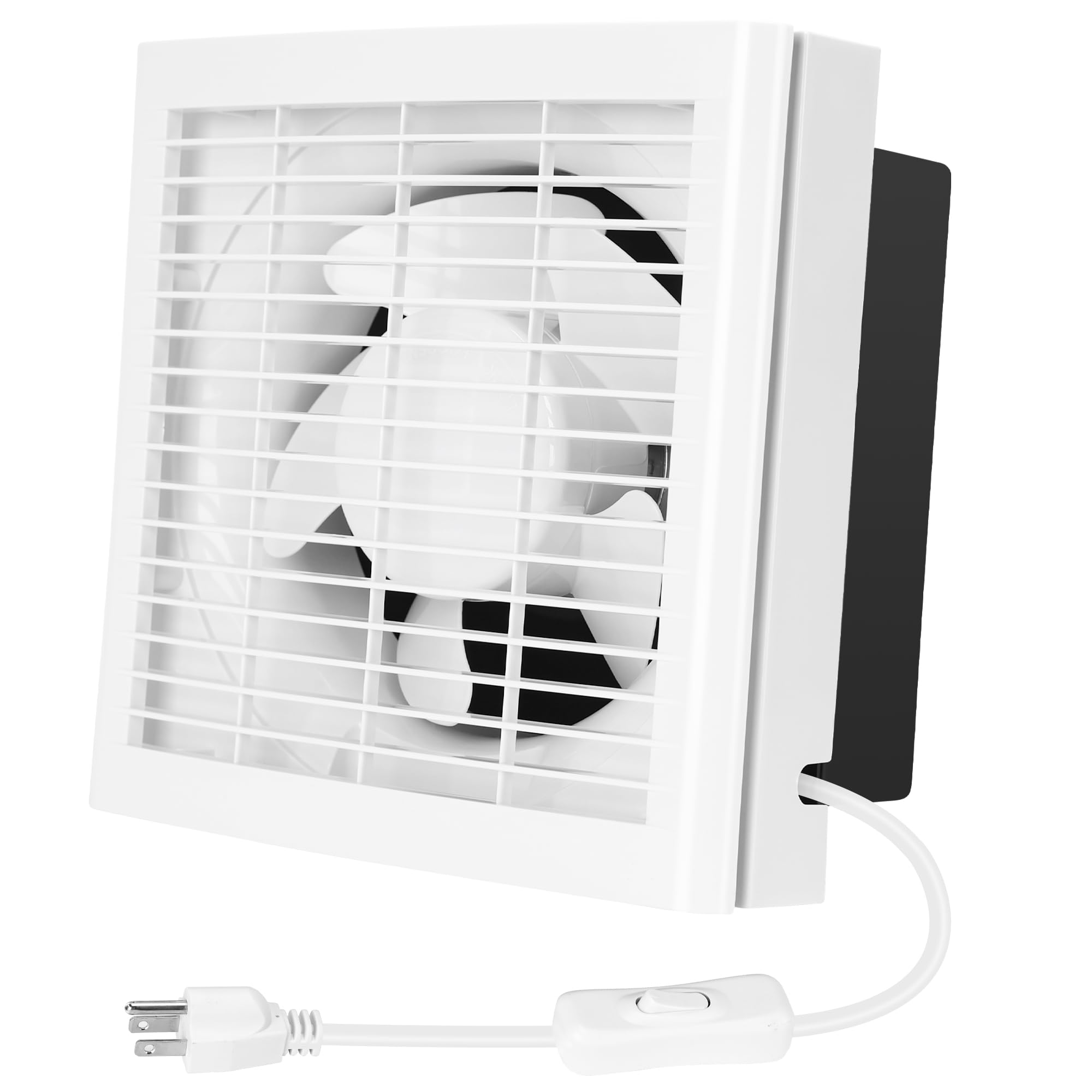

How To Choose The Best Wall Bathroom Exhaust Fan
You are shopping for a fan that goes through the wall, not through the ceiling. That single fact decides most of your shopping list. A through-wall unit needs a clear path outside, a wall cavity deep enough to take the housing, and enough grunt to push against wind and a shutter flap.
Match CFM to your room, then round up
CFM means cubic feet per minute — the volume of air the fan clears in sixty seconds. Small powder rooms and half baths sit comfortably in the 50 to 80 CFM range. Garages, utility rooms, and big family baths want 200 CFM or more. Undersize this number and the fan runs long, stays loud, and still leaves the mirror fogged.
Read the sone rating, not just the marketing word “quiet”
A sone is a measure of how loud a fan sounds to the human ear, and lower is better. A 1.0 sone fan is close to silent; a 4.0 sone unit is a noticeable whir. An 8.5 sone fan is loud by design — that is a utility-room fan doing heavy lifting, not a spa fan. If the fan sits next to your shower, hunt for the low sone number.
Measure the wall cavity before you order
Thick brick, siding over sheathing, and old plaster walls all behave differently. Adjustable-duct fans are built for this problem because the duct telescopes to cover different wall depths. Fixed housing fans need a cavity within a narrow range. Grab a tape measure and check the depth at the exact spot you plan to cut.
Decide if you want to wire a switch
Some through-wall fans have a built-in on/off switch right on the cover. That saves you a run of electrical cable to a wall switch. Others need a hardwired switch, and a few plug straight into an outlet with a cord. Pick the wiring style that matches your comfort level — and your electrician’s quote.
Side-by-Side Comparison
| Model | Best For | Airflow (CFM) | Noise | Install Type | Amazon |
|---|---|---|---|---|---|
| Delta BreezSlim SLM50★ Best Overall | Small baths and litterbox rooms | 50 cfm | 1.0 sone | Ceiling or wall | Amazon |
| Fanspex 6-inch Shutter Exhaust FanBest for Garages | Garage, greenhouse, and laundry rooms | 258 cfm | 40 dB | Window or wall | Amazon |
| Mdeinu 8-inch with Speed ControllerMost Powerful Value | Kitchens and smoking rooms | 700 cfm | Not listed | Wall mount | Amazon |
| Amico 10-inch Remote DC Fan | Workshops and stuffy basements | 1000 cfm | 42 dB | Plug-in wall | Amazon |
| Quini 6-inch Through-Wall Fan | Thick walls and outdoor bathrooms | 80 cfm | 4.0 sones | Through-the-wall | Amazon |
| Delta BreezSlim SLM70H | Humidity-triggered small baths | 70 cfm | 2.0 sones | Ceiling or wall | Amazon |
| Panasonic WhisperValue | Tight cavities and continuous run | 30–100 cfm | Whisper quiet | Wall, ceiling, or tub | Amazon |
| Broan-NuTone 509S | Garages and big utility rooms | 200 cfm | 8.5 sones | Through-the-wall | Amazon |
Detailed Reviews
1. Delta BreezSlim SLM50 50 CFM Exhaust Bath Fan
Our pick — 4.5+★ from 750+ verified ratings; the strongest balance of quality and price.
The one that disappears: a 1.0 sone fan you forget is running behind the shower curtain.
A noise level of 1.0 sone is the number that sells this fan, and it is genuinely close to silent — the review pages sum it up as a unit you cannot hear even with the door shut. That is the whole appeal for a small bathroom where the fan sits an arm’s length from your head while you brush your teeth.
Airflow is 50 CFM, which the maker rates for rooms up to 50 square feet. That is a half bath, a powder room, or a vented litterbox corner, not a big family bathroom. It fits ceiling or wall mounting and the slim profile is aimed squarely at retrofit jobs where you are swapping out an old fan in the same opening.
The maker rates the DC motor for 70,000 continuous hours (about 8 years) and claims up to 85% energy savings — both are manufacturer figures, not our measurements. The quiet is not magic: 50 CFM is a modest pull, so a steamy shower in a room larger than its rated footprint will still leave some fog behind. It holds 4.5+ stars across 700+ ratings, the strongest record of any fan here.
Where it wins
- 1.0 sone operation — effectively silent next to a shower
- Rated for rooms up to 50 sq. ft. with 50 CFM
- Slim housing made for retrofit swaps
- Runs for a tested 70,000 hours
Where it leans small
- 50 CFM is modest for a full-size bathroom
- Fit depends on your existing opening matching the slim housing
Reach for this if: you have a small bath or half bath and quiet is the whole point.
Look elsewhere if: your bathroom is big enough to need real air movement, because 50 CFM will feel underpowered.
2. Fanspex 6″ Shutter Exhaust Fan
A small fan that punches above its size, moving 258 CFM out of a garage or greenhouse.
Most of the way this fan earns its keep is the raw air movement: 258 CFM through a 6-inch fan with five blades spinning at 1350 RPM. That is a lot of pull for the footprint, and it is why it clears hot air, laundry-room damp, and basement mustiness rather than just tickling it. The biggest slice of buyer goodwill lands on how functional it is day to day — in practical terms, it does the job you bought it for without fuss.
Noise sits at 40 dB, which the maker calls super quiet. In practice that is a soft, steady hum — noticeable but not the kind of racket that drives you out of the garage. The 5-foot cord with a plug makes it one of the easiest fans here to get running: hang it, plug it in, done, no switch wiring required. The front oil-sink panel comes off so you can wipe the blades clean.
Here is the honest catch: it is a shutter fan first, so the look is industrial rather than bathroom-elegant, and a 40 dB hum in a small quiet bath will be audible. It is built as a window or wall mount with a sturdy ABS frame, so it suits a garage, barn, workshop, or greenhouse better than a spa-like master bath.
Measured take: 258 CFM and a 5-foot plug-in cord turn a fiddly job into a one-afternoon mount, and the oil-sink front panel means cleaning does not need a screwdriver marathon.
Suits the utility-minded: garages, greenhouses, laundry rooms, and basements that need genuine air movement from a plug-in unit.
Pass if: you want a near-silent fixture beside a soaking tub — the 40 dB hum and industrial look are not that product.
3. Mdeinu 8 Inch Exhaust Fan with Speed Controller, 700 CFM
Speed dial plus a 700 CFM motor: the fan that clears a smoky kitchen without a fight.
Seven blades, a brushless motor, and 700 CFM at up to 2600 RPM is serious extraction — the kind that pulls smoke and cooking odors out of a kitchen rather than letting them settle into the curtains. Pulling 700 CFM takes more power than a gentle bath fan: this one runs at 80W, against the Amico’s 13W, so it draws noticeably harder on the meter when it is working.
The infinity speed controller is the feature you will actually touch every day. Crank it down for gentle background ventilation, or open it up for a fast purge when the pan starts smoking. The metal housing resists corrosion and moisture, a dense mesh guard protects your fingers, and an automatic closing valve shuts out insects and backdrafts when the fan is off. A double ball-bearing motor cuts friction to stretch service life.
What will divide buyers is noise. The builder pushes air hard and the review consensus calls it powerful but loud at full tilt — the speed dial is exactly how you manage that, since you can ease it down to a tolerable level. It also wants a proper wall opening: the panel measures 9.8 x 9.8 inches with a 7.5-inch actual fan diameter, sized to slide into a standard 8-inch duct or wall opening.
The deciding detail: a 700 CFM fan with a dial is a tunable powerhouse, and the 8.2 ft cord gives you reach to a socket that is not right beside the hole.
Pick it for: kitchens, smoking rooms, shops, or any space where you want to dial in real airflow on demand.
Think twice if: the fan will sit right beside a tub — at 700 CFM this moves air loudly and wants a switch to calm it.
4. Amico 10″ Shutter Exhaust Fan
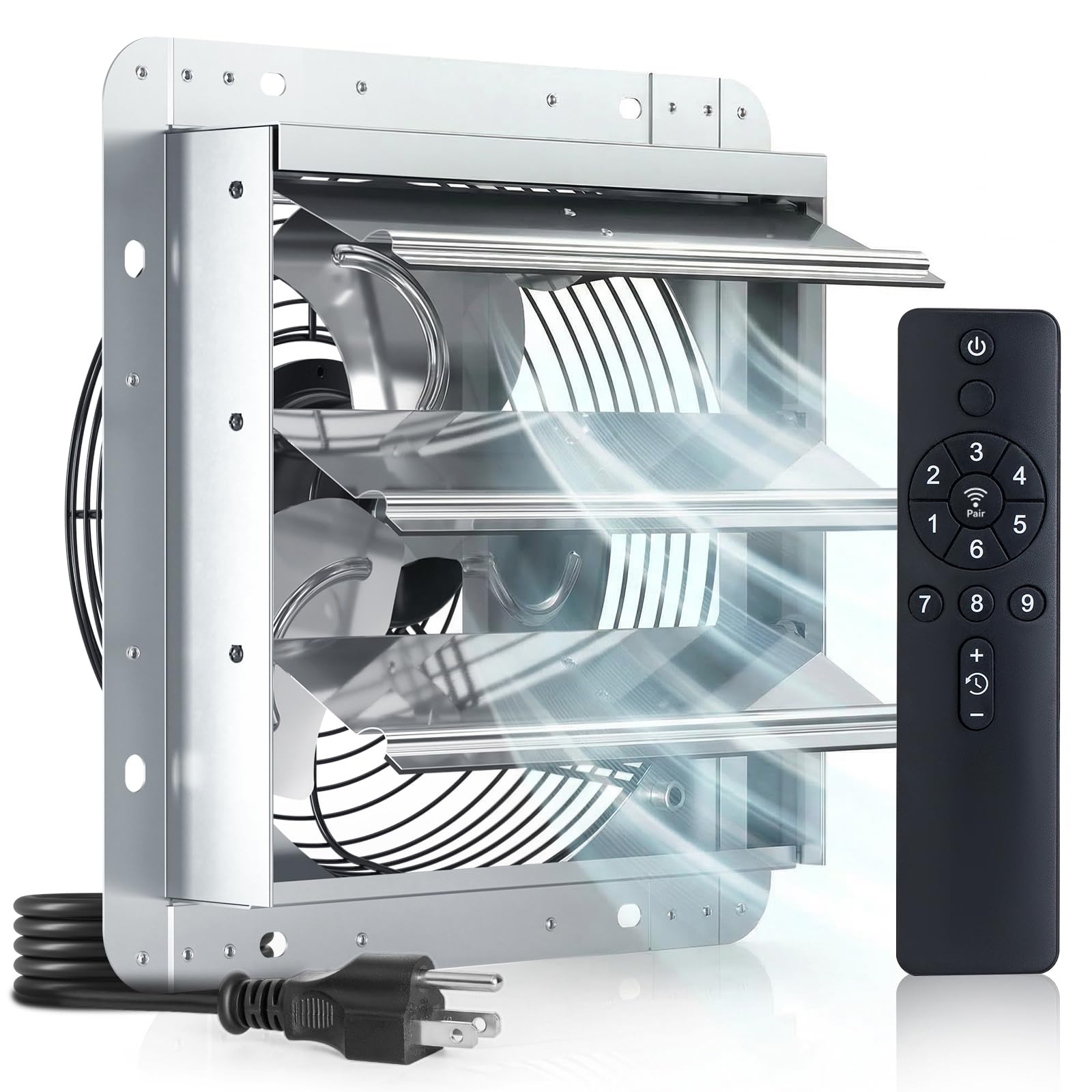
A thousand cubic feet a minute on a 13W motor — huge pull, tiny power draw, remote in hand.
A 1000 CFM blast on a 13W DC motor is the standout combination here. The maker says the DC drive cuts utility costs versus older AC models and runs cool without heat buildup — their claim, not a tested result. What is solid is the pull: 1000 CFM sustained through a smart chip that holds 2100 RPM even under pressure. That is enough to clear a welding workshop or stuffy basement, or to lift a garage door’s worth of hot air — the review pages mention that garage-door scenario directly.
The 9-speed remote handles the hard-to-reach-wall-switch problem, and a 1-8H timer lets you cool the space automatically and forget it. Some buyers grumble about the remote itself — that is the one relationship you will maintain, though replacements are kept in stock. Operation lands at 42 dB, and the gravity-driven louvered shutter seals shut when the fan is off, blocking rain, dust, insects, and cold backflow.
Setup is genuinely plug-and-play: a 1:1 cutting template marks the hole, you mount it, you plug it in. No electrician visit required. It is a big unit, measuring 12.3 inches wide, so measure that wall opening twice before you cut.
Big-air verdict: the 1000 CFM figure leads the whole list, and the 13W DC motor means you can run it hard without watching the meter the way an 80W fan would make you.
Made for: high-demand spaces and anyone who wants to control the airflow from across the room without touching a wall switch.
The trade-off: the remote is the weak link in the chain — keep track of it and replacements are available.
5. Quini 6-Inch Through Wall Exhaust Fan, 80 CFM
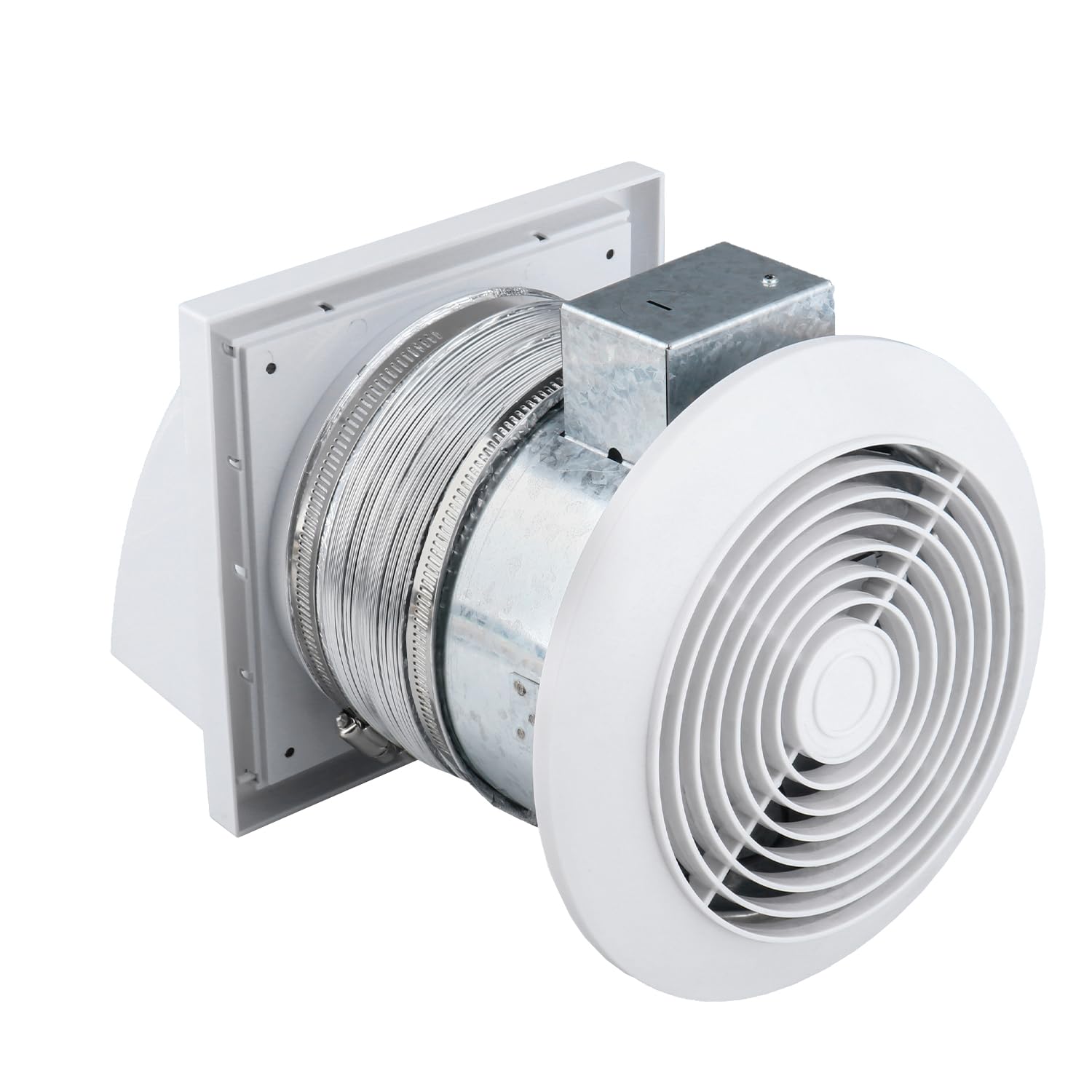
Built for the wall you actually have: an adjustable duct that stretches from 2 to 15 inches.
The adjustable aluminum-foil duct is the reason to buy this one. It extends from 2 to 15 inches in length, which lets it fit wall thicknesses ranging from 6 to 19 inches — that is brick, siding over sheathing, and plenty of old plaster in between. A fixed-depth fan would simply not reach across a chunky exterior wall.
At 80 CFM it clears up to 65 square feet, which is a solid garage corner, a laundry room, or a spot near a workbench. The copper motor coil is built for a longer lifespan, and the exterior cover shields the fan from rain and wind. The vent cover lets air pass while keeping birds and mosquitoes out, and a special flap stops outside air from flowing back inside. It works indoors and out, so a covered outdoor bathroom is in its wheelhouse.
Noise is the honest split point: at 4.0 sones it is a real hum, and the reviews land on both sides of that — fine for a garage, less ideal next to a soaking tub. Plan for an opening of roughly 6.4 inches cut through both the interior and exterior walls, with a switch wired to it.
The strong side
- Adjustable duct spans walls 6 to 19 inches thick
- 80 CFM clears up to 65 sq. ft.
- Bird screen and backdraft flap built into the cover
- Copper motor coil for longer life
The honest other side
- 4.0 sones is an audible hum, not a whisper
- Needs a cut opening and wiring to a switch
The right call when: your wall is thick, uneven, or just plain awkward, and only a telescoping duct will bridge the gap.
Not the fit for: a sleep-adjacent quiet bath — you would want a lower sone number.
6. Delta BreezSlim SLM70H Exhaust Bath Fan

The fan that knows when it is steamy: it kicks in past 60% humidity, all by itself.
This is the hands-off option. Leave the switch alone and the fan starts when humidity rises above 60%, then stops itself once the air dries out below the same line. For a bathroom where one person showers and forgets to hit the switch, that automatic trigger does more for your grout lines than any manual setting.
At 70 CFM and 2.0 sones, it steps up from the smaller SLM50 on both airflow and noise, and it is Energy Star qualified with a brushless DC motor rated around 5.8 CFM per watt. The housing measures 7.5 inches wide by 7.25 inches deep, sized as a compact replacement so the maker pitches it for swapping an older bath fan without remodeling the opening. Blue and amber LED lights show which mode it is in.
Be clear-eyed about the sensor and the long-term reliability: the reviews split on both. Plenty of owners get exactly the humidity control the maker promised, but some find the sensing fussy or the unit giving out sooner than they would like. It is a genuine reason to weigh the sensor convenience against the record, rather than an automatic buy.
What it earns: the humidity sensor runs the fan for you, so the steam gets cleared even when you walk away and forget.
Best for: a compact bathroom where automatic moisture control beats flipping a switch every time.
Consider the risk: the humidity sensor and long-term reliability get mixed reports, so buy it for the convenience, not as a set-and-forget certainty.
7. Panasonic FV-0810VSS1 WhisperValue Bath Fan + Dual Speed
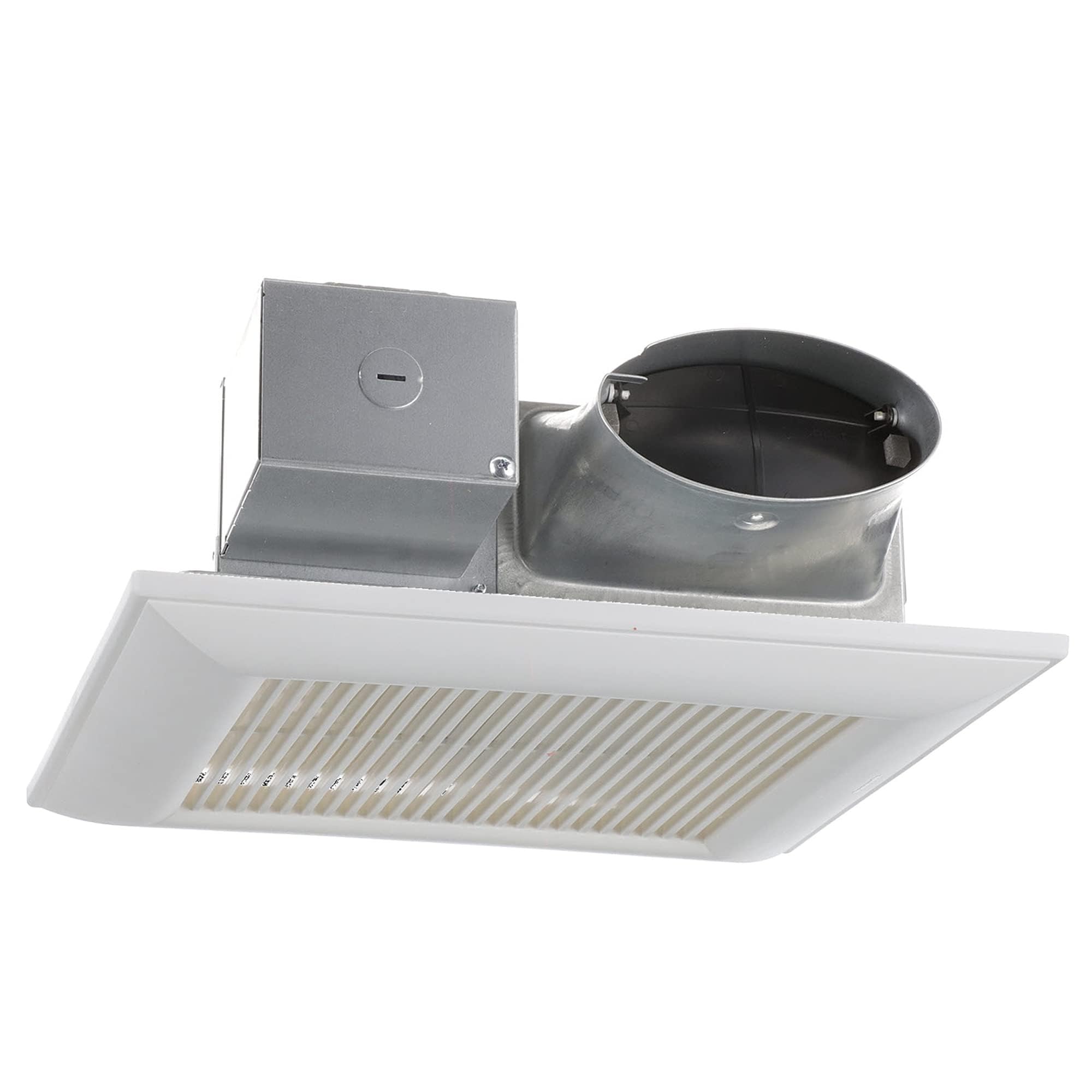
Set a low continuous breath, then flip the switch for a 100 CFM surge.
This fan keeps air moving all day without you touching a thing, then boosts hard when you need it. The feature is called SmartFlow: it holds a low continuous level you set anywhere from 0 to 70 CFM (cubic feet per minute, the measure of how much air the fan moves) in 10 CFM steps. Flip the wall switch and it jumps to 80 or 100 CFM for the shower. So you get quiet background ventilation around the clock and a real surge when steam builds, all on a duct with a 4-inch oval profile.
The 3-3/8 inch housing depth is built for tight spaces — one of the shallowest bodies in this shortlist, and useful where an older fan left you little ceiling or wall room to work with. The maker’s L-shaped bracket is there to make the install simpler and add support, and it is UL listed for ceiling, wall, and tub/shower enclosure mounting when GFCI protected. An Energy Star rated DC/ECM motor sits behind the quiet.
The honest trade-off is that adjustability comes at the top of the price range, and that continuous low-speed running depends on how you set and wire it. Sellers also stock a range of variants with LED lights, timers, heaters, and condensation sensors, so confirm you have the exact dual-speed glass model before ordering.
What makes it flexible
- Low level 0 to 70 CFM in 10 CFM steps
- Full 80 or 100 CFM on the wall switch
- 3-3/8 inch housing depth for tight cavities
- UL listed for wall, ceiling, and tub mounting
Value to weigh
- Premium tier pricing for the adjustability
- Continuous low speed relies on getting the wiring right
Your fan if: you want a low background breath plus on-demand full power and the shallowest housing.
Second-guess it if: a simple single-speed fan would do, since the flexibility pushes the price up.
8. Broan-NuTone 509S Through-the-Wall Ventilation Fan, 200 CFM

The garage workhorse: 200 CFM, no ducting, and a switch right on the cover.
This is the fan for the one-car garage, rec room, or laundry that fills with hot air every summer. At 200 CFM it is rated to ventilate rooms up to 195 square feet, and it does not need a duct run at all. The built-in exterior wall cap means you cut a hole, twist-lock the motor in, and the breeze is going outside.
The install conveniences are its real selling point. A built-in on/off switch on the cover saves you wiring a separate wall switch, the motor twists out for fast servicing, and the galvanized steel housing shrugs off the weather. A built-in bird screen keeps critters from claiming the vent as a home. The housing measures 14.25 x 14.25 x 8 inches and adjusts to walls from 4.5 to 9.5 inches thick.
Set your expectations on sound: at 8.5 sones this fan is loud, and the reviews split exactly there — fine for a garage, wrong for a quiet bathroom. That is a designed trade for the 200 CFM it moves, not a defect. Buy it when you want serious extraction, not a whisper.
Bottom line on it: a ductless 200 CFM through-wall unit with a cover switch is the least fuss, highest-effort-to-install ratio in this list for a garage job.
It fits: a garage, rec room, or laundry room where moving hot air fast matters and quiet does not.
Not for: a bathroom beside a bedroom — 8.5 sones is an unavoidably loud fan.
Know the Specs
CFM (Cubic Feet Per Minute)
This is the volume of air the fan clears in sixty seconds, and it is the first number you match to your room. Small baths sit near 50 to 80 CFM; garages, workshops, and big rooms go to 200 CFM or beyond. Buy a fan undersized for the space and it runs forever, stays loud, and still leaves the mirror fogged.
Sones vs. Decibels
A sone is a perceived-loudness unit — lower is quieter — while a decibel (dB) is a raw sound-pressure figure. Both appear on this list. Under 1.0 sone is close to silent; 2.0 to 4.0 is an audible hum; 8.5 sones is loud on purpose. Use these numbers to match the fan to whether it lives next to a shower or out in the garage.
Wall Cavity and Duct Fit
Through-wall fans care about depth. Adjustable ducts telescope to bridge different wall thicknesses, while fixed housings fit a narrow range. Measure the wall at the exact cut spot, then check whether the fan sizes to a standard duct or opening.
Humidity Sensors and Speed Control
A humidity sensor (a switch that trips when air gets steamy) starts and stops the fan for you, so the moisture clears even when you forget to touch a switch. Adjustable speed control lets you dial airflow and manage noise on demand. Both are convenience features — worth the premium if you will actually use them.
Common Questions
How many CFM do I need for a wall bathroom exhaust fan?
Will a through-the-wall exhaust fan fit a thick exterior wall?
Is a humidity sensor worth the extra cost?
What is the difference between a sone and a decibel rating?
Do I need to wire a separate wall switch for a wall exhaust fan?
Can a wall exhaust fan be mounted in a shower or tub enclosure?
How loud is too loud for a bathroom exhaust fan?
Does a bigger CFM fan always mean better ventilation?
Can I clean a through-wall exhaust fan without removing it from the wall?
Do these fans keep out rain, bugs, and backdrafts?
The Bottom Line
For most bathrooms, the wall bathroom exhaust fan to beat is the Delta BreezSlim SLM50, because its 1.0 sone operation is close to silent and its 50 CFM suits the small baths most people are venting. If your wall is thick or awkwardly deep, grab the Quini 6-Inch, whose adjustable duct spans walls from 6 to 19 inches. And for a garage or utility room that fills with hot air, the Broan-NuTone 509S moves 200 CFM with no ducting at all.
One honest nudge: the quietest picks are the ones owners keep recommending, and that held-true reputation is why the small-bath fans here are the safer bet than a bargain box that roars.
How we choose
We do not accept paid placement. Every pick is matched to a real buyer and a real use-case; we do not hands-on test units.
Sources
Specifications: manufacturer listings and product documentation. Review insights: verified customer reviews, as of November 2026. Pricing: not shown on this page (it changes often); check the current price via the retailer link.
As an Amazon Associate, Tactical Gear Guy earns from qualifying purchases. This does not affect which products we feature.