Specs are compiled from manufacturer listings and verified buyer reviews and can change over time — please confirm the key details on the product page before buying.
If your sidewalk edge looks like a ragged green fringe, you already know the problem: string trimmers chew turf instead of slicing a clean line. A walk-behind lawn edger is the tool that fixes it, with a steel blade that runs along the pavement and cuts a straight, vertical groove you can see from the street. The four machines below cover the real split in this category — cordless electric for quiet neighborhoods and small lots, gas for thick turf and long borders that need muscle.
This guide is built by comparing the manufacturers’ published specifications and the patterns across verified customer reviews, so you get each pick’s real strengths and trade-offs instead of marketing spin.
You will see how cutting depth, blade style, wheel count, and power source change the job in front of you. A four-wheel frame with a locked depth lever cuts a straight groove in one pass; a wobbly three-wheel design wanders off line. Here is the honest breakdown of the best walk-behind lawn edgers for keeping concrete and turf separated cleanly all season.
Top Picks
How To Choose The Best Walk-Behind Lawn Edgers
The single biggest mistake buyers make here is shopping by engine size. Horsepower gets the blade spinning, but it is the depth setting, the blade shape, and the number of wheels that decide whether your edge comes out straight or ragged. Start with the job in front of you, not the spec sheet.
Match the power source to your lot
Battery power means instant starts, no gas-oil mixing, and far less noise for a suburban street. Gas power means you never wait on a charge, and it holds up better on overgrown borders and hard-packed soil. If your edging job runs long or your turf fights back, gas torque is the safer bet.
How deep do you actually need to cut
A shallow touch-up pass keeps a line tidy week to week. A deeper cut severs roots below the surface, which is what you want on a neglected border. Look for a machine with several depth positions so you can start shallow on hard ground and go deeper once the line is established.
Why wheel count changes the cut
A four-wheel frame resists the sideways wobble that throws a line off course on long driveways. Three-wheel designs can wander, and handheld stick edgers make it hard to hold a straight groove at all. Wheel count and frame weight, not engine size, decide whether the blade tracks straight along a curb.
Side-by-Side Comparison
| Model | Best For | Power Source | Cutting Width | Weight | Amazon |
|---|---|---|---|---|---|
| EARTHQUAKE 41273 79cc★ Best Overall | Deep cuts and trenching | Gas (79cc 4-cycle) | — | 57 pounds | Amazon |
| Greenworks 80V 8 in Cordless | Quiet cordless edging | Battery (80V, tool only) | 8 inches | 10.3 pounds | Amazon |
| Wild Badger Power 31cc | Entry gas edging | Gas (31cc 4-cycle) | 1.34 inches | 29.8 pounds | Amazon |
| McLane 9 Inch Gas Edger | Long-term pro results | Gas powered | 7 inches | — | Amazon |
Detailed Reviews
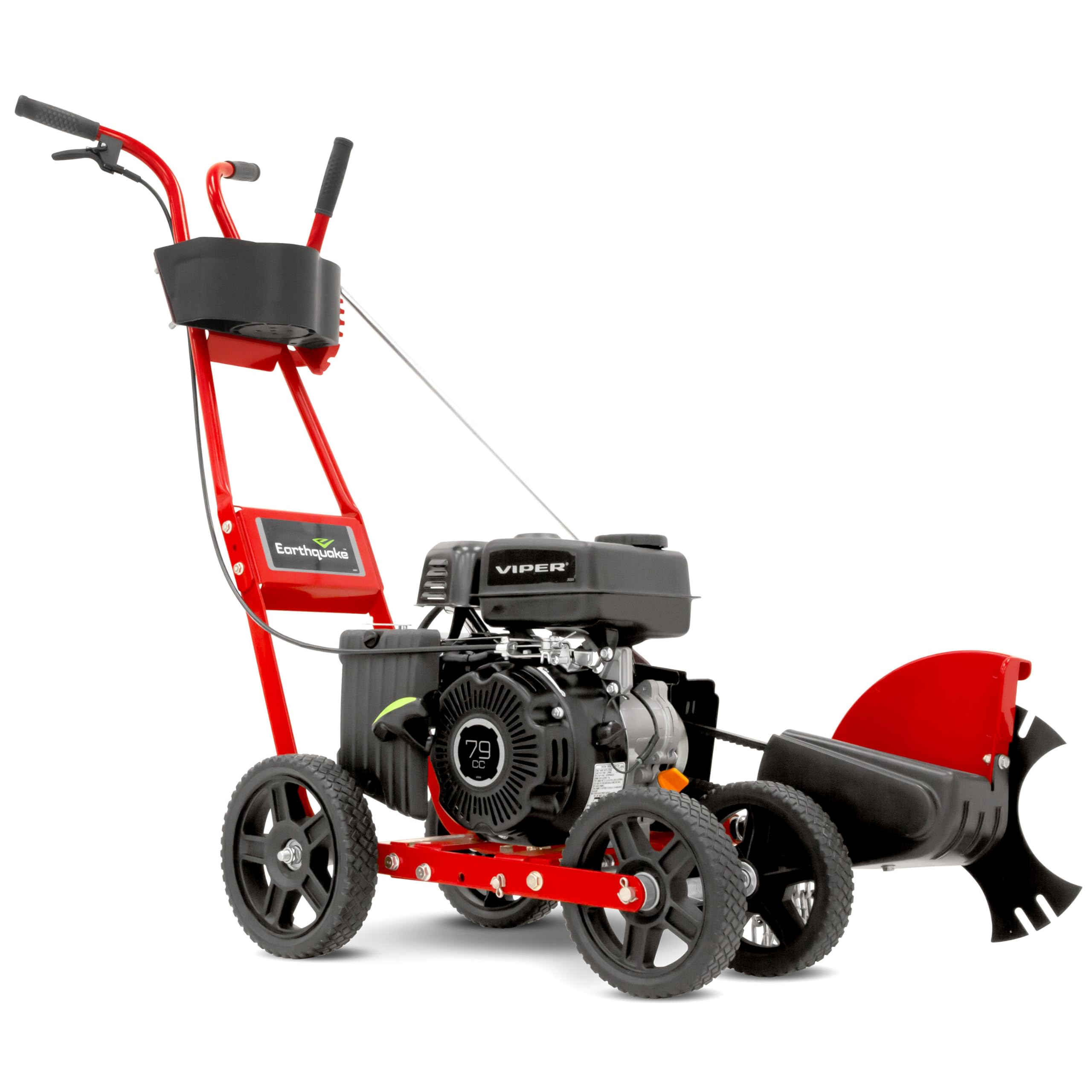
1. EARTHQUAKE 41273 79cc 4-Cycle Walk-Behind Edger
Our pick — 4.5+★ from 100+ verified ratings; the strongest balance of quality and price.
A four-wheel gas brute that slices roots instead of chewing them, then trenches cable runs when the edging is done.
The number that earns this machine the top spot is the 2.5-inch maximum cut depth. Set the blade low and it severs roots below the surface, so the green fringe does not creep back over the concrete in two weeks. Ten separate depth settings let you start shallow on hard summer ground and go deeper once the line is established, and the pivoting blade swings up to 20 degrees either way for beveled cuts around flowerbeds or a dead-straight pass along the driveway.
What wins owners over most is simple function — the thing just does the job, and it does it with a 79cc 4-cycle Viper engine that runs on straight gas with no oil mixing. It is also a legitimately heavy tool at 57 pounds, roughly five times the mass of the Greenworks cordless pick, and that weight is exactly why it stays planted through compacted soil. The four-wheel frame resists the sideways wobble that spoils a straight line, and the tri-tip steel blade cuts cleaner than a bar-style blade. A built-in cup and tool holder means your shears are right there when you stop.
Budget real time for assembly. Getting it together is straightforward for most, but the printed directions leave some folks second-guessing the steps, so go slow and dry-fit the parts first. The other honest note is the depth lever — one report describes it shifting during a run, so check it is locked before you start a long pass. Neither issue touches the core cutting ability. A 79cc engine with a 2.5-inch cut depth makes this the do-it-all edger for most yards.
What earns its keep
- 2.5-inch max depth severs roots below the surface
- 79cc 4-cycle engine runs on straight gas, no mixing
- Four-wheel frame holds a straight line on long driveways
- Doubles as a light trencher for fence or cable runs
Know before you buy
- Assembly directions leave some owners working it out
- Check the depth lever stays locked during a pass
Reach for this if: you have thick turf, deep roots, or a long border and want one gas machine that powers through it all.
Pass if: the 57-pound frame is more heft than you want to push around a small lot.
2. Greenworks 80V 8 in Cordless Electric Lawn Edger, Tool Only

The quiet one — an 8-inch brushless blade on a 10.3-pound frame that starts with a trigger, not a pull cord.
Two numbers tell this machine’s whole story. It weighs 10.3 pounds, versus the 57-pound Earthquake, so it is the choice if you have a short driveway and no interest in mixing fuel or hauling a heavy engine around a small lot. And that 8-inch blade is a broad cutting path, paired with an 80V brushless motor spinning at 7000 rpm and a curb wheel to guide you along concrete. Depth adjustment is tool-free across five positions, so you can dial in a shallow touch-up or a deeper cut without hunting for a wrench.
Where it shines is the everyday grind. It handles heavily overgrown stretches and cuts deep into dirt for a clean edge, and the battery holds up for a full edging session rather than dying halfway down the walk. Owners also flag the weight both ways — some call it light, others find it a touch heavy with a battery loaded — so it lands somewhere in the middle in real use.
Here is the catch you must plan for: this listing is the tool only. No battery, no charger. If you already own Greenworks 80V batteries you are set, because it works with the full 80V lineup. If you do not, budget for a battery and charger on top. A cordless 8-inch brushless edger at 10.3 pounds makes quiet, fuel-free edging an easy daily habit.
The cordless advantage: no gas, no oil, no pull cord — trigger, edge, done. The 8-inch blade and curb wheel keep the line clean without the noise of a small engine.
Battery reality check: it is tool-only, so the total cost depends on what 80V batteries you already have on the shelf.
Best for: Greenworks 80V owners who want a light, quiet edger that starts every time with no maintenance ritual.
Look elsewhere if: you have no 80V batteries yet and want a single purchase that runs on day one.
3. Wild Badger Power 31cc 4-Cycle Gas Walk-Behind Lawn Edger
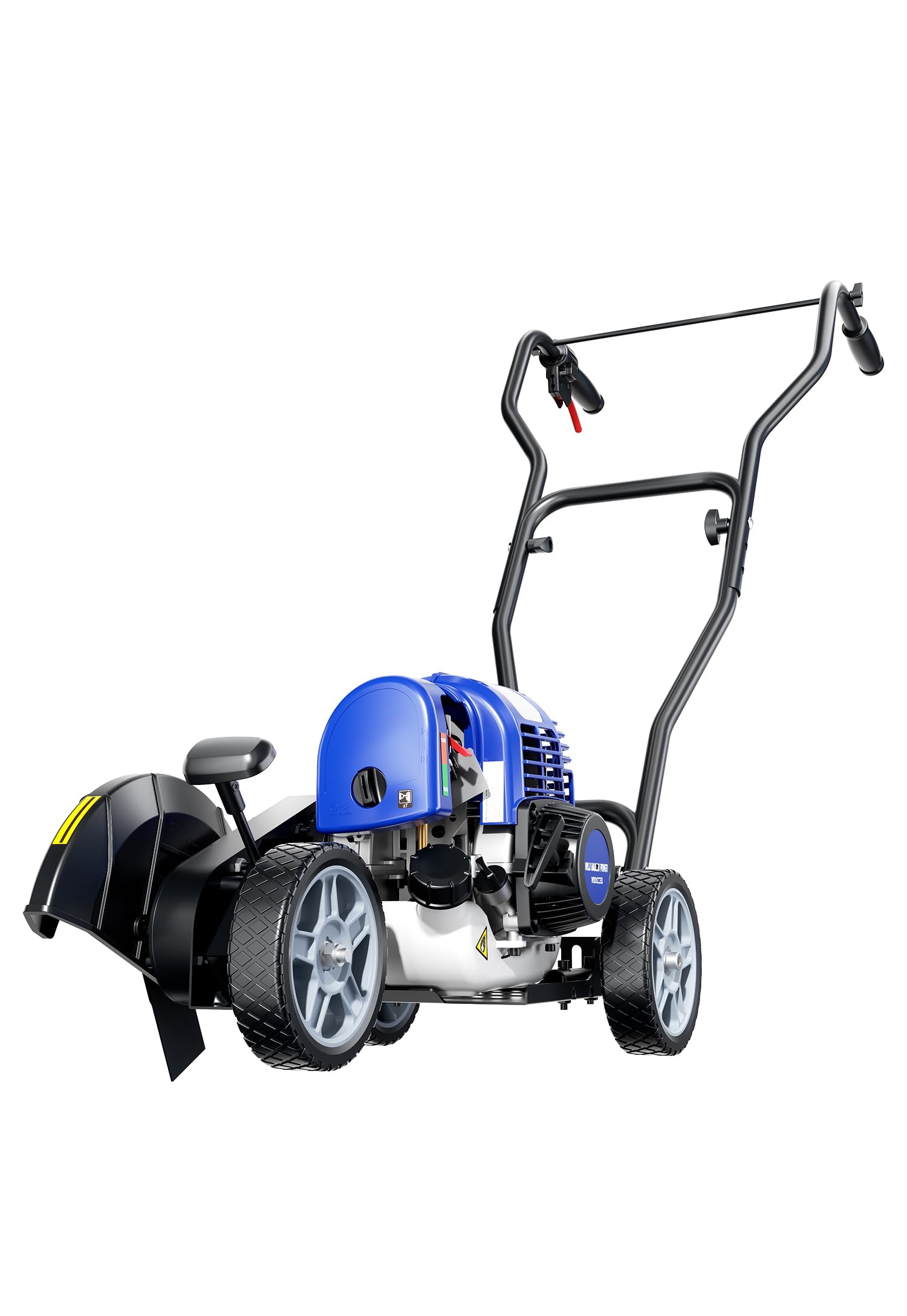
The lightest gas ticket into the category, with a 9.5-inch blade that eats thick Bermuda grass without drama.
If you want gas power without the weight of a big engine, this 31cc 4-cycle unit is the entry point. It tips the scale at 29.8 pounds, and its full-crank engine spins the blade up to 9,800 rpm while running on straight gas — no oil mixing. The 2-tooth steel blade separates turf from hardscape, and five depth settings let you start shallow on hard soil or roots and go deeper on overgrown borders. There is a 4-wheel stable push design with three handle-height positions, so you can set the bar where your arms want it.
Owners talk up how easily it assembles and how it handles the tough stuff — thick Bermuda grass in particular gets mentioned as no real obstacle. A digital ignition helps starting, and tool-free air-filter access keeps the upkeep simple. It is the friendly first gas edger.
The trade-off is a smaller engine than the Earthquake, so on rock-hard, root-heavy ground it will want a shallow first pass. Treat it as a reliable weekly edge-keeper, not a root-splitting trencher. A 31cc gas edger at 29.8 pounds is the light, affordable way to get a real gas blade turning.
The good side of the ledger
- 29.8 pounds — the lightest gas machine here
- 9,800 rpm blade splits turf from concrete curbs
- Five depths for touch-ups or seasonal deep cuts
- Three handle heights for a comfortable push posture
The part that bites
- 31cc engine means shallow first passes on hard ground
- Best suited to maintaining an edge, not breaking new roots
Pick it when: you want gas starting torque and a real metal blade without a heavy engine to manhandle.
Think twice if: your border is dense, ancient roots and you expect one deep pass to clear it.
4. McLane 9 Inch Gas Powered Walk Behind Lawn Edger

The pro-grade upgrade — a spring steel blade on rubber tires that rides curbs and tilts to almost any angle.
This is the machine for someone who wants the edge to look professionally cut every single time, year after year. The cutter head is precision machined with sealed precision ball bearings spinning a 2-inch by 9-inch spring steel blade, and the single-lever blade clutch and depth control put the exact cut in one hand. It rides on most curbs while still delivering a clean cut, and it cuts vertically or horizontally with wide rubber tires and ball bearings feeding it along smoothly.
The blade tilts to nearly any angle — seven positions — for beveled edges and flat trim at any height. A 5.50 gross torque engine sits behind it, and build quality is the loudest praise in the room: the steel throttle cable assembly and the way it starts on the first pull come up again and again. It is the pick owners call worth the money, producing professional-level results.
Here is the honest limit. Durability draws mixed feedback across the reviews — some report issues over time — so treat maintenance seriously and store it dry. It is also the premium option in this lineup, a bigger commitment than the others. For a homeowner with a long, visible curb who wants a decade-grade tool, that trade can make sense. A spring steel 9-inch blade with seven tilt positions delivers the cleanest, most controllable edge of the bunch.
Where the money goes: sealed ball bearings, a 2-inch by 9-inch spring steel blade, and single-lever clutch and depth control — the parts that make a cut feel easy and repeatable.
The honest caveat: durability reports are mixed, so a dry storage spot and routine upkeep are part of the deal.
Worth it for: a homeowner with a long, highly visible curb who wants pro-looking lines and is fine paying for the premium build.
Skip the splurge if: you want a no-fuss weekly touch-up tool and do not need the widest tilt range.
Know the Specs
Cutting Depth
This is how far the blade sinks below the surface — measured in inches. A shallow setting keeps an established line tidy, while a deeper cut severs roots below the surface so the grass creeps back over the concrete more slowly. More depth positions give you more control; the Earthquake offers ten, cutting up to 2.5 inches deep, and the Greenworks offers five tool-free positions.
Blade Style
The blade shape decides how cleanly it separates turf from pavement. A tri-tip steel blade, a 2-tooth steel blade, and a spring steel blade all cut a vertical groove, but they behave differently in roots and hard soil. Spring steel with sealed ball bearings, like the McLane’s, gives the most precise, repeatable cut.
Power Source
Gas engines deliver torque for overgrown borders and long runs but add weight and fuel handling. Cordless electric starts instantly, runs quieter, and needs no oil mixing, but you must already own the matching battery — the Greenworks is tool-only. Match the source to your lot size and turf density.
Wheel Count
Four wheels hold a straighter line than three on long driveways, resisting the sideways wobble that throws an edge off course. Wheeled stability is why a walk-behind beats a handheld stick edger for keeping a consistent depth along a curb.
Common Questions
Will a walk-behind edger cut through hard, root-filled soil?
Do I need to mix gas and oil for these edgers?
Is the Greenworks 80V edger ready to use from the start?
How deep should I set the blade for a normal edge?
Can a walk-behind edger also be used to trench?
What is the difference between a tri-tip blade and a 2-tooth blade?
How heavy are these edgers to push?
Can I edge on a concrete curb without damaging it?
Which power source suits a small suburban yard?
The Bottom Line
For most yards, the walk-behind lawn edgers winner is the EARTHQUAKE 41273 — its 2.5-inch max cut depth, four-wheel stability, and 79cc engine handle roots, long borders, and even light trenching in one machine. If you have Greenworks 80V batteries and want quiet, light edging, grab the Greenworks 8 in Cordless. For an affordable 29.8-pound gas starter, the Wild Badger 31cc does the weekly job. And if a pro-looking curb is the goal and you will store it dry and keep up the upkeep, the McLane spring steel edger is the premium reach.
How we choose
We do not accept paid placement. Every pick is matched to a real buyer and a real use-case; we do not hands-on test units.
Sources
Specifications: manufacturer listings and product documentation. Review insights: verified customer reviews, as of November 2026. Pricing: not shown on this page (it changes often); check the current price via the retailer link.
As an Amazon Associate, Tactical Gear Guy earns from qualifying purchases. This does not affect which products we feature.