Specs are compiled from manufacturer listings and verified buyer reviews and can change over time — please confirm the key details on the product page before buying.
You step off the curb into a half-frozen puddle, and you find out within three seconds whether your boots were worth buying. Waterproof suede is the whole game here — a suede upper that has been treated or built over a sealed membrane so slush beads up instead of soaking through to your sock. This guide covers eight pairs that actually hold that promise, from hiking-ready tread to tall winter styles, and explains in plain words what each one does well and where it asks something of you.
This guide is built by comparing the manufacturers’ published specifications and the patterns across verified customer reviews, so you get each pick’s real strengths and trade-offs instead of marketing spin.
Some pairs here are built for trail mud, others for city slush and deep snow, so the right answer depends on where you actually walk. Below you’ll find the top waterproof suede boots lined up by job, with the real specs and honest fit notes spelled out.
Top Picks


How To Choose The Best Waterproof Suede Boots
Most people buy suede boots for how they look and then discover the waterproof part matters far more. The trick is that “waterproof suede” can mean two different things, and knowing which one you’re getting stops you from buying a boot that only shrugs off a light drizzle. Start with where you walk, then work down this list.
Waterproofing: treated surface versus sealed membrane
A treated suede upper makes water bead on the outside, which handles light rain and wet sidewalks. A sealed inner membrane — a thin layer stitched inside the boot — is what keeps your foot dry when you stand in a puddle or walk through slush for an hour. The strongest pairs name both a treatment and a membrane. If a listing only says “suede upper” with no waterproof technology named, treat it as a fair-weather boot.
Insulation and how cold you actually get
Insulation is measured in grams, and the number tells you the season. A boot with 200g of 3M Thinsulate plus a fur lining is built for deep winter, while an unlined suede hiker suits spring and fall. More insulation means more warmth but also more bulk, so match the grams to your climate rather than buying the heaviest pair you can find.
Shaft height, heel, and ankle coverage
Shaft height is how far the boot rises from the heel — an ankle-high pair stops just above the ankle, while a tall boot climbs the calf. Taller shafts block more snow and splash, but they also take longer to pull on. Low stacked heels are easier to walk in all day; a no-heel or flat sole is better for uneven ground.
Fit and sizing on suede you can’t try on
Suede has little stretch, so a snug pair stays snug. Check the size chart against your measured foot length, and if you plan to wear thick socks, consider going up a size where the maker suggests it. Laces and adjustable shafts let you fine-tune the fit around the calf, which helps if your legs and feet don’t match a single standard size.
Side-by-Side Comparison
| Model | Best For | Style | Weight | Waterproof Claim | Amazon |
|---|---|---|---|---|---|
| Columbia Women’s Transverse Suede★ Best Overall | All-terrain hiking | Suede hiking boot | — | Waterproof suede | Amazon |
| FREE SOLDIER 6-Inch Tactical BootToughest Build | Tactical and work wear | 6-inch tactical | 1.59 lb | Waterproof leather upper + sock liner | Amazon |
| AUSLAND Genuine Suede Winter Ankle BootCozy Everyday | Cold-weather everyday | Ankle snow boot | — | Waterproof suede | Amazon |
| Dansko Women’s Frankie Bootie | Long workdays on your feet | Ankle bootie | 1.5 lb | Waterproof suede | Amazon |
| Danner Mountain 600 | Serious trail hiking | Hiking boot | — | Danner Dry waterproof protection | Amazon |
| Blondo Women’s Liam | Everyday city wear | Ankle bootie | 13 oz | Waterproof | Amazon |
| SOREL Buxton Pull On | Deep winter and snow | Pull-on snow boot | 4.13 lb | Waterproof suede + thermal rubber | Amazon |
| Warsaw Tall Winter Boot | Coldest climates | Tall winter boot | — | CanDry Waterproof + sealed membrane | Amazon |
Detailed Reviews
1. Columbia Women’s Transverse Suede
Our pick — 4.5+★ from 800+ verified ratings; the strongest balance of quality and price.
The trail boot that keeps feet dry from creek splash to waterfall spray.
If you hike in wet weather and want one pair that does not protest, this is the pick. The upper is suede built for weather, matched to a sole that grips across varied ground — so a muddy incline and a wet rock slab both feel manageable. Cushioning is described by the maker as lightweight and responsive, which is the difference between a boot that helps you along and one you’re lugging.
What wins people over is comfort, and it shows up fast: the fit runs wide enough to take different sock thicknesses without pinching, and buyers report no blisters. Owners talk about walking through puddles and shallow streams with nothing getting in, and one pair came back from waterfall hikes and beaches in Iceland still going. Ankle support gets its due too, which matters on loose ground.
The honest catch is the width itself — that roomy fit is a gift if your feet run average to wide, and it can feel sloppy if you’re on the narrow side and prefer a locked-in feel. Otherwise this is a genuine all-rounder: hiking-ready tread, a dry foot, and a look clean enough for a coffee run after the trail.
Where it earns its keep
- Waterproof suede upper paired with a sole that adapts across terrains
- Wide fit that takes thicker socks without squeezing
- Ankle support that holds up on uneven ground
- Owners mention dry feet through puddles, shallow streams, and waterfall hikes
What to weigh first
- The roomy fit can feel loose for narrow feet
- Suede still wants a brush and protector to stay looking sharp
Reach for this if: you want one waterproof suede boot for wet trails and everyday wear, and your feet run average to wide.
Look elsewhere if: you have very narrow feet and need a snug, locked-in fit from the first step.
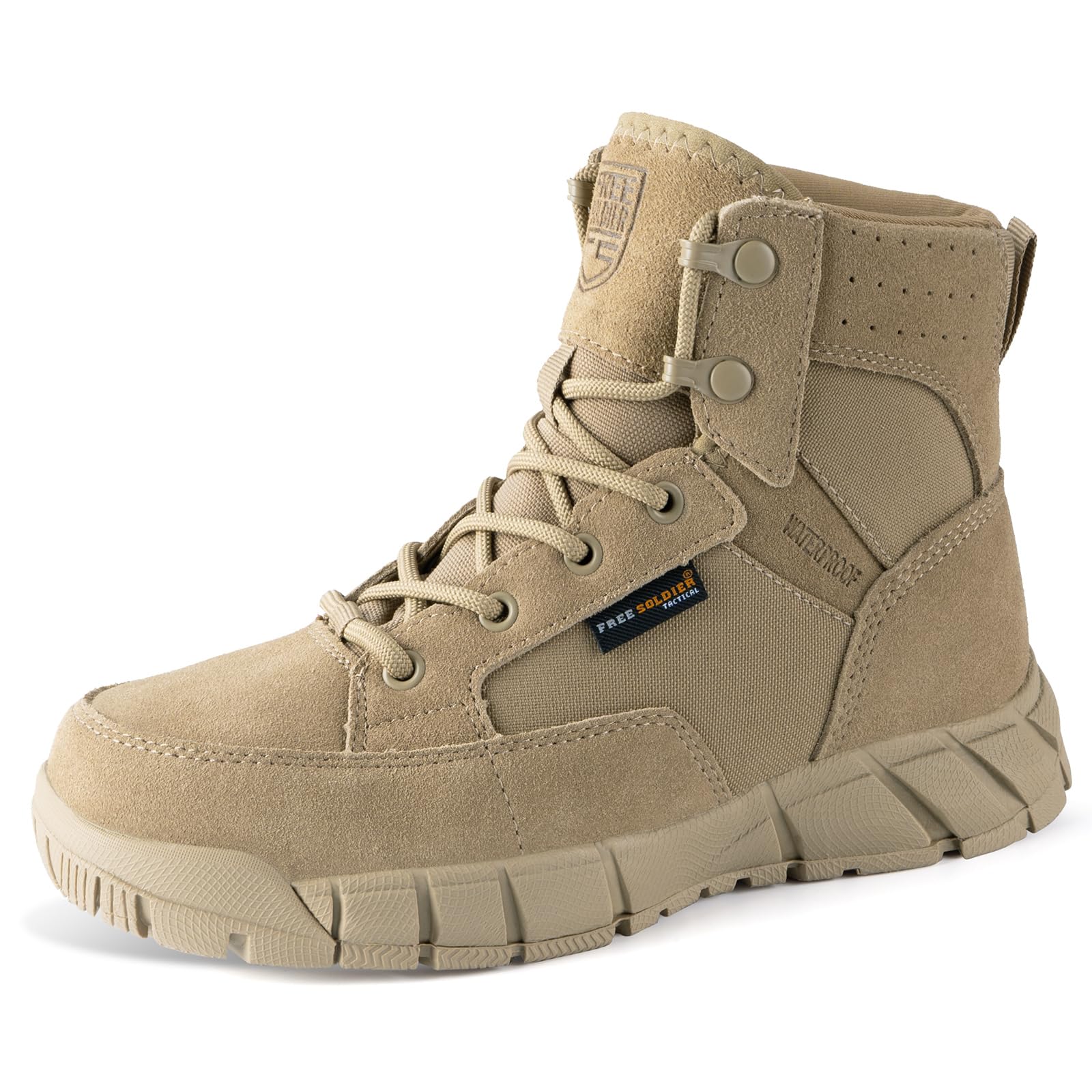
2. FREE SOLDIER Hiking Work Boots 6 Inches
A tactical shell that weighs 1.59 lb and shrugs off scratches as easily as rain.
The first number worth knowing here is weight: these come in at about 1.59 lb, which is light enough to wear through a long shift without your legs complaining. The upper mixes suede leather with 1005D Cordura fabric — a dense woven material built to resist scuffs and scrapes — over a reinforced toe cap and heel. A gusseted tongue (a flap that seals the gap behind the laces) keeps pebbles, sand and dirt from working their way in.
Wet weather gets handled by a waterproof leather upper plus a waterproof sock liner, a thin sealed layer that blocks rain and puddle water, while the breathable material lets air move so your feet don’t stew. The shaft climbs roughly 6 inches from the heel, giving real ankle coverage, and the heel sits at about 1.4 inches. For work or trail days that turn muddy, that is coverage you feel.
Comfort is the thing owners bring up most — one describes standing all day at work in them — and the wide toe box gets steady praise. The fit story is mixed, though: some buyers find them true to size while others say they run small, so checking your foot length against the size chart before ordering is worth the two minutes. A few also note less arch support than they wanted, so plan on adding an insole if you’re on hard floors all day.
Who it fits: anyone who wants a rugged tactical or work boot that stays light on the feet and keeps water out, and who wants a wide toe box rather than a tapered one.
The fit warning: sizing opinions split, and arch support is on the thin side — order with your measured foot length and budget for an insole.
Your pick if: long work days, muddy ground, and a boot that resists scrapes matter more to you than plush cushioning.
Think twice if: you need strong built-in arch support or you prefer to order your usual size without checking a chart.
3. AUSLAND Genuine Suede Waterproof Boots
The short winter boot you reach for when the sidewalk turns to slush.
Suede leather on the outside, thick fur lining and a faux fur insole inside — this pair is built for snow days and cold commutes, not mountain climbs. The ankle height keeps it easy to pull on with jeans or leggings, and the fur is what turns a cold morning into a comfortable one. It has been on sale since 2016, so the shape has had a decade to prove itself.
The look is what people respond to first, and quality runs right behind it — buyers describe them as still looking new after plenty of wear, which is the compliment that matters with suede. Warmth holds up through a real winter, and the value lands where people expect it. If your priority is a boot that looks put-together in snow and keeps your toes from going numb, this does that job.
Here’s the trade-off, and it’s a familiar one with fur boots: fit and the fur itself split opinion. Some find them roomy and toasty; others find them tight and the fur below their expectations. Sizing runs across a range, so measure your foot length and check the chart rather than assuming your usual number. Treat them as a comfort-first winter boot and you’ll be happy.
The draw: a genuine suede ankle boot with a thick fur lining at a budget-friendly tier — warm, good-looking, and built for snow-day errands.
The caveat: sizing is inconsistent enough that the size chart is your friend, and the fur quality varies from pair to pair.
Best matched to: cold-weather commuters who want a short, warm, good-looking suede boot and are happy to check measurements before ordering.
Not the one for: hikers or anyone who needs a boot to handle rocky, uneven ground.
4. Dansko Women’s Frankie Bootie
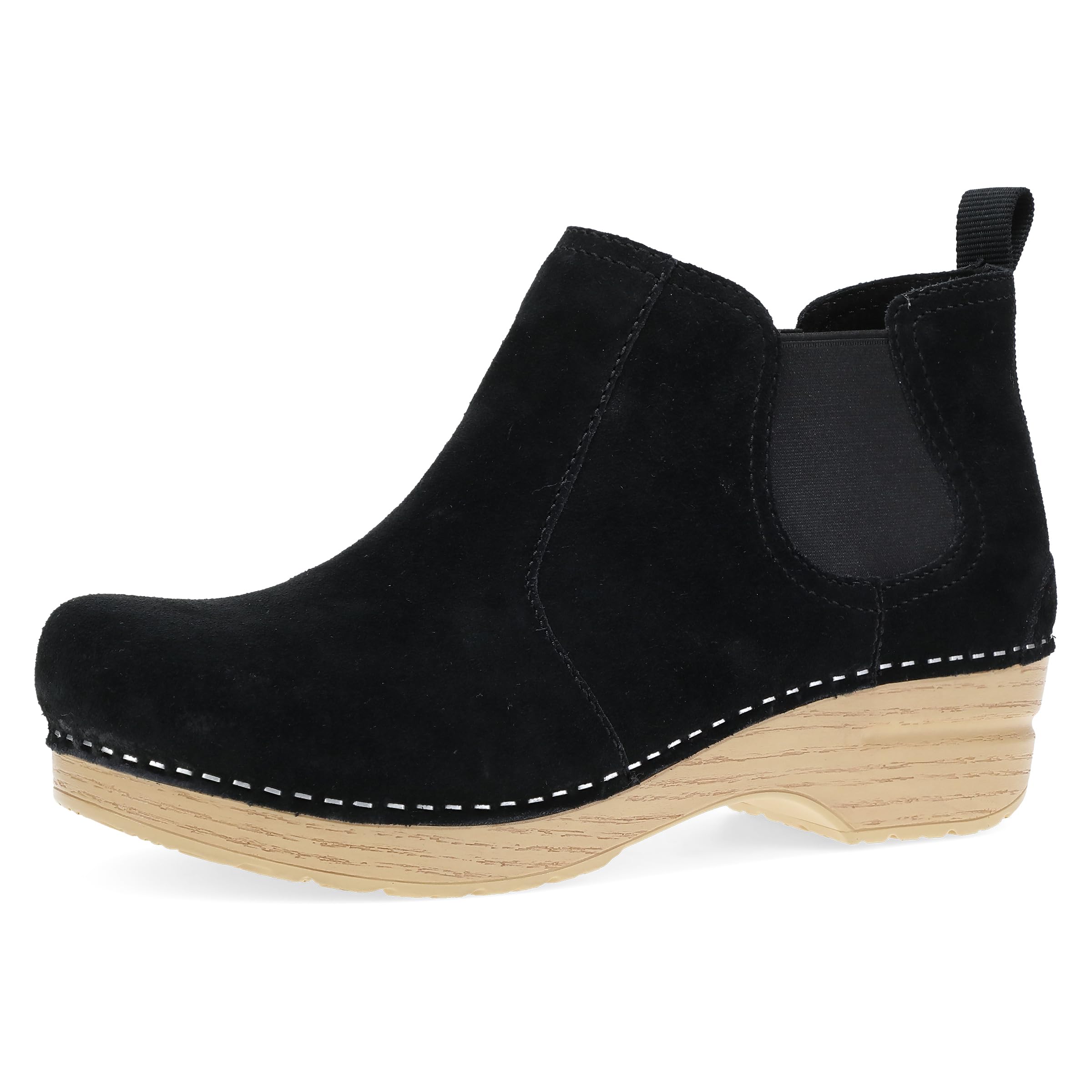
A waterproof suede bootie built for people who are on their feet nine hours straight.
What separates this one is the footbed: a high arch and firm ankle support, which is what a clog maker’s heritage translates into a boot. At 1.5 lb it stays manageable through a long day, and there’s no break-in period to survive — you lace up and go. The style is versatile enough to wear with almost anything, so it covers the office and the weekend without a second pair in the car.
Owners put it through 9-hour workdays and come back without soreness, which is the real test for a boot at this tier. Quality and comfort dominate the conversation, style lands right behind, and durability holds up. One buyer sums up the silhouette as a cute hybrid between clogs and boots — a fair read on the shape.
The one thing to watch is fit, which splits opinion. Suede doesn’t give much, so if you land between sizes, size against your measured foot length rather than guessing. Once you have the fit right, this is a boot that quietly disappears under your feet for a full shift.
Why it earns a spot
- High arch and ankle support for long hours standing
- No break-in — comfortable from the first wear
- Waterproof suede in a versatile, easy-to-style shape
What to expect
- Fit runs inconsistent, so check sizing carefully
- Not a cold-weather insulated boot — better for rain and city wet than deep snow
Made for: nurses, teachers, retail staff — anyone standing all day who wants arch support and a waterproof upper in one boot.
Pick another if: you need real winter insulation or you can’t order without trying the size first.
5. Danner Mountain 600 Waterproof Hiking Boots for Women

The hiking boot that feels like a tennis shoe until the trail turns rocky.
Danner built this alongside Vibram, and the pairing shows: a Vibram SPE midsole plus a Fuga outsole gives grip on wet and dry surfaces without the usual brick-on-your-foot weight. The upper is smooth suede, backed by Danner Dry waterproof protection — a sealed internal barrier rather than just a sprayed surface. It was designed around Pacific Northwest weather, which is a polite way of saying rain, mud, and roots.
Fit is the headline here, and by a wide margin — the shape works for foot after foot without the usual break-in misery. Comfort follows close behind: customers note they feel like tennis shoes and report no pain or blisters on the trail, and the light build keeps long hikes from turning into a slog. Traction earns consistent praise on slick ground, and pairs hold up over years of use.
Compare that to a heavier tactical-style boot and the difference lands where it counts — this one is built for distance, not duty. The catch is that suede needs occasional brushing and a protector to keep its looks, and the price sits in the premium tier, so it’s a buy-it-once proposition rather than a cheap spare pair.
The strongest argument: real all-weather grip from the Vibram sole and a sealed waterproof lining, wrapped in a boot that fits like a favorite sneaker and asks for almost no break-in.
Where it costs you: premium-tier pricing, and suede still wants care to stay looking new.
Worth the upgrade if: you hike regularly in wet, rooty, rocky terrain and want one boot that will last through it.
Overkill if: your walking is mostly pavement and errands, where a lighter ankle boot does the job.
6. Blondo Women’s Liam Waterproof

An ankle bootie that looks dressed up and handles a rainy sidewalk anyway.
At about 13 oz, this is one of the lightest pairs on the list — closer to a shoe than a boot in hand. The shape is an ankle bootie with a low stacked heel and a textured rubber sole for grip and flexibility, and the waterproof build is the feature that lets you wear it past the first autumn drizzle. There’s a braided tassel detail on the outer side that gives it a bit of character without shouting.
For a bootie this light, the quality lands better than you’d expect — owners talk about the leather and construction holding up, and the appearance gets a steady stream of compliments. Waterproofing does its job on wet commutes, which is exactly the point of buying suede with a sealed build.
Now the honest part: sizing is the sticking point. This cut runs tight through the width, so if your feet are on the wide side, consider sizing up or trying your normal size plus a half. Suede won’t stretch much to rescue a snug fit. Treat it as a shoe for city days and light rain, and it earns its place in the rotation.
The appeal: a light 13 oz waterproof suede bootie with a low heel that looks right with jeans, trousers, or a dress, and shrugs off wet sidewalks.
The fit reality: narrow through the width, so wide-footed buyers should plan to size up rather than hope for stretch.
Fits the bill for: commuters and office wearers who want a polished bootie that survives rain, and whose feet run average to narrow.
skip it if: you have wide feet or you need a boot for snow and deep slush rather than city damp.
7. SOREL Men’s Buxton Pull On Waterproof Boot
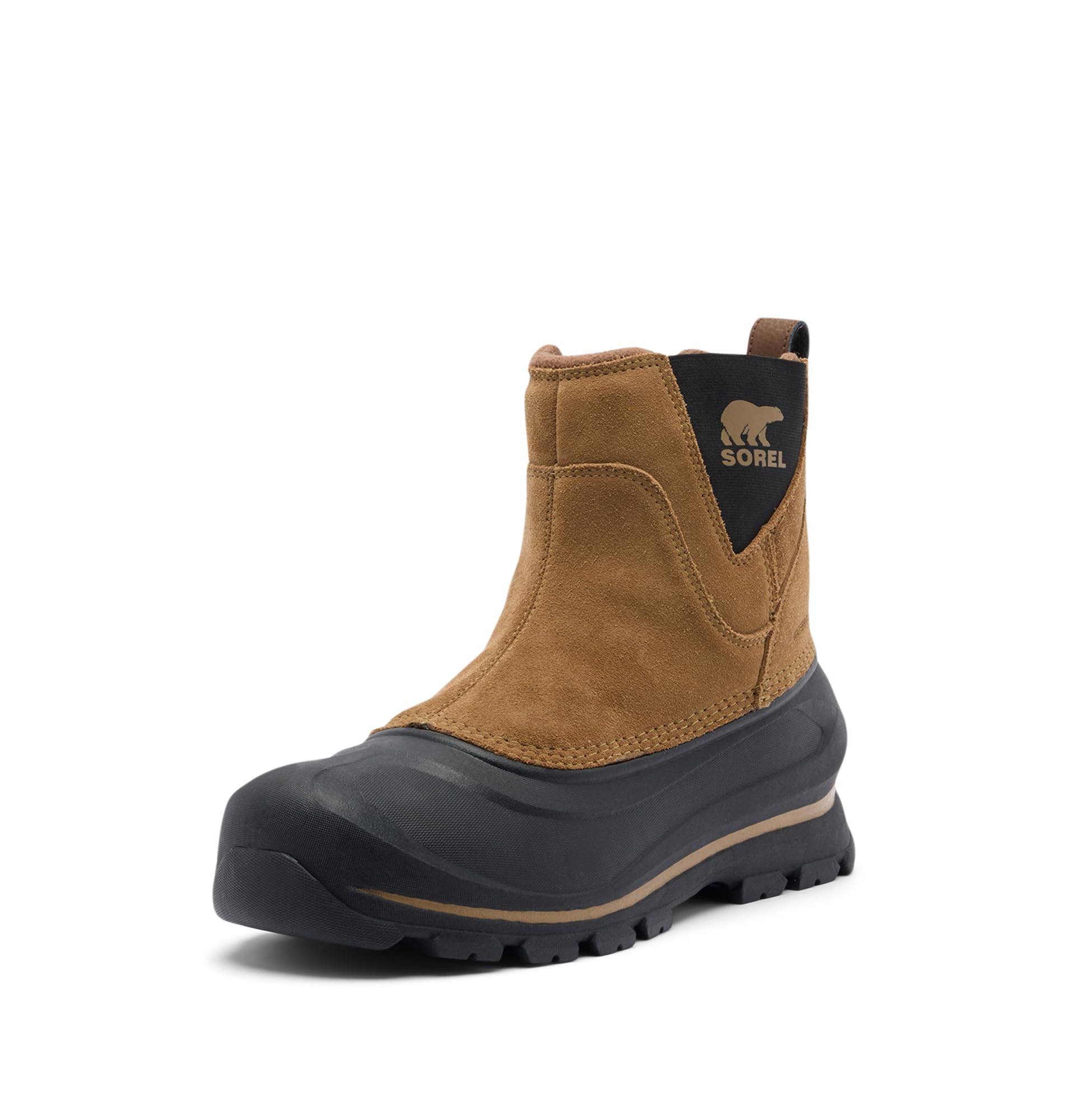
A pull-on snow boot with winter insulation built into every layer.
This one is engineered around cold. Waterproof suede and an injection-molded thermal rubber upper sit over 200g of insulating fabric lining — 200g being the grams-per-area measure of how much warmth the lining traps — and the thick rubber sole includes a 2.5 mm felt antifreeze plug underfoot to stop cold creeping up from the ground. A padded collar and tongue cushion the top of the boot for comfort on long walks.
Owners describe them as comfortable enough to feel like slippers, and the insulation and waterproofing both get credit for keeping snow and rain on the outside. For city streets in a hard winter or a weekend upstate, that combination is exactly what you want.
The tension, and it’s worth knowing upfront, is getting them on. It’s a pull-on design with no laces, and some buyers find the opening too tight to slide into easily. Sizing also runs small, so going up is a sensible call if your feet land between sizes. Warmth and build quality carry the day; just go in expecting a firm pull and a half-size worth of adjustment.
Built for the cold: 200g insulation, thermal rubber upper, and an antifreeze plug in the sole — real winter engineering, not a fashion boot.
The one friction point: pull-on entry can be a struggle, and the sizing runs small enough that you should size up if unsure.
Choose this if: you face real snow and sub-freezing mornings and want a warm, well-insulated boot you can pull on fast.
Look past it if: you need easy on-and-off entry or you have wide feet that need a roomier opening.
8. Women’s Waterproof Suede Leather Tall Winter Boots

A tall boot built to hold warmth down to -25°C with a waterproof membrane inside.
These are the warmest boots in this lineup on paper, and the numbers tell you why. The lining pairs 200g of 3M Thinsulate — a synthetic insulation that traps body heat — with 800g of faux fur, and the maker rates the pair down to -25°C / -13°F. An insulated midsole with a layer of aluminum foil adds another barrier to keep warmth in and cold out, and natural wool insoles wick moisture so feet don’t get clammy.
Waterproofing runs deeper than the surface here: a CanDry waterproof build with seam sealing or an internal breathable membrane, plus treated tongues and zippers and integrated gussets. On top of that, spacer inserts let you dial in fit, and laces adjust the calf for a custom feel — a rare bit of tune-ability on a tall boot.
Appearance is what people fall for first, and comfort and warmth come right on its heels — buyers describe the feeling as wearing a coat on your legs. The fit runs snug, though, and the maker’s own guidance is to size up if your foot length sits close to the insole or you wear thick socks. Suede this premium also wants regular brushing to keep salt and slush from dulling it.
Why it stands out: 200g Thinsulate plus 800g faux fur rated to -25°C / -13°F, sealed CanDry waterproofing, and an adjustable calf — a genuine deep-cold build with style to match.
What it asks: a snug fit means many buyers should size up, and premium suede needs brushing and a protector to stay looking its best.
The right call for: people in genuinely cold climates who want the warmest, tallest boot here and don’t mind a snug initial fit.
Not for you if: you need an easy slip-on for quick errands or you prefer a minimal, low-maintenance boot.
Know the Specs
Waterproof suede and membrane technology
A waterproof suede upper is suede that has been treated so water beads on the surface instead of soaking in. That handles light rain. A membrane — a thin sealed layer built inside the boot, like Danner Dry or CanDry — is what keeps water out when you actually stand in a puddle. The best pairs combine both: treated suede outside, sealed membrane inside. If a listing names no membrane and no treatment, assume it is a dry-weather boot.
Insulation weight in grams
Insulation is measured in grams, which tells you how much fill the lining carries — the higher the number, the warmer the boot. A pair with 200g of 3M Thinsulate is built for winter, and one rated to -25°C / -13°F is meant for deep cold. Higher grams mean more warmth but also more bulk and less breathability, so match the fill to your climate instead of maxing it out.
Shaft height and heel
The shaft is how far the boot rises from the heel. A 6-inch or ankle-high boot covers the ankle and stops there, while a tall boot climbs the calf and blocks more snow. A low stacked heel is easy to walk on all day; a flat, no-heel build is more stable on uneven ground. Taller shafts give more coverage but take longer to pull on.
Outsole and traction
The outsole is the bottom of the boot and decides your grip. Rubber outsoles with a geometrical, non-slip pattern hold on wet pavement and loose dirt. Brands sometimes mix materials — like a Vibram midsole and outsole combo — for grip without extra weight. An antifreeze plug or foil layer in the sole is a winter extra that slows cold coming up from frozen ground.
Common Questions
How do I keep suede boots waterproof over time?
Will waterproof suede boots keep my feet dry in heavy snow?
Are insulated suede boots too warm for fall?
Should I size up in waterproof suede boots?
Do I need a membrane if the suede is already treated?
How do I clean salt stains off suede in winter?
Are pull-on snow boots harder to get on than laced boots?
What is the warmest boot here for sub-freezing weather?
Can I wear waterproof suede boots for hiking?
How should I break in new suede boots?
The Bottom Line
For most people shopping for the best waterproof suede boots, the Columbia Women’s Transverse Suede is the easy answer — a waterproof suede upper with trail grip and a roomy fit that takes thick socks, and and it holds 4.5+ stars across 800+ ratings. If the trail is your real terrain and you want the finest grip and no break-in, step up to the Danner Mountain 600. For deep cold and heavy snow, the tall winter boot brings the most warmth on paper. And for a light, polished bootie built for rainy commutes, the Blondo Liam earns its place in the rotation.
How we choose
We do not accept paid placement. Every pick is matched to a real buyer and a real use-case; we do not hands-on test units.
Sources
Specifications: manufacturer listings and product documentation. Review insights: verified customer reviews, as of November 2026. Pricing: not shown on this page (it changes often); check the current price via the retailer link.
As an Amazon Associate, Tactical Gear Guy earns from qualifying purchases. This does not affect which products we feature.