Specs are compiled from manufacturer listings and verified buyer reviews and can change over time — please confirm the key details on the product page before buying.
If you want one machine that plugs into a normal wall outlet, welds steel plate, and fits in a truck bed, the short answer is this: buy the Lincoln Electric 90i FC if you want the smoothest arc and least fuss, or the ARCCAPTAIN 200A if you need to weld aluminum and want six processes in one box. Everything else here is a variation on those two jobs — lighter, cheaper, more modes, or a bigger accessory box — and the rest of this page sorts out which variation fits your garage, your farm, or your weekend project.
This guide is built by comparing the manufacturers’ published specifications and the patterns across verified customer reviews, so you get each pick’s real strengths and trade-offs instead of marketing spin.
Portable welders live or die on three things: how many amps they push, whether they run on 110V or 220V, and how much they weigh when you carry them to the job. Below you get all three for every machine, plus the honest catch on each — what it does well, and where it will leave you wanting more. For home garages and job sites where the machine has to travel, this portable welding set list covers the models that actually earn their spot.
Top Picks
How To Choose The Best Portable Welding Set
A portable welding set is really a box of decisions stacked on top of one another. Get the power source wrong and a 220V-only machine sits in the corner of a garage that only has a 110V outlet. Get the weight wrong and a 27.5 lb unit stops making the trip to the fence line after the second haul. Get the process wrong and you own a MIG welder when the job needed stick. Work through the four choices below in order and the field narrows itself.
Start with the outlet, not the machine
The single biggest filter is input voltage. A 120V-only machine plugs into any household outlet, so it works anywhere there is a wall socket — that is the Lincoln 90i FC and the Forney 271. A 110V/220V dual-voltage machine gives you the option of a hotter, more stable arc when a 220V circuit is available, which matters for thicker steel and longer beads. If you only have a standard garage outlet, buying a 220V-only unit is the fastest way to own a welder you never use.
Match amperage to the metal thickness you actually weld
Output current, measured in amps, sets the thickness ceiling. A 135A machine handles the 1/8-inch and 3/16-inch work that most home repairs involve. A 165A or 200A unit gives you headroom for thicker plate and longer continuous welds before the machine starts to struggle. Beginners consistently over-buy here — you need enough amps for your real projects, not the thickest plate in a catalog.
Weigh what you will actually carry
A 27.5 lb welder feels like 40 lb by the third trip to the fence line. Machines in this group run from 8.6 lb to 27.5 lb, and that range is the difference between one-handing it up a ladder and needing a second person. If the welder lives on a bench, the 27.5 lb YESWELDER costs you nothing. If it rides in a truck or gets carried across a field, the 8.6 lb HITBOX 200A and 9.9 lb HITBOX 145A are the ones you will actually take with you.
Decide how much setup work you want to do
Synergic control means the machine suggests voltage and wire feed speed once you tell it the wire diameter or the current — less knob-twisting, faster first bead. Manual control gives you every dial and lets you dial in a weld the machine would never guess. Synergic suits the welder who wants a bead this weekend; manual suits the fabricator running the same joint all day. A beginner who wants a bead this weekend should start with synergic control. A fabricator who welds the same joint all day wants the dials.
Side-by-Side Comparison
| Model | Best For | Output | Input Voltage | Weight | Amazon |
|---|---|---|---|---|---|
| Lincoln Electric 90i FC★ Best Overall | Smoothest arc for home repairs | 20 to 120 A | 120V | 15 lb | Amazon |
| ANDELI 135A Pulse MIGFull Kit Pick | Field work with a full kit | 135 A | 110V/220V | 18.55 lb | Amazon |
| BESTMIG 135A 3-in-1Featherweight Pick | Beginners who want everything included | 135 A | 110V | 10.71 lb | Amazon |
| Bestarc 145A | Garage fabrication on either voltage | 145 A | 110V/220V | 22.6 lb | Amazon |
| HITBOX 145A 3-in-1 | Light repair and first practice | 145 A | 110V/220V | 9.9 lb | Amazon |
| HITBOX 200A | Moving between garage, farm and jobsite | 200 A | 110V/220V | 8.6 lb | Amazon |
| YESWELDER 160A | Shop workhorse on a budget | 160 A | 110V/220V | 27.5 lb | Amazon |
| YESWELDER 165A | Upgraded torch and stick controls | 165 A | 110V/220V | 25.7 lb | Amazon |
| ARCCAPTAIN 160A | Carrying by handle or shoulder strap | 160 A | 110V/220V | 10 lb | Amazon |
| ARCCAPTAIN 200A MIG200 | Six processes including aluminum | 200 A | 110V/220V | — | Amazon |
| Forney 271 Easy Weld 140 MP | All-metal case, simple controls | 140 A | 120V | 25.8 lb | Amazon |
Detailed Reviews
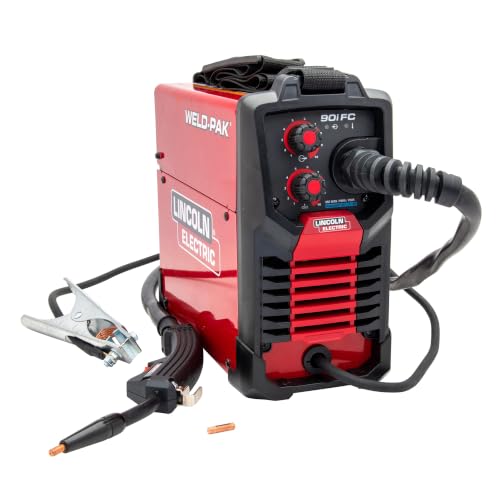
1. Lincoln Electric 90i FC Flux Core Welder, 120V, K5255-1
Our pick — 4.5+★ from 550+ verified ratings; the strongest balance of quality and price.
The 15-pound inverter that turns a household outlet into a welding station.
Here is the whole pitch in one line: this is a 15 lb welder with a shoulder strap that runs on a standard 120V outlet and lays down flux-core wire with no gas bottle anywhere in sight. Lincoln builds it as an inverter machine — meaning it converts wall power electronically rather than through a heavy transformer, which is why it weighs 15 lb instead of 25 or 30. For a home garage, a fence repair, or a gate hinge that snapped on a Saturday, that combination means you carry it out, plug it into the same outlet as your coffee maker, and weld.
What wins people over, judging by the long trail of owner feedback, is the arc quality on thin material. Two simple knobs set wire speed and voltage across 20 to 120 amps of output, and the infinite voltage control lets you fine-tune rather than click between presets. Owners also single out the cold feed switch, which lets you swap a wire spool without the wire going live. The machine welds steel up to 1/4 inch, and the whole thing packs down to about 11 x 13 x 5 inches with a protective metal case over it.
The honest catch is the 120V ceiling and the 120-amp top end. There is no 220V option here, so you will never get the hotter, more stable arc that a dual-voltage machine offers on thicker plate. If your projects are 1/4-inch and under — hinges, brackets, trailer patches, exhaust hangers — that is a non-issue, and you get the least complicated machine on this list in return. A one-year warranty covers the machine, with 90 days on the gun and cable.
Where the 90i FC earns its keep
- Runs on 120V, so any household outlet works — no 220V circuit needed.
- 15 lb with a shoulder strap and carry handle; it travels to the job rather than sitting on a bench.
- Flux-cored wire means no shielding gas bottle, so wind outdoors does not wreck your weld.
- Two-knob control and infinite voltage fine-tuning make it easy to dial in without a manual open.
What you give up
- No 220V option and a 120-amp ceiling — thin to medium steel only.
- Wire and gun/cable warranty runs shorter than the machine coverage.
Reach for this if: you have a normal wall outlet, weld 1/4-inch steel or thinner, and want the machine from the start and onto the workbench with the least possible fuss.
Look elsewhere if: your projects regularly need thicker plate and you have a 220V circuit available — the dual-voltage machines further down give you that extra headroom.
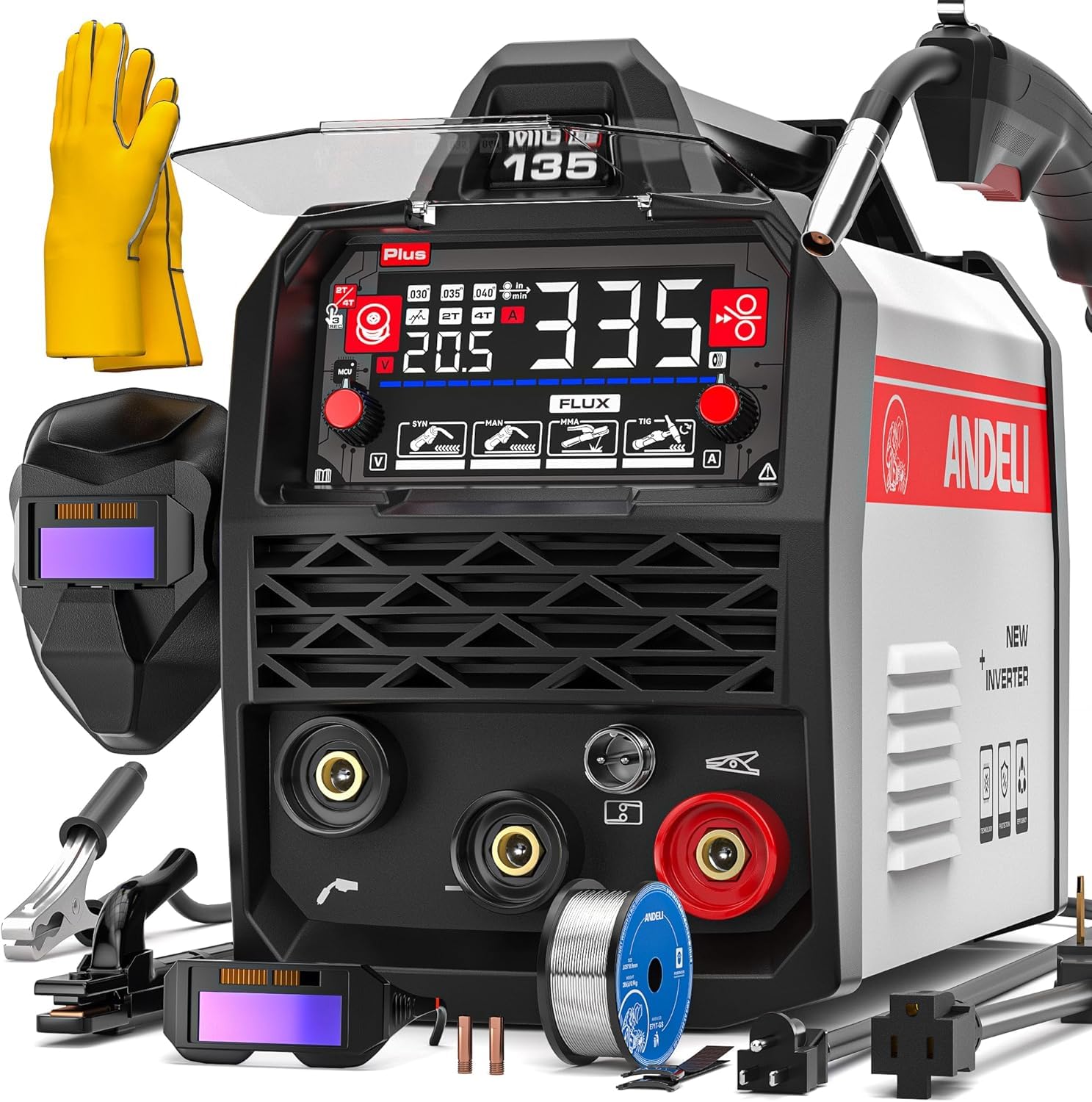
2. ANDELI 110V/220V Pulse Flux Core MIG Welder 135A
One box that shows up with the helmet, the gloves, and the wire already inside.
Most welders ship you a machine and a shopping list. This one ships the whole start-up kit: the 110/220V power adapter, flux core wire, two MIG torch contact tips, an electrode holder, a welding torch, a ground clamp, leather gloves, an auto-darkening helmet that converts to goggles, and the welder itself. If you are starting from nothing, that difference is real — one delivery instead of three, and no afternoon lost realizing the helmet you own is a grinder face shield.
The machine underneath is a 135A pulse MIG that welds material up to 5.0 mm (3/16 inch) thick, with adjustable inductance control to calm spatter and a 4.1-inch LED display you can read without lifting your helmet. That display has a transparent protective cover over it, which sounds minor until you have watched sparks land on an unprotected screen. Dual voltage lets you run 110V for home work and 220V when you want more stable output. It supports.030,.035, and.040 flux-core wire, and it runs flux-cored MIG with pulse, gasless MIG, Lift TIG, and MMA — with one note: the Lift TIG torch is sold separately.
Set the weight expectation honestly. At 18.55 lb against the 10.71 lb BESTMIG, and roughly 13 inches long against that machine’s 14.8-inch body, this is heavier than the lightest machines here but shorter in footprint, so it tucks onto a shelf. There is also a protective cover over the display and built-in voltage, over-current, overload, overheating, and over-voltage safeguards. The fit note: a handful of owners hit reliability issues, so buy from a seller with a clear return path and test it on arrival.
The kit math: add up a helmet, gloves, wire, tips, and a torch and you have most of a second machine’s worth of accessories; here they arrive together with a 135A pulse unit that tops out at 3/16-inch steel.
Best for: a first-time welder with no gear at all who wants one delivery to cover the machine plus the safety kit.
The trade-off: heavier than the lightest portables here at 18.55 lb, and the Lift TIG torch is an extra purchase if you want that mode.
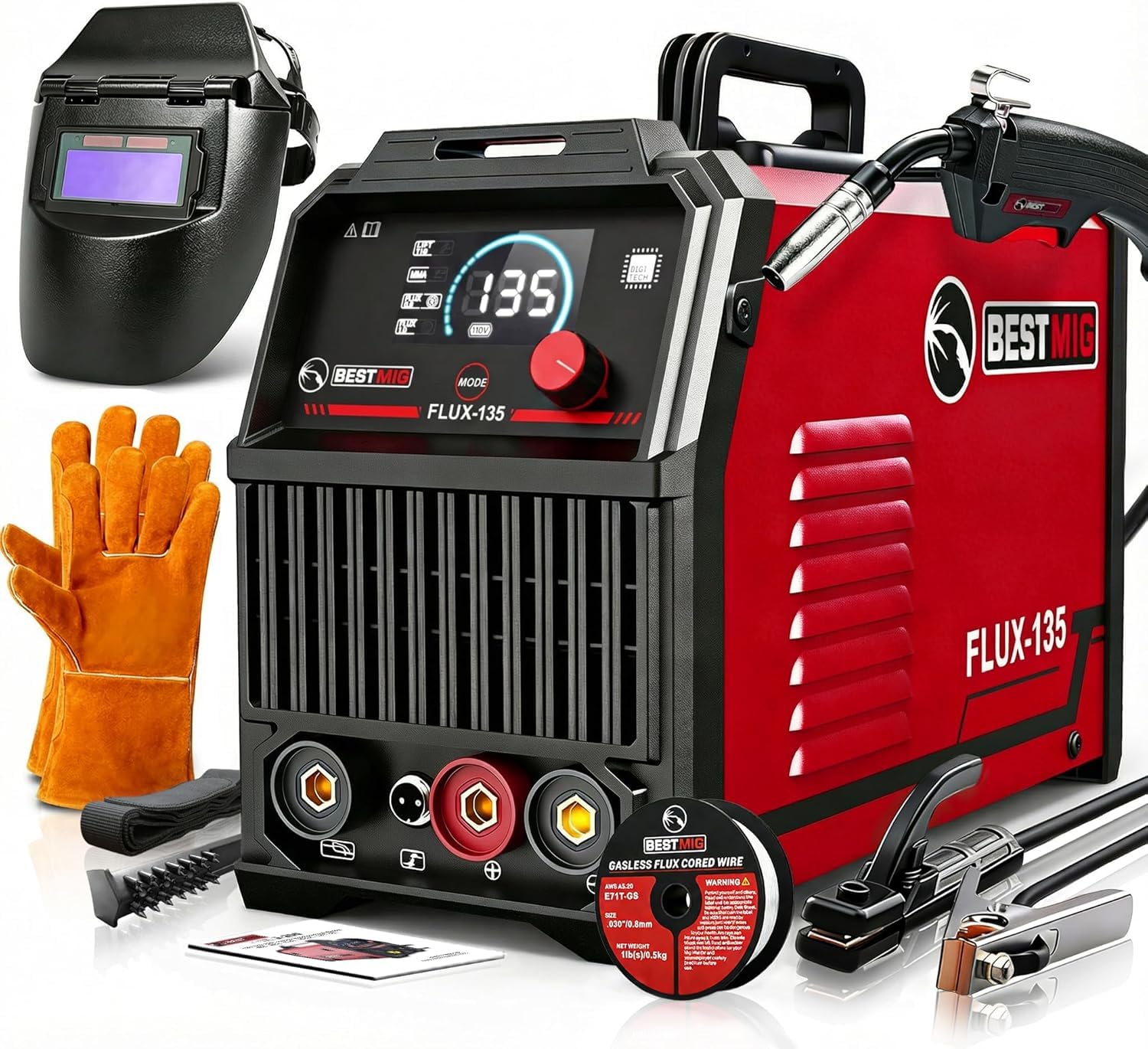
3. BESTMIG 135A 3-in-1 Flux Core Welder, MIG/Lift TIG/Stick
Ten pounds of welder that still ships with a helmet and a pair of gloves.
The number that decides this one is 10.71 lb. That sits against the 18.55 lb ANDELI, and at 14.8 inches long against the ANDELI’s 12.99-inch body — so it trades a little length for a lot of saved weight. Load it into a truck bed or carry it up a set of stairs and the difference shows up in your shoulder, not your imagination. The body measures 14.8 x 9.8 x 6.6 inches, so it stores on a shelf without eating a whole bay.
Three processes in one box: flux-core MIG, Lift TIG, and Stick, with true 135A output that welds material up to 1/8 inch. The accessory bundle follows the same all-in idea — ground clamp, electrode holder, welding torch, auto-darkening helmet that converts to goggles, leather gloves, flux core wire, and a wire brush. Setup is deliberately simple: load the spool, connect the gun, plug in, and start. The full-color LED display shows your parameters in real time, and integrated wire feeding adjusts voltage and feed speed to cut spatter. Note the TIG torch is not in the box.
Owners describe it as a solid tool for basic work with controls that are not hard to understand, and the included helmet and gloves do a lot of the convincing. The honest limit is thickness: 1/8 inch is the ceiling, so trailer frames and thick plate are not on the menu. For a first welder making repairs around a house or a small shop, that ceiling rarely gets in the way.
Where it lands: light enough to carry anywhere, bundled enough to start the same day, and honest about its 1/8-inch thickness limit.
Pick this one if: portability matters more than capacity and you want the helmet and gloves in the same box.
Keep looking if: you need to weld thicker than 1/8 inch or want a 220V mode.
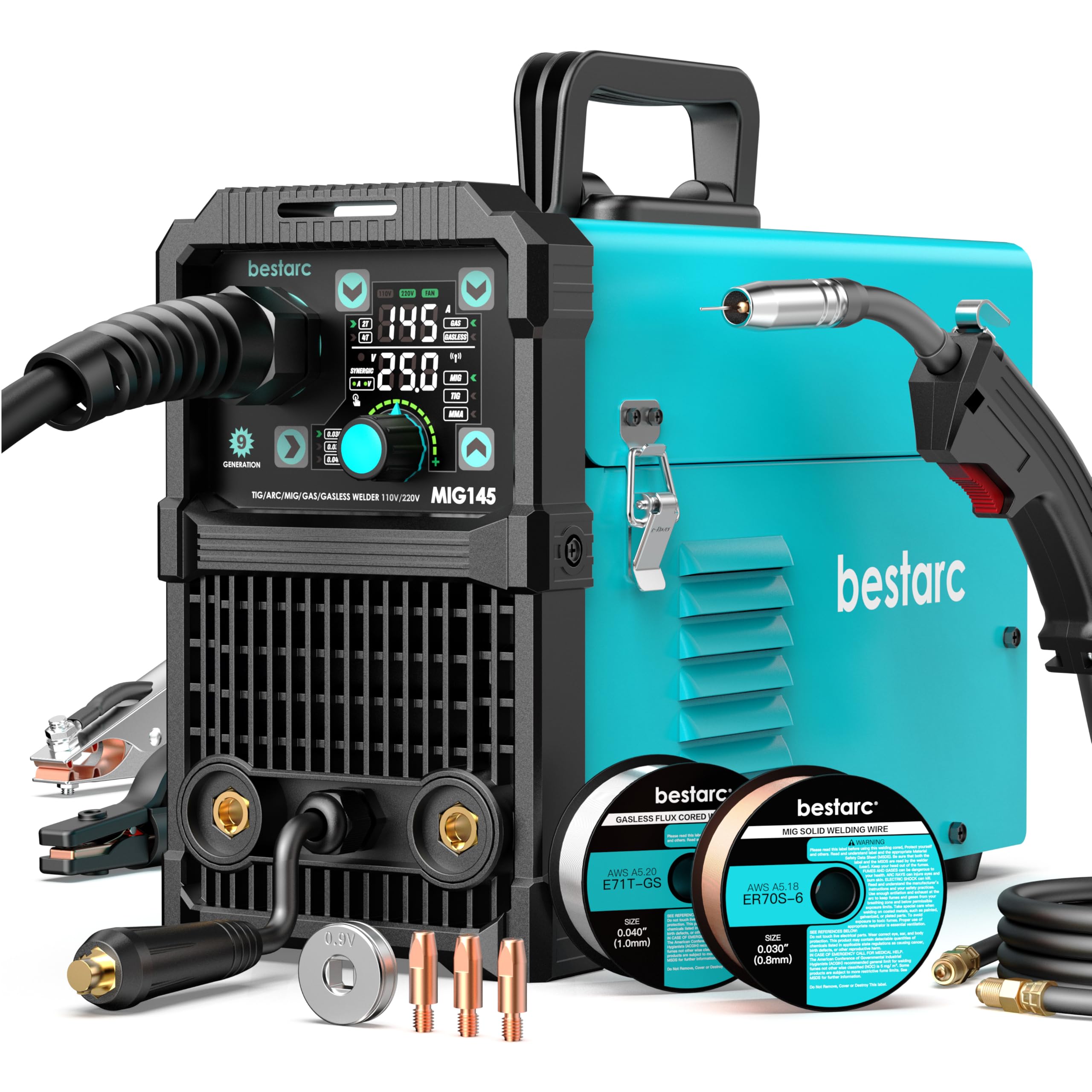
4. Bestarc 145A MIG Welder
The 145-amp do-it-all that switches between gas and gasless without a fight.
At 145A this machine runs hotter than the 135A group around it — the ANDELI and BESTMIG both cap at 135A, so you get a bit more reserve for thicker stock and longer beads. The 4-in-1 layout covers gas MIG, gasless flux core MIG, Lift TIG, and Stick, so you can switch to flux core for outdoor work where wind would blow away a gas shield, then back to solid wire with gas for clean indoor welds. That flexibility is why it suits a garage that sees every kind of job.
Synergic control does the setup thinking. Pick your wire and the machine matches voltage and wire feed speed; then nudge the voltage from -3V to +3V when you want more precision. Dual voltage 110/220 detects the input and shows it on the front panel, so there is no guessing which outlet you are on. The built-in protection set covers voltage fluctuation, over-current, over-load, and over-heating — the same family of safeguards the other dual-voltage machines here carry.
Performance is where the feedback lands hardest, with functionality close behind — owners talk about strong, clean results rather than a machine that merely runs. Weigh the trade carefully at 22.6 lb: that is the heaviest of the mid-group, well above the 10.71 lb BESTMIG and the 15 lb Lincoln. Durability feedback is split, so treat it as a machine that likes being plugged into steady power and stored dry rather than bounced around a truck bed. It handles 0.030, 0.035, and 0.040 flux core wire plus 0.030 solid wire.
What it brings to a garage
- Four processes — gas MIG, gasless flux core, Lift TIG, and Stick — in one unit.
- 145A output with synergic setup plus a -3V to +3V voltage trim for fine work.
- Dual 110/220V with an automatic input readout on the panel.
What to plan around
- 22.6 lb puts it among the heavier mid-range machines here.
- Durability stories run mixed, so steady power and dry storage matter.
The right call when: you want a fixed bench machine with four processes and the amps to handle real fabrication on either voltage.
Think twice when: the welder has to travel every weekend — this one earns its keep in one spot.
5. HITBOX 145A MIG Welder
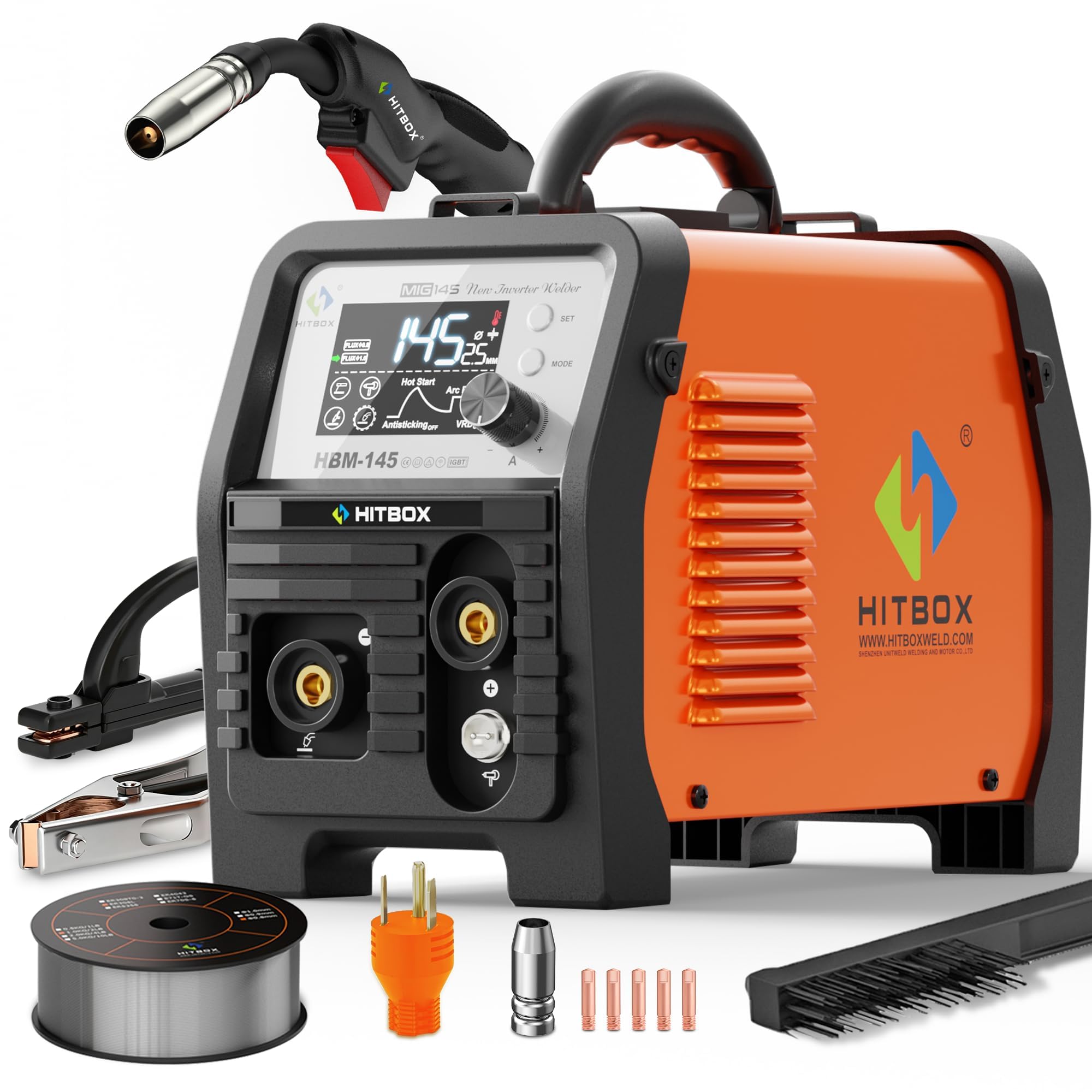
9.9 pounds with 110V and 220V both on the menu.
Very few machines combine dual voltage with a weight this low. At 9.9 lb the HBM145 is lighter than the 10.71 lb BESTMIG and far below the 15 lb Lincoln, yet it still offers 110V for the home garage and 220V when you want more stable output at a bench. That combination — carry it anywhere, plug into either — is the reason this one earns a spot rather than blending in with the single-voltage crowd.
Three processes cover the practical repair range: flux core MIG, Stick/MMA, and Lift TIG. Synergic control matches voltage and wire feed speed after you set the current, and a ±3V fine-tune window gives you room to adjust the arc for different material. The LCD shows real-time parameters, and on the Stick side you get Hot Start, Arc Force, Anti-Stick, and VRD support — features that make stick welding forgiving for someone still learning to strike an arc. The kit includes a 7.9 ft 14AK MIG gun, a flux core wire spool, welding rods, an adapter plug, a hammer, nozzles, and a ground clamp.
The limits are worth knowing up front. It is built for light repair, first practice, and small projects rather than production welding, and two useful accessories are missing: a Lift TIG torch and a spool gun. If you want TIG capability, budget for the torch separately. For a first machine that moves between a garage and a truck, though, the weight-to-voltage ratio here is hard to argue with.
Worth grabbing if: portability is your top priority and you want both voltage options in a machine under ten pounds.
The honest gap: Lift TIG and spool gun are extra purchases, and this is a light-repair machine, not a fabrication rig.
6. HITBOX 200A MIG Welder
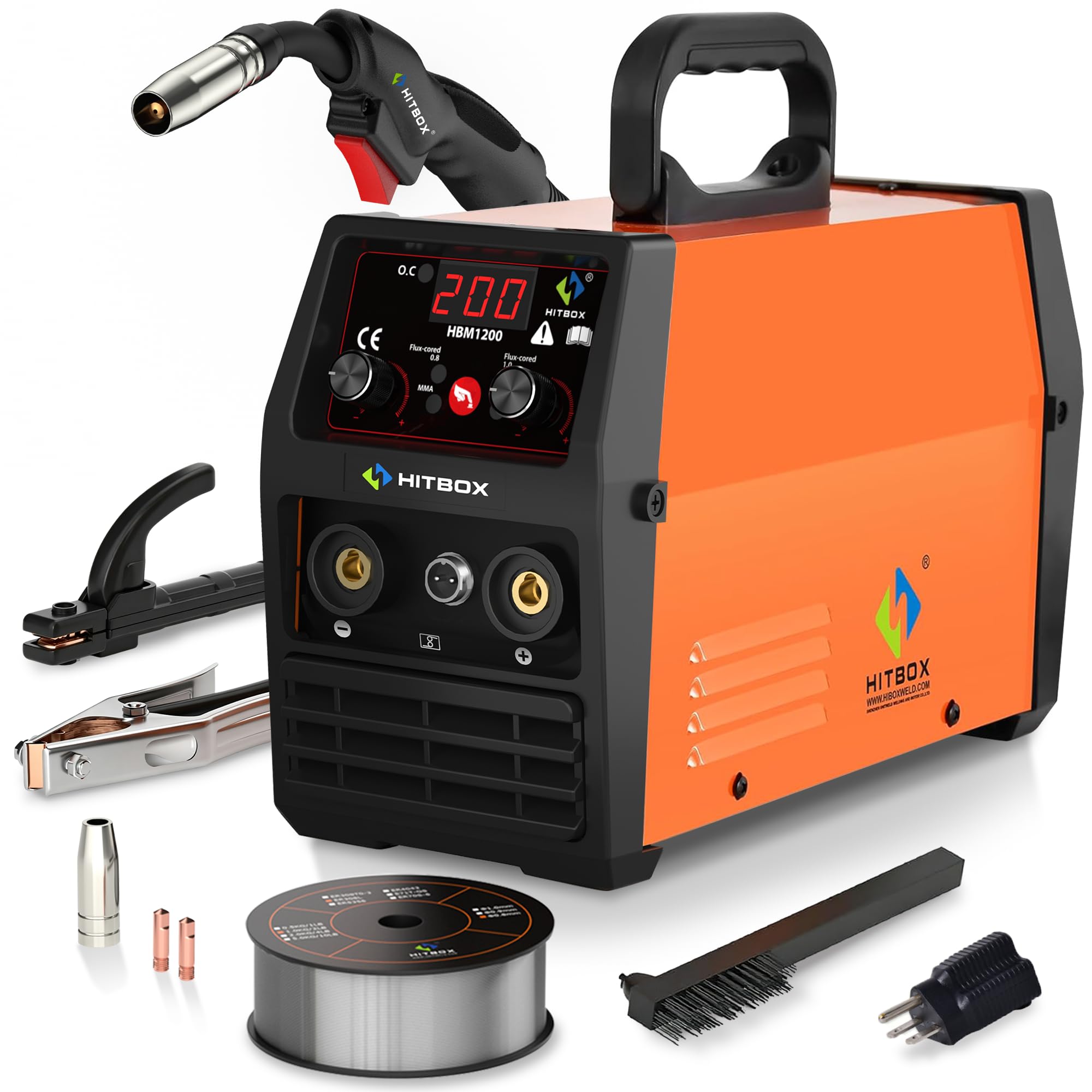
Eight and a half pounds with a 200-amp label on the side.
Read that weight again: 8.6 lb, with a built-in carrying handle. For someone moving between a garage, a workshop, a farm, and a job site, that is the whole argument — you can carry it with one hand and weld the same repairs the heavier units handle.
The 3-in-1 layout covers gasless flux core MIG, MMA, and Lift TIG, aimed at carbon steel, stainless, and iron work. Synergic control automatically coordinates voltage and wire feed speed when you adjust the current or wire diameter, which shortens setup for a beginner and speeds up a repetitive job for someone experienced. The protection set — over-current, overload, over-voltage, and overheat — sits inside a metal housing that takes the knocks of shop life. For a compact machine its size, the welds are described as surprisingly fine.
The caution flag here is durability, and it is a louder note than on most machines in this group. Multiple owner reports describe units coming apart after minimal use, and wire feed and instructions also draw criticism. That does not mean every unit is a problem, but it does mean this is a machine to test thoroughly in the return window rather than one to trust on a critical job without a backup. Buy it for convenience and light repair, and keep the receipt.
The trade in plain terms: the lightest 200A body here with the simplest setup, balanced against the most durability complaints in this lineup.
Go for it if: you want the lightest machine available with a synergic setup and you are doing light repair work.
Weigh the risk if: you need a machine to run production jobs — the durability feedback here is too consistent to ignore.
7. YESWELDER 160A MIG Welder
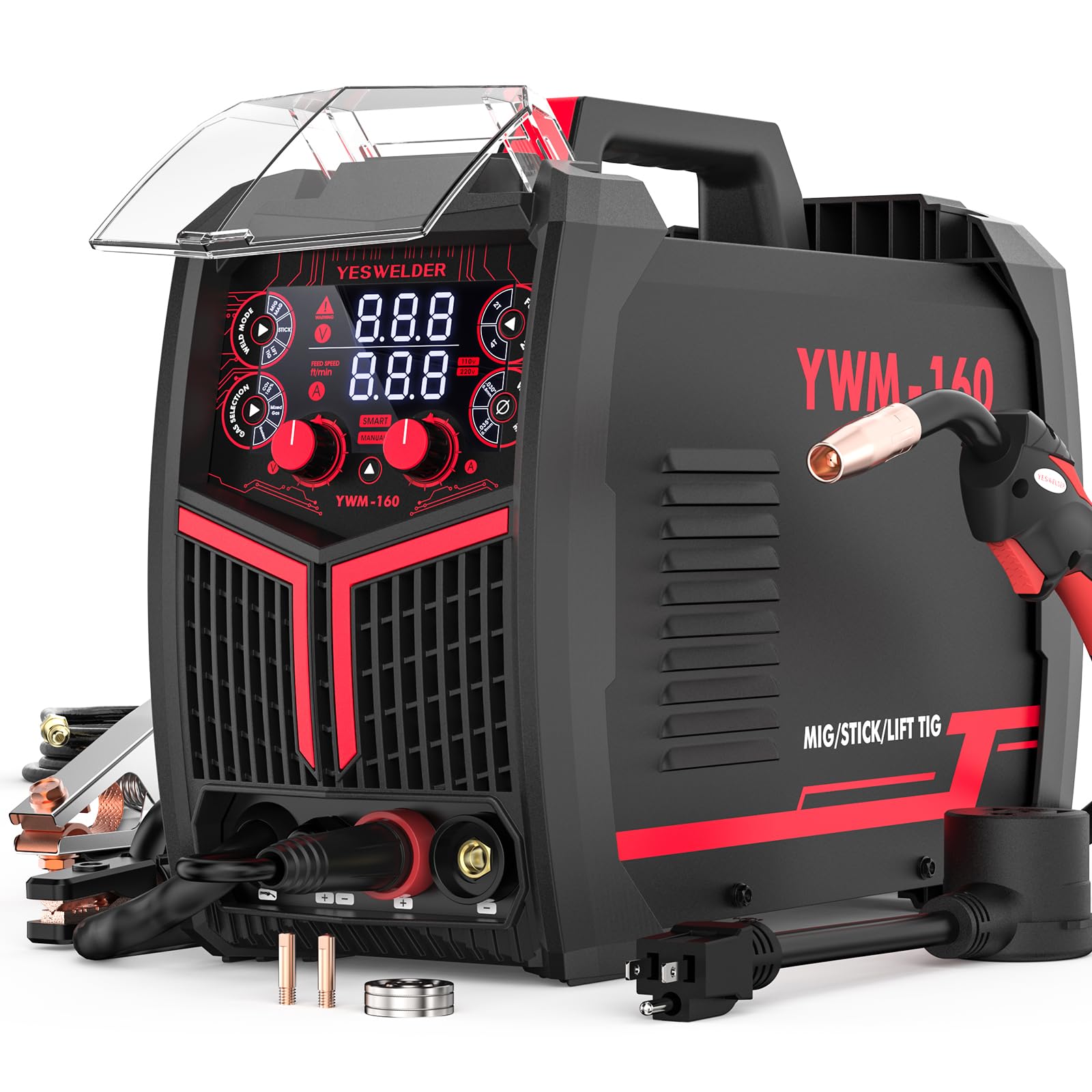
A 160-amp four-process machine that lets you choose smart control or full manual.
This is the machine for someone who wants to grow into their welder rather than out of it. Four processes — flux core MIG, gas MIG, Stick, and Lift TIG (with the TIG torch bought separately) — backed by 160A of output. There are two control philosophies built into one box: synergic control where the machine suggests the voltage and wire feed speed once you pick a thickness or amperage, and a manual mode where you set wire speed and voltage yourself. Beginners start in smart mode; the same machine becomes a shop tool once you know what you want.
The LED digital display gives you a clear readout of your settings, and the protection suite covers voltage fluctuation compensation, over-current, over-load, and over-heating. Quality is the loudest theme in what owners say, with functionality right behind it — this is the machine people describe as doing everything they need without drama. Value comes up often too, especially from buyers who expected to spend more for the same capability.
Then there is the weight. At 27.5 lb this is the heaviest welder on this page, heavier than the 25.7 lb YESWELDER 165A and a long way from the 10.71 lb BESTMIG. It is a bench machine — set it on a cart or a workbench and leave it. Durability feedback is mixed rather than unanimous. If your welding happens in one spot with power close by, the heft is irrelevant and the four processes carry the day.
Why it holds a spot
- 160A and four processes, with synergic mode for beginners and manual mode for experienced welders.
- Owners consistently describe it as doing everything they need.
- LED digital display and a full protection suite for voltage swings and overheating.
The catch you should know
- 27.5 lb — the heaviest model here, so it lives on a bench rather than in a truck.
- Durability feedback is mixed, so steady power and dry storage matter.
Best suited to: a fixed shop bench where the machine never travels and you want smart mode now with manual dials later.
Not the one for: anyone hauling a welder to different jobs — the 27.5 lb body makes that a chore.
8. YESWELDER 165A MIG Welder
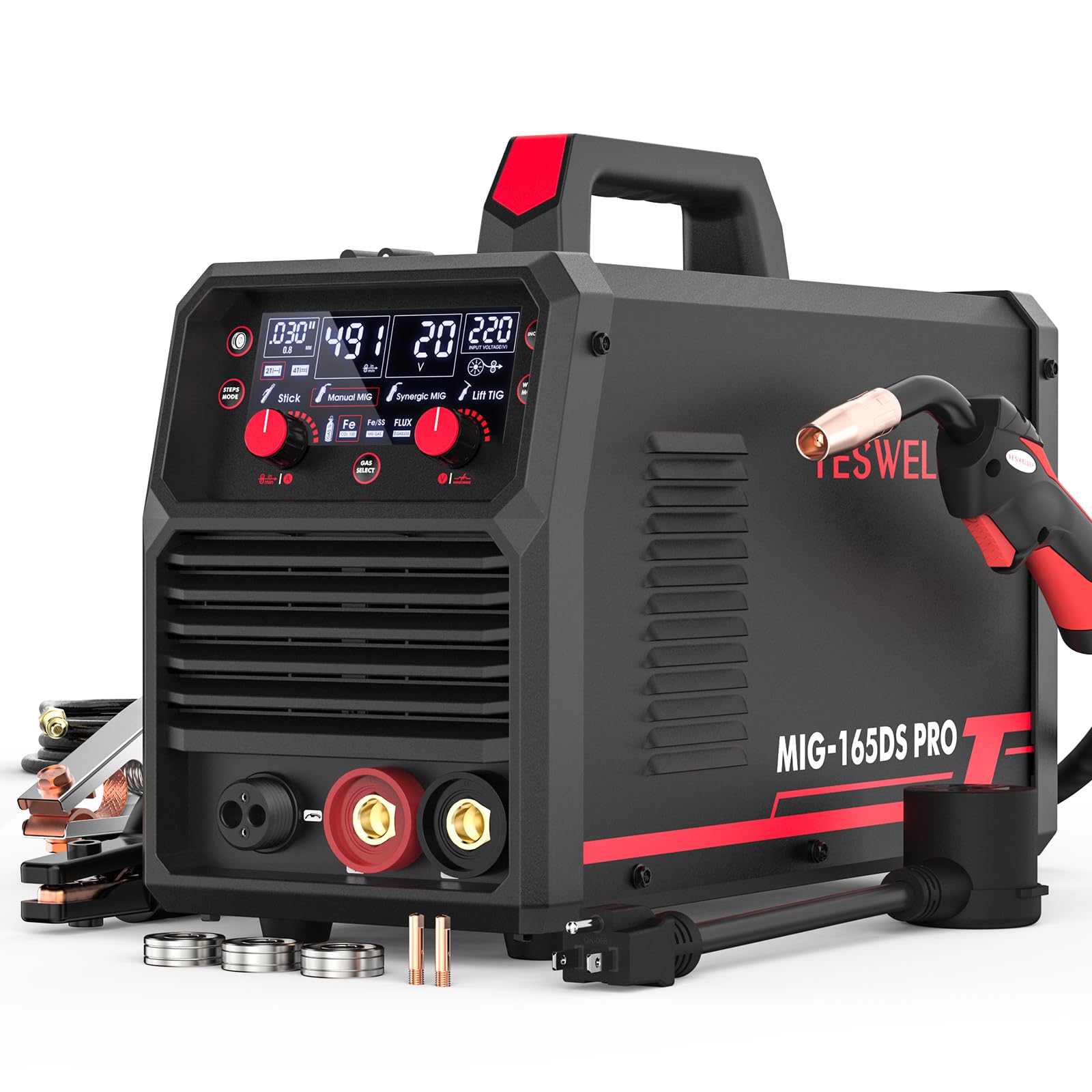
165 amps and a torch you can actually take off the machine.
The step from the YESWELDER 160A to this 165A model looks small on paper and feels bigger in the hand. Output climbs to 165A, and the MIG torch is now detachable — that is the headline change. A fixed torch means a damaged cable takes the whole machine out of service; a detachable one means you swap the torch and keep working. For anyone who has nursed a frayed gun cable, that design choice alone is worth the upgrade.
Four processes are on board: gasless flux core MIG, gas MIG, Stick, and Lift TIG (with the TIG torch an extra purchase). It runs 2LB and 10LB spools of.023,.030, and.035 wire, and synergic MIG matches recommended voltage as you change feed speed while manual mode keeps every dial available. On the Stick side you get Hot Start, Arc Force, VRD, and Anti-Stick adjustments. The digital display is easy to read, and the protection suite covers voltage fluctuation, over-current, over-load, and over-heating.
At 25.7 lb it is a bench machine, sitting just under the 27.5 lb YESWELDER 160A and well above the 10.71 lb BESTMIG. Owners describe solid, clean welds and a compact footprint that fits comfortably on a bench — one of the small machines that does not feel like a compromise. It is a step up in control and serviceability rather than a jump in raw power; if you mainly want more amps, look at the ARCCAPTAIN 200A further down.
The upgrade that matters: a detachable torch turns a broken cable into a quick swap instead of a repair ticket, and the 165A ceiling covers thicker work than the 135A group.
Choose this if: you want four processes, a serviceable detachable torch, and enough amps for thicker stock at a bench.
Two limits to accept: the TIG torch is separate, and at 25.7 lb this is a stationary machine.
9. ARCCAPTAIN 160A MIG Welder
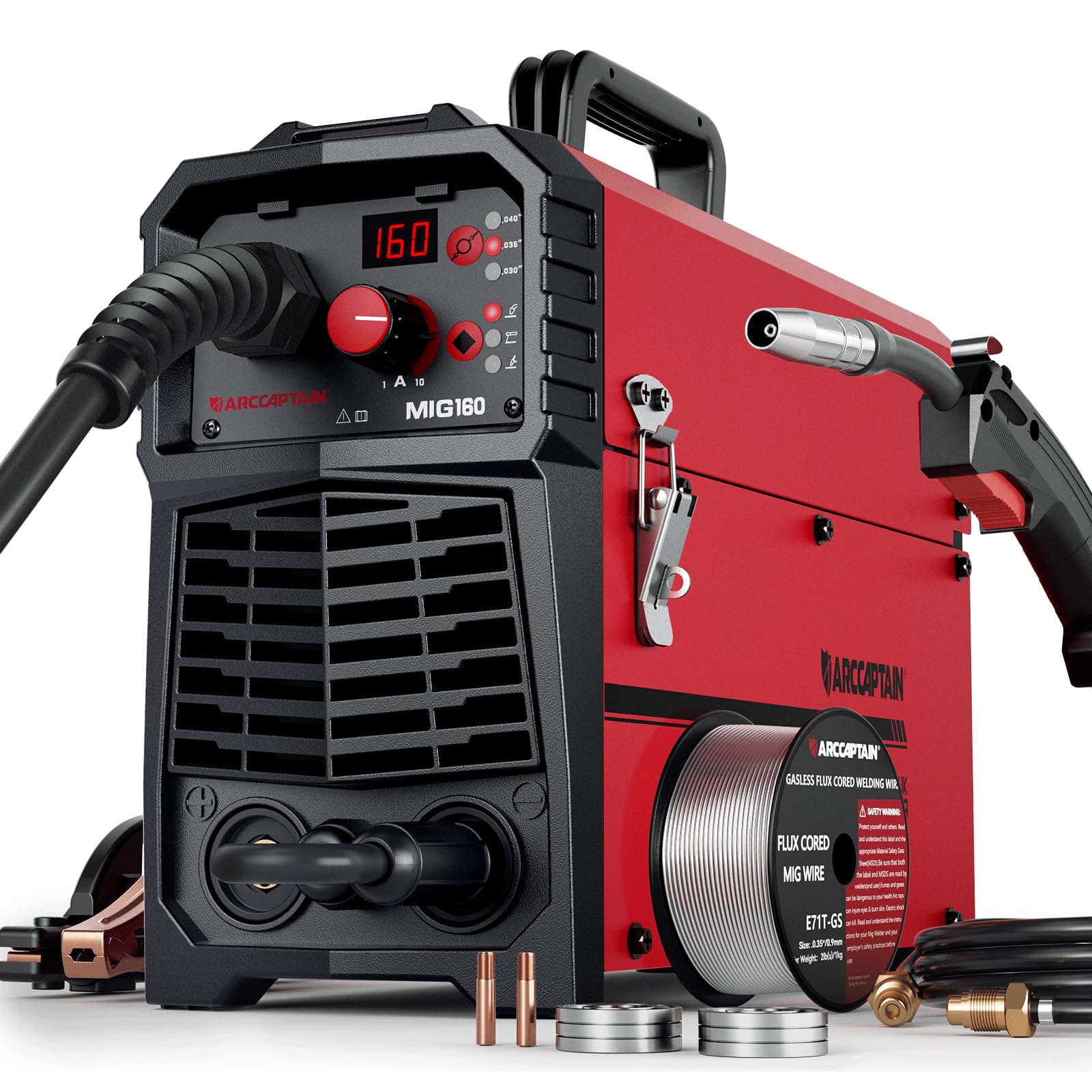
Ten pounds of four-process welder with a shoulder strap and a two-year warranty.
The listing gives two weights — 10 pounds in the spec sheet and 11.8 pounds in the description — and either way this sits in the featherweight half of this group, well under the 22.6 lb Bestarc and the 27.5 lb YESWELDER 160A. What you do with that weight is the point: it has a handle and a shoulder strap, so it goes over your shoulder and up a ladder instead of needing a cart. Then there is a 2-year manufacturer warranty, which is longer coverage than the machines carrying a 12-month term.
Four processes cover gas MIG, gasless flux core MIG, Lift TIG, and MMA, with a 160A ceiling. Synergic control matches current and wire feed speed once you pick a wire diameter, and it runs.030,.035, and.040 wire. Buyers report strong results and a machine that works on both 110V and 220V power. It handles carbon steel, stainless, and thicker stock, and the fit is home DIY, outdoor repairs, rusty metal, farm and road equipment, and general maintenance.
The honest caveat is durability: while the broad experience is a strong-performing machine, some units have reportedly burned out in use. That is the reason for the longer warranty being genuinely valuable here, and the reason to register the machine and keep your paperwork. If your work is occasional repair rather than daily production, the weight, the strap, and the warranty make a persuasive case.
This one earns the spot if: you want four processes in a ten-pound body you can sling over your shoulder, backed by a 2-year manufacturer warranty.
Go elsewhere if: you need production-grade endurance — treat this as a repair tool, not a full-time fabrication machine.
10. ARCCAPTAIN 200A MIG Welder
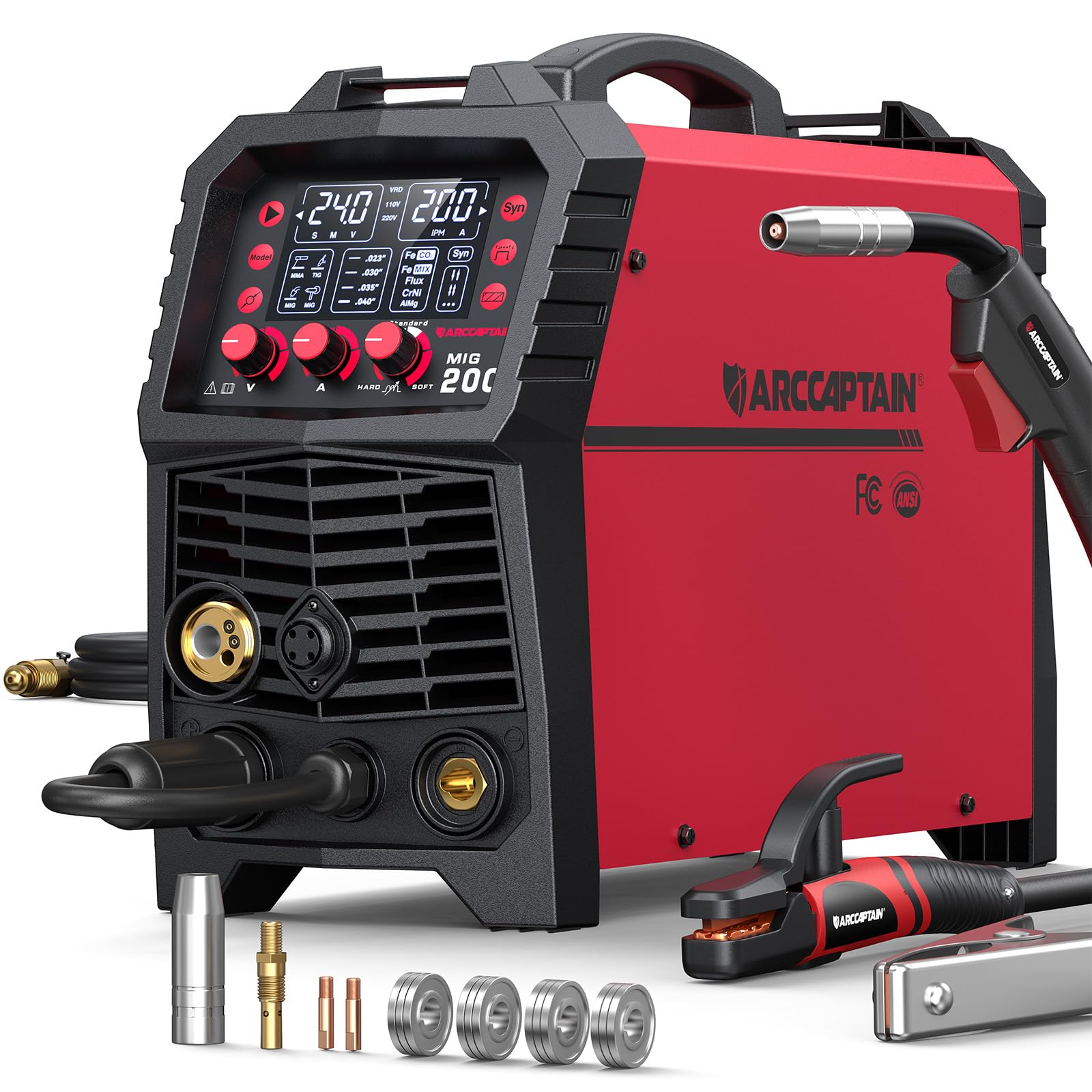
Six processes, ten saved presets, and a path to aluminum welding.
This is the most capable machine on the page, and the extra modes are the reason. Six processes: gas/solid wire MIG, gasless flux core MIG, Stick/MMA, spot welding, Lift TIG, and a spool gun connector for aluminum (the TIG gun and spool gun are sold separately). Output is 200A, and it accepts.023,.030, and.035 solid wire,.030 and.035 flux core, and.035 and.040 aluminum wire — with the note that.023 and.040 rollers are a separate buy. If you ever plan to weld aluminum, this is the machine in this lineup that makes it possible.
Synergic control matches current and wire feed speed to your wire diameter, and the machine adds adaptive crater, burn-back adjustment, and pre-flow/post-flow controls that improve the finish on a bead. It stores 10 presets across the modes, so a repeat job starts with your saved settings rather than a fresh setup. The cooling fan kicks in only when needed. The LED screen is designed to be readable without lifting your helmet, and there is a handle plus a shoulder strap included for carrying it to outdoor maintenance, farm, or road equipment work.
Owners describe a versatile machine that is easy to learn on and a strong value against name-brand alternatives, with quality the theme that comes up most. Two practical cautions: never switch between 110V and 220V while the screen is on (wait for it to power down), and the durability feedback is mixed rather than glowing. It carries a 2-year manufacturer warranty. Treat the aluminum and TIG capability as a reason to buy only if you will actually use them.
The case for it: six processes, 10 stored presets, and aluminum capability put this a full tier above the 4-in-1 machines — provided you will use the extra modes.
Buy this if: aluminum welding, spot welding, or saving preset settings is on your real project list, and you want one machine to cover all of it.
Skip the upgrade if: you weld steel in a garage — the four-process machines lower down cover that for far less complexity.
11. Forney 271 Easy Weld 140 MP Multi-Process Welder
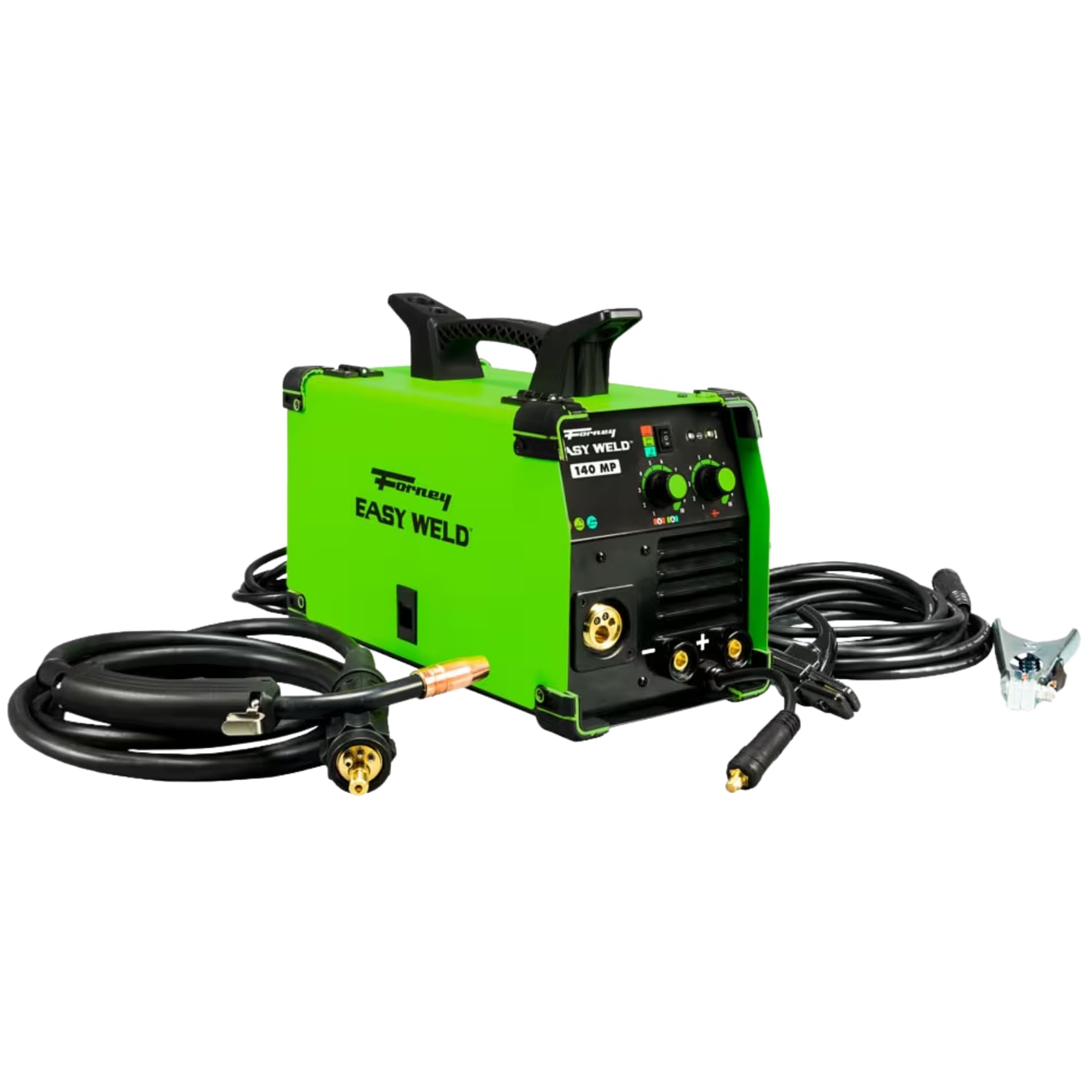
An all-metal box that runs on 120V and switches processes with one knob.
Forney builds this one around simplicity and durability rather than feature count. Three processes — Stick, MIG, and DC TIG — with a 3-position switch that changes between them, plus infinite voltage and wire feed speed adjustments so you can dial in a weld rather than pick from presets. A simple start feature shortens the setup. The case is all metal, made to survive daily shop life, and the whole machine runs on a 120-volt power source, which means no 220V circuit requirement anywhere in the plan.
The box includes a 10-foot MIG gun, an 8-foot electrode holder, an 8-foot ground clamp, a 20-amp to 15-amp adaptor, and an extra.030-inch contact tip. Those longer cables matter more than they sound: at 10 feet the gun reaches farther than a short lead, so you can weld a trailer rail or a fence panel without dragging the machine closer.
Weigh that against 25.8 lb, which makes it a bench welder rather than a carry-along unit, and 120V-only operation, which caps the arc power where a dual-voltage machine would have headroom. It carries a 12-month warranty. The buyers who like it most are the ones who want a solid, uncomplicated machine plugged into a wall outlet and left where it sits.
Pick it if: you have a 120V outlet, want an all-metal case and a simple process switch, and the machine will stay in one spot.
Not your match if: you need 220V headroom or a welder you can carry — the 25.8 lb body and 120V-only input rule that out.
Know the Specs
Output current (amps)
Amps are the simplest measure of how much welding power the machine can deliver. More amps let you weld thicker material and run longer beads before the machine struggles. The machines here run from 120A up to 200A. For thin sheet and householdrepairs, 120A to 145A covers you. For thicker stock, trailer work, and fabrication, 160A or 200A gives you the reserve. Match the amp ceiling to your real projects, not to the thickest plate you might one day weld.
Input voltage (110V vs 220V)
Input voltage decides where you can plug in. A 120V machine runs off a normal household outlet, which is what makes a welder genuinely portable — you can weld at a fence line, a friend’s driveway, or a rental with nothing more than an extension cord and a decent circuit. A 110V/220V dual-voltage machine gives you the option of the higher setting when a 220V circuit is available, which typically means a more stable arc on thicker metal. If your garage only has standard outlets, a 220V-only machine is the wrong buy.
Flux core vs gas MIG
Flux-core wire carries its own shielding inside the wire, so no gas bottle is needed. That makes it the practical choice outdoors, in wind, and anywhere you do not want to haul a cylinder. Gas MIG uses a separate shielding gas and produces cleaner welds with less spatter, but it requires a bottle, a regulator, and still air. Several machines here offer both modes, which lets you run flux core at the fence and gas MIG at the bench.
Synergic control and wire feed
Synergic control means the machine suggests the right voltage and wire feed speed once you tell it the wire diameter or the current. It shortens setup and gets a beginner to a usable bead faster. Manual control leaves every dial in your hands for welders who want to fine-tune. Wire feed speed itself controls how fast wire arrives at the puddle — too fast and it pushes the gun back, too slow and the arc stutters. Machines with integrated feed systems adjust both together.
Duty cycle and thermal protection
Duty cycle is how long a machine can weld before it needs to cool, usually expressed as a percentage of a ten-minute window. Portable inverter welders run shorter duty cycles than industrial boxes, which is why built-in thermal and overheat protection matters — the machine shuts itself down rather than cooking the internals. On the dual-voltage machines here, that protection set also covers over-current, over-load, and voltage fluctuation.
Weight and carrying
Weight is a real spec on a portable welder, not a footnote. The machines on this page range from 8.6 lb to 27.5 lb. Under about 12 lb you can carry the unit with one hand or sling it on a shoulder strap; above about 25 lb it belongs on a cart or a bench. Before you buy, decide honestly whether the welder travels or stays put — that single answer eliminates half this list.
Common Questions
Can a portable welder run on a normal household outlet?
What thickness of steel can a 135A welder handle?
Do I need a shielding gas bottle with a flux core welder?
Is synergic control worth it for a beginner?
How heavy is too heavy to call a welder portable?
Can these welders weld aluminum?
What is the difference between Lift TIG and Stick welding on these machines?
Do I need a 220V circuit for these portable welders?
Can I use flux core wire in a machine set up for gas MIG?
How long does a portable welder typically last?
The Bottom Line
For most people buying a portable welding set, the winner is the Lincoln Electric 90i FC because it does the one thing that matters most — it plugs into a normal outlet, weighs 15 lb with a shoulder strap, and welds steel up to 1/4 inch through flux-core wire with no gas bottle. If you want a complete start-up kit in one delivery, the ANDELI 135A Pulse MIG arrives with helmet, gloves, wire, and torch included. And for work that includes aluminum or needs six processes in one box, the ARCCAPTAIN 200A MIG200 is the one to reach for.
A 120V machine that matches your outlet and a 135A to 160A ceiling that matches your steel will out-weld a 200A box you can’t plug in. Pick by voltage first, amps second, and weight only if the welder has to travel — that order keeps the decision simple and the machine working.
How we choose
We do not accept paid placement. Every pick is matched to a real buyer and a real use-case; we do not hands-on test units.
Sources
Specifications: manufacturer listings and product documentation. Review insights: verified customer reviews, as of November 2026. Pricing: not shown on this page (it changes often); check the current price via the retailer link.
As an Amazon Associate, Tactical Gear Guy earns from qualifying purchases. This does not affect which products we feature.