Specs are compiled from manufacturer listings and verified buyer reviews and can change over time — please confirm the key details on the product page before buying.
You do not need a wall of cameras to protect a business — you need recording that never naps and a feed clear enough to identify a face or a plate after the fact. That is the whole job. This guide sorts nine wireless multi-camera systems by how they actually behave at a loading bay, a stockroom door, or a back fence: whether the cameras stay powered, whether the footage survives a smashed unit, and whether you are locked into a monthly cloud plan just to see what happened last Tuesday.
This guide is built by comparing the manufacturers’ published specifications and the patterns across verified customer reviews, so you get each pick’s real strengths and trade-offs instead of marketing spin.
Commercial buyers tend to overpay for resolution and underpay attention to power and storage, which are the two things that decide whether a system is still working in month eight. Below you get the honest trade-offs spelled out, so you can match a kit to your building instead of a listing photo — a practical wireless video surveillance system for business shortlist built on real specs.
Top Picks
How To Choose The Best Wireless Video Surveillance System for Business
Start with the boring question: where does power come from? A “wireless” camera still needs electricity, and how it gets that electricity decides whether your system is reliable or a chore. Battery-and-solar cameras go anywhere without an outlet but depend on sunlight and a charge cycle. Plug-in cameras never sleep but need a socket near every mounting point. Pick the power model first and the rest of the shopping gets much easier.
Match power source to your building, not the brochure
Solar kits shine on a fenced yard, a remote gate, or a storage lot where running cable is a job in itself. The trade is that you are trusting a battery and a panel through a grey winter week. Plug-in kits suit a shop with eaves, soffits, or interior corners near sockets, and they record continuously because there is no battery to conserve. If your site has both, mix them: solar on the perimeter, plug-in at the doors that matter most.
Understand what the recorder does for you
A wireless camera sends video to a recorder — an NVR (network video recorder, the box that stores and organizes the footage) or a hub base. Storage inside that box is what you actually own. Hard-drive capacities here range from a memory card up to 4TB, and the bigger drives mean you can scroll back further before old footage overwrites itself. Local storage also means no monthly cloud fee and no third party holding your recordings.
Resolution only counts if you can identify someone
Two systems can both claim “HD” and behave nothing alike. A 2K or 4MP camera gives you enough pixels to make out a face at a doorway; a 5MP camera goes a step sharper; 4K (8MP) is the top of this group. Higher numbers cost more storage per hour of footage, so a huge resolution with a small drive is a false economy. Buy the resolution you need to identify, then buy the drive that can hold it.
False alerts are the quiet deal-breaker
A system that pings your phone every time a branch moves gets ignored within a week, and an ignored system is not security. Look for human detection (software that filters out pets, insects and headlights) and detection zones you can shape in the app. Some kits add face recognition or vehicle-specific alerts. That filtering is worth more day to day than a slightly sharper lens.
Side-by-Side Comparison
| Model | Best For | Cameras Included | Resolution | Local Storage | Amazon |
|---|---|---|---|---|---|
| ELYSOO 2K/4MP 4-Cam Kit★ Best Overall | Yards with no outlets | 4 | 2K / 4MP | Memory card, up to 256GB | Amazon |
| Vivideye 8-Channel Solar KitBest Expandable Hub | Big properties, hands-off power | 4 | 2.5K / 4MP | 128GB in hub, up to 256GB | Amazon |
| OOSSXX 5MP 4TB SystemMost Storage Per Camera | Long look-back on a budget | 4 | 5MP | 4TB HDD | Amazon |
| Jennov 5MP with Monitor | Counter-top live viewing | 4 | 5MP | 500GB HDD | Amazon |
| OOSSXX 8-Cam 3MP System | Wide coverage of a large site | 8 | 3MP (1536P) | 4TB HDD | Amazon |
| Anssipo 8-Cam Business Kit | Doors, docks and warehouses | 8 | 2K | 1TB HDD | Amazon |
| aosu D1 Max 4-Cam Kit | 4K detail over wide yards | 4 | 4K / 8MP | 32GB, up to 1TB | Amazon |
| Hiseeu 14″ LCD 4-Cam Kit | Self-contained viewing station | 4 | 5MP | 3TB HDD | Amazon |
| ANNKE 6-Cam 4K Solar Kit | Full-perimeter coverage | 6 | 4MP (2.5K) | 1TB HDD, up to 8TB | Amazon |
Detailed Reviews
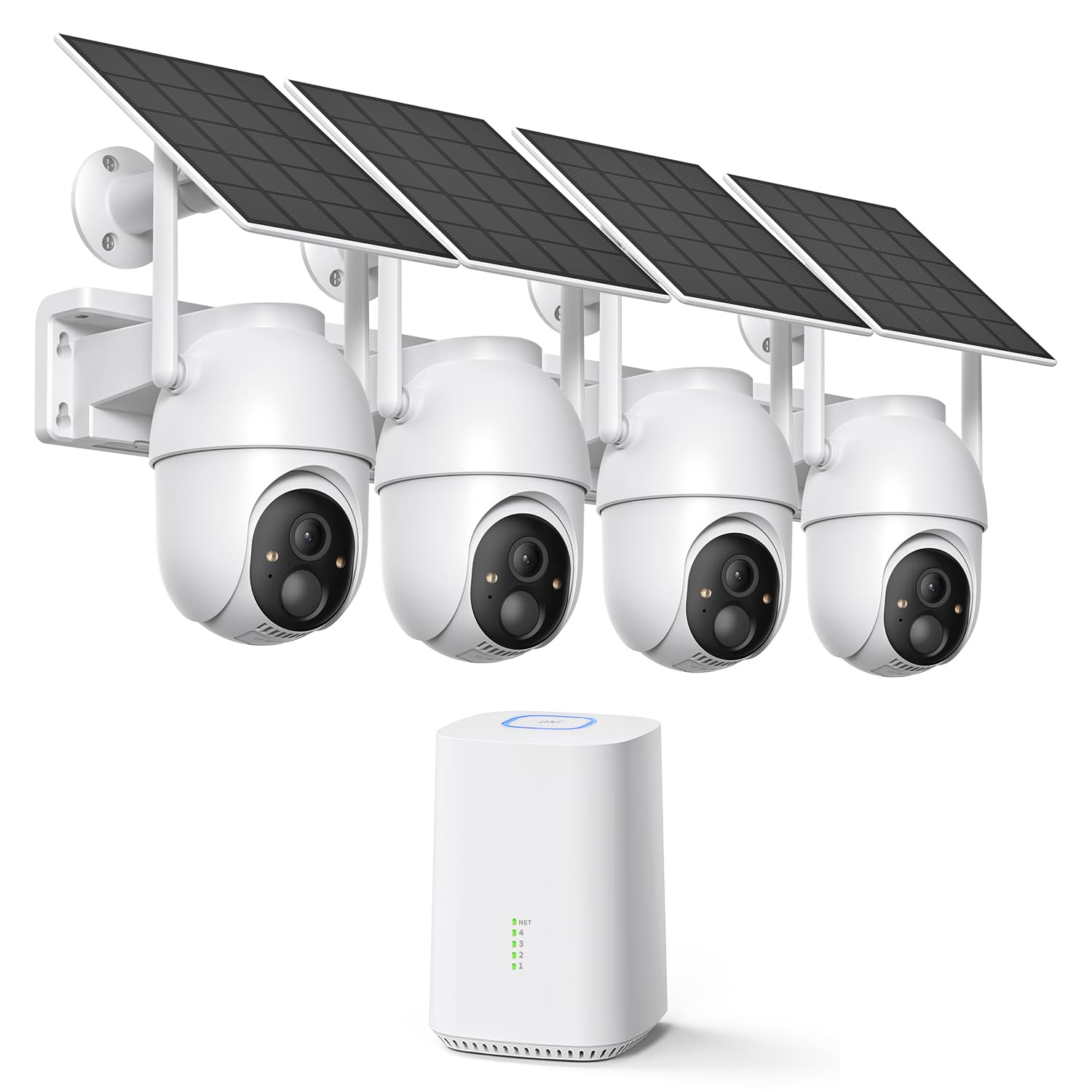
1. ELYSOO 2K/4MP Home Security Camera System
Our pick — 4.5+★ from 300+ verified ratings; the strongest balance of quality and price.
Four solar cameras that keep recording through winter without a single cloud bill.
This is the system for a business yard, lot, or outbuilding where running power cable is the expensive part. Each camera carries an IP65 weatherproof rating (sealed against rain and dust) and is rated to keep working from -4°F to 122°F, so a cold snap or a heatwave does not knock the feed out. Two hours of sunlight a day is the stated charge requirement. What wins people over most is build quality — the housing and construction are the single most-praised element in the reviews — and setup is close behind, because a monitored kit that configures in an afternoon is a kit that actually gets finished.
Recording lands on a preloaded memory card and gives you up to 60 days of loop recording with no monthly fees — loop recording meaning the oldest footage is overwritten as the card fills. The card slot supports up to 256GB if you want a longer archive. Dual-band Wi-Fi (2.4GHz for distance and 5GHz for speed) matters on a large site, because it lets you choose reach over throughput camera by camera. Night footage turns to full color automatically when the spotlight kicks in, and the 350° pan and 90° tilt range lets you sweep the whole yard from the app.
The honest limit is the connectivity and alerting layer. Signal strength and motion detection land in mixed territory across the reviews, which is normal for solar cameras pushing video over Wi-Fi at range, and it means you should plan mounting points with the router’s reach in mind rather than placing cameras purely where the view is prettiest. Skinny on blind-spot math, generous on freedom of placement. At 4.5+ stars across hundreds of owners it has the strongest track record of any fixed four-camera kit here.
Where this kit earns its place
- Solar charging keeps four cameras alive with two hours of daily sun and no outlets.
- 60 days of loop recording on the included card, with no subscription attached.
- IP65 housing rated from -4°F to 122°F for year-round outdoor duty.
- Color night vision plus 350° pan and 90° tilt coverage from one camera position.
What to weigh before buying
- Signal and motion alerting review as mixed — site the cameras within reliable Wi-Fi reach.
- A microSD archive is easier to lose than a hard drive if the unit is damaged.
Reach for this if: your cameras need to go where no socket exists and you refuse a monthly bill.
Look elsewhere if: your mounting points are far from decent Wi-Fi, or you want 24/7 continuous recording rather than motion clips.
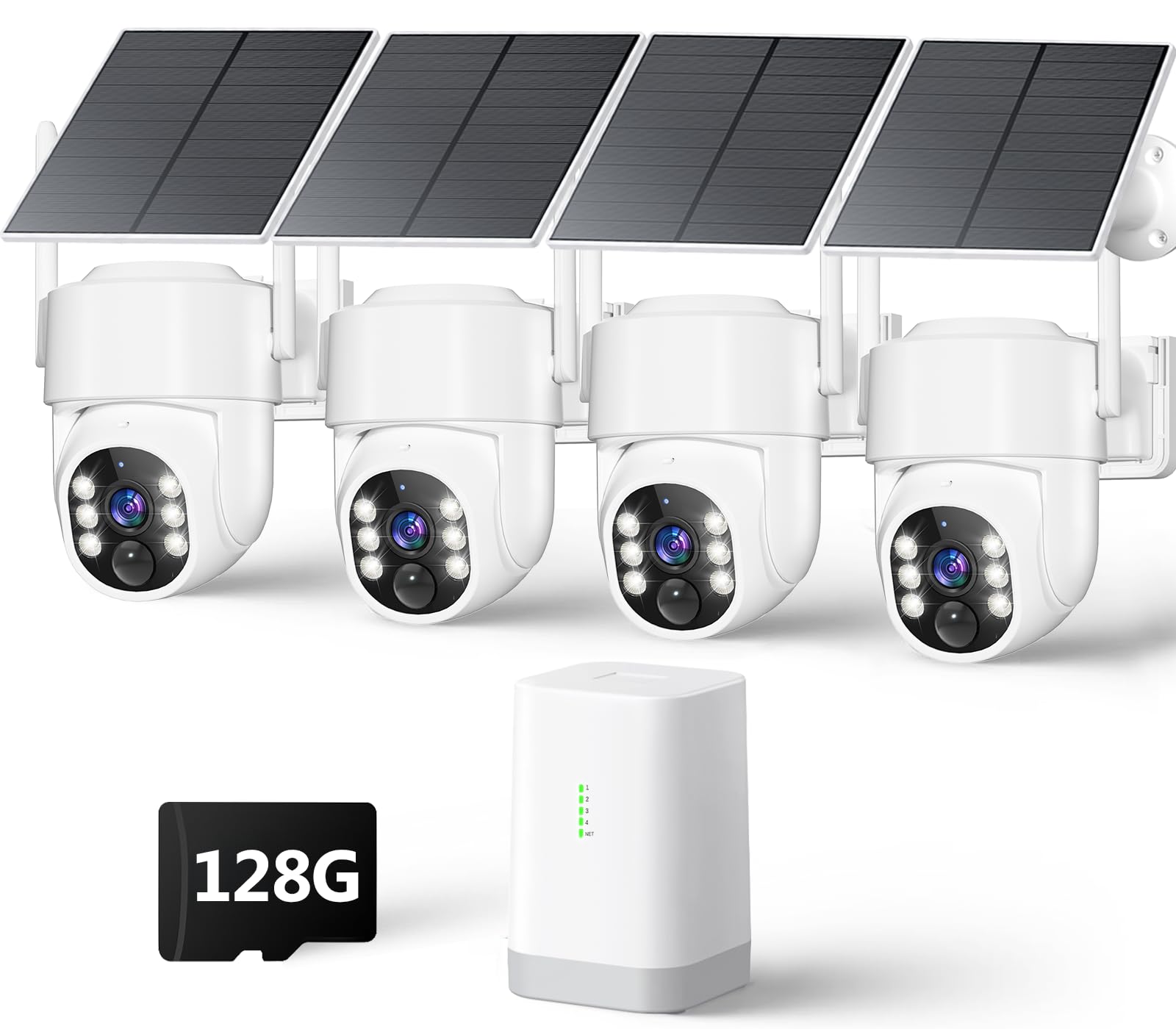
2. Vivideye 8-Channel Solar Security Camera System
Recordings live in the hub, not the camera — so a smashed camera loses you nothing.
Eight-channel expandability is the headline for a growing site: you start with four solar cameras and the hub accepts up to eight, with storage that can grow to 256GB. The 128GB built into the base is the detail that matters most commercially. Footage sits in the hub rather than on the camera, so even if an outdoor unit is damaged or carried off, the recordings are still there.That 128GB hub also beats the 256GB card ceiling of the solar kit above only if you count the hub’s expandability to 256GB, so weigh archive length against placement freedom honestly.
Power comes from an 8000mAh battery paired with a 5W solar panel per camera, and the maker states three hours of daily sunlight keeps them running through cloudy spells. The 4MP sensor with six LED lights gives full-color night vision stated to reach 65 ft, and Alexa compatibility means you can pull a live feed onto an Echo Show without opening the app. Installation is drill three holes and go — the cameras ship already paired to the base unit.
There are two defaults you will want to change on day one. Auto-tracking ships switched off and has to be enabled in the app, and the cameras are set to record only on human motion, so vehicle and animal detection requires turning that person-only setting off first. Neither is a fault, but both are the kind of thing that makes a first-week owner think a feature is broken. Once configured, pan-and-tilt coverage plus cross-camera event tracking gives you a linked timeline across the property.
The storage play: keeping footage in a central hub rather than on each camera is the right architecture for a business, because the cameras are the exposed part of any outdoor install.
Setup quirks to know: auto-tracking and non-human detection are both off at the factory, so budget ten minutes in the app before you trust the alerts.
The smart pick for: a site that will add cameras over time and wants recordings centralized and protected.
Worth knowing: a hub-based 128GB archive fills faster than a big hard-drive NVR if you record continuously.
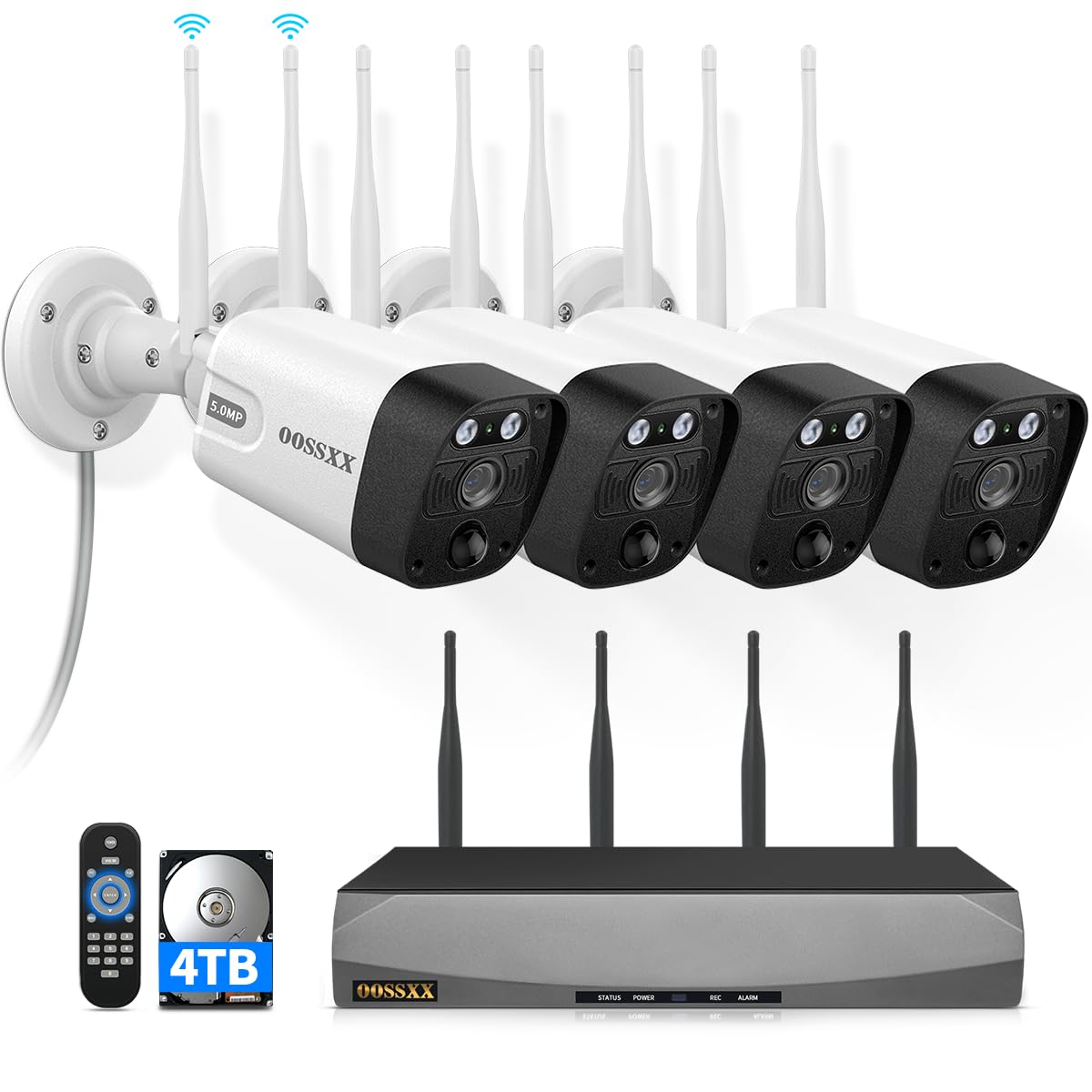
3. OOSSXX 5MP Wireless Camera System, 4TB HDD
A 4TB drive with 120 days of footage — scroll back to last quarter if you have to.
If the point of your system is evidence rather than live watching, the drive size is the spec that pays you back. The pre-installed 4TB hard drive is stated to hold up to 120 days of continuous 24/7 recording, so last quarter’s footage is still on hand. It pairs with 5MP cameras — a step sharper than 1080P, per the maker — so the footage you dig up is detailed enough to be useful. The 16-channel NVR leaves plenty of headroom past the four included cameras.
Coverage per camera is generous: 130° wide-angle lenses mean four units can watch driveways, entrances and a yard with fewer blind spots than narrower lenses would allow. Dual antennas on each camera are claimed to extend wireless transmission distance by up to 55% over single-antenna designs, which matters when cameras sit far from the NVR. Two-way audio on every camera lets you speak to whoever is at the gate from the app, and there are no monthly fees attached to the free app.
Reliability is what the owner feedback leads with — long stretches of uptime without intervention — followed by how quickly the kit comes together. It is a 9 lb box with a hard drive inside, so treat the NVR like the piece of equipment it is rather than tucking it on a shelf edge. The trade-off versus the solar kits here is wiring: each camera needs its 10FT power cable run to a socket, so the placement freedom you get from a battery camera is gone in exchange for never thinking about charging again.
Best suited to: a business that needs a long forensic archive and has sockets near its camera positions.
Think twice if: your mounting points have no nearby power — the 10FT camera cables set a hard limit on placement.
4. Jennov 5MP WiFi Security Camera System with Monitor
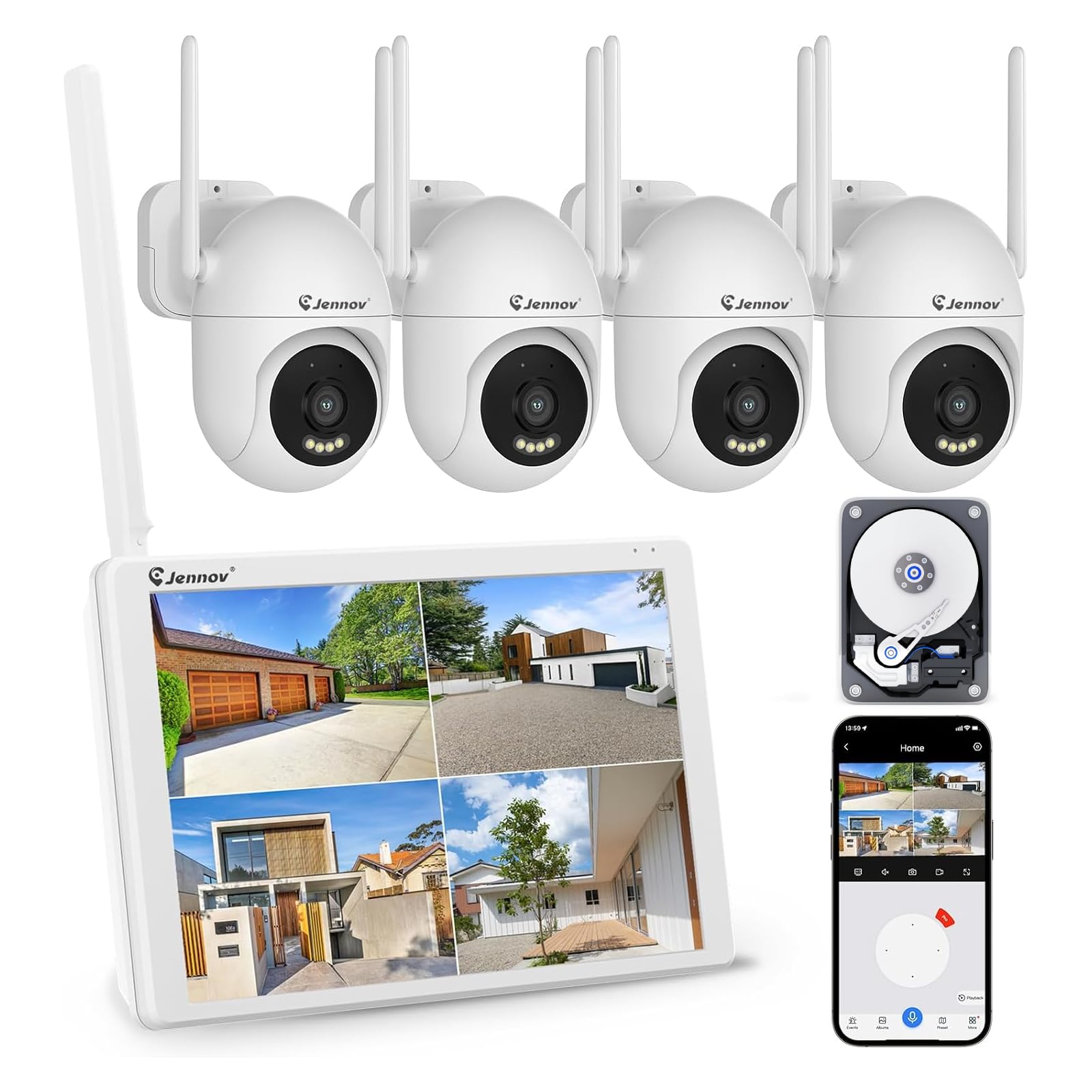
A 10-inch screen in the box means someone can watch the shopfront without a phone.
Not every staff member wants to log into an app to check the back door, and that is exactly the gap this kit fills. The included 10-inch LCD monitor is wired to the NVR, so a live view of the whole property sits on a counter or in a back office with nobody touching a phone. The 10-channel NVR supports expansion past the four cameras, and the built-in 500GB hard drive stores footage locally so there is no required cloud plan behind it.
Video arrives over wireless transmission between the cameras and the NVR, which cuts the long video cable runs a fully wired install demands. The cameras themselves are outlet-powered, so each one needs a socket nearby — the trade for never charging a battery or losing a camera to a flat cell. 5MP resolution with color night vision is the useful part after dark; the reviews describe it picking out faces and cars in a driveway rather than just shapes.
The housing carries an IP66 rating (dust-tight and protected against strong water jets) with a working range of -20℃ to 60℃, which covers a warehouse exterior or an open storefront. Reviewers find the app easy to navigate and the value strong for what the box contains. The honest caveat is that a monitor mounted near the NVR is only useful where someone actually stands — if your office is nowhere near the recorder, the app does the same job and the screen is a bonus rather than the reason to buy.
The screen argument: a fixed live view is genuinely easier for staff than a phone login, and the 500GB drive handles the storage without a subscription.
Placement reality: outlet power at every camera keeps install simple but pins you to sockets, so walk the building before you commit to camera spots.
Pick this when: you want a station someone can glance at, not just an app they have to remember to open.
The limitation: the monitor lives with the NVR, so the screen only helps if staff are near the recorder.
5. OOSSXX 8-Camera 3MP Wireless System, 4TB HDD

Eight cameras on one 4TB recorder — the widest starting coverage in this group.
Where the four-camera kits leave gaps you have to budget for later, this one starts at eight and runs a 16-channel NVR for future additions. That matters on a site with multiple entrances, a yard and a stockroom door, because you can cover all of them on day one. The 4TB drive is stated to hold 60 days of continuous recording across eight cameras, and H.265 compression (a video format that saves space without wrecking the picture) stretches that archive further than older formats would.
The cameras carry an IP67 waterproof rating and 3MP resolution at 1536P, which is a step down from the 5MP units elsewhere in this list — a trade you are making for camera count. Dual antennas on every camera are claimed to deliver up to 55% stronger and more stable signal than single-antenna designs, which matters on a farm or warehouse where cameras sit far from the router. AI human detection is the standout software feature, with the maker claiming it avoids 99% of false alarms from leaves, cloud, animals and insects, and you can switch it off to record every motion event.
It is the lowest-scoring pick on this page, and the honest read is that eight cameras and a big drive at this tier means some corners sit elsewhere. Picture quality and setup still draw steady praise, but if razor-sharp identification is your priority, the 5MP systems above give you more per pixel. Buy this for breadth of coverage, not for the sharpest possible image.
What eight cameras buys you
- Eight IP67 cameras and a 16-channel NVR out of one box.
- 4TB drive rated for 60 days of continuous recording, with no monthly fee.
- AI human detection claimed to filter 99% of false alarms.
The trade you are accepting
- 3MP resolution sits below the 5MP and 4K options here.
- Cameras need their 10FT power cables run to sockets.
Built for: large sites that need many viewpoints first and pixel-perfect detail second.
Better elsewhere if: you only have four spots to cover — the sharper kits above do more per camera.
6. Anssipo 8-Camera 2K System with 1TB HDD
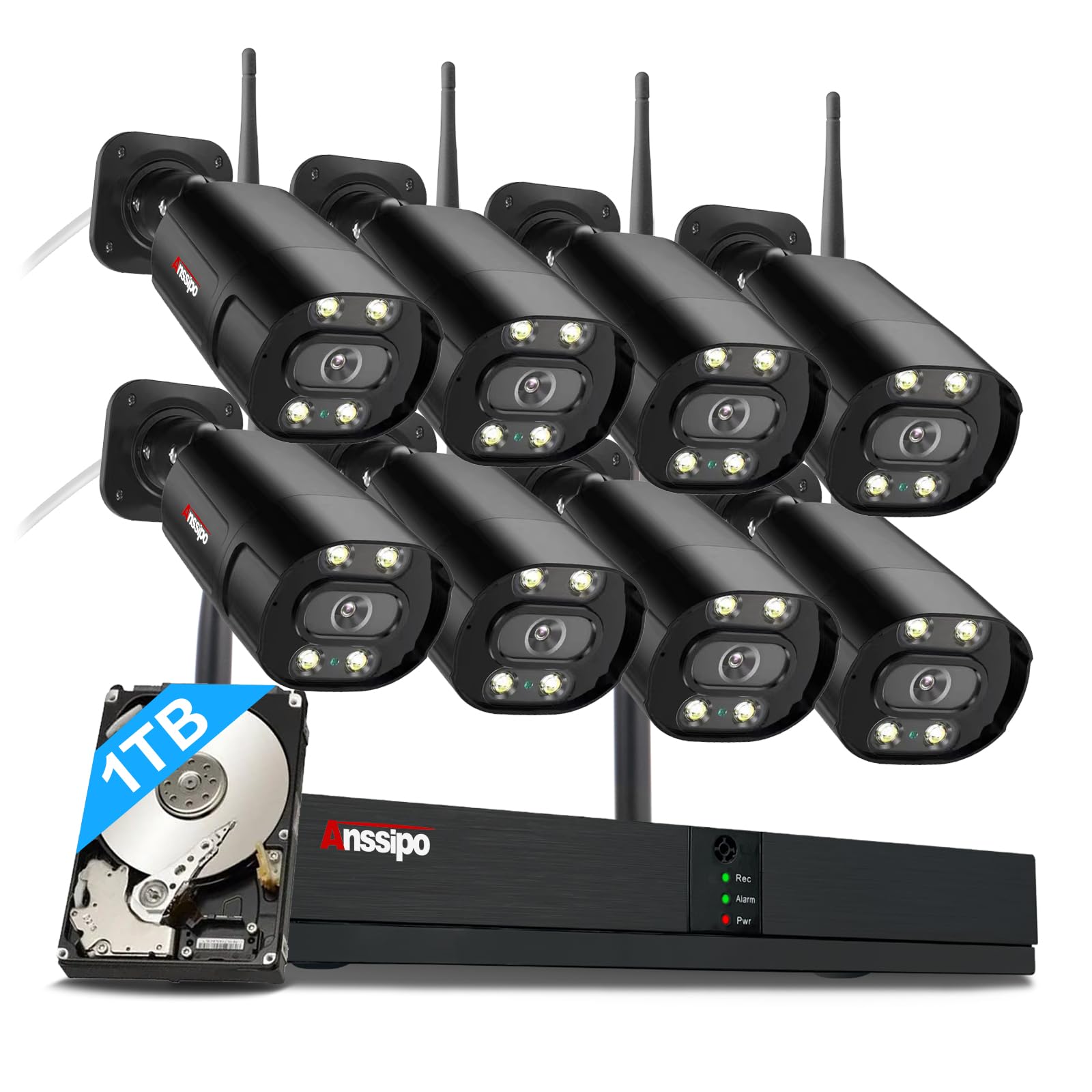
Corded power and eight cameras built to watch a warehouse, not a hallway.
The argument for plug-in power is made clearest here: because the cameras never run on a battery, they never sleep, so you capture the seconds before an incident rather than a clip that starts once motion trips. That is the difference between seeing someone approach your loading dock and seeing them already inside it. Eight 2K cameras cover front door, driveway, side yard, backyard, garage, shop and warehouse at once, and the 8-channel NVR already supports 4K cameras if you upgrade later.
Night footage can stay on infrared so nobody knows the camera is watching, or switch to white LEDs for color — clothing, car colors and faces instead of grey shapes. Human detection is designed to give you one alert when a person walks up rather than a stream of them from a cat or a passing headlight. Face recognition learns the people who belong and marks the ones it does not. Two-way audio and a siren with spotlight on all eight cameras let you talk to a delivery driver or make a stranger leave without going outside.
The housing is metal with an IP66 rating, working from 14 to 122 degrees F, and night vision is rated to 50 feet. Everything ships paired, so setup is power cords and one network cable rather than IP addresses and port forwarding. The catch is thin owner data — this is a newer listing with a small review base, so you are leaning on the specification sheet more than on a long track record. The 1TB drive is also modest next to the 4TB systems here, so plan on shorter archives if you record all eight continuously.
The commercial case: continuous power plus eight cameras plus two-way audio is a genuine front-desk tool for a business that deals with the public.
Check before you buy: 1TB across eight cameras fills faster than you might expect, and the review history here is still short.
Right for: a shop, depot or warehouse that wants eyes on eight zones and a speaker at every door.
Not the one for: buyers who want a deep archive — the 1TB drive is the smallest in this premium group.
7. aosu D1 Max 4K Solar Camera System, 4-Cam Kit
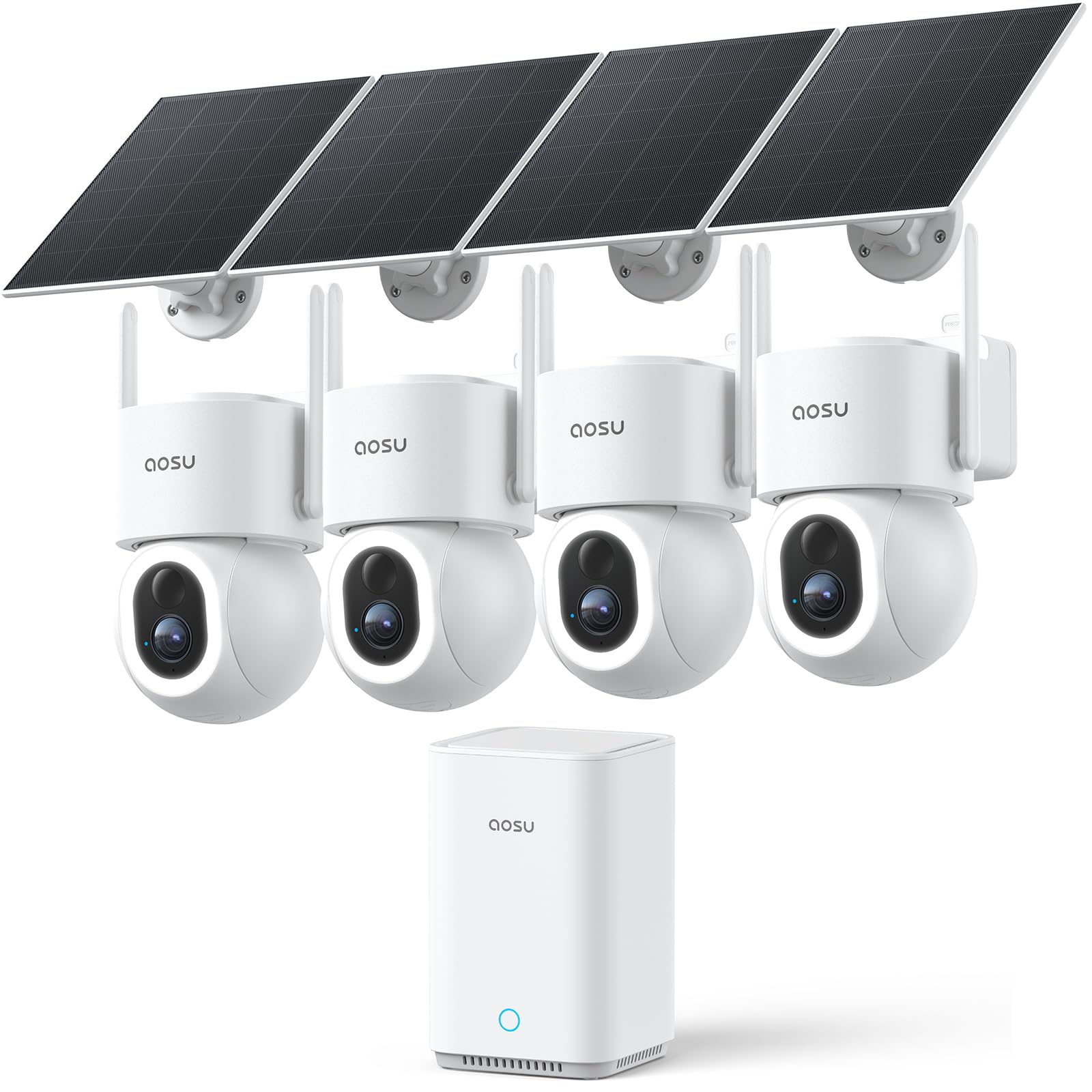
4K detail that reads a plate from 33 feet — with a solar panel doing the charging.
If the thing you actually need is identification, the 8MP sensor here is the sharpest in this group. The maker states it reads license plates from up to 33ft (10m) away, with 6× digital zoom to push in on the footage afterward. Spotlights deliver full color at night, and infrared mode gives you a discreet black-and-white view when you would rather not announce the camera. Solar power with a detached panel lets you angle the charger toward the sun independently of the camera’s field of view — a small design choice that pays off on a shaded wall.
The tracking layer is where the engineering shows. On-device AI detects people and vehicles, and Smart Vehicle Guard watches parked vehicles and alerts you to movement nearby. Panorama View jumps the camera to a saved key area with one tap, and cross-camera tracking stitches multiple cameras into a continuous timeline so a single event reads as one story instead of four separate clips. It supports Alexa and Google Assistant, and storage is local — 32GB included, expandable to 1TB — with no subscription required.
Here is what the reputation is built on and where it wobbles. Build and setup are the two things buyers talk up, and picture quality follows close behind. The mixed signals are battery life, connectivity and general performance — expected when four 4K cameras push heavy video over wireless — so wired placement near the aosuBase pays off. The included 32GB is also small for 4K footage; plan on expanding toward that 1TB ceiling.
Why the detail matters
- 4K/8MP with plate-reading claimed at 33ft and 6× digital zoom.
- Pan, tilt and auto tracking that follows people and vehicles across the yard.
- Detached solar panels let you angle the charger away from the camera.
Where it asks for care
- Battery life and connectivity read mixed across owner feedback — 4K over wireless is demanding.
- 32GB of included storage is thin for 4K; budget for a larger card.
Go with this for: a yard or forecourt where the footage has to identify a face or a plate.
Look past it if: you want maximum recording days from the start — the included 32GB will not carry four 4K cameras far.
8. Hiseeu 5MP 4-Cam Kit with 14″ LCD

A 16-channel recorder, a 14-inch screen and four PTZ domes in one box.
This is the self-contained option: a 14-inch Full HD monitor is built into the recorder, so you get a viewing station with no extra screen to buy or mount. Behind it sits a 16-channel NVR that supports up to 16 cameras, which is far more expansion room than the four included units need today. The 3TB hard drive handles continuous recording locally with no subscription attached.
The four domes are 5MP PTZ units — pan-tilt-zoom, meaning they move to follow an area rather than stare at one fixed spot — with 355° pan and 90° tilt. Auto tracking follows moving objects automatically, and the housing is described as explosion-proof with an IP66 waterproof rating for harsh outdoor conditions. Remote viewing and playback run through the HiseeCloud app, and the whole thing installs wirelessly to keep cable clutter down.
What buyers respond to is how quickly it comes together and how clear the picture is, and the indoor-or-outdoor flexibility of the domes is a running theme. One note on the waterproof caps and screws: they are in the box for a reason, so fit them properly on outdoor mounts rather than leaving them for later. The review base is still small relative to the four-camera kits here, which is worth knowing before you commit a whole property to it.
One-box simplicity: a 14-inch screen plus a 16-channel recorder means you have a complete viewing and storage station without sourcing parts.
What to note: the 355° pan and 90° tilt domes cover more ground than fixed cameras, but the small review history means you are trusting the spec sheet.
A natural fit for: a small shop or office that wants a screen, a recorder and moving cameras without assembling a parts list.
The thing to watch: you are buying on specifications more than a long track record here.
9. ANNKE 6-Cam 4K Solar NVR System
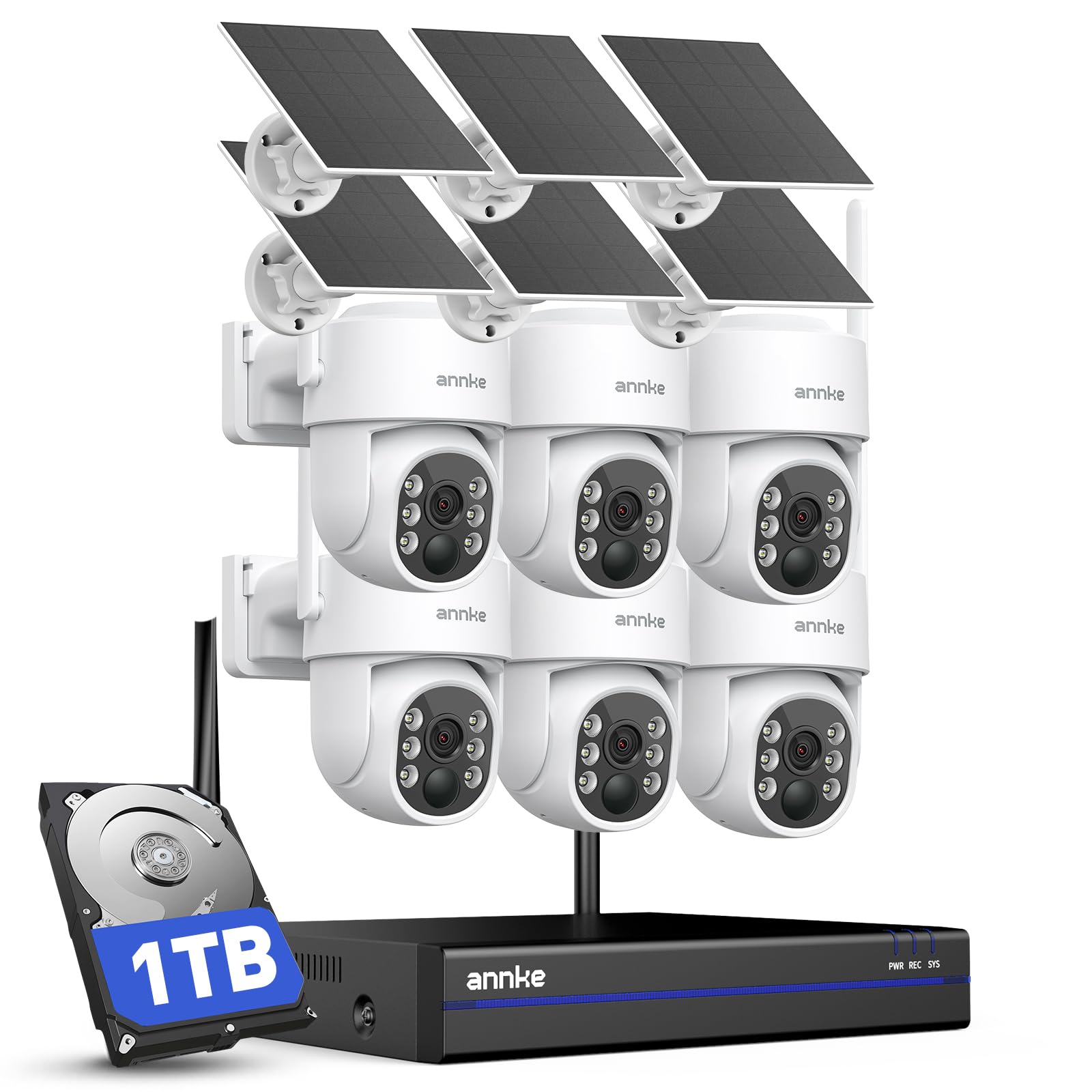
Six solar cameras on a 10-channel recorder you can grow to eight terabytes.
Coverage-first buyers get six cameras here, and the NVR behind them is a 10-channel 4K unit that accepts up to 10 cameras total — four spare slots if the property grows. Storage is the standout: the 1TB drive can expand to 8TB, the largest ceiling on this page, which is what lets you keep footage long-term rather than for a fortnight. Everything stays on the local NVR, so there is no cloud subscription and no third party sitting between you and your recordings.
The cameras capture 4MP (2.5K) with a 270° pan and 90° tilt range, so each unit sweeps a wide arc instead of staring at one spot. Full-color night footage comes from built-in LEDs, and dual-band Wi-Fi lets each camera choose 5.8GHz for faster streaming or 2.4GHz for longer range. The IP65 rating covers temperatures from -4°F to 140°F. A PIR motion sensor (a heat-based detector that reacts to bodies rather than light changes) filters out wind-blown branches and shifting light, and AI then checks whether the hot spot is human before it pings you.
Solar charging keeps the cameras topped up through cloudy and rainy spells, and the panels work independently of the camera angle. Build quality is the strength the owners lead with, with function and image quality behind it. Ease of use is the mixed note — several find the app takes some learning — so factor in a settling-in period before anyone else on staff relies on it. The 1TB starting drive is also modest for six cameras; the expansion path is there, but you may want to use it.
The pick for: a property you want covered end to end, with room to add cameras and years of footage.
The honest catch: the app takes time to learn, and six cameras on the included 1TB drive will not archive as long as the 4TB systems here.
Know the Specs
Resolution: 3MP, 5MP, 2K, 4MP and 4K
Resolution is how many pixels make up each frame, and it decides whether footage identifies a person or just shows a shape. A 3MP or 1080P-class camera gives you usable detail at close range. 5MP goes sharper, which helps with plates and faces at distance. 4K (8MP) is the top tier and the most demanding on storage — every hour of 4K footage eats far more drive space than an hour of 3MP. Buy the resolution your identification needs require, then size the drive to match.
Local Storage: Hard Drive vs Memory Card
Local storage means footage is recorded onto hardware you own — an NVR with a hard drive, or a hub with a memory card — instead of a paid cloud plan. Hard-drive systems here range from 1TB to 4TB, and cards range from 32GB to 256GB. A drive inside a recorder is harder to damage or walk off with than a card inside a camera. Capacity decides your look-back window: loop recording overwrites the oldest footage once the drive fills, so a bigger drive gives you a longer window before that happens.
Power Source: Solar, Battery or Plug-In
A “wireless” camera still needs electricity. Solar-plus-battery cameras install anywhere without an outlet and charge from daylight, but they depend on sun and a healthy cell. Plug-in cameras run continuous power and never sleep, which means they record the moments before an event instead of starting on motion. Match power to your building: solar on a fence line with no socket, plug-in at the doors that matter most, and check every camera position has either reasonable sunlight or a nearby outlet before you mount anything.
Detection: PIR, Human Detection and AI Filtering
PIR sensing detects body heat, which is more reliable than a camera that reacts to any pixel change. Human detection adds a layer of software on top that checks whether the heat source is a person, filtering out cats, insects and headlights. Some kits add face recognition or vehicle-specific guard modes. The practical payoff is fewer junk notifications — a system that pings you constantly gets ignored, and an ignored system is not doing its job. Look for detection zones and sensitivity controls in the app as well.
Common Questions
Does a “wireless” security camera system still need power cables?
Do I need a monthly subscription to view my footage?
How long will a 3TB or 4TB hard drive actually store footage?
Will a solar camera really keep working through winter?
What is the difference between 5MP and 4K for a business camera?
Can I add more cameras to these systems later?
How do I stop my phone getting alerts every time a cat walks past?
Is footage safer on a camera memory card or in a central recorder?
Do these systems work over 5GHz Wi-Fi or only 2.4GHz?
How hard is it to install one of these systems without an installer?
The Bottom Line
The best overall pick for most businesses is the ELYSOO 2K/4MP 4-Cam Kit, because it puts four solar cameras anywhere you need them,records locally with no monthly bill, and holds up outdoors from -4°F to 122°F. One honest note on that top spot: it does not carry the largest rating base here — the Jennov lists hundreds more owners — but the ELYSOO holds the higher score at 4.5+, so if a long crowd track record matters most to you, weigh both carefully.
If your priority is a long, searchable archive, take the OOSSXX 5MP system with the 4TB drive, where 120 days of continuous recording means last quarter is still on hand. For a site with eight zones to cover, the Anssipo 8-camera kit brings corded power that never sleeps, face recognition and a speaker on every camera. And if the footage has to identify a plate at distance, the aosu D1 Max is the one to reach for with its 8MP sensor and 33-foot plate reading.
How we choose
We do not accept paid placement. Every pick is matched to a real buyer and a real use-case; we do not hands-on test units.
Sources
Specifications: manufacturer listings and product documentation. Review insights: verified customer reviews, as of November 2026. Pricing: not shown on this page (it changes often); check the current price via the retailer link.
As an Amazon Associate, Tactical Gear Guy earns from qualifying purchases. This does not affect which products we feature.