Specs are compiled from manufacturer listings and verified buyer reviews and can change over time — please confirm the key details on the product page before buying.
If you are shopping for a wide camping pad, here is the short answer: the HomeMate Memory Foam Camping Mattress Pad is the strongest all-round pick, because it pairs a 3-inch memory foam build with a waterproof cover and a roomy cot-size footprint. Not every pad on this list is the exact width you typed into the search bar. This list uses flexible, human-like matching for wide and extra-wide widths — wider than the standard 20 inches, with wide 25-inch options accepted — so some picks land near your number rather than on it. Each one serves the same purpose: a wider sleeping surface that lets you turn over without sliding off the edge.
This guide is built by comparing the manufacturers’ published specifications and the patterns across verified customer reviews, so you get each pick’s real strengths and trade-offs instead of marketing spin.
A pad’s width matters more than almost anything else once you are tired, because a narrow mat means a cold shoulder and a midnight scramble back to center. Save this page and use it to compare payload, thickness, and packed size side by side, then grab the best wide camping pad for your next trip.
Top Picks

How To Choose The Best Wide Camping Pad
The width is the whole point of this search, so start there. You want a pad that lets you roll onto your side without your hip dropping off the foam. Pick your number first, then sort the rest of the specs around it.
Match the listed width to your sleeping style
A 24-inch pad at cot length gives you a comfortable single sleeping surface. If you want real room to stretch, a 27-inch pad opens up the shoulders and elbows noticeably. For two sleepers or one person who sprawls, the Teton XXL runs 30 inches wide.
Keep one trap in mind: some listings advertise a “wide” size but ship a cot-length mat. Check the letter-and-number spec in the listing’s detail block, not the marketing headline.
Thickness is comfort, not just bulk
Foam density and thickness decide whether you bottom out. A 2-inch pad can work on soft ground, while a 3-inch or 4-inch pad is the safer bet over hard tent floors and cots. The extra thickness comes at a weight cost, so weigh that against how far you carry it.
R-value tells you how cold the ground will feel
The R-value is a number that rates how well a pad blocks ground chill, and higher is warmer. The Therm-a-Rest Basecamp carries an R-value of 6, and the Zzuvjoy pad carries an R-value of 9.5. A low-R pad is fine for summer trips and rough for frosty nights.
Self-inflating versus solid foam
Self-inflating pads open a valve and pull in air on their own, then you top off firmness. Solid foam needs no inflation at all but takes up more room when packed. If you mostly car-camp, neither is a problem. If you carry your pad in a pack, the packed size decides it.
Side-by-Side Comparison
| Model | Best For | Width | Thickness | Weight | Amazon |
|---|---|---|---|---|---|
| HomeMate Memory Foam Camping Mattress Pad★ Best Overall | Overall foam comfort | 24 in | 3 in | 7.8 lb | Amazon |
| Foam Camping Mattress (TokSay)Firm Foam Favorite | Firm foam with washable cover | 24 in | 2.5 in | 2.6 kg | Amazon |
| Lxotvae Memory Foam Camping Mattress PadGel Foam Value | Gel foam on a budget | 24 in | 3 in | — | Amazon |
| OGERY Self-Inflating Sleeping Pad | Side sleepers who want a foot pump | 27.17 in | 3.15 in | 6 lb | Amazon |
| Sea to Summit Camp Plus SI | Light packable warmth | 25.2 in | 2.6 in | 3.2 lb | Amazon |
| Teton XXL Sleeping Pad | Widest surface for sprawling | 30 in | 2.5 in | 5.6 lb | Amazon |
| Gaialoop Memory Foam Camping Mattress | Maximum cushioning on a cot | 24 in | 4 in | 11 lb | Amazon |
| Therm-a-Rest Basecamp | Year-round thermal insulation | 20 in | 2 in | 2 lb 8 oz | Amazon |
Detailed Reviews
1. HomeMate Memory Foam Camping Mattress Pad
Our pick — 4.5+★ from 800+ verified ratings; the strongest balance of quality and price.
The foam pad that turns a hard cot into something you actually want to sleep on.
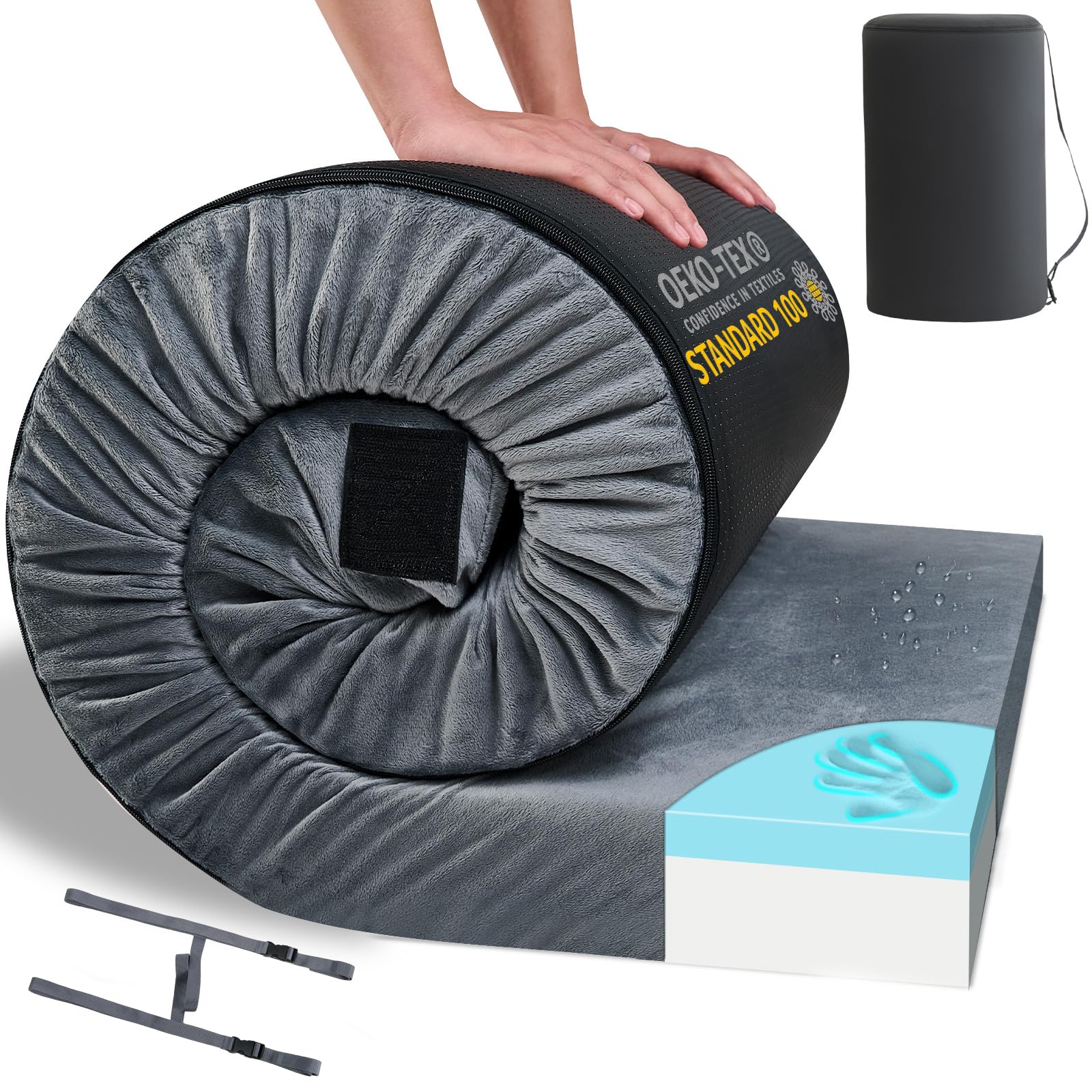
Two inches of memory foam sitting on high-density support foam, cut to a 72 by 24-inch footprint at 3 inches thick, is the core of this pick. That is a full cot-length surface that gives you 24 inches of width to roll onto. The memory layer takes the pressure off your shoulders and hips while the dense base stops you sinking through to the floor. At 7.8 pounds it is the heaviest non-cot mattress in the first half of this list, and that weight is the price of the foam.
What wins people over is the memory-over-support foam — comfort is the most-praised quality of this pad, with build quality right behind it. Owners single out how it mutes the lumps of uneven ground and how a morning on it does not leave them stiff. The cover unzips and goes in the wash, and the whole thing rolls up with the included straps into the storage bag. It works just as well on a cot, an RV bed, or a guest-room floor, which is why it sits at the top.
The honest catch is the foam’s memory. The manufacturer asks for 72 hours after unboxing so it can fully expand, and a short first night on a half-inflated pad feels firmer than the finished product. A few buyers also find the 24-inch width snug if they are used to a full bed. Neither is a defect — it is a setup and expectations note.
What the foam delivers
- Three inches of memory-over-support foam that softens cot bars and rough tent floors.
- Waterproof, anti-slip surface that handles damp ground.
- Removable, washable cover plus straps and a storage bag.
- Velcro connectors let you join two pads into a bigger sleeping surface.
Where it asks patience
- 7.8 pounds is a car-camping weight, not a backpacking one.
- Needs up to 72 hours to reach full thickness after unboxing.
- 24 inches of width is roomy but still a single sleeper’s surface.
Grab this one for: car campers, cot sleepers, and guest-room setups who want bed-like foam without an air pump.
Think twice if: you need to carry your pad on your back for miles — the 7.8-pound weight will be the first thing you feel.
2. Foam Camping Mattress with Washable Cover (TokSay)
No pump, no hiss, no overnight deflation — just a slab of dense foam that stays put.
The 30D high-density foam is the story here. It never needs inflating, so it cannot quietly lose air at 2 a.m. the way an air-filled pad can. The 72 by 24-inch surface is 2.5 inches thick, which is thinner than the HomeMate above — a half-inch less foam under your hip. What you get for that trade is a firmer, more stable sleep surface and a plush cover that unzips for machine washing.
The grippy bottom is a small detail that earns its keep on tent floors, RV beds, and hardwood. Owners describe the cushioning as smooth and fleece-like, and the general read is that it feels firmer than an air mattress rather than softer. It rolls up with the included straps into a carry bag, and the whole thing packs into a trunk or closet without fuss.
One thing to plan around: the maker wants the foam to rest in a warm space around 77°F for 48 to 72 hours after you open it. That is what lets a compressed pad come back to shape, and cold weather can slow it down. Also note the listing recommends this cot size for sleepers under 5’5″ — taller buyers should size up before committing.
Space-saving reality: at 2.5 inches thick and a 2.6 kg weight, this is the easy one to stow in a small car or a closet shelf.
The trade to accept: thinner foam means less padding than a full 3-inch pad, and the height guidance is worth a hard look before you buy.
Suit it to: campers who want zero inflation fuss and a washable cover for dirty weekends.
Leave it if: you are taller than the recommended height or want the deepest possible cushion.
3. Lxotvae Memory Foam Camping Mattress Pad
Gel memory foam over dense support, wrapped in a waterproof shell that shrugs off rain.
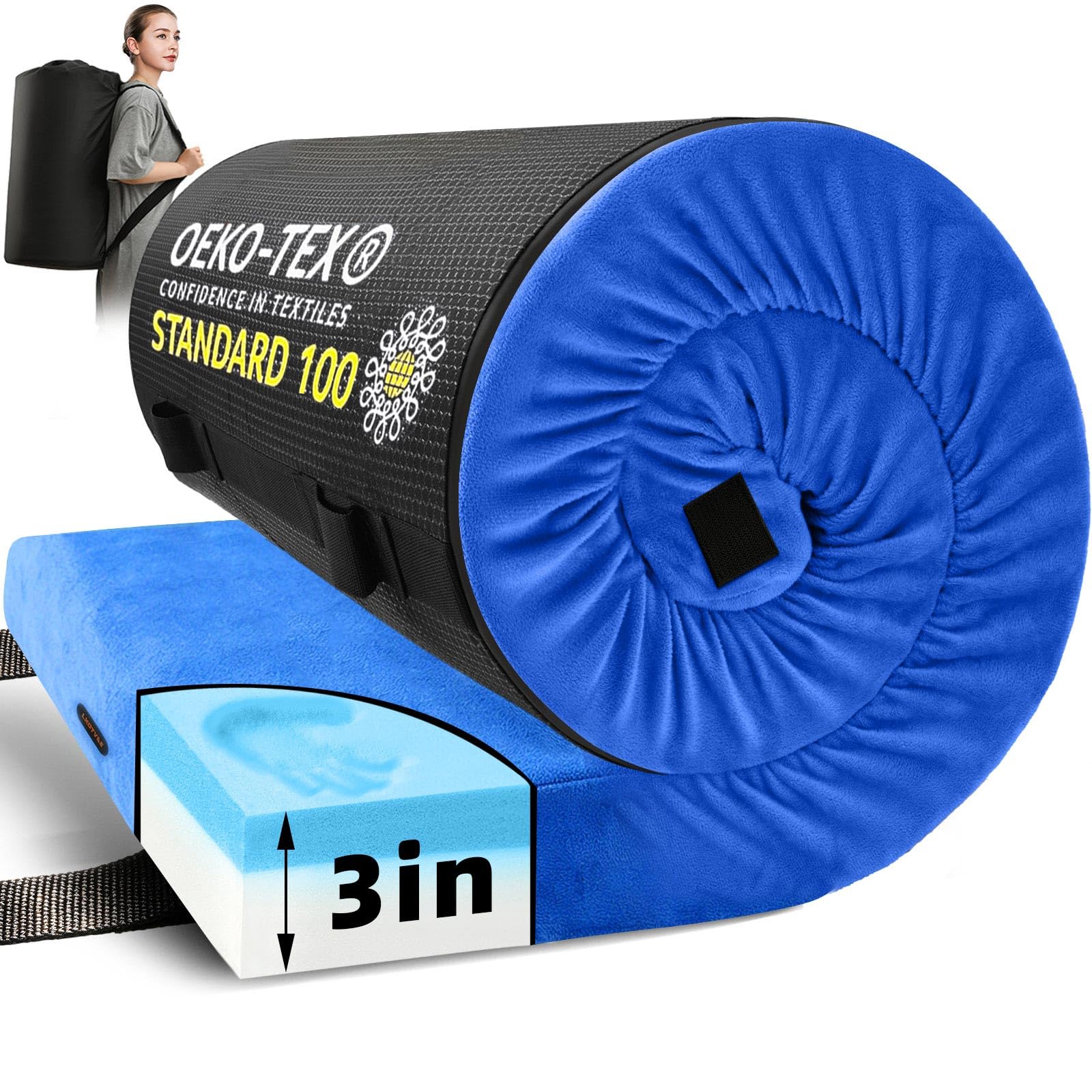
This one runs a double-layer build: gel memory foam on top and 30D high-density foam underneath. The gel layer gives you a 3-inch thick, 72 by 24-inch surface that adapts to your body shape, while the dense base does the load-bearing. A TPU waterproof membrane sits at the top and bottom, so rain on the tent walls or a damp floor does not soak the foam. The bottom is honeycomb-textured to grip.
Owners rate the gel memory foam’s comfort and the 30D support layer’s build quality as this pad’s two strongest points. The velvet cover detaches for washing, and the pad picks up a layer of knitted fabric that catches dust before it reaches the foam. It doubles as a guest bed, a nap mat, or even a yoga surface indoors.
The catch is consistency. Size and softness both draw mixed feelings — some sleepers find the surface cushy, others hit a lumpy feel where the foam sits — and a handful question the value once they compare it side by side. Give it the full 48 hours to expand, and inspect the foam as it comes up. If it arrives right, it is a lot of mattress for an entry-level spend.
Rain-ready design: the TPU waterproof membrane plus the anti-slip honeycomb bottom makes this a smart pick for wet, uneven ground.
Set expectations on finish: foam consistency varies unit to unit, so check the surface before your first trip.
Made for: budget-minded campers who want gel foam and real waterproofing in one pad.
Not the best fit for: sleepers who need identical firmness edge to edge and want zero variance between units.
4. OGERY Self-Inflating Sleeping Pad, 3″ Memory Foam
A hybrid foam-and-air pad that cushions a hip without the trampoline bounce of an air bed.
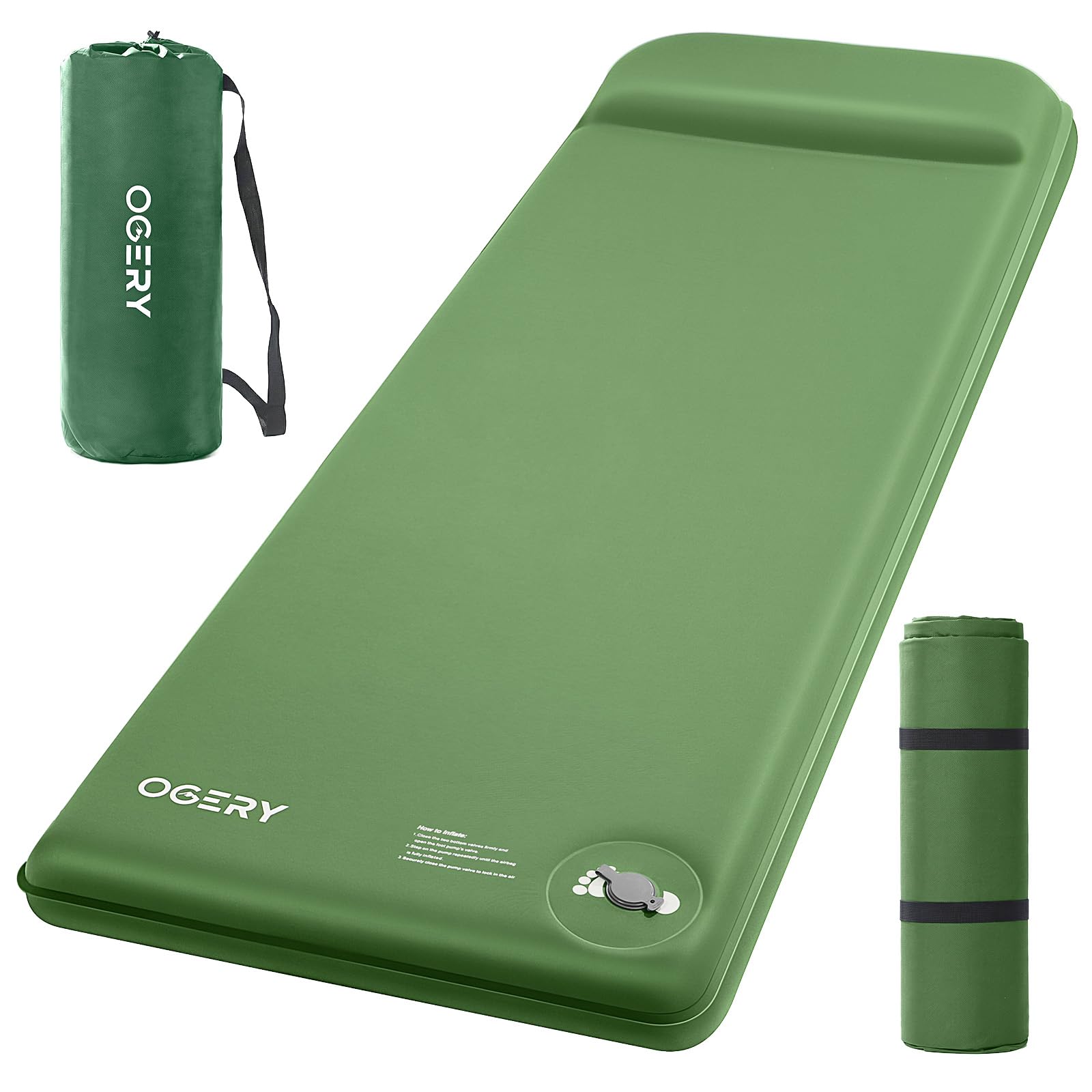
The width is the quiet hero: 27.17 inches across and 76.77 inches long, with 3.15 inches of hybrid foam-and-air support. That extra width is what gives a side sleeper room to hinge a knee forward without falling off the edge. The foam core reduces the bouncy feel that pure air pads have, which makes the surface more stable for stomach and back sleepers too. Six pounds packed weight keeps it manageable for drive-in camping.
Firmness tuning happens two ways — open the valve and the foam pulls air in, then use the built-in foot pump to add pressure without a separate pump or mouth blowing. Owners rate the built-in foot pump highly for how fast it firms the pad after a long day outside. They also call out air retention, with pads holding firm through multiple nights, and the softness gets described as closer to a firm foam mattress than an inflatable. Abrasion-resistant nylon and a textured bottom help it stay put on a cot or a trunk liner.
The one thing to know: the internal foam cuts movement noise but also adds bulk to the rolled pad. That is the same trade every self-inflating hybrid makes. It is not a backpacking pad, and you should not expect one.
Why side sleepers like it
- 27.17-inch width gives real elbow and knee room.
- Built-in foot pump tunes firmness with no separate pump.
- Foam-and-air build trims the bouncy feel of an air mattress.
- Textured non-slip base holds on cots and tent floors.
What to weigh up
- Six pounds is a car-camping weight, not a through-hike one.
- Foam core adds bulk when rolled.
Almost certainly your pick if: you sleep on your side and want firm, tuneable support without a separate pump.
Look elsewhere if: you need a featherweight pad for a backpack — 6 pounds will weigh on you by mile three.
5. Sea to Summit Camp Plus SI Sleeping Mat
Three pounds, 4.3 R-value, and a valve that empties fast enough to beat the weather.
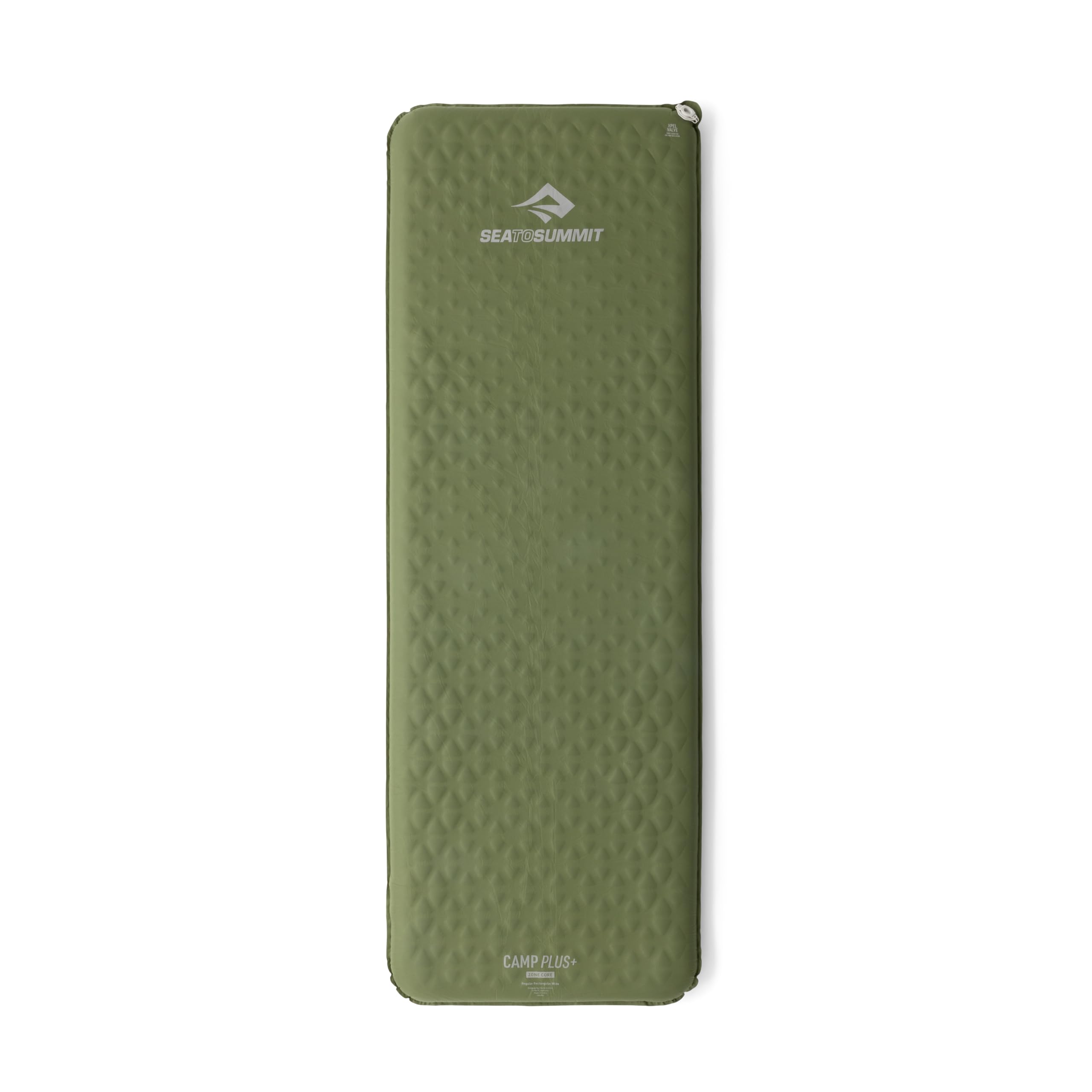
This rectangular mat runs 72 inches long and 25.2 inches wide at 2.6 inches thick, then packs to 13 by 7.5 inches. That is a serious packability trick: a wide rectangular pad that rolls down to roughly the size of a sleeping bag. The 4.3 R-value insulates against all but the coldest ground, and the coring technique keeps the body-contact areas warm while trimming bulk elsewhere. A 75D polyester face stands up to years of use.
The multi-function reversible valve does fast inflation, one-way deflation, and pressure fine-tuning. Owners praise the 75D polyester build quality first and comfort second, and the 4.3 R-value holds warmth on cold, hard ground. A stuff sack, field repair kit, and PillowLock patches come in the box — the patches hold a Sea to Summit pillow in place so it does not slide off mid-night.
The self-inflating feature is the split opinion here. Some find it opens and fills well, others say it needs extra breaths to reach full firmness. Size and weight also divide sleepers, with some calling it bulky and others calling it light. Weighed against the Zzuvjoy pad’s 6.5 pounds for the same 4-season idea, 3.2 pounds is a real packing advantage — but anyone expecting a self-inflating pad to fill itself completely will want to budget a top-off.
Pack-and-go build: 3.2 pounds and a 13 x 7.5-inch packed size make this the most travel-friendly wide mat here.
Plan a top-off: the self-inflation works, but expect to add a little air for full firmness.
Right for: campers who want a wide 4-season mat that packs small enough to carry farther than a car.
Wrong for: anyone expecting a pad to fill completely with zero added air.
6. Teton XXL Sleeping Pad
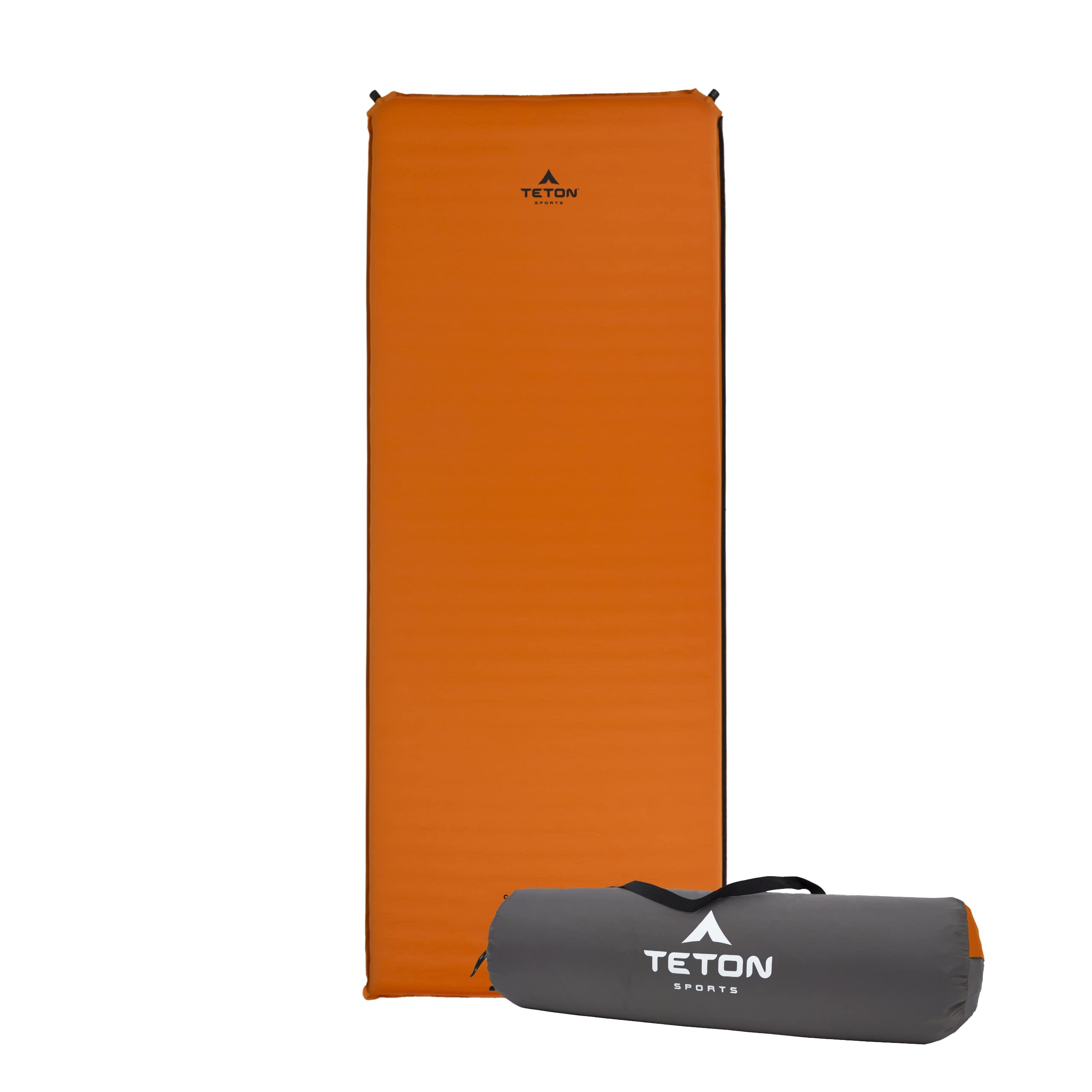
Thirty inches wide is a full-size sleeping luxury — more room than any other pad on this list.
If width is the reason you are shopping, this one wins the number. Thirty inches across, 78 inches long, 2.5 inches thick. That 30-inch surface is six inches wider than the 24-inch foam pads above, giving you real room to stretch, sprawl, or share with a kid. It self-inflates through a rapid-inflation valve and tops off with a few puffs. Side strip attachments let you join two into a double-wide or double-thick setup. The 5.6-pound weight keeps it a car-camper’s companion rather than a backpacker’s.
Owners like how easily it stows in its bag and how well it suits base camp and car camping. It works as a standalone ground pad, on a cot, or as an extra guest bed — and it fits the TETON Sports Celsius Regular sleeping bag and Adventurer Cot. The insulation layer adds warmth over cold, uneven ground or a bare cot surface.
Air retention is the place to be careful. Some buyers report the pad loses air over the course of several nights, so the first thing to do is test it inflated at home before a trip. A firm top-off with the valve fully seated usually handles the slow-leak cases. That is a setup check, not a reason to write the pad off — the width and price-to-size ratio hold up.
The width payoff: 30 inches is the largest surface here, and side strips let you join two for a double.
Do a home test first: inflate it and leave it out a night before your trip to confirm it holds air.
Go this route if: spreading out matters more than packed weight and you camp near the car.
Pick another if: you need a leak-free pad you can trust on the very first night from the start.
7. Gaialoop Memory Foam Camping Mattress, 4-Inch
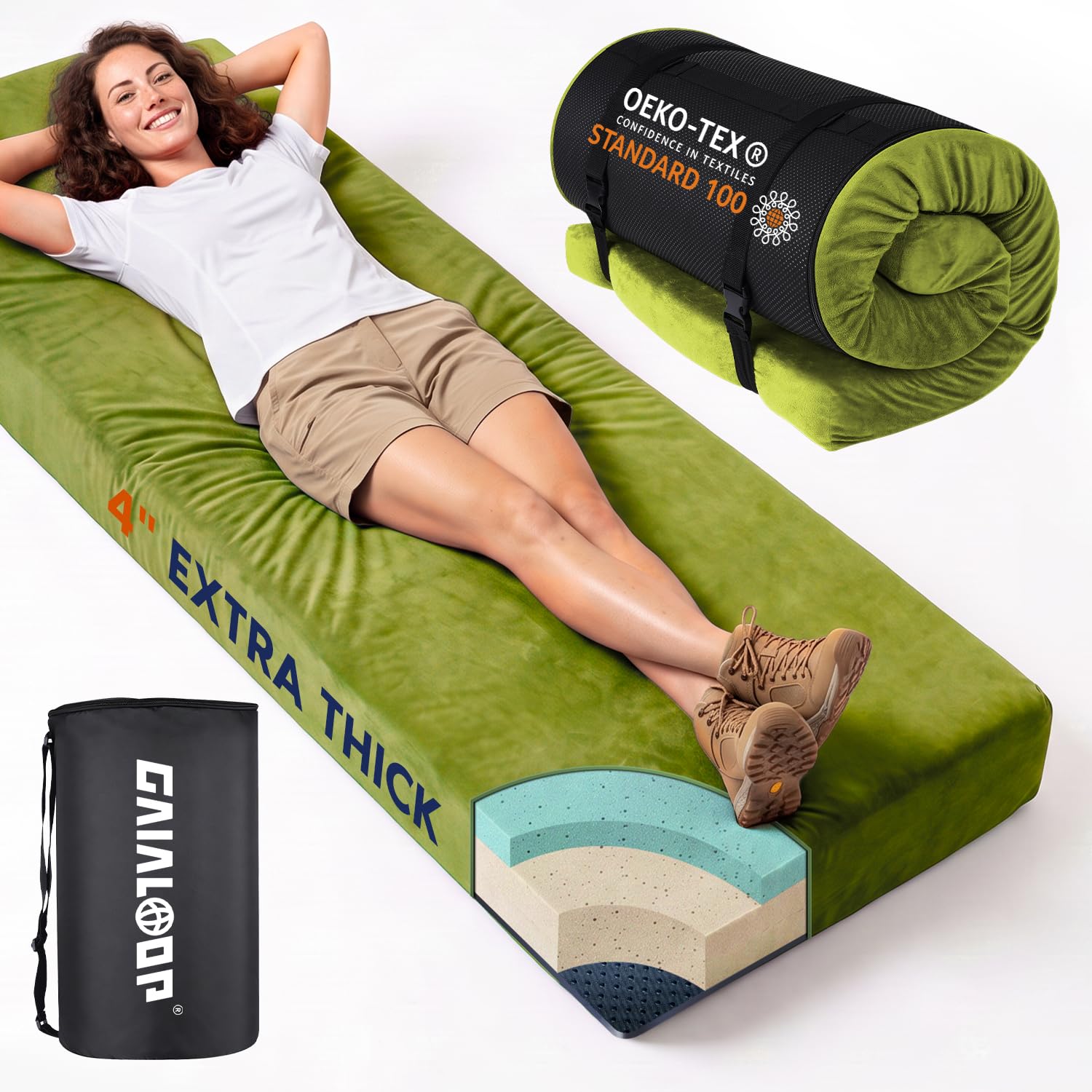
Four inches of dual-layer foam is the closest thing here to sleeping on a real bed.
Nothing else on this list goes this thick. Four inches of dual-layer foam — a memory comfort layer over a supportive base — makes this the deepest cushion on the list, and the 72 by 24-inch footprint carries a pillow in the box. The foam is CertiPUR-US certified and the cover fabric is OEKO-TEX STANDARD 100 certified. Zero inflation needed, so a hard cot or prepared ground stops being a problem for side, back, and stomach sleepers alike.
Comfort is the most-praised quality of this 4-inch pad, with value for money a close second. The fit gets strong feedback too, since it slips onto an SUV bed or a cot easily. The velvet-like cover unzips for machine washing after a trip, and the included straps and carrying bag handle storage.
Here is the real trade: 11 pounds and a large packed size. The maker says plainly it suits vehicle-based camping and not long-distance backpacking. Rollability and thickness also split opinion — some roll it up with no trouble, others find it a fight to compress and awkward to store at home. If you have the trunk space, none of that matters. If you are carrying it, it does.
Where it shines
- A full 4 inches of dual-layer foam for hard cots and rough ground.
- CertiPUR-US foam and OEKO-TEX STANDARD 100 cover fabric.
- Removable, washable velvet-like cover plus a pillow in the box.
- No pump or inflation required.
Where it strains
- 11 pounds makes it a vehicle-camping pad only.
- Large packed size takes up real trunk room.
Your pad if: comfort is the priority and the car carries your gear.
Not your pad if: you are hauling it on foot — the 11 pounds and big roll make that a no.
8. Therm-a-Rest Basecamp Self-Inflating Sleeping Pad

The thermal benchmark — an R-value of 6 in a two-pound pad made in the USA.
This is the pad the rest get measured against on insulation. The R-value of 6 gives year-round warmth, and the thick thermal foam handles nights that turn cold. The WingLock valve inflates 3 times faster than a classic valve and deflates lightning-fast. It rolls down to 21 by 7 inches and weighs 2 pounds 8 ounces. A stuff sack with a PFAS-free DWR coating keeps the pad dry on the trip.
Build quality draws the most praise, comfort runs second, and the thick thermal foam feels substantial on a cot rather than like a thin sheet of air. Owners find it great for car camping and base camp duty, where the 20-inch width and 2-inch thickness are enough. That 20-inch width sits right at the standard line rather than the wide tier, so this is the narrowest pick here; treat it as the benchmark for warmth and longevity rather than for sprawl.
The valve setup is a small learning curve. The maker recommends inflating by breath or with the included pump sack and leaving the pad fully inflated for 2 to 4 hours before first use. Some owners find self-inflation easy, others want more air for full firmness. Note also that the capacity is rated at 1440 pounds. Get past the first-use prep and it is a durable, dependable pad for cool-weather camping.
Cold-night insurance: R-value 6 is the warmth benchmark in this group, short only of the Zzuvjoy’s 9.5.
The width reality: at 20 inches it is the narrowest pick here, so buy it for weather performance, not sprawl.
Best matched to: year-round campers who want proven insulation and a 2 pound 8 ounce packed weight.
Steer clear if: you came here for extra width — this one holds the standard 20-inch line.
Know the Specs
Width and Length
Width is measured across the pad at its widest point and decides how much room your shoulders and hips get. A standard mat holds around 20 inches. A wide pad pushes past that into the 24 to 25-inch range, and a 27 to 30-inch pad gives you real room to roll. Length tracks your height — 72 inches suits most sleepers, while 77 to 80 inches helps taller campers.
Thickness and Foam Density
Thickness is measured in inches and controls how far you sink before you feel the ground. A 2 to 2.5-inch pad works on soft surfaces, and a 3 to 4-inch pad handles hard cot bars and rough tent floors. Foam density — like 19D, 30D, or 75D — measures how firm and how long-lasting the foam is, with higher numbers tending to hold shape longer.
R-Value
The R-value rates how well a pad resists heat loss to the ground, so a higher number means a warmer night. It is tested against a standard, and a pad in the 4 to 6 range covers most three-season camping. Pads near 9 suit cold mornings and shoulder seasons. This spec only covers warmth, not comfort.
Weight and Packed Size
Weight and packed size tell you whether the pad goes in a pack or a trunk. Foam pads tend to land in the 5 to 11-pound range, while self-inflating pads can go lighter. Packed size matters most when you have limited space, so check the listed rolled dimensions against your pack or roof box.
Common Questions
Will a wide camping pad fit inside a standard two-person tent?
Is a wide camping pad better than a standard-width one for side sleepers?
How long does a foam camping pad take to fully expand after unboxing?
Do I need a pump for a self-inflating camping pad?
What R-value do I need for cold-weather camping?
Can I put a wide camping pad on top of a cot?
How do I clean a memory foam camping pad?
Is a 4-inch camping pad too thick to roll up?
Will a wide pad still work if I only car-camp?
Can I join two wide camping pads into one bigger bed?
The Bottom Line
The wide camping pad that earns the top spot is the HomeMate Memory Foam Camping Mattress Pad, because its 3 inches of memory-over-support foam and 72 by 24-inch surface turn a hard cot into a real night’s sleep. If cold ground is your enemy, the Zzuvjoy Memory Sleeping Pad answers with its 9.5 R-value and a 27.6-inch width. And for anyone who wants maximum sprawl, the Teton XXL Sleeping Pad serves up a full 30 inches of width.
One fair note before you buy: the HomeMate is the crowd favorite, holding a higher star score than the cheaper Lxotvae despite the Lxotvae drawing more ratings — A 4.5+ star average across 800+ owners is a strong record for a foam pad that needs 72 hours to fully expand. Grab the one that matches where you sleep, and give any foam pad its 48 to 72 hours before the first trip.
How we choose
We do not accept paid placement. Every pick is matched to a real buyer and a real use-case; we do not hands-on test units.
Sources
Specifications: manufacturer listings and product documentation. Review insights: verified customer reviews, as of November 2026. Pricing: not shown on this page (it changes often); check the current price via the retailer link.
As an Amazon Associate, Tactical Gear Guy earns from qualifying purchases. This does not affect which products we feature.