Specs are compiled from manufacturer listings and verified buyer reviews and can change over time — please confirm the key details on the product page before buying.
You are burying a line you cannot easily reach again, so the pipe itself has to be right the first time. The short answer: match the pipe to your pump’s pressure and your fitting tools, not to the prettiest coil on the page. On a well system, the wrong wall thickness or the wrong material is what turns a weekend job into a second trench.
This guide is built by comparing the manufacturers’ published specifications and the patterns across verified customer reviews, so you get each pick’s real strengths and trade-offs instead of marketing spin.
Below you will find coils rated for pressure and temperature, plus the one sand-point kit that belongs in a completely different job. My picks run longest-lasting first, and they cover hot-and-cold supply, cold-only lines and radiant-floor runs. Here is the plain breakdown of the well water pipe options worth your time and trench space.
Top Picks
How To Choose The Best Well Water Pipe
A well line is not a garden hose. It sits under pressure, sometimes under frost, and usually under dirt you do not want to move twice. Four things decide your purchase: the material family, the pressure rating at your working temperature, the fittings you already own tools for, and whether the run needs to go under concrete.
PEX-A versus PEX-B, in plain terms
Both are cross-linked polyethylene (a flexible plastic tubing that bends instead of snapping). PEX-A is the more flexible version, so it bends in a tighter arc and recovers from a kink better. PEX-B is made by a different process that tends to cost less and holds a slightly stiffer shape. Neither is “better” in the abstract — an expansion tool points you to PEX-A, crimp or cinch clamps to PEX-B. PEX-A usually wants an expansion tool; PEX-B works with crimp or cinch clamps.
Read the pressure rating at the right temperature
A coil rated 160 PSI at 33–70 degrees F is not rated 160 PSI in a hot line. The same tubing often drops to 80 PSI at 200 degrees F. On a cold well supply you are usually fine, but if the pipe feeds a water heater or a recirculating loop, check the hot-side number before you buy. UV exposure matters too: several coils here are rated for six-month UV exposure, which means sunlight is tolerable during the job, not for years on a fence post.
Fittings, burial and the kink question
Every coil on this list works with push-to-connect fittings, and most also take crimp or barb systems. Direct burial under concrete is supported on the SharkBite coils. Flexible pipe with a long bending radius means fewer elbows and fewer joints — and every joint you skip is a leak you never have to chase.
Side-by-Side Comparison
| Model | Best For | Length | Max Pressure | Wall Thickness | Amazon |
|---|---|---|---|---|---|
| SharkBite 3/4 Inch x 300 Feet Blue PEX-B★ Best Overall | All-round potable water line | 300 feet | 160 psi | 0.051 inches | Amazon |
| Cresline 100 ft. L Polyethylene Pipe 125 psiBest for Tight Budgets | Cold water runs on a tighter budget | 100 feet | 125 psi | 0.072 inches | Amazon |
| Cresline Polyethylene Pipe 1 ” X 100 ‘ 100 PsiFit for Farm Lines | Drinking water in agricultural setups | 100 feet | 100 psi | — | Amazon |
| VEVOR PEX-B Pipe 0.75in X 500 Feet | Long runs and radiant heat | 500 feet | 217 psi | 0.1 inches | Amazon |
| Happybuy Non-Barrier PEX Tubing 1 Inch X 300 Feet | Radiant floor and boiler loops | 300 feet | 217 psi | 0.15 inch | Amazon |
| Supply Giant PEX-B Pipe 1 In x 300 Ft Blue | Cold water plumbing and outdoor lines | 300 feet | 160 psi | — | Amazon |
| SharkBite 1 Inch x 300 Feet White PEX-B | Big-volume whole-house supply | 300 feet | 160 psi | 0.0625 inches | Amazon |
| Well Drive Point Kit 1-1/4″ x 36″ + 5PK 39″ Pipes | Driving a shallow sand point by hand | 36″ point + 39″ pipes | — | — | Amazon |
Detailed Reviews
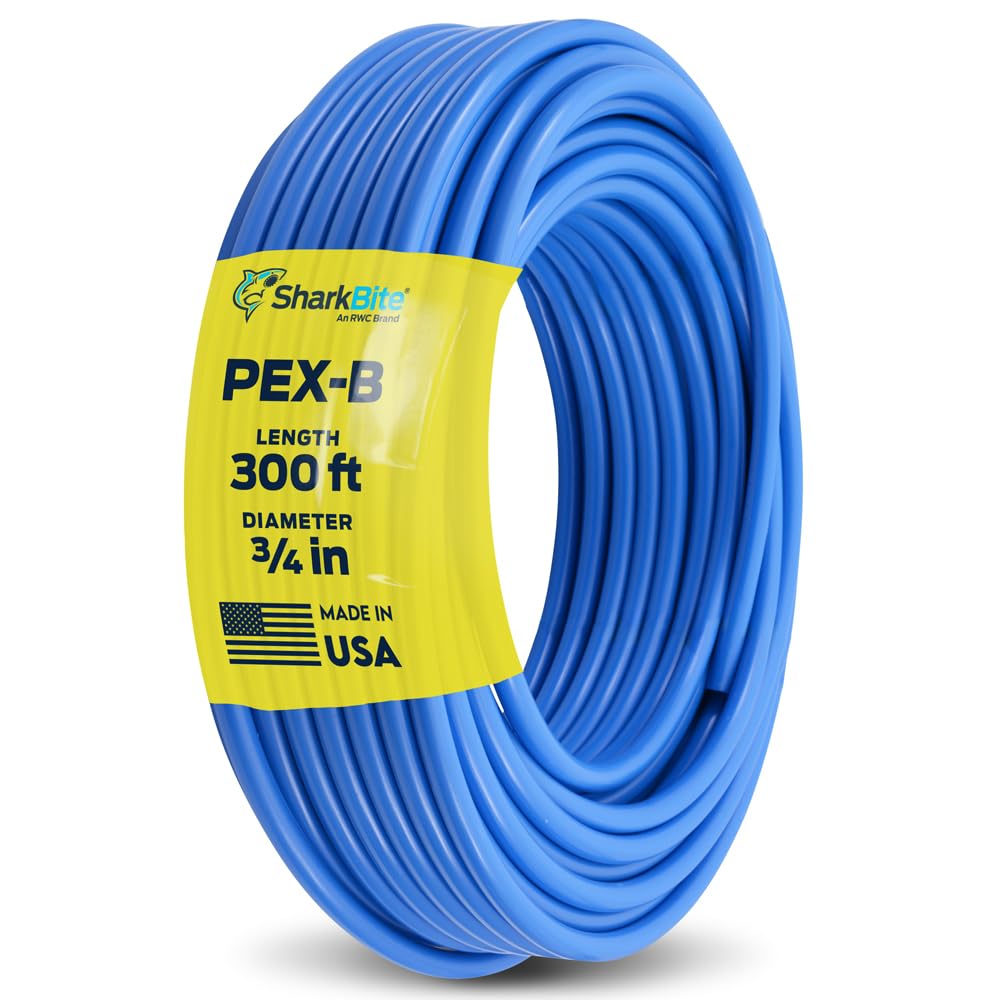
1. SharkBite 3/4 Inch x 300 Feet Blue PEX-B
Our pick — 4.5+★ from 350+ verified ratings; the strongest balance of quality and price.
A 300-foot coil you can bury under concrete and forget about.
If your well line goes into a trench and then disappears, this is the coil to buy. You get 300 feet of 3/4-inch blue PEX-B — cross-linked polyethylene, meaning a flexible plastic tube that bends around corners instead of needing an elbow joint. That flexibility cuts your fittings and your leak points at the same time, because every joint you skip is one fewer place to fail.
You pick it for the pressure headroom. It carries a 160 PSI rating (pounds per square inch — how much water pressure the tube holds) at 33–70 degrees F, then drops to 80 PSI at 200 degrees F. So it suits both a cold well feed and a hot line, just not at full pressure on the hot side. The wall is 0.051 inches thick, and the pipe expands slightly when it freezes and contracts once thawed — exactly what you want in a shallow trench that catches frost. Direct burial under concrete is permitted, and the coil is rated for six-month UV exposure (sunlight resistance), so daylight during the install is fine, but years of sun on a fence post is not.
It fits the tools you already own. It takes push-to-connect, PEX expansion, plastic barb and brass barb fittings, so it works with whatever is already in your truck or shed. On length, it stretches 300 feet against the Cresline 100 ft. coil’s 100 feet, and at 30.9 pounds it carries that length comfortably. Buyers report quality first and value close behind — and that reputation rides on the ASTM F2023 oxidative-tolerance rating (a test of how the tube handles chlorinated water over time, not just on day one).
What earns the top slot
- 300 feet of 3/4-inch blue PEX-B in one coil, so a long well run needs no splices.
- Direct burial including under concrete, with a six-month UV exposure rating for the install window.
- Fits push-to-connect, expansion, plastic barb and brass barb fittings, and carries a limited 25-year warranty.
- 160 PSI maximum at 33–70 degrees F, stepping to 80 PSI at 200 degrees F for hot service.
Where it asks for care
- The 0.051-inch wall is the thinnest of the large-footage coils here, so a plumbing that handles the coil roughly risks a kink.
- Sunlight tolerance is counted in months, not seasons — plan the burial rather than leaving it exposed.
Made for your trench: anyone running a 300-foot potable line, hot or cold, who wants push-to-connect fittings and concrete burial in one purchase.
Think twice if: your run is short and a 100-foot coil already covers it — the extra footage just gets coiled in storage.
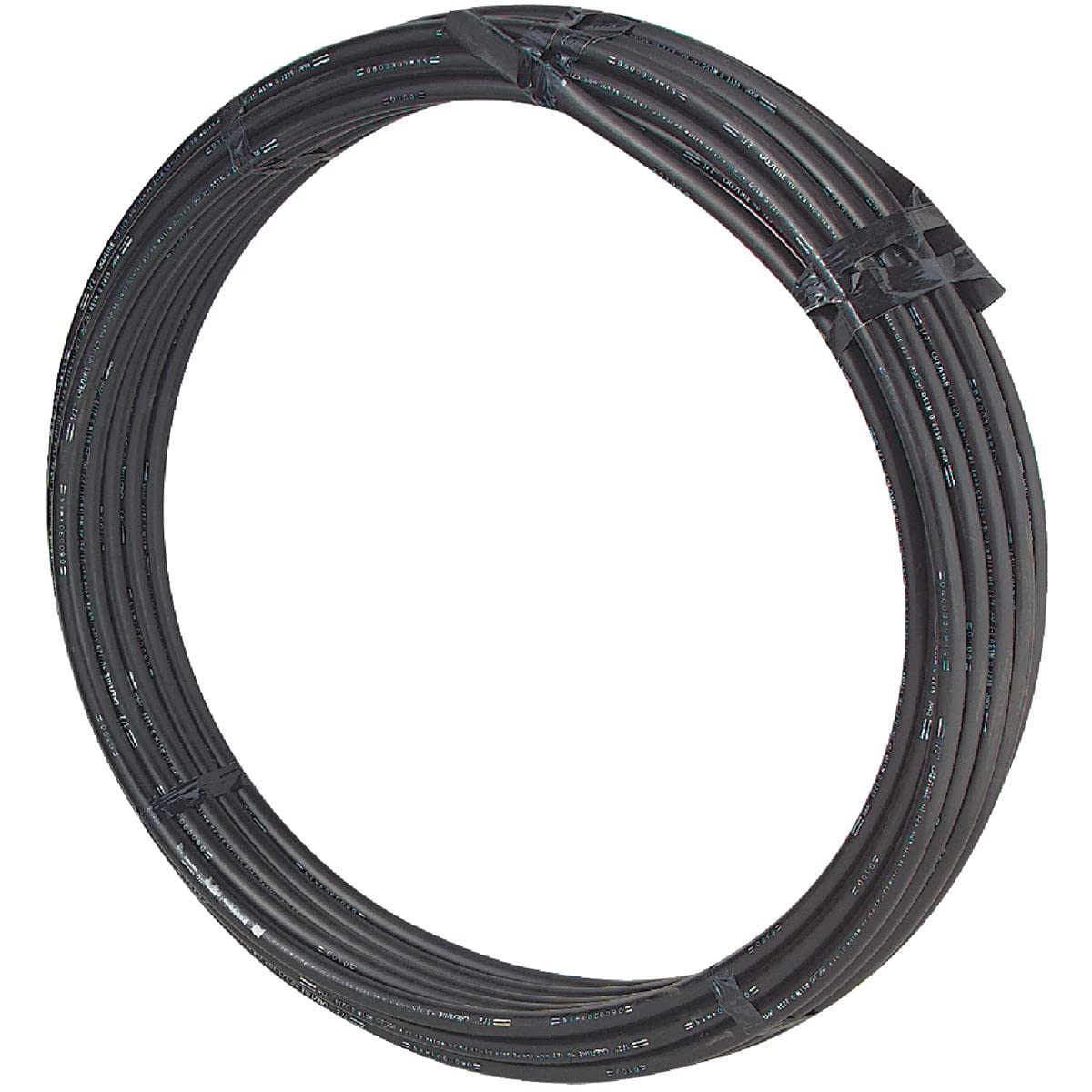
2. Cresline 100 ft. L Polyethylene Pipe 125 psi
A short black polyethylene roll for the cold side when the footage is small.
This is the entry-level roll in this group: 100 feet of black polyethylene (a plain, flexible plastic — not cross-linked PEX), rated 125 psi. You get it as a single 1 ROLL unit, 1200 inches of length, with an outside diameter of 1.05 inches and a 0.072-inch nominal wall. That wall is the interesting part next to the SharkBite above — at 0.072 inches it is thicker than the 0.051-inch PEX-B, and that is a real reason some buyers go this route for cold water where the line might take a knock.
Read the limits honestly. Polyethylene is not PEX: you should not be planning a 200-degree hot run on it. Treat it as a cold-water coil and it does the simple job — 100 feet of line at 125 psi. If you need to reach 300 feet or cross a hot-water loop, the VEVOR at 6000 inches of length or the SharkBite 3/4 at 160 psi is the better-matched buy. The 1.05-inch outside diameter also matters when you are threading the line through an existing sleeve or a tight meter pit.
The value read: a clean, simple coil for a cold run that does not need the extra flexibility of PEX. The thicker 0.072-inch wall gives it a little more margin against a shovel nick than the thinnest PEX coils here.
The trade-off: the smaller coil and lower feet count mean it is for short, cold-only runs, not a whole-house rebuild — measure the trench before you commit.
Reach for this if: you are adding a short cold-water offshoot and you want a black roll that matches an existing Poly line.
Leave it be when: the line touches hot water or you need to run more than 100 feet in one piece.
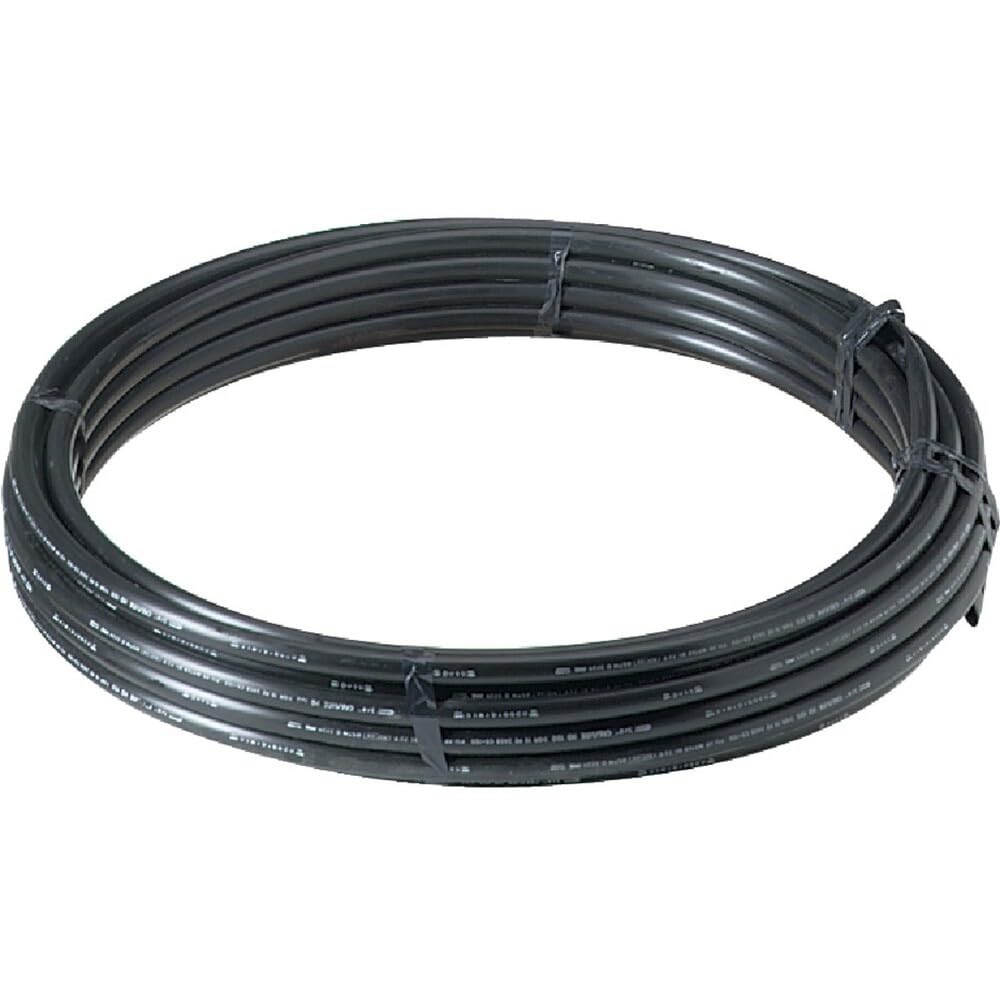
3. Cresline Polyethylene Pipe 1 ” X 100 ‘
A one-inch, drinking-water-rated poly line built for well, irrigation and farm setups.
Here is the buyer for this coil: someone running water to a garden, a stock tank or a small well head, where a full-pressure domestic supply is not the goal, but a clean potable line is. It comes as 1 inch x 100 feet with a 100 psi maximum — the lowest pressure ceiling on this list. The spec sheet says it fits water well, irrigation and plumbing, and it is made in the USA, which is why it sits in farm and small-hold work.
The 100 psi rating is the line you have to respect. For a shallow well pump feeding a tank, that is usually plenty; for a high-pressure domestic system, it is the lower edge. The catch is also the straightforward one: a one-inch line carries volume but the 100-foot roll ends fast, so a long farm run needs splicing or a second coil. If your pressure runs higher, the VEVOR at 217 psi max covers the headroom instead.
The farm fit: one-inch bore, potable-rated, made in the USA, with a 100-foot length that suits tank fills, garden feeds and shallow well leads.
Honest limit: at 100 psi max, this is the least pressure headroom here — match it to a low-pressure farm pump rather than a high-pressure domestic supply.
Pick it for: a potable one-inch feed to livestock tanks, gardens or a shallow well on a farm.
Look elsewhere for: any line that needs to hold more than 100 psi.
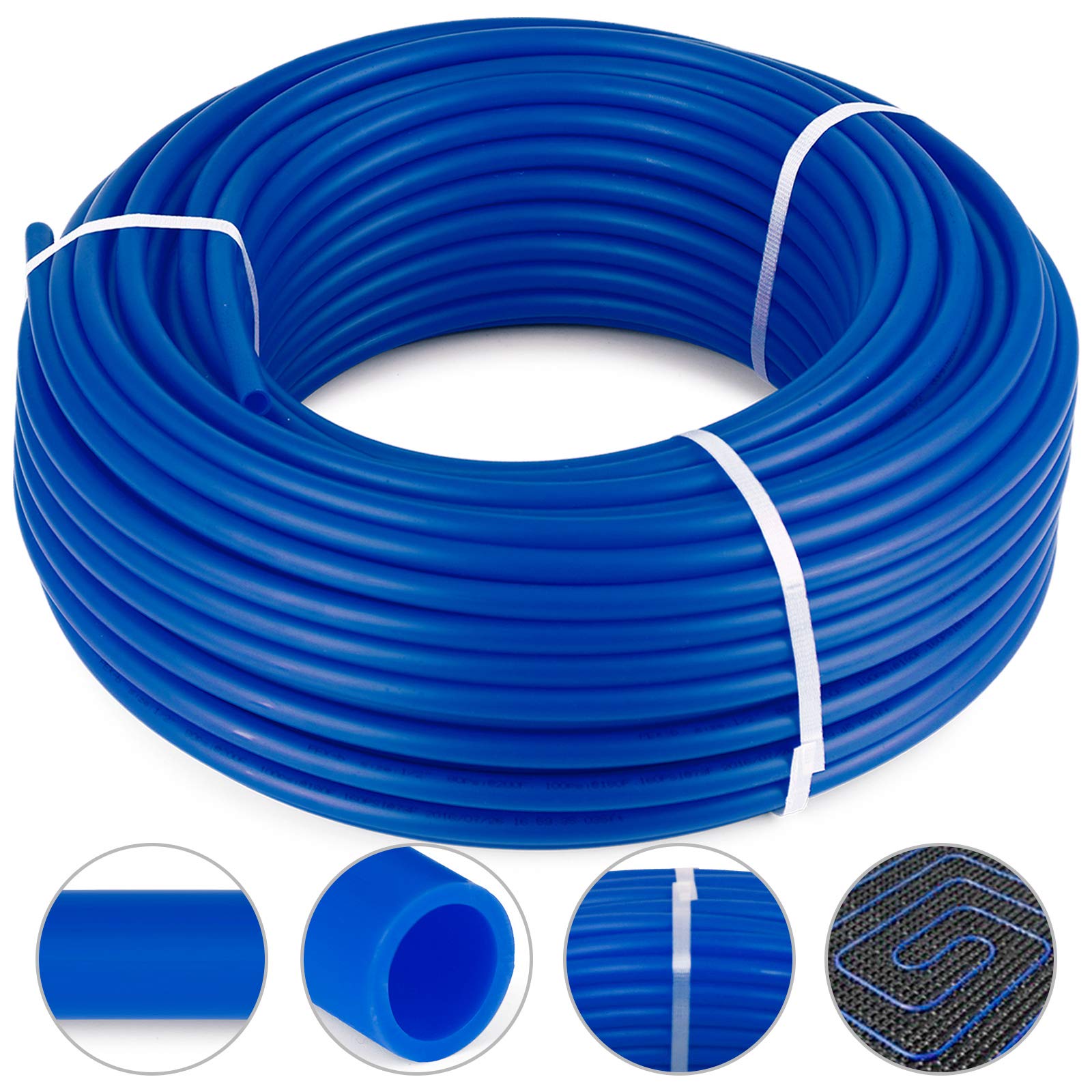
4. VEVOR PEX-B Pipe 0.75in X 500 Feet
The one that covers a whole property in a single pull.
Compare lengths first, because that is the whole point here. This VEVOR runs 6000 inches — 500 feet — in one non-barrier PEX-B blue coil. The Cresline 100 ft. coil stretches 1200 inches. That is the gap: 6000 inches against 1200 inches, which is why a long run that would need splicing on a short coil goes in as one unbranched line on this one.
It holds the highest pressure rating here at 217 psi max, and it holds 188–217 psi at 20 degrees C while dropping to 101–108 psi at 95 degrees C, with a working temperature range of -47 to 230 degrees F. In plain terms, this is a coil you can trust through both a hard freeze and a hot loop. The 7-inch minimum bending radius (the tightest curve it can take without kinking) lets it snake around obstacles where a stiff roll would fail. The non-barrier construction (no oxygen-blocking layer) suits radiant floor, solar water heating and central A/C piping as well as potable water.
Weight and length come together here. At 48.9 pounds on the coil and 6000 inches of length, you need two people and a clear path to lay it out without kinking. Fittings are the usual four systems — crimp, cinch, press and compression. Owners mention quality first, with value right behind. The honest caveat: a 500-foot coil demands careful uncoiling, because a kink in a single-line run has no splice to fall back on.
For long, uninterrupted runs: 500 feet at 217 psi max makes this the coil for dry lines, radiant slabs and full-property feeds where splicing is no option.
The handling cost: 48.9 pounds and 6000 inches of tubing need space and patience to lay flat — plan the uncoil before the trench is open.
Buy this one when: the run is long, the pressure is high, and you want one continuous piece rather than several.
Skip if: you have a short 100-foot job where a smaller coil is easier to store and handle.
5. Happybuy Non-Barrier PEX Tubing 1 Inch X 300 Feet

Ships with the cutter and clamps, so the install starts the day it lands.
Most coils leave you to buy the tools. This one does not — it arrives with a pipe cutter and 10 clamps, which turns a first radiant-floor or boiler project into something you can start immediately. The tubing itself is one-inch non-barrier PEX-B, 300 feet of it, with a 0.15-inch nominal wall that is the thickest on this list after the 0.125-inch PEX-A above and clearly heavier than the SharkBite 3/4 at 0.051 inches.
Pressure is the standout. It rates 217 psi max with 188–217 psi at 20 degrees C dropping to 101–108 psi at 95 degrees C, and a working temperature range of -47 to 230 degrees F. That mix of high pressure and wide temperature is exactly what a radiant floor, solar heater or A/C line asks for. The 5-foot minimum bending radius is a wide arc, so this is a coil for sweeping runs, not tight snaking. Its use list is radiant floor (structural slabs, staple-up and sandwich installations), snow-and-ice melting, and boiler loops.
Weight lands at 52.8 pounds. Set that against the VEVOR above at 48.9 pounds, or against the SharkBite 3/4-inch PEX-B at 30.9 pounds, and you see the price of the thicker wall: more material per foot. What buyers talk about most is quality, with value close behind — the cutter being in the box takes some of the edge off the handling cost.
What lands in the box: 300 feet of one-inch PEX-B, a pipe cutter and 10 stainless clamps, so the joinery is covered from the first hour.
Where the bulk bites: a 5-foot minimum bending radius and 52.8 pounds of coil mean you plan sweeping arcs and bring help, not a tight closet job.
Point it at: radiant-floor, solar or A/C piping where a wide bend radius is fine and the included cutter and clamps save a trip.
Don’t pick it for: tight, twisty runs — the 5-foot bending radius simply will not fold into them.
6. Supply Giant PEX-B Pipe 1 In x 300 Ft Blue

One inch of blue PEX-B for cold lines that run indoors and out.
For a cold-only line — pool fill, garden feed, washing machine, or an outdoor run that spends part of its life in daylight — this is the coil to look at. It is 300 feet of one-inch blue PEX-B, rated 160 psi and built to 200 degrees F, UV resistant and chlorine resistant, with the NSF and ASTM potable-water standards listed. That combination of UV and chlorine resistance is the reason it earns an outdoor label rather than a slab-only one.
It takes push-to-connect fittings as well as F1807 and F2159 crimp fittings, so clamp tools and push fittings both work here. At 59.2 pounds it is the heaviest of the 300-foot coils, which is simply one inch of material over that length.
Built for the outdoors: UV resistance plus chlorine resistance and a 160 psi rating make it a fit for pool, sprinkler and filter lines that touch daylight.
Match it to cold service: this is a cold-water plumbing coil, so a hot recirculating loop belongs on a different pick.
Fits your job if: you are feeding a pool, garden, fountain or filter with one-inch blue line and want UV rating in the spec.
Pick another coil if: the run carries hot water — pressure and temperature headroom favor a different pick.
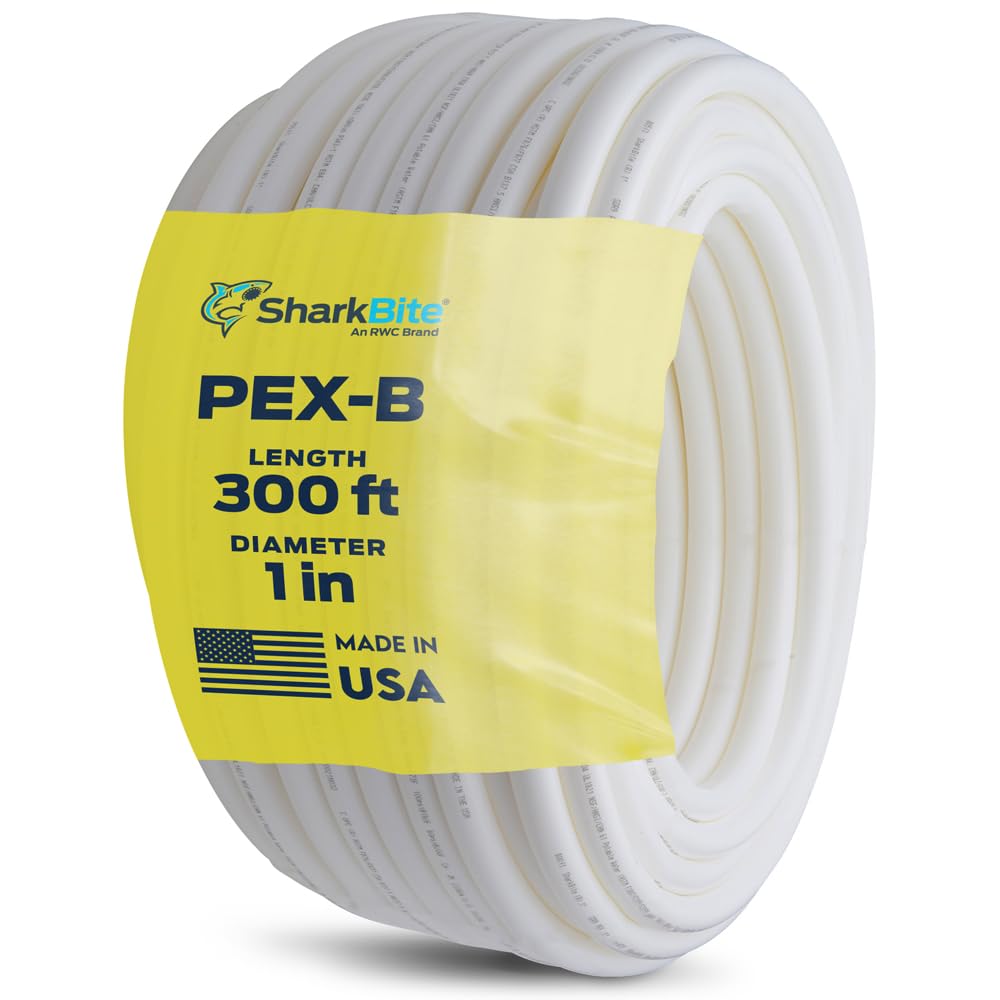
7. SharkBite 1 Inch x 300 Feet White PEX-B
A one-inch main line for a whole-house rebuild.
When the line you are laying is the trunk of a system rather than an offshoot, bore decides it — and one inch over 300 feet is a serious trunk. This is white PEX-B rated 160 psi at 33–70 degrees F, dropping to 80 psi at 200 degrees F, with direct burial including under concrete permitted and a six-month UV exposure rating. The 0.0625-inch nominal wall is modest, but the tube is cross-linked polyethylene, so it withstands kinks and bends around corners without elbows.
The fitting list is where SharkBite earns its keep: PEX expansion, push-to-connect, plastic barb and brass barb all work, so a mixed-tool job is not a problem. It is a 1-inch line, so flow capacity is high and the 300 feet goes a long way from a well house to the house itself. One honest wrinkle — the coil can take some work to straighten before it lays flat, so budget time to uncoil and weight the ends rather than fighting it mid-trench.
Standout strengths
- One-inch bore over 300 feet for a whole-house trunk line from a well head.
- Fits expansion, push-to-connect, plastic barb and brass barb fittings to match your tools.
- 160 psi maximum at 33–70 degrees F with a limited 25-year warranty.
Sizing notes
- The 0.0625-inch wall is thin next to the 0.125-inch PEX-A, so treat the coil with care when uncoiling.
- It takes time to straighten out before it lays flat, so plan the layout before the trench closes.
Right for the main line: a whole-house one-inch trunk run where high flow and a long footage in one coil both matter.
Wrong for a hot loop: the 80 psi at 200 degrees F rating points it at the cold side of the system.
8. Well Drive Point Kit 1-1/4″ x 36″

Not tubing — this is a kit for driving your own shallow sand point by hand.
Every other product here is flexible line. This one is a different species: a 1-1/4-inch x 36-inch stainless well point, plus five 39-inch galvanized drive pipes and couplings, so you can hammer a shallow water well into soft ground yourself. The point has a 60-gauze stainless steel mesh screen to filter out sand and keep the water clean, and the driving pipe is galvanized steel. The method is simple to describe: drive the point, add pipe sections one at a time with couplings, then attach a manual pump.
The maker rates this kit for soft soils — sand, silt, clay, loam — and warns hard soil, stone, rock and glacial river gravel may hold no usable water. The maker says soft soils — sand, silt, clay, loam — are the ideal ground, and that hard soil, stone, rock and glacial river gravel may hold no usable water source. If your plot is rocky, this is the wrong tool regardless of anything else the listing promises.
Owner feedback on this kit flags build quality, with reports of pipe threads breaking during installation. The kit has drawn consistent concern over build quality and durability, with reports that the pipe threads break during installation — a failure mode you will meet at the moment you are driving it. It is the right buy only for someone in soft soil doing a shallow garden or livestock point, and who can keep the drive on the cap and off the pipe itself to avoid damage.
The real use: a self-driven shallow sand point in soft garden or farm ground, with a 1-1/4-inch stainless point and five 39-inch galvanized pipe sections in the box.
The caution that matters: threaded connections have been the recurring weak point in owner feedback, so it is a soft-soil tool for patient hands — not a hard-ground shortcut.
Worth it for: a soft-soil garden or livestock water point you plan to drive by hand with a manual pump.
Look away if: your ground is rocky, stony or glacial gravel, where the maker itself says usable water may not come.
Know the Specs
PEX-A versus PEX-B
PEX-A and PEX-B are both cross-linked polyethylene, a flexible plastic line made by linking the molecules together. PEX-A tends to be more flexible and is built for cold expansion — you flare the end, seat the fitting and let it close. PEX-B is made a different way and usually pairs with crimp or cinch clamps. Neither is automatically stronger; an expansion tool points you to PEX-A, crimp or cinch clamps to PEX-B.
Pressure and temperature ratings
A pressure rating only means something next to the temperature it is measured at. A coil rated 160 psi at 33–70 degrees F often drops to 80 psi at 200 degrees F. If your line feeds a heater or a hot recirculating loop, check the hot-side number, not just the headline. For a cold well feed, the headline number is usually the one that matters.
Nominal wall thickness
Wall thickness is the amount of material between the water and the outside world. A 0.051-inch wall and a 0.15-inch wall are not the same tube under a shovel nick or a kink. Thicker walls resist impact better but add weight and stiffness — which is why the thickest coils here are also the heaviest to uncoil.
Fitting systems and burial
Most PEX coils take push-to-connect fittings, and many also handle crimp, cinch or expansion systems. Push-to-connect is the fastest and needs no special tool. Direct burial under concrete is permitted on several coils here, and UV exposure is usually counted in months — enough for the install, not enough for a season on a fence.
Common Questions
Can I use PEX for a well water line?
What pressure rating do I need for a well supply?
Is PEX-A better than PEX-B for a well line?
Can PEX pipe be buried underground?
How long does PEX pipe last?
Does PEX pipe resist freezing?
What size well pipe should I use for a long run?
How is a well drive point different from a PEX coil?
Can I install PEX with push-to-connect fittings?
Does a thicker wall PEX coil matter for a well line?
The Bottom Line
For most well runs, the winner is the SharkBite 3/4 Inch x 300 Feet Blue PEX-B — 300 feet of direct-burial-rated coil that takes push-to-connect, expansion, plastic barb or brass barb fittings, so it fits the tools you already have. If you need to reach further in one pull with more pressure headroom, grab the VEVOR 0.75in X 500 Feet at 217 psi max and 6000 inches of single-line length. And if the job is actually driving a shallow sand point in soft garden ground rather than laying a line, the Well Drive Point Kit is the one to reach for — with the caveat that it is the soft-soil tool and nothing more.
Match the coil’s pressure rating and wall thickness to your pump before you compare price. The SharkBite 3/4-inch PEX-B, at 4.5+ stars across 300+ owners, holds 160 psi cold and 80 psi at 200 degrees F. A buried well line is the wrong place to save a few dollars, since re-digging costs far more than the coil.
How we choose
We do not accept paid placement. Every pick is matched to a real buyer and a real use-case; we do not hands-on test units.
Sources
Specifications: manufacturer listings and product documentation. Review insights: verified customer reviews, as of November 2026. Pricing: not shown on this page (it changes often); check the current price via the retailer link.
As an Amazon Associate, Tactical Gear Guy earns from qualifying purchases. This does not affect which products we feature.