Specs are compiled from manufacturer listings and verified buyer reviews and can change over time — please confirm the key details on the product page before buying.
You are standing under a loft opening with a 400-pound engine block swinging from a chain, and your shoulder is already telling you this was a bad idea. An electric wire rope hoist replaces that chain and your back with a motor and a steel cable — you press a button, the load rises, and you keep both feet on the floor. The catch most first-time buyers hit: the headline capacity is usually the double-line figure, so a single-line straight pull lifts roughly half that, and the remote range on the spec sheet rarely matches real life through a wall. This guide breaks down seven machines by the numbers that actually decide a lift — capacity per line (how much weight each cable line can pull), lifting speed, cable height, and how far the remote really reaches.
This guide is built by comparing the manufacturers’ published specifications and the patterns across verified customer reviews, so you get each pick’s real strengths and trade-offs instead of marketing spin.
The short answer up front: match the hoist’s single-line capacity to your heaviest straight-up pull, not the doubled figure on the front of the box, and buy the remote range you will actually stand back to use. Below you will find the honest breakdown of each wire rope hoist worth considering for a garage or workshop.
Top Picks

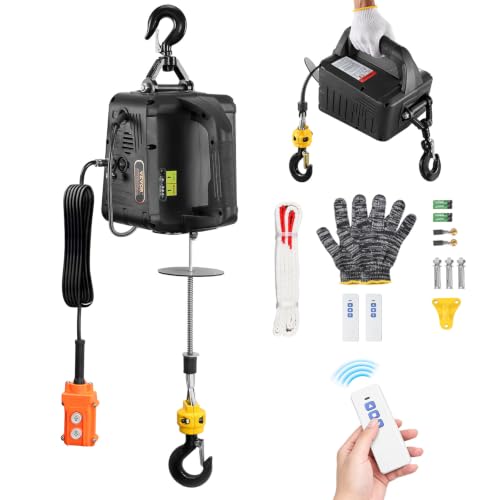
How To Choose The Best Wire Rope Hoist
A wire rope hoist is a motorized winch that lifts with a steel cable instead of a chain. You mount it on a ceiling beam or hang it from a pole, hook your load, and let the motor do the pulling. Buying one well depends on four numbers — single-line capacity, lifting speed, cable height, and wireless range — plus one habit: a loaded first lift.
Read the capacity per line, not the headline
The big number on the box is usually the double-line figure — the load the hoist can pull when the cable runs down through a pulley and back up. That doubles the capacity but roughly halves the lifting height and speed. If you are lifting a load straight up on a single cable, look for that single-line rating instead. The VEVOR 2200-pound unit, for example, carries 1100 lbs on a single line and doubles that on a double line while cutting the maximum height from 39.4 ft to 19.7 ft.
Match lifting speed to your job
Speed is published in feet per minute, and it decides whether a 30-foot pull takes one minute or three. A short garage pull of a few feet barely notices 13 ft/min. A 59-ft lift up a tall bay does — that is why the high-reach models tend to trade capacity for speed.
Check the cable height against your ceiling
Maximum lifting height is how much cable the drum holds. Measure from your mounting point to the floor, then add clearance. A 20-ft hoist in a 30-ft barn leaves you short; a 59-ft unit in a low garage just carries unused cable.
Handle the remote and the first run correctly
Wireless remote range matters more than most buyers expect, because a signal that cuts out at distance leaves a load hanging mid-air until you reach the wired remote. Several of these hoists also warn you to run the first lift with a load attached — running unloaded first can let the steel cable spool loosely and tangle.
Side-by-Side Comparison
| Model | Best For | Capacity | Lifting Height | Lifting Speed | Amazon |
|---|---|---|---|---|---|
| VIVOHOME 3in1 Electric Hoist Winch★ Best Overall | All-round garage lifting | 1100 lbs | 40 ft | 13 ft/min | Amazon |
| VEVOR 3-in-1 Electric Hoist WinchBest Value | Budget garage and warehouse pulls | 1100 lbs | 22.9 ft | 13 ft/min | Amazon |
| TKK 3 in 1 Electric Hoist Winch | Heavy loads in tight spaces | 1540 lbs | 25 ft | 13 ft/min | Amazon |
| BEAMNOVA 3-in-1 Portable | Carrying between jobs | 1543 lbs | 20 ft | 16.4 ft/min | Amazon |
| Electric Hoist 2 in 1 (PA800) | Long reaches up a tall bay | 1760 lbs | 59 ft | 32 ft/min | Amazon |
| VEVOR Electric Hoist 2200lbs | Loft and heavy-object lifting | 2200 lbs | 39.4 ft | 32 ft/min | Amazon |
| 3-in-1 Electric Hoist with Remotes | Roadside and rescue work | 1100 lbs | 25 ft | 16 ft/min | Amazon |
Detailed Reviews
1. VIVOHOME 3in1 Electric Hoist Winch 1100lbs
Our pick — 4.0+★ from 150+ verified ratings; the strongest balance of quality and price.
Forty feet of cable, three ways to run it, and a motor that shrugs at a full load.
This is the hoist to buy when you want one machine that covers a garage, a shed, and the occasional forest job. It lifts 1100 pounds on a 1500W motor, and the drum holds enough galvanized steel wire rope to reach 40 feet. That height matters: versus the VEVOR 1100-pound unit at 22.9 feet, this one carries nearly double the cable, so a tall bay or a two-storey barn opening is within reach instead of short.
You get three control routes — a wireless remote good out to 200 feet, a 19-foot wired remote, and plain manual operation. The wireless range is what wins people over in this class: the same 200-foot figure shows up on the TKK pick, but here it comes attached to the taller drum. The overload protection is real, too. Push past the limit and a switch cuts the power before the motor cooks.
The honest caveat is the wireless link itself. Signal feedback on this model is mixed, and a remote that drops out at distance leaves your load hanging — so treat the wired remote or a planned stop as your safety net for anything overhead. The other habit worth forming: never run it unloaded on the first use, or the steel cable spools loosely and tangles. The 360° rotating manganese steel hook helps you seat a load without fighting the cable, and the heat-dissipating housing keeps the motor cool through repeated pulls.
What earns its place up top
- 40 ft of cable out-reaches the 22.9-ft VEVOR and the 25-ft TKK on height
- Wireless remote rated to 200 ft for operating from a safe distance
- Overload switch cuts power when the weight limit is passed
- Galvanized anti-rotation rope keeps the load from twisting
Where it asks for care
- Wireless control reports mixed signal stability at range
- Running it unloaded first can spool the cable and tangle it
Grab this one: if you need real cable height plus a long remote reach for garage, barn, or forest lifting.
Plan around this: the wireless link is the weak point at distance — keep the wired remote handy for overhead loads.
2. VEVOR 3-in-1 Electric Hoist Winch, 1100lbs 1500W
Three control modes and an aerospace-grade rope at the entry end of the market.
If your lifting is confined to a garage or a warehouse floor, the 22.9-foot cable height on this VEVOR is plenty, and you save the premium the taller hoists charge. It runs a 1500W motor at 13 ft/min with an 1100-pound hook and a 360° rotating latch that keeps loads seated. The reel holds galvanized steel wire rope rated at up to 1520Mpa in tensile strength — in plain terms, a cable built to resist stretching under load and to resist twisting as it spools.
The remote setup is the standout: a 200-foot wireless remote plus a 19-foot wired one, and the electronics can pair with extra controllers so a helper can run a second unit alongside you. That is a genuine convenience when you are hoisting an engine and need a second pair of hands on the load rather than the switch.
Reliability is where this model splits buyers — some units run excellent, others land in the lesser camp. It is worth a careful first-lift check with a load attached rather than a dry run, since VEVOR warns that an unloaded start can tangle the rope. The cool-running gearbox and heat-away housing are there for repeated pulls, not long idle stretches.
The value read: you get the same 1500W motor and 13 ft/min speed as the pricier picks, with a shorter 22.9-ft cable — that is where the savings sit.
What to expect: one good pair of wireless controllers from the start, plus room to add more for team lifts.
Choose it if: your ceiling is low and your lifting jobs are short, frequent workshop pulls.
Look past it if: you need the cable to reach up a tall bay — the 22.9-ft height tops out fast.
3. TKK 3 in 1 Electric Hoist Winch, 1540lbs Capacity
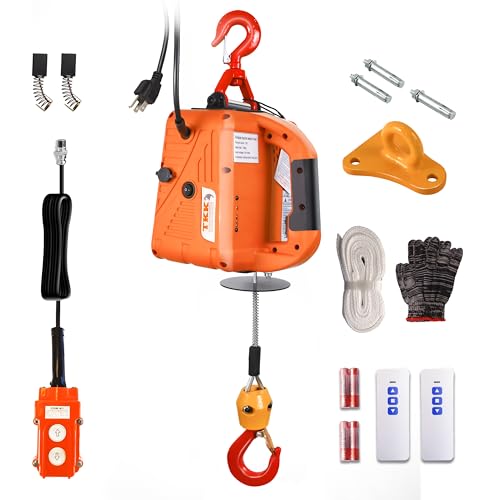
A 1540-pound hook that hangs a load heavier than most garage hoists dare to try.
Here is the muscle pick. The TKK carries 1540 pounds on a 1500W pure copper motor at 13 ft/min, and that capacity edges out the 1100-pound VIVOHOME for anyone lifting engines, transmissions, or big shop tools. The anti-rotation galvanized wire rope stops the load spinning mid-lift, and the manganese steel hook turns a full 360° so you seat it without fighting the cable.
what separates it functionally is the auto-stop limit switch (a sensor that cuts power when the hook reaches its top travel). When the hook reaches its top travel, the power cuts before the hook bashes into the hoist body — a small detail that protects the machine and saves you a repair. The machine also carries a manual control and both wired and wireless remotes, and TKK stands behind the wireless reach at 200 feet, matching the VIVOHOME and clearly beyond the 98-foot wireless span on the PA800.
Fair warning: the cable is the part to treat gently. Keep an eye on the rope for kinks and seat loads evenly, and do the first lift with weight on the hook rather than a dry run. This is a newer listing, so it has less track record behind it than the established VEVORs, but the build spec is honest on paper.
Standout number: 1540 lbs of lift capacity beats every 1100-pound pick on this list, giving you real headroom for heavy gear.
Go gently: the steel cable rewards care — run a loaded first lift and watch for tangling.
Best for: the workshop that routinely clears 1100-pound loads and wants the auto-stop safety net.
skip it if: you need maximum cable height — the 25-ft drum falls short of the tallest picks.
4. BEAMNOVA 3-in-1 Portable 1543lbs Electric Hoist

Weighs about what a big toolbox does, then hangs itself on any sturdy pole.
If your job moves — a tailgate, a rented trailer, a borrowed shop — this is the one to grab. It tips the scale at 22.7 pounds, lighter than the 25.7-pound TKK, and it is built to carry by a side handle and drop in a car trunk. The top hook lets you hang it on any pole with enough weight, and you can pull it off by hand when you are done. No bolting a mount to a ceiling just to lift once.
On the lift itself, it carries 700kg / 1543lbs on a single line at 5m/min (16.4 ft/min) up to 6m (20 ft). The galvanized wire rope and 360° rotating hook are standard here, and a circuit board stops the machine when weight passes the limit. The stopper device protects the top travel so the hook cannot slam the housing. Three control methods cover manual, wired, and wireless, so you are not locked to one spot.
The trade-offs are real. The 20-foot reach is the shortest on the list, and the build quality is called mixed — a few describe it as a cheap import. That does not undo its job, which is being the hoist you can carry to the load rather than mounting one in place. If you want fixed performance, look elsewhere; if you want a hoist that travels, this delivers.
Why the handle wins
- 22.7 lb body and side handle make it a genuine carry-along tool
- Top hook hangs from any pole with enough weight, removed by hand
- Automatic stop when the load exceeds its limit
- Three control modes including wireless
The honest limits
- 20 ft of cable reach is the shortest here
- Build quality reads mixed in reviews
Reach for this if: the hoist needs to travel — tailgates, trailers, and jobs that move.
Look elsewhere if: you want a long cable reach or a fixed ceiling mount — this one favors portability.
5. Electric Hoist 2 in 1, 1760lbs with 98ft Wireless Control

Fifty-nine feet of cable and a 32 ft/min pull that makes tall lifts feel quick.
This is the model for a tall bay, a barn loft, or any climb the shorter hoists cannot finish. It carries 880 pounds on a single line at 32 ft/min up to 59 feet — versus the BEAMNOVA’s 20-foot maximum, this reaches roughly three times the height. Switch to a double line and it lifts 1760 pounds at 16 ft/min up to 29.5 feet. The 1350W motor and a large cooling fan keep it working through repeated pulls without overheating.
Speed is the headline here as much as height: 32 ft/min on a single line is more than double the 13 ft/min you get from the VIVOHOME and the VEVORs, which matters when a single pull spans most of a building. The 2-in-1 control runs a 98-foot wireless remote and a wired remote, and the electromagnetic braking system (a magnetic brake that holds the load) stops the load from sliding when you let go. There is an emergency stop switch on the unit.
The 98-foot wireless span is the number to weigh against the competition — the TKK and VIVOHOME both reach 200 feet, so if you need to operate from far down a long building this one falls short. It is also the heaviest machine on the list at 42.9 pounds, a fixed-mount hoist that wants a solid ceiling, not a carry-around. The maker’s manual notes a 0.5-second delay before a reverse move — respect it or the circuit board takes damage. The remote needs 2 AAA batteries, so fit them before you climb the ladder.
Where it leads: 59 ft of reach and 32 ft/min crush the shorter hoists on both height and pace for tall single-line pulls.
Set it up right: 42.9 pounds means a real ceiling mount, plus batteries in the remote and a pause before reversing.
Your pick if: height and speed are the job — tall bays, loft openings, and long single-line pulls.
Think twice if: you need to work the remote from far away — its 98-foot reach trails the 200-foot picks.
6. VEVOR Electric Hoist 2200lbs with 328ft Wireless Remote

The biggest remote and the biggest capacity in one heavy orange-and-black frame.
If you are hoisting heavy goods into a loft and want to stand far back while you do it, start here. This VEVOR pulls 1100 pounds on a single line at 32 ft/min up to 39.4 feet, and doubles to 2200 pounds at 16 ft/min up to 19.7 feet. The 1600W motor is the strongest on the list, and a large cooling fan keeps it from cooking through back-to-back lifts. The 19-strand thickened steel rope and high-strength metal hook are built for repeated heavy use.
The wireless remote is the reason many choose it: it reaches 328 feet, far beyond the 98-foot span on the PA800, and even beyond the 200-foot range of the TKK and VIVOHOME. That kind of reach lets you run a lift from across a yard or down a long warehouse aisle, and the emergency stop button lets you halt a load fast. The mounting brackets make a two-step ceiling install, and it ships with a 13-foot lifting strap and a 3.2-foot shaft belt with a metal ring.
The catch worth naming is installation and weight. At 58 pounds this is the heaviest hoist here, and setting it up on a beam alone is a two-person job for many owners. Build quality reads mixed on some units, so check your mounting points carefully before the first heavy pull. That said, for raw capacity and remote freedom, nothing else here matches the 2200-pound double-line pull or the 328-foot range.
Two numbers that win: 2200 lbs on a double line and a 328-ft wireless remote stand above every other pick.
The setup cost: 58 pounds and mixed install reports mean plan for a helper and a solid beam.
Built for you if: you lift heavy goods into a loft and want to control it from far off.
Not your fit if: you work solo in a tight space — the weight and mounting ask for planning.
7. 3-in-1 Electric Hoist with Remotes, 2200lb Capacity

A roadside rescue hoist with a limit you set yourself, not one the factory fixes.
This one is built for the trunk of a recovery truck and the awkward lift in a tight space. A 1500W pure copper motor gives it a 1100-pound max load capacity at 16 ft/min, reaching 25 feet. That 16 ft/min lands between the 13 ft/min of the VIVOHOME and the 32 ft/min of the PA800 — quick enough for most short lifts without giving up load control. Three control routes cover a 200-foot wireless remote, a 19-foot wired remote, and manual operation.
The feature worth the money is the manually adjustable limit height. Instead of a fixed auto-stop, you set the safety range to match the job, so a confined-space lift stops exactly where you tell it to. The overload protection and automatic limit switch still cut power when the load exceeds the limit or the hook hits the top. Reliability is where buyers lean positive — the machine holds up on lifts well over its mid-range.
Quality is the split point: some call it a good product, others find the build wanting. It is the lightest of the higher-capacity picks at 23.3 pounds, so it carries better than the 58-pound VEVOR 2200, and it wants the same care as the rest — first lift with a load on the hook. If roadside recovery or confined-space handling is your job, the adjustable limit is the reason to pick it over a fixed-stop model.
Why the adjustable stop matters
- Set your own lift limit for confined-space and roadside jobs
- 200-ft wireless remote for safe stand-back operation
- 23.3 lb body is lighter than the 58-pound VEVOR 2200
- Overload and auto-stop protection built in
What to weigh
- Build quality reads mixed across buyers
- 1100 lb single-line capacity sits under the 1540-pound picks
Made for: roadside recovery, high-rise material handling, and lifts where you set the ceiling yourself.
Choose otherwise if: you need the tallest cable reach or the heaviest single-line pull.
Know the Specs
Capacity: single line vs double line
Capacity is the most misunderstood number on a hoist box. A single line runs the cable straight down to the hook — that is the weight it lifts bare. A double line threads the cable through a pulley and back up, roughly doubling the pull but halving the height and speed. The PA800 demonstrates it plainly: 880 lbs on a single line at 59 ft, or 1760 lbs on a double line at 29.5 ft. Buy to your single-line number if you lift straight up.
Lifting speed and why it changes
Speed is published in feet per minute, and it slows down as the load doubles. The VEVOR 2200 hits 32 ft/min on a single line but 16 ft/min on a double. On a short garage pull, 13 ft/min barely registers. On a tall bay, the 32 ft/min picks turn a long crawl into a quick hoist. Match the speed to the length of your typical lift: 13 ft/min is fine for a few feet of garage travel, while a 59-ft pull wants the 32 ft/min models.
Maximum lifting height and cable
Maximum height is how much steel cable sits on the drum. The tallest here reaches 59 ft, the shortest 20 ft. Measure your mount-to-floor distance first — extra cable on the drum is harmless, but a drum that runs short leaves a load stranded mid-lift. Galvanized wire rope resists corrosion; an anti-rotation design keeps loads from spinning.
Wireless range and overload protection
Remote range on paper is line-of-sight, so a wall or a truck bed trims the working span well below the box figure. Expect walls, vehicles, and distance to trim it in practice, so treat the top number as a ceiling, not a guarantee. Overload protection is the safety backbone: a limit switch cuts power when weight passes the set capacity or the hook tops out, protecting both the motor and the load before anything breaks.
Common Questions
What is the difference between single-line and double-line lifting on a wire rope hoist?
How much weight can a 1500W electric hoist actually lift?
Why does my hoist manual say not to run it unloaded on the first use?
Will the wireless remote work through a garage wall?
What does an overload limit switch do on an electric hoist?
Can I mount a wire rope hoist on a ceiling or a beam?
How far can a wire rope hoist reach vertically?
Are electric wire rope hoists safe for lifting people or pets?
How fast do these hoists lift, and does speed change with load?
Do I need to add batteries or accessories to run the remote?
The Bottom Line
The wire rope hoist that earns the top spot is the VIVOHOME 3in1, because it pairs 40 feet of cable with a 200-foot wireless remote and a 1500W motor that handles an 1100-pound load — the widest spread of real-use capability on this list. If your jobs mean carrying the hoist to the load, the lighter BEAMNOVA at 22.7 pounds travels with you. And for the heaviest loft pulls with the longest remote reach, the VEVOR 2200 doubles to 2200 pounds and works from 328 feet away.
Whichever you pick, two habits keep the machine working: run the first lift with a load on the hook so the cable spools cleanly, and set your mount to hold far more than you plan to lift. Match the single-line capacity to your heaviest straight-up pull, choose the cable height that clears your ceiling, and buy the remote range you will actually stand back to use — that is the whole decision in three numbers.
How we choose
We do not accept paid placement. Every pick is matched to a real buyer and a real use-case; we do not hands-on test units.
Sources
Specifications: manufacturer listings and product documentation. Review insights: verified customer reviews, as of November 2026. Pricing: not shown on this page (it changes often); check the current price via the retailer link.
As an Amazon Associate, Tactical Gear Guy earns from qualifying purchases. This does not affect which products we feature.